Kate Petersen Mace, Campus network engineering workshop
19/10/2016 Science DMZ Security
Science DMZ Security
Kate Petersen Mace
Science Engagement
Energy Sciences Network
Lawrence Berkeley National Laboratory
kate@es.net
engage@es.net
Campus network engineering for data-intensive science
Workshop
etc.venues Marble Arch
London
19 October 2016
Science DMZ as Security Architecture
• Allows for better segmentation of risks, more granular application of controls to
those segmented risks.
– Limit risk profile for high-performance data transfer applications
– Apply specific controls to data transfer hosts
– Avoid including unnecessary risks, unnecessary controls
• Remove degrees of freedom – focus only on what is necessary
– Easier to secure
– Easier to achieve performance
– Easier to troubleshoot
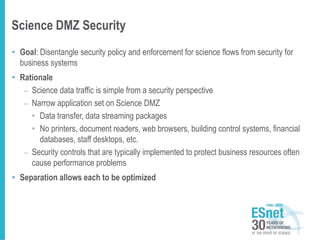
• Goal: Disentangle security policy and enforcement for science flows from security for
business systems
• Rationale
– Science data traffic is simple from a security perspective
– Narrow application set on Science DMZ
• Data transfer, data streaming packages
• No printers, document readers, web browsers, building control systems, financial
databases, staff desktops, etc.
– Security controls that are typically implemented to protect business resources often
cause performance problems
• Separation allows each to be optimized
Science DMZ Security
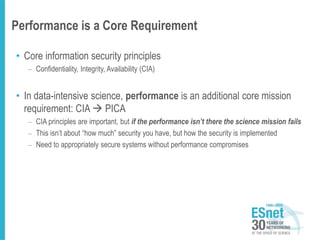
Performance is a Core Requirement
• Core information security principles
– Confidentiality, Integrity, Availability (CIA)
• In data-intensive science, performance is an additional core mission
requirement: CIA  PICA
– CIA principles are important, but if the performance isn’t there the science mission fails
– This isn’t about “how much” security you have, but how the security is implemented
– Need to appropriately secure systems without performance compromises
Motivations
• The big myth: The main goal of the Science DMZ is to avoid firewalls
and other security controls.
– Leads to all sorts of odd (and wrong) claims like:
• “Our whole backbone is a Science DMZ because there is no
firewall in front of the backbone.”
• “The Science DMZ doesn’t allow for any security controls.”
• “The Science DMZ requires a default-permit policy.”
• The reality: The Science DMZ emphasizes reducing degrees-of-
freedom, reducing the number of network devices (including
middleboxes) in the path, eliminating devices that can’t perform, and
ensuring that the devices that remain in the path are capable of large-
scale data-transfer caliber performance.
11/1/20166
Motivations
• Goal is to break down this myth by viewing the Science DMZ as
a security architecture.
• That is, by thinking about Science DMZ as a form of security
control, not just something that needs to be controlled.
• At the same time, Science DMZ enables us to do a better job of
risk-based security through segmentation.
11/1/20167
Risk-based vs. Control-based Security
• Risk-based (ideal form):
– Identify risks (impact and likelihood over a period of time)
– Identify and/or create controls that are specifically designed to mitigate
those risks
– Apply controls as necessary
• Control-based (ideal form):
– Select controls from a checklist or standard
– Controls are, or at one point were, believed to mitigate a general set of
risks.
– Apply controls (more controls==better security)
• So why do we still practice control-based security in many instances?
– Risk based security is actually pretty hard.
11/1/20168
Assessing Risk - Data
• Simple goal: Protecting data from destructive forces, and from the unwanted actions
of unauthorized users
– Know what you want to protect
• PII (personally identifiable info)
– Information that can be used on its own or with other information to identify,
contact, or locate a single person, or to identify an individual in context
• Master class of things like PHI (health information)
• All data types shouldn’t be treated in the same manner
– Not all research data is created equal – talk to the researchers about this.
Network Segmentation
• Think about residence hall networks, business application networks, and the
networks that are primarily in research areas:
• The risk profiles are clearly different, so it makes sense to segment along these
lines.
• Your institution may already be doing this for things like HIPAA and PCI-DSS.
Why? Because of the controls!
• The Science DMZ follows the same concept, from a security perspective.
• Using a Science DMZ to segment research traffic (especially traffic from
specialized research instruments) can actually improve campus security
posture.
11/1/201610
Science DMZ Placement Outside the Enterprise
Firewall
• Why? For performance reasons
– Specifically: Science DMZ traffic does not traverse the firewall data plane
– This has nothing to do with whether packet filtering is part of the security enforcement
toolkit
• Lots of heartburn over this, especially from the perspective of a conventional
firewall manager
– Organizational policy directives can mandate firewalls
– Firewalls are designed to protect converged enterprise networks
– Why would you put critical assets outside the firewall?
• The answer: Firewalls are typically a poor fit for high-performance science
applications
Typical Firewall Internals
• Composed of a set of processors which inspect traffic in parallel
– Traffic distributed among processors so all traffic for a particular connection goes to the
same processor
– Simplifies state management
– Parallelization scales deep analysis
• Excellent fit for enterprise traffic profile
– High connection count, low per-connection data rate
– Complex protocols with embedded threats
• Each processor is a fraction of firewall link speed
– Significant limitation for data-intensive science applications
– Overload causes packet loss – performance crashes
© 2015, Energy Sciences Network
Firewall Capabilities and Science Traffic
• Firewalls have a lot of sophistication in an enterprise setting
– Application layer protocol analysis (HTTP, POP, MSRPC, etc.)
– Built-in VPN servers
– User awareness
• Data-intensive science flows don’t match this profile
– Common case – data on filesystem A needs to be on filesystem Z
• Data transfer tool verifies credentials over an encrypted channel
• Then open a socket or set of sockets, and send data until done (1TB, 10TB, 100TB, …)
– One workflow can use 10% to 50% or more of a 10G network link
• Do we have to use a firewall?
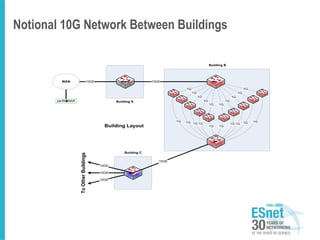
Notional 10G Network Between Buildings
WAN
perfSONAR Building A
10GE 10GE
Building B
Building C
1G
1G
1G
1G
1G 1G
1G
1G
1G
1G
1G1G
1G 1G1G 1G1G 1G1G
1G
10GE
Building Layout
ToOtherBuildings
10GE
10GE
10GE
Clearly Not A 10Gbps Network
• Inside of Building B: Obvious (from a network engineering perspective) this is not a
10Gbps network
– Maximum per-flow data rate is 1Gbps, not 10Gbps
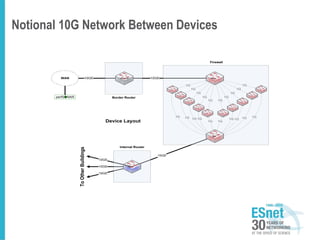
– However, if you convert the buildings into network elements while keeping their internals
intact, you get routers and firewalls
– What firewall did the organization buy? What’s inside it?
– Those little 1G “switches” are firewall processors
• This parallel firewall architecture has been in use for years
– Slower processors are cheaper
– Typically fine for a commodity traffic load
– Therefore, design is cost competitive and common
Notional 10G Network Between Devices
WAN
perfSONAR Border Router
10GE 10GE
Firewall
Internal Router
1G
1G
1G
1G
1G 1G
1G
1G
1G
1G
1G1G
1G 1G1G 1G1G 1G1G
1G
10GE
Device Layout
ToOtherBuildings
10GE
10GE
10GE
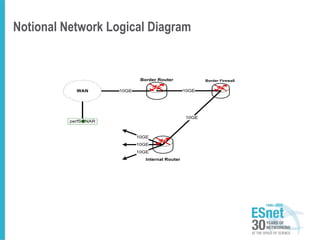
Notional Network Logical Diagram
10GE
10GE
10GE
10GE
10GE10GE
Border Router
WAN
Internal Router
Border Firewall
perfSONAR
Security Without Enterprise Firewalls
• Data intensive science traffic interacts poorly with enterprise firewalls
• Does this mean we ignore security? NO!
– We must protect our systems
– We need to find a way to do security that does not prevent us from getting the
science done
• Key point – security policies and mechanisms that protect the Science
DMZ should be implemented so that they do not compromise performance
• Traffic permitted by policy should not experience performance impact as a result
of the application of policy
Systems View Of Science Infrastructure
• Security is a component, not a gatekeeper
• Think about workflows
• Think about the interfaces to data (tools, applications)
– How do collaborators access data?
– How could they access data if the architecture were different?
• Cost/benefit
– What is a new cancer breakthrough worth?
– $30k for a few DTNs – what is that in context?
• Risks
– What risks do specific technologies mitigate?
– What are opportunity costs of poor performance?
Firewalls as Access Lists
• What does a firewall admin ask for when asked to allow data transfers?
– IP address of your host
– IP address of the remote host
– Port range
– That looks like an ACL to me – I can do that on the router!
• No special config for advanced protocol analysis – just address/port
• Router ACLs do not drop traffic permitted by policy, while enterprise firewalls can
(and often do)
Other Security Mechanisms: ACLs
• Aggressive access lists
– More useful with project-specific DTNs
– Exchanging data with a small set of remote collaborators = ACL is fairly easy to
manage
– Large-scale data distribution servers = difficult/time consuming to handle (but then,
the firewall ruleset for such a service would be, too)
• Limitation of the application set
– Makes it easier to protect
– Keep unnecessary applications off the DTN (and watch for them anyway using a
host IDS – take violations seriously)
Other Security Mechanisms: Network IDS
• Intrusion Detection Systems (IDS)
– One example is Bro – http://bro-ids.org/
– Bro is high-performance and battle-tested
• Bro protects several high-performance national assets
• Bro can be scaled with clustering: http://www.bro-ids.org/documentation/cluster.html
– Other IDS solutions also available
Other Security Mechanisms: Host IDS
• Using a Host IDS is recommended for hosts in a Science DMZ
• Several open source solutions have been recommended:
• OSSec: http://www.ossec.net/
• Rkhunter: http://rkhunter.sourceforge.net (rootkit detection + FIM)
• chkrootkit: http://chkrootkit.org/
• Logcheck: http://logcheck.org (log monitoring)
• Fail2ban: http://www.fail2ban.org/wiki/index.php/Main_Page
• denyhosts: http://denyhosts.sourceforge.net/
Collaboration Within The Organization
• All stakeholders should collaborate on Science DMZ design, policy, and
enforcement
• The security people have to be on board
– Political cover for security officers
– If the deployment of a Science DMZ is going to jeopardize the job of the security officer,
expect pushback
• The Science DMZ is a strategic asset, and should be understood by the
strategic thinkers in the organization
– Changes in security models
– Changes in operational models
– Enhanced ability to compete for funding
– Increased institutional capability – greater science output
Conclusions and Implications
• Think about what the Science DMZ is trying to do.
– Improve performance, both by removing impediments and improving the
performance of the devices that must be in line.
– Ease troubleshooting.
– In general, reduce degrees of freedom from science networks.
– Maximize performance and security and resiliency.
11/1/201625
Examples and Scenarios
• See the longer talks!
– Science DMZ Security: Presented to CENIC 2015:
http://registration.cenic.org/cenic2015slides/ScienceDMZSecurity-Buraglio--
Sinatra-dart-v2.pptx
– CTSC Presentation: http://trustedci.org/s/trustedci-sciencedmz-security.pdf
and nice long webinar archive
(https://ctsc.adobeconnect.com/dmz_recorded/event/registration.html)
• Center for Trustworthy Scientific Cyberinfrastructure (CTSC) Cyberinfrastructure
Security Workshop paper forthcoming, author: Michael Sinatra, ESnet
– 2016 US National Science Foundation Cybersecurity Summit:
http://trustedci.org/
11/1/201626

Science DMZ security

  • 1.
    Kate Petersen Mace,Campus network engineering workshop 19/10/2016 Science DMZ Security
  • 2.
    Science DMZ Security KatePetersen Mace Science Engagement Energy Sciences Network Lawrence Berkeley National Laboratory kate@es.net engage@es.net Campus network engineering for data-intensive science Workshop etc.venues Marble Arch London 19 October 2016
  • 3.
    Science DMZ asSecurity Architecture • Allows for better segmentation of risks, more granular application of controls to those segmented risks. – Limit risk profile for high-performance data transfer applications – Apply specific controls to data transfer hosts – Avoid including unnecessary risks, unnecessary controls • Remove degrees of freedom – focus only on what is necessary – Easier to secure – Easier to achieve performance – Easier to troubleshoot
  • 4.
    • Goal: Disentanglesecurity policy and enforcement for science flows from security for business systems • Rationale – Science data traffic is simple from a security perspective – Narrow application set on Science DMZ • Data transfer, data streaming packages • No printers, document readers, web browsers, building control systems, financial databases, staff desktops, etc. – Security controls that are typically implemented to protect business resources often cause performance problems • Separation allows each to be optimized Science DMZ Security
  • 5.
    Performance is aCore Requirement • Core information security principles – Confidentiality, Integrity, Availability (CIA) • In data-intensive science, performance is an additional core mission requirement: CIA  PICA – CIA principles are important, but if the performance isn’t there the science mission fails – This isn’t about “how much” security you have, but how the security is implemented – Need to appropriately secure systems without performance compromises
  • 6.
    Motivations • The bigmyth: The main goal of the Science DMZ is to avoid firewalls and other security controls. – Leads to all sorts of odd (and wrong) claims like: • “Our whole backbone is a Science DMZ because there is no firewall in front of the backbone.” • “The Science DMZ doesn’t allow for any security controls.” • “The Science DMZ requires a default-permit policy.” • The reality: The Science DMZ emphasizes reducing degrees-of- freedom, reducing the number of network devices (including middleboxes) in the path, eliminating devices that can’t perform, and ensuring that the devices that remain in the path are capable of large- scale data-transfer caliber performance. 11/1/20166
  • 7.
    Motivations • Goal isto break down this myth by viewing the Science DMZ as a security architecture. • That is, by thinking about Science DMZ as a form of security control, not just something that needs to be controlled. • At the same time, Science DMZ enables us to do a better job of risk-based security through segmentation. 11/1/20167
  • 8.
    Risk-based vs. Control-basedSecurity • Risk-based (ideal form): – Identify risks (impact and likelihood over a period of time) – Identify and/or create controls that are specifically designed to mitigate those risks – Apply controls as necessary • Control-based (ideal form): – Select controls from a checklist or standard – Controls are, or at one point were, believed to mitigate a general set of risks. – Apply controls (more controls==better security) • So why do we still practice control-based security in many instances? – Risk based security is actually pretty hard. 11/1/20168
  • 9.
    Assessing Risk -Data • Simple goal: Protecting data from destructive forces, and from the unwanted actions of unauthorized users – Know what you want to protect • PII (personally identifiable info) – Information that can be used on its own or with other information to identify, contact, or locate a single person, or to identify an individual in context • Master class of things like PHI (health information) • All data types shouldn’t be treated in the same manner – Not all research data is created equal – talk to the researchers about this.
  • 10.
    Network Segmentation • Thinkabout residence hall networks, business application networks, and the networks that are primarily in research areas: • The risk profiles are clearly different, so it makes sense to segment along these lines. • Your institution may already be doing this for things like HIPAA and PCI-DSS. Why? Because of the controls! • The Science DMZ follows the same concept, from a security perspective. • Using a Science DMZ to segment research traffic (especially traffic from specialized research instruments) can actually improve campus security posture. 11/1/201610
  • 11.
    Science DMZ PlacementOutside the Enterprise Firewall • Why? For performance reasons – Specifically: Science DMZ traffic does not traverse the firewall data plane – This has nothing to do with whether packet filtering is part of the security enforcement toolkit • Lots of heartburn over this, especially from the perspective of a conventional firewall manager – Organizational policy directives can mandate firewalls – Firewalls are designed to protect converged enterprise networks – Why would you put critical assets outside the firewall? • The answer: Firewalls are typically a poor fit for high-performance science applications
  • 12.
    Typical Firewall Internals •Composed of a set of processors which inspect traffic in parallel – Traffic distributed among processors so all traffic for a particular connection goes to the same processor – Simplifies state management – Parallelization scales deep analysis • Excellent fit for enterprise traffic profile – High connection count, low per-connection data rate – Complex protocols with embedded threats • Each processor is a fraction of firewall link speed – Significant limitation for data-intensive science applications – Overload causes packet loss – performance crashes © 2015, Energy Sciences Network
  • 13.
    Firewall Capabilities andScience Traffic • Firewalls have a lot of sophistication in an enterprise setting – Application layer protocol analysis (HTTP, POP, MSRPC, etc.) – Built-in VPN servers – User awareness • Data-intensive science flows don’t match this profile – Common case – data on filesystem A needs to be on filesystem Z • Data transfer tool verifies credentials over an encrypted channel • Then open a socket or set of sockets, and send data until done (1TB, 10TB, 100TB, …) – One workflow can use 10% to 50% or more of a 10G network link • Do we have to use a firewall?
  • 14.
    Notional 10G NetworkBetween Buildings WAN perfSONAR Building A 10GE 10GE Building B Building C 1G 1G 1G 1G 1G 1G 1G 1G 1G 1G 1G1G 1G 1G1G 1G1G 1G1G 1G 10GE Building Layout ToOtherBuildings 10GE 10GE 10GE
  • 15.
    Clearly Not A10Gbps Network • Inside of Building B: Obvious (from a network engineering perspective) this is not a 10Gbps network – Maximum per-flow data rate is 1Gbps, not 10Gbps – However, if you convert the buildings into network elements while keeping their internals intact, you get routers and firewalls – What firewall did the organization buy? What’s inside it? – Those little 1G “switches” are firewall processors • This parallel firewall architecture has been in use for years – Slower processors are cheaper – Typically fine for a commodity traffic load – Therefore, design is cost competitive and common
  • 16.
    Notional 10G NetworkBetween Devices WAN perfSONAR Border Router 10GE 10GE Firewall Internal Router 1G 1G 1G 1G 1G 1G 1G 1G 1G 1G 1G1G 1G 1G1G 1G1G 1G1G 1G 10GE Device Layout ToOtherBuildings 10GE 10GE 10GE
  • 17.
    Notional Network LogicalDiagram 10GE 10GE 10GE 10GE 10GE10GE Border Router WAN Internal Router Border Firewall perfSONAR
  • 18.
    Security Without EnterpriseFirewalls • Data intensive science traffic interacts poorly with enterprise firewalls • Does this mean we ignore security? NO! – We must protect our systems – We need to find a way to do security that does not prevent us from getting the science done • Key point – security policies and mechanisms that protect the Science DMZ should be implemented so that they do not compromise performance • Traffic permitted by policy should not experience performance impact as a result of the application of policy
  • 19.
    Systems View OfScience Infrastructure • Security is a component, not a gatekeeper • Think about workflows • Think about the interfaces to data (tools, applications) – How do collaborators access data? – How could they access data if the architecture were different? • Cost/benefit – What is a new cancer breakthrough worth? – $30k for a few DTNs – what is that in context? • Risks – What risks do specific technologies mitigate? – What are opportunity costs of poor performance?
  • 20.
    Firewalls as AccessLists • What does a firewall admin ask for when asked to allow data transfers? – IP address of your host – IP address of the remote host – Port range – That looks like an ACL to me – I can do that on the router! • No special config for advanced protocol analysis – just address/port • Router ACLs do not drop traffic permitted by policy, while enterprise firewalls can (and often do)
  • 21.
    Other Security Mechanisms:ACLs • Aggressive access lists – More useful with project-specific DTNs – Exchanging data with a small set of remote collaborators = ACL is fairly easy to manage – Large-scale data distribution servers = difficult/time consuming to handle (but then, the firewall ruleset for such a service would be, too) • Limitation of the application set – Makes it easier to protect – Keep unnecessary applications off the DTN (and watch for them anyway using a host IDS – take violations seriously)
  • 22.
    Other Security Mechanisms:Network IDS • Intrusion Detection Systems (IDS) – One example is Bro – http://bro-ids.org/ – Bro is high-performance and battle-tested • Bro protects several high-performance national assets • Bro can be scaled with clustering: http://www.bro-ids.org/documentation/cluster.html – Other IDS solutions also available
  • 23.
    Other Security Mechanisms:Host IDS • Using a Host IDS is recommended for hosts in a Science DMZ • Several open source solutions have been recommended: • OSSec: http://www.ossec.net/ • Rkhunter: http://rkhunter.sourceforge.net (rootkit detection + FIM) • chkrootkit: http://chkrootkit.org/ • Logcheck: http://logcheck.org (log monitoring) • Fail2ban: http://www.fail2ban.org/wiki/index.php/Main_Page • denyhosts: http://denyhosts.sourceforge.net/
  • 24.
    Collaboration Within TheOrganization • All stakeholders should collaborate on Science DMZ design, policy, and enforcement • The security people have to be on board – Political cover for security officers – If the deployment of a Science DMZ is going to jeopardize the job of the security officer, expect pushback • The Science DMZ is a strategic asset, and should be understood by the strategic thinkers in the organization – Changes in security models – Changes in operational models – Enhanced ability to compete for funding – Increased institutional capability – greater science output
  • 25.
    Conclusions and Implications •Think about what the Science DMZ is trying to do. – Improve performance, both by removing impediments and improving the performance of the devices that must be in line. – Ease troubleshooting. – In general, reduce degrees of freedom from science networks. – Maximize performance and security and resiliency. 11/1/201625
  • 26.
    Examples and Scenarios •See the longer talks! – Science DMZ Security: Presented to CENIC 2015: http://registration.cenic.org/cenic2015slides/ScienceDMZSecurity-Buraglio-- Sinatra-dart-v2.pptx – CTSC Presentation: http://trustedci.org/s/trustedci-sciencedmz-security.pdf and nice long webinar archive (https://ctsc.adobeconnect.com/dmz_recorded/event/registration.html) • Center for Trustworthy Scientific Cyberinfrastructure (CTSC) Cyberinfrastructure Security Workshop paper forthcoming, author: Michael Sinatra, ESnet – 2016 US National Science Foundation Cybersecurity Summit: http://trustedci.org/ 11/1/201626

Editor's Notes

  • #10 Talk about benefits of risk-based approach. Want to identify and Quantify your risks, reduce risks as much as possible - based on the application and data transferring through the DMZ. - Student/Staff records containing PII (National Insurance Number, DOB, bank information, health records, grades, etc.) - Research data (patents, original research work, NDA’ed joint work, grant information, human subjects) - Software licenses
  • #12 **Use text as notes, shorten slide significantly!**
  • #13 Each individual processor is typically a fraction of link speed (e.g. eight 1.25Gbps processors for a 10G firewall)
  • #15 This is supposedly a 10Gbps network end to end (look at the links on the buildings) Building A houses the border router – not much goes on there except the external connectivity Lots of work happens in building B – so much so that the processing is done with multiple processors to spread the load in an affordable way, and aggregate the results after Building C is where we branch out to other buildings Every link between buildings is 10Gbps – this is a 10Gbps network, right?...? If you look at the inside of Building B, it is obvious from a network engineering perspective that this is not a 10Gbps network
  • #17 Inside of Building B: Obvious (from a network engineering perspective) this is not a 10Gbps network Maximum per-flow data rate is 1Gbps, not 10Gbps However, if you convert the buildings into network elements while keeping their internals intact, you get routers and firewalls What firewall did the organization buy? What’s inside it? Those little 1G “switches” are firewall processors This parallel firewall architecture has been in use for years Slower processors are cheaper Typically fine for a commodity traffic load Therefore, design is cost competitive and common This parallel firewall architecture has been in use for years Slower processors are cheaper Typically fine for a commodity traffic load Therefore, this design is cost competitive and common
  • #18 If you’re not allowed to look inside, this is all you see
  • #21 Remember – we have mission requirements for high performance scientific data mobility, and business requirements for cost efficiency. A firewall mandate is an expensive solution that is a poor match for the task at hand and jeopardizes the scientific mission of the organization.
  • #25 Stress this point – mention at the beginning as well. Requires: Networking, security, scientists