Combat Cyber Threats
with Cloudera Impala & Apache Hadoop
Justin Erickson | Director, Product Management, Cloudera
Wayne Wheeles | Analytic, Infrastructure and Enrichment Developer Cyber
Security, Six3 Systems
July 2013
Agenda
What’s new in Impala?
• Impala recap
• Impala 1.1
• Authorization with Sentry
Cyber security with Impala
• Cyber security demo overview
• Working with WebProxy Data
• Working with Netflow Data
• IDS Amplification and Correlation “holy grail use case”
• Discussion and questions
2
Cloudera Impala
3
Interactive SQL for Hadoop
 Responses in seconds
 ANSI-92 standard SQL with Hive SQL
Native MPP Query Engine
 Purpose-built for low-latency queries
 Separate runtime from MapReduce
 Designed as part of the Hadoop ecosystem
Open Source
 Apache-licensed
Benefits of Impala
4
More & Faster Value from “Big Data”
 Interactive BI/analytics experience via SQL
 No delays from data migration
Flexibility
 Query across existing data
 Select best-fit file formats (Parquet, Avro, etc.)
 Run multiple frameworks on the same data at the same time
Cost Efficiency
 Reduce movement, duplicate storage & compute
 10% to 1% the cost of analytic DBMS
Full Fidelity Analysis
 No loss from aggregations or fixed schemas
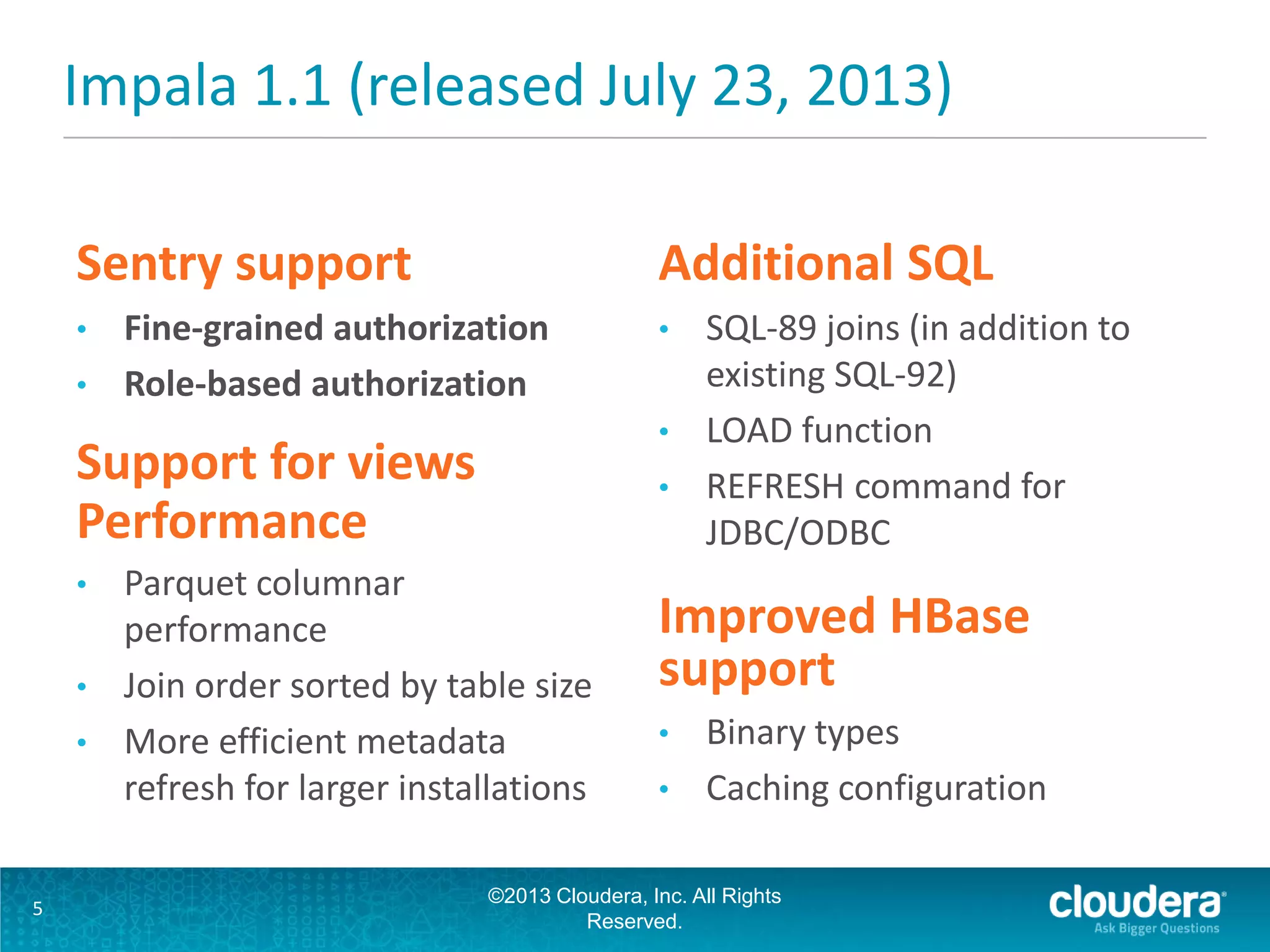
Impala 1.1 (released July 23, 2013)
Sentry support
• Fine-grained authorization
• Role-based authorization
Support for views
Performance
• Parquet columnar
performance
• Join order sorted by table size
• More efficient metadata
refresh for larger installations
Additional SQL
• SQL-89 joins (in addition to
existing SQL-92)
• LOAD function
• REFRESH command for
JDBC/ODBC
Improved HBase
support
• Binary types
• Caching configuration
©2013 Cloudera, Inc. All Rights
Reserved.
5
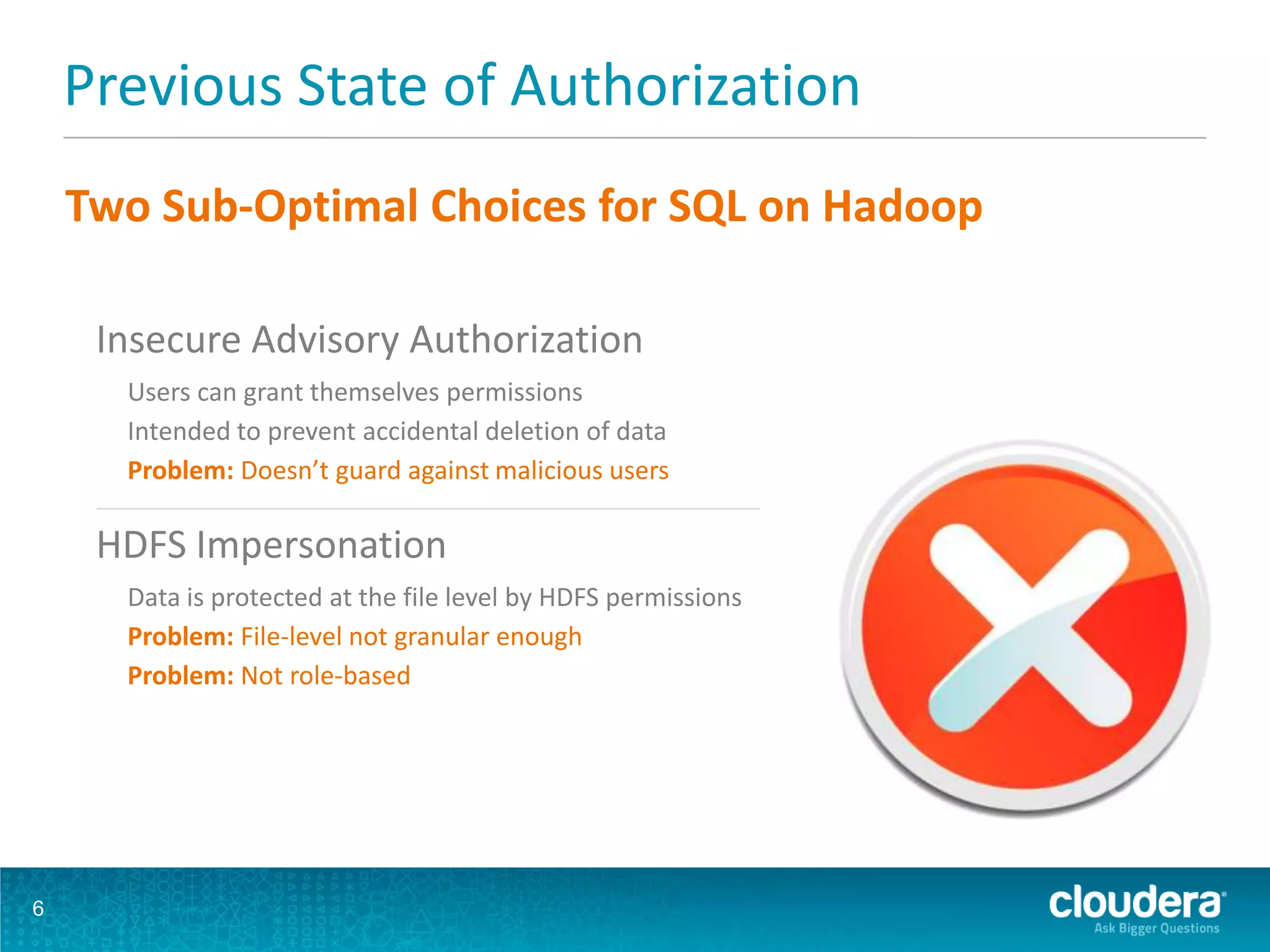
Previous State of Authorization
6
Insecure Advisory Authorization
Users can grant themselves permissions
Intended to prevent accidental deletion of data
Problem: Doesn’t guard against malicious users
HDFS Impersonation
Data is protected at the file level by HDFS permissions
Problem: File-level not granular enough
Problem: Not role-based
Two Sub-Optimal Choices for SQL on Hadoop
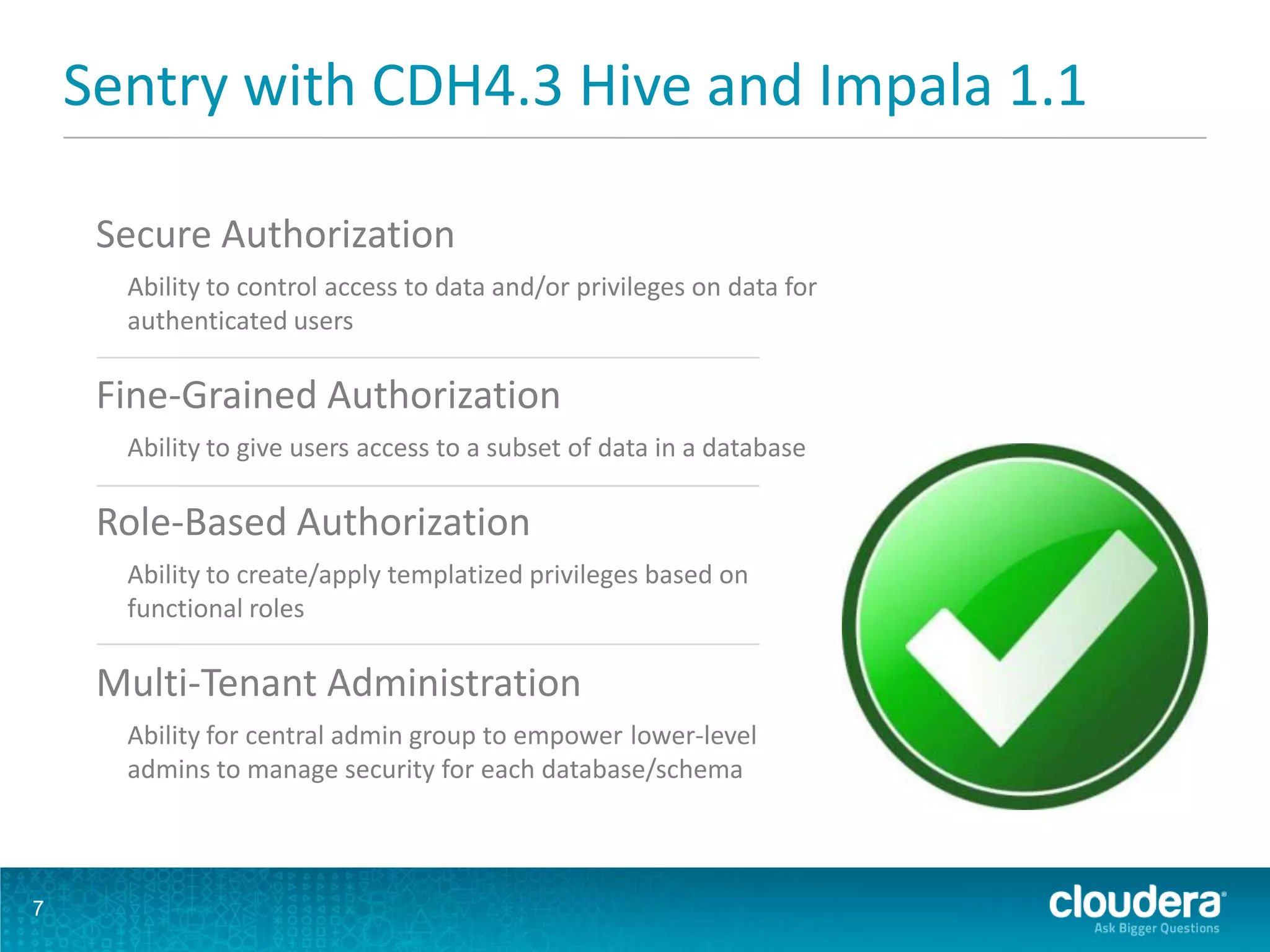
Sentry with CDH4.3 Hive and Impala 1.1
7
Secure Authorization
Ability to control access to data and/or privileges on data for
authenticated users
Fine-Grained Authorization
Ability to give users access to a subset of data in a database
Role-Based Authorization
Ability to create/apply templatized privileges based on
functional roles
Multi-Tenant Administration
Ability for central admin group to empower lower-level
admins to manage security for each database/schema
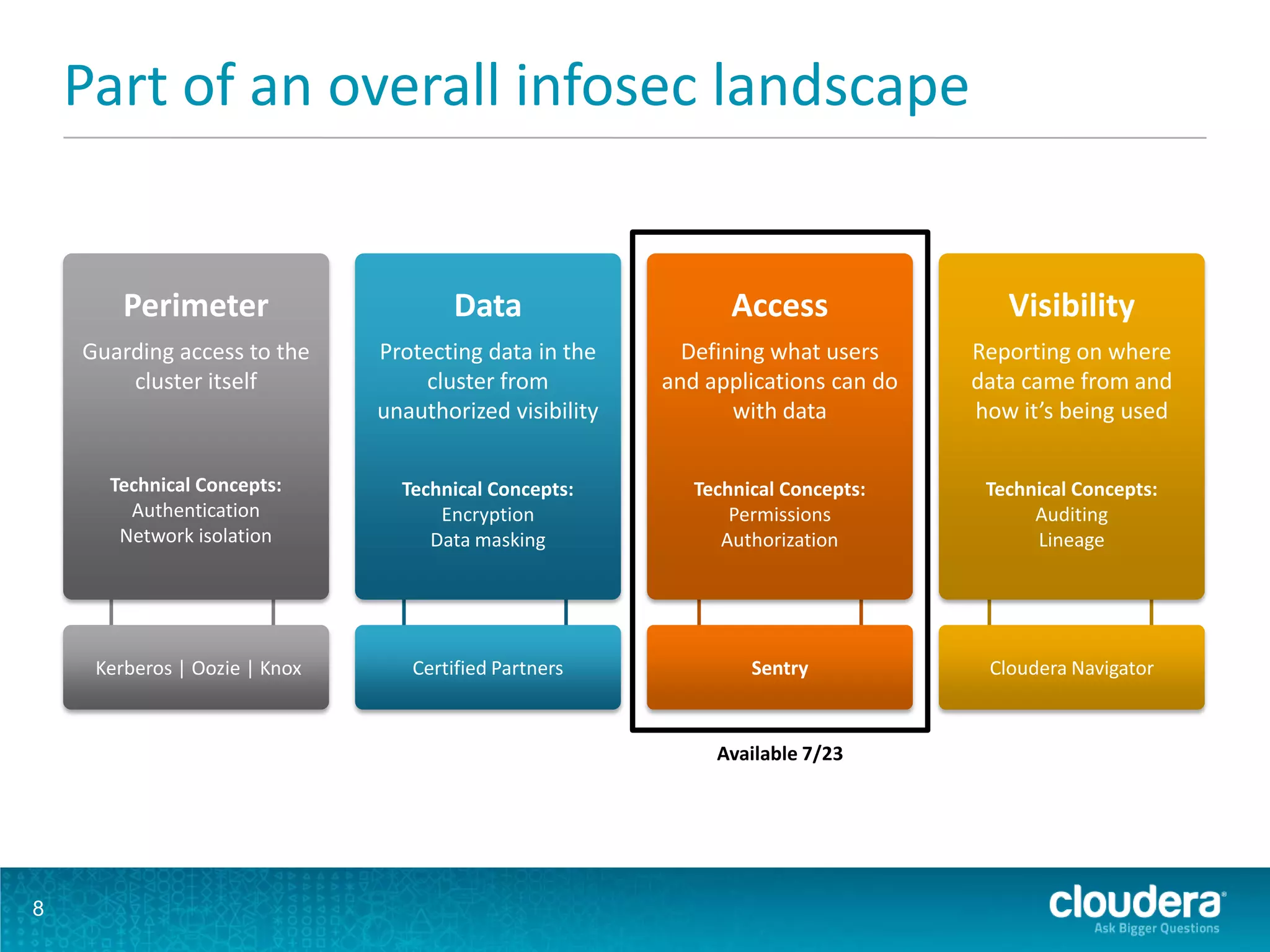
Part of an overall infosec landscape
8
Perimeter
Guarding access to the
cluster itself
Technical Concepts:
Authentication
Network isolation
Data
Protecting data in the
cluster from
unauthorized visibility
Technical Concepts:
Encryption
Data masking
Access
Defining what users
and applications can do
with data
Technical Concepts:
Permissions
Authorization
Visibility
Reporting on where
data came from and
how it’s being used
Technical Concepts:
Auditing
Lineage
SentryKerberos | Oozie | Knox Cloudera NavigatorCertified Partners
Available 7/23
Agenda – Cyber security with Impala
What’s new in Impala?
• Impala recap
• Impala 1.1
• Authorization with Sentry
Cyber security with Impala
• Cyber security demo overview
• Working with WebProxy Data
• Working with Netflow Data
• IDS Amplification and Correlation “holy grail use case”
• Discussion and questions
9
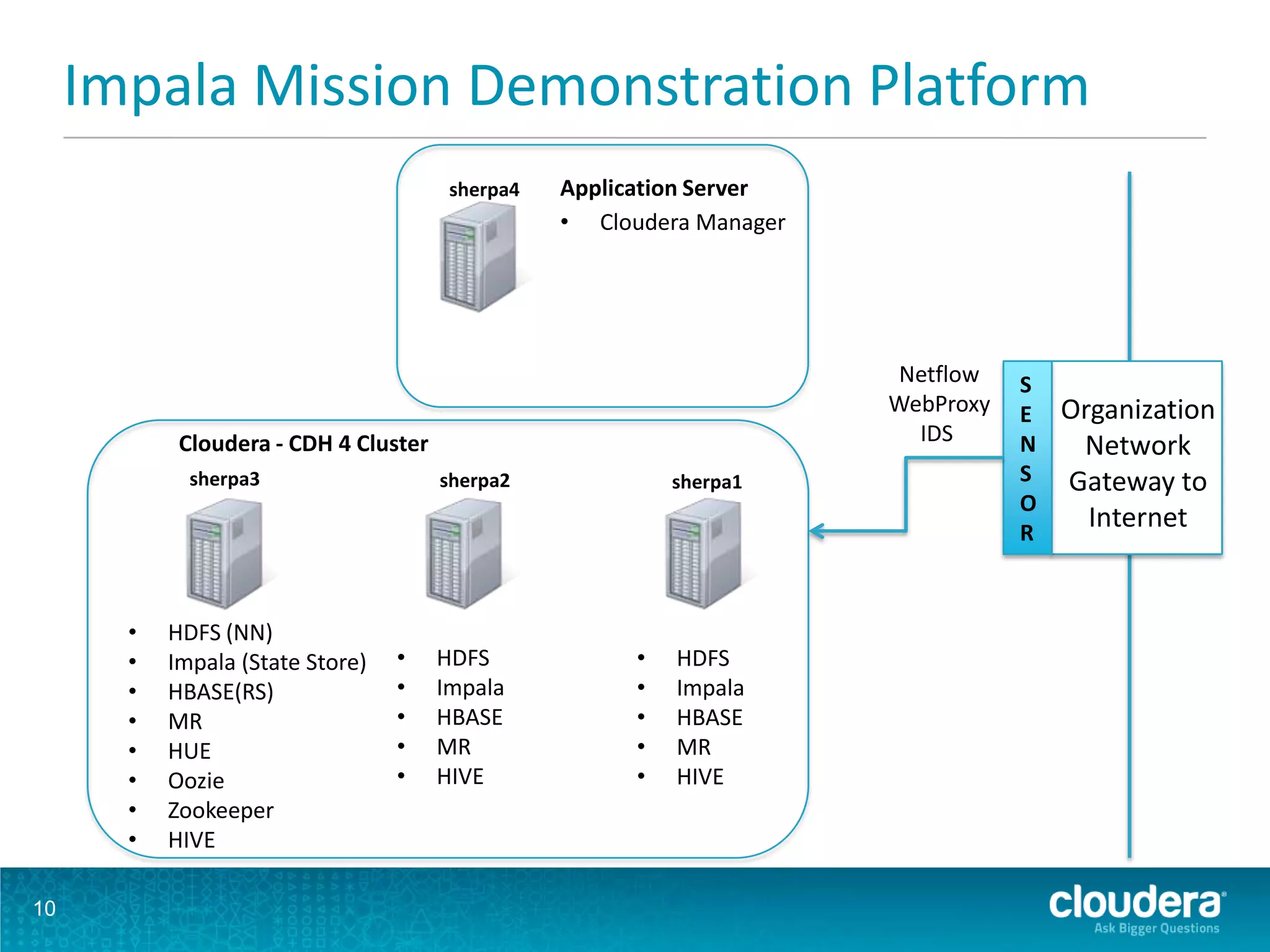
Impala Mission Demonstration Platform
10
Application Server
Cloudera - CDH 4 Cluster
sherpa4
sherpa3 sherpa2 sherpa1
• Cloudera Manager
• HDFS
• Impala
• HBASE
• MR
• HIVE
• HDFS
• Impala
• HBASE
• MR
• HIVE
• HDFS (NN)
• Impala (State Store)
• HBASE(RS)
• MR
• HUE
• Oozie
• Zookeeper
• HIVE
Organization
Network
Gateway to
Internet
S
E
N
S
O
R
Netflow
WebProxy
IDS
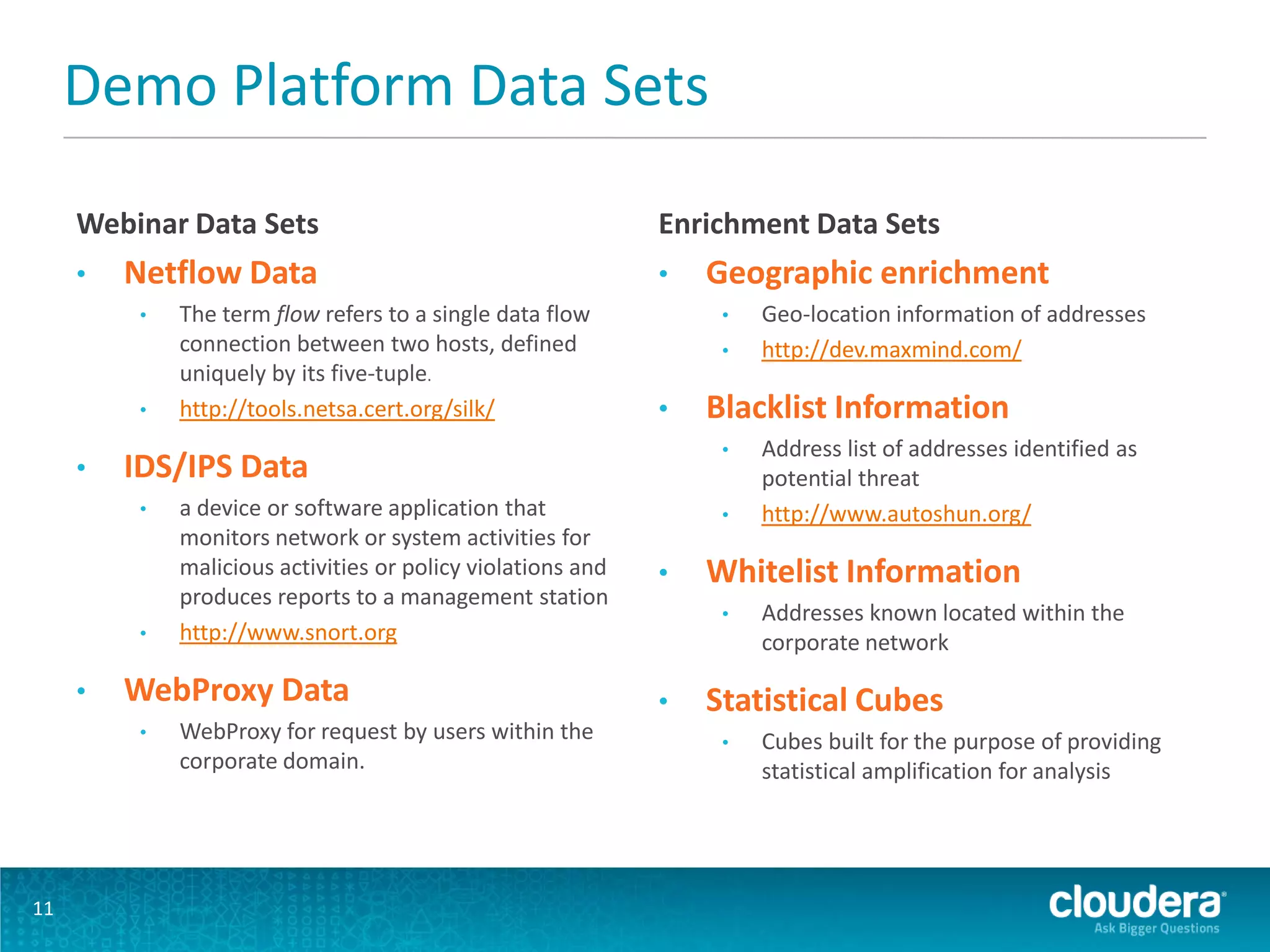
Demo Platform Data Sets
Webinar Data Sets
• Netflow Data
• The term flow refers to a single data flow
connection between two hosts, defined
uniquely by its five-tuple.
• http://tools.netsa.cert.org/silk/
• IDS/IPS Data
• a device or software application that
monitors network or system activities for
malicious activities or policy violations and
produces reports to a management station
• http://www.snort.org
• WebProxy Data
• WebProxy for request by users within the
corporate domain.
Enrichment Data Sets
• Geographic enrichment
• Geo-location information of addresses
• http://dev.maxmind.com/
• Blacklist Information
• Address list of addresses identified as
potential threat
• http://www.autoshun.org/
• Whitelist Information
• Addresses known located within the
corporate network
• Statistical Cubes
• Cubes built for the purpose of providing
statistical amplification for analysis
11
Demonstration
12
Impala Mission Demonstration Platform
13
Why Impala for Cyber Security?
Cloudera Impala and HDFS are a great choice for cyber
security:
• Offers one powerful and secure platform for
structured and unstructured data.
• Uniquely provides the capability to store large
amounts of data at a acceptable price point.
• Sentry provides even greater protection for your
cyber security data.
Thank You
• Ask questions on the Q&A tab
• Recording will be available
at cloudera.com
• After webinar, inquire at:
info@cloudera.com
• Contact info:
Email:
sherpasurfing@gmail.com
impala-user@cloudera.org
Twitter:
@WayneWheeles
@JustinErickson
@Cloudera
14
Cloudera Impala
cloudera.com/impala
“Imagination is more important than
knowledge. For knowledge is limited to all
we now know and understand, while
imagination embraces the entire world, and
all there ever will be to know and
understand.”
~Albert Einstein
Six3 Cyber Security Demo
https://github.com/sherpasurfing

Combat Cyber Threats with Cloudera Impala & Apache Hadoop

  • 1.
    Combat Cyber Threats withCloudera Impala & Apache Hadoop Justin Erickson | Director, Product Management, Cloudera Wayne Wheeles | Analytic, Infrastructure and Enrichment Developer Cyber Security, Six3 Systems July 2013
  • 2.
    Agenda What’s new inImpala? • Impala recap • Impala 1.1 • Authorization with Sentry Cyber security with Impala • Cyber security demo overview • Working with WebProxy Data • Working with Netflow Data • IDS Amplification and Correlation “holy grail use case” • Discussion and questions 2
  • 3.
    Cloudera Impala 3 Interactive SQLfor Hadoop  Responses in seconds  ANSI-92 standard SQL with Hive SQL Native MPP Query Engine  Purpose-built for low-latency queries  Separate runtime from MapReduce  Designed as part of the Hadoop ecosystem Open Source  Apache-licensed
  • 4.
    Benefits of Impala 4 More& Faster Value from “Big Data”  Interactive BI/analytics experience via SQL  No delays from data migration Flexibility  Query across existing data  Select best-fit file formats (Parquet, Avro, etc.)  Run multiple frameworks on the same data at the same time Cost Efficiency  Reduce movement, duplicate storage & compute  10% to 1% the cost of analytic DBMS Full Fidelity Analysis  No loss from aggregations or fixed schemas
  • 5.
    Impala 1.1 (releasedJuly 23, 2013) Sentry support • Fine-grained authorization • Role-based authorization Support for views Performance • Parquet columnar performance • Join order sorted by table size • More efficient metadata refresh for larger installations Additional SQL • SQL-89 joins (in addition to existing SQL-92) • LOAD function • REFRESH command for JDBC/ODBC Improved HBase support • Binary types • Caching configuration ©2013 Cloudera, Inc. All Rights Reserved. 5
  • 6.
    Previous State ofAuthorization 6 Insecure Advisory Authorization Users can grant themselves permissions Intended to prevent accidental deletion of data Problem: Doesn’t guard against malicious users HDFS Impersonation Data is protected at the file level by HDFS permissions Problem: File-level not granular enough Problem: Not role-based Two Sub-Optimal Choices for SQL on Hadoop
  • 7.
    Sentry with CDH4.3Hive and Impala 1.1 7 Secure Authorization Ability to control access to data and/or privileges on data for authenticated users Fine-Grained Authorization Ability to give users access to a subset of data in a database Role-Based Authorization Ability to create/apply templatized privileges based on functional roles Multi-Tenant Administration Ability for central admin group to empower lower-level admins to manage security for each database/schema
  • 8.
    Part of anoverall infosec landscape 8 Perimeter Guarding access to the cluster itself Technical Concepts: Authentication Network isolation Data Protecting data in the cluster from unauthorized visibility Technical Concepts: Encryption Data masking Access Defining what users and applications can do with data Technical Concepts: Permissions Authorization Visibility Reporting on where data came from and how it’s being used Technical Concepts: Auditing Lineage SentryKerberos | Oozie | Knox Cloudera NavigatorCertified Partners Available 7/23
  • 9.
    Agenda – Cybersecurity with Impala What’s new in Impala? • Impala recap • Impala 1.1 • Authorization with Sentry Cyber security with Impala • Cyber security demo overview • Working with WebProxy Data • Working with Netflow Data • IDS Amplification and Correlation “holy grail use case” • Discussion and questions 9
  • 10.
    Impala Mission DemonstrationPlatform 10 Application Server Cloudera - CDH 4 Cluster sherpa4 sherpa3 sherpa2 sherpa1 • Cloudera Manager • HDFS • Impala • HBASE • MR • HIVE • HDFS • Impala • HBASE • MR • HIVE • HDFS (NN) • Impala (State Store) • HBASE(RS) • MR • HUE • Oozie • Zookeeper • HIVE Organization Network Gateway to Internet S E N S O R Netflow WebProxy IDS
  • 11.
    Demo Platform DataSets Webinar Data Sets • Netflow Data • The term flow refers to a single data flow connection between two hosts, defined uniquely by its five-tuple. • http://tools.netsa.cert.org/silk/ • IDS/IPS Data • a device or software application that monitors network or system activities for malicious activities or policy violations and produces reports to a management station • http://www.snort.org • WebProxy Data • WebProxy for request by users within the corporate domain. Enrichment Data Sets • Geographic enrichment • Geo-location information of addresses • http://dev.maxmind.com/ • Blacklist Information • Address list of addresses identified as potential threat • http://www.autoshun.org/ • Whitelist Information • Addresses known located within the corporate network • Statistical Cubes • Cubes built for the purpose of providing statistical amplification for analysis 11
  • 12.
  • 13.
    13 Why Impala forCyber Security? Cloudera Impala and HDFS are a great choice for cyber security: • Offers one powerful and secure platform for structured and unstructured data. • Uniquely provides the capability to store large amounts of data at a acceptable price point. • Sentry provides even greater protection for your cyber security data.
  • 14.
    Thank You • Askquestions on the Q&A tab • Recording will be available at cloudera.com • After webinar, inquire at: info@cloudera.com • Contact info: Email: sherpasurfing@gmail.com impala-user@cloudera.org Twitter: @WayneWheeles @JustinErickson @Cloudera 14 Cloudera Impala cloudera.com/impala “Imagination is more important than knowledge. For knowledge is limited to all we now know and understand, while imagination embraces the entire world, and all there ever will be to know and understand.” ~Albert Einstein Six3 Cyber Security Demo https://github.com/sherpasurfing

Editor's Notes

  • #4 Interactive SQL for HadoopResponses in seconds vs. minutes or hours4-100x faster than HiveNearly ANSI-92 standard SQL with HiveQLCREATE, ALTER, SELECT, INSERT, JOIN, subqueries, etc.ODBC/JDBC drivers Compatible SQL interface for existing Hadoop/CDH applicationsNative MPP Query EnginePurpose-built for low latency queries – another application being brought to HadoopSeparate runtime from MapReduce which is designed for batch processingTightly integrated with Hadoop ecosystem – major design imperative and differentiator for ClouderaSingle system (no integration)Native, open file formats that are compatible across the ecosystem (no copying)Single metadata model (no synchronization)Single set of hardware and system resources (better performance, lower cost)Integrated, end-to-end security (no vulnerabilities)Open SourceKeeps with our strategy of an open platform – i.e. if it stores or processes data, it’s open sourceApache-licensedCode available on Github
  • #5 More & Faster Value from Big DataProvides an interactive BI/Analytics experience on HadoopPreviously BI/Analytics was impractical due to the batch orientation of MapReduceEnables more users to gain value from organizational data assets (SQL/BI users)Makes more data available for analysis (raw data, multi-structured data, historical data)Removes delays from data migrationInto specialized analytical DBMSsInto proprietary file formats that happen to be stored in HDFSInto transient in-memory storesFlexibilityQuery across existing data in HadoopHDFS and HBaseAccess data immediately and directly in its native formatSelect best-fit file formatsUse raw data formats when unsure of access patterns (text files, RCFiles, LZO)Increase performance with optimized file formats when access patterns are known (Parquet, Avro)All file formats are compatible across the entire Hadoop ecosystem – i.e. MapReduce, Pig, Hive, Impala, etc. on the same data at the same timeCost EfficiencyReduce movement, duplicate storage & computeData movement: no time or resource penalty for migrating data into specialized systems or formatsDuplicate storage: no need to duplicate data across systems or within the same system in different file formatsCompute: use the same compute resources as the rest of the Hadoop system – You don’t need a separate set of nodes to run interactive query vs. batch processing (MapReduce)You don’t need to overprovision your hardware to enable memory-intensive, on-the-fly format conversions10% to 1% the cost of analytic DMBSLess than $1,000/TBFull Fidelity AnalysisNo loss of fidelity from aggregations or conforming to fixed schemasIf the attribute exists in the raw data, you can query against it
  • #11 This is an overview of my simple cluster I put together for the Webinar, 4 nodes in total: 3 node Hadoop Cluster and an Application Server.So the configuration here is one that would be present in many public and private organizationsWe have placed a sensor at the gateway or gateway(s) across the enterprise monitoring traffic incoming and outgoing.This information is captured by a variety of sensor/collectors and written to files on a regular basis.So now lets go through the data sets.
  • #13 1.) Provide a brief tour of the cluster using Cloudera Manager