Newton’s 3 laws of motionDone by: Ong Kian Han (2p320)
Agenda:Brief  introduction to NewtonWhat are his lawsSome formulasWhat is the significance of the 3 laws?What are they used for?
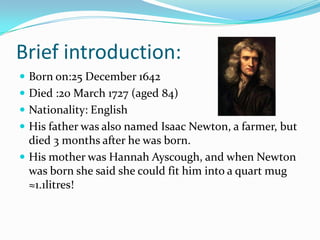
Brief introduction:Born on:25 December 1642Died :20 March 1727 (aged 84)Nationality: EnglishHis father was also named Isaac Newton, a farmer, but died 3 months after he was born.His mother was Hannah Ayscough, and when Newton was born she said she could fit him into a quart mug ≈1.1litres!
Contributions to science:Discovery of the theory of universal gravitationHe used a prism to better understand the properties of light, refractionHe also created a new telescope that was only six inches long but it could see Jupiter's satellites!
First Law:Also known as the inertia law.The velocity of a body remains constant unless the body is acted upon by an external force.Lex I: Corpus omne perseverare in statu suo quiescendi vel movendi uniformiter in directum, nisi quatenus a viribus impressis cogitur statum illum mutare.(latin)Every body persists in its state of being at rest or of moving uniformly straight forward, except insofar as it is compelled to change its state by force impressed.(English)
First law:Formula:  ΣF=0=>dv/dt=0His law states that if the resultant force (the vector sum of all forces acting on an object) is zero, then the velocity of the object is constant.An object that is at rest will stay at rest unless an unbalanced force acts upon it. When you do not touch a ball, it is stationary and will remain stationary unless you push it.An object that is in motion will not change its velocity unless an unbalanced force acts upon it. If you throw a dart, by right, it should move in the fixed path that you have thrown it. How ever, due to gravity and other factors, the dart does not travel  straight for ever, instead landing on the floor.
Second law:Second law: The acceleration a of a body is parallel and directly proportional to the net force F and inversely proportional to the mass m, i.e., F = ma.Formula=(F=[dp/dt]=[d(mw)/dv]	net force on a particle is equal to the time rate of change of its linear momentum p in an inertial reference frame: only applies to constant-mass systemsF=m(dv/dt)=maF is the net force applied, m is the mass of the body, and a is the body's acceleration.
Second law:Any mass that is gained or lost by the system will cause a change in momentum that is not the result of an external force. A different equation is necessary for variable-mass systems .Newton's second law requires modification if the effects of special relativity are to be taken into account, because at high speeds the approximation that momentum is the product of rest mass and velocity is not accurate.
Second law: ImpulseAn impulse (J) occurs when a force (F) acts over an interval of time,  (small triangle)t,	F dt.Since F is the time derivative of momentum, it follows that J=(triangle)p=m(triangle)v.This relation between impulse and momentum is closer to Newton's wording of the second law.Impulse is a concept frequently used in the analysis of collisions and impacts.
Second Law: variable mass systemsVariable-mass systems, like a rocket burning fuel and ejecting spent gases, are not closed and cannot be directly treated by making mass a function of time in the second law
Second law:Consistent with the first law, the time derivative of the momentum is non-zero when the momentum changes direction, even if there is no change in its magnitude; such is the case with uniform circular motion. The relationship also implies the conservation of momentum: when the net force on the body is zero, the momentum of the body is constant. Any net force is equal to the rate of change of the momentum.
Third law:Formula:ΣFa,b=-Σfb,aThe Third Law means that all forces are interactions between different bodies, and thus that there is no such thing as a unidirectional force or a force that acts on only one body.Whenever a first body exerts a force F on a second body, the second body exerts a force −F on the first body. F and −F are equal in magnitude and opposite in direction. This law is sometimes referred to as the action-reaction law, with F called the "action" and −F the "reaction". The action and the reaction are simultaneous.
Third Law:Simply: a force acts between a pair of objects, and not on a single object. So each and every force has two ends. Each of the two ends is the same except for being opposite in direction. The ends of a force are mirror images of each other, one might say.
Bibliography Wikipediahttp://library.thinkquest.org/28327/html/exploration/people/newton.html
Thank You

Science ace 2

  • 1.
    Newton’s 3 lawsof motionDone by: Ong Kian Han (2p320)
  • 2.
    Agenda:Brief introductionto NewtonWhat are his lawsSome formulasWhat is the significance of the 3 laws?What are they used for?
  • 3.
    Brief introduction:Born on:25December 1642Died :20 March 1727 (aged 84)Nationality: EnglishHis father was also named Isaac Newton, a farmer, but died 3 months after he was born.His mother was Hannah Ayscough, and when Newton was born she said she could fit him into a quart mug ≈1.1litres!
  • 4.
    Contributions to science:Discoveryof the theory of universal gravitationHe used a prism to better understand the properties of light, refractionHe also created a new telescope that was only six inches long but it could see Jupiter's satellites!
  • 5.
    First Law:Also knownas the inertia law.The velocity of a body remains constant unless the body is acted upon by an external force.Lex I: Corpus omne perseverare in statu suo quiescendi vel movendi uniformiter in directum, nisi quatenus a viribus impressis cogitur statum illum mutare.(latin)Every body persists in its state of being at rest or of moving uniformly straight forward, except insofar as it is compelled to change its state by force impressed.(English)
  • 6.
    First law:Formula: ΣF=0=>dv/dt=0His law states that if the resultant force (the vector sum of all forces acting on an object) is zero, then the velocity of the object is constant.An object that is at rest will stay at rest unless an unbalanced force acts upon it. When you do not touch a ball, it is stationary and will remain stationary unless you push it.An object that is in motion will not change its velocity unless an unbalanced force acts upon it. If you throw a dart, by right, it should move in the fixed path that you have thrown it. How ever, due to gravity and other factors, the dart does not travel straight for ever, instead landing on the floor.
  • 7.
    Second law:Second law:The acceleration a of a body is parallel and directly proportional to the net force F and inversely proportional to the mass m, i.e., F = ma.Formula=(F=[dp/dt]=[d(mw)/dv] net force on a particle is equal to the time rate of change of its linear momentum p in an inertial reference frame: only applies to constant-mass systemsF=m(dv/dt)=maF is the net force applied, m is the mass of the body, and a is the body's acceleration.
  • 8.
    Second law:Any massthat is gained or lost by the system will cause a change in momentum that is not the result of an external force. A different equation is necessary for variable-mass systems .Newton's second law requires modification if the effects of special relativity are to be taken into account, because at high speeds the approximation that momentum is the product of rest mass and velocity is not accurate.
  • 9.
    Second law: ImpulseAnimpulse (J) occurs when a force (F) acts over an interval of time, (small triangle)t, F dt.Since F is the time derivative of momentum, it follows that J=(triangle)p=m(triangle)v.This relation between impulse and momentum is closer to Newton's wording of the second law.Impulse is a concept frequently used in the analysis of collisions and impacts.
  • 10.
    Second Law: variablemass systemsVariable-mass systems, like a rocket burning fuel and ejecting spent gases, are not closed and cannot be directly treated by making mass a function of time in the second law
  • 11.
    Second law:Consistent withthe first law, the time derivative of the momentum is non-zero when the momentum changes direction, even if there is no change in its magnitude; such is the case with uniform circular motion. The relationship also implies the conservation of momentum: when the net force on the body is zero, the momentum of the body is constant. Any net force is equal to the rate of change of the momentum.
  • 12.
    Third law:Formula:ΣFa,b=-Σfb,aThe ThirdLaw means that all forces are interactions between different bodies, and thus that there is no such thing as a unidirectional force or a force that acts on only one body.Whenever a first body exerts a force F on a second body, the second body exerts a force −F on the first body. F and −F are equal in magnitude and opposite in direction. This law is sometimes referred to as the action-reaction law, with F called the "action" and −F the "reaction". The action and the reaction are simultaneous.
  • 13.
    Third Law:Simply: aforce acts between a pair of objects, and not on a single object. So each and every force has two ends. Each of the two ends is the same except for being opposite in direction. The ends of a force are mirror images of each other, one might say.
  • 14.
  • 15.