PAIN MANAGEMENT IN
AYURVEDA :
Sciatica(GRADHRASI): Low back and Leg
Pain Diagnosis and Treatment Options
DR.DEEPAK VERMA
BAMS MD DIP.Y&P
LECTURER DRAVYAGUNA VIGYAN
DAC,JALANDHAR
Anatomy:-
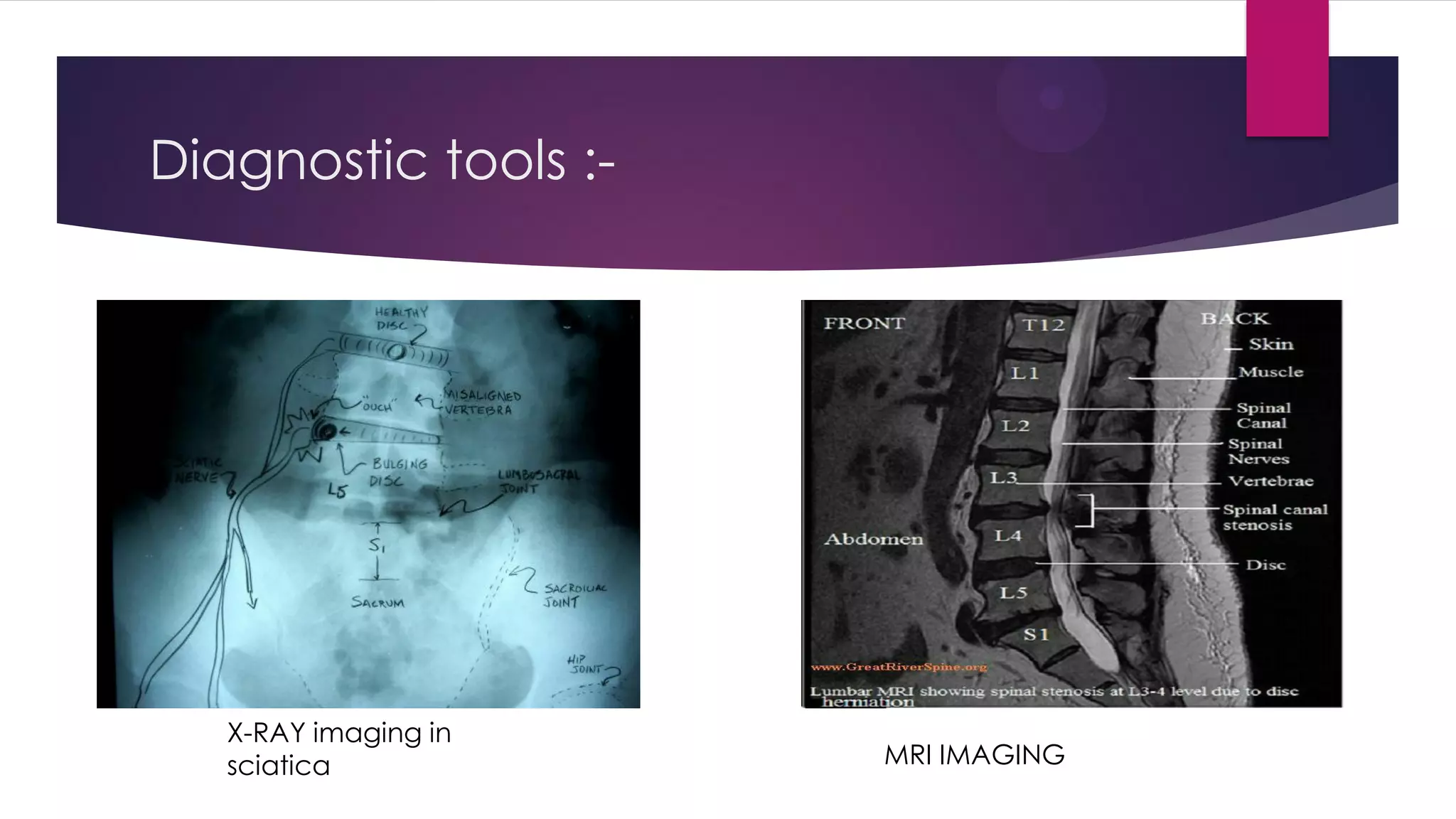
Diagnostic tools :-
X-RAY imaging in
sciatica MRI IMAGING
Disk Herniation With Sciatica : -
 60%–90% lifetime prevalence
 Second most common complaint to prompt a medical
evaluation
 Leading cause of long-term work disability
 90% of ruptured disks at L4-L5 and L5-S1
 90% of patients with back pain and sciatica will recover
without surgery
 At least 50% within 6 wk
Assessment of Patients With Low Back,
Hip, and Leg Pain
Neurologic exam
 – strength, sensitivity, gait
Regional exam of spine and leg
 –Inspection for scoliosis or skin rash,
palpation for bone tenderness
Sciatic- and femoral-nerve stretching
tests
 –SLR, reverse and contra lateral SLR
maneuver
Physical examination :-
Assessment of Acute Back Pain and
Sciatica: “Red Flags”
 Nighttime pain, fever, weight loss, history of cancer
 Fever, IV drug abuse
 Bladder, bowel dysfunction; leg weakness
 Trauma
 Neoplasm
 Infection (diskitis, epidural abscess)
 Cauda-equina syndrome
 Compression Fx
Back Pain and Sciatica: Imaging
Evaluation
 Lumbosacral x-ray studies with flexion/ extension/oblique
views
 MRI of the spine
 CT with 3-D reconstruction
 CT plus mylography
 Provocative diskograms or disk blockade to rule out
discogenic pain and pain associated with segmental
spinal instability
Introduction :-
 fLQd~iwokZ dfVi`"B m:tkuqta?kk ina dzekr~A
x`/kzlh LrEHk :d~ rksnS% x`gzkfr Lianrs eqgq%AA ¼ p] fp] 28@55½
 The Ayurvedic treatises in the context of Vata Vyadhi explain a painful condition
afflicting the lower limbs called ‘Gridhrasi’wherein the pain along with stiffness,
sensation of pins and needles, gripping and pulsations start in the spik or the buttocks
[gluteal region] initially and gradually encroach the regions of the posterior aspect of
kati (pelvis and lumbo sacral regions), ooru (thigh), jaanu (behind the knee), jangha
(leg) and pada (foot) in that order. This occurs due to the vitiation of vata. But when
kapha gets involved with vata stupor, heaviness of the body and anorexia are also
associated with the above said complaints.
 Gridhrasi can be compared with the ‘Sciatica’ explained in the modern texts due to a
close resemblance in the manifestations of both the conditions.
NIDAN :-
 Samprapti-Ghataka of Gridhrasi can be traced out as below –
Dosha – Vata (Vyana) and Kapha(vata kaphaja).
Dushya – Kandara, Snayu, Sira, Asthi & Mamsa.
Srotasa – Raktavaha, Mamsavaha,Asthivaha.
Srotodushti Prakara – Sanga, obstruction
Agni – Jatharagni and Dhatwagni
Ama – Jatharagnijanya and Dhatwagnijanya
Udbhavasthana – Pakwashaya
Sanchara Sthana – Kati and adharanga
Adhisthana – Kati,Sphik.
Vyakta sthana – Spik, kati prista, Uru, Janu,Jangha and Pada.
Panchkarma :-
 Urdhwa and adho shuddhi – Vamana and Virechana are the
purificatory measures which are implemented to get rid of the
morbid kapha and pitta respectively.
 Gridhrasi is a vata vyadhi.
 Vamana logically need not be given in the diseases of vata origin.
But Acharya Chakrapani suggests to bring about Urdhwa shuddhi
by administering Vamana before giving Vasti. He further
emphasizes that giving vasti which is a treatment of choice in vata
vyadhis without giving vamana will be a waste exercise and will
be unfruitful.
Continue :-
 Virechana any how is a useful remedy in all the vata vyadhis. Snehayukta Virechana
especially by regular use of eranda taila is very useful when there is no association of
kapha. But when there is heaviness and stiffness of lower limb along with mild to
moderate pain, the association of kapha should be suspected and rooksha virechana in
the form of choorna and kashayas can be given. Eg – Trivrit choorna, Hareetaki
choorna, Gandharvahastadi kashayam etc.
 Vasti: After koshta shuddhi vasti will be highly effective in relieving the complaints of
gridhrasi or sciatica.
 Guggulutiktaka ghrita or Narayana taila or Sahacharadi taila can be used for
anuvasana or matra vasti.
 Dashamoola kashayam or Erandamooladi kashayam as kashaya vastis
have been proved to be highly effective in gridhrasi.
Sanshman aushdhiyaan :-
Ras aushadhi evm vati churna
 Agnitundi vati ajmodadi churna
 Sameerpannag rasa naagradya churna
 Ekangveer rasa narsingh churna
 Vishtinduk vati panchkol churna
 Vaatvidhwansak rasa
Tailum , guggulu and kwath :-
Aabhyantera use for massage ext. use
 Rasone tailam naarayan tailam
 Bala tailam maash tailam
 Ashwagandha tailam vishgarbha tailam
Guggulu kwath
Yograj guggulu dashmool kwath
Simnhnaad guggulu erandmool kwath
Panchamrat louh guggulu shephalikamool kwath
Sthanika:Local treatments
 Kati vasti or Prishta vasti
 Kati Pichu
 Abhyanga and patra pinda sweda
 Shastika shali panda sweda
 Upanaha and Lepa
 Agni karma
 Sira vedha
 Pada Abhyangam
Do’s when having sciatica:
 Apply alternate cold and hot packs in the region which is painful
 Sleep on a firm mattress without using pillow
 Sleep in a childs position keeping a pillow in between the flexed legs or
keep a pillow
 below the knees while sleeping supine
 Back belt may come in handy
Don’t’s when having sciatica:
 Don’t bend down suddenly while sitting or trying to lift an object. Slowly sit
down
 flexing your knees and get up slowly by supporting your hands against the
floor.
 Don’t rush and push with your work since you have a sensitive back
 Don’t jump and jolt. Be careful while climbing stairs.
Conservative treatments
 Bed rest (trade-off)
 Staying active, in contrast to bed rest (likely to be
 beneficial)
 Analgesics or non-steroidal anti-inflammatory drugs,
 acupuncture, epidural steroid injections, spinal
manipulation, traction therapy, physical therapy, yoga therapy
 behavioral treatment, multidisciplinary treatment
(unknown effectiveness)
AGNI KARMA :-
 A few Ayurvedic para-surgical procedures, which are very effective, simple, safe and cheap
in nature can became handy for Ayurvedicians. Agnikarma is one of such procedures.
Sushrutacharya mentioned Agnikarma chikitsa in the management of Sira,(Vain),
Snayu(Nerve), Sandhi(Joints), and Gridhrasi(Sciatica). Charakacharya mentioned Agnikarma
chikitsa in the management of Gridhrasi(Sciatica) at the site of Antara-Kandara-Gulpha
pradesha.
 Pradhana Karma (Operative Procedure): The affected leg of the patient was seen and at
the site of 4 Angula (finger)above of Gulpha sandhi (Ankle joint)on posterior side of
affected leg, 5 – 30 bindu size (bindu dahana vishesha), Samyaka dagdha vrana were
produced in the form of Vilekha by red hot Loha dhatu Shalaka. The proper space
between two Samyaka dagdha vrana was kept
 Paschat Karma (Post Operative Procedure): After producing Samyaka Dagdha Vrana, the
Kumari Swarasa was applied on samyaka dagdha vrana to get relief from burning
sensation and after wiping of Kumari Swarasa, Avachurnan (dusting) of Yashtimadhu
churna was done on Samyaka Dagdha Vrana and from next day patients were advised
for local application of an ointment made of Haridra powder mixed with coconut oil.
Pathya-pathya advised as per Sushrutacharya’s Vrana Rogadhikara until healing of
Samyaka Dagdha Vrana.
Siravedha
 In the chikitsa sutra of Gridhrasi Acharya Charaka, Sushruta,
Vagbhatta Yogratnakara and Bhela have mentioned
Siravedha.
 Lightness in the painful areas and in body, reduction of pain,
decrease in the intensity of vyadhi and cheerfulness of mind
are symptoms of proper Siravedha. Mainly siravedha is done
in an acute condition of diseases having pain as prominent
feature. Siravedha has an important procedure in
management of pain in Gridharasi.
ACUPUNCTURE
Yoga aasan :-
Conclusion :-
 Ayutrveda has a biggest opportunity in
the management of sciatica disease.it
relieves pain by the methods of shaman,
shodhan,agnikarma, siravedha and
yoga.
REF. GOOGLE SEARCG, TEXT BOOKS AND
INTRNET

Sciatica

  • 1.
    PAIN MANAGEMENT IN AYURVEDA: Sciatica(GRADHRASI): Low back and Leg Pain Diagnosis and Treatment Options DR.DEEPAK VERMA BAMS MD DIP.Y&P LECTURER DRAVYAGUNA VIGYAN DAC,JALANDHAR
  • 2.
  • 3.
    Diagnostic tools :- X-RAYimaging in sciatica MRI IMAGING
  • 4.
    Disk Herniation WithSciatica : -  60%–90% lifetime prevalence  Second most common complaint to prompt a medical evaluation  Leading cause of long-term work disability  90% of ruptured disks at L4-L5 and L5-S1  90% of patients with back pain and sciatica will recover without surgery  At least 50% within 6 wk
  • 5.
    Assessment of PatientsWith Low Back, Hip, and Leg Pain Neurologic exam  – strength, sensitivity, gait Regional exam of spine and leg  –Inspection for scoliosis or skin rash, palpation for bone tenderness Sciatic- and femoral-nerve stretching tests  –SLR, reverse and contra lateral SLR maneuver
  • 6.
  • 7.
    Assessment of AcuteBack Pain and Sciatica: “Red Flags”  Nighttime pain, fever, weight loss, history of cancer  Fever, IV drug abuse  Bladder, bowel dysfunction; leg weakness  Trauma  Neoplasm  Infection (diskitis, epidural abscess)  Cauda-equina syndrome  Compression Fx
  • 8.
    Back Pain andSciatica: Imaging Evaluation  Lumbosacral x-ray studies with flexion/ extension/oblique views  MRI of the spine  CT with 3-D reconstruction  CT plus mylography  Provocative diskograms or disk blockade to rule out discogenic pain and pain associated with segmental spinal instability
  • 9.
    Introduction :-  fLQd~iwokZdfVi`"B m:tkuqta?kk ina dzekr~A x`/kzlh LrEHk :d~ rksnS% x`gzkfr Lianrs eqgq%AA ¼ p] fp] 28@55½  The Ayurvedic treatises in the context of Vata Vyadhi explain a painful condition afflicting the lower limbs called ‘Gridhrasi’wherein the pain along with stiffness, sensation of pins and needles, gripping and pulsations start in the spik or the buttocks [gluteal region] initially and gradually encroach the regions of the posterior aspect of kati (pelvis and lumbo sacral regions), ooru (thigh), jaanu (behind the knee), jangha (leg) and pada (foot) in that order. This occurs due to the vitiation of vata. But when kapha gets involved with vata stupor, heaviness of the body and anorexia are also associated with the above said complaints.  Gridhrasi can be compared with the ‘Sciatica’ explained in the modern texts due to a close resemblance in the manifestations of both the conditions.
  • 10.
    NIDAN :-  Samprapti-Ghatakaof Gridhrasi can be traced out as below – Dosha – Vata (Vyana) and Kapha(vata kaphaja). Dushya – Kandara, Snayu, Sira, Asthi & Mamsa. Srotasa – Raktavaha, Mamsavaha,Asthivaha. Srotodushti Prakara – Sanga, obstruction Agni – Jatharagni and Dhatwagni Ama – Jatharagnijanya and Dhatwagnijanya Udbhavasthana – Pakwashaya Sanchara Sthana – Kati and adharanga Adhisthana – Kati,Sphik. Vyakta sthana – Spik, kati prista, Uru, Janu,Jangha and Pada.
  • 11.
    Panchkarma :-  Urdhwaand adho shuddhi – Vamana and Virechana are the purificatory measures which are implemented to get rid of the morbid kapha and pitta respectively.  Gridhrasi is a vata vyadhi.  Vamana logically need not be given in the diseases of vata origin. But Acharya Chakrapani suggests to bring about Urdhwa shuddhi by administering Vamana before giving Vasti. He further emphasizes that giving vasti which is a treatment of choice in vata vyadhis without giving vamana will be a waste exercise and will be unfruitful.
  • 12.
    Continue :-  Virechanaany how is a useful remedy in all the vata vyadhis. Snehayukta Virechana especially by regular use of eranda taila is very useful when there is no association of kapha. But when there is heaviness and stiffness of lower limb along with mild to moderate pain, the association of kapha should be suspected and rooksha virechana in the form of choorna and kashayas can be given. Eg – Trivrit choorna, Hareetaki choorna, Gandharvahastadi kashayam etc.  Vasti: After koshta shuddhi vasti will be highly effective in relieving the complaints of gridhrasi or sciatica.  Guggulutiktaka ghrita or Narayana taila or Sahacharadi taila can be used for anuvasana or matra vasti.  Dashamoola kashayam or Erandamooladi kashayam as kashaya vastis have been proved to be highly effective in gridhrasi.
  • 13.
    Sanshman aushdhiyaan :- Rasaushadhi evm vati churna  Agnitundi vati ajmodadi churna  Sameerpannag rasa naagradya churna  Ekangveer rasa narsingh churna  Vishtinduk vati panchkol churna  Vaatvidhwansak rasa
  • 14.
    Tailum , gugguluand kwath :- Aabhyantera use for massage ext. use  Rasone tailam naarayan tailam  Bala tailam maash tailam  Ashwagandha tailam vishgarbha tailam Guggulu kwath Yograj guggulu dashmool kwath Simnhnaad guggulu erandmool kwath Panchamrat louh guggulu shephalikamool kwath
  • 15.
    Sthanika:Local treatments  Kativasti or Prishta vasti  Kati Pichu  Abhyanga and patra pinda sweda  Shastika shali panda sweda  Upanaha and Lepa  Agni karma  Sira vedha  Pada Abhyangam
  • 16.
    Do’s when havingsciatica:  Apply alternate cold and hot packs in the region which is painful  Sleep on a firm mattress without using pillow  Sleep in a childs position keeping a pillow in between the flexed legs or keep a pillow  below the knees while sleeping supine  Back belt may come in handy
  • 17.
    Don’t’s when havingsciatica:  Don’t bend down suddenly while sitting or trying to lift an object. Slowly sit down  flexing your knees and get up slowly by supporting your hands against the floor.  Don’t rush and push with your work since you have a sensitive back  Don’t jump and jolt. Be careful while climbing stairs.
  • 18.
    Conservative treatments  Bedrest (trade-off)  Staying active, in contrast to bed rest (likely to be  beneficial)  Analgesics or non-steroidal anti-inflammatory drugs,  acupuncture, epidural steroid injections, spinal manipulation, traction therapy, physical therapy, yoga therapy  behavioral treatment, multidisciplinary treatment (unknown effectiveness)
  • 19.
    AGNI KARMA :- A few Ayurvedic para-surgical procedures, which are very effective, simple, safe and cheap in nature can became handy for Ayurvedicians. Agnikarma is one of such procedures. Sushrutacharya mentioned Agnikarma chikitsa in the management of Sira,(Vain), Snayu(Nerve), Sandhi(Joints), and Gridhrasi(Sciatica). Charakacharya mentioned Agnikarma chikitsa in the management of Gridhrasi(Sciatica) at the site of Antara-Kandara-Gulpha pradesha.  Pradhana Karma (Operative Procedure): The affected leg of the patient was seen and at the site of 4 Angula (finger)above of Gulpha sandhi (Ankle joint)on posterior side of affected leg, 5 – 30 bindu size (bindu dahana vishesha), Samyaka dagdha vrana were produced in the form of Vilekha by red hot Loha dhatu Shalaka. The proper space between two Samyaka dagdha vrana was kept  Paschat Karma (Post Operative Procedure): After producing Samyaka Dagdha Vrana, the Kumari Swarasa was applied on samyaka dagdha vrana to get relief from burning sensation and after wiping of Kumari Swarasa, Avachurnan (dusting) of Yashtimadhu churna was done on Samyaka Dagdha Vrana and from next day patients were advised for local application of an ointment made of Haridra powder mixed with coconut oil. Pathya-pathya advised as per Sushrutacharya’s Vrana Rogadhikara until healing of Samyaka Dagdha Vrana.
  • 20.
    Siravedha  In thechikitsa sutra of Gridhrasi Acharya Charaka, Sushruta, Vagbhatta Yogratnakara and Bhela have mentioned Siravedha.  Lightness in the painful areas and in body, reduction of pain, decrease in the intensity of vyadhi and cheerfulness of mind are symptoms of proper Siravedha. Mainly siravedha is done in an acute condition of diseases having pain as prominent feature. Siravedha has an important procedure in management of pain in Gridharasi.
  • 21.
  • 22.
  • 24.
    Conclusion :-  Ayutrvedahas a biggest opportunity in the management of sciatica disease.it relieves pain by the methods of shaman, shodhan,agnikarma, siravedha and yoga.
  • 25.
    REF. GOOGLE SEARCG,TEXT BOOKS AND INTRNET