SCIENCE V
Quarter 1, week 5
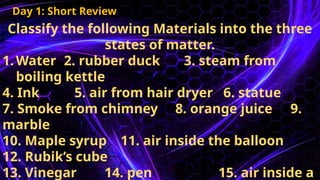
Classify the following Materials into the three
states of matter.
1. Water 2. rubber duck 3. steam from
boiling kettle
4. Ink 5. air from hair dryer 6. statue
7. Smoke from chimney 8. orange juice 9.
marble
10. Maple syrup 11. air inside the balloon
12. Rubik’s cube
13. Vinegar 14. pen 15. air inside a
Day 1: Short Review
You already know the different states of
matter. Do these states changes?
What do you think causes the change?
What is heat and how does it travel?
What is its effect on the different states of
matter?
Let us learn
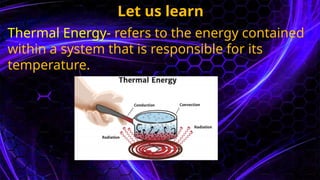
Thermal Energy- refers to the energy contained
within a system that is responsible for its
temperature.
Let us learn
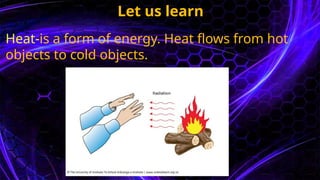
Heat-is a form of energy. Heat flows from hot
objects to cold objects.
Let us learn
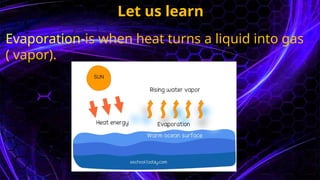
Evaporation-is when heat turns a liquid into gas
( vapor).
Let us learn
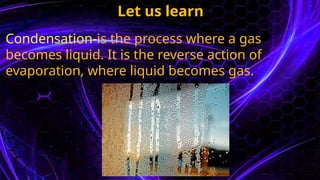
Condensation-is the process where a gas
becomes liquid. It is the reverse action of
evaporation, where liquid becomes gas.
Let us learn
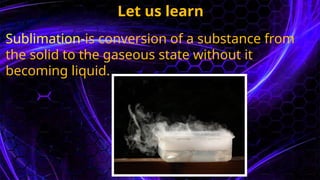
Sublimation-is conversion of a substance from
the solid to the gaseous state without it
becoming liquid.
Let us learn
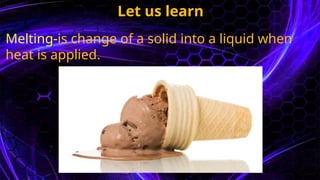
Melting-is change of a solid into a liquid when
heat is applied.
Let us learn
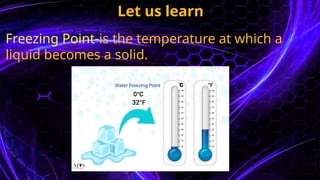
Freezing Point-is the temperature at which a
liquid becomes a solid.
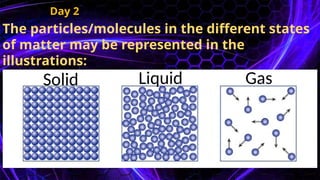
The particles/molecules in the different states
of matter may be represented in the
illustrations:
Which state of matter is shown in the picture?
Day 2
Solid Liquid Gas
When you think of the word heat, what comes
to your mind?
What do you think?
Remember: Heat is not a matter but is a form
of energy.
It is a type of energy known as thermal
energy. It is measured using a thermometer.
Energy can be transferred to and from
molecules through heat. A rise in temperature
causes atoms and molecules to move faster
What do you think will happen to the
molecules of the different states of matter
whenever heat is applied?
What happens to the state of matter when
heat is applied to the object?
Guide Questions

SCI .pptx

  • 1.
  • 2.
    Classify the followingMaterials into the three states of matter. 1. Water 2. rubber duck 3. steam from boiling kettle 4. Ink 5. air from hair dryer 6. statue 7. Smoke from chimney 8. orange juice 9. marble 10. Maple syrup 11. air inside the balloon 12. Rubik’s cube 13. Vinegar 14. pen 15. air inside a Day 1: Short Review
  • 3.
    You already knowthe different states of matter. Do these states changes? What do you think causes the change? What is heat and how does it travel? What is its effect on the different states of matter?
  • 4.
    Let us learn ThermalEnergy- refers to the energy contained within a system that is responsible for its temperature.
  • 5.
    Let us learn Heat-isa form of energy. Heat flows from hot objects to cold objects.
  • 6.
    Let us learn Evaporation-iswhen heat turns a liquid into gas ( vapor).
  • 7.
    Let us learn Condensation-isthe process where a gas becomes liquid. It is the reverse action of evaporation, where liquid becomes gas.
  • 8.
    Let us learn Sublimation-isconversion of a substance from the solid to the gaseous state without it becoming liquid.
  • 9.
    Let us learn Melting-ischange of a solid into a liquid when heat is applied.
  • 10.
    Let us learn FreezingPoint-is the temperature at which a liquid becomes a solid.
  • 11.
    The particles/molecules inthe different states of matter may be represented in the illustrations: Which state of matter is shown in the picture? Day 2 Solid Liquid Gas
  • 12.
    When you thinkof the word heat, what comes to your mind? What do you think? Remember: Heat is not a matter but is a form of energy. It is a type of energy known as thermal energy. It is measured using a thermometer. Energy can be transferred to and from molecules through heat. A rise in temperature causes atoms and molecules to move faster
  • 13.
    What do youthink will happen to the molecules of the different states of matter whenever heat is applied? What happens to the state of matter when heat is applied to the object? Guide Questions

Editor's Notes

  • #11 It isimportant for us to remember the arrangement of the molecules in the different states of matter so that it would be easy to understand the effect of heat on the different states of matter.
  • #12 It isimportant for us to remember the arrangement of the molecules in the different states of matter so that it would be easy to understand the effect of heat on the different states of matter.
  • #13 It isimportant for us to remember the arrangement of the molecules in the different states of matter so that it would be easy to understand the effect of heat on the different states of matter.