Introduction
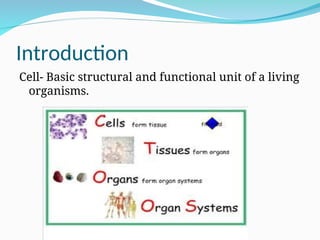
Cell- Basic structural and functional unit of a living
organisms.
Types of Organ Systems
 Digestive system
 Respiratory system
 Circulatory system
 Skeletal system
 Muscular system
 Excretory system
 Nervous system
 Reproductive system
Digestive system
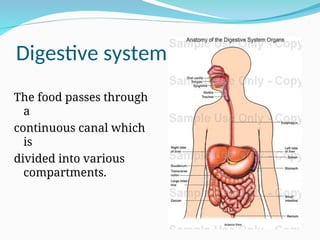
The food passes through
a
continuous canal which
is
divided into various
compartments.
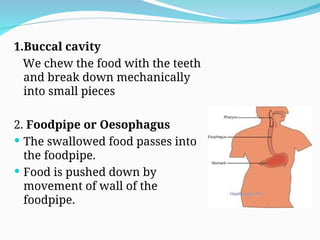
1.Buccal cavity
We chew the food with the teeth
and break down mechanically
into small pieces
2. Foodpipe or Oesophagus
 The swallowed food passes into
the foodpipe.
 Food is pushed down by
movement of wall of the
foodpipe.
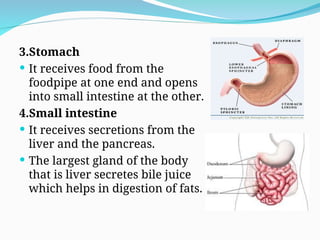
3.Stomach
 It receives food from the
foodpipe at one end and opens
into small intestine at the other.
4.Small intestine
 It receives secretions from the
liver and the pancreas.
 The largest gland of the body
that is liver secretes bile juice
which helps in digestion of fats.
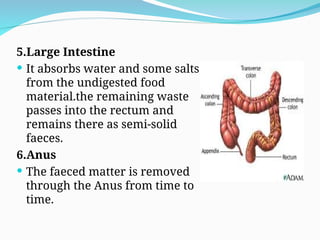
5.Large Intestine
 It absorbs water and some salts
from the undigested food
material.the remaining waste
passes into the rectum and
remains there as semi-solid
faeces.
6.Anus
 The faeced matter is removed
through the Anus from time to
time.
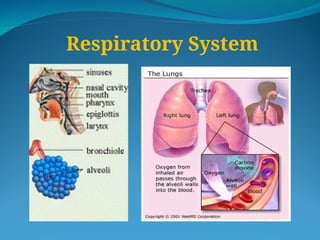
Respiratory System
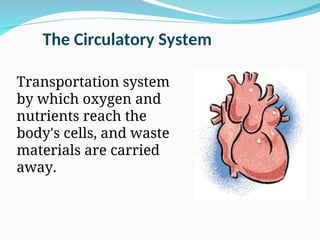
The Circulatory System
Transportation system
by which oxygen and
nutrients reach the
body's cells, and waste
materials are carried
away.
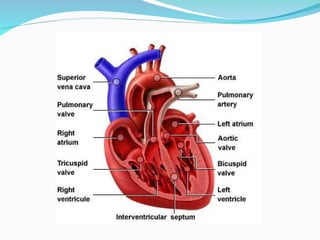
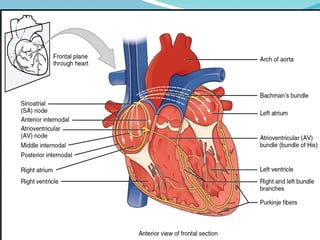
The Heart
 Size of your fist
 Thick muscular walls
 Divided into two pumps
 Each pump has two chambers
 Upper chamber - atrium receives blood coming
in from the veins
 Lower chamber - ventricle squeezes blood out
into the arteries
Blood
 Pumped by your heart.
 Travels through thousands of miles of blood
vessels
 Carries nutrients, water, oxygen and waste
products to and from your body cells.
 Made up of liquids, solids and small amounts of
oxygen and carbon dioxide.
Blood
 Red blood cells carry oxygen from the lungs to
all the cells of the body.
 Takes carbon dioxide and transports it back to
the lungs
 About 5,000,000 Red Blood Cells in ONE drop of
blood.
 White blood cells protect the body from germs
 Attack and destroy germs when they enter the
body
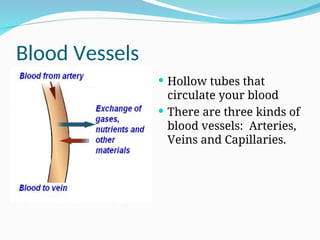
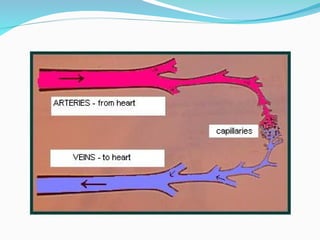
Blood Vessels
 Hollow tubes that
circulate your blood
 There are three kinds of
blood vessels: Arteries,
Veins and Capillaries.
3 Kinds of Circulation:
 Pulmonary circulation
 Coronary circulation
 Systemic circulation
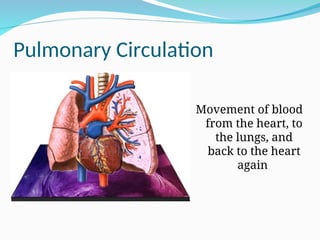
Pulmonary Circulation
Movement of blood
from the heart, to
the lungs, and
back to the heart
again
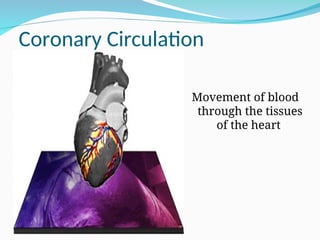
Coronary Circulation
Movement of blood
through the tissues
of the heart
Systemic Circulation
Supplies nourishment to all of the tissue located
throughout the body , except for the heart and
lungs
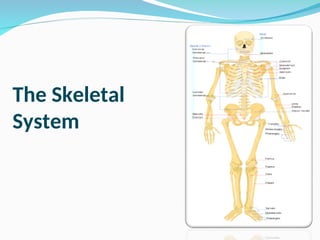
The Skeletal
System
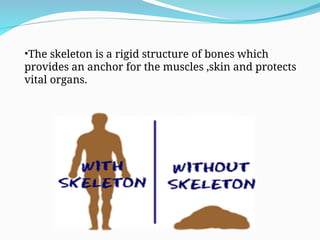
•The skeleton is a rigid structure of bones which
provides an anchor for the muscles ,skin and protects
vital organs.
•The human body has 206 bones as a
adult ,when you are born you have 300 bones.
•Over 230 moveable and semi-moveable joints in
your body.
•Bones are connected to each other by ligaments.
•Organs are protected by the skeleton.
•The brain is protected by skull
•The heart, liver and lungs are protected by the
rib and sternum.
The skull
 The skull or cranium is a protective cover of
the brain ,and provides a structure for the face
or head.
 The skull consists of 28 bones or vertebrae.
 The skull is made of many bones that are closely
fitted together.
Arms
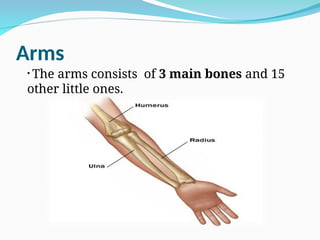
• The arms consists of 3 main bones and 15
other little ones.
The Spine
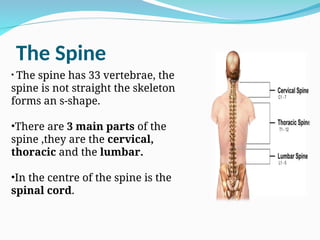
• The spine has 33 vertebrae, the
spine is not straight the skeleton
forms an s-shape.
•There are 3 main parts of the
spine ,they are the cervical,
thoracic and the lumbar.
•In the centre of the spine is the
spinal cord.
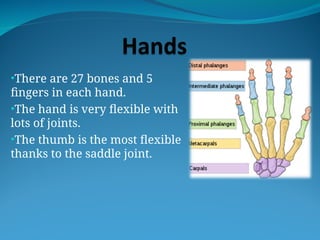
•There are 27 bones and 5
fingers in each hand.
•The hand is very flexible with
lots of joints.
•The thumb is the most flexible
thanks to the saddle joint.
What are bones made of?
• Bones are made of calcium, mineral salt, cells and living parts
your body.
• They are also made of stringlike material called the collagen.
• Bones have a red and yellow tube called the marrow.
• The marrow is a tube that makes red blood cells to replace the
destroyed and worn out ones.
• The marrow also stores fat and sugar.
• An average of 2.6 million red blood cells are made every
second by the marrow.
• The outer layer is called hard bone, the spongy bone is a
honeycomb of bones cells with spaces between them.
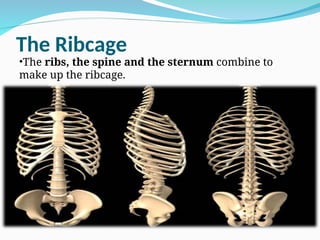
The Ribcage
•The ribs, the spine and the sternum combine to
make up the ribcage.
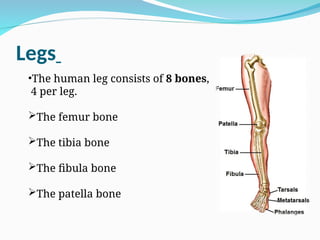
Legs
•The human leg consists of 8 bones,
4 per leg.
The femur bone
The tibia bone
The fibula bone
The patella bone
What are the possible diseases?
Osteoporosis Rickets
Arthritis
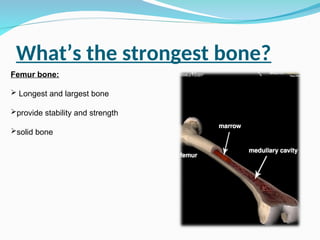
What’s the strongest bone?
Femur bone:
 Longest and largest bone
provide stability and strength
solid bone
Most sensitive bones
 Hips
 Shoulders
 Spine
 Thighs
 Sternum
 Skull
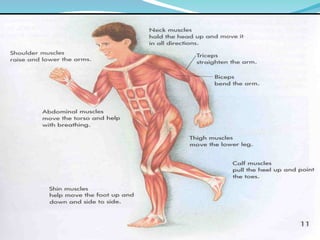
The Muscular
system
Specialized tissue that
enable the body and its
part to move.
Functions of the Muscles
 Movement
 Maintenance of postures and muscles
 Heat production
 Protect the bones and internal organs
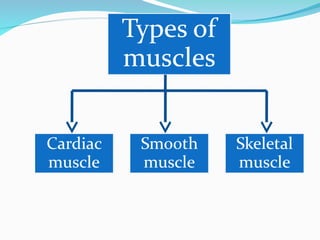
Cardiac Muscle
 Found ONLY in the heart.
 Contractions of the heart muscles pump blood
throughout the body and account for the
heartbeat.
 Healthy cardiac muscle NEVER fatigue.
Smooth Muscle
 They fatigue..But very slowly.
 Helps in circulation of the blood.
 Lining of blood vessels.
 Controls digestion.
 Controls breathing.
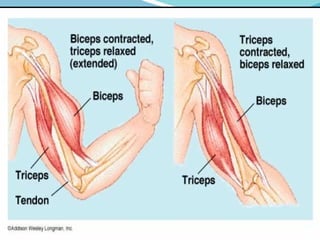
Skeletal Muscles
 Attached to skeleton by tendons.
 Causes movement of bones at the joints.
 They also do fatigue.
 Can be moved at will-Voluntarily.
 Fibers are long and cylindrical.
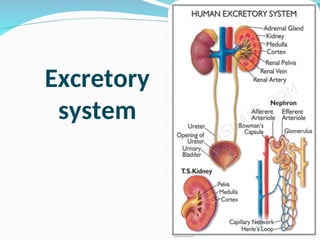
Excretory
system
 The process by which the unwanted substances
and metabolic wastes are eliminated from the
body.
 Various systems in the body are involved
 Digestive system excretes food residues in the
from of feces.
 Some bacteria and toxic substances also are
excreted through feces.
 Lungs remove carbon dioxide and water vapor.
 Skin excretes water, salts, and some wastes. It
also remove heat from the body.
 Liver excretes many substances like bile
pigments, heavy metals, drugs, toxins, bacteria
etc though bile.
 Although various organs are involved in removal
of wastes from the body, their excretory capacity
is limited.
 The renal system or urinary system is the one
having maximum capacity of excretory function
and so, it plays the major role.
Process of urinary system
 Kidneys produce the urine.
 Ureters transports the urine to urinary bladder.
 Urinary bladder stores the urine until it is
voided.
 Urine is voided from bladder through urethra.
Renal System
 Renal system includes:
 1) pair of kidneys
 2) urethras
 3) urinary bladder
 4) urethra
 Skin, liver, lung, large intestine are also part of
excretory system.
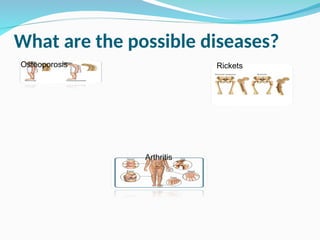
SKIN
 SKIN useful to maintain body temperature.
 Excess heat is lost from the body through skin by
radiation, conduction. Sweat glands of the skin
play active part in heat loss by secreting sweat.
 Skin can excrete small quantities of wast
material.

SCi 7 Human Body organ system and their Function.ppt

  • 2.
    Introduction Cell- Basic structuraland functional unit of a living organisms.
  • 3.
    Types of OrganSystems  Digestive system  Respiratory system  Circulatory system  Skeletal system  Muscular system  Excretory system  Nervous system  Reproductive system
  • 4.
    Digestive system The foodpasses through a continuous canal which is divided into various compartments.
  • 5.
    1.Buccal cavity We chewthe food with the teeth and break down mechanically into small pieces 2. Foodpipe or Oesophagus  The swallowed food passes into the foodpipe.  Food is pushed down by movement of wall of the foodpipe.
  • 6.
    3.Stomach  It receivesfood from the foodpipe at one end and opens into small intestine at the other. 4.Small intestine  It receives secretions from the liver and the pancreas.  The largest gland of the body that is liver secretes bile juice which helps in digestion of fats.
  • 7.
    5.Large Intestine  Itabsorbs water and some salts from the undigested food material.the remaining waste passes into the rectum and remains there as semi-solid faeces. 6.Anus  The faeced matter is removed through the Anus from time to time.
  • 8.
  • 9.
    The Circulatory System Transportationsystem by which oxygen and nutrients reach the body's cells, and waste materials are carried away.
  • 11.
    The Heart  Sizeof your fist  Thick muscular walls  Divided into two pumps  Each pump has two chambers  Upper chamber - atrium receives blood coming in from the veins  Lower chamber - ventricle squeezes blood out into the arteries
  • 13.
    Blood  Pumped byyour heart.  Travels through thousands of miles of blood vessels  Carries nutrients, water, oxygen and waste products to and from your body cells.  Made up of liquids, solids and small amounts of oxygen and carbon dioxide.
  • 14.
    Blood  Red bloodcells carry oxygen from the lungs to all the cells of the body.  Takes carbon dioxide and transports it back to the lungs  About 5,000,000 Red Blood Cells in ONE drop of blood.  White blood cells protect the body from germs  Attack and destroy germs when they enter the body
  • 15.
    Blood Vessels  Hollowtubes that circulate your blood  There are three kinds of blood vessels: Arteries, Veins and Capillaries.
  • 17.
    3 Kinds ofCirculation:  Pulmonary circulation  Coronary circulation  Systemic circulation
  • 18.
    Pulmonary Circulation Movement ofblood from the heart, to the lungs, and back to the heart again
  • 19.
    Coronary Circulation Movement ofblood through the tissues of the heart
  • 20.
    Systemic Circulation Supplies nourishmentto all of the tissue located throughout the body , except for the heart and lungs
  • 21.
  • 22.
    •The skeleton isa rigid structure of bones which provides an anchor for the muscles ,skin and protects vital organs.
  • 23.
    •The human bodyhas 206 bones as a adult ,when you are born you have 300 bones. •Over 230 moveable and semi-moveable joints in your body. •Bones are connected to each other by ligaments. •Organs are protected by the skeleton. •The brain is protected by skull •The heart, liver and lungs are protected by the rib and sternum.
  • 24.
    The skull  Theskull or cranium is a protective cover of the brain ,and provides a structure for the face or head.  The skull consists of 28 bones or vertebrae.  The skull is made of many bones that are closely fitted together.
  • 25.
    Arms • The armsconsists of 3 main bones and 15 other little ones.
  • 26.
    The Spine • Thespine has 33 vertebrae, the spine is not straight the skeleton forms an s-shape. •There are 3 main parts of the spine ,they are the cervical, thoracic and the lumbar. •In the centre of the spine is the spinal cord.
  • 27.
    •There are 27bones and 5 fingers in each hand. •The hand is very flexible with lots of joints. •The thumb is the most flexible thanks to the saddle joint.
  • 28.
    What are bonesmade of? • Bones are made of calcium, mineral salt, cells and living parts your body. • They are also made of stringlike material called the collagen. • Bones have a red and yellow tube called the marrow. • The marrow is a tube that makes red blood cells to replace the destroyed and worn out ones. • The marrow also stores fat and sugar. • An average of 2.6 million red blood cells are made every second by the marrow. • The outer layer is called hard bone, the spongy bone is a honeycomb of bones cells with spaces between them.
  • 29.
    The Ribcage •The ribs,the spine and the sternum combine to make up the ribcage.
  • 30.
    Legs •The human legconsists of 8 bones, 4 per leg. The femur bone The tibia bone The fibula bone The patella bone
  • 31.
    What are thepossible diseases? Osteoporosis Rickets Arthritis
  • 32.
    What’s the strongestbone? Femur bone:  Longest and largest bone provide stability and strength solid bone
  • 33.
    Most sensitive bones Hips  Shoulders  Spine  Thighs  Sternum  Skull
  • 34.
    The Muscular system Specialized tissuethat enable the body and its part to move.
  • 35.
    Functions of theMuscles  Movement  Maintenance of postures and muscles  Heat production  Protect the bones and internal organs
  • 37.
    Cardiac Muscle  FoundONLY in the heart.  Contractions of the heart muscles pump blood throughout the body and account for the heartbeat.  Healthy cardiac muscle NEVER fatigue.
  • 39.
    Smooth Muscle  Theyfatigue..But very slowly.  Helps in circulation of the blood.  Lining of blood vessels.  Controls digestion.  Controls breathing.
  • 41.
    Skeletal Muscles  Attachedto skeleton by tendons.  Causes movement of bones at the joints.  They also do fatigue.  Can be moved at will-Voluntarily.  Fibers are long and cylindrical.
  • 43.
  • 44.
     The processby which the unwanted substances and metabolic wastes are eliminated from the body.  Various systems in the body are involved  Digestive system excretes food residues in the from of feces.  Some bacteria and toxic substances also are excreted through feces.
  • 45.
     Lungs removecarbon dioxide and water vapor.  Skin excretes water, salts, and some wastes. It also remove heat from the body.  Liver excretes many substances like bile pigments, heavy metals, drugs, toxins, bacteria etc though bile.
  • 46.
     Although variousorgans are involved in removal of wastes from the body, their excretory capacity is limited.  The renal system or urinary system is the one having maximum capacity of excretory function and so, it plays the major role.
  • 47.
    Process of urinarysystem  Kidneys produce the urine.  Ureters transports the urine to urinary bladder.  Urinary bladder stores the urine until it is voided.  Urine is voided from bladder through urethra.
  • 49.
    Renal System  Renalsystem includes:  1) pair of kidneys  2) urethras  3) urinary bladder  4) urethra  Skin, liver, lung, large intestine are also part of excretory system.
  • 50.
    SKIN  SKIN usefulto maintain body temperature.  Excess heat is lost from the body through skin by radiation, conduction. Sweat glands of the skin play active part in heat loss by secreting sweat.  Skin can excrete small quantities of wast material.