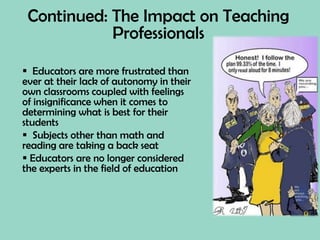
School Reform ProjectCritical Analysis of Schools and Educational PracticeESED 9132Spring 2010Cathy Griffin
Three Major IssuesClosing the Achievement Gap & No Child Left Behind Act AccountabilityStandardized Testing
Where’s the Gap?Between white and minority children.
NCLB Truths and Consequences
Is NCLB Legislation the Solution?Key Factors of Concern Regarding NCLB Legislation  The goal has been set that by the year 2014 the achievement gap will no longer exist
  High-stakes standardized testing has been implemented to monitor student achievement
  Free tutoring must be offered by schools that do not meet NCLB standards.
  Federal funding will be provided to support research-based teaching strategies
  More choices for parents will be offered for students who attend schools that do not meet NCLB standards(No Child Left Behind Act of 2001, 2001)
Pros, Cons & Alternatives of NCLB?Pros:  Improved test scores since implementation
  Decreases in achievement gap
  Increases in highly qualified teachers
  Additional testing has helped to identify low-performing 	students
  Increases in the number of schools attaining AYP status.(Ramsay, 2008), (No Child Left Behind's 5th Anniversary, 2007),  (Jehlen, 2007)
Pros, Cons & Alternatives of NCLB?Cons:  Program funding is lacking each year
  Multiple choice testing is the only measure of student performance
  Since math and reading are the target areas, other subject areas are being neglected
  Teachers are being forced to tech to the test
  Educators are punished for working in high-risk schools
  All students regardless of their native language or ability level are held to the same standards(Ramsay, 2008), (No Child Left Behind's 5th Anniversary, 2007),  (Jehlen, 2007)
Pros, Cons & Alternatives of NCLB?Alternatives:  Provide multiple assessment criteria to allow students to show mastery and achievement
  Smaller class sizes
  Support programs that encourage parental and community involvement
  Acknowledge educators who show significant gains in student achievement(Ramsay, 2008), (No Child Left Behind's 5th Anniversary, 2007),  (Jehlen, 2007)
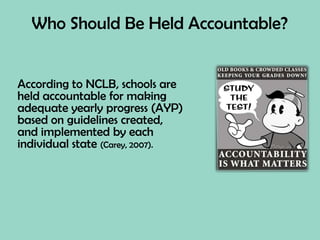
Who Should Be Held Accountable?According to NCLB, schools are held accountable for making adequate yearly progress (AYP) based on guidelines created, and implemented by each individual state (Carey, 2007).
Pros, Cons & Alternatives ~ AccountabilityPros:    Disaggregation of data by subgroups helps schools to center attention on problem areas
  School systems are being forced to take a closer look at their low-performing students and design new programs to assist with closing the achievement gap
  School systems are required to publish their accountability reports which keeps the community informed(Carey, 2007)
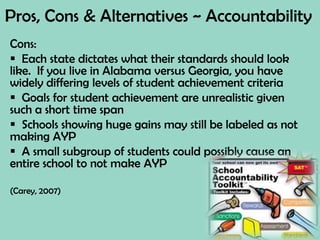
Pros, Cons & Alternatives ~ AccountabilityCons:    Each state dictates what their standards should look like.  If you live in Alabama versus Georgia, you have widely differing levels of student achievement criteria
  Goals for student achievement are unrealistic given such a short time span
  Schools showing huge gains may still be labeled as not making AYP
  A small subgroup of students could possibly cause an entire school to not make AYP(Carey, 2007)
Pros, Cons & Alternatives ~ AccountabilityAlternatives:    Instead of tracking students from one grade to the next longitudinally, a successive comparison.  For example comparing 6th grade students from 2009 to 6th grade students from 2010 would be more informative (Linn, 2005).
  Standardize minimum requirements for state standards
  Create attainable goals
  Create accountability measures that include achievement gains.(Carey, 2007)
Standardized Testing as the ONLY Determining Factor in Student Achievement.Definition:  “Standardized Test – a form of measure that has been normed against a specific population” (A Glossary of Measurement Terms, ERIC Digest, 1989)
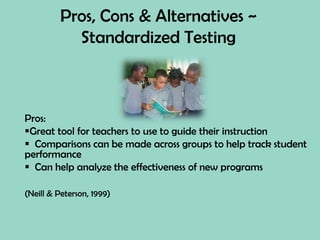
Pros, Cons & Alternatives ~ Standardized TestingPros:  Great tool for teachers to use to guide their instruction

School reform project vs2

  • 1.
    School Reform ProjectCriticalAnalysis of Schools and Educational PracticeESED 9132Spring 2010Cathy Griffin
  • 2.
    Three Major IssuesClosingthe Achievement Gap & No Child Left Behind Act AccountabilityStandardized Testing
  • 3.
    Where’s the Gap?Betweenwhite and minority children.
  • 4.
    NCLB Truths andConsequences
  • 5.
    Is NCLB Legislationthe Solution?Key Factors of Concern Regarding NCLB Legislation The goal has been set that by the year 2014 the achievement gap will no longer exist
  • 6.
    High-stakesstandardized testing has been implemented to monitor student achievement
  • 7.
    Freetutoring must be offered by schools that do not meet NCLB standards.
  • 8.
    Federalfunding will be provided to support research-based teaching strategies
  • 9.
    Morechoices for parents will be offered for students who attend schools that do not meet NCLB standards(No Child Left Behind Act of 2001, 2001)
  • 10.
    Pros, Cons &Alternatives of NCLB?Pros: Improved test scores since implementation
  • 11.
    Decreasesin achievement gap
  • 12.
    Increasesin highly qualified teachers
  • 13.
    Additionaltesting has helped to identify low-performing students
  • 14.
    Increasesin the number of schools attaining AYP status.(Ramsay, 2008), (No Child Left Behind's 5th Anniversary, 2007), (Jehlen, 2007)
  • 15.
    Pros, Cons &Alternatives of NCLB?Cons: Program funding is lacking each year
  • 16.
    Multiplechoice testing is the only measure of student performance
  • 17.
    Sincemath and reading are the target areas, other subject areas are being neglected
  • 18.
    Teachersare being forced to tech to the test
  • 19.
    Educatorsare punished for working in high-risk schools
  • 20.
    Allstudents regardless of their native language or ability level are held to the same standards(Ramsay, 2008), (No Child Left Behind's 5th Anniversary, 2007), (Jehlen, 2007)
  • 21.
    Pros, Cons &Alternatives of NCLB?Alternatives: Provide multiple assessment criteria to allow students to show mastery and achievement
  • 22.
    Smallerclass sizes
  • 23.
    Supportprograms that encourage parental and community involvement
  • 24.
    Acknowledgeeducators who show significant gains in student achievement(Ramsay, 2008), (No Child Left Behind's 5th Anniversary, 2007), (Jehlen, 2007)
  • 25.
    Who Should BeHeld Accountable?According to NCLB, schools are held accountable for making adequate yearly progress (AYP) based on guidelines created, and implemented by each individual state (Carey, 2007).
  • 26.
    Pros, Cons &Alternatives ~ AccountabilityPros: Disaggregation of data by subgroups helps schools to center attention on problem areas
  • 27.
    Schoolsystems are being forced to take a closer look at their low-performing students and design new programs to assist with closing the achievement gap
  • 28.
    Schoolsystems are required to publish their accountability reports which keeps the community informed(Carey, 2007)
  • 29.
    Pros, Cons &Alternatives ~ AccountabilityCons: Each state dictates what their standards should look like. If you live in Alabama versus Georgia, you have widely differing levels of student achievement criteria
  • 30.
    Goalsfor student achievement are unrealistic given such a short time span
  • 31.
    Schoolsshowing huge gains may still be labeled as not making AYP
  • 32.
    Asmall subgroup of students could possibly cause an entire school to not make AYP(Carey, 2007)
  • 33.
    Pros, Cons &Alternatives ~ AccountabilityAlternatives: Instead of tracking students from one grade to the next longitudinally, a successive comparison. For example comparing 6th grade students from 2009 to 6th grade students from 2010 would be more informative (Linn, 2005).
  • 34.
    Standardizeminimum requirements for state standards
  • 35.
    Createattainable goals
  • 36.
    Createaccountability measures that include achievement gains.(Carey, 2007)
  • 37.
    Standardized Testing asthe ONLY Determining Factor in Student Achievement.Definition: “Standardized Test – a form of measure that has been normed against a specific population” (A Glossary of Measurement Terms, ERIC Digest, 1989)
  • 38.
    Pros, Cons &Alternatives ~ Standardized TestingPros: Great tool for teachers to use to guide their instruction