Instruction Essentials for
Emerging Readers
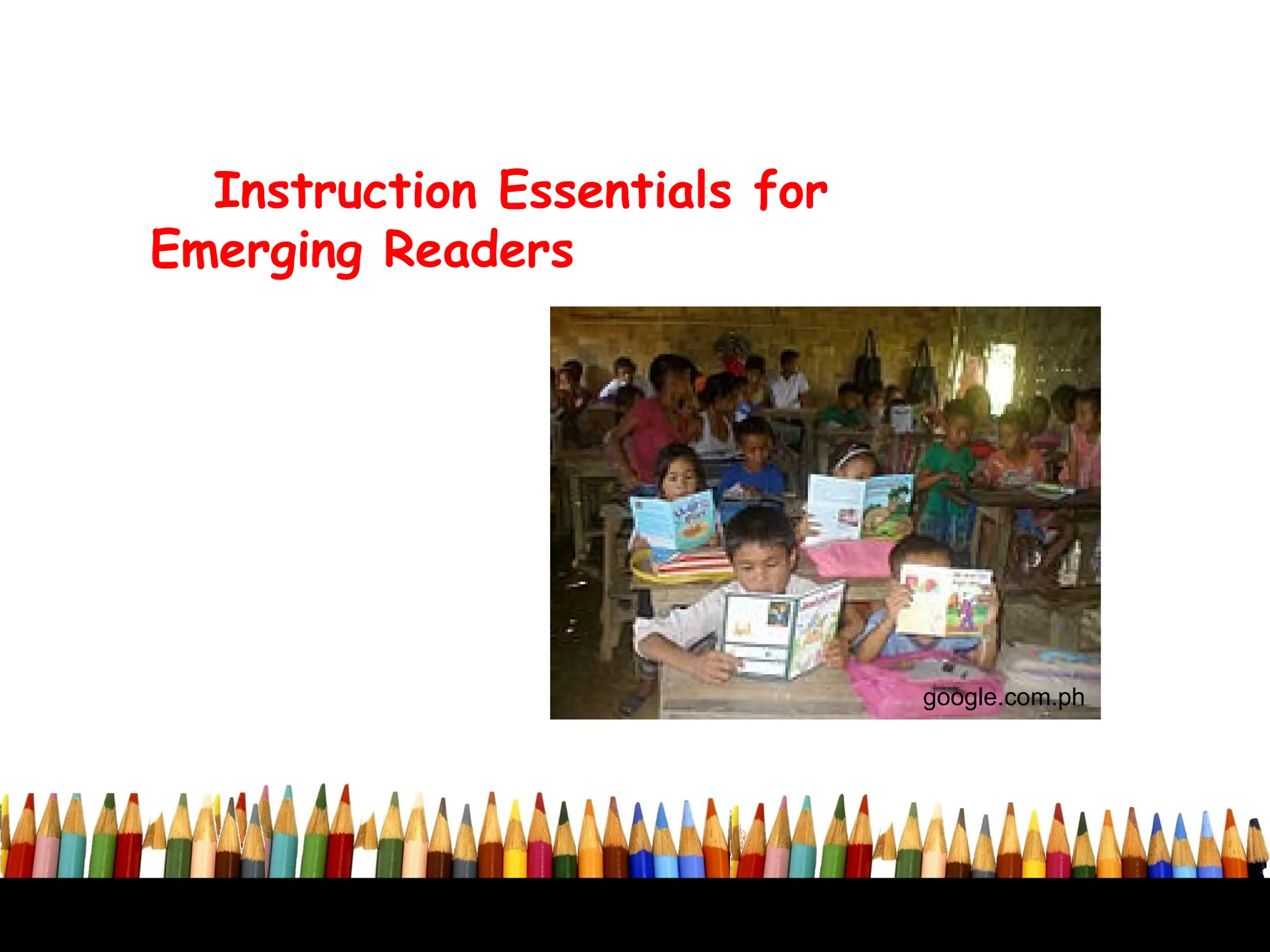
google.com.ph
Children who do not want to participate may
engage in quiet activities away from the group
so long as they do not disturb others. This
expectation of course varies according to the
age and developmental abilities of children.
Developmentally Appropriate Practice
we can apply :
Instruction Essentials for
Emerging Readers
Should I require
all the children to
participate in the
activity?
Literacy work stations are
opportunities for small group time.
While it is critical that everyone must
participate and our goal is for
everyone to get involved, not all are
required.
Consequently younger and/or less experienced
children may have more flexibility than the
older or experienced children, whichever it has
to be consistent so that children know which
behavior demonstrate compliance.
Developmentally Appropriate Practice
we can apply :
Instruction Essentials for
Emerging Readers
How can I
facilitate
conversation
among
children?
Using discussion as a strategies
assures reciprocal interactions among the
teacher and the children. Teacher talks to
the children by using invitations, reflections,
questions and statements, this is guided
conversation that encourages children to
express themselves and communicate their
ideas aloud.
Engaging children in conversation is one of the
main purpose of literacy station hence “NO
TALKING” Rule must not be enforced.
Teachers can help children to learn skills
associated with the art of conversation.
Remind them about oral turn
taking, paraphrasing one
child’s words to another child
and help them relate their
response to the idea
expressed by their peers.
These are ways to enhance
children’s conversational
abilities and can be practiced
by prompting discussion with
open-ended questions. We can see children talk as much as, if
not more than, their teacher.
Developmentally Appropriate
Practice we can apply :
Instruction Essentials for
Emerging Readers
What should I
do when children
interrupt a story or
a presentation?
The best way to avoid interruption
is to make sure children are
comfortable and in a good position
to see and hear before you begin.
Another strategy is to tell children
before you begin that they will have
a chance to talk when you are
finished.
However, children who make a connection between what you are
doing and their own lives may find waiting too difficult.
This prevents
complaints of “I
can’t see” or
“Teacher, she’s
squishing me.”
Developmentally Appropriate
Practice we can apply :
Instruction Essentials for
Emerging Readers
What can be
done to support
easily distractible
children?
If there is difficulty paying attention, it may be
a sign that time has gone too long or that the
content is not relevant or engaging
In these situations revise
your plan on the spot and
rethink them for the future.
However, if only one or two children
consistently have difficulty remaining
focused, more targeted techniques are
advisable.
Developmentally Appropriate
Practice we can apply :
Instruction Essentials for
Emerging Readers
What can be
done to support
easily distractible
children?
Break the larger group into
smaller
groups so that easily distractible
children have more opportunities
for personal attention, less
waiting, and fewer competing
stimuli with which to cope.
The following are strategies to help
children be more successful and get
the most out of the class activity:
Tell the children what
will be happening
before you begin.
Have easily distractible children sit near adults who
can cue them as necessary.
Use scaffolding to
help the child function
more independently with
the group.
Give the child
something for which to
watch or listen or give
the child something to
do in a the group e.g.
turn pages
Ask the child to begin
by participating in the
group and then allow
him or her to leave
group time midway
through and work
quietly nearby.
Gradually increase the
amount of time the child
stays
with the group
If no other adult is available, the child could sit
within arm’s length of the teacher to see and
hear more clearly, without being the center of
attention
School Instruction for Emerging Readers.ppt

  • 1.
  • 2.
    Children who donot want to participate may engage in quiet activities away from the group so long as they do not disturb others. This expectation of course varies according to the age and developmental abilities of children. Developmentally Appropriate Practice we can apply : Instruction Essentials for Emerging Readers Should I require all the children to participate in the activity? Literacy work stations are opportunities for small group time. While it is critical that everyone must participate and our goal is for everyone to get involved, not all are required. Consequently younger and/or less experienced children may have more flexibility than the older or experienced children, whichever it has to be consistent so that children know which behavior demonstrate compliance.
  • 3.
    Developmentally Appropriate Practice wecan apply : Instruction Essentials for Emerging Readers How can I facilitate conversation among children? Using discussion as a strategies assures reciprocal interactions among the teacher and the children. Teacher talks to the children by using invitations, reflections, questions and statements, this is guided conversation that encourages children to express themselves and communicate their ideas aloud. Engaging children in conversation is one of the main purpose of literacy station hence “NO TALKING” Rule must not be enforced. Teachers can help children to learn skills associated with the art of conversation. Remind them about oral turn taking, paraphrasing one child’s words to another child and help them relate their response to the idea expressed by their peers. These are ways to enhance children’s conversational abilities and can be practiced by prompting discussion with open-ended questions. We can see children talk as much as, if not more than, their teacher.
  • 4.
    Developmentally Appropriate Practice wecan apply : Instruction Essentials for Emerging Readers What should I do when children interrupt a story or a presentation? The best way to avoid interruption is to make sure children are comfortable and in a good position to see and hear before you begin. Another strategy is to tell children before you begin that they will have a chance to talk when you are finished. However, children who make a connection between what you are doing and their own lives may find waiting too difficult. This prevents complaints of “I can’t see” or “Teacher, she’s squishing me.”
  • 5.
    Developmentally Appropriate Practice wecan apply : Instruction Essentials for Emerging Readers What can be done to support easily distractible children? If there is difficulty paying attention, it may be a sign that time has gone too long or that the content is not relevant or engaging In these situations revise your plan on the spot and rethink them for the future. However, if only one or two children consistently have difficulty remaining focused, more targeted techniques are advisable.
  • 6.
    Developmentally Appropriate Practice wecan apply : Instruction Essentials for Emerging Readers What can be done to support easily distractible children? Break the larger group into smaller groups so that easily distractible children have more opportunities for personal attention, less waiting, and fewer competing stimuli with which to cope. The following are strategies to help children be more successful and get the most out of the class activity: Tell the children what will be happening before you begin. Have easily distractible children sit near adults who can cue them as necessary. Use scaffolding to help the child function more independently with the group. Give the child something for which to watch or listen or give the child something to do in a the group e.g. turn pages Ask the child to begin by participating in the group and then allow him or her to leave group time midway through and work quietly nearby. Gradually increase the amount of time the child stays with the group If no other adult is available, the child could sit within arm’s length of the teacher to see and hear more clearly, without being the center of attention