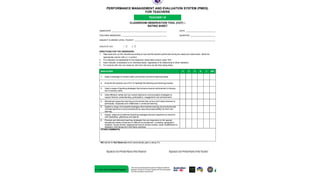
This tool wasdeveloped through the Philippine National
Research Center for Teacher Quality (RCTQ) with support
from the Australian Government
S.Y. 2024-2025 | Proficient Teacher
TEACHER I-III
PERFORMANCE MANAGEMENT AND EVALUATION SYSTEM (PMES)
FOR TEACHERS
CLASSROOM OBSERVATION TOOL (COT) –
RATING SHEET
OBSERVER: DATE:
TEACHER OBSERVED: QUARTER:
SUBJECT & GRADE LEVEL TAUGHT:
OBSERVATION: 1 □ 2 □
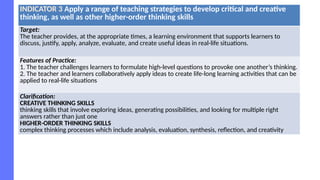
DIRECTIONS FOR THE OBSERVERS:
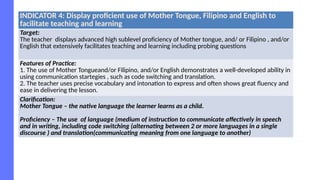
1. Rate each item on the checklist according to how well the teacher performed during the classroom observation. Mark the
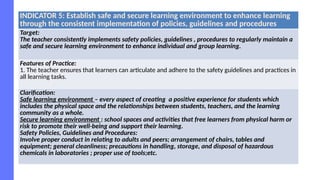
appropriate column with a (✓) symbol.
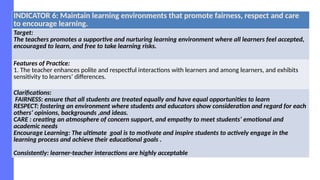
2. For indicators not applicable for the classroom observation period, place ‘N/A’.
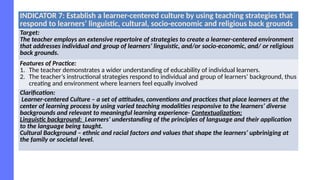
3. Each indicator is assessed on an individual basis, regardless of its relationship to other indicators.
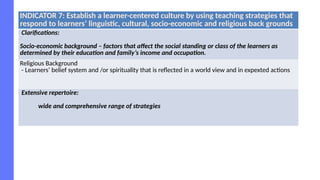
4. For schools with only one observer, this form will serve as the final rating sheet.
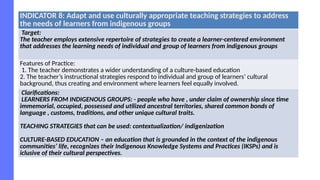
INDICATORS 3 4 5 6 7 NO*
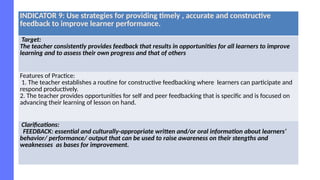
1. Apply knowledge of content within and across curriculum teaching areas
2. Ensured the positive use of ICT to facilitate the teaching and learning process.
3. Used a range of teaching strategies that enhance learner achievement in literacy
and numeracy skills.
4. Used effective verbal and non-verbal classroom communication strategies to
support learner understanding, participation, engagement and achievement.
5. Maintained supportive learning environments that nurture and inspire learners to
participate, cooperate and collaborate in continued learning.
6. Applied a range of successful strategies that maintain learning environments that
motivate learners to work productively by assuming responsibility for their own
learning.
7. Design, adapt and implement teaching strategies that are responsive to learners
with disabilities, giftedness and talents.
8. Planned and delivered teaching strategies that are responsive to the special
educational needs of learners in difficult circumstances*, including: geographic
isolation; chronic illness; displacement due to armed conflict, urban resettlement or
disasters; child abuse and child labor practices.
OTHER COMMENTS:
* NO stands for Not Observed which automatically gets a rating of 3.
Signature over Printed Name of the Observer Signature over Printed Name of the Teacher
3.
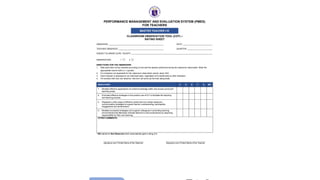
MASTER TEACHER I-IV
PERFORMANCEMANAGEMENT AND EVALUATION SYSTEM (PMES)
FOR TEACHERS
CLASSROOM OBSERVATION TOOL (COT) –
RATING SHEET
OBSERVER: DATE:
TEACHER OBSERVED: QUARTER:
SUBJECT & GRADE LEVEL TAUGHT:
OBSERVATION: 1 □ 2 □
DIRECTIONS FOR THE OBSERVERS:
1. Rate each item on the checklist according to how well the teacher performed during the classroom observation. Mark the
appropriate column with a (✓) symbol.
2. For indicators not applicable for the classroom observation period, place ‘N/A’.
3. Each indicator is assessed on an individual basis, regardless of its relationship to other indicators.
4. For schools with only one observer, this form will serve as the final rating sheet.
INDICATORS 4 5 6 7 8 NO*
1. Modeled effective applications of content knowledge within and across curriculum
teaching areas.
2. Promoted effective strategies in the positive use of ICT to facilitate the teaching
and learning process.
3. Displayed a wide range of effective verbal and non-verbal classroom
communication strategies to support learner understanding, participation,
engagement and achievement.
4. Modeled successful strategies and support colleagues in promoting learning
environments that effectively motivate learners to work productively by assuming
responsibility for their own learning.
OTHER COMMENTS:
* NO stands for Not Observed which automatically gets a rating of 4.
Signature over Printed Name of the Observer Signature over Printed Name of the Teacher
4.
Applied knowledge of
contentwithin and
across curriculum
teaching areas
in accordance with DepEd Memo 17, s. 2025
Guidelines on the RPMS -PPST
INDICATOR 1
5.
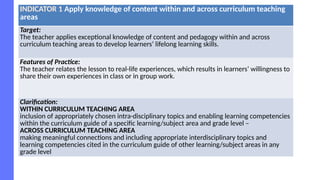
INDICATOR 1 Applyknowledge of content within and across curriculum teaching
areas
Target:
The teacher applies exceptional knowledge of content and pedagogy within and across
curriculum teaching areas to develop learners’ lifelong learning skills.
Features of Practice:
The teacher relates the lesson to real-life experiences, which results in learners’ willingness to
share their own experiences in class or in group work.
Clarification:
WITHIN CURRICULUM TEACHING AREA
inclusion of appropriately chosen intra-disciplinary topics and enabling learning competencies
within the curriculum guide of a specific learning/subject area and grade level –
ACROSS CURRICULUM TEACHING AREA
making meaningful connections and including appropriate interdisciplinary topics and
learning competencies cited in the curriculum guide of other learning/subject areas in any
grade level
6.
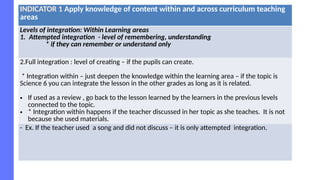
INDICATOR 1 Applyknowledge of content within and across curriculum teaching
areas
Levels of integration: Within Learning areas
1. Attempted integration - level of remembering, understanding
* if they can remember or understand only
2.Full integration : level of creating – if the pupils can create.
* Integration within – just deepen the knowledge within the learning area – if the topic is
Science 6 you can integrate the lesson in the other grades as long as it is related.
• If used as a review , go back to the lesson learned by the learners in the previous levels
connected to the topic.
• * Integration within happens if the teacher discussed in her topic as she teaches. It is not
because she used materials.
- Ex. If the teacher used a song and did not discuss – it is only attempted integration.
7.
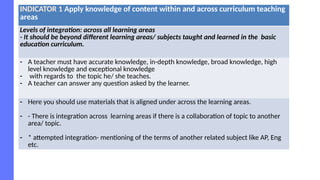
INDICATOR 1 Applyknowledge of content within and across curriculum teaching
areas
Levels of integration: across all learning areas
- It should be beyond different learning areas/ subjects taught and learned in the basic
education curriculum.
- A teacher must have accurate knowledge, in-depth knowledge, broad knowledge, high
level knowledge and exceptional knowledge
- with regards to the topic he/ she teaches.
- A teacher can answer any question asked by the learner.
- Here you should use materials that is aligned under across the learning areas.
- - There is integration across learning areas if there is a collaboration of topic to another
area/ topic.
- * attempted integration- mentioning of the terms of another related subject like AP, Eng
etc.
8.
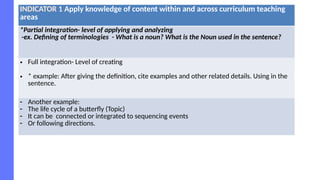
INDICATOR 1 Applyknowledge of content within and across curriculum teaching
areas
*Partial integration- level of applying and analyzing
-ex. Defining of terminologies - What is a noun? What is the Noun used in the sentence?
• Full integration- Level of creating
• * example: After giving the definition, cite examples and other related details. Using in the
sentence.
- Another example:
- The life cycle of a butterfly (Topic)
- It can be connected or integrated to sequencing events
- Or following directions.
9.
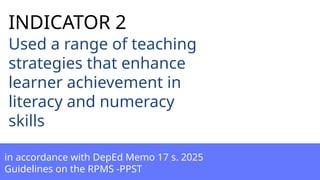
Used a rangeof teaching
strategies that enhance
learner achievement in
literacy and numeracy
skills
in accordance with DepEd Memo 17 s. 2025
Guidelines on the RPMS -PPST
INDICATOR 2
10.
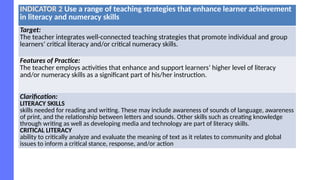
INDICATOR 2 Usea range of teaching strategies that enhance learner achievement
in literacy and numeracy skills
Target:
The teacher integrates well-connected teaching strategies that promote individual and group
learners’ critical literacy and/or critical numeracy skills.
Features of Practice:
The teacher employs activities that enhance and support learners’ higher level of literacy
and/or numeracy skills as a significant part of his/her instruction.
Clarification:
LITERACY SKILLS
skills needed for reading and writing. These may include awareness of sounds of language, awareness
of print, and the relationship between letters and sounds. Other skills such as creating knowledge
through writing as well as developing media and technology are part of literacy skills.
CRITICAL LITERACY
ability to critically analyze and evaluate the meaning of text as it relates to community and global
issues to inform a critical stance, response, and/or action
11.
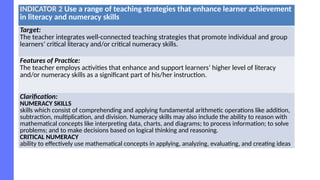
INDICATOR 2 Usea range of teaching strategies that enhance learner achievement
in literacy and numeracy skills
Target:
The teacher integrates well-connected teaching strategies that promote individual and group
learners’ critical literacy and/or critical numeracy skills.
Features of Practice:
The teacher employs activities that enhance and support learners’ higher level of literacy
and/or numeracy skills as a significant part of his/her instruction.
Clarification:
NUMERACY SKILLS
skills which consist of comprehending and applying fundamental arithmetic operations like addition,
subtraction, multiplication, and division. Numeracy skills may also include the ability to reason with
mathematical concepts like interpreting data, charts, and diagrams; to process information; to solve
problems; and to make decisions based on logical thinking and reasoning.
CRITICAL NUMERACY
ability to effectively use mathematical concepts in applying, analyzing, evaluating, and creating ideas
12.
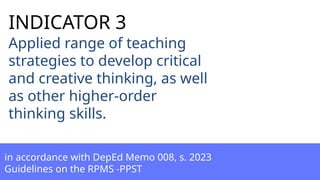
Applied range ofteaching
strategies to develop critical
and creative thinking, as well
as other higher-order
thinking skills.
in accordance with DepEd Memo 008, s. 2023
Guidelines on the RPMS -PPST
INDICATOR 3
13.
INDICATOR 3 Applya range of teaching strategies to develop critical and creative
thinking, as well as other higher-order thinking skills
Target:
The teacher provides, at the appropriate times, a learning environment that supports learners to
discuss, justify, apply, analyze, evaluate, and create useful ideas in real-life situations.
Features of Practice:
1. The teacher challenges learners to formulate high-level questions to provoke one another’s thinking.
2. The teacher and learners collaboratively apply ideas to create life-long learning activities that can be
applied to real-life situations
Clarification:
CREATIVE THINKING SKILLS
thinking skills that involve exploring ideas, generating possibilities, and looking for multiple right
answers rather than just one
HIGHER-ORDER THINKING SKILLS
complex thinking processes which include analysis, evaluation, synthesis, reflection, and creativity
14.
INDICATOR 4: Displayproficient use of Mother Tongue, Filipino and English to
facilitate teaching and learning
Target:
The teacher displays advanced high sublevel proficiency of Mother tongue, and/ or Filipino , and/or
English that extensively facilitates teaching and learning including probing questions
Features of Practice:
1. The use of Mother Tongueand/or Filipino, and/or English demonstrates a well-developed ability in
using communication startegies , such as code switching and translation.
2. The teacher uses precise vocabulary and intonation to express and often shows great fluency and
ease in delivering the lesson.
Clarification:
Mother Tongue – the native language the learner learns as a child.
Proficiency – The use of language (medium of instruction to communicate affectively in speech
and in writing, including code switching (alternating between 2 or more languages in a single
discourse ) and translation(communicating meaning from one language to another)
15.
INDICATOR 5: Establishsafe and secure learning environment to enhance learning
through the consistent implementation of policies, guidelines and procedures
Target:
The teacher consistently implements safety policies, guidelines , procedures to regularly maintain a
safe and secure learning environment to enhance individual and group learning.
Features of Practice:
1. The teacher ensures that learners can articulate and adhere to the safety guidelines and practices in
all learning tasks.
Clarification:
Safe learning environment – every aspect of creating a positive experience for students which
includes the physical space and the relationships between students, teachers, and the learning
community as a whole.
Secure learning environment : school spaces and activities that free learners from physical harm or
risk to promote their well-being and support their learning.
Safety Policies, Guidelines and Procedures:
Involve proper conduct in relating to adults and peers; arrangement of chairs, tables and
equipment; general cleanliness; precautions in handling, storage, and disposal of hazardous
chemicals in laboratories ; proper use of tools;etc.
16.
INDICATOR 6: Maintainlearning environments that promote fairness, respect and care
to encourage learning.
Target:
The teachers promotes a supportive and nurturing learning environment where all learners feel accepted,
encouraged to learn, and free to take learning risks.
Features of Practice:
1. The teacher enhances polite and respectful interactions with learners and among learners, and exhibits
sensitivity to learners’ differences.
Clarifications:
FAIRNESS: ensure that all students are treated equally and have equal opportunities to learn
RESPECT: fostering an environment where students and educators show consideration and regard for each
others’ opinions, backgrounds ,and ideas.
CARE : creating an atmosphere of concern support, and empathy to meet students’ emotional and
academic needs
Encourage Learning: The ultimate goal is to motivate and inspire students to actively engage in the
learning process and achieve their educational goals .
Consistently: learner-teacher interactions are highly acceptable
17.
INDICATOR 7: Establisha learner-centered culture by using teaching strategies that
respond to learners’ linguistic, cultural, socio-economic and religious back grounds
Target:
The teacher employs an extensive repertoire of strategies to create a learner-centered environment
that addresses individual and group of learners’ linguistic, and/or socio-economic, and/ or religious
back grounds.
Features of Practice:
1. The teacher demonstrates a wider understanding of educability of individual learners.
2. The teacher’s instructional strategies respond to individual and group of learners’ background, thus
creating and environment where learners feel equally involved
Clarification:
Learner-centered Culture – a set of attitudes, conventions and practices that place learners at the
center of learning process by using varied teaching modalities responsive to the learners’ diverse
backgrounds and relevant to meaningful learning experience- Contextualization;
Linguistic background: Learners’ understanding of the principles of language and their application
to the language being taught.
Cultural Background – ethnic and racial factors and values that shape the learners’ upbriniging at
the family or societal level.
18.
INDICATOR 7: Establisha learner-centered culture by using teaching strategies that
respond to learners’ linguistic, cultural, socio-economic and religious back grounds
Clarifications:
Socio-economic background – factors that affect the social standing or class of the learners as
determined by their education and family’s income and occupation.
Religious Background
- Learners’ belief system and /or spirituality that is reflected in a world view and in expexted actions
Extensive repertoire:
wide and comprehensive range of strategies
19.
INDICATOR 8: Adaptand use culturally appropriate teaching strategies to address
the needs of learners from indigenous groups
Target:
The teacher employs extensive repertoire of strategies to create a learner-centered environment
that addresses the learning needs of individual and group of learners from indigenous groups
Features of Practice:
1. The teacher demonstrates a wider understanding of a culture-based education
2. The teacher’s instructional strategies respond to individual and group of learners’ cultural
background, thus creating and environment where learners feel equally involved.
Clarifications:
LEARNERS FROM INDIGENOUS GROUPS: - people who have , under claim of ownership since time
immemorial, occupied, possessed and utilized ancestral territories, shared common bonds of
language , customs, traditions, and other unique cultural traits.
TEACHING STRATEGIES that can be used: contextualization/ indigenization
CULTURE-BASED EDUCATION – an education that is grounded in the context of the indigenous
communities’ life, recognizes their Indigenous Knowledge Systems and Practices (IKSPs) and is
iclusive of their cultural perspectives.
20.
INDICATOR 9: Usestrategies for providing timely , accurate and constructive
feedback to improve learner performance.
Target:
The teacher consistently provides feedback that results in opportunities for all learners to improve
learning and to assess their own progress and that of others
Features of Practice:
1. The teacher establishes a routine for constructive feedbacking where learners can participate and
respond productively.
2. The teacher provides opportunities for self and peer feedbacking that is specific and is focused on
advancing their learning of lesson on hand.
Clarifications:
FEEDBACK: essential and culturally-appropriate written and/or oral information about learners’
behavior/ performance/ output that can be used to raise awareness on their stengths and
weaknesses as bases for improvement.
21.
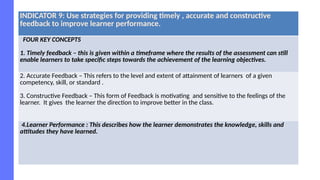
INDICATOR 9: Usestrategies for providing timely , accurate and constructive
feedback to improve learner performance.
FOUR KEY CONCEPTS
1. Timely feedback – this is given within a timeframe where the results of the assessment can still
enable learners to take specific steps towards the achievement of the learning objectives.
2. Accurate Feedback – This refers to the level and extent of attainment of learners of a given
competency, skill, or standard .
3. Constructive Feedback – This form of Feedback is motivating and sensitive to the feelings of the
learner. It gives the learner the direction to improve better in the class.
4.Learner Performance : This describes how the learner demonstrates the knowledge, skills and
attitudes they have learned.

![INSTRUCTIONAL SUPERVISION [Autosaved].pptx](https://cdn.slidesharecdn.com/ss_thumbnails/instructionalsupervisionautosaved-250310102953-7a4e397e-thumbnail.jpg?width=640&height=640&fit=bounds)


![INSTRUCTIONAL SUPERVISION [Autosaved].pptx](https://cdn.slidesharecdn.com/ss_thumbnails/instructionalsupervisionautosaved-240309234708-b4e3eee3-thumbnail.jpg?width=640&height=640&fit=bounds)


