School Facilities
2010 Educational Facilities Manual
PAUL JOHN REY A. TANGHAL
2
Topics:
• Proper Utilization of School Facilities
• Illegal Utilization of School Facilities
• Financing Educational Facilities
• Disposal of Educational Facilities
Proper Utilization
of School Facilities
•Educational facilities in the school shall be
utilized properly. The use of the ground
and facilities of the school other than for
the school activities must be subject to the
approval of the Schools Division
Superintendent.
3
Proper Utilization
of School Facilities
•Among other public activities and
utilization of the school grounds and
facilities which may be permitted by the
Schools Division Superintendent thru the
principal/head teacher are as follows:
4
Other Public Activities:
1. Civil Service Examinations
2. Literacy Classes – instruction of
illiterates and other literacy activities
3. Polling Places – for meetings of
election inspectors and as polling places
for election
4. Religious Services/Instruction
5
Other Public Activities:
5. Community Program – sectoral groups
may be allowed to use the school
buildings, grounds and facilities for civic
and educational activities
6. Evacuation Center – allowed in case of
natural calamities. The utilization of
school property and facilities shall always
be under the strict authority and
responsibility of the school administrator.
6
Illegal Utilization
of School Facilities
•Any illegal act or activity resulting from or
related to, the utilization of the school
property or facilities shall be the
accountability of the school head. Article
20 of the Revised Penal Code prohibits
and penalizes the illegal use of public
funds and property. 7
Personal Use of
Educational Facilities
The use of school property for the
personal convenience of an employee as
his residence and not in connection with
his official duties is illegal. Likewise, the
use of school property for the furtherance
of private interest is considered illegal.
8
Squatters
No squatters shall be allowed in the
school site. In cases where there are
squatters within the school site, their
ejection shall be done in a proper and legal
manner.
9
Financing Educational
Facilities
The legal basis for the financial support of
public elementary and secondary schools,
including their educational facilities, is a
constitutional mandate which provides that
the government shall establish and
maintain a complete and adequate system
of public education. 10
11
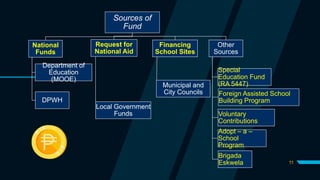
Sources of
Fund
National
Funds
Department of
Education
(MOOE)
DPWH
Request for
National Aid
Local Government
Funds
Financing
School Sites
Municipal and
City Councils
Other
Sources
Special
Education Fund
(RA 5447)
Voluntary
Contributions
Foreign Assisted School
Building Program
Adopt – a –
School
Program
Brigada
Eskwela
Disposal of
Educational Facilities
Despite of the proliferation of various laws, rules
and regulations governing disposal of property, a
considerable quantity of unserviceable, no longer
needed, obsolete, forfeited/seized supplies,
materials and equipment and valueless records
which have grown unmanageable and
uneconomical proportions now exist in various
government agencies. 12
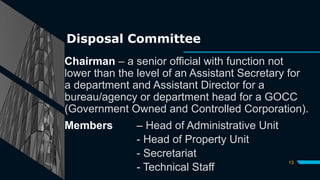
Disposal Committee
Chairman – a senior official with function not
lower than the level of an Assistant Secretary for
a department and Assistant Director for a
bureau/agency or department head for a GOCC
(Government Owned and Controlled Corporation).
13
Members – Head of Administrative Unit
- Head of Property Unit
- Secretariat
- Technical Staff
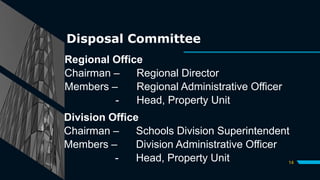
Disposal Committee
Regional Office
Chairman – Regional Director
Members – Regional Administrative Officer
- Head, Property Unit
14
Division Office
Chairman – Schools Division Superintendent
Members – Division Administrative Officer
- Head, Property Unit
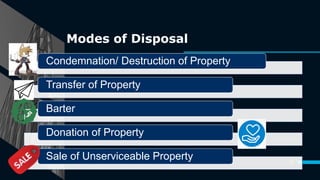
Modes of Disposal
15
Condemnation/ Destruction of Property
Transfer of Property
Barter
Donation of Property
Sale of Unserviceable Property
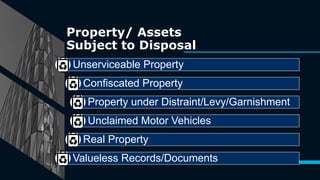
Property/ Assets
Subject to Disposal
16
Unserviceable Property
Confiscated Property
Property under Distraint/Levy/Garnishment
Unclaimed Motor Vehicles
Real Property
Valueless Records/Documents
Factors in Disposal of
Unserviceable Property
17
Property which can no longer be repaired or
reconditioned.
Property whose maintenance costs of repair
more than outweighs the benefits and services
that will be derived from its continued use.
Property that has become obsolete or
outmoded because of changes in technology.
Factors in Disposal of
Unserviceable Property
18
Serviceable property that has been rendered
unnecessary due to change in the agency’s
function or mandate.
Unused supplies, materials and spare parts that
were procured in excess of requirement.
Unused supplies and materials that have become
dangerous to use because of long storage or use
of which is determined to be hazardous.
Inspection and Appraisal of
Property for Disposal
Inspection is conducted to observe the
physical condition of the property to be
disposed. An ocular inspection is usually
done to have first –hand observation of the
conditions of the property.
19
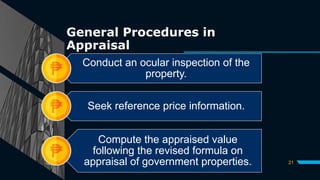
General Procedures in
Appraisal
The objective is to set the
government’s minimum selling price so
that the government shall receive fair
compensation for the items sold. The
disposal committee members, including
the owning agency shall each prepare its
appraisal report.
20
21
Conduct an ocular inspection of the
property.
Seek reference price information.
Compute the appraised value
following the revised formula on
appraisal of government properties.
General Procedures in
Appraisal
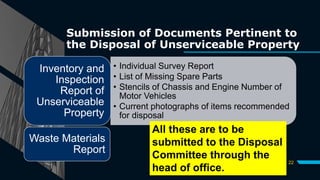
22
Submission of Documents Pertinent to
the Disposal of Unserviceable Property
• Individual Survey Report
• List of Missing Spare Parts
• Stencils of Chassis and Engine Number of
Motor Vehicles
• Current photographs of items recommended
for disposal
Inventory and
Inspection
Report of
Unserviceable
Property
Waste Materials
Report
All these are to be
submitted to the Disposal
Committee through the
head of office.
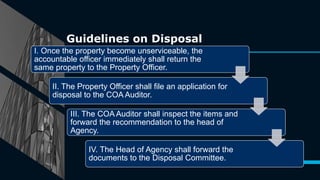
23
Guidelines on Disposal
I. Once the property become unserviceable, the
accountable officer immediately shall return the
same property to the Property Officer.
II. The Property Officer shall file an application for
disposal to the COA Auditor.
III. The COA Auditor shall inspect the items and
forward the recommendation to the head of
Agency.
IV. The Head of Agency shall forward the
documents to the Disposal Committee.
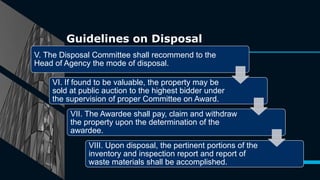
24
Guidelines on Disposal
V. The Disposal Committee shall recommend to the
Head of Agency the mode of disposal.
VI. If found to be valuable, the property may be
sold at public auction to the highest bidder under
the supervision of proper Committee on Award.
VII. The Awardee shall pay, claim and withdraw
the property upon the determination of the
awardee.
VIII. Upon disposal, the pertinent portions of the
inventory and inspection report and report of
waste materials shall be accomplished.
END
THANK
YOU!
Paul John
Rey A.
Tanghal
School
Cotabato State University – Graduate College
Email
paultanghal95@gmail.com

School Facilities.pptx

  • 1.
    School Facilities 2010 EducationalFacilities Manual PAUL JOHN REY A. TANGHAL
  • 2.
    2 Topics: • Proper Utilizationof School Facilities • Illegal Utilization of School Facilities • Financing Educational Facilities • Disposal of Educational Facilities
  • 3.
    Proper Utilization of SchoolFacilities •Educational facilities in the school shall be utilized properly. The use of the ground and facilities of the school other than for the school activities must be subject to the approval of the Schools Division Superintendent. 3
  • 4.
    Proper Utilization of SchoolFacilities •Among other public activities and utilization of the school grounds and facilities which may be permitted by the Schools Division Superintendent thru the principal/head teacher are as follows: 4
  • 5.
    Other Public Activities: 1.Civil Service Examinations 2. Literacy Classes – instruction of illiterates and other literacy activities 3. Polling Places – for meetings of election inspectors and as polling places for election 4. Religious Services/Instruction 5
  • 6.
    Other Public Activities: 5.Community Program – sectoral groups may be allowed to use the school buildings, grounds and facilities for civic and educational activities 6. Evacuation Center – allowed in case of natural calamities. The utilization of school property and facilities shall always be under the strict authority and responsibility of the school administrator. 6
  • 7.
    Illegal Utilization of SchoolFacilities •Any illegal act or activity resulting from or related to, the utilization of the school property or facilities shall be the accountability of the school head. Article 20 of the Revised Penal Code prohibits and penalizes the illegal use of public funds and property. 7
  • 8.
    Personal Use of EducationalFacilities The use of school property for the personal convenience of an employee as his residence and not in connection with his official duties is illegal. Likewise, the use of school property for the furtherance of private interest is considered illegal. 8
  • 9.
    Squatters No squatters shallbe allowed in the school site. In cases where there are squatters within the school site, their ejection shall be done in a proper and legal manner. 9
  • 10.
    Financing Educational Facilities The legalbasis for the financial support of public elementary and secondary schools, including their educational facilities, is a constitutional mandate which provides that the government shall establish and maintain a complete and adequate system of public education. 10
  • 11.
    11 Sources of Fund National Funds Department of Education (MOOE) DPWH Requestfor National Aid Local Government Funds Financing School Sites Municipal and City Councils Other Sources Special Education Fund (RA 5447) Voluntary Contributions Foreign Assisted School Building Program Adopt – a – School Program Brigada Eskwela
  • 12.
    Disposal of Educational Facilities Despiteof the proliferation of various laws, rules and regulations governing disposal of property, a considerable quantity of unserviceable, no longer needed, obsolete, forfeited/seized supplies, materials and equipment and valueless records which have grown unmanageable and uneconomical proportions now exist in various government agencies. 12
  • 13.
    Disposal Committee Chairman –a senior official with function not lower than the level of an Assistant Secretary for a department and Assistant Director for a bureau/agency or department head for a GOCC (Government Owned and Controlled Corporation). 13 Members – Head of Administrative Unit - Head of Property Unit - Secretariat - Technical Staff
  • 14.
    Disposal Committee Regional Office Chairman– Regional Director Members – Regional Administrative Officer - Head, Property Unit 14 Division Office Chairman – Schools Division Superintendent Members – Division Administrative Officer - Head, Property Unit
  • 15.
    Modes of Disposal 15 Condemnation/Destruction of Property Transfer of Property Barter Donation of Property Sale of Unserviceable Property
  • 16.
    Property/ Assets Subject toDisposal 16 Unserviceable Property Confiscated Property Property under Distraint/Levy/Garnishment Unclaimed Motor Vehicles Real Property Valueless Records/Documents
  • 17.
    Factors in Disposalof Unserviceable Property 17 Property which can no longer be repaired or reconditioned. Property whose maintenance costs of repair more than outweighs the benefits and services that will be derived from its continued use. Property that has become obsolete or outmoded because of changes in technology.
  • 18.
    Factors in Disposalof Unserviceable Property 18 Serviceable property that has been rendered unnecessary due to change in the agency’s function or mandate. Unused supplies, materials and spare parts that were procured in excess of requirement. Unused supplies and materials that have become dangerous to use because of long storage or use of which is determined to be hazardous.
  • 19.
    Inspection and Appraisalof Property for Disposal Inspection is conducted to observe the physical condition of the property to be disposed. An ocular inspection is usually done to have first –hand observation of the conditions of the property. 19
  • 20.
    General Procedures in Appraisal Theobjective is to set the government’s minimum selling price so that the government shall receive fair compensation for the items sold. The disposal committee members, including the owning agency shall each prepare its appraisal report. 20
  • 21.
    21 Conduct an ocularinspection of the property. Seek reference price information. Compute the appraised value following the revised formula on appraisal of government properties. General Procedures in Appraisal
  • 22.
    22 Submission of DocumentsPertinent to the Disposal of Unserviceable Property • Individual Survey Report • List of Missing Spare Parts • Stencils of Chassis and Engine Number of Motor Vehicles • Current photographs of items recommended for disposal Inventory and Inspection Report of Unserviceable Property Waste Materials Report All these are to be submitted to the Disposal Committee through the head of office.
  • 23.
    23 Guidelines on Disposal I.Once the property become unserviceable, the accountable officer immediately shall return the same property to the Property Officer. II. The Property Officer shall file an application for disposal to the COA Auditor. III. The COA Auditor shall inspect the items and forward the recommendation to the head of Agency. IV. The Head of Agency shall forward the documents to the Disposal Committee.
  • 24.
    24 Guidelines on Disposal V.The Disposal Committee shall recommend to the Head of Agency the mode of disposal. VI. If found to be valuable, the property may be sold at public auction to the highest bidder under the supervision of proper Committee on Award. VII. The Awardee shall pay, claim and withdraw the property upon the determination of the awardee. VIII. Upon disposal, the pertinent portions of the inventory and inspection report and report of waste materials shall be accomplished.
  • 25.
  • 26.
    THANK YOU! Paul John Rey A. Tanghal School CotabatoState University – Graduate College Email paultanghal95@gmail.com