TapendrakumarVaishnav(2022imsbph025)
SumerkumarSaini(2022imsbph022)
Gauravkumar(2022imsbph010)
SubhashParmar(2022imsbph021)
Submittedto :dr.kanaksharma
conceptofSchoolenvironment
• “School environment refers to the physical , social,and psychological
context in which learning and educational activity take place .”
It include both concrete elements like buildings , classrooms,and facilities
as well as abstract aspects like culture ,relationships and ethics of the
school .
The school environment significantly influences the overall educational
experience .
it plays a crucial role in shaping the academic social and emotional
development of students.
INTRODUCTION
Typesof school environment
physical environment
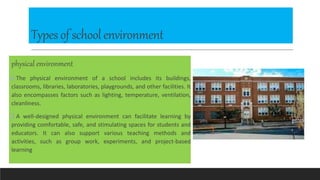
 The physical environment of a school includes its buildings,
classrooms, libraries, laboratories, playgrounds, and other facilities. It
also encompasses factors such as lighting, temperature, ventilation,
cleanliness.
 A well-designed physical environment can facilitate learning by
providing comfortable, safe, and stimulating spaces for students and
educators. It can also support various teaching methods and
activities, such as group work, experiments, and project-based
learning
Psychologicalenvironment
 The psychological environment of a school would
refer to the stimuli that effect upon the learner's
psyche in the school.
For example, the attitude of the principal and
teachers towards a learner would act as a stimulus for
the learner to do or not do certain things in the
school.
 Promote positive relationship and communication .
 Promote equity and inclusion
Social environment
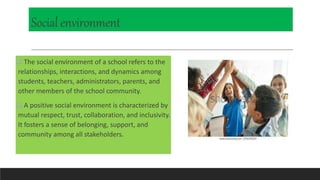
 The social environment of a school refers to the
relationships, interactions, and dynamics among
students, teachers, administrators, parents, and
other members of the school community.
 A positive social environment is characterized by
mutual respect, trust, collaboration, and inclusivity.
It fosters a sense of belonging, support, and
community among all stakeholders.
Culturalenvironment
Culture can also be regarded as part of the environment
created by human beings.
Culture includes products that are humanly produced, both
material (buildings, artifacts, factories, slum housing), and
immaterial (ideology, value systems, mores), as well as materially
derived products such as social class and the socio/political
order.
A good deal of human behaviour can be understood and
predicted if we know the culture of the inhabitants, which is
their design or road map for living.
Howdoesschoolenvironmentaffecttheirownschool/institution
 A positive school environment for kids affects a child’s academic performance.
 The school environment includes highly qualified teachers who develop a child’s interest in
learning. They try to main a fruitful relationship with the child.
 The child participation level also increases that results in more interactive classes with a good
attendance ratio.
 It provides necessary health care facilities.
 The children learn moral and social values that make them respect their culture and tradition.
Conclusion
The school environment has broad influence on students’ learning and growth,
including a significant aspect of their social, emotional and ethical development.
By implementing these strategies and fostering a culture of collaboration,
respect, and continuous improvement, schools can positively affect their
environment and create a supportive and enriching learning environment for all
students.

School climate and its effect on teaching learning process.pptx

  • 1.
  • 2.
    • “School environmentrefers to the physical , social,and psychological context in which learning and educational activity take place .” It include both concrete elements like buildings , classrooms,and facilities as well as abstract aspects like culture ,relationships and ethics of the school . The school environment significantly influences the overall educational experience . it plays a crucial role in shaping the academic social and emotional development of students. INTRODUCTION
  • 3.
    Typesof school environment physicalenvironment  The physical environment of a school includes its buildings, classrooms, libraries, laboratories, playgrounds, and other facilities. It also encompasses factors such as lighting, temperature, ventilation, cleanliness.  A well-designed physical environment can facilitate learning by providing comfortable, safe, and stimulating spaces for students and educators. It can also support various teaching methods and activities, such as group work, experiments, and project-based learning
  • 4.
    Psychologicalenvironment  The psychologicalenvironment of a school would refer to the stimuli that effect upon the learner's psyche in the school. For example, the attitude of the principal and teachers towards a learner would act as a stimulus for the learner to do or not do certain things in the school.  Promote positive relationship and communication .  Promote equity and inclusion
  • 5.
    Social environment  Thesocial environment of a school refers to the relationships, interactions, and dynamics among students, teachers, administrators, parents, and other members of the school community.  A positive social environment is characterized by mutual respect, trust, collaboration, and inclusivity. It fosters a sense of belonging, support, and community among all stakeholders.
  • 6.
    Culturalenvironment Culture can alsobe regarded as part of the environment created by human beings. Culture includes products that are humanly produced, both material (buildings, artifacts, factories, slum housing), and immaterial (ideology, value systems, mores), as well as materially derived products such as social class and the socio/political order. A good deal of human behaviour can be understood and predicted if we know the culture of the inhabitants, which is their design or road map for living.
  • 7.
    Howdoesschoolenvironmentaffecttheirownschool/institution  A positiveschool environment for kids affects a child’s academic performance.  The school environment includes highly qualified teachers who develop a child’s interest in learning. They try to main a fruitful relationship with the child.  The child participation level also increases that results in more interactive classes with a good attendance ratio.  It provides necessary health care facilities.  The children learn moral and social values that make them respect their culture and tradition.
  • 8.
    Conclusion The school environmenthas broad influence on students’ learning and growth, including a significant aspect of their social, emotional and ethical development. By implementing these strategies and fostering a culture of collaboration, respect, and continuous improvement, schools can positively affect their environment and create a supportive and enriching learning environment for all students.