Schizophrenia
PRESENTED BY: GUIDED BY:
AVINASH M. HANWATE PROF. B. R. BOMBADE
2016MNS013
Contents:
 Introduction
 Causes
 Symptoms
 Types
 Implementation
 Treatment
 Conclusion
What is Schizophrenia?
 Schizophrenia is a serious mental illness that has an effect on how a person feels,
behaves, and thinks.
 Brain disorder
 Often confused with “Multiple Personality Disorder.”
 Patients of Schizophrenia are not violent and do not pose a danger to others.
Causes:
 No one knows the exact causes of Schizophrenia, but multiple possible factors have
been discovered.
 These factors include:
1. Genetics
2. Brain chemical imbalance
3. Environmental factors
4. Family history
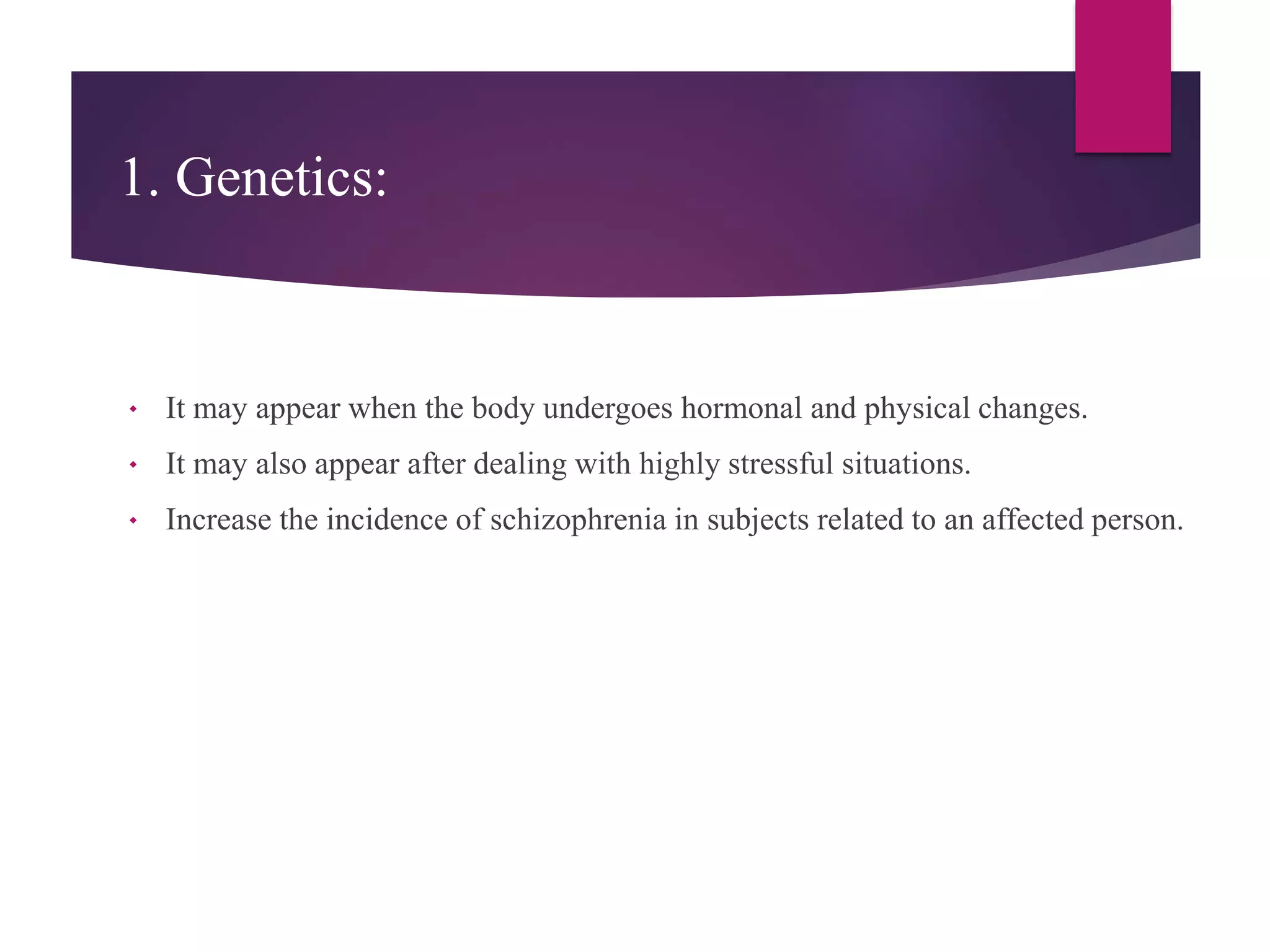
1. Genetics:
 It may appear when the body undergoes hormonal and physical changes.
 It may also appear after dealing with highly stressful situations.
 Increase the incidence of schizophrenia in subjects related to an affected person.
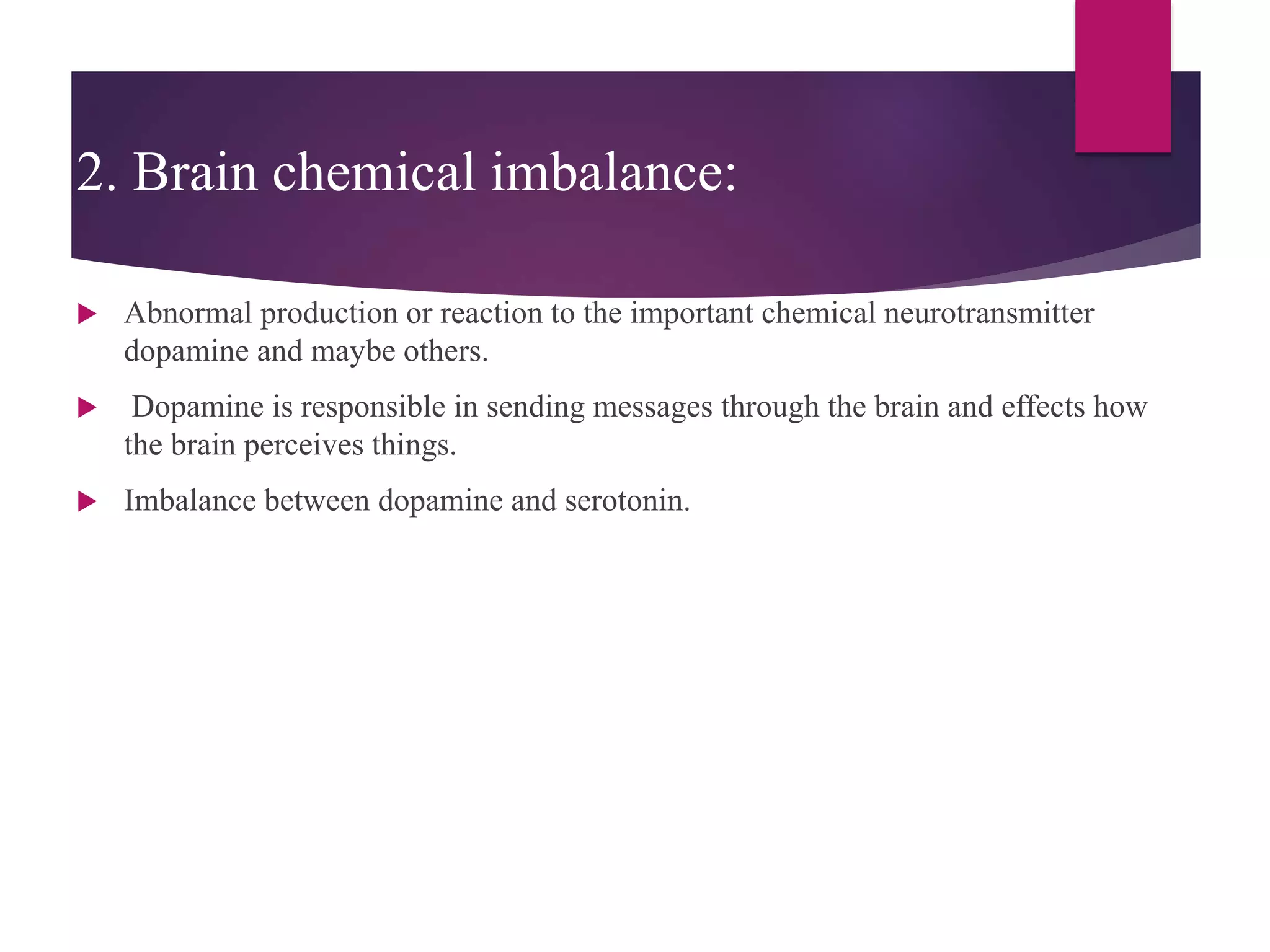
2. Brain chemical imbalance:
 Abnormal production or reaction to the important chemical neurotransmitter
dopamine and maybe others.
 Dopamine is responsible in sending messages through the brain and effects how
the brain perceives things.
 Imbalance between dopamine and serotonin.
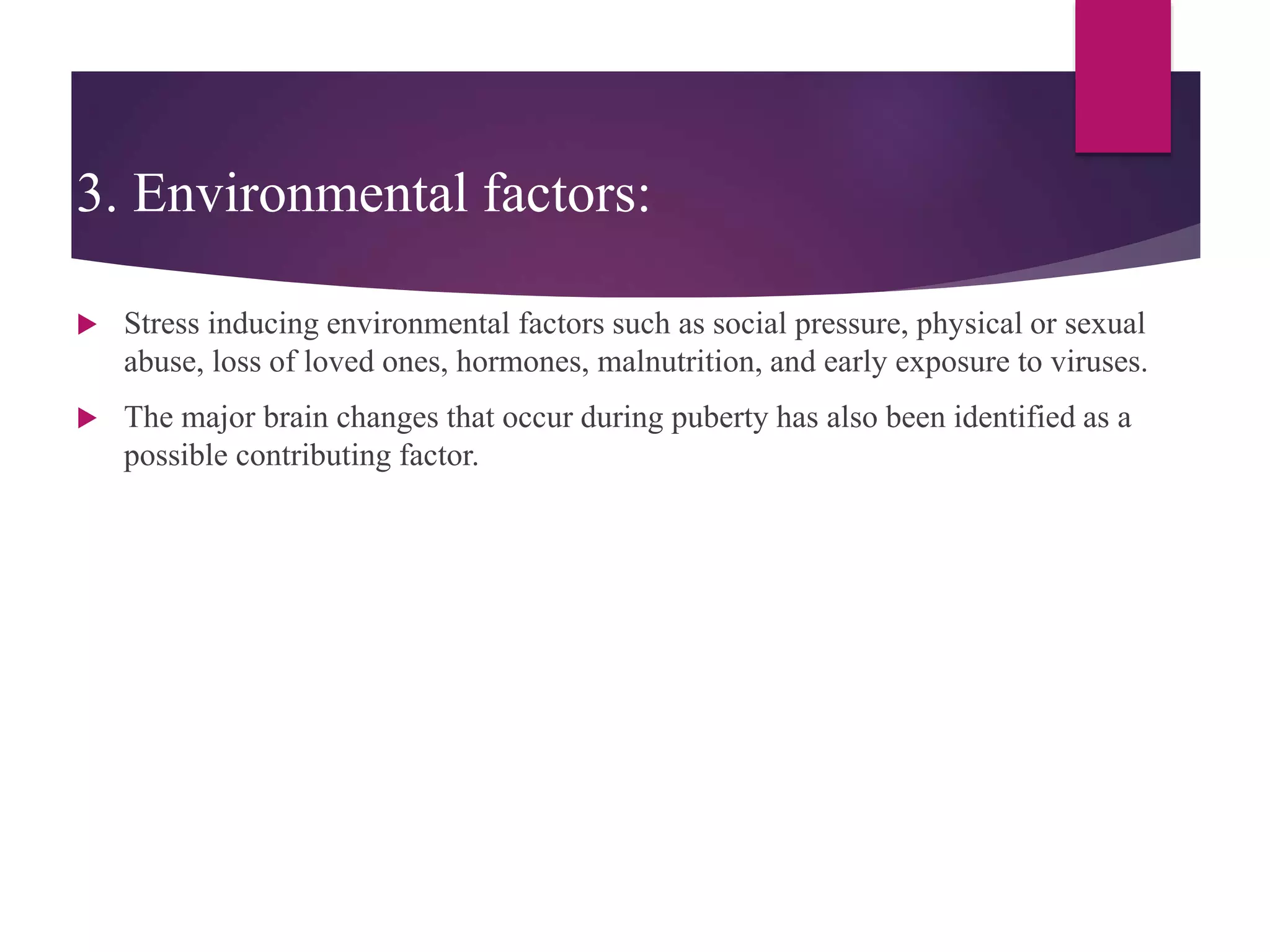
3. Environmental factors:
 Stress inducing environmental factors such as social pressure, physical or sexual
abuse, loss of loved ones, hormones, malnutrition, and early exposure to viruses.
 The major brain changes that occur during puberty has also been identified as a
possible contributing factor.
4. Family history:
 If ones mother, father, brother or sister has the illness, statistics show a 10 percent
chance of developing it.
 If ones twin, or both father and mother has the disorder then the probability of
developing it rises to 40 percent.
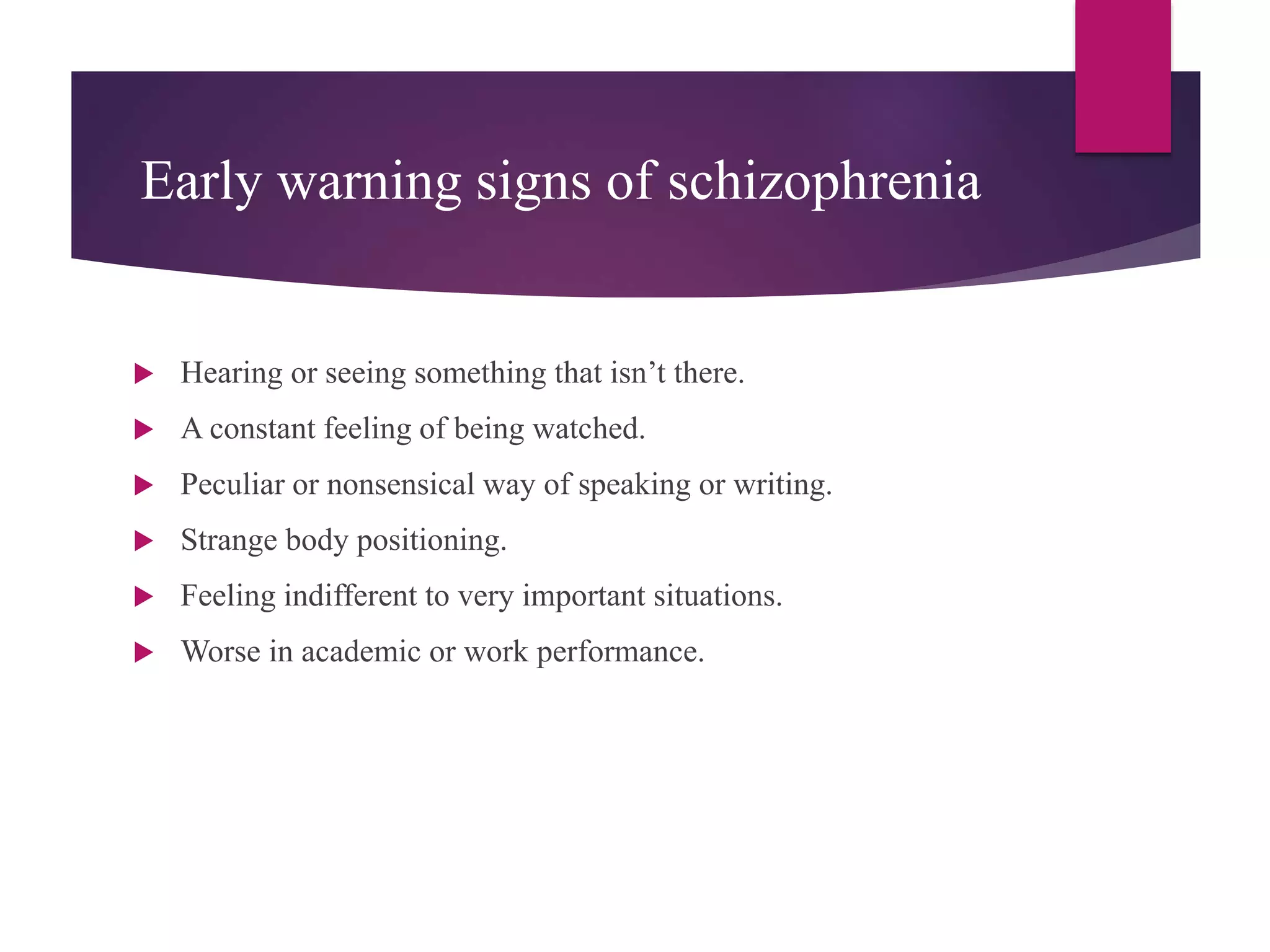
Early warning signs of schizophrenia
 Hearing or seeing something that isn’t there.
 A constant feeling of being watched.
 Peculiar or nonsensical way of speaking or writing.
 Strange body positioning.
 Feeling indifferent to very important situations.
 Worse in academic or work performance.
Symptoms:
 The symptoms of schizophrenia can be categorized into three wide-ranging groups.
1. Positive symptoms
2. Negative symptoms
3. Cognitive symptoms
Types:
1. Catatonic : Consists of activity levels on either end of the spectrum; either a dazed,
coma-like state or a hyperactive state
2. Paranoid : Typically consists of false beliefs and hearing things that aren’t there.
3. Disorganized : Typically consists of thoughts, speech and behavior that is
inappropriate and incomprehensible
4. Residual : Consists of some schizophrenic symptoms of lesser severity
5. Undifferentiated : A form of schizophrenia that does not match any of the above
types; sometimes this is called schizophrenia not otherwise specified
Implementation
 Preparatory step:
 Load the libraries:
 library(caret), library(randomForest), library(e1071), library(kernlab), library(doMC),
library(foreach), library(RColorBrewer).
 Read the data:
 Training set:
trFC <- read.csv('/Your-Path-To-Train-Data/train_FNC.csv')
trSBM <- read.csv('/Your-Path-To-Train-Data/train_SBM.csv')
tr <- merge(trFC, trSBM, by='Id')
 Test set:
tstFC <- read.csv('/Your-Path-To-Test-Data/test_FNC.csv')
tstSBM <- read.csv('/Your-Path-To-Test-Data/test_SBM.csv')
tst <- merge(tstFC, tstSBM, by='Id')
y <- read.csv('/Your-Path-To-Train-Data/train_labels.csv')
 Analysis
 "Feature Trimming”
 Registering 6 cores to speed up my computations:
registerDoMC(cores=6)
 Converting a y-label vector into appropriate format:
y <- as.factor(paste('X.', y[,2], sep = ‘ '))
 Introducing a random vector into feature set:
all <- cbind(tr, rnorm(1:dim(tr)[1]))
colnames(all)[412] <- 'rand‘
 Now train Random Forest with this (full) feature set:
rf.mod <- foreach(ntree=rep(25000, 6), .combine=combine, .multicombine=TRUE,
.packages='randomForest') %dopar% {
randomForest(all[,2:412], y, ntree=ntree)
}
• Looking at the feature importances:
color <- brewer.pal(n = 8, "Dark2")
imp <-as.data.frame(rf.mod$importance[order(rf.mod$importance),])
barplot(t(imp),col=color[1])
points(which(imp==imp['rand',]),0.6,col=color[2],type='h',lwd=2)
• Everything below importance of our "dummy" feature (random vector) can likely be ignored.
imp <- subset(imp, imp>imp['rand',])
• Saving the data in one rda-file for further analyses:
save('all', 'y', 'tst', 'imp', file = ‘./AllData.rda')
• Now reduce the feature set:
dat <- all[,rownames(imp)]
 Final Model
• First, estimate "sigma" (inverse width parameter for the RBF-SVM).
sigDist <- sigest(y ~ as.matrix(dat), data=dat, frac = 1)
• Creating a tune grid for further C-parameter selection):
svmTuneGrid <- data.frame(.sigma = sigDist[1], .C = 2^(-20:100))
• Training the final RBF-SVM model:
svmFit <- train(dat,y, method = "svmRadial",
preProc = c("center", "scale"), tuneGrid = svmTuneGrid,
trControl = trainControl(method = "cv", number = 86, classProbs = TRUE))
• Making predictions:
ttst <- tst[,rownames(imp)]
predTst <- predict(svmFit, ttst, type='prob')
predTst <- predTst[,2]
• Formatting submission:
pred <- cbind(as.integer(tst$Id), as.numeric(predTst))
colnames(pred) <- c('Id', 'Probability')
• Writing:
write.table(pred, file = ‘./submission.csv', sep=',', quote=F, row.names=F, fileEncoding = 'UTF-16LE')
Diagnosis:
 Two or more of the following must be
present:
1) Hallucinations.
2) Delusions.
3) Disorganized behavior or catatonic behavior.
4) Disorganized speech.
5) Negative symptoms
The symptoms must last at least for 6
months.
Treatment:
 Medications
 Antipsychotic Drugs
 Psychotherapy
 Hospitalization
 Electroconvulsive Therapy (ECT)
Conclusion:
 As per our observations the result we got
by comparing GP classifier and SVM
classifier, SVM gives accuracy greater
than GP classifier.
References
[1] "Schizophrenia Fact sheet N°397", WHO.
[2] "Schizophrenia". National Institute of Mental Health.
[3] Schizophrenia dataset from “kaggle.com/c/mlsp-2014-mri/data”
[4] “National Institute of Medical Health”
https://www.nimh.nih.gov/health/topics/schizophrenia/index.shtml
[5] “National Alliance on Mental Illness”
https://www.nami.org/Learn-More/Mental-Health-Conditions/Schizophrenia
[6] “Schizophrenia –Wikipedia” https://en.wikipedia.org/wiki/Schizophrenia
[7] http://www.mentalhealthamerica.net/conditions/schizophrenia
Thank you!!!

Schizophrenia Clasiification Using SVM

  • 1.
    Schizophrenia PRESENTED BY: GUIDEDBY: AVINASH M. HANWATE PROF. B. R. BOMBADE 2016MNS013
  • 2.
    Contents:  Introduction  Causes Symptoms  Types  Implementation  Treatment  Conclusion
  • 3.
    What is Schizophrenia? Schizophrenia is a serious mental illness that has an effect on how a person feels, behaves, and thinks.  Brain disorder  Often confused with “Multiple Personality Disorder.”  Patients of Schizophrenia are not violent and do not pose a danger to others.
  • 4.
    Causes:  No oneknows the exact causes of Schizophrenia, but multiple possible factors have been discovered.  These factors include: 1. Genetics 2. Brain chemical imbalance 3. Environmental factors 4. Family history
  • 5.
    1. Genetics:  Itmay appear when the body undergoes hormonal and physical changes.  It may also appear after dealing with highly stressful situations.  Increase the incidence of schizophrenia in subjects related to an affected person.
  • 6.
    2. Brain chemicalimbalance:  Abnormal production or reaction to the important chemical neurotransmitter dopamine and maybe others.  Dopamine is responsible in sending messages through the brain and effects how the brain perceives things.  Imbalance between dopamine and serotonin.
  • 7.
    3. Environmental factors: Stress inducing environmental factors such as social pressure, physical or sexual abuse, loss of loved ones, hormones, malnutrition, and early exposure to viruses.  The major brain changes that occur during puberty has also been identified as a possible contributing factor.
  • 8.
    4. Family history: If ones mother, father, brother or sister has the illness, statistics show a 10 percent chance of developing it.  If ones twin, or both father and mother has the disorder then the probability of developing it rises to 40 percent.
  • 9.
    Early warning signsof schizophrenia  Hearing or seeing something that isn’t there.  A constant feeling of being watched.  Peculiar or nonsensical way of speaking or writing.  Strange body positioning.  Feeling indifferent to very important situations.  Worse in academic or work performance.
  • 10.
    Symptoms:  The symptomsof schizophrenia can be categorized into three wide-ranging groups. 1. Positive symptoms 2. Negative symptoms 3. Cognitive symptoms
  • 11.
    Types: 1. Catatonic :Consists of activity levels on either end of the spectrum; either a dazed, coma-like state or a hyperactive state 2. Paranoid : Typically consists of false beliefs and hearing things that aren’t there. 3. Disorganized : Typically consists of thoughts, speech and behavior that is inappropriate and incomprehensible 4. Residual : Consists of some schizophrenic symptoms of lesser severity 5. Undifferentiated : A form of schizophrenia that does not match any of the above types; sometimes this is called schizophrenia not otherwise specified
  • 12.
    Implementation  Preparatory step: Load the libraries:  library(caret), library(randomForest), library(e1071), library(kernlab), library(doMC), library(foreach), library(RColorBrewer).  Read the data:  Training set: trFC <- read.csv('/Your-Path-To-Train-Data/train_FNC.csv') trSBM <- read.csv('/Your-Path-To-Train-Data/train_SBM.csv') tr <- merge(trFC, trSBM, by='Id')  Test set: tstFC <- read.csv('/Your-Path-To-Test-Data/test_FNC.csv') tstSBM <- read.csv('/Your-Path-To-Test-Data/test_SBM.csv') tst <- merge(tstFC, tstSBM, by='Id') y <- read.csv('/Your-Path-To-Train-Data/train_labels.csv')
  • 13.
     Analysis  "FeatureTrimming”  Registering 6 cores to speed up my computations: registerDoMC(cores=6)  Converting a y-label vector into appropriate format: y <- as.factor(paste('X.', y[,2], sep = ‘ '))  Introducing a random vector into feature set: all <- cbind(tr, rnorm(1:dim(tr)[1])) colnames(all)[412] <- 'rand‘  Now train Random Forest with this (full) feature set: rf.mod <- foreach(ntree=rep(25000, 6), .combine=combine, .multicombine=TRUE, .packages='randomForest') %dopar% { randomForest(all[,2:412], y, ntree=ntree) }
  • 14.
    • Looking atthe feature importances: color <- brewer.pal(n = 8, "Dark2") imp <-as.data.frame(rf.mod$importance[order(rf.mod$importance),]) barplot(t(imp),col=color[1]) points(which(imp==imp['rand',]),0.6,col=color[2],type='h',lwd=2) • Everything below importance of our "dummy" feature (random vector) can likely be ignored. imp <- subset(imp, imp>imp['rand',])
  • 15.
    • Saving thedata in one rda-file for further analyses: save('all', 'y', 'tst', 'imp', file = ‘./AllData.rda') • Now reduce the feature set: dat <- all[,rownames(imp)]  Final Model • First, estimate "sigma" (inverse width parameter for the RBF-SVM). sigDist <- sigest(y ~ as.matrix(dat), data=dat, frac = 1) • Creating a tune grid for further C-parameter selection): svmTuneGrid <- data.frame(.sigma = sigDist[1], .C = 2^(-20:100))
  • 16.
    • Training thefinal RBF-SVM model: svmFit <- train(dat,y, method = "svmRadial", preProc = c("center", "scale"), tuneGrid = svmTuneGrid, trControl = trainControl(method = "cv", number = 86, classProbs = TRUE)) • Making predictions: ttst <- tst[,rownames(imp)] predTst <- predict(svmFit, ttst, type='prob') predTst <- predTst[,2] • Formatting submission: pred <- cbind(as.integer(tst$Id), as.numeric(predTst)) colnames(pred) <- c('Id', 'Probability') • Writing: write.table(pred, file = ‘./submission.csv', sep=',', quote=F, row.names=F, fileEncoding = 'UTF-16LE')
  • 17.
    Diagnosis:  Two ormore of the following must be present: 1) Hallucinations. 2) Delusions. 3) Disorganized behavior or catatonic behavior. 4) Disorganized speech. 5) Negative symptoms The symptoms must last at least for 6 months.
  • 18.
    Treatment:  Medications  AntipsychoticDrugs  Psychotherapy  Hospitalization  Electroconvulsive Therapy (ECT)
  • 19.
    Conclusion:  As perour observations the result we got by comparing GP classifier and SVM classifier, SVM gives accuracy greater than GP classifier.
  • 20.
    References [1] "Schizophrenia Factsheet N°397", WHO. [2] "Schizophrenia". National Institute of Mental Health. [3] Schizophrenia dataset from “kaggle.com/c/mlsp-2014-mri/data” [4] “National Institute of Medical Health” https://www.nimh.nih.gov/health/topics/schizophrenia/index.shtml [5] “National Alliance on Mental Illness” https://www.nami.org/Learn-More/Mental-Health-Conditions/Schizophrenia [6] “Schizophrenia –Wikipedia” https://en.wikipedia.org/wiki/Schizophrenia [7] http://www.mentalhealthamerica.net/conditions/schizophrenia
  • 21.