Schizophrenia
Positive and negative symptoms of schizophrenia
Schizophrenia
• Schizophrenia is a severe and chronic mental disorder characterized
by disturbances in thought, perception and behavior.
• Schizophrenia involves a range of cognitive, behavioral, and
emotional symptoms.
Positive symptoms of schizophrenia :
Feelings or behaviors that are usually not
present,
such as:
• Believing that what other people are saying
is not true (delusions).
• Hearing, seeing, tasting, feeling, or smelling
things that others do not experience
(hallucinations).
• Disorganized speech and behavior.
While these symptoms can be scary and
extremely debilitating, taking the time to
understand them
Hallucinations:
An experience involving the apparent perception of something
not present.
In short, to hallucinate means to perceive things
that others do not.
5 Types of Hallucinations:
1. Auditory: hearing voices or sounds that are not there.
2. Visual: seeing people, colors, shapes, or items that
aren't real.
3. Tactile: feeling sensations (bugs crawling on or under
your skin) or as if you're being touched when you're
not.
4. Olfactory: Smelling something that has no physical
source.
5. Taste: Experiencing taste in your mouth when you
have not eaten anything.
People with schizophrenia can experience a variety of
hallucinations, but the most common are auditory
hallucinations .This can include clicks and knocks, full
conversations between people, or voices that talk to
them directly. The voices can be good, but more often
they are bad, dismissive, and mean. At times, the voices
can be in the form of commands..
Delusions :
An idiosyncratic belief or impression maintained despite being
contradicted by reality or rational argument, typically as a
symptom of mental disorder.
Delusions are ideas that are not true. For example, people with
schizophrenia might believe that the secret service is out to get
them, or that TV anchors are transmitting coded messages, or
their food is poisoned—and without any evidence.
There are several types of delusions :
Erotomanic
The person believes that a famous or important person (like an
actor or politician) is in love with him or her, often resulting in
stalking behavior.
Grandiose
Rooted in the French term "grande," grandiosity refers to an
exaggerated sense of one's power, talent, knowledge, identity,
or importance—and without any evidence. This may cause a
person to treat others who are "inferior" with disdain or
contempt.
Persecutory
A person with persecutory delusions believes others are out to
harm him or her, despite evidence to the contrary. This may
include a belief that he or she is being followed or spied on,
drugged, slandered, or somehow mistreated.
Somatic
A person with somatic delusions has central themes involving
bodily functions or sensations.
Referential
A belief that gestures, comments, or other cues have special
meaning directed at oneself. Delusions can be bizarre, such as
the belief that one's organs have been removed by aliens, or
non-bizarre, such as believing one is under surveillance by the
police
Disorganized Thinking :
Disorganized thinking can be extremely frustrating, making it
nearly impossible for people with schizophrenia to keep their
thoughts straight or express what's on their minds. This
positive symptom causes a series of disjointed thoughts,
making it hard to follow or make sense of what a loved one
with schizophrenia is trying to say.
Types of Disorganized Thinking :
Derailment:
Shifting topics mid-sentence, before
completing original thought
Circumstantial thinking:
Talking in circles, adding unnecessary
details and never getting to the point
Tangential thinking:
Answers are unrelated to the questions
Loose associations:
Illogical thinking, or disconnected thoughts
Clang associations:
Choosing words for sound (rhyming or pun
associations) rather than meaning
Incoherence :
No discernible connection between words
Negative symptoms of schizophrenia :
Negative symptoms, including lack of emotion,
decreased joy or motivation, delayed speech, and
difficulty beginning and sustaining activities, can be scary
and extremely debilitating. If you or someone you love is
struggling with negative symptoms, you may need help
in order to complete daily tasks.
The cause of negative symptoms is not clear. While some
studies say these deficits run in families, there is no known
genetic association for negative symptoms or deficit
schizophrenia
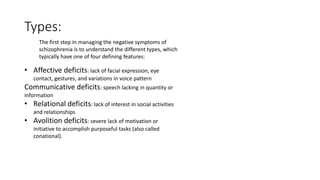
Types:
The first step in managing the negative symptoms of
schizophrenia is to understand the different types, which
typically have one of four defining features:
• Affective deficits: lack of facial expression, eye
contact, gestures, and variations in voice pattern
Communicative deficits: speech lacking in quantity or
information
• Relational deficits: lack of interest in social activities
and relationships
• Avolition deficits: severe lack of motivation or
initiative to accomplish purposeful tasks (also called
conational).
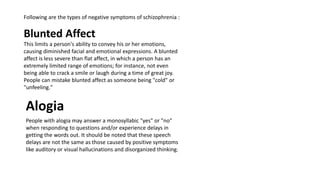
Following are the types of negative symptoms of schizophrenia :
Blunted Affect
This limits a person's ability to convey his or her emotions,
causing diminished facial and emotional expressions. A blunted
affect is less severe than flat affect, in which a person has an
extremely limited range of emotions; for instance, not even
being able to crack a smile or laugh during a time of great joy.
People can mistake blunted affect as someone being "cold" or
"unfeeling."
Alogia
People with alogia may answer a monosyllabic "yes" or "no"
when responding to questions and/or experience delays in
getting the words out. It should be noted that these speech
delays are not the same as those caused by positive symptoms
like auditory or visual hallucinations and disorganized thinking.
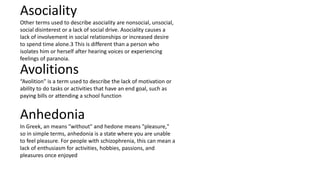
Asociality
Other terms used to describe asociality are nonsocial, unsocial,
social disinterest or a lack of social drive. Asociality causes a
lack of involvement in social relationships or increased desire
to spend time alone.3 This is different than a person who
isolates him or herself after hearing voices or experiencing
feelings of paranoia.
Avolitions
“Avolition” is a term used to describe the lack of motivation or
ability to do tasks or activities that have an end goal, such as
paying bills or attending a school function
Anhedonia
In Greek, an means "without" and hedone means "pleasure,"
so in simple terms, anhedonia is a state where you are unable
to feel pleasure. For people with schizophrenia, this can mean a
lack of enthusiasm for activities, hobbies, passions, and
pleasures once enjoyed

Schizophrenia

  • 1.
    Schizophrenia Positive and negativesymptoms of schizophrenia
  • 2.
    Schizophrenia • Schizophrenia isa severe and chronic mental disorder characterized by disturbances in thought, perception and behavior. • Schizophrenia involves a range of cognitive, behavioral, and emotional symptoms.
  • 3.
    Positive symptoms ofschizophrenia : Feelings or behaviors that are usually not present, such as: • Believing that what other people are saying is not true (delusions). • Hearing, seeing, tasting, feeling, or smelling things that others do not experience (hallucinations). • Disorganized speech and behavior. While these symptoms can be scary and extremely debilitating, taking the time to understand them
  • 4.
    Hallucinations: An experience involvingthe apparent perception of something not present. In short, to hallucinate means to perceive things that others do not. 5 Types of Hallucinations: 1. Auditory: hearing voices or sounds that are not there. 2. Visual: seeing people, colors, shapes, or items that aren't real. 3. Tactile: feeling sensations (bugs crawling on or under your skin) or as if you're being touched when you're not. 4. Olfactory: Smelling something that has no physical source. 5. Taste: Experiencing taste in your mouth when you have not eaten anything.
  • 5.
    People with schizophreniacan experience a variety of hallucinations, but the most common are auditory hallucinations .This can include clicks and knocks, full conversations between people, or voices that talk to them directly. The voices can be good, but more often they are bad, dismissive, and mean. At times, the voices can be in the form of commands.. Delusions : An idiosyncratic belief or impression maintained despite being contradicted by reality or rational argument, typically as a symptom of mental disorder. Delusions are ideas that are not true. For example, people with schizophrenia might believe that the secret service is out to get them, or that TV anchors are transmitting coded messages, or their food is poisoned—and without any evidence.
  • 6.
    There are severaltypes of delusions : Erotomanic The person believes that a famous or important person (like an actor or politician) is in love with him or her, often resulting in stalking behavior. Grandiose Rooted in the French term "grande," grandiosity refers to an exaggerated sense of one's power, talent, knowledge, identity, or importance—and without any evidence. This may cause a person to treat others who are "inferior" with disdain or contempt. Persecutory A person with persecutory delusions believes others are out to harm him or her, despite evidence to the contrary. This may include a belief that he or she is being followed or spied on, drugged, slandered, or somehow mistreated.
  • 7.
    Somatic A person withsomatic delusions has central themes involving bodily functions or sensations. Referential A belief that gestures, comments, or other cues have special meaning directed at oneself. Delusions can be bizarre, such as the belief that one's organs have been removed by aliens, or non-bizarre, such as believing one is under surveillance by the police Disorganized Thinking : Disorganized thinking can be extremely frustrating, making it nearly impossible for people with schizophrenia to keep their thoughts straight or express what's on their minds. This positive symptom causes a series of disjointed thoughts, making it hard to follow or make sense of what a loved one with schizophrenia is trying to say.
  • 8.
    Types of DisorganizedThinking : Derailment: Shifting topics mid-sentence, before completing original thought Circumstantial thinking: Talking in circles, adding unnecessary details and never getting to the point Tangential thinking: Answers are unrelated to the questions Loose associations: Illogical thinking, or disconnected thoughts Clang associations: Choosing words for sound (rhyming or pun associations) rather than meaning Incoherence : No discernible connection between words
  • 9.
    Negative symptoms ofschizophrenia : Negative symptoms, including lack of emotion, decreased joy or motivation, delayed speech, and difficulty beginning and sustaining activities, can be scary and extremely debilitating. If you or someone you love is struggling with negative symptoms, you may need help in order to complete daily tasks. The cause of negative symptoms is not clear. While some studies say these deficits run in families, there is no known genetic association for negative symptoms or deficit schizophrenia
  • 10.
    Types: The first stepin managing the negative symptoms of schizophrenia is to understand the different types, which typically have one of four defining features: • Affective deficits: lack of facial expression, eye contact, gestures, and variations in voice pattern Communicative deficits: speech lacking in quantity or information • Relational deficits: lack of interest in social activities and relationships • Avolition deficits: severe lack of motivation or initiative to accomplish purposeful tasks (also called conational).
  • 11.
    Following are thetypes of negative symptoms of schizophrenia : Blunted Affect This limits a person's ability to convey his or her emotions, causing diminished facial and emotional expressions. A blunted affect is less severe than flat affect, in which a person has an extremely limited range of emotions; for instance, not even being able to crack a smile or laugh during a time of great joy. People can mistake blunted affect as someone being "cold" or "unfeeling." Alogia People with alogia may answer a monosyllabic "yes" or "no" when responding to questions and/or experience delays in getting the words out. It should be noted that these speech delays are not the same as those caused by positive symptoms like auditory or visual hallucinations and disorganized thinking.
  • 12.
    Asociality Other terms usedto describe asociality are nonsocial, unsocial, social disinterest or a lack of social drive. Asociality causes a lack of involvement in social relationships or increased desire to spend time alone.3 This is different than a person who isolates him or herself after hearing voices or experiencing feelings of paranoia. Avolitions “Avolition” is a term used to describe the lack of motivation or ability to do tasks or activities that have an end goal, such as paying bills or attending a school function Anhedonia In Greek, an means "without" and hedone means "pleasure," so in simple terms, anhedonia is a state where you are unable to feel pleasure. For people with schizophrenia, this can mean a lack of enthusiasm for activities, hobbies, passions, and pleasures once enjoyed