Schizophrenia
Diagnostic criteria for Schizophrenia
Delusions Hallucinations Disorganized speech Catatonic behavior Negative symptoms
False believes
without
evidence.
Sensory experience
without stimulus.
Ex: auditory
hallucinations.
Word salad: severely
disorganized speech
with switching from
one topic to another.
Answers may be
completely unrelated to
questions.
psychomotor disturbance
ranging from motor
immobility to excessive
motor activity.
May be observed as:
Catalepsy
Waxy flexibility
Stupor
Negativism
Mutism
Agitation
Stereotypy
Echolalia
Echopraxia
Diminished emotional
expression sp. by face.
Avolition: Decreased self-
initiated activities.
Asociality: Lack of interest
in social interaction
(social withdrawal).
Anhedonia: Inability to
experience pleasure from
positive events.
Alogia: Diminished speech
output.
The most common type of psychotic disorders
DSM-5, 2013
Ex: Nihilistic
delusions of
being guilty
and blame
worthy.
Thought block: speech
is suddenly interrupted
by silence.
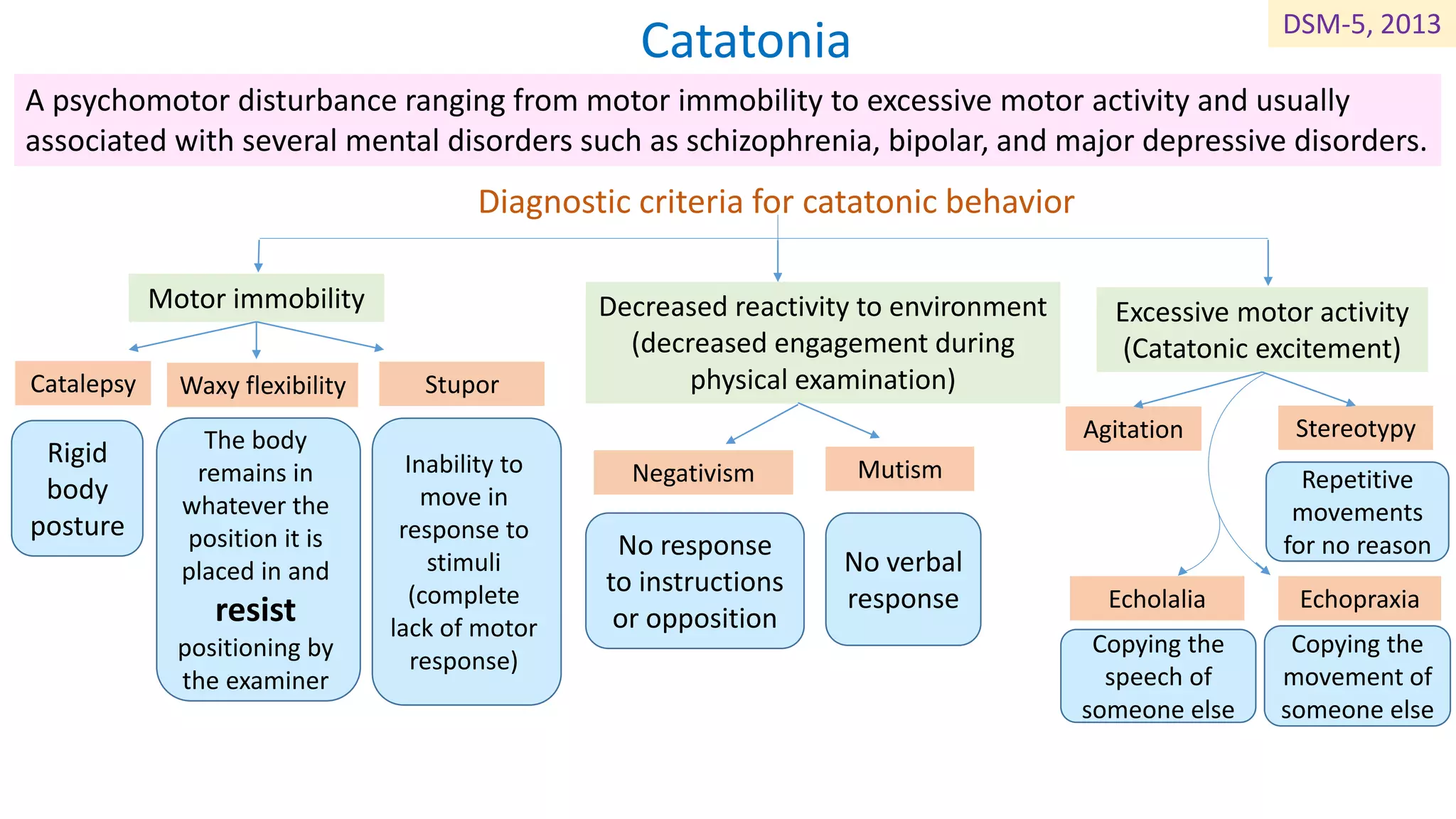
Catatonia
Diagnostic criteria for catatonic behavior
A psychomotor disturbance ranging from motor immobility to excessive motor activity and usually
associated with several mental disorders such as schizophrenia, bipolar, and major depressive disorders.
Motor immobility
Catalepsy Waxy flexibility Stupor
Rigid
body
posture
The body
remains in
whatever the
position it is
placed in and
resist
positioning by
the examiner
Inability to
move in
response to
stimuli
(complete
lack of motor
response)
Decreased reactivity to environment
(decreased engagement during
physical examination)
MutismNegativism
No verbal
response
No response
to instructions
or opposition
Excessive motor activity
(Catatonic excitement)
EchopraxiaEcholalia
StereotypyAgitation
Copying the
speech of
someone else
Repetitive
movements
for no reason
Copying the
movement of
someone else
DSM-5, 2013

Schizophrenia

  • 1.
    Schizophrenia Diagnostic criteria forSchizophrenia Delusions Hallucinations Disorganized speech Catatonic behavior Negative symptoms False believes without evidence. Sensory experience without stimulus. Ex: auditory hallucinations. Word salad: severely disorganized speech with switching from one topic to another. Answers may be completely unrelated to questions. psychomotor disturbance ranging from motor immobility to excessive motor activity. May be observed as: Catalepsy Waxy flexibility Stupor Negativism Mutism Agitation Stereotypy Echolalia Echopraxia Diminished emotional expression sp. by face. Avolition: Decreased self- initiated activities. Asociality: Lack of interest in social interaction (social withdrawal). Anhedonia: Inability to experience pleasure from positive events. Alogia: Diminished speech output. The most common type of psychotic disorders DSM-5, 2013 Ex: Nihilistic delusions of being guilty and blame worthy. Thought block: speech is suddenly interrupted by silence.
  • 2.
    Catatonia Diagnostic criteria forcatatonic behavior A psychomotor disturbance ranging from motor immobility to excessive motor activity and usually associated with several mental disorders such as schizophrenia, bipolar, and major depressive disorders. Motor immobility Catalepsy Waxy flexibility Stupor Rigid body posture The body remains in whatever the position it is placed in and resist positioning by the examiner Inability to move in response to stimuli (complete lack of motor response) Decreased reactivity to environment (decreased engagement during physical examination) MutismNegativism No verbal response No response to instructions or opposition Excessive motor activity (Catatonic excitement) EchopraxiaEcholalia StereotypyAgitation Copying the speech of someone else Repetitive movements for no reason Copying the movement of someone else DSM-5, 2013