28 January 201615:48
Standard Specifications for the Construction of Local Fishing
Vessels of less than 24 metres in Length Overall
Country........
Fisheries Act................
Regulation ....................
Section .........................
Schedule 4 Fire protection, fire detection, fire extinguishing and fire
fighting equipment
ii
Contents
Fire protection, fire detection, fire extinguishing and fire fighting equipment.............................................. 1
Appendix 1 .................................................................................................................................................... 7
List of Schedules ........................................................................................................................................... 7
1
Fire protection, fire detection, fire extinguishing and fire fighting
equipment
1 Definitions
In this Schedule, unless the context otherwise requires-
i. “Class A Fires “refers to fires of common combustible solids such as wood, paper and
plastic.
ii. “Class B Fires” refers to fires of oil, grease, gas and other substances that give large
amounts of flammable vapours.
iii. “Class C Fires” refers to fires involving energized electrical equipment, conductors
and appliances.
iv. “LPG” refers to liquid petroleum gas used for domestic purposes.
v. The symbol “m” refers to the metric measure metres.
vi. The symbol “mm” refers to the metric measure millimeters.
2 General
2.1 Every local fishing vessel shall be so constructed and equipped that there is no substantial fire
risk to the vessel or to persons on board the vessel. The structural fire protection
arrangements, for a decked local fishing vessel, shall be capable of withstanding the passage
of flame for at least one half-hour unless the Minister or delegated authority is satisfied that
suitable alternative arrangements have been provided.
2.2 Fire extinguishing appliances shall be kept in good order and available for immediate use at
all times. For this purpose they shall be fitted with a means to show the state of the charge
2.3 Where in this schedule any special type of appliance, apparatus, extinguishing medium or
arrangement is specified, any other type of appliance etc. may be allowed provided that the
Minister or delegated authority is satisfied that it is not less effective
3 Structural fire protection
3.1 If steel decks or steel bulkheads in accommodation form the top or side of a fuel oil tank, they
shall be coated with a non-flammable material of minimum thickness of 40 mm. Manholes or
other openings to fuel oil tanks shall not be positioned in the accommodation.
3.2 External bulkheads and vessel’s sides, which delimit the accommodation spaces, should be
insulated with at least 50 mm insulating material. Bulkheads between accommodation spaces
and machinery spaces or fishrooms shall be made of steel in a steel vessel. In wooden vessels,
they can be built of 2 layers of wood with 2 layers of felt or similar in between or of 60mm
thick wood with a lining of insulating plates.
3.3 Where there is a door between the accommodation space and the machinery space, this shall
be self-closing. Doors between galley rooms and dining rooms might be permitted, provided
they are made of fire-retardant material.
4 Ventilation systems
4.1 Where powered ventilators are installed they shall be fitted with a means of stopping the
motors in an emergency from a position outside the spaces served by the ventilators. The
position of the emergency stop shall be to the approval of the Minister or delegated authority.
4.2 Means shall be provided for the closing of ventilator air intakes and exhaust openings.
4.3 Storerooms, that contain considerable quantities of highly flammable products, shall be
provided with ventilation systems, which are separate from other ventilation systems.
Ventilation should be effected at both the top and bottom of the room, and the ventilators’
2
inlet and outlet openings should be located in safe areas. Suitable wire netting screen for
extinguishing sparks shall be fitted over ventilation openings’ inlets and outlets. Such
ventilation systems shall not exhaust in close proximity to the inlets of other ventilation
systems.
4.4 Ventilation systems, that serve machinery spaces, shall be independent of systems serving
other rooms.
5 Means of escape
5.1 In accommodation spaces, there shall be at least two exit possibilities from each large room or
group of rooms and the exits shall be positioned as far from each other as possible.
5.2 In special cases, the Minister or delegated authority might grant exemption from the one of the
exits, taking account of the location of the room and the number of persons who will normally
accommodate the room. In such cases, the width of and course to exits shall be to the
approval of the Minister or delegated authority.
6 Cooking appliances
6.1 In spaces where gas appliances are used for cooking, or other domestic purposes and where
such gas supplies are stored, audible alarm/hydrocarbon sensors shall be fitted in appropriate
locations to give warning of the leakage of gas. Audible alarm/sensors shall also be installed at
the low point of adjoining accommodation and or mess room spaces.
6.2 Spaces which contain such cookers or water heaters shall have suitable ventilation in order to
remove vapours and any gas leaks to a safe place.
6.3 All pipes which conduct gas from tank to cooker or water heater shall be made of steel or
another approved material. Gas supply pipe of seamless annealed copper pipe shall be of type
K or L conforming to ASTM B88-75a the wall thickness of which shall not be less than
0.815mm (0.032”). Flexible reinforced rubber gas piping shall be of an approved marine
quality type with permanently attached swaged end fittings. There shall be automatic, gas
switch-off devices which are activated in event of a fall in the gas pressure in the main gas
pipe or failure of the pilot flame in any appliance.
6.4 A single action shut-off valve shall be installed adjacent to the stove in an easily accessible
location and a pressure gauge shall be installed at the low-pressure side of the gas cylinder,
regulator unit.
6.5 A cooking appliance shall be fitted with a system of potholders to prevent pots from sliding
off stovetop or overturning.
6.6 LPG warning notices shall be placed at the cylinder locker and adjacent to the cooking
appliance.
7 Automatic fire detection and fire alarm systems
7.1 Machinery spaces containing propelling machinery should be provided with suitable alarm
and fire detection systems.
8 Storage of gas cylinders
8.1 Containers for compressed, liquid or dissolved gases should be carefully secured and clearly
marked, using the prescribed identity colours, with a clear, legible identification of the name
and chemical formula of the content.
8.1 Gas cylinders supplying domestic appliances shall be installed outside wheelhouse/deckhouse
in a ventilated dedicated locker. Such lockers shall not be closer than 0.9m (36”) to any
opening to the interior of the vessel or ventilator intake.
9 Fire pumps
9.1 A decked local fishing vessel of 15 m LOA but less than 24 m LOA shall be provided with at
least one (1) power-driven fire pump and one (1) manually operated pump. Each individual
3
pump shall operate at sufficient pressure to be capable of issuing a jet of water through a hose
connected to a nozzle of not less than 12 mm bore a distance of at least eight (8) metres. The
sea suction shall not be interconnected with any suction from spaces within the hull. The
discharge shall be coupled to the fire main.
9.2 A power driven pump may be driven by the main engine providing the engine can be
disconnected from the propeller shaft.
9.3 All decked local fishing vessels of 9m LOA but less than 15m LOA shall be fitted with at least
a hand pump located outside or away from the machinery space and attached to a permanent
sea suction. The pump shall operate at sufficient pressure to be capable of issuing a jet of
water through a hose connected to a nozzle of not less than 9.5 mm bore a distance of at least
six metres.
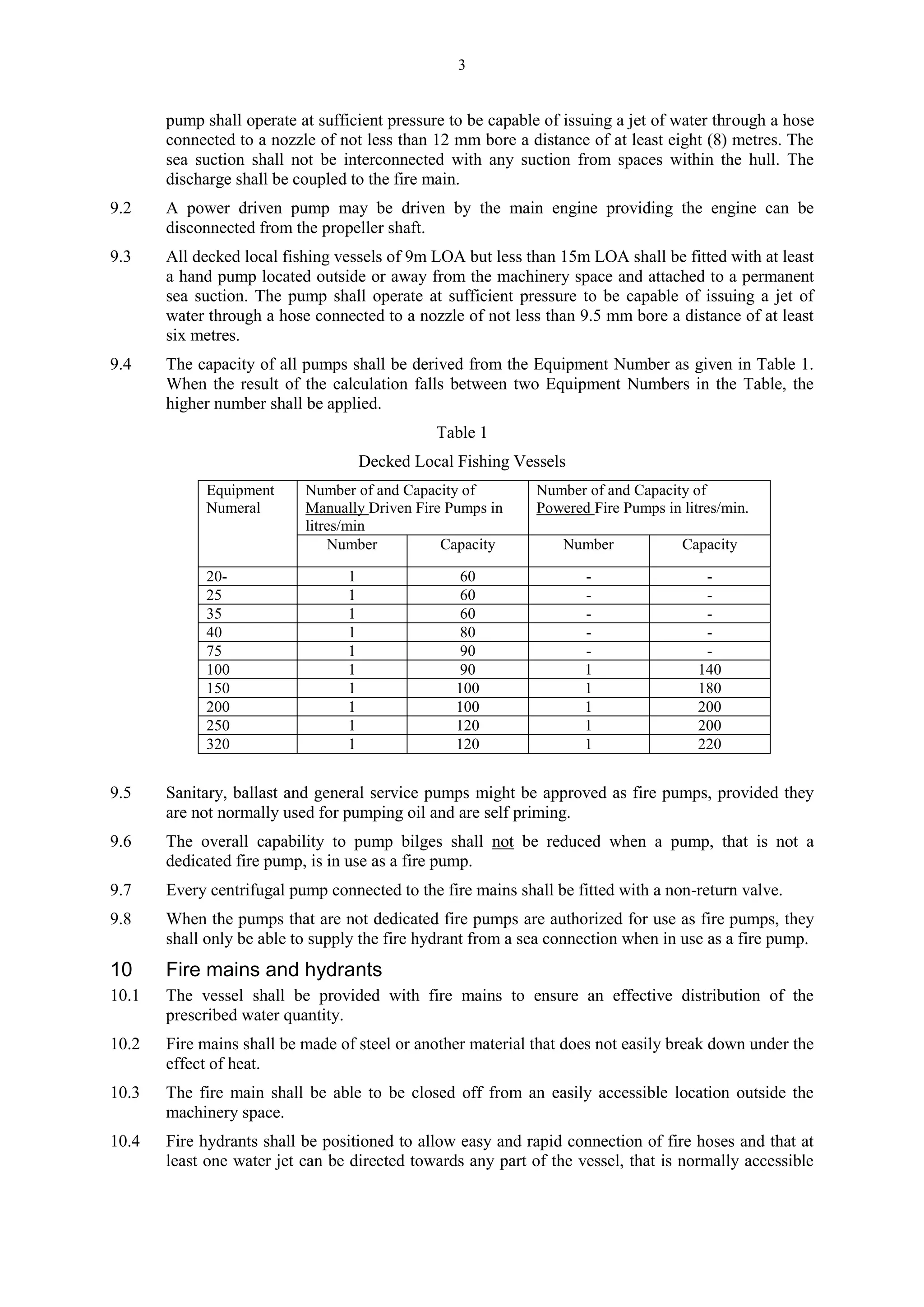
9.4 The capacity of all pumps shall be derived from the Equipment Number as given in Table 1.
When the result of the calculation falls between two Equipment Numbers in the Table, the
higher number shall be applied.
Table 1
Decked Local Fishing Vessels
Equipment
Numeral
Number of and Capacity of
Manually Driven Fire Pumps in
litres/min
Number of and Capacity of
Powered Fire Pumps in litres/min.
Number Capacity Number Capacity
20- 1 60 - -
25 1 60 - -
35 1 60 - -
40 1 80 - -
75 1 90 - -
100 1 90 1 140
150 1 100 1 180
200 1 100 1 200
250 1 120 1 200
320 1 120 1 220
9.5 Sanitary, ballast and general service pumps might be approved as fire pumps, provided they
are not normally used for pumping oil and are self priming.
9.6 The overall capability to pump bilges shall not be reduced when a pump, that is not a
dedicated fire pump, is in use as a fire pump.
9.7 Every centrifugal pump connected to the fire mains shall be fitted with a non-return valve.
9.8 When the pumps that are not dedicated fire pumps are authorized for use as fire pumps, they
shall only be able to supply the fire hydrant from a sea connection when in use as a fire pump.
10 Fire mains and hydrants
10.1 The vessel shall be provided with fire mains to ensure an effective distribution of the
prescribed water quantity.
10.2 Fire mains shall be made of steel or another material that does not easily break down under the
effect of heat.
10.3 The fire main shall be able to be closed off from an easily accessible location outside the
machinery space.
10.4 Fire hydrants shall be positioned to allow easy and rapid connection of fire hoses and that at
least one water jet can be directed towards any part of the vessel, that is normally accessible
4
during navigation. In fully decked vessel of 17m LOA and over but less than 24m LOA, at
least one (1) hydrant shall be fitted in the machinery space containing propelling machinery.
10.5 The water jet shall come from a single length of fire hose fitted with a nozzle of not less than
12mm bore for a vessel of 21m LOA but less than 24 m LOA. In vessels of 9m LOA but less
than 21m LOA the bore of the nozzle shall be not less than 12mm if the pump is power driven
or not less than 9.5mm if the fire pump is a hand pump.
10.6 The pressure in the fire mains and velocity of water through nozzles shall not cause difficulty
to the operator when handling a hose and in maneuvering.
10.7 The length of individual fire hoses shall not exceed 18 metres.
10.8 With the exception of installations, where fire hoses are permanently connected to the main
fire hydrant, the couplings on fire hoses and spraying nozzles shall be interchangeable.
11 Fire extinguishing systems in machinery spaces
11.1 The Minister or delegated authority may require the machinery spaces containing main
propelling machinery and auxiliary machinery of a decked vessel having a total energy output
of at least 375 kW (502Hp) to be provided with one of the following fire-fighting systems.
 a water spray system that may be supplied from a manually operated pump or other
suitable means of pressurizing the system;
 a system for fire-fighting using gases;
 a fire-fighting system using high-expansion foam; or
 a fire extinguishing system using vapour from low toxicity vapourizing liquids.
11.2 Where the systems referred to in 11.1 are fixed, they should be able to be operated from an
easily accessible location outside spaces which are unlikely to be cut off in case of fire in the
protected space. Measures should be taken to ensure that there is an adequate supply of
energy and water to operate the system in event of fire in the protected space.
12 Portable fire extinguishers
12.1 General
12.1.1 Fire extinguishers shall be of a type and size approved by the Minister or delegated authority
for each class of vessel.
12.2 Undecked or partially decked vessel
12.2.1 A vessels fitted with petrol fuelled outboard engines shall carry not less than:
 one in number 2kg fire extinguisher suitable for classes A, B and C fire.
12.2.2 A vessel fitted with an inboard diesel engine or a diesel fueled outboard engine shall carry:
 not less than two in number 2 kg extinguishers suitable for class A, B and C fires.
12.3 Decked vessels
12.3.1 A decked vessel of 12m in length overall and over but less than 15m in length overall shall
carry not less than: -
 one 5 kg. CO2 extinguisher where the installed power does not exceed 75 kW to be
placed close to the entrance to the machinery space. Where the installed power
exceeds 75kW but less than 250kw an additional 5 kg. transportable fire
extinguishers of a type suitable for Class A, B and C fires is required in the
machinery space.
 one 5kg extinguisher suitable for Class A, B and C fires shall be located at the
entrance to the accommodation space and
5
 one 2 kg extinguisher suitable for Class A, B and C fires shall be located in the
wheelhouse;
 where the galley or cooking area is separate, one 2 kg extinguisher suitable for the
fuel to be used.
12.4.2 A decked vessel of 15m in length overall and over but less than 17m in length overall shall
carry for: -
Machinery spaces
 2 x 5 kg. transportable fire extinguishers of a type suitable for Class A, B and C fires
one of which shall be CO2. If such spaces contain machinery with a total energy
output of more than 250 kW (335Hp), there shall be 2 x 5 kg fire extinguishers
suitable for A, B and C fires. One of the fire extinguishers should be positioned close
to the entrance of the space; and,
 one in number 5 kg extinguisher suitable for electrical fires and located close the
electrical switchboard in the machinery space; and,
 if the machinery space is fitted with a fixed smothering system, the control shall be
located outside the machinery space and fitted with an alarm system to allow
adequate time for persons to evacuate the machinery space.
Accommodation spaces
 two in number 5 kg extinguishers suitable for Class A, B and C fires located at the
entrance to the accommodation and;
 one in number 5 kg extinguisher suitable for Class A, B and C fires located in the
wheelhouse and;
 a galley or cooking area shall be provided with at least one in number 5 kg
extinguisher to be suitable for fighting a fire that may be caused by the type of galley
stove fitted and fuel used. The extinguisher to be located close to the entrance to the
galley.
12.4.3 Decked vessel of 17m in length overall and over but less than 24m in Length shall carry for:
Machinery spaces where the installed power does not exceed 375 kW (500 hp):
 2 x 5 kg. transportable fire extinguishers of a type suitable for extinguishing Class A,
B and C fires and one 2 kg CO2 extinguisher. One of the extinguishers for class A, B
and C fires should be positioned close to the entrance of the machinery space and one
at or close to the control position for the main engine(s) in the machinery space; and,
 one in number 5 kg extinguisher suitable for Class C fires located in machinery space
containing the main electrical switchboard, and;
 if the machinery space is fitted a fixed smothering system, the control shall be located
outside the machinery space and fitted with an alarm system to allow adequate time
for persons to evacuate the machinery space.
Machinery spaces where the installed power is greater than 375 kW (500hp)
 the competent authority, may require a fixed smothering system.
Accommodation areas
 a galley or cooking area shall be provided with at least one in number 5 kg to be
suitable for fighting a fire that may be caused by the type of galley stove fitted and
fuel used. The extinguisher to be located close to the entrance to the galley; and,
 two in number 5 kg extinguishers suitable for Class A and C fires one to be located at
6
the entrance to the accommodation space and the other close to the emergency escape
position; and,
 where a separate mess room is provided, one in number 2 kg extinguisher suitable for
Class A and C fires to be located at the entrance; and
 in control stations, one in number 5 kg extinguisher suitable for Class A, B and C
fires.
13 Outfit
13.1 Every fully decked vessel shall carry a fireman’s axe.
13.2 Protective clothing for the crew and suitable lifelines shall also be carried.
13.3 At least two fire hose nozzles shall be carried one of which to be able to produce a spray of
water. The number of fire hoses shall not be less than one for a vessel of less than 17m and not
less than two for a vessel of 17m in length overall and over but less than 24m in length
overall.
7
Appendix 1
List of Schedules
Schedule 1 Prescribed Forms
Schedule 2 Prescribed Fees
Schedule 3 Safety Equipment for a Local Fishing Vessel
Schedule 4 Fire Protection, Fire Detection, Fire Extinguishing and Fire Fighting Equipment.
Schedule 5 Equipment/Ground Tackle/Anchors and Chains
Schedule 6 Stability and Associated Seaworthiness
Schedule 7 Scantlings for the Construction of a Wooden Hulled Local Fishing Vessel
Schedule 8 Scantlings for the Construction of a Fibreglass Hulled Local Fishing Vessel
Schedule 9 Scantlings for the Construction of a Steel Hulled Local Fishing Vessel
Schedule 10 Machinery and Electrical Installations
Schedule 11 Specifications for the Marking of Fishing Vessels

Schedule 4

  • 1.
    28 January 201615:48 StandardSpecifications for the Construction of Local Fishing Vessels of less than 24 metres in Length Overall Country........ Fisheries Act................ Regulation .................... Section ......................... Schedule 4 Fire protection, fire detection, fire extinguishing and fire fighting equipment
  • 2.
    ii Contents Fire protection, firedetection, fire extinguishing and fire fighting equipment.............................................. 1 Appendix 1 .................................................................................................................................................... 7 List of Schedules ........................................................................................................................................... 7
  • 3.
    1 Fire protection, firedetection, fire extinguishing and fire fighting equipment 1 Definitions In this Schedule, unless the context otherwise requires- i. “Class A Fires “refers to fires of common combustible solids such as wood, paper and plastic. ii. “Class B Fires” refers to fires of oil, grease, gas and other substances that give large amounts of flammable vapours. iii. “Class C Fires” refers to fires involving energized electrical equipment, conductors and appliances. iv. “LPG” refers to liquid petroleum gas used for domestic purposes. v. The symbol “m” refers to the metric measure metres. vi. The symbol “mm” refers to the metric measure millimeters. 2 General 2.1 Every local fishing vessel shall be so constructed and equipped that there is no substantial fire risk to the vessel or to persons on board the vessel. The structural fire protection arrangements, for a decked local fishing vessel, shall be capable of withstanding the passage of flame for at least one half-hour unless the Minister or delegated authority is satisfied that suitable alternative arrangements have been provided. 2.2 Fire extinguishing appliances shall be kept in good order and available for immediate use at all times. For this purpose they shall be fitted with a means to show the state of the charge 2.3 Where in this schedule any special type of appliance, apparatus, extinguishing medium or arrangement is specified, any other type of appliance etc. may be allowed provided that the Minister or delegated authority is satisfied that it is not less effective 3 Structural fire protection 3.1 If steel decks or steel bulkheads in accommodation form the top or side of a fuel oil tank, they shall be coated with a non-flammable material of minimum thickness of 40 mm. Manholes or other openings to fuel oil tanks shall not be positioned in the accommodation. 3.2 External bulkheads and vessel’s sides, which delimit the accommodation spaces, should be insulated with at least 50 mm insulating material. Bulkheads between accommodation spaces and machinery spaces or fishrooms shall be made of steel in a steel vessel. In wooden vessels, they can be built of 2 layers of wood with 2 layers of felt or similar in between or of 60mm thick wood with a lining of insulating plates. 3.3 Where there is a door between the accommodation space and the machinery space, this shall be self-closing. Doors between galley rooms and dining rooms might be permitted, provided they are made of fire-retardant material. 4 Ventilation systems 4.1 Where powered ventilators are installed they shall be fitted with a means of stopping the motors in an emergency from a position outside the spaces served by the ventilators. The position of the emergency stop shall be to the approval of the Minister or delegated authority. 4.2 Means shall be provided for the closing of ventilator air intakes and exhaust openings. 4.3 Storerooms, that contain considerable quantities of highly flammable products, shall be provided with ventilation systems, which are separate from other ventilation systems. Ventilation should be effected at both the top and bottom of the room, and the ventilators’
  • 4.
    2 inlet and outletopenings should be located in safe areas. Suitable wire netting screen for extinguishing sparks shall be fitted over ventilation openings’ inlets and outlets. Such ventilation systems shall not exhaust in close proximity to the inlets of other ventilation systems. 4.4 Ventilation systems, that serve machinery spaces, shall be independent of systems serving other rooms. 5 Means of escape 5.1 In accommodation spaces, there shall be at least two exit possibilities from each large room or group of rooms and the exits shall be positioned as far from each other as possible. 5.2 In special cases, the Minister or delegated authority might grant exemption from the one of the exits, taking account of the location of the room and the number of persons who will normally accommodate the room. In such cases, the width of and course to exits shall be to the approval of the Minister or delegated authority. 6 Cooking appliances 6.1 In spaces where gas appliances are used for cooking, or other domestic purposes and where such gas supplies are stored, audible alarm/hydrocarbon sensors shall be fitted in appropriate locations to give warning of the leakage of gas. Audible alarm/sensors shall also be installed at the low point of adjoining accommodation and or mess room spaces. 6.2 Spaces which contain such cookers or water heaters shall have suitable ventilation in order to remove vapours and any gas leaks to a safe place. 6.3 All pipes which conduct gas from tank to cooker or water heater shall be made of steel or another approved material. Gas supply pipe of seamless annealed copper pipe shall be of type K or L conforming to ASTM B88-75a the wall thickness of which shall not be less than 0.815mm (0.032”). Flexible reinforced rubber gas piping shall be of an approved marine quality type with permanently attached swaged end fittings. There shall be automatic, gas switch-off devices which are activated in event of a fall in the gas pressure in the main gas pipe or failure of the pilot flame in any appliance. 6.4 A single action shut-off valve shall be installed adjacent to the stove in an easily accessible location and a pressure gauge shall be installed at the low-pressure side of the gas cylinder, regulator unit. 6.5 A cooking appliance shall be fitted with a system of potholders to prevent pots from sliding off stovetop or overturning. 6.6 LPG warning notices shall be placed at the cylinder locker and adjacent to the cooking appliance. 7 Automatic fire detection and fire alarm systems 7.1 Machinery spaces containing propelling machinery should be provided with suitable alarm and fire detection systems. 8 Storage of gas cylinders 8.1 Containers for compressed, liquid or dissolved gases should be carefully secured and clearly marked, using the prescribed identity colours, with a clear, legible identification of the name and chemical formula of the content. 8.1 Gas cylinders supplying domestic appliances shall be installed outside wheelhouse/deckhouse in a ventilated dedicated locker. Such lockers shall not be closer than 0.9m (36”) to any opening to the interior of the vessel or ventilator intake. 9 Fire pumps 9.1 A decked local fishing vessel of 15 m LOA but less than 24 m LOA shall be provided with at least one (1) power-driven fire pump and one (1) manually operated pump. Each individual
  • 5.
    3 pump shall operateat sufficient pressure to be capable of issuing a jet of water through a hose connected to a nozzle of not less than 12 mm bore a distance of at least eight (8) metres. The sea suction shall not be interconnected with any suction from spaces within the hull. The discharge shall be coupled to the fire main. 9.2 A power driven pump may be driven by the main engine providing the engine can be disconnected from the propeller shaft. 9.3 All decked local fishing vessels of 9m LOA but less than 15m LOA shall be fitted with at least a hand pump located outside or away from the machinery space and attached to a permanent sea suction. The pump shall operate at sufficient pressure to be capable of issuing a jet of water through a hose connected to a nozzle of not less than 9.5 mm bore a distance of at least six metres. 9.4 The capacity of all pumps shall be derived from the Equipment Number as given in Table 1. When the result of the calculation falls between two Equipment Numbers in the Table, the higher number shall be applied. Table 1 Decked Local Fishing Vessels Equipment Numeral Number of and Capacity of Manually Driven Fire Pumps in litres/min Number of and Capacity of Powered Fire Pumps in litres/min. Number Capacity Number Capacity 20- 1 60 - - 25 1 60 - - 35 1 60 - - 40 1 80 - - 75 1 90 - - 100 1 90 1 140 150 1 100 1 180 200 1 100 1 200 250 1 120 1 200 320 1 120 1 220 9.5 Sanitary, ballast and general service pumps might be approved as fire pumps, provided they are not normally used for pumping oil and are self priming. 9.6 The overall capability to pump bilges shall not be reduced when a pump, that is not a dedicated fire pump, is in use as a fire pump. 9.7 Every centrifugal pump connected to the fire mains shall be fitted with a non-return valve. 9.8 When the pumps that are not dedicated fire pumps are authorized for use as fire pumps, they shall only be able to supply the fire hydrant from a sea connection when in use as a fire pump. 10 Fire mains and hydrants 10.1 The vessel shall be provided with fire mains to ensure an effective distribution of the prescribed water quantity. 10.2 Fire mains shall be made of steel or another material that does not easily break down under the effect of heat. 10.3 The fire main shall be able to be closed off from an easily accessible location outside the machinery space. 10.4 Fire hydrants shall be positioned to allow easy and rapid connection of fire hoses and that at least one water jet can be directed towards any part of the vessel, that is normally accessible
  • 6.
    4 during navigation. Infully decked vessel of 17m LOA and over but less than 24m LOA, at least one (1) hydrant shall be fitted in the machinery space containing propelling machinery. 10.5 The water jet shall come from a single length of fire hose fitted with a nozzle of not less than 12mm bore for a vessel of 21m LOA but less than 24 m LOA. In vessels of 9m LOA but less than 21m LOA the bore of the nozzle shall be not less than 12mm if the pump is power driven or not less than 9.5mm if the fire pump is a hand pump. 10.6 The pressure in the fire mains and velocity of water through nozzles shall not cause difficulty to the operator when handling a hose and in maneuvering. 10.7 The length of individual fire hoses shall not exceed 18 metres. 10.8 With the exception of installations, where fire hoses are permanently connected to the main fire hydrant, the couplings on fire hoses and spraying nozzles shall be interchangeable. 11 Fire extinguishing systems in machinery spaces 11.1 The Minister or delegated authority may require the machinery spaces containing main propelling machinery and auxiliary machinery of a decked vessel having a total energy output of at least 375 kW (502Hp) to be provided with one of the following fire-fighting systems.  a water spray system that may be supplied from a manually operated pump or other suitable means of pressurizing the system;  a system for fire-fighting using gases;  a fire-fighting system using high-expansion foam; or  a fire extinguishing system using vapour from low toxicity vapourizing liquids. 11.2 Where the systems referred to in 11.1 are fixed, they should be able to be operated from an easily accessible location outside spaces which are unlikely to be cut off in case of fire in the protected space. Measures should be taken to ensure that there is an adequate supply of energy and water to operate the system in event of fire in the protected space. 12 Portable fire extinguishers 12.1 General 12.1.1 Fire extinguishers shall be of a type and size approved by the Minister or delegated authority for each class of vessel. 12.2 Undecked or partially decked vessel 12.2.1 A vessels fitted with petrol fuelled outboard engines shall carry not less than:  one in number 2kg fire extinguisher suitable for classes A, B and C fire. 12.2.2 A vessel fitted with an inboard diesel engine or a diesel fueled outboard engine shall carry:  not less than two in number 2 kg extinguishers suitable for class A, B and C fires. 12.3 Decked vessels 12.3.1 A decked vessel of 12m in length overall and over but less than 15m in length overall shall carry not less than: -  one 5 kg. CO2 extinguisher where the installed power does not exceed 75 kW to be placed close to the entrance to the machinery space. Where the installed power exceeds 75kW but less than 250kw an additional 5 kg. transportable fire extinguishers of a type suitable for Class A, B and C fires is required in the machinery space.  one 5kg extinguisher suitable for Class A, B and C fires shall be located at the entrance to the accommodation space and
  • 7.
    5  one 2kg extinguisher suitable for Class A, B and C fires shall be located in the wheelhouse;  where the galley or cooking area is separate, one 2 kg extinguisher suitable for the fuel to be used. 12.4.2 A decked vessel of 15m in length overall and over but less than 17m in length overall shall carry for: - Machinery spaces  2 x 5 kg. transportable fire extinguishers of a type suitable for Class A, B and C fires one of which shall be CO2. If such spaces contain machinery with a total energy output of more than 250 kW (335Hp), there shall be 2 x 5 kg fire extinguishers suitable for A, B and C fires. One of the fire extinguishers should be positioned close to the entrance of the space; and,  one in number 5 kg extinguisher suitable for electrical fires and located close the electrical switchboard in the machinery space; and,  if the machinery space is fitted with a fixed smothering system, the control shall be located outside the machinery space and fitted with an alarm system to allow adequate time for persons to evacuate the machinery space. Accommodation spaces  two in number 5 kg extinguishers suitable for Class A, B and C fires located at the entrance to the accommodation and;  one in number 5 kg extinguisher suitable for Class A, B and C fires located in the wheelhouse and;  a galley or cooking area shall be provided with at least one in number 5 kg extinguisher to be suitable for fighting a fire that may be caused by the type of galley stove fitted and fuel used. The extinguisher to be located close to the entrance to the galley. 12.4.3 Decked vessel of 17m in length overall and over but less than 24m in Length shall carry for: Machinery spaces where the installed power does not exceed 375 kW (500 hp):  2 x 5 kg. transportable fire extinguishers of a type suitable for extinguishing Class A, B and C fires and one 2 kg CO2 extinguisher. One of the extinguishers for class A, B and C fires should be positioned close to the entrance of the machinery space and one at or close to the control position for the main engine(s) in the machinery space; and,  one in number 5 kg extinguisher suitable for Class C fires located in machinery space containing the main electrical switchboard, and;  if the machinery space is fitted a fixed smothering system, the control shall be located outside the machinery space and fitted with an alarm system to allow adequate time for persons to evacuate the machinery space. Machinery spaces where the installed power is greater than 375 kW (500hp)  the competent authority, may require a fixed smothering system. Accommodation areas  a galley or cooking area shall be provided with at least one in number 5 kg to be suitable for fighting a fire that may be caused by the type of galley stove fitted and fuel used. The extinguisher to be located close to the entrance to the galley; and,  two in number 5 kg extinguishers suitable for Class A and C fires one to be located at
  • 8.
    6 the entrance tothe accommodation space and the other close to the emergency escape position; and,  where a separate mess room is provided, one in number 2 kg extinguisher suitable for Class A and C fires to be located at the entrance; and  in control stations, one in number 5 kg extinguisher suitable for Class A, B and C fires. 13 Outfit 13.1 Every fully decked vessel shall carry a fireman’s axe. 13.2 Protective clothing for the crew and suitable lifelines shall also be carried. 13.3 At least two fire hose nozzles shall be carried one of which to be able to produce a spray of water. The number of fire hoses shall not be less than one for a vessel of less than 17m and not less than two for a vessel of 17m in length overall and over but less than 24m in length overall.
  • 9.
    7 Appendix 1 List ofSchedules Schedule 1 Prescribed Forms Schedule 2 Prescribed Fees Schedule 3 Safety Equipment for a Local Fishing Vessel Schedule 4 Fire Protection, Fire Detection, Fire Extinguishing and Fire Fighting Equipment. Schedule 5 Equipment/Ground Tackle/Anchors and Chains Schedule 6 Stability and Associated Seaworthiness Schedule 7 Scantlings for the Construction of a Wooden Hulled Local Fishing Vessel Schedule 8 Scantlings for the Construction of a Fibreglass Hulled Local Fishing Vessel Schedule 9 Scantlings for the Construction of a Steel Hulled Local Fishing Vessel Schedule 10 Machinery and Electrical Installations Schedule 11 Specifications for the Marking of Fishing Vessels