Presented by Vruddhi Jadhav
Table of Content
Introduction
1.
How Scene Recognition Works
2.
Applications of Scene Recognition
3.
Problems
4.
Conclusion
5.
Introduction
1.
What is Scene Recognition?
Scene recognition is a subfield of digital image processing that focuses
on identifying and categorizing entire scenes within images. Unlike
object recognition, which centers on detecting specific objects, scene
recognition analyzes the overall context of the image.
Why is it Important?
Enhances understanding of visual data, enabling applications in various
fields.
Real-world Applications
Autonomous vehicles, surveillance, image search, robotics, etc
How Scene Recognition Works
2.
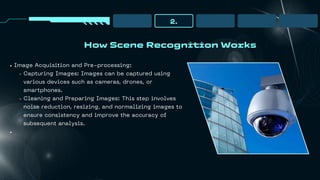
Image Acquisition and Pre-processing:
Capturing Images: Images can be captured using
various devices such as cameras, drones, or
smartphones.
Cleaning and Preparing Images: This step involves
noise reduction, resizing, and normalizing images to
ensure consistency and improve the accuracy of
subsequent analysis.
How Scene Recognition Works
2. Problems Innovation Conclusion
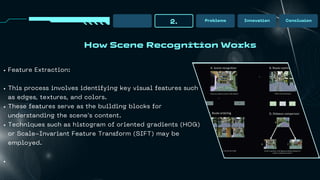
Feature Extraction:
This process involves identifying key visual features such
as edges, textures, and colors.
These features serve as the building blocks for
understanding the scene's content.
Techniques such as histogram of oriented gradients (HOG)
or Scale-Invariant Feature Transform (SIFT) may be
employed.
How Scene Recognition Works
2.
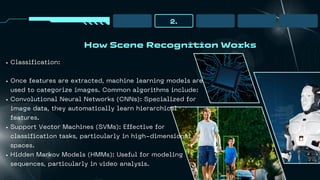
Classification:
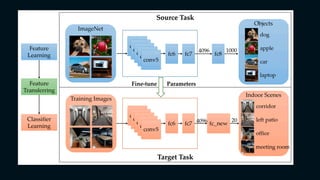
Once features are extracted, machine learning models are
used to categorize images. Common algorithms include:
Convolutional Neural Networks (CNNs): Specialized for
image data, they automatically learn hierarchical
features.
Support Vector Machines (SVMs): Effective for
classification tasks, particularly in high-dimensional
spaces.
Hidden Markov Models (HMMs): Useful for modeling
sequences, particularly in video analysis.
3.
Applications
Autonomous Vehicles Image Search Robotics Surveillance Systems
Problems
Problems
Challenges and Limitations of Scene Recognition
Data Dependency
1.
Requires large, labeled datasets for training, which can be time-consuming to collect.
Variability in Scenes
2.
Environmental changes (lighting, weather) can affect scene appearance.
Computational Requirements
3.
High resource consumption for training deep learning models.
Model Complexity
4.
Risk of overfitting to training data, leading to poor generalization.
Dynamic Environments
5.
Challenges in recognizing scenes with moving objects or rapidly changing contexts.
Generalization
6.
Difficulty in adapting models trained on specific datasets to new domains.
Ethical Considerations
7.
Privacy concerns arise with the use of scene recognition in surveillance.
4.
Conclusion
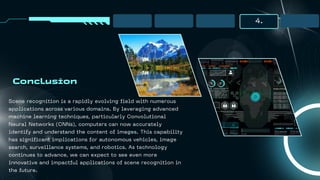
Scene recognition is a rapidly evolving field with numerous
applications across various domains. By leveraging advanced
machine learning techniques, particularly Convolutional
Neural Networks (CNNs), computers can now accurately
identify and understand the content of images. This capability
has significant implications for autonomous vehicles, image
search, surveillance systems, and robotics. As technology
continues to advance, we can expect to see even more
innovative and impactful applications of scene recognition in
the future.
Scene_recognition_in_digital_image_processing.pdf

Scene_recognition_in_digital_image_processing.pdf

  • 1.
  • 2.
    Table of Content Introduction 1. HowScene Recognition Works 2. Applications of Scene Recognition 3. Problems 4. Conclusion 5.
  • 3.
    Introduction 1. What is SceneRecognition? Scene recognition is a subfield of digital image processing that focuses on identifying and categorizing entire scenes within images. Unlike object recognition, which centers on detecting specific objects, scene recognition analyzes the overall context of the image. Why is it Important? Enhances understanding of visual data, enabling applications in various fields. Real-world Applications Autonomous vehicles, surveillance, image search, robotics, etc
  • 4.
    How Scene RecognitionWorks 2. Image Acquisition and Pre-processing: Capturing Images: Images can be captured using various devices such as cameras, drones, or smartphones. Cleaning and Preparing Images: This step involves noise reduction, resizing, and normalizing images to ensure consistency and improve the accuracy of subsequent analysis.
  • 6.
    How Scene RecognitionWorks 2. Problems Innovation Conclusion Feature Extraction: This process involves identifying key visual features such as edges, textures, and colors. These features serve as the building blocks for understanding the scene's content. Techniques such as histogram of oriented gradients (HOG) or Scale-Invariant Feature Transform (SIFT) may be employed.
  • 7.
    How Scene RecognitionWorks 2. Classification: Once features are extracted, machine learning models are used to categorize images. Common algorithms include: Convolutional Neural Networks (CNNs): Specialized for image data, they automatically learn hierarchical features. Support Vector Machines (SVMs): Effective for classification tasks, particularly in high-dimensional spaces. Hidden Markov Models (HMMs): Useful for modeling sequences, particularly in video analysis.
  • 8.
    3. Applications Autonomous Vehicles ImageSearch Robotics Surveillance Systems
  • 9.
    Problems Problems Challenges and Limitationsof Scene Recognition Data Dependency 1. Requires large, labeled datasets for training, which can be time-consuming to collect. Variability in Scenes 2. Environmental changes (lighting, weather) can affect scene appearance. Computational Requirements 3. High resource consumption for training deep learning models. Model Complexity 4. Risk of overfitting to training data, leading to poor generalization. Dynamic Environments 5. Challenges in recognizing scenes with moving objects or rapidly changing contexts. Generalization 6. Difficulty in adapting models trained on specific datasets to new domains. Ethical Considerations 7. Privacy concerns arise with the use of scene recognition in surveillance.
  • 10.
    4. Conclusion Scene recognition isa rapidly evolving field with numerous applications across various domains. By leveraging advanced machine learning techniques, particularly Convolutional Neural Networks (CNNs), computers can now accurately identify and understand the content of images. This capability has significant implications for autonomous vehicles, image search, surveillance systems, and robotics. As technology continues to advance, we can expect to see even more innovative and impactful applications of scene recognition in the future.