V i k i n g s T e a m
Nhat Nguyen (735637) , Abbie Sauter (735048) , Kelvin Simeon (734639)
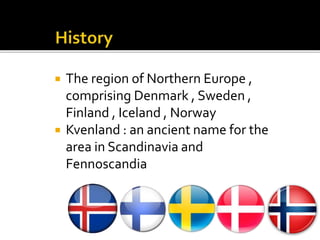
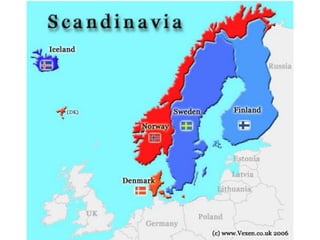
 The region of Northern Europe ,
comprising Denmark , Sweden ,
Finland , Iceland , Norway
 Kvenland : an ancient name for the
area in Scandinavia and
Fennoscandia
 The date ofVikingAge are not clearly drawn ,
but many consider the start to be the year 793
and the end to be the year 1066
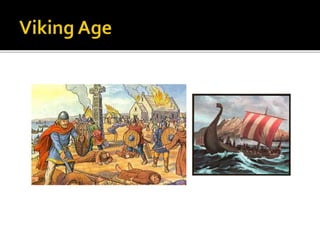
 Scandinavian explored Europe by sea and
rivers for trades , raids , colonisation and
conquest
 The information aboutVikingAge was written
by theViking’s enemies and primary sources of
archaeology
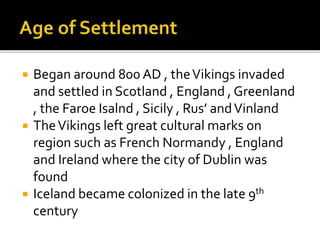
 Began around 800 AD , theVikings invaded
and settled in Scotland , England , Greenland
, the Faroe Isalnd , Sicily , Rus’ andVinland
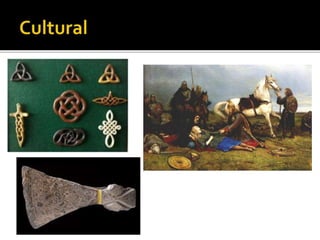
 TheVikings left great cultural marks on
region such as French Normandy , England
and Ireland where the city of Dublin was
found
 Iceland became colonized in the late 9th
century
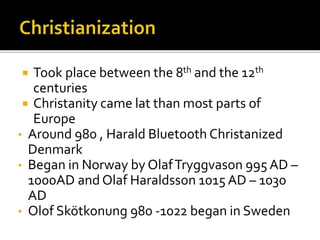
 Took place between the 8th and the 12th
centuries
 Christanity came lat than most parts of
Europe
• Around 980 , Harald Bluetooth Christanized
Denmark
• Began in Norway by OlafTryggvason 995 AD –
1000AD and Olaf Haraldsson 1015 AD – 1030
AD
• Olof Skötkonung 980 -1022 began in Sweden
 The Scandinavians still tend to see their native
cuisine in humble terms because they started
their industrialized from a background of rural
poverty within the last century
 The cooking is pure and simple . So many thing
fish , pork and poutry , as well as beets ,
potatoes , cucumbers etc
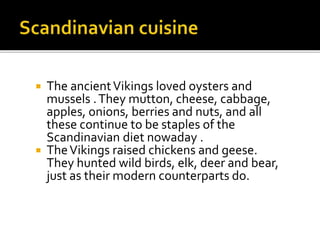
 The ancientVikings loved oysters and
mussels .They mutton, cheese, cabbage,
apples, onions, berries and nuts, and all
these continue to be staples of the
Scandinavian diet nowaday .
 TheVikings raised chickens and geese.
They hunted wild birds, elk, deer and bear,
just as their modern counterparts do.
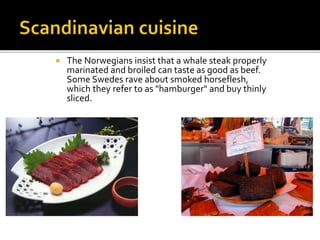
 The Norwegians insist that a whale steak properly
marinated and broiled can taste as good as beef.
Some Swedes rave about smoked horseflesh,
which they refer to as "hamburger" and buy thinly
sliced.
 To cook the Scandinavian way is to re-create
the past. For hundreds of years many of the
recipes being used today weren’t written down
but handed down , mouth to mouth, memory
to memory.
 If many of the foods of the area have a salty or
smoky taste, or are pickled or dried, it’s largely
because of winter
 The Danes for centuries have eaten a lot of
meat –especially loads of Pork , but also Beef
with plenty of potatoes and vegetables
 Poutry and Fish are the second choice
 Ancient food recipes from all over the kingdom
created first and foremost to protect the Danes
aginst the cold weather conditions
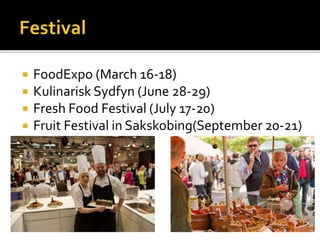
 FoodExpo (March 16-18)
 Kulinarisk Sydfyn (June 28-29)
 Fresh Food Festival (July 17-20)
 Fruit Festival in Sakskobing(September 20-21)
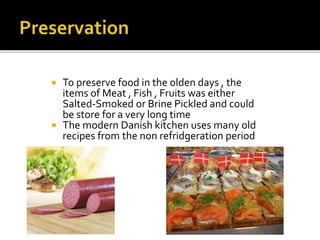
 To preserve food in the olden days , the
items of Meat , Fish , Fruits was either
Salted-Smoked or Brine Pickled and could
be store for a very long time
 The modern Danish kitchen uses many old
recipes from the non refridgeration period
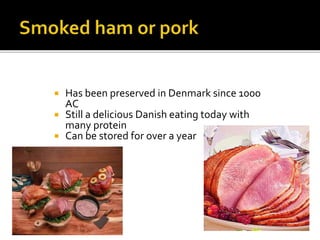
 Has been preserved in Denmark since 1000
AC
 Still a delicious Danish eating today with
many protein
 Can be stored for over a year
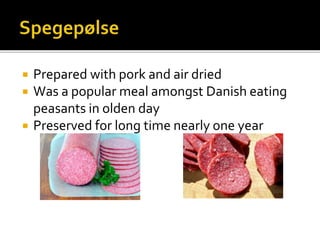
 Prepared with pork and air dried
 Was a popular meal amongst Danish eating
peasants in olden day
 Preserved for long time nearly one year
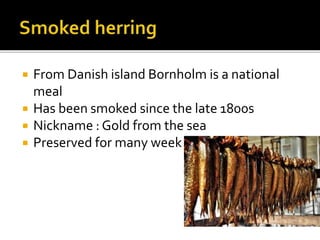
 From Danish island Bornholm is a national
meal
 Has been smoked since the late 1800s
 Nickname : Gold from the sea
 Preserved for many week
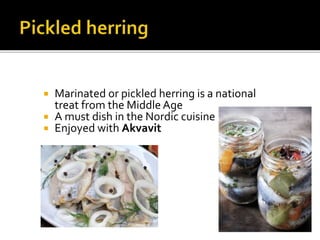
 Marinated or pickled herring is a national
treat from the Middle Age
 A must dish in the Nordic cuisine
 Enjoyed with Akvavit
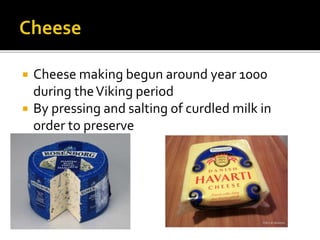
 Cheese making begun around year 1000
during theViking period
 By pressing and salting of curdled milk in
order to preserve
 There are 3 main meals in Denmark :
Breakfast and Dinner typically eaten at home
 Lunch for practical reason has been eaten
somewhere , brought from home
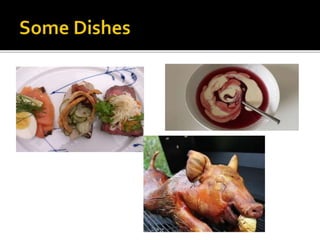
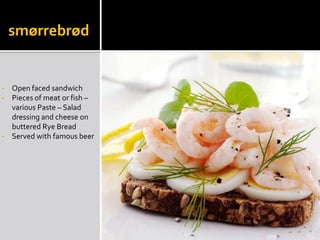
smørrebrød
• Open faced sandwich
• Pieces of meat or fish –
various Paste – Salad
dressing and cheese on
buttered Rye Bread
• Served with famous beer
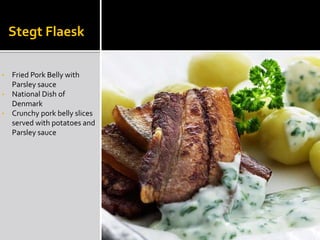
Stegt Flaesk
• Fried Pork Belly with
Parsley sauce
• National Dish of
Denmark
• Crunchy pork belly slices
served with potatoes and
Parsley sauce
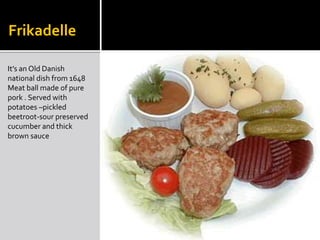
Frikadelle
It’s an Old Danish
national dish from 1648
Meat ball made of pure
pork . Served with
potatoes –pickled
beetroot-sour preserved
cucumber and thick
brown sauce
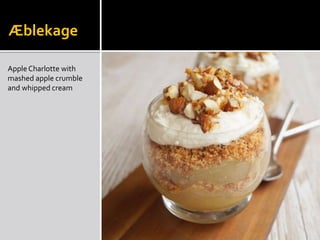
Æblekage
AppleCharlotte with
mashed apple crumble
and whipped cream
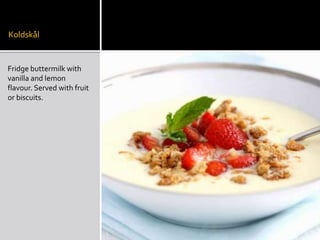
Koldskål
Fridge buttermilk with
vanilla and lemon
flavour. Served with fruit
or biscuits.
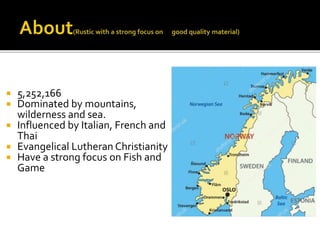
 5,252,166
 Dominated by mountains,
wilderness and sea.
 Influenced by Italian, French and
Thai
 Evangelical Lutheran Christianity
 Have a strong focus on Fish and
Game
 young country
 10000 years ago
 Survived by hunting and fishing and eventually
began farming
 500 BC- Bronze Age
 1030 Norway became a kingdom and Christianity
was introduced
 1350 the black death wiped out half of Norway's
population
 1905
 Oils and gas fields discovered off the coast
 Sami, also known as Lapps
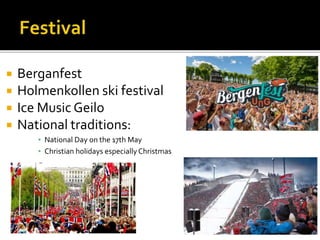
 Berganfest
 Holmenkollen ski festival
 Ice Music Geilo
 National traditions:
▪ National Day on the 17th May
▪ Christian holidays especiallyChristmas
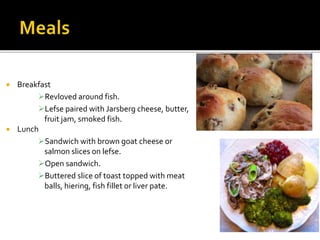
 Breakfast
Revloved around fish.
Lefse paired with Jarsberg cheese, butter,
fruit jam, smoked fish.
 Lunch
Sandwich with brown goat cheese or
salmon slices on lefse.
Open sandwich.
Buttered slice of toast topped with meat
balls, hiering, fish fillet or liver pate.
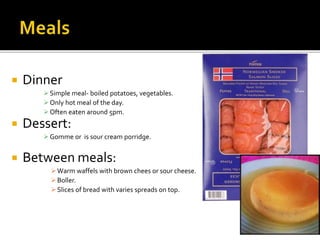
 Dinner
Simple meal- boiled potatoes, vegetables.
Only hot meal of the day.
Often eaten around 5pm.
 Dessert:
Gomme or is sour cream porridge.
 Between meals:
Warm waffels with brown chees or sour cheese.
Boller.
Slices of bread with varies spreads on top.
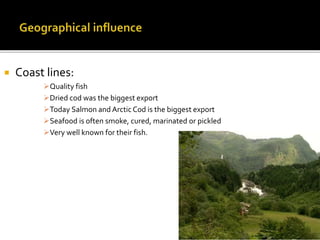
 Coast lines:
Quality fish
Dried cod was the biggest export
Today Salmon and Arctic Cod is the biggest export
Seafood is often smoke, cured, marinated or pickled
Very well known for their fish.
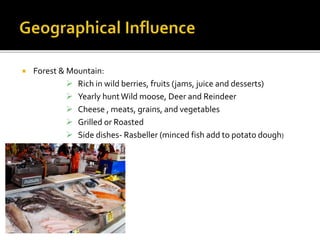
 Forest & Mountain:
 Rich in wild berries, fruits (jams, juice and desserts)
 Yearly huntWild moose, Deer and Reindeer
 Cheese , meats, grains, and vegetables
 Grilled or Roasted
 Side dishes- Rasbeller (minced fish add to potato dough)
 Preserve fish, meat and game by drying,
pickling or salting.
 Fish is commonly braised or poached
 Meats are roasted, braised or stewed.
 Vegetables are often boiled or braised.
 Dill is a common seasoning ingredient.
 Staple food is potatoes, peas, cabbage
and carrots.
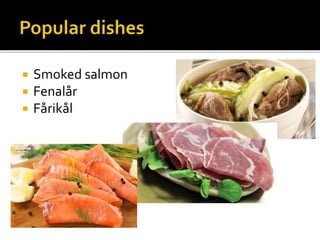
 Smoked salmon
 Fenalår
 Fårikål
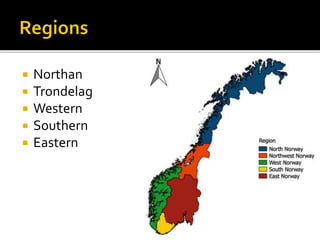
 Northan
 Trondelag
 Western
 Southern
 Eastern
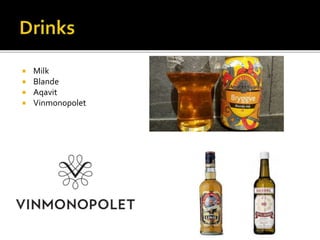
 Milk
 Blande
 Aqavit
 Vinmonopolet
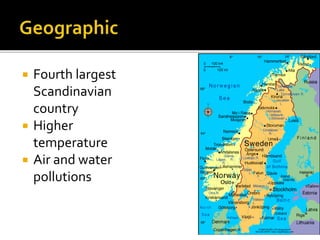
 Fourth largest
Scandinavian
country
 Higher
temperature
 Air and water
pollutions
 Christian country
 Preserve because long winter
 Developed by vikings
 Raid tea from England
 Get sauces and soup from French
 Use leftover for soups
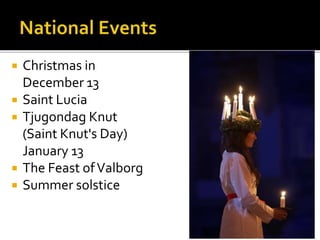
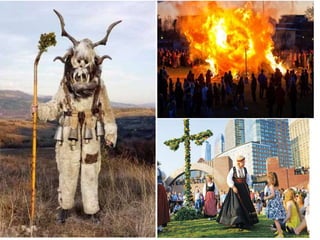
 Christmas in
December 13
 Saint Lucia
 Tjugondag Knut
(Saint Knut's Day)
January 13
 The Feast ofValborg
 Summer solstice
 Start with herring and other fishes
 Cold meat
 Salad
 Egg dishes
 Hot dishes
 Fruit salads and cheese cake
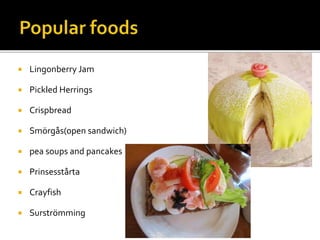
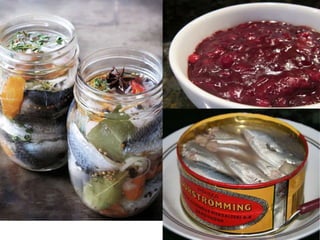
 Lingonberry Jam
 Pickled Herrings
 Crispbread
 Smörgås(open sandwich)
 pea soups and pancakes
 Prinsesstårta
 Crayfish
 Surströmming
 http://recipes.wikia.com/wiki/Scandinavian_Cuisine
 https://www.buzzfeed.com/laurasilver/lingonberry-appreciation-
society?utm_term=.xorz5XnqM2#.iovkmgBZrq
 http://thanksforthefood.com/key-ingredients-norwegian-cuisine/
 http://www.copenhagenet.dk/cph-eating.htm
 http://allscandinavia.com/scandinaviancuisine.htm
 https://en.wikipedia.org/wiki/History_of_Scandinavia
 http://www.hurstwic.org/history/articles/society/text/norse_lands.
htm
 http://www.visitdenmark.co.uk/en-
gb/denmark/gastronomy/danish-pastries
 http://denmark.dk/en/lifestyle/food-drink/
 http://denmark.dk/en/lifestyle/food-drink/danish-food-culture
 http://denmark.dk/en/meet-the-danes/traditions
 Amilien, v. (2012). Anthropology of food . Retrieved from Nordic food culture
https://aof.revues.org/7014
 Kester, B. (n.d.). Visual Geography . Retrieved from Norwat-food:
http://www.visualgeography.com/categories/norway/food.html
 Love, W. (2014, June 12). Thanks for the food . Retrieved from Noregian Cuisine
Explained : http://thanksforthefood.com/norwegian-cuisine/
 Oulton, R. (2010, December 06). Cooks Info. Retrieved from Norwegian Food:
http://www.cooksinfo.com/norwegian-food
 Safari the Globe . (2013, August). Retrieved from Food, Dinning and Drinks in
Norway: http://www.safaritheglobe.com/norway/culture/food-drinks/
 UNKNOWN. (2015, December 17). Hurtigruten . Retrieved fromTraditional cuisine
of Norway: https://www.hurtigruten.us/must-read-articles/cuisine/traditional-
cuisine-of-norway/
 UNKNOWN. (2016). Just Landed . Retrieved from Norwegian Cuisine :
https://www.justlanded.ch/english/Norway/Norway-Guide/Culture/Norwegian-
cuisine
 UNKNOWN. (2017). Norway powered by nature . Retrieved from Food and Drink :
https://www.visitnorway.com/things-to-do/food-and-drink/cuisine/
 Unknown. (n/a). Samfunnskunnskap. Retrieved from History, Geography and way
of life: http://www.samfunnskunnskap.no/?page_id=353&lang=en
 Sampson, A. (2015) Swedish cuisine.Available at:
http://www.sweden.org.za/swedish-cuisine.html (Accessed: 18
February 2017).
 10 things to know about Swedish food (2013)Available at:
https://sweden.se/culture-traditions/10-things-to-know-about-
swedish-food/ (Accessed: 18 February 2017).
 Bergflødt, S., Amilien,V. and Skuland, S. (2012) ‘Snapshots of
Swedish food culture’, Anthropology of food, (S7).
 Top facts about Sweden (2015)Available at:
https://sweden.se/society/sweden-an-overview/ (Accessed: 18
February 2017).
 What is the old name of Scandinavia area ?
 When was the Christianization took place ?
 Why the Scandinavian product have a salty and smoked taste ?
 What is a second choice of the Danes ?
 What is Spegepølse ?
 What is the nicknameof Smoked herring ?
 Where was he Danish pastry actually came from ?
 What is the Norwegian preserve techniques ?
 Name some Nowegian popular dishes ?
 How many regions of Norway ?
 What do people do in Sant Lucia Day ?
 Why Swedish preserve food ?
 List 3 foods from Sweden ?
 What is the open sandwich in Swedish ?

Scandinavia Cuisine

  • 1.
    V i ki n g s T e a m Nhat Nguyen (735637) , Abbie Sauter (735048) , Kelvin Simeon (734639)
  • 2.
     The regionof Northern Europe , comprising Denmark , Sweden , Finland , Iceland , Norway  Kvenland : an ancient name for the area in Scandinavia and Fennoscandia
  • 3.
     The dateofVikingAge are not clearly drawn , but many consider the start to be the year 793 and the end to be the year 1066  Scandinavian explored Europe by sea and rivers for trades , raids , colonisation and conquest  The information aboutVikingAge was written by theViking’s enemies and primary sources of archaeology
  • 5.
     Began around800 AD , theVikings invaded and settled in Scotland , England , Greenland , the Faroe Isalnd , Sicily , Rus’ andVinland  TheVikings left great cultural marks on region such as French Normandy , England and Ireland where the city of Dublin was found  Iceland became colonized in the late 9th century
  • 6.
     Took placebetween the 8th and the 12th centuries  Christanity came lat than most parts of Europe • Around 980 , Harald Bluetooth Christanized Denmark • Began in Norway by OlafTryggvason 995 AD – 1000AD and Olaf Haraldsson 1015 AD – 1030 AD • Olof Skötkonung 980 -1022 began in Sweden
  • 10.
     The Scandinaviansstill tend to see their native cuisine in humble terms because they started their industrialized from a background of rural poverty within the last century  The cooking is pure and simple . So many thing fish , pork and poutry , as well as beets , potatoes , cucumbers etc
  • 11.
     The ancientVikingsloved oysters and mussels .They mutton, cheese, cabbage, apples, onions, berries and nuts, and all these continue to be staples of the Scandinavian diet nowaday .  TheVikings raised chickens and geese. They hunted wild birds, elk, deer and bear, just as their modern counterparts do.
  • 12.
     The Norwegiansinsist that a whale steak properly marinated and broiled can taste as good as beef. Some Swedes rave about smoked horseflesh, which they refer to as "hamburger" and buy thinly sliced.
  • 13.
     To cookthe Scandinavian way is to re-create the past. For hundreds of years many of the recipes being used today weren’t written down but handed down , mouth to mouth, memory to memory.  If many of the foods of the area have a salty or smoky taste, or are pickled or dried, it’s largely because of winter
  • 15.
     The Danesfor centuries have eaten a lot of meat –especially loads of Pork , but also Beef with plenty of potatoes and vegetables  Poutry and Fish are the second choice  Ancient food recipes from all over the kingdom created first and foremost to protect the Danes aginst the cold weather conditions
  • 16.
     FoodExpo (March16-18)  Kulinarisk Sydfyn (June 28-29)  Fresh Food Festival (July 17-20)  Fruit Festival in Sakskobing(September 20-21)
  • 17.
     To preservefood in the olden days , the items of Meat , Fish , Fruits was either Salted-Smoked or Brine Pickled and could be store for a very long time  The modern Danish kitchen uses many old recipes from the non refridgeration period
  • 18.
     Has beenpreserved in Denmark since 1000 AC  Still a delicious Danish eating today with many protein  Can be stored for over a year
  • 19.
     Prepared withpork and air dried  Was a popular meal amongst Danish eating peasants in olden day  Preserved for long time nearly one year
  • 20.
     From Danishisland Bornholm is a national meal  Has been smoked since the late 1800s  Nickname : Gold from the sea  Preserved for many week
  • 21.
     Marinated orpickled herring is a national treat from the Middle Age  A must dish in the Nordic cuisine  Enjoyed with Akvavit
  • 22.
     Cheese makingbegun around year 1000 during theViking period  By pressing and salting of curdled milk in order to preserve
  • 23.
     There are3 main meals in Denmark : Breakfast and Dinner typically eaten at home  Lunch for practical reason has been eaten somewhere , brought from home
  • 25.
    smørrebrød • Open facedsandwich • Pieces of meat or fish – various Paste – Salad dressing and cheese on buttered Rye Bread • Served with famous beer
  • 26.
    Stegt Flaesk • FriedPork Belly with Parsley sauce • National Dish of Denmark • Crunchy pork belly slices served with potatoes and Parsley sauce
  • 27.
    Frikadelle It’s an OldDanish national dish from 1648 Meat ball made of pure pork . Served with potatoes –pickled beetroot-sour preserved cucumber and thick brown sauce
  • 28.
  • 29.
    Koldskål Fridge buttermilk with vanillaand lemon flavour. Served with fruit or biscuits.
  • 32.
     5,252,166  Dominatedby mountains, wilderness and sea.  Influenced by Italian, French and Thai  Evangelical Lutheran Christianity  Have a strong focus on Fish and Game
  • 33.
     young country 10000 years ago  Survived by hunting and fishing and eventually began farming  500 BC- Bronze Age  1030 Norway became a kingdom and Christianity was introduced  1350 the black death wiped out half of Norway's population  1905  Oils and gas fields discovered off the coast  Sami, also known as Lapps
  • 34.
     Berganfest  Holmenkollenski festival  Ice Music Geilo  National traditions: ▪ National Day on the 17th May ▪ Christian holidays especiallyChristmas
  • 35.
     Breakfast Revloved aroundfish. Lefse paired with Jarsberg cheese, butter, fruit jam, smoked fish.  Lunch Sandwich with brown goat cheese or salmon slices on lefse. Open sandwich. Buttered slice of toast topped with meat balls, hiering, fish fillet or liver pate.
  • 36.
     Dinner Simple meal-boiled potatoes, vegetables. Only hot meal of the day. Often eaten around 5pm.  Dessert: Gomme or is sour cream porridge.  Between meals: Warm waffels with brown chees or sour cheese. Boller. Slices of bread with varies spreads on top.
  • 37.
     Coast lines: Qualityfish Dried cod was the biggest export Today Salmon and Arctic Cod is the biggest export Seafood is often smoke, cured, marinated or pickled Very well known for their fish.
  • 38.
     Forest &Mountain:  Rich in wild berries, fruits (jams, juice and desserts)  Yearly huntWild moose, Deer and Reindeer  Cheese , meats, grains, and vegetables  Grilled or Roasted  Side dishes- Rasbeller (minced fish add to potato dough)
  • 39.
     Preserve fish,meat and game by drying, pickling or salting.  Fish is commonly braised or poached  Meats are roasted, braised or stewed.  Vegetables are often boiled or braised.  Dill is a common seasoning ingredient.  Staple food is potatoes, peas, cabbage and carrots.
  • 40.
     Smoked salmon Fenalår  Fårikål
  • 41.
     Northan  Trondelag Western  Southern  Eastern
  • 42.
     Milk  Blande Aqavit  Vinmonopolet
  • 44.
     Fourth largest Scandinavian country Higher temperature  Air and water pollutions
  • 45.
     Christian country Preserve because long winter  Developed by vikings  Raid tea from England  Get sauces and soup from French  Use leftover for soups
  • 46.
     Christmas in December13  Saint Lucia  Tjugondag Knut (Saint Knut's Day) January 13  The Feast ofValborg  Summer solstice
  • 48.
     Start withherring and other fishes  Cold meat  Salad  Egg dishes  Hot dishes  Fruit salads and cheese cake
  • 49.
     Lingonberry Jam Pickled Herrings  Crispbread  Smörgås(open sandwich)  pea soups and pancakes  Prinsesstårta  Crayfish  Surströmming
  • 51.
     http://recipes.wikia.com/wiki/Scandinavian_Cuisine  https://www.buzzfeed.com/laurasilver/lingonberry-appreciation- society?utm_term=.xorz5XnqM2#.iovkmgBZrq http://thanksforthefood.com/key-ingredients-norwegian-cuisine/  http://www.copenhagenet.dk/cph-eating.htm  http://allscandinavia.com/scandinaviancuisine.htm  https://en.wikipedia.org/wiki/History_of_Scandinavia  http://www.hurstwic.org/history/articles/society/text/norse_lands. htm  http://www.visitdenmark.co.uk/en- gb/denmark/gastronomy/danish-pastries  http://denmark.dk/en/lifestyle/food-drink/  http://denmark.dk/en/lifestyle/food-drink/danish-food-culture  http://denmark.dk/en/meet-the-danes/traditions
  • 52.
     Amilien, v.(2012). Anthropology of food . Retrieved from Nordic food culture https://aof.revues.org/7014  Kester, B. (n.d.). Visual Geography . Retrieved from Norwat-food: http://www.visualgeography.com/categories/norway/food.html  Love, W. (2014, June 12). Thanks for the food . Retrieved from Noregian Cuisine Explained : http://thanksforthefood.com/norwegian-cuisine/  Oulton, R. (2010, December 06). Cooks Info. Retrieved from Norwegian Food: http://www.cooksinfo.com/norwegian-food  Safari the Globe . (2013, August). Retrieved from Food, Dinning and Drinks in Norway: http://www.safaritheglobe.com/norway/culture/food-drinks/  UNKNOWN. (2015, December 17). Hurtigruten . Retrieved fromTraditional cuisine of Norway: https://www.hurtigruten.us/must-read-articles/cuisine/traditional- cuisine-of-norway/  UNKNOWN. (2016). Just Landed . Retrieved from Norwegian Cuisine : https://www.justlanded.ch/english/Norway/Norway-Guide/Culture/Norwegian- cuisine  UNKNOWN. (2017). Norway powered by nature . Retrieved from Food and Drink : https://www.visitnorway.com/things-to-do/food-and-drink/cuisine/  Unknown. (n/a). Samfunnskunnskap. Retrieved from History, Geography and way of life: http://www.samfunnskunnskap.no/?page_id=353&lang=en
  • 53.
     Sampson, A.(2015) Swedish cuisine.Available at: http://www.sweden.org.za/swedish-cuisine.html (Accessed: 18 February 2017).  10 things to know about Swedish food (2013)Available at: https://sweden.se/culture-traditions/10-things-to-know-about- swedish-food/ (Accessed: 18 February 2017).  Bergflødt, S., Amilien,V. and Skuland, S. (2012) ‘Snapshots of Swedish food culture’, Anthropology of food, (S7).  Top facts about Sweden (2015)Available at: https://sweden.se/society/sweden-an-overview/ (Accessed: 18 February 2017).
  • 54.
     What isthe old name of Scandinavia area ?  When was the Christianization took place ?  Why the Scandinavian product have a salty and smoked taste ?  What is a second choice of the Danes ?  What is Spegepølse ?  What is the nicknameof Smoked herring ?  Where was he Danish pastry actually came from ?  What is the Norwegian preserve techniques ?  Name some Nowegian popular dishes ?  How many regions of Norway ?  What do people do in Sant Lucia Day ?  Why Swedish preserve food ?  List 3 foods from Sweden ?  What is the open sandwich in Swedish ?