A Brief Introduction to Scala
@pranavek
● Scala is new generation JVM language
– It is intended to be compiled to Java bytecode
– The resulting executable runs on the JVM
● The name Scala is a portmanteau of "scalable" and
"language" (SCAlable LAnguage)
● James Strachan, the creator of Groovy, described
Scala as a possible successor to Java
Scala Vs Java
● Similar to Java compiler javac, Scala has a compiler
scalac, which compiles Scala code into byte code
● You can call Scala from Java and Java from Scala, it
offers seems less integration
● Major Java programming IDE like Eclipse, Netbeans
and InetelliJ supports Scala
● Both are OOP, Scala goes one steps further and also
supports functional programming paradigm
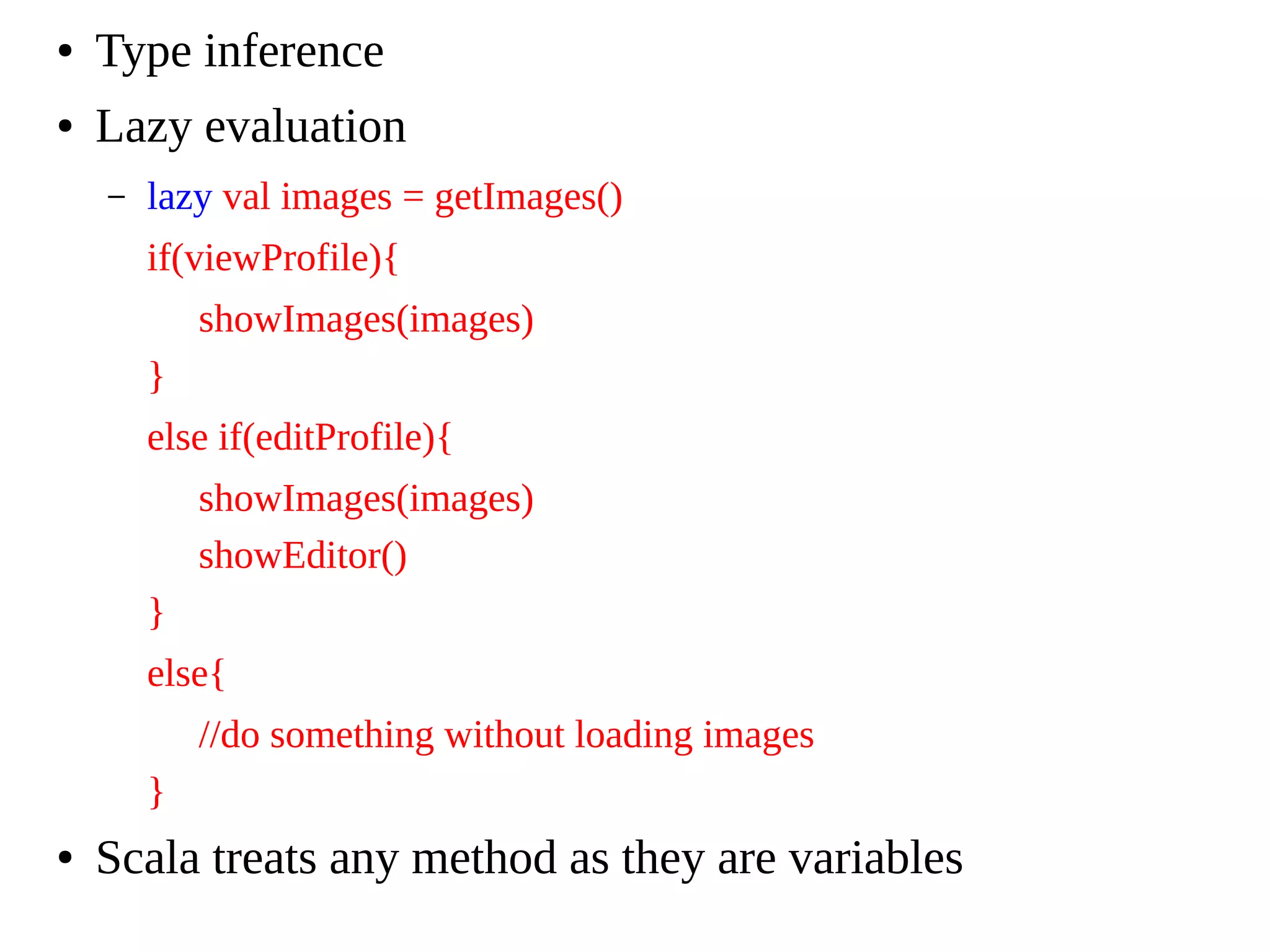
● Type inference
● Lazy evaluation
– lazy val images = getImages()
if(viewProfile){
showImages(images)
}
else if(editProfile){
showImages(images)
showEditor()
}
else{
//do something without loading images
}
● Scala treats any method as they are variables
object HelloWorld {
def main(args: Array[String]) {
println("Hello, world!")
}
}
●object declaration (Singleton object: class with single object)
–Declares both a class called HelloWorld and an instance of that
class, also called HelloWorld
The classic Hello, World! program
● Convenience and flexibility
var capital = Map("US" -> "Washington", "France" -> "Paris")
capital += ("Japan" -> "Tokyo")
println(capital("France"))
– The notation in this example is high-level, to
the point
– Not cluttered with extraneous semicolons or type
annotations.
– Scala gives you fine-grained control if you need it
val x = new HashMap[Int, String]((1,”Hello”))
val x: Map[Int, String] = new HashMap()
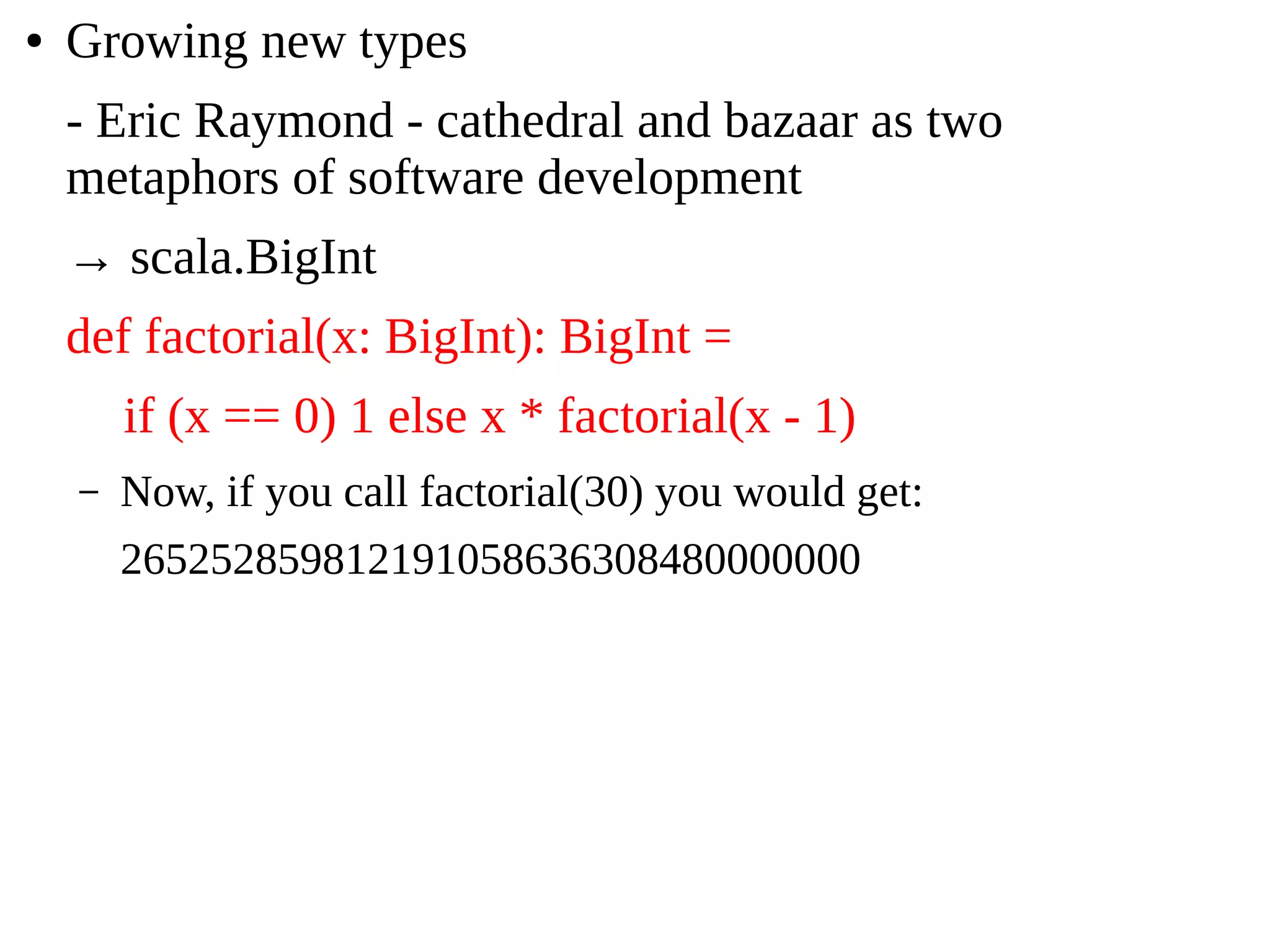
● Growing new types
- Eric Raymond - cathedral and bazaar as two
metaphors of software development
→ scala.BigInt
def factorial(x: BigInt): BigInt =
if (x == 0) 1 else x * factorial(x - 1)
– Now, if you call factorial(30) you would get:
265252859812191058636308480000000
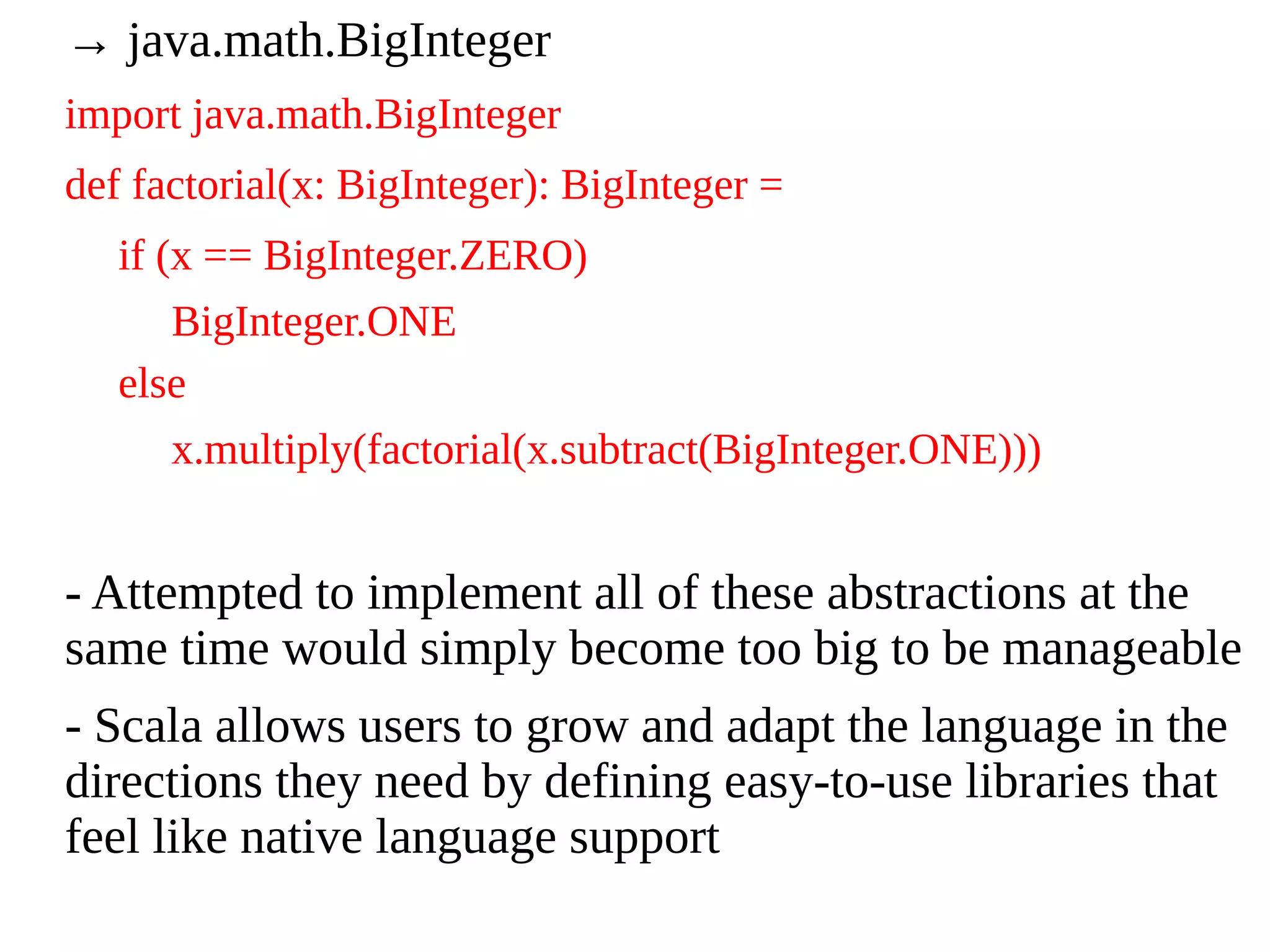
→ java.math.BigInteger
import java.math.BigInteger
def factorial(x: BigInteger): BigInteger =
if (x == BigInteger.ZERO)
BigInteger.ONE
else
x.multiply(factorial(x.subtract(BigInteger.ONE)))
- Attempted to implement all of these abstractions at the
same time would simply become too big to be manageable
- Scala allows users to grow and adapt the language in the
directions they need by defining easy-to-use libraries that
feel like native language support
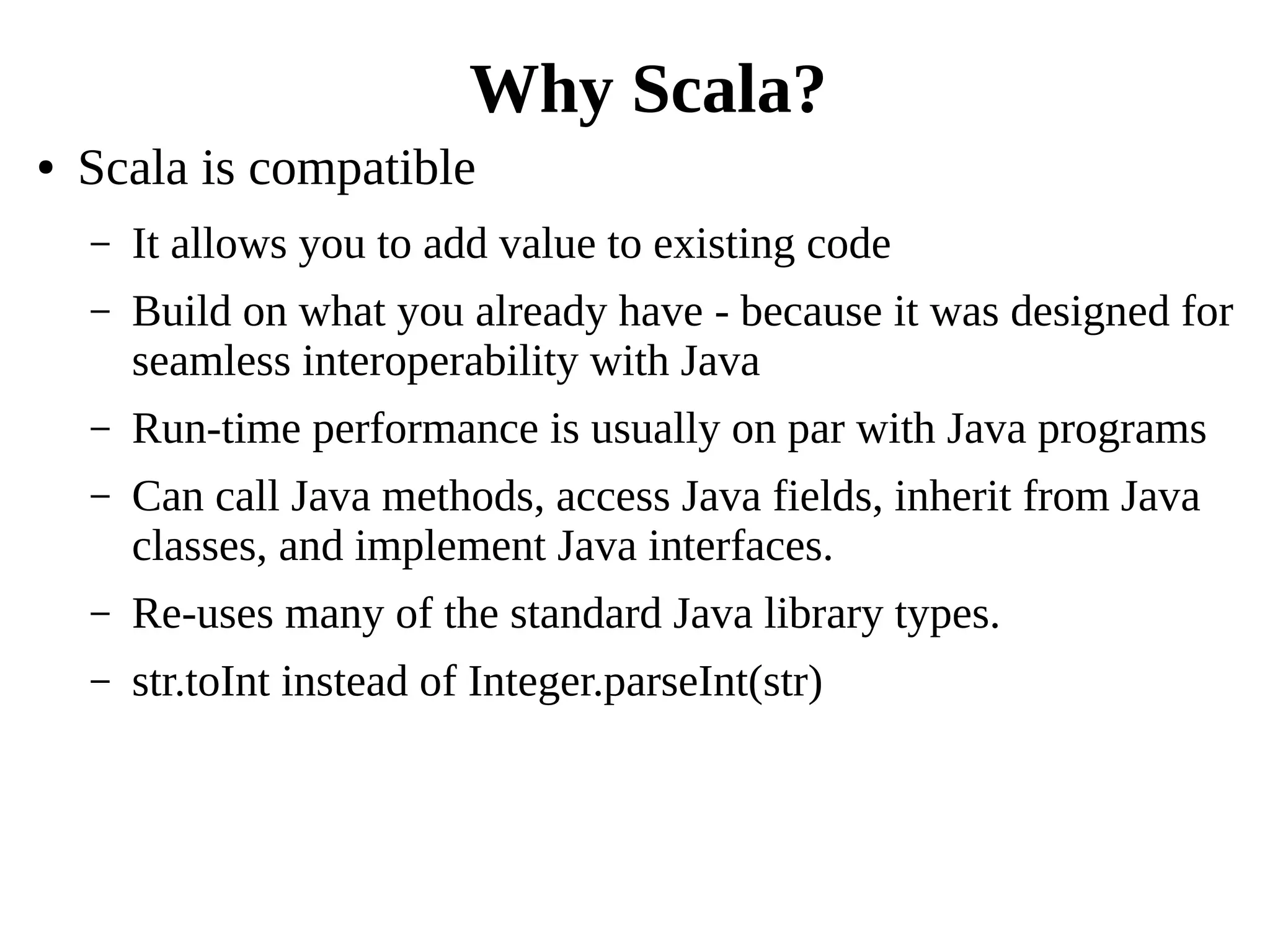
● Scala is compatible
– It allows you to add value to existing code
– Build on what you already have - because it was designed for
seamless interoperability with Java
– Run-time performance is usually on par with Java programs
– Can call Java methods, access Java fields, inherit from Java
classes, and implement Java interfaces.
– Re-uses many of the standard Java library types.
– str.toInt instead of Integer.parseInt(str)
Why Scala?
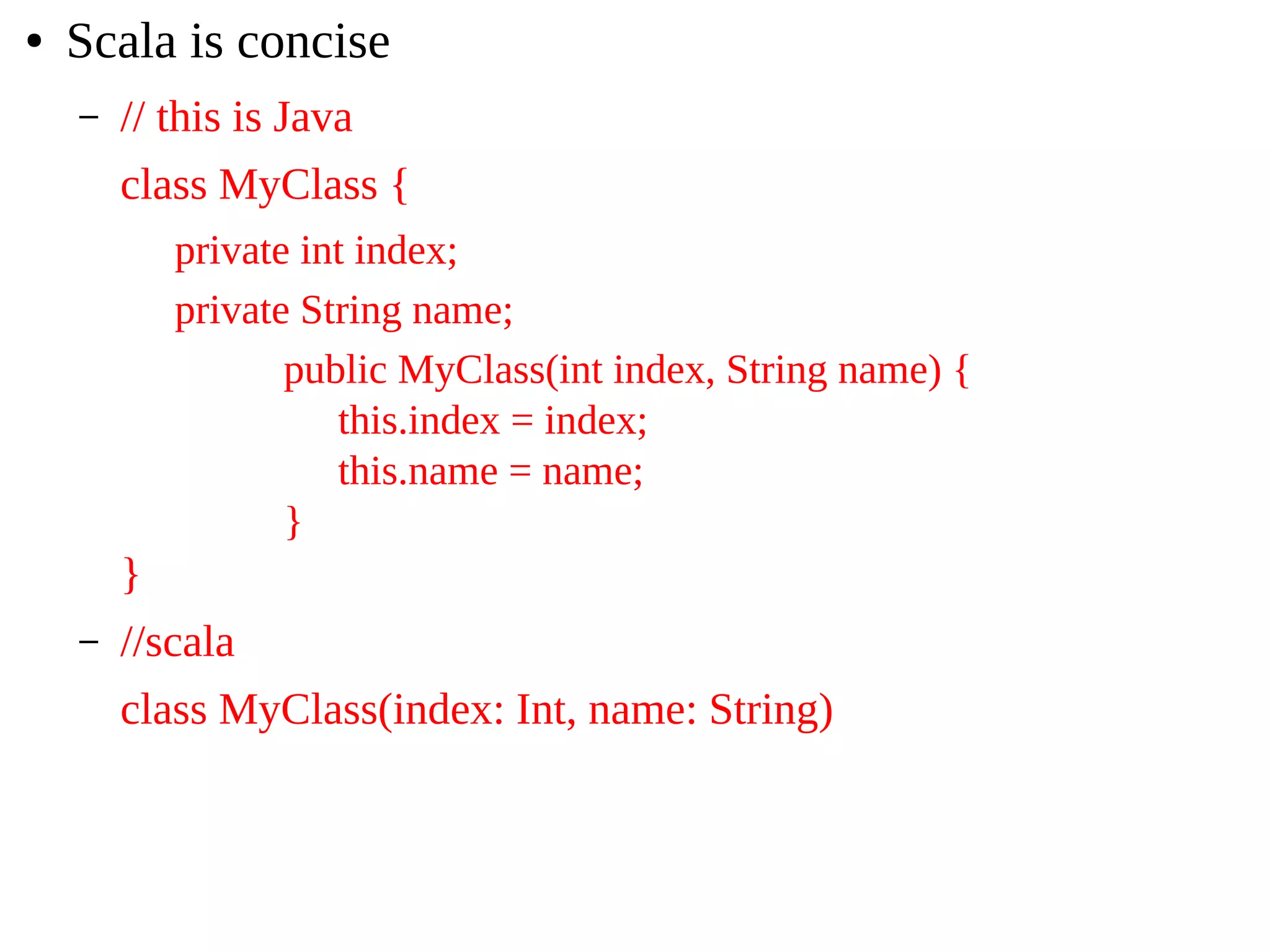
● Scala is concise
– // this is Java
class MyClass {
private int index;
private String name;
public MyClass(int index, String name) {
this.index = index;
this.name = name;
}
}
– //scala
class MyClass(index: Int, name: String)
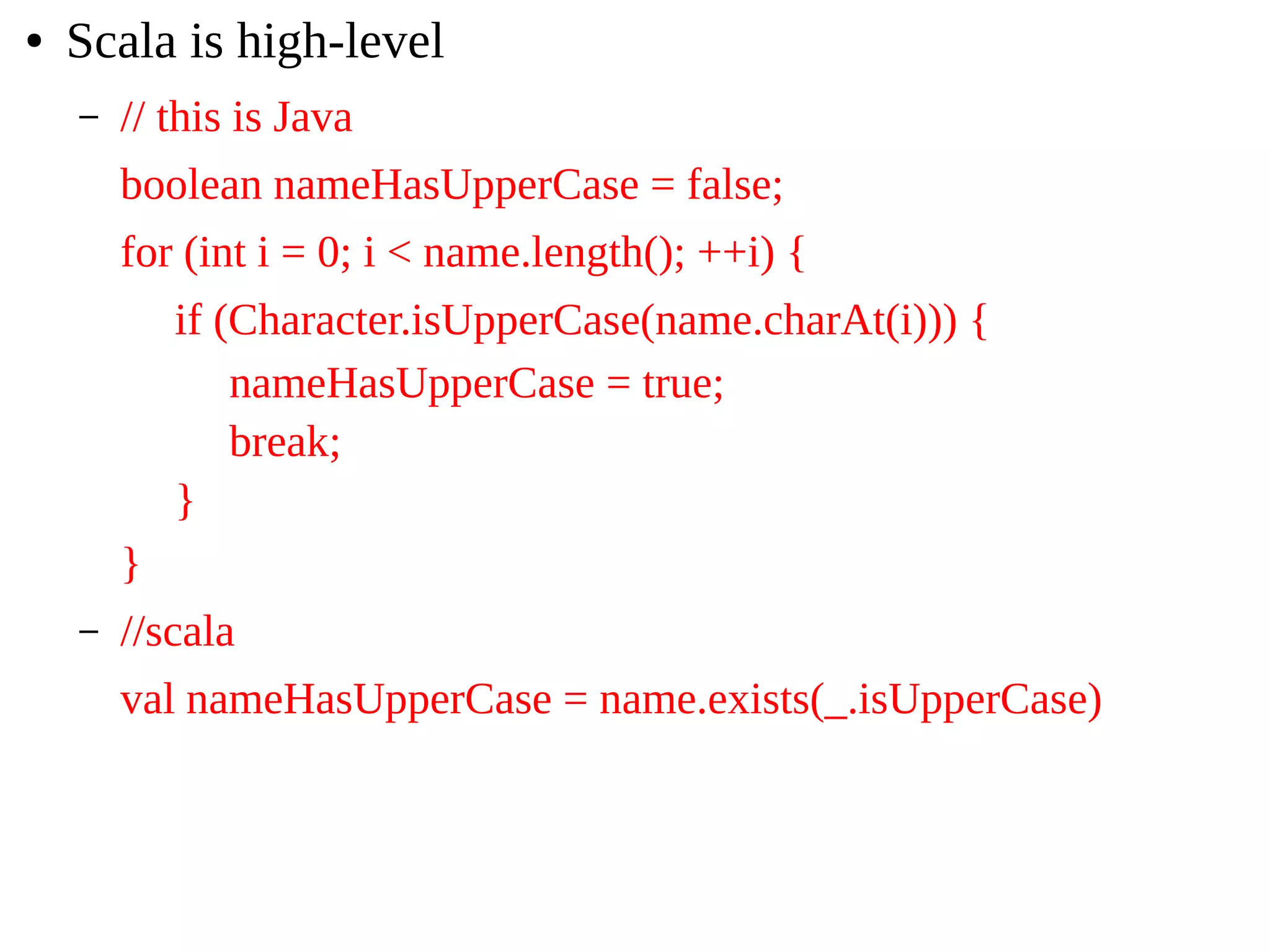
● Scala is high-level
– // this is Java
boolean nameHasUpperCase = false;
for (int i = 0; i < name.length(); ++i) {
if (Character.isUpperCase(name.charAt(i))) {
nameHasUpperCase = true;
break;
}
}
– //scala
val nameHasUpperCase = name.exists(_.isUpperCase)
● Interaction with Java
import java.util.{Date, Locale}
import java.text.DateFormat
import java.text.DateFormat._
object FrenchDate {
def main(args: Array[String]) {
val now = new Date
val df = getDateInstance(LONG, Locale.FRANCE)
println(df format now)
}
}
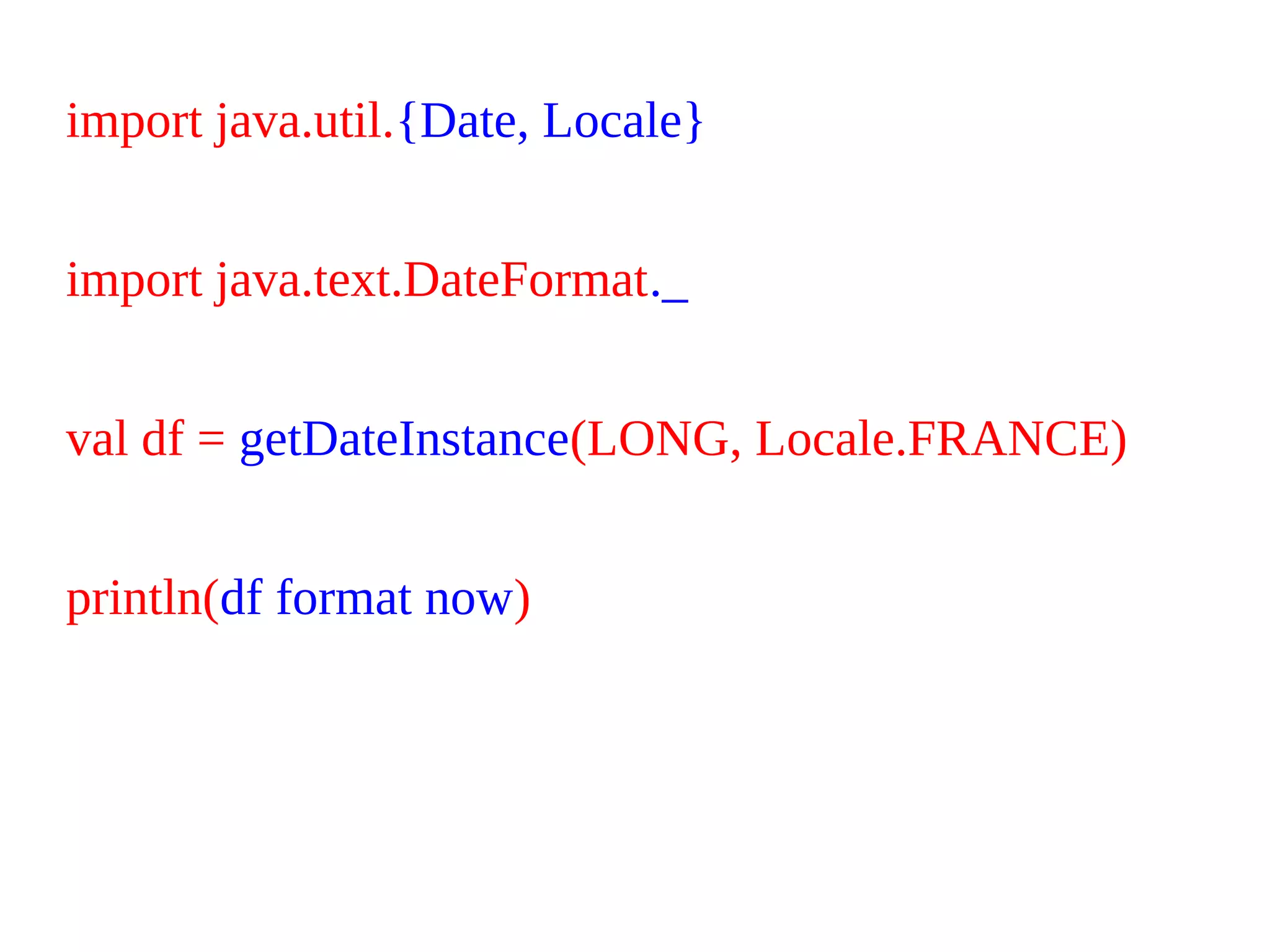
import java.util.{Date, Locale}
import java.text.DateFormat._
val df = getDateInstance(LONG, Locale.FRANCE)
println(df format now)
● A Scala Tutorial for Java programmers [Michel
Schinz, Philipp Haller]
● http://javarevisited.blogspot.in/
● Programming in Scala [Martin Odersky, Lex Spoon,
Bill Venners]
● wikipedia.com
References

scala

  • 1.
    A Brief Introductionto Scala @pranavek
  • 2.
    ● Scala isnew generation JVM language – It is intended to be compiled to Java bytecode – The resulting executable runs on the JVM ● The name Scala is a portmanteau of "scalable" and "language" (SCAlable LAnguage) ● James Strachan, the creator of Groovy, described Scala as a possible successor to Java
  • 3.
    Scala Vs Java ●Similar to Java compiler javac, Scala has a compiler scalac, which compiles Scala code into byte code ● You can call Scala from Java and Java from Scala, it offers seems less integration ● Major Java programming IDE like Eclipse, Netbeans and InetelliJ supports Scala ● Both are OOP, Scala goes one steps further and also supports functional programming paradigm
  • 4.
    ● Type inference ●Lazy evaluation – lazy val images = getImages() if(viewProfile){ showImages(images) } else if(editProfile){ showImages(images) showEditor() } else{ //do something without loading images } ● Scala treats any method as they are variables
  • 5.
    object HelloWorld { defmain(args: Array[String]) { println("Hello, world!") } } ●object declaration (Singleton object: class with single object) –Declares both a class called HelloWorld and an instance of that class, also called HelloWorld The classic Hello, World! program
  • 6.
    ● Convenience andflexibility var capital = Map("US" -> "Washington", "France" -> "Paris") capital += ("Japan" -> "Tokyo") println(capital("France")) – The notation in this example is high-level, to the point – Not cluttered with extraneous semicolons or type annotations. – Scala gives you fine-grained control if you need it val x = new HashMap[Int, String]((1,”Hello”)) val x: Map[Int, String] = new HashMap()
  • 7.
    ● Growing newtypes - Eric Raymond - cathedral and bazaar as two metaphors of software development → scala.BigInt def factorial(x: BigInt): BigInt = if (x == 0) 1 else x * factorial(x - 1) – Now, if you call factorial(30) you would get: 265252859812191058636308480000000
  • 8.
    → java.math.BigInteger import java.math.BigInteger deffactorial(x: BigInteger): BigInteger = if (x == BigInteger.ZERO) BigInteger.ONE else x.multiply(factorial(x.subtract(BigInteger.ONE))) - Attempted to implement all of these abstractions at the same time would simply become too big to be manageable - Scala allows users to grow and adapt the language in the directions they need by defining easy-to-use libraries that feel like native language support
  • 9.
    ● Scala iscompatible – It allows you to add value to existing code – Build on what you already have - because it was designed for seamless interoperability with Java – Run-time performance is usually on par with Java programs – Can call Java methods, access Java fields, inherit from Java classes, and implement Java interfaces. – Re-uses many of the standard Java library types. – str.toInt instead of Integer.parseInt(str) Why Scala?
  • 10.
    ● Scala isconcise – // this is Java class MyClass { private int index; private String name; public MyClass(int index, String name) { this.index = index; this.name = name; } } – //scala class MyClass(index: Int, name: String)
  • 11.
    ● Scala ishigh-level – // this is Java boolean nameHasUpperCase = false; for (int i = 0; i < name.length(); ++i) { if (Character.isUpperCase(name.charAt(i))) { nameHasUpperCase = true; break; } } – //scala val nameHasUpperCase = name.exists(_.isUpperCase)
  • 12.
    ● Interaction withJava import java.util.{Date, Locale} import java.text.DateFormat import java.text.DateFormat._ object FrenchDate { def main(args: Array[String]) { val now = new Date val df = getDateInstance(LONG, Locale.FRANCE) println(df format now) } }
  • 13.
    import java.util.{Date, Locale} importjava.text.DateFormat._ val df = getDateInstance(LONG, Locale.FRANCE) println(df format now)
  • 14.
    ● A ScalaTutorial for Java programmers [Michel Schinz, Philipp Haller] ● http://javarevisited.blogspot.in/ ● Programming in Scala [Martin Odersky, Lex Spoon, Bill Venners] ● wikipedia.com References