Programming Scala 3rd Edition Dean Wampler Dean Wampler
Programming Scala 3rd Edition Dean Wampler Dean Wampler
Programming Scala 3rd Edition Dean Wampler Dean Wampler
Programming Scala 3rd Edition Dean Wampler Dean Wampler
Programming Scala 3rd Edition Dean Wampler Dean Wampler
1.
Programming Scala 3rdEdition Dean Wampler Dean
Wampler download
https://ebookbell.com/product/programming-scala-3rd-edition-dean-
wampler-dean-wampler-30356214
Explore and download more ebooks at ebookbell.com
2.
Here are somerecommended products that we believe you will be
interested in. You can click the link to download.
Programming Scala 3rd Edition Dean Wampler
https://ebookbell.com/product/programming-scala-3rd-edition-dean-
wampler-47620436
Programming Scala 3rd Edition Dean Wampler
https://ebookbell.com/product/programming-scala-3rd-edition-dean-
wampler-47618488
Programming Scala 3rd Edition 3rd Edition Dean Wampler
https://ebookbell.com/product/programming-scala-3rd-edition-3rd-
edition-dean-wampler-47632640
Programming Scala 3rd Edition 3 Ea Dean Wampler
https://ebookbell.com/product/programming-scala-3rd-edition-3-ea-dean-
wampler-24440486
3.
Programming In ScalaUpdated For Scala 212 3rd Edition Martin Odersky
https://ebookbell.com/product/programming-in-scala-updated-for-
scala-212-3rd-edition-martin-odersky-5196380
Programming Scala Tackle Multicore Complexity On The Java Virtual
Machine Pragmatic Programmers 1st Edition Venkat Subramaniam
https://ebookbell.com/product/programming-scala-tackle-multicore-
complexity-on-the-java-virtual-machine-pragmatic-programmers-1st-
edition-venkat-subramaniam-2480206
Programming Scala Scalability Functional Programming Objects Animal
Guide 1st Edition Dean Wampler
https://ebookbell.com/product/programming-scala-scalability-
functional-programming-objects-animal-guide-1st-edition-dean-
wampler-1307710
Programming Scala Dean Wampler Alex Payne
https://ebookbell.com/product/programming-scala-dean-wampler-alex-
payne-43090548
Programming Scala Dean Wampler Alex Payne
https://ebookbell.com/product/programming-scala-dean-wampler-alex-
payne-42252436
2020-11-26: Third release
2021-02-09:Fourth release
See http://oreilly.com/catalog/errata.csp?isbn=9781491949856 for
release details.
The O’Reilly logo is a registered trademark of O’Reilly Media, Inc.
Programming Scala, the cover image, and related trade dress are
trademarks of O’Reilly Media, Inc.
While the publisher and the authors have used good faith efforts to
ensure that the information and instructions contained in this work
are accurate, the publisher and the authors disclaim all responsibility
for errors or omissions, including without limitation responsibility for
damages resulting from the use of or reliance on this work. Use of
the information and instructions contained in this work is at your own
risk. If any code samples or other technology this work contains or
describes is subject to open source licenses or the intellectual
property rights of others, it is your responsibility to ensure that your
use thereof complies with such licenses and/or rights.
978-1-492-07782-4
[LSI]
Foreword
If there hasbeen a common theme throughout my career as a
programmer, it has been the quest for better abstractions and better
tools to support the craft of writing software. Over the years, I have
come to value one trait more than any other: composability. If one
can write code with good composability, it usually means that other
traits we software developers value—such as orthogonality, loose
coupling, and high cohesion—are already present. It is all
connected.
When I discovered Scala some years ago, the thing that made the
biggest impression on me was its composability.
Through some very elegant design choices and simple yet powerful
abstractions that were taken from the object-oriented and functional
programming worlds, Martin Odersky has managed to create a
language with high cohesion and orthogonal, deep abstractions that
invites composability in all dimensions of software design. Scala is
truly a SCAlable LAnguage that scales with usage, from scripting all
the way up to large-scale enterprise applications and middleware.
Scala was born out of academia, but it has grown into a pragmatic
and practical language that is very much ready for real-world
production use.
What excites me most about this book is that it’s so practical. Dean
has done a fantastic job, not only by explaining the language through
interesting discussions and samples, but also by putting it in the
context of the real world. It’s written for the programmer who wants
to get things done.
I had the pleasure of getting to know Dean some years ago when we
were both part of the aspect-oriented programming community. Dean
holds a rare mix of deep analytical academic thinking and a
pragmatic, get-things-done kind of mentality.
11.
You are aboutto learn how to write reusable components using
mixin and function composition; how to write Reactive applications
using Akka; how to make effective use of advanced features in Scala
such as macros and higher kinded types; how to utilize Scala’s rich,
flexible, and expressive syntax to build domain-specific languages;
how to effectively test your Scala code; how to let Scala simplify your
Big Data problems; and much, much more.
Enjoy the ride. I sure did.
Jonas Bonér
CTO & cofounder Typesafe
August 2014
12.
Preface
A NOTE FOREARLY RELEASE READERS
With Early Release ebooks, you get books in their earliest form—
the author’s raw and unedited content as they write—so you can
take advantage of these technologies long before the official
release of these titles.
This will be the preface of the final book. Please note that the
GitHub repo will be made active later on.
If you have comments about how we might improve the content
and/or examples in this book, or if you notice missing material
within this chapter, please reach out to the author at
mcronin@oreilly.com.
Programming Scala introduces an exciting and powerful language
that offers all the benefits of a modern object model, functional
programming (FP), and an advanced type system, while leveraging
the industry’s investment in the Java Virtual Machine (JVM). Packed
with code examples, this comprehensive book teaches you how to
be productive with Scala quickly, and explains what makes this
language ideal for today’s scalable, distributed, component-based
applications that support concurrency and distribution. You’ll also
learn how Scala takes advantage of the advanced JVM as a platform
for programming languages.
Learn more at http://programming-scala.org or at the book’s catalog
page.
Welcome to Programming Scala, Third Edition
13.
Programming Scala, SecondEdition was published six years ago, in
the fall of 2014. At that time, interest in Scala was surging, driven by
two factors.
First, alternative languages for the JVM instead of Java were very
appealing. Java’s evolution had slowed, in part because its steward,
Sun Microsystems was sold to Oracle Corporation a few years
previously. Developers wanted improvements like more concise
syntax for some constructs and features they saw in other
languages, like support for functional programming.
Second, big data was a hot sector of the software industry and some
of the most popular tools in that sector, especially Apache Spark and
Apache Kafka, where written in Scala and offered elegant Scala
APIs, along with APIs in other languages.
A lot has changed in six years. Oracle deserves a lot of credit for
reinvigorating Java after the Sun Microsystems acquisition. The pace
of innovation has improved considerably. Java 8 was a ground-
breaking release, as it introduced two of the most important
improvements needed to address limitations compared to Scala.
One was support for anonymous functions, called lambdas, which
addressed the biggest missing feature needed for functional
programming. The second feature was support for “default”
implementations of the methods declared in interfaces, which made
Java interfaces more useful as composable “mixins”.
Also, the Kotlin language was created by the tool vendor Jet Brains,
as a “better Java” that isn’t as sophisticated as Scala. Kotlin received
a big boost when Google endorsed it as the preferred language for
Android apps. Around the same time, Apple introduced a language
called Swift primarily for iOS development that has a very Scala-like
syntax, although it does not target the JVM.
Big data drove the emergence of data science as a profession.
Actually, this was just a rebranding and refinement of what data
analysts and statisticians had been doing for years. The specialties
14.
of data sciencecalled deep learning (DL - i.e., using neural
networks), reinforcement learning (RL), and artificial intelligence (AI)
are currently the hottest topics in the data world. All fit under the
umbrella of machine learning (ML). A large percentage of the
popular tools for data science, especially ML, are written in Python or
expose Python APIs on top of C++ “kernels”. As a result, interest in
Python is growing strongly again, while Scala’s growth in the data
world has slowed.
But Scala hasn’t been sitting still. This edition introduces you to
version 3 of the language, with significant changes to improve the
expressiveness and correctness of Scala, and to remove deprecated
and less useful features.
Also, Scala is now a viable language for targeting JavaScript
applications through Scala.js. Early support for Scala as a native
language is now available through Scala Native, although the
version of Scala supported tends to lag the JVM version.
I currently split my time between the Python-based ML world and the
Scala-based JVM world. When using Python, I miss the concision,
power, and correctness of Scala, but when using Scala, I miss the
wealth of data-centric libraries available in the Python world. So, I
think we’re entering a period of consolidation for Scala, where
developers who want that power and elegance will keep the Scala
community vibrant and growing, especially in larger enterprises that
are JVM-centered. Scala will remain a preferred choice for hosted
services, even while the data and mobile communities tend to use
other languages. Who knows what the next five or six years will
bring, when it’s time for the fourth edition of Programming Scala?
With each addition of this book, I have attempted to provide a
comprehensive introduction to Scala features and core libraries,
illustrated with plenty of pragmatic examples, tips, and tricks.
However, each edition has shifted more towards pragmatism and
away from comprehensive surveying of features.
15.
I think thismakes the book more useful to you, in an age when so
much of our information is gathered in small, ad hoc snippets
through Google searches. Libraries come and go. For example,
when you need the best way to parse JSON, an Internet search for
Scala JSON libraries is your best bet. Second, what doesn’t change
so quickly and what’s harder to find on Stack Overflow, is the
wisdom of how best to leverage Scala for real-world development.
Hence, my goal in this edition is to teach you how to use Scala
effectively for a wide class of pragmatic problems, without getting
bogged down in corner cases, obscure features, or advanced
capabilities that you won’t need to know until you become an
advanced Scala developer.
Hence, I also won’t discuss how to use Scala.js or Scala Native, as
the best sources of information for targeting those platforms are their
respective websites.
Finally, I wrote this book for professional programmers. I’ll err on the
side of tackling deeply technical topics, rather than keeping the
material “light”. Other books provide less thorough, but more gentle
introductions, if that’s what you prefer. This is a book if you are
serious about using Scala professionally.
Welcome to Programming Scala, Second Edition
Programming Scala, First Edition was published five years ago, in
the fall of 2009. At the time, it was only the third book dedicated to
Scala, and it just missed being the second by a few months. Scala
version 2.7.5 was the official release, with version 2.8.0 nearing
completion.
A lot has changed since then. At the time of this writing, the Scala
version is 2.11.2. Martin Odersky, the creator of Scala, and Jonas
Bonér, the creator of Akka, an actor-based concurrency framework,
cofounded Typesafe (now Lightbend) to promote the language and
tools built on it.
16.
There are alsoa lot more books about Scala. So, do we really need
a second edition of this book? Many excellent beginner’s guides to
Scala are now available. A few advanced books have emerged. The
encyclopedic reference remains Programming in Scala, Second
Edition, by Odersky et al. (Artima Press).
Yet, I believe Programming Scala, Second Edition remains unique
because it is a comprehensive guide to the Scala language and
ecosystem, a guide for beginners to advanced users, and it retains
the focus on the pragmatic concerns of working professionals. These
characteristics made the first edition popular.
Scala is now used by many more organizations than in 2009 and
most Java developers have now heard of Scala. Several persistent
questions have emerged. Isn’t Scala complex? Since Java 8 added
significant new features found in Scala, why should I switch to
Scala?
I’ll tackle these and other, real-world concerns. I have often said that
I was seduced by Scala, warts and all. I hope you’ll feel the same
way after reading Programming Scala, Second Edition.
Welcome to Programming Scala, First Edition
Programming languages become popular for many reasons.
Sometimes, programmers on a given platform prefer a particular
language, or one is institutionalized by a vendor. Most Mac OS
programmers use Objective-C. Most Windows programmers use
C++ and .NET languages. Most embedded-systems developers use
C and C++.
Sometimes, popularity derived from technical merit gives way to
fashion and fanaticism. C++, Java, and Ruby have been the objects
of fanatical devotion among programmers.
Sometimes, a language becomes popular because it fits the needs
of its era. Java was initially seen as a perfect fit for browser-based,
17.
rich client applications.Smalltalk captured the essence of object-
oriented programming as that model of programming entered the
mainstream.
Today, concurrency, heterogeneity, always-on services, and ever-
shrinking development schedules are driving interest in functional
programming. It appears that the dominance of object-oriented
programming may be over. Mixing paradigms is becoming popular,
even necessary.
We gravitated to Scala from other languages because Scala
embodies many of the optimal qualities we want in a general-
purpose programming language for the kinds of applications we build
today: reliable, high-performance, highly concurrent Internet and
enterprise applications.
Scala is a multiparadigm language, supporting both object-oriented
and functional programming approaches. Scala is scalable, suitable
for everything from short scripts up to large-scale, component-based
applications. Scala is sophisticated, incorporating state-of-the-art
ideas from the halls of computer science departments worldwide. Yet
Scala is practical. Its creator, Martin Odersky, participated in the
development of Java for years and understands the needs of
professional developers.
Both of us were seduced by Scala, by its concise, elegant, and
expressive syntax and by the breadth of tools it put at our disposal.
In this book, we strive to demonstrate why all these qualities make
Scala a compelling and indispensable programming language.
If you are an experienced developer who wants a fast, thorough
introduction to Scala, this book is for you. You may be evaluating
Scala as a replacement for or complement to your current
languages. Maybe you have already decided to use Scala, and you
need to learn its features and how to use it well. Either way, we hope
to illuminate this powerful language for you in an accessible way.
18.
We assume thatyou are well versed in object-oriented programming,
but we don’t assume that you have prior exposure to functional
programming. We assume that you are experienced in one or more
other programming languages. We draw parallels to features in
Java, C#, Ruby, and other languages. If you know any of these
languages, we’ll point out similar features in Scala, as well as many
features that are new.
Whether you come from an object-oriented or functional
programming background, you will see how Scala elegantly
combines both paradigms, demonstrating their complementary
nature. Based on many examples, you will understand how and
when to apply OOP and FP techniques to many different design
problems.
In the end, we hope that you too will be seduced by Scala. Even if
Scala does not end up becoming your day-to-day language, we hope
you will gain insights that you can apply regardless of which
language you are using.
Conventions Used in This Book
The following typographical conventions are used in this book:
Italic
Indicates new terms, URLs, email addresses, filenames, and file
extensions.
Constant width
Used for program listings, as well as within paragraphs to refer to
program elements such as variable or function names,
databases, data types, environment variables, statements, and
keywords.
Constant width bold
19.
Shows commands orother text that should be typed literally by
the user.
Constant width italic
Shows text that should be replaced with user-supplied values or
by values determined by context.
TIP
This element signifies a tip or suggestion.
NOTE
This element signifies a general note.
WARNING
This element indicates a warning or caution.
Using Code Examples
This book is here to help you get your job done. In general, you may
use the code in this book in your programs and documentation. You
do not need to contact us for permission unless you’re reproducing a
significant portion of the code. For example, writing a program that
uses several chunks of code from this book does not require
permission. Selling or distributing a CD-ROM of examples from
O’Reilly books does require permission. Answering a question by
citing this book and quoting example code does not require
permission. Incorporating a significant amount of example code from
this book into your product’s documentation does require permission.
20.
We appreciate, butdo not require, attribution. An attribution usually
includes the title, author, publisher, and ISBN. For example:
“Programming Scala, Third Edition by Dean Wampler. Copyright
2020 Kevin Dean Wampler, 978-1-491-94985-6.”
If you feel your use of code examples falls outside fair use or the
permission given above, feel free to contact us at
permissions@oreilly.com.
Getting the Code Examples
NOTE
TODO: At this time, the CLI tools are actually called dotr and dotc, not scala
and scalac. The latter names are used in the expectation that when Scala 3
release candidates begin, the tools will be renamed. I’ll refine this text
depending on what final names are used for Scala 3 tools. Also, some features
shown for scala are actually not yet implemented in dotr!
You can download the code examples from GitHub. Unzip the files to
a convenient location. See the README file in the distribution for
instructions on building and using the examples. I’ll summarize those
instructions in the first chapter.
Some of the example files can be run as scripts using the scala
command. Others must be compiled into class files. A few files are
only compatible with Scala 2 and a few files are additional examples
that aren’t built by SBT, the build tool. To keep these groups
separate, I have adopted the following directory structure
conventions:
src/main/scala/…/*.scala
All Scala 3 source files built with SBT. The standard Scala file
extension is .scala.
21.
src/main/scala-2/…/*.scala
All Scala 2source files, some of which won’t compile with Scala
3. They are not built with SBT.
src/test/…/*.scala
All Scala 3 test source files built and executed with SBT.
src/script/…/*.scala
“Script” files that won’t compile with scalac, but can be
interpreted with the scala interpreter.
O’Reilly Safari
Safari (formerly Safari Books Online) is a membership-based training
and reference platform for enterprise, government, educators, and
individuals.
Members have access to thousands of books, training videos,
Learning Paths, interactive tutorials, and curated playlists from over
250 publishers, including O’Reilly Media, Harvard Business Review,
Prentice Hall Professional, Addison-Wesley Professional, Microsoft
Press, Sams, Que, Peachpit Press, Adobe, Focal Press, Cisco
Press, John Wiley & Sons, Syngress, Morgan Kaufmann, IBM
Redbooks, Packt, Adobe Press, FT Press, Apress, Manning, New
Riders, McGraw-Hill, Jones & Bartlett, and Course Technology,
among others.
For more information, please visit http://oreilly.com/safari.
How to Contact Us
22.
Please address commentsand questions concerning this book to the
publisher:
O’Reilly Media, Inc.
1005 Gravenstein Highway North
Sebastopol, CA 95472
800-998-9938 (in the United States or Canada)
707-829-0515 (international or local)
707-829-0104 (fax)
We have a web page for this book, where we list errata, examples,
and any additional information. You can access this page at
http://bit.ly/programmingScala_2E.
To comment or ask technical questions about this book, send email
to bookquestions@oreilly.com.
For more information about our books, courses, conferences, and
news, see our website at http://www.oreilly.com.
Find us on Facebook: http://facebook.com/oreilly
Follow us on Twitter: http://twitter.com/oreillymedia
Watch us on YouTube: http://www.youtube.com/oreillymedia
Acknowledgments for the Third Edition
Working with early builds of Scala 3, I often ran into unimplemented
features and incomplete documentation. The members of the Scala
community have provided valuable help while I learned what’s new.
The EPFL documentation for Dotty, https://dotty.epfl.ch/docs/,
provided essential information.
23.
Acknowledgments for theSecond Edition
As I, Dean Wampler, worked on this edition of the book, I continued
to enjoy the mentoring and feedback from many of my Typesafe
colleagues, plus the valuable feedback from people who reviewed
the early-access releases. I’m especially grateful to Ramnivas
Laddad, Kevin Kilroy, Lutz Huehnken, and Thomas Lockney, who
reviewed drafts of the manuscript. Thanks to my long-time colleague
and friend, Jonas Bonér, for writing an updated Foreword for the
book.
And special thanks to Ann who allowed me to consume so much of
our personal time with this project. I love you!
Acknowledgments for the First Edition
As we developed this book, many people read early drafts and
suggested numerous improvements to the text, for which we are
eternally grateful. We are especially grateful to Steve Jensen,
Ramnivas Laddad, Marcel Molina, Bill Venners, and Jonas Bonér for
their extensive feedback.
Much of the feedback we received came through the Safari Rough
Cuts releases and the online edition available at
http://programmingscala.com. We are grateful for the feedback
provided by (in no particular order) Iulian Dragos, Nikolaj Lindberg,
Matt Hellige, David Vydra, Ricky Clarkson, Alex Cruise, Josh
Cronemeyer, Tyler Jennings, Alan Supynuk, Tony Hillerson, Roger
Vaughn, Arbi Sookazian, Bruce Leidl, Daniel Sobral, Eder Andres
Avila, Marek Kubica, Henrik Huttunen, Bhaskar Maddala, Ged
Byrne, Derek Mahar, Geoffrey Wiseman, Peter Rawsthorne,
Geoffrey Wiseman, Joe Bowbeer, Alexander Battisti, Rob Dickens,
Tim MacEachern, Jason Harris, Steven Grady, Bob Follek, Ariel
Ortiz, Parth Malwankar, Reid Hochstedler, Jason Zaugg, Jon
Hanson, Mario Gleichmann, David Gates, Zef Hemel, Michael Yee,
24.
Marius Kreis, MartinSüsskraut, Javier Vegas, Tobias Hauth,
Francesco Bochicchio, Stephen Duncan Jr., Patrik Dudits, Jan
Niehusmann, Bill Burdick, David Holbrook, Shalom Deitch, Jesper
Nordenberg, Esa Laine, Gleb Frank, Simon Andersson, Patrik
Dudits, Chris Lewis, Julian Howarth, Dirk Kuzemczak, Henri Gerrits,
John Heintz, Stuart Roebuck, and Jungho Kim. Many other readers
for whom we only have usernames also provided feedback. We wish
to thank Zack, JoshG, ewilligers, abcoates, brad, teto, pjcj, mkleint,
dandoyon, Arek, rue, acangiano, vkelman, bryanl, Jeff, mbaxter,
pjb3, kxen, hipertracker, ctran, Ram R., cody, Nolan, Joshua, Ajay,
Joe, and anonymous contributors. We apologize if we have
overlooked anyone!
Our editor, Mike Loukides, knows how to push and prod gently. He’s
been a great help throughout this crazy process. Many other people
at O’Reilly were always there to answer our questions and help us
move forward.
We thank Jonas Bonér for writing the Foreword for the book. Jonas
is a longtime friend and collaborator from the aspect-oriented
programming (AOP) community. For years, he has done pioneering
work in the Java community. Now he is applying his energies to
promoting Scala and growing that community.
Bill Venners graciously provided the quote on the back cover. The
first published book on Scala, Programming in Scala (Artima), that
he cowrote with Martin Odersky and Lex Spoon, is indispensable for
the Scala developer. Bill has also created the wonderful ScalaTest
library.
We have learned a lot from fellow developers around the world.
Besides Jonas and Bill, Debasish Ghosh, James Iry, Daniel
Spiewak, David Pollack, Paul Snively, Ola Bini, Daniel Sobral, Josh
Suereth, Robey Pointer, Nathan Hamblen, Jorge Ortiz, and others
have illuminated dark corners with their blog entries, forum
discussions, and personal conversations.
25.
Dean thanks hiscolleagues at Object Mentor and several developers
at client sites for many stimulating discussions on languages,
software design, and the pragmatic issues facing developers in
industry. The members of the Chicago Area Scala Enthusiasts
(CASE) group have also been a source of valuable feedback and
inspiration.
Alex thanks his colleagues at Twitter for their encouragement and
superb work in demonstrating Scala’s effectiveness as a language.
He also thanks the Bay Area Scala Enthusiasts (BASE) for their
motivation and community.
Most of all, we thank Martin Odersky and his team for creating Scala.
26.
Chapter 1. Zeroto Sixty:
Introducing Scala
A NOTE FOR EARLY RELEASE READERS
With Early Release ebooks, you get books in their earliest form—
the author’s raw and unedited content as they write—so you can
take advantage of these technologies long before the official
release of these titles.
This will be the 1st chapter of the final book. Please note that the
GitHub repo will be made active later on.
If you have comments about how we might improve the content
and/or examples in this book, or if you notice missing material
within this chapter, please reach out to the author at
mcronin@oreilly.com.
Let’s start with a brief look at why you should investigate Scala. Then
we’ll dive in and write some code.
Why Scala?
Scala is a language that addresses the needs of the modern
software developer. It is a statically typed, object-oriented and
functional, mixed-platform language with a succinct, elegant, and
flexible syntax, a sophisticated type system, and idioms that promote
scalability from small, interpreted scripts to large, sophisticated
applications. So let’s consider each of those ideas in more detail:
A JVM, JavaScript, and native language
27.
Scala started asa JVM language that exploits the performance
and optimizations of the JVM, as well as the rich ecosystem of
tools and libraries built around Java. More recently, Scala.js
brings Scala to JavaScript and Scala Native is an experimental
Scala that compiles to native machine code, bypassing the JVM
and JavaScript runtimes.
Statically typed
Scala embraces static typing as a tool for creating robust
applications. It fixes many of the flaws of Java’s type system and
it uses type inference to eliminate much of the typing boilerplate.
Object-oriented programming
Scala fully supports object-oriented programming (OOP). Scala
improves Java’s object model with the addition of traits, providing
a clean way to implement types using mixin composition. In
Scala, everything really is an object, even numeric types,
providing much more consistent handling, especially in
collections.
Functional programming
Scala fully supports functional programming (FP). FP has
emerged as the best tool for thinking about problems of
concurrency, Big Data, and general code correctness. Immutable
values, first-class functions, functions without side effects,
“higher-order” functions, and functional collections all contribute
to concise, powerful, and correct code.
A sophisticated type system
Scala extends the type system of Java with more flexible
generics and other enhancements to improve code correctness.
With type inference, Scala code is often as concise as code in
dynamically typed languages, yet inherently safer.
28.
A succinct, elegant,and flexible syntax
Verbose expressions in Java become concise idioms in Scala.
Scala provides several facilities for building domain-specific
languages (DSLs), APIs that feel “native” to users.
Scalable—architectures
You can write small, interpreted scripts to large, distributed
applications in Scala.
The name Scala is a contraction of the words scalable language. It is
pronounced scah-lah, like the Italian word for “staircase.” Hence, the
two “a”s are pronounced the same.
Scala was started by Martin Odersky in 2001. The first public release
was January 20th, 2004. Martin is a professor in the School of
Computer and Communication Sciences at the Ecole Polytechnique
Fédérale de Lausanne (EPFL). He spent his graduate years working
in the group headed by Niklaus Wirth, of Pascal fame. Martin worked
on Pizza, an early functional language on the JVM. He later worked
on GJ, a prototype of what later became Generics in Java, along
with Philip Wadler, one of the designers of Haskell. Martin was hired
by Sun Microsystems to produce the reference implementation of
javac, the descendant of which is the Java compiler that ships with
the Java Developer Kit (JDK) today.
The Seductions of Scala
The growth of Scala users since it was introduced over fifteen years
ago confirms my view that Scala is a language for our time. You can
leverage the maturity of the JVM and JavaScript ecosystems while
enjoying state-of-the-art language features with a concise, yet
expressive syntax for addressing today’s development challenges.
1
29.
In any fieldof endeavor, the professionals need sophisticated,
powerful tools and techniques. It may take a while to master them,
but you make the effort because mastery is the key to your success.
I believe Scala is a language for professional developers. Not all
users are professionals, of course, but Scala is the kind of language
a professional in our field needs, rich in features, highly performant,
expressive for a wide class of problems. It will take you a while to
master Scala, but once you do, you won’t feel constrained by your
programming language.
Why Scala 3?
If you used Scala before, you used Scala 2, the major version since
March 2006! Scala 3 aims to improve Scala in several ways.
First, Scala 3 strengthens Scala’s foundations, especially in the type
system. Martin Odersky and collaborators have been developing the
dependent object typing (DOT) calculus, which provides a more
sound foundation for Scala’s type system. Scala 3 integrates DOT.
Second, Scala 2 has many powerful features, but sometimes they
can be hard to use. Scala 3 improves the usability and safety of
these features, especially implicits. Other language warts and
“puzzlers” are removed.
Third, Scala 3 improves the consistency and expressiveness of
Scala’s language constructs and it removes unimportant constructs
to make the language smaller and more regular. The previous
experimental approach to macros is replaced with a principled
approach to meta-programming.
We’ll call out these changes as we explore the corresponding
language features.
Migrating to Scala 3
30.
The Scala teamhas worked hard to make migration to Scala 3 from
Scala 2 as painless as possible, while still allowing the language to
make improvements that require breaking changes. Scala 3 uses the
same collections library as Scala 2.13. Hence, if you are using a
Scala 2 version earlier than 2.13, I recommend upgrading to Scala
2.13 first, to update uses of the library, then upgrade to Scala 3.
However, to make this transition as painless as possible, there are
several ways to compile Scala code that allows or disallows
deprecated Scala 2 constructs. There are even compiler flags that
will do some rewrites for you. See later chapter [x] and the section
on the command line in Chapter 21 for details.
Installing Scala
Let’s learn how to install the command-line tools that you need to
work with the book’s code examples. The examples used in this
book were written and compiled using Scala version 3.0, the latest
release at the time of this writing.
All the examples will use Scala on the JVM. See the Scala.js and
Scala Native websites for information on targeting those platforms.
At a minimum, you need to install a recent Java JDK and the de
facto build tool for Scala, SBT. Then you can use the sbt command
to bootstrap everything else for the examples. However, the following
sections go into more details about tools you might want to install
and how to install them.
The Scala website Getting Started page discusses even more
options to get started with Scala.
Coursier
Coursier (get-coursier.io) is a new dependency resolver and tool
manager. It replaces Maven and Ivy, the traditional dependency
2
31.
resolvers for Javaand Scala projects. Written in Scala, it is fast and
easy to embed in other applications.
Installing Coursier is not required, but it is recommended as it will
install all the tools you need and more, in addition to providing many
other convenient features. For example, the Coursier CLI is handy
for managing dependency metadata and artifacts from Maven and
Ivy repositories, although we’ll do this indirectly through the SBT
build for the examples. Coursier also has convenient commands for
working with applications embedded in libraries and it can even
manages installations of different Java JDK versions.
See the installation instructions at get-coursier.io/docs/cli-installation
for details. After installing Coursier, see get-coursier.io/docs/cli-install
for a description of the coursier install command for installing
other tools, like SBT (sbt-launcher) and Scala. For example, this
command shows the default set of available applications (at the time
of this writing in early 2020):
$ unzip -l "$(cs fetch io.get-coursier:apps:0.0.8)" | grep json
188 02-09-2020 17:48 ammonite.json
175 02-09-2020 17:48 coursier.json
332 02-09-2020 17:48 cs.json
241 02-09-2020 17:48 dotty-repl.json
150 02-09-2020 17:48 echo-graalvm.json
108 02-09-2020 17:48 echo-java.json
172 02-09-2020 17:48 echo-native.json
335 02-09-2020 17:48 giter8.json
135 02-09-2020 17:48 mdoc.json
323 02-09-2020 17:48 mill-interactive.json
321 02-09-2020 17:48 mill.json
524 02-09-2020 17:48 sbt-launcher.json
222 02-09-2020 17:48 scala.json
209 02-09-2020 17:48 scalac.json
213 02-09-2020 17:48 scaladoc.json
180 02-09-2020 17:48 scalafix.json
184 02-09-2020 17:48 scalafmt.json
204 02-09-2020 17:48 scalap.json
32.
(Many of thetools shown here are discussed in Chapter 21.) For
now, run the following command to install the sbt command. Note
that the .json suffix is removed from the name. I recommend
installing all the scala* commands, but they aren’t strictly necessary,
as discussed below.
coursier install --install-dir path sbt-launcher
Note that the --install-dir path arguments are optional.
Depending on your platform, the default installation location will vary.
Whatever location you use, make sure you add it to your PATH.
Java JDK
Use a recent Java JDK release. Version 11 or newer is
recommended, although Java 8 should work. To install the JDK, go
to the Oracle Java website and follow the instructions to install the
full Java Development Kit (JDK).
SBT
The most popular build tool for Scala, SBT, version 1.3.8 or newer, is
used for the code examples. Install using Coursier or follow the
instructions at scala-sbt.org.
When you are finished, you will have an sbt command that you can
run from a Linux or OS X terminal or Windows command window.
Scala
You actually don’t need to install the Scala command-line tools
separately, as SBT will install the basics that you need as
dependencies. However, if you want to install these tools, use
Coursier or see the instructions at scala-lang.org/download.
33.
Building the CodeExamples
Now that you have the tools you need, you can download and build
the code examples.
Get the Code
Download the code examples as described in “Getting the Code
Examples”.
Start SBT
Open a terminal and change to the root directory for the code
examples. Type the command sbt test. It will download all the
library dependencies you need, including the Scala compiler. This
will take a while and you’ll need an Internet connection. Then sbt
will compile the code and run the unit tests. You’ll see lots of
output, ending with a “success” message. If you run the
command again, it should finish very quickly because it won’t
need to do anything again.
Congratulations! You are ready to get started.
TIP
For most of the book, we’ll use the Scala tools indirectly through SBT, which
downloads the Scala compiler version we want, the Scala interpreter, Scala’s
standard library, and the required third-party dependencies automatically.
More Tips
In your browser, it’s useful to bookmark the URL for the Scala
library’s Scaladocs, the analog of Javadocs for Scala. For your
convenience, most times when I mention a type in the Scala library,
I’ll include a link to the corresponding Scaladocs entry.
34.
Use the searchfield at the top of the page to quickly find anything in
the docs. The documentation page for each type has a link to view
the corresponding source code in Scala’s GitHub repository, which is
a good way to learn how the library was implemented. Look for the
link on the line labeled “Source.”
Any text editor or IDE (integrated development environment) will
suffice for working with the examples. Scala plug-ins exist for all the
popular editors and IDEs. For more details, see later chapters. In
general, the community for your favorite editor is your best source of
up-to-date information on Scala support.
Using SBT
Let’s cover the basics of using SBT, which you’ll need to work with
the code examples.
When you start the sbt command, if you don’t specify a task to run,
SBT starts an interactive REPL (Read, Eval, Print, Loop). Let’s try
that now and see a few of the available “tasks.”
In the listing that follows, the $ is the shell command prompt (e.g.,
bash), where you start the sbt command, the > is the default SBT
interactive prompt, and the # starts an sbt comment. You can type
most of these commands in any order:
$ sbt
> help # Describe commands.
> launchIDE # Open the project in Visual Studio Code.
> tasks # Show the most commonly-used, available tasks.
> tasks # Show ALL the available tasks.
> compile # Incrementally compile the code.
> test # Incrementally compile the code and run the tests.
> clean # Delete all build artifacts.
> console # Start the Scala REPL.
> run # Run one of the "main" routines in the project.
> show # Show the definition of variable "x".
> exit # Quit the REPL (also control-d works).
35.
TIP
The SBT projectfor the code examples is actually configured to show the
following as the SBT prompt:
sbt:Programming Scala, Third Edition - Code examples>
We’ll use the more concise prompt, >, the default for SBT, to save space.
The launchIDE task is convenient for those of you who prefer IDEs,
although currently only Visual Studio Code is supported. The details
can be found at dotty.epfl.ch/docs/usage/ide-support.html.
Both IntelliJ IDEA and Visual Studio Code can open SBT project,
once you install a Scala plug-in.
A handy SBT technique is to add ~ at the front of any command.
Whenever file changes are saved to disk, the command will be
rerun. For example, I use ~test all the time to keep compiling amd
running my code and tests. SBT uses an incremental compiler, so
you don’t have to wait for a full rebuild every time. Break out of this
loop by hitting the return key.
Scala has its own REPL. Invoke it using the console command in
SBT. You will use this a lot to try examples in the book. The Scala
REPL prompt is scala>.
Before starting the REPL, SBT will build your project and set up the
CLASSPATH with your built artifacts and depedent libraries. This
convenience means it’s rare to use the scala command-line tool
outside of SBT.
You can exit both the SBT REPL and the Scala REPL with Ctrl-D.
36.
TIP
Using the ScalaREPL is a very effective way to experiment with code idioms
and to learn an API, even Java APIs. Invoking it from SBT using the console
task conveniently adds project dependencies and the compiled project code to
the classpath for the REPL.
Running the Scala Command-Line Tools
If you installed the Scala command-line tools separately, the Scala
compiler is called scalac, analogous to the Java compiler javac. We
will let SBT run it for us, but the command syntax is straightforward if
you’ve ever run javac. Use scalac -help to see the options.
Similarly, the scala command, which is similar to java, is used to run
programs, but it also supports the interactive REPL mode we just
discussed and the ability to run Scala “scripts”. Consider this
example script from the code examples:
// src/script/scala/progscala3/introscala/Upper1.scala
class Upper1:
def convert(strings: Seq[String]): Seq[String] =
strings.map((s: String) => s.toUpperCase())
val up = new Upper1()
println(up.convert(List("Hello", "World!")))
Let’s run it with the scala command. Change your current working
directory to the root of the code examples. For Windows, use
backslashes in the next command:
$ scala src/script/scala/progscala3/introscala/Upper1.scala
List(HELLO, WORLD!)
...
And thus we have satisfied the Prime Directive of the Programming
Book Authors Guild, which states that our first program must print
37.
“Hello World!”
TIP
As youcan see from the listing above for Upper1.scala, each of these files is
listed starting with a comment that contains the file path in the code examples.
That makes it easy to find the file.
If you invoke scala without a compiled main class to run or a script
file, scala enters the REPL mode. Here is a REPL session
illustrating some useful commands. If you didn’t install Scala
separately, just start console in sbt. The REPL prompt is scala>
(some output elided):
$ scala
...
scala> :help
The REPL has several commands available:
:help print this summary
:load <path> interpret lines in a file
:quit exit the interpreter
:type <expression> evaluate the type of the given expression
:doc <expression> print the documentation for the given
expresssion
:imports show import history
:reset reset the repl to its initial state, ...
scala> val s = "Hello, World!"
val s: String = Hello, World!
scala> println("Hello, World!")
Hello, World!
scala> 1 + 2
val res0: Int = 3
scala> s.con<tab>
concat contains containsSlice contentEquals
38.
scala> s.contains("el")
val res1:Boolean = true
scala> :quit
$ # back at the terminal prompt.
We assigned a string, "Hello, World!", to a variable named s,
which we declared as an immutable value using the val keyword.
The println function prints a string to the console, followed by a line
feed.
This println is effectively the same thing as Java’s
System.out.println. Also, Scala Strings are Java Strings.
When we added two numbers, we didn’t assign the result to a
variable, so the REPL made up a name for us, res0, which we could
use in subsequent expressions.
The REPL supports tab completion. The input shown is used to
indicate that a tab was typed after s.con. The REPL responded with
a list of methods on String that could be called. The expression was
completed with a call to the contains method.
We didn’t always explicit specify type information. When type
information is shown, either when it is inferred or explicit type
information is added to declarations, these type annotations, as they
are called, follow a colon after the item name. The output of REPL
shows several examples.
Why doesn’t Scala follow Java conventions? When type annotations
aren’t explicitly in the code, then the type is inferred. Compared to
Java’s type item convention, the item: type convention is easier for
the compiler to analyze unambiguously when you omit the type
annotation and just write item.
As a general rule, Scala follows Java conventions, departing from
them for specific reasons, like supporting a new feature that would
be difficult using Java syntax.
39.
TIP
Showing the typesin the REPL is very handy for learning the types that Scala
infers for particular expressions. It’s one example of exploration that the REPL
enables.
Finally, we used :quit to exit the REPL. Ctrl-D can also be used.
We’ll see additional REPL commands as we go and we’ll explore the
REPL commands in depth in a later chapter.
A Taste of Scala
We’ve already seen a bit of Scala as we discussed tools, including
how to print “Hello World!”. The rest of this chapter and the two
chapters that follow provide a rapid tour of Scala features. As we go,
we’ll discuss just enough of the details to understand what’s going
on, but many of the deeper background details will have to wait for
later chapters. Think of this tour as a primer on Scala syntax and a
taste of what programming in Scala is like day to day.
TIP
When we mention a type in the Scala library, you might find it useful to read
more in the Scaladocs about it. The Scaladocs for the current release of Scala
can be found here. Note that Scala 3 uses the Scala 2.13 collections library,
while other parts of the library have changed in Scala 3.
All examples shown in the book start with a comment line like this:
// src/script/scala/progscala3/introscala/Upper1.scala
Scala follows the same comment conventions as Java, C#, C, etc. A
// comment goes to the end of a line, while a /* comment */ can
40.
cross line boundaries.Scaladoc comments follow Java conventions,
/** comment */.
When the path starts with src/script, use scala to run the script, as
follows:
$ scala src/script/scala/progscala3/introscala/Upper1.scala
However, this may not work if the script uses libraries. Instead, run
the SBT console, then use the :load command:
scala> :load src/script/scala/progscala3/introscala/Upper1.scala
Finally, you can also copy code and paste it at the scala> prompt.
Files named src/test/scala/.../*Suite.scala are tests written
using MUnit (see later chapters). To run all the tests, use the sbt
command test. To run just one particular test, use testOnly path,
where path is the fully-qualified type name for the test.
> testOnly progscala3.objectsystem.equality.EqualitySuite
[info] Compiling 1 Scala source to ...
progscala3.objectsystem.equality.EqualitySuite:
+ The == operator is implemented with the equals method 0.01s
+ The != operator is implemented with the equals method 0.001s
...
[info] Passed: Total 14, Failed 0, Errors 0, Passed 14
[success] Total time: 1 s, completed Feb 29, 2020, 5:00:41 PM
>
The corresponding source file is
src/test/scala/progscala3/objectsystem/equality/EqualitySuite
.scala. SBT follows Maven conventions that directories for compiled
source code go under src/main/scala and tests go under
src/test/scala. So, in this example, the package definition for this
test is progscala3.objectsystem.equality. The compiled class
name is EqualitySuite.
41.
NOTE
Java requires thatpackage and file names must match the declared package
and public class declared within the file. Scala doesn’t require this practice.
However, I follow these conventions most of the time for compiled code (less
often for scripts) and I recommend you do this, too, for your production code.
Finally, many of the files under the src/main/scala define a main
method that you can execute in one of several ways.
First, use SBT’s run command. It will find all the classes with main
methods and prompt you to pick which one. Note that SBT will only
search src/main/scala and src/main/java directories, ignoring the
other directories under src, including src/script.
Let’s use another example we’ll study later in the chapter,
src/main/scala/progscala3/introscala/UpperMain1.scala. Invoke
run hello world, then enter the number shown for
progscala3.introscala.UpperMain1. Note we are passing
arguments to run, hello world, which will be passed to the program
to convert to upper case:
> run hello world
...
Multiple main classes detected, select one to run:
...
[20] progscala3.introscala.UpperMain1
...
20
[info] running progscala3.introscala.UpperMain1 hello world
HELLO WORLD
[success] Total time: 2 s, completed Feb 29, 2020, 5:08:18 PM
42.
The second wayto run this program is to use runMain and specify
the specific program class name. This skips the prompt:
> runMain progscala3.introscala.UpperMain1 hello world
[warn] Multiple main classes detected. Run 'show
discoveredMainClasses' ...
[info] running progscala3.introscala.UpperMain1
HELLO WORLD
[success] Total time: 0 s, completed Feb 29, 2020, 5:18:05 PM
>
Finally, once your program is ready for production runs, you’ll use
the scala command, similar to how java is used. Now the correct
classpath must be defined, including all dependencies. This
example is relatively easy; we just point to the output directory for
the compiled code:
$ scala -cp target/scala-3.0.0/classes/
progscala3.introscala.UpperMain1 words
Let’s explore other differences between scripts, like the Upper1 script
we’ve used, and compiled code, like the UpperMain1 example we just
executed.
Here is the script again:
// src/script/scala/progscala3/introscala/Upper1.scala
class Upper1:
def convert(strings: Seq[String]): Seq[String] =
strings.map((s: String) => s.toUpperCase())
val up = new Upper1()
println(up.convert(List("Hello", "World!")))
We declare a class, Upper1, using the class keyword. The entire
class body is indented on the subsequent lines (or inside curly
braces {…} if you use that syntax instead).
43.
Upper1 contains amethod called convert. Method definitions start
with the def keyword, followed by the method name and an optional
parameter list. The method signature ends with an optional return
type. The return type can be inferred in many cases, but adding the
return type explicitly, as shown, provides useful documentation and
also avoids occasional surprises from the type inference process.
NOTE
I’ll use parameters to refer to the things a method or function is defined as
accepting when you call it. I’ll use arguments to refer to values you actually pass
to it when making the call.
Type annotations are specified using name: type. This is used here
for both the parameter list and the return type of the method, the last
Seq[String] before the equals sign.
An equals sign (=) separates the signature from the method body.
Why an equals sign?
One reason is to reduce ambiguity. Scala infers the return type if the
colon and type are omitted. If the method takes no parameters, you
can omit the parentheses, too. So, the equal sign makes parsing
unambiguous when either or both of these features are omitted. It’s
clear where the signature ends and the method body begins.
The equals sign also reminds us of the functional programming
principle that variables and functions are treated uniformly. As we
saw in the invocation of map, functions can be passed as arguments
to other functions, just like values. They can also be returned from
functions, and assigned to variables. In fact, it’s correct to say that
functions are values.
This method takes a sequence (Seq) of zero or more input strings
and returns a new sequence, where each of the input strings is
converted to uppercase. Seq is an abstraction for collections that you
44.
can iterate through.The actual type returned by this method will be
the same concrete type that was passed into it as an argument, like
Vector or List (both of which are immutable collections).
Collection types like Seq are parameterized types, very similar to
generic types in Java. They are a “collection of something,” in this
example a sequence of strings. Scala uses square brackets ([…]) for
parameterized types, whereas Java uses angle brackets (<…>).
NOTE
Scala allows angle brackets to be used in identifiers, like method and variable
names. For example, defining a “less than” method and naming it < is common
and allowed by Scala, whereas Java doesn’t allow characters like that in
identifiers. So, to avoid ambiguity, Scala uses square brackets instead for
parameterized types and disallows them in identifiers.
Inside the body, we use one of the powerful methods available for
most collections, map, which iterates through the collection, calls the
provided method on each element, and returns a new collection with
the transformed elements.
The function passed to map is an unnamed function literal
(parameters) => body, similar to Java’s lambda syntax:
(s: String) => s.toUpperCase()
It takes a parameter list with a single String named s. The body of
the function literal is after the “arrow,” =>. (The UTF8 ⇒ characters
was also allowed in Scala 2, but is now deprecated.) The body calls
toUpperCase() on s. The result of this call is automatically returned
by the function literal. In Scala, the last expression in a function or
method is the return value. The return keyword exists in Scala, but it
can only be used in methods, not in anonymous functions like this
one. In fact, it is rarely used in methods.
45.
METHODS VERSUS FUNCTIONS
Followingthe convention in most object-oriented programming
languages, the term method is used to refer to a function defined
within a class. Methods have an implied this reference to the
object as an additional argument when they are called. Like most
OO languages, the syntax used is this.method_name(other_
args). We’ll use the term method this way. We’ll use the term
function to refer to non-methods, but also sometimes use it
generically to include methods. The context will indicate the
distinction.
The expression (s: String) => s.toUpperCase() in
Upper1.scala is an example of a function that is not a method.
On the JVM, functions are implemented using JVM lambdas:
scala> (s: String) => s.toUpperCase()
val res0: String => String = Lambda$7775/0x00000008035fc040@7673711e=
The last two lines create an instance of Upper1, named up, and use it
to convert two strings to uppercase and finally print the resulting Seq.
As in Java, the syntax new Upper1() creates a new instance. The up
variable is declared as a read-only “value” using the val keyword. It
behaves like a final variable in Java.
Now lets look at the compiled example, where I added Main to the
name. Note the path to the source file now contains src/main,
instead of src/script:
// src/main/scala/progscala3/introscala/UpperMain1.scala
package progscala3.introscala
object UpperMain1:
def main(params: Array[String]): Unit =
params.map(s => s.toUpperCase()).foreach(s => printf("%s ",s))
println("")
46.
end main
@main defhello(params: String*) = main(params.toArray)
end UpperMain1
Declare the package location.
Declare a main method, the program entry point.
For long methods (unlike this one), you can use end name, but
this is optional.
An alternative way to define an entry point method.
Optional end to the object definition.
Packages work much like they do in Java. Packages provide a
“namespace” for scoping. Here we specify that this class exists in
the progscala3.introscala package.
To declare a main method in Java, you would put it in a class and
declare it static, meaning not tied to any one instance. You can
then call it with the syntax MyClass.main. This pattern is so
pervasive, that Scala builds it into the language. We instead declare
an object, named UpperMain1, using the object keyword, then
declare main as we would any other method. At the JVM level, it
looks like a static method. When running this program like we did
above, this main method is invoked.
Note the parameter list is an Array[String] and it returns Unit,
which is analogous to void in programs like Java, where nothing
useful is returned.
You use end name with all of the constructs like method and type
definitions, if, while expressions, etc. that support the braceless,
indentation-based structure. It is optional, intended for long
definitions where it can be hard to see the beginning and end at the
47.
same time. Hence,for this short definition of main, you wouldn’t use
it normally. Here are other examples for control constructs:
if sequence.length > 0 then
println(sequence)
end if // "end if" is optional
while i < 10 do
i += 1
end while // "end while" is optional
The end … lines shown are not required, but they are useful for
readability if the indented blocks are many lines long.
The @main def hello method is another way to declare an entry
point, especially useful when you don’t need to process arguments,
so you don’t need to declare the parameter list. Note that in the list
printed by the sbt run command, this entry point is shown as
progscala3.introscala.hello, while the main method was shown by
the type name, progscala3.introscala.UpperMain1. Try run and
invoke hello.
Declaring UpperMain1 as an object makes it a singleton, meaning
there will always only be one instance of it, controlled by the Scala
runtime library. You can’t create your own instances with new.
Scala makes the Singleton Design Pattern a first-class member of
the language. In most ways, these object declarations are just like
class declarations. Scala uses these objects to replace “class-level”
members, like statics in Java. You use the declared object like an
instance created from a regular class, reference the member
variables and functions as required, e.g., UpperMain1.hello.
When you define the main method for your program, you must
declare it inside an object, but in general, UpperMain1 is a good
candidate for a singleton, because we don’t need more than one
instance and it carries no state information.
48.
The Singleton DesignPattern has drawbacks. It’s hard to replace a
singleton instance with a test double in unit tests and forcing all
computation through a single instance raises concerns about thread
safety and performance. However, there are times when singletons
make sense, as in this example where these concerns don’t apply.
NOTE
Why doesn’t Scala support statics? Compared to languages that allow static
members (or equivalent constructs), Scala is more true to the vision that
everything should be an object. The object construct keeps this policy more
consistent than in languages that mix static and instance class members.
UpperMain1.main takes the user arguments in the params array,
maps over them to convert to upper case, then uses another
common method, foreach, to print them out.
The function we passed to map drops the type annotation for s:
s => s.toUpperCase()
Most of the time, Scala can infer the types of parameters for function
literals, because the context provided by map tells the compiler what
type to expect.
The foreach method is used when we want to process each element
and do something with complete side effects, without returning a
new value, unlike map. Here we print a string to standard out, without
a newline after each one. The last println call prints the newline
before the program exits.
The notion of side effects means that the function we pass to
foreach does something to affect state outside the local context. We
could write to a database or to a file system, or print to the console,
as we do here.
49.
Look again atthe first line inside main, how concise it is, where we
compose operations together. Sequencing transformations together
lets us create concise, powerful programs, as we’ll see over and
over again.
We haven’t needed to “import” any library items yet, but Scala
imports work the same was as they do in Java. Scala automatically
imports many commonly used types and features, like the Seq and
List types above and methods for I/O, like println, a method on the
scala.Console object.
In Java, to use println, you have to write System.out.println or
import System.out and then write out.println. In Scala, you can
import objects and even individual methods from them. This is done
automatically for you for Console.println, so we can just use
println by itself. This method is one of many methods and types
imported automatically that are defined in a library object called
Predef.
To run this code, you must first compile to a JVM-compatible .class
file using scalac. (Sometimes multiple class files are generated.)
SBT will do this for you, but let’s so how to do it yourself. If you
installed the Scala command-line tools separately, open a terminal
window and change the working directory to the root of the project.
Then run the following command (ignoring the $ prompt):
$ scalac src/main/scala/progscala3/introscala/UpperMain1.scala
You should now have a new directory named
progscala3/introscala that contains several .class and .tasty
files, including a file named UpperMain1.class. (“Tasty” files are an
intermediate representation generated by the compiler.) Scala must
generate valid JVM byte code and files. For example, the directory
structure must match the package structure.
Now, you can execute this program to process a list of strings. Here
is an example:
50.
$ scala -cp. progscala3.introscala.UpperMain1 Hello World!
HELLO WORLD!
The -cp . option adds the current directory to the search classpath,
although this is actually the default behavior.
Allowing SBT to compile it for us instead, we can run it at the SBT
prompt using this command:
> runMain progscala3.introscala.UpperMain1 Hello World!
For completeness, if you compile with SBT, but run it using the scala
command outside SBT, then set the classpath to point to the correct
directory where SBT writes class files:
$ scala -cp target/scala-3.0.0/classes
progscala3.introscala.UpperMain1 hello
HELLO
INTERPRETING VERSUS COMPILING AND RUNNING
SCALA CODE
To summarize, if you type scala on the command line without a
file argument, the REPL is started. You type in commands,
expressions, and statements that are evaluated on the fly. If you
give the scala command a Scala source file argument, it
compiles and runs the file as a script. Otherwise, if you provide a
JAR file or the name of class with a main routine, scala executes
it just like the java command.
Returning to the script version, we can actually simplify it even more.
Consider this simplified version:
// src/script/scala/progscala3/introscala/Upper2.scala
object Upper2:
def convert(strings: Seq[String]) = strings.map(_.toUpperCase())
51.
println(Upper2.convert(List("Hello", "World!")))
This codedoes exactly the same thing, but it’s more concise.
I omitted the return type for the method declaration, because it’s
“obvious” what’s returned. However, we can’t omit the type
annotations for parameters. Technically, the type inference algorithm
does local type inference, which means it doesn’t work globally over
your whole program, but locally within certain scopes. It can’t infer
caller’s expectations for the parameter types, but it is able to infer the
type of the method’s returned value in most cases, because it sees
the whole function body. Recursive functions are one exception
where the return type must be declared.
However, explicit type annotations in the parameter lists and explicit
return type annotations provide useful documentation for the reader.
Just because Scala can infer the return type of a function, should
you let it? For simple functions, where the return type is obvious to
the reader, perhaps it’s not that important to show it explicitly.
However, sometimes the inferred type won’t be what’s expected,
perhaps due to a bug or some subtle behavior triggered by certain
input arguments or expressions in the function body. Explicit return
types express what you think should be returned and the compiler
confirms it. Hence, I recommend adding return types rather than
inferring them, especially in public APIs.
We have also exploited a shorthand for the function literal.
Previously we wrote it in the following two, equivalent ways:
(s: String) => s.toUpperCase()
s => s.toUpperCase()
We have now shortened it even further to the following expression:
_.toUpperCase()
52.
The map methodtakes a single function parameter, where the
function itself takes a single parameter. In this case, the function
body only uses the parameter once, so we can use the anonymous
variable _ instead of a named parameter. The string parameter will
be assigned to it before toUpperCase is called.
Finally, using an object instead of a class simplifies the invocation,
because we don’t need to first create an instance with new. We just
call Upper2.convert directly.
Let’s do one last version of the compiled code (under
src/main/scala) to show another way of working with collections for
this situation:
// src/main/scala/progscala3/introscala/UpperMain2.scala
package progscala3.introscala
object UpperMain2:
def main(params: Array[String]): Unit =
val output = params.map(_.toUpperCase()).mkString(" ")
println(output)
Instead of using foreach to print each transformed word as before,
we map the array to a new array of strings, then call a convenience
method to concatenate the strings into a final string. There are two
mkString methods. One takes a single parameter to specify the
delimiter between the collection elements. The second version that
takes three parameters, a leftmost prefix string, the delimiter, and a
rightmost suffix string. Try changing the code to use mkString("[",
", ", "]").
As a little exercise, return to the script Upper2.scala and try
simplifying it further. Eliminate the Upper2 object completely and just
call map on the list of words directly. You should have just one line of
code when you’re done! (See the code examples for one
implementation.)
53.
A Sample Application
Let’sfinish this chapter by exploring several more seductive features
of Scala using a sample application. We’ll use a simplified hierarchy
of geometric shapes, which we will “send” to another object for
drawing on a display. Imagine a scenario where a game engine
generates scenes. As the shapes in the scene are completed, they
are sent to a display subsystem for drawing.
However, to keep it simple, this will be a single-threaded
implementation. We won’t actually do anything with concurrency
right now.
To begin, we define a Shape class hierarchy:
// src/main/scala/progscala3/introscala/shapes/Shapes.scala
package progscala3.introscala.shapes
case class Point(x: Double = 0.0, y: Double = 0.0)
abstract class Shape():
/**
* Draw the shape.
* @param f is a function to which the shape will pass a
* string version of itself to be rendered.
*/
def draw(f: String => Unit): Unit = f(s"draw: $this")
case class Circle(center: Point, radius: Double) extends Shape
case class Rectangle(lowerLeft: Point, height: Double, width: Double)
extends Shape
case class Triangle(point1: Point, point2: Point, point3: Point)
extends Shape
54.
Declare a classfor two-dimensional points.
Declare an abstract class for geometric shapes.
Implement a draw method for “rendering” the shapes. The
documentation comment uses the same conventions that Java
uses.
A circle with a center and radius.
A rectangle with a lower-left point, height, and width. We assume
for simplicity that the sides are are parallel to the horizontal and
vertical axes.
A triangle defined by three points.
Let’s unpack what’s going on.
The parameter list after the Point class name is the list of
constructor parameters. In Scala, the whole class body is the
constructor, so you list the parameters for the primary constructor
after the class name and before the class body. In this case, there is
no class body, so we can omit the colon (or curly braces if you use
those instead).
Because we put the case keyword before the class declaration, each
constructor parameter is automatically converted to a read-only
(immutable) field of Point instances. That is, if you instantiate a
Point instance named point, you can read the fields using point.x
and point.y, but you can’t change their values. Attempting to use
point.y = 3.0 triggers a compilation error.
You can also provide default values for method parameters,
including constructors. The = 0.0 after each parameter definition
specifies 0.0 as the default. Hence, the user doesn’t have to provide
them explicitly, but they are inferred left to right.
seen on thesouth face of the pass, nor did the dwarf Rhododendron
and little Andromeda appear till the summit had been gained,
though they were abundant on the northern face. Rhododendron
campanulatum was the next plant observed, forming bushes four or
five feet in height, and growing in large green patches, along with
the willow, which I had found on the top, and the same rose
common on the southern side. About 1200 feet below the summit,
that is, about 12,000 feet above the sea, pine-trees commenced—
Pinus excelsa and Picea making their appearance together, the
deodar not till a considerably lower level had been reached. The
trees of silver fir were small, with smaller and shorter leaves than
the common tree of the forests in the outer Himalaya, and were
therefore the true Picea Webbiana of Royle, the more common long-
leaved form being the Picea Pindrow of that author[5].
At an elevation of 11,000 feet, at a rough estimate, we passed the
first deodars, and at the same height cultivation commenced. The
first fields were wheat, now nearly ripe. With the cultivation many
plants of lower elevation began to appear, which had disappeared on
the upper part of the mountain, but many were missed which had
been common, and the general aspect of the vegetation was
strikingly altered, the diminution affecting at once the number, the
abundance, and the luxuriance of the plants. Juniper was frequent
till some time after the first corn-fields were passed, and Gerard's
pine was common on the lower part of the descent. Throughout the
whole distance from the crest to the Lipa stream, the road lay along
a ravine, which was very rough and uneven, and covered with
numerous and often very large boulders of granite[6] scattered
irregularly over the surface of the valley. Towards the end of the
day's march, we reached the Lipa stream, which was of large size;
and we continued along its right bank, through a dry fir-wood, till
close to the village, when we crossed by a substantial wooden
bridge to enter Lipa, which is situate on a flattish piece of ground on
the left bank of the stream, and very little above its level. It is a
small village, with some cultivation, and a rather odd-looking little
57.
LIPA.
August, 1847.
temple, closeto which are two fine trees of Juniperus excelsa, the
sacred juniper of the Kunawarees and Tibetans. We were
accommodated with a room close to the temple, which afforded us
sufficiently comfortable quarters.
At the back of the village a thick bank of alluvial clay was observed
resting on the rocks behind, and vast masses of the same extended
up the valley for a considerable distance. This was the first
occurrence of a very common feature of Tibetan valleys, so common
as to be almost universal; and as I shall have many opportunities of
referring to it again, and shall find it necessary to try to give some
explanation, or rather to attempt some conjectures as to its cause, I
shall only here pause to observe that the first time of its occurrence
coincided with the first entrance into an extremely dry climate; the
passage of the Werang ridge having effected a greater change in the
aspect of the country than had been seen during very many previous
days—the change from luxuriant forest, not indeed to treelessness,
but to thin and stunted woods.
In the valley of Lipa I met with a species of caper,
apparently the same which I had collected at
Rampur on the Sutlej, on hot rocky places close to
the river, but which had not been met with in the intermediate parts
of the journey. This little prickly shrub I afterwards found to be a
common Tibetan plant, which (like most of its tribe) prefers the
hottest and driest exposures, expanding its large white blossoms on
dry stony ground, or among rocks where hardly any other plant will
vegetate.
Lipa is situated at no great distance from the Sutlej, at an elevation
of 8000 feet above the level of the sea. The next range to the
eastward is that of Runang, separating the Lipa valley from that of
the Ruskalan, on which is situated the village of Sungnam. As in the
former instance, we divided the passage into two days' journey,
encamping on the 20th of August at an elevation of 12,500 feet. The
road began to ascend as soon as we left Lipa. At first we took the
direction of the stream, gradually rising along the face of a rocky hill
58.
ASCENT TOWARDS
THE RUNANGPASS.
August, 1847.
composed of a dark clay-slate, which had now taken the place of the
gneiss of the lower part of the Sutlej; but turning to the left, to
ascend the ridge, as soon as its crest had been gained. The surface
was everywhere barren and dried up. A few scattered pine trees
occurred at intervals, but nothing approaching to forest, and the
parched stony ground was quite destitute of any covering of turf or
of herbaceous vegetation in sufficient quantity to attract the notice
of the general observer. The ascent on the ridge was steep and
uninterrupted; but as the general direction of the day's journey was
down the range, or towards the Sutlej, we had to pass from one
ridge to the next in succession, across the ravine by which the two
were separated. Here the road was nearly level, and took a long
curve in the receding hollow of the hill, turning round a belt of green
which occupied the middle of the hollow.
On the left hand, above the road, there was not a trace of verdure in
the ravine; but just below the road a small spring burst out from the
stony ground. For three or four yards the banks of the little
streamlet were quite bare, but at about that distance from its source
they were fringed with luxuriant marsh plants, Veronica Beccabunga
and Anagallis, rushes, and several kinds of grasses, which gradually
increased in abundance. Within a hundred yards of its origin a
thicket of willows bordered the stream, and a rich vegetation grew
under their shade. From this it would appear that the barrenness of
the country cannot be ascribed to any fault of temperature or of
altitude, but solely to the deficiency of moisture.
On the next ridge beyond this little green spot, the
ascent continued steep, over loose shingly soil,
among scattered trees of deodar, and occasionally
a fine tree of Pinus Gerardiana; a spinous
Astragalus, and several species of Artemisia, formed almost all the
scanty vegetation. Higher up there was, in one place, a good view of
the Sutlej to the south-east, with a very lofty snowy mountain
beyond. A little further on, the pines ceased to grow, and no tree but
juniper was seen, the vegetation becoming more and more wretched
59.
in appearance, thoughthe same Astragalus and Artemisiæ
predominated. Above 12,000 feet, two or three alpine species made
their appearance; these were a Polygonum, a Mulgedium, and a little
shrubby Potentilla. Except these, however, not one of the numerous
alpine forms observed on the Werang pass two days before were to
be seen.
We encamped at an elevation of 12,500 feet on the north-east slope
of the ridge, overhanging a deep wide valley, in which there were
several patches of cultivation still green, at an elevation which I
estimated at about 1000 feet below the level of our tents. By this
wide valley, (in the lower part of which, on its east side, is the village
of Kanam,) we were still separated from the central range on which
the Runang pass is situated. The hills all round had a desolate
aspect. They were rounded in outline, and appeared quite smooth
and destitute of herbage, excepting large dark-green patches of
juniper, by which they were mottled. A single stunted tree of Pinus
excelsa stood within a short distance of our encampment, and four
or five hundred feet lower was a small grove, apparently of birch.
During the afternoon a furious west wind blew without intermission.
The morning had been quite calm, but before noon the wind had
begun to blow, and gradually increased in violence till late in the
afternoon; after dark it became calm.
The next morning was clear, with scarcely any wind, but the
mountains above us were partly shrouded in mist. For the first time
during our journey we had Zobos furnished for the conveyance of
our tents. These animals, which are mules between a Yak bull and
Indian cow, are intermediate between the two, having most of the
peculiarities by which the Yak is distinguished, though in a much less
degree. Their colour varies much,—black, white, and iron-grey being
all common. They have coarse long shaggy hair, much shorter than
in the Yak, a stout rounded body, and the tail has a small tuft at the
end, quite similar in miniature to that of the Yak. These mules are
exceedingly common in Upper Kunawar and Hangarang, and are
60.
THE RUNANG PASS.
August,1847.
VEGETATION.
August, 1847.
much preferred as beasts of burden to the Yak, being more docile,
and less sensitive to climatic influences.
The first half-mile of the ascent to the pass was
very gentle, till we passed round the hollow of the
valley which lay below our encampment. The hill-
sides were covered with stones, among which grew a few tufts of
thyme, a large-leaved saxifrage, a yellow Scorzonera, a curious
Polygonum, and an Oxyria, the same in appearance with that of the
Alps of Europe. Two or three little rills of water trickled across the
road, but their margins had no trace of green. The remainder of the
ascent was more rapid, but nowhere fatiguing, and I reached the top
about 9 A.M. Nothing can be conceived more dreary and bare than
the aspect of the pass and the mountains all around. The hills, which
at a distance appeared smooth and rounded, were now seen to be
covered with loose stones piled upon one another, in the crevices of
which a few plants found an attachment for their roots. The
elevation was about 14,500 feet, but there was no appearance of
snow. To the north-east a wide and straight valley ran from the
crest, at the end of which, far below and perhaps eight miles off,
was seen the village of Sungnam, beyond which another lofty range
of equally rounded mountains, apparently smooth, ran parallel to
that on which I stood. On this range, at a level, to the eye sensibly
the same as that of the Runang pass, an evident track indicated the
pass of Hangarang, over which lay the continuation of our journey.
I spent a considerable time on the top of the pass,
and by close searching, in the crevices of the
stones, especially on the hill which rose to the
south-east, I succeeded in collecting a considerable number of
species of plants, though very much fewer than on the Werang pass
two days before. From our morning's camp to the top of the pass
the whole number of species which I met with was only forty-six, not
half of which were observed on the summit. The number gathered
on the former pass was nearly three times as great. It must not be
forgotten, however, in comparing the two ranges, that the Werang
61.
pass is 1300feet lower than that of Runang, and ought therefore,
independent of climate, to be more productive. The species which
were observed for the first time on the summit of the Runang pass
were not more than six, and were all forms which I have since found
to be abundant throughout the higher parts of Tibet. A little willow,
creeping among the stones, and scarcely more luxuriant than Salix
herbacea, was the only shrubby plant. The others were Oxytropis
chiliophylla, Biebersteinia odora, a Draba, Lamium rhomboideum of
Bentham, and a species of rhubarb, of which I found only a few
leaves and one or two panicles, from which the ripe fruit had nearly
fallen away.
The descent from the pass to Sungnam was even more barren and
desolate than the other side. The valley was open and almost
straight, and the slope gradual. Till nearly half-way not a drop of
water occurred on the road, and for miles almost the only vegetation
on the hill-sides was an erect branched Polygonum, never more than
a foot in height. At an elevation of about 10,000 feet, a few deodars
occurred, all miserably stunted in height, though often with trunks of
considerable diameter. Gerard's pine, and the ash of Tibet, also
appeared a little lower, but in very small numbers. During the
greater part of the descent, the white houses of Sungnam were in
sight, to all appearance at the end of the valley down which we were
proceeding; but when near the bottom, we discovered that we were
still separated from them by a wide and level plain, that of the
Ruskalan river. On the opposite side of this plain, on the side of a hill
just sufficiently high to terminate the vista down the valley by which
we descended from the pass, stands the town of Sungnam; while
the cultivated lands, which form a wide belt, scarcely higher than the
level of the river, were entirely out of sight till we arrived close to the
precipitous bank parallel to the river. Here the descent was abrupt to
the bed of the Ruskalan. The bank was alluvial, with enormous
boulders, and was covered with tufts of Ephedra, a remarkable
leafless plant with rod-like branches, which is abundant in every part
of northern Tibet, especially in the driest and hottest exposures. It
62.
SUNGNAM.
August, 1847.
extends alsooccasionally into the partially rainy district, being found
in Kunawar nearly as far west as the bridge of Wangtu.
Sungnam is one of the principal places of
Kunawar, dividing with Kanam, which we did not
visit, the claim to be the principal seat in the Sutlej
valley of the Buddhist religion. It contains numerous temples and
monasteries, with also a considerable industrial population.
Cultivation occupies a great part of the valley, and extends up the
course of the stream to a considerable distance. The level tract
along the river has in many places a breadth of nearly a quarter of a
mile, and the town occupies a ridge on the mountain side, to which
a gently-sloping road leads from the bridge by which we crossed the
Ruskalan.
The elevation of Sungnam above the level of the sea is 9000 feet.
Still the vine thrives well, the steep slopes facing the river being
covered with vineyards: the grapes were not yet ripe. The principal
fruit-trees are apricots and apples. Willows and poplars are also
frequent in the village; a new species of the latter being for the first
time observed, with leaves white and downy underneath, which
appears in no way to differ from Populus alba, the common white
poplar of Europe.
CHAPTER IV.
Hangarang ridge separates Kunawar from Piti—Ascent to Hangarang Pass—Alluvial
deposit—Steep ascent—View of valley—Limestone rocks—Caragana versicolor,
or Dama—Camp at 14,000 feet—Top of pass—View from pass—Vegetation of
summit—Descent to Hango—Cultivation round the village—Luxuriant wild plants
—Road to Lio—Crambe—Ravine of Piti river—Lio—Bridge over Piti river—Ascent
63.
BEDS OF
CONGLOMERATE.
August, 1847.
toNako—Nako—Cultivation of the village—Buddhist temple—Transported blocks
—Chango—Changar—Stopped by villagers on Chinese frontier—Natural bridge—
Kyuri—Alluvium—Clay deposit with shells—Lari—Ramifications of mountain
ranges—Alluvial platforms—Pok—Dankar—Lara—Rangrig—Upper part of Piti—
Climate—Saline exudations
The Hangarang ridge, as we may conveniently call that mountain
range on which the pass of Hangarang is situated, forms the
boundary between the districts of Kunawar and Hangarang. As this
range terminates at or close to the point where the Sutlej is joined
by the Piti river, this division is geographically convenient. It has also
a marked physical signification, forming the absolute limit of the
deodar and Gerard's pine; and indeed, if we except the juniper, of all
tree vegetation.
On the 22nd of August, our party left Sungnam to ascend towards
the Hangarang pass, encamping, as on the two previous occasions,
on the upper part of the ascent, so as to get to the summit of the
pass at an early hour next day. Our road lay up a narrow ravine,
through which a small stream descended from the vicinity of the
Hangarang pass, to join the Ruskalan immediately below Sungnam.
We followed for a long time the course of this rivulet, so that the
ascent was by no means fatiguing. A very few stunted deodars, and
a single tree of Pinus Gerardiana, were the only trees met with. A
little shrubby vegetation was now and then seen, consisting of an
ash, rose, Colutea, Lonicera, and Spiræa. The banks of the ravine
were everywhere composed of a conglomerate of angular stones, in
general imbedded in soft clay, though the matrix was not
unfrequently calcareous, and in several places even composed of
crystalline carbonate of lime.
The hard calcareous conglomerates are, I think, of
different origin from the clayey ones. Indeed, I
was induced to believe from what I saw in the
neighbourhood of Sungnam, and occasionally in
other districts (as I shall have again occasion to notice), that the
64.
ALLUVIAL
CONGLOMERATE.
August, 1847.
calcareous conglomerates,which only occur in the neighbourhood of
the limestone formation, and therefore where calcareous springs are
common, are formed by the infiltration of water containing lime
among beds of loose shingle which have accumulated along the
base of the steep hills. These calcareous conglomerates are quite
local, never very extensive, and are often covered with an
incrustation of lime, showing the continued existence of the
calcareous springs, by the action of which I suppose them to have
been formed.
The clay beds, on the other hand, are continuous
and uniform in appearance. They vary much in
thickness, but are on the whole much thicker and
more remarkable in the upper part of the ravine,
where (on the east side) a mass of clay, not less than five or six
hundred feet in thickness, has accumulated, forming steep sloping or
quite perpendicular banks, which at the top are worn away into
pinnacles, and excavated into deep grooves and hollows, I presume
by the action of melting snow. The fragments of rock which it
contained were all angular, or at most a very little worn at the
edges.
Five or six miles from Sungnam, the road left the course of the
ravine, and began rapidly to ascend the steep spur which bounded it
on the left. At first we followed a fissure in the clay conglomerate,
which still had a thickness of nearly two hundred feet. Above, the
ridge was rocky and very steep. When we had attained a sufficient
height to overlook the valley by which we had ascended from
Sungnam, I was able to estimate better than while in the ravine, the
extent of the clay deposit. It was now seen to occupy both sides of
the valley, and to be pretty equally diffused throughout, but certainly
thicker on the left or eastern side,—in the upper part at least, for
low down, just behind Sungnam, it capped a round sloping hill of
considerable elevation to the right of the little streamlet and of the
road. The valley did not narrow at the lower extremity, where it
debouched into that of the Ruskalan, so much as to give any reason
65.
ROCKS OF
HANGARANG.
August, 1847.
forsupposing that it could have been closed by a barrier, so as to
form a lake. Indeed, the absolute elevation of the conglomerate was
so great at the upper end of the valley, that it would be necessary to
suppose a barrier several thousand feet above the bed of the
Ruskalan to produce such an effect. The greater thickness of the
conglomerate in the upper part of the ravine, and the almost
complete angularity of the fragments, were equally opposed to such
a view. Nor was I able to form any probable conjecture as to the
mode in which these accumulations had been formed.
In the earlier part of the day's journey, the rock,
where exposed, was invariably clay-slate, not
different in appearance from that which,
commencing at Lipa, had been observed on every
part of the Runang ridge. It dipped generally at a high angle, but
was often much contorted. In the upper part of the ravine, thick
beds of a hard cherty quartz rock alternated with the slate; and in
the course of the last steep ascent, at an elevation of about 13,500
feet, the first limestone was observed. It was of a dark blue colour,
very hard, coarsely stratified, and much veined with white calcareous
spar. It seemed to dip at a high angle towards the north-east.
The ridge by which we ascended was quite bare of trees and
exceedingly barren, producing very little vegetation of any sort, and
no novelty, till we had almost attained an elevation of 14,000 feet.
We then observed bushes of a species of Caragana (C. versicolor),
the Dama of the Tibetans, a very curious stunted shrub, which is
very extensively distributed at elevations which no other woody
plants attain, and which, therefore, is much prized and extensively
used as fuel. I had not met with it before, nor does it appear to
extend at all into the wooded region of the Himalaya. We encamped
on a flat piece of ground at 14,000 feet. Notwithstanding the
elevation, the heat of the sun was very great during the day, but the
evening and night were extremely cold.
Early next morning a short steep ascent of about 800 feet brought
us to the top of the pass, which has an elevation of 14,800 feet
66.
HANGARANG PASS.
August, 1847.
abovethe sea. The Dama, in green patches from
two to four feet in diameter, was abundant till near
the summit. The pass occupies a hollow in the
ridge, which rises considerably on both sides. To the north-west, on
the northern exposure, there was at a short distance one small
patch of snow, from which the pass and surrounding mountains
were otherwise quite free. No remarkable difficulty of breathing was
experienced by any of the party, except immediately after any
exertion. The ascent was latterly so steep, that it was necessary to
stop frequently to take breath, and the pulse was found to be very
considerably accelerated when counted immediately after walking.
There was, however, a great difference according to the individual;
in one case it rose as high as 136; but a few minutes' rest restored it
nearly to the usual standard.
At the crest of the pass, the rock was a hard bluish-grey limestone,
traversed in every direction by numerous crystalline veins. I
ascended the hill to the south-east, to an elevation of nearly 16,000
feet, which was within a few hundred feet of the summit. At that
height it was composed of a mass of loose fragments of black slate,
perfectly moveable, and so steep, that it was difficult to progress in
an upward direction. Vegetation had almost disappeared; more,
however, from the moveable shingly soil than from the elevation
attained, for wherever a solid rock peeped out, straggling plants still
lingered; the rhubarb, Biebersteinia, a minute saxifrage, and a
yellow lichen, were the species which attained the greatest altitude.
The view from the summit of the pass, and the steep hill above it,
was extensive, but very desolate. In the direction of our previous
journey, the rounded outline of the Runang range bounded the view,
but in front a much wider and more diversified extent of country was
embraced. To the eastward, the lofty mountain of Porgyul was seen
almost to its base; its upper part a magnificent mass of snow, the
summit being upwards of 22,000 feet in height. To the north of
Porgyul, where the valley of the Piti river allowed the distant
mountains to be seen, a succession of ranges rose one beyond
67.
HANGO.
August, 1847.
another, thefurthest evidently at a great distance, and covered with
heavy snow[7].
The vegetation at the summit of the ridge was even more scanty
than on the Runang pass. There was, however, more novelty in
species than I had met with there. A grass, several saxifrages,
Potentillæ and Seda, a little Thermopsis, an Anemone, and a
beautiful Delphinium (D. Brunonianum, Royle), were the new species
observed; and these, I believe, (as was indeed to be expected from
the minuteness with which the country had been investigated by Dr.
Royle's collectors,) were all previously described species.
From the pass the descent was pretty steep all the
way to Hango, a small village, elevated 11,500
feet. The road lay on the side of a ravine, keeping
the hills on the left hand, and the channel of the stream on the
right. The Dama, which had disappeared at the summit, was again
plentiful on the northern slope; and a shrubby species of Potentilla,
quite new to me, was exceedingly common. Otherwise, little change
was visible. The road was good, but the hills were dry and stony.
The village of Hango, notwithstanding its great elevation, has a
considerable extent of cultivation, though I think the corn was less
luxuriant than at lower levels. The wheat was still green, and rather
scanty, a good deal of a wild oat (perhaps Avena fatua) being mixed
with it; but the barley was stronger and more productive. There was
also a number of fields of Hordeum Ægiceras, that curious awnless
monstrous barley, which seems peculiar to the higher regions of
Tibet, where it is very frequently cultivated. This grain was much
further advanced than the wheat, being nearly ripe. The arable lands
of Hango are nearly destitute of trees, a few willows being the only
arboreous vegetation. They are abundantly supplied with water,
circulating in copious rills among the different fields, which are
disposed in terraces one above another, faced by walls about three
feet in height. On the margins of the cultivation, stimulated by the
moisture derived from the irrigation, there was a very abundant
68.
HANGO VALLEY.
August, 1847.
growthof shrubs, and of luxuriant herbaceous plants. The
gooseberry, Hippophaë, and rose, were the shrubs, and several large
Umbelliferæ, one of which was closely allied to the Assafœtida, a tall
Thalictrum, a yellow-flowered Medicago, Verbascum Thapsus, two
species of thistle, the common henbane, dock, mint, Plantago, and
various species of Artemisia, were the most common herbaceous
plants.
On the 24th of August we proceeded to Lio, a
village on the right or west bank of the Piti river.
The road crosses the small stream which runs past
Hango, a little below the village, and gradually ascends the slope of
the hill on its left bank. Close to the stream there is a bank of clayey
alluvium, with stones, and traces of it may be seen at intervals for
some distance down the valley, but it is nowhere of any great
thickness. The hill along which the road lay was composed of a
cherty sandstone of a light-blue colour, often nearly white; in
fragments, and especially when pulverized, it was quite so; and
being extremely brittle, the slopes were covered with fine white
dust, the glare of which, in the bright sunshine, was very
unpleasant. On this gravelly ascent the vegetation was equally
scanty, and much the same in character as at moderate elevations
on the two previous days; a large thistle, species of Artemisia,
Chenopodiaceæ, and a spinous Astragalus, being the most abundant
plants.
The road continued to ascend gently for about half a mile, rapidly
increasing its height above the stream, which had a considerable
slope. The next two miles were tolerably level, over a good but stony
road, at an elevation a little under 12,000 feet. A species of Crambe,
with a long fusiform root, smelling somewhat like a turnip, was
common along this part of the road. The young leaves of this plant
are used by the Tibetans as a pot-herb, and are said to be well-
flavoured. A species of currant (R. glandulosum), with viscid,
glandular, very aromatic-smelling leaves, was also met with; its fruit,
69.
THE PITI RIVER.
August,1847.
now ripe, had a sweetish taste, but no flavour. It is a common
Tibetan species, extending on the Indus as low down as 6500 feet.
An abrupt descent followed, of not less than seven
or eight hundred feet, into a wide steeply-sloping
valley, descending from the north to join that of
Hango. On the surface of this hollow, the road passed among a
multitude of large angular boulders of limestone, irregularly
scattered over the surface. This limestone was much like that of the
Hangarang pass, and as it nowhere occurred in situ on the road, the
boulders must have come from the hills on the upper part of the
lateral ravine. A small spring of water and a solitary willow marked
the centre of the valley, beyond which the road again ascended
slightly, till on rounding a corner, the Piti river came into view, at the
bottom of a most remarkable rocky ravine. Full in front, just beyond
the river, was a scarped rock of great height; it was of a dark grey
colour, and was traversed in every direction by immense white veins.
Round this precipice, which seemed to project beyond the general
mass, the river swept in a deep curve, of which the convexity was
towards me.
The mountains on the right bank of the river, which formed the
termination of the range on which I stood, seemed not less steep
than those opposite, for the road, instead of passing round them
without change of level, rose rapidly as it turned to the left, till it had
attained an elevation of at least 12,000 feet, at which height it
wound among precipitous rocks of hard dark slate, covered with
bushes of Ephedra, and scattered trees of Juniperus excelsa. When
fairly round the rocky projecting range, the village of Lio was
discovered more than 2000 feet below, in a narrow ravine, on the
bank of a small stream descending from the north-west, and close to
its junction with the Piti river. The descent was very abrupt, in a
rocky ravine among large boulders, partly of slate, partly of granite.
This rock occurred in thick veins in the clay-slate, most abundantly
on the lower part of the precipices which rose on the left hand
during the descent.
70.
LIO.
August, 1847.
CROSS THEPITI
RIVER.
August, 1847.
Lio, at an elevation of 9600 feet above the sea, is
a considerable village, with a large tract of
cultivation, disposed in terraces from three to six
feet above one another. The crops of wheat and barley had been all
cut, but there were many fields of buckwheat in full flower, and of
millet (Panicum miliaceum) still quite green. Numerous apricot-trees,
from which the fruit had long been gathered, were interspersed
among the cultivated lands. Surrounded on all sides by very
precipitous mountains, which reflect the sun's rays, Lio appears to
enjoy a great amount of heat, and the weeds which bordered the
corn-fields were rank and abundant, and included many species
which had not been seen at the higher villages. Salvia glutinosa,
almost the only remaining Simla plant, burdock, sow-thistle, lucerne,
and melilot, were the commonest weeds. A little Cuscuta was
common on these latter. No tree of any kind occurred in the valley,
nor on the slopes on either side. Elevation could not be the cause of
this, the height being much lower than the line of upper limit of tree
vegetation in the outer Himalaya, and the temperature of the valley,
as was evident from the kinds of grain cultivated, very much greater
than it would have been at the same level, in the more rainy
climates nearer the plains of India.
The ravine through which the Lio stream runs is narrow and rocky,
and contains a great number of transported blocks of various sizes,
scattered irregularly over the surface. Close to the village there is a
curious isolated rock, separated by the stream from the mountain
mass with which it has evidently once been connected.
On the 25th of August we crossed the Piti river, a
little above Lio, and ascended to the village of
Nako, on a very steep ridge, which descended
from the great mountain Porgyul. After leaving the
cultivated lands of Lio, which extend for half a mile from the upper
part of the village, we ascended the right bank of the Piti river for
nearly a mile, to a bridge, by which it is crossed. The river ran here
in an extremely narrow ravine, precipitous mountains rising on either
71.
ASCENT TO NAKO.
August,1847.
side. Its banks were steep, and covered with loose shingle, the
débris of the precipices above. The stream is of considerable size,
but much inferior to the Sutlej where we had last observed it close
at hand, though I believe it is nearly as large as that river, at the
point of junction of the two. The Piti runs in this part of its course
with great rapidity, and is probably of considerable depth.
The bridge was situated at a bend of the river,
where the rocky banks contract more than usual.
It was similar in structure to that over the Sutlej at
Wangtu, but much smaller, and in so dilapidated a state, that it could
scarcely be expected to last another year. The ascent to Nako was
throughout steep, the difference of elevation being about 2500 feet,
and the distance not more than two miles and a half. When at a
sufficient height above the narrow dell in which the Piti runs, a good
view was obtained of the mountains by which we were surrounded,
which rose on all sides in rugged precipices. The steepness of the
cliffs allowed their geological structure to be well seen. The
fundamental rock, wherever I saw it, appeared to be clay-slate,
sometimes passing into chert or quartzy sandstone. This basal rock
was everywhere traversed by innumerable veins of quartz and
granite, which exhibited no signs of parallelism, but ramified in every
direction. These veins were often of great thickness. Not
unfrequently, indeed, the mass of granite much exceeded the slaty
beds between which it was interposed; but its connection with other
veins of more moderate size rendered it evident that it had been
injected into the slate.
Behind the village of Lio a thick deposit of alluvial clay was
discernible, which seemed to suggest the idea of the valley having
formerly been a lake; and at no place where I had seen these clayey
accumulations was this hypothesis so plausible, for the precipices
south of the junction of the Lio stream, rose almost perpendicularly
for more than 1000 feet above the Piti river, and approached so
close to one another, that their disruption was at least a possible
contingency.
72.
NAKO.
August, 1847.
BUDDHIST
TEMPLES.
August, 1847.
Theslopes, as we ascended, were covered with boulders of granite
in countless profusion, and the vegetation was extremely scanty,
Ephedra being the most abundant plant observed. On the upper part
of the ascent the road crossed a little streamlet, which was
conducted in an artificial channel to irrigate a few fields of wheat.
The margins of this little stream, and a belt a few feet in width on
both sides, where the ground was swampy, were covered with a
dense thicket of Hippophaë and rose-bushes, among which grew
thickly and luxuriantly a scandent Clematis, and Rubia cordifolia,
mint, dock, and thistles. The number of species altogether was
scarcely more than a dozen, but the brilliant green formed so
delightful a contrast with the prevailing monotony, that what in a
more fertile country would have been passed as a mere thicket of
thorns, to my eyes appeared a most beautiful grove of graceful
shrubs; and I lingered in the swampy ground, till I had traversed it
repeatedly in every direction, and completely exhausted the flora.
Nako is a smaller village than Lio, and from its
elevation (12,000 feet) has no fruit-trees; but at
the base of the cultivation, which is extensive,
there was a copse of willows and poplars. The predominant crop was
barley, now quite ripe, and being cut; the species was the common
one, not H. Ægiceras, but the ears were very short, and the return
must, I should think, have been very small. There was abundance of
water, which ran in every direction through the fields. The little
streamlets had a narrow belt of green on their margins, consisting of
small grasses, several gentians, and Potentillæ, one of which I could
not distinguish from P. anserina, a Polygonum very like P. viviparum,
and, most remarkable of all, a small orchideous plant, which seemed
to be a species of Herminium.
At Nako, we had a most satisfactory proof of the
little estimation in which the lamas, or priests of
the Buddhist religion, hold their religious buildings,
the apartments furnished to us in the village being
the different parts of the temple, surrounded with full-sized figures
73.
PORGYUL
August, 1847.
of thedifferent incarnations of Buddha, in sitting posture, each with
his hands in the position which is conventionally used to indicate the
individual. The remarkable forms and system of the Buddhist
religion, as practised in Kunawar and Ladak, have been so often and
accurately described, that it would be useless for me to attempt to
give any account of what I could, from want of previous knowledge,
very imperfectly understand, and from my other occupations
scarcely at all inquire into. The gradual transition, in ascending the
Sutlej, from Hinduism to Buddhism, is very remarkable, and not the
less so because it is accompanied by an equally gradual change in
the physical aspect of the inhabitants, the Hindus of the lower Sutlej
appearing to pass by insensible gradations as we advance from
village to village, till at last we arrive at a pure Tartar population.
The people of upper Piti have quite the Tartar physiognomy, the
small stature and stout build of the inhabitants of Ladak, to whom
also they closely approximate in dress. To what extent mere climatic
influences may cause these differences, and how far they depend on
an intermixture of races, I do not pretend to decide. It is impossible,
however, to avoid being struck by the coincidence between these
physical and moral changes in the human race, and the gradual
alteration in the forms of the vegetable world, which are observable
as we advance from a wet to a dry climate.
From Nako we proceeded, on the 26th of August,
nearly due north, to Chango, about ten miles up
the Piti valley. Nako is situated on the shoulder of
the great mountain Porgyul, which rises to a height of 10,000 feet
above that village, and Chango is at the very extremity of a long
spur given off by that mountain further east: it is therefore
separated from the Nako spur by a valley of considerable size, which
descends abruptly towards the Piti river. Our road lay in a long
sweep round the deep bay formed by this valley, at an elevation not
lower than that of Nako, crossing in the most receding part a
foaming torrent which descends from the perpetual snows of the
mountain behind. Half a mile from Nako, and scarcely lower than
that place, is a patch of cultivation, watered, as I was surprised to
74.
ANGULAR
BOULDERS.
August, 1847.
find, bya conduit brought more than a mile along the side of the hill
from the stream which occupies the mid-valley; the water of which
was collected into several ponds, one above another, in which it was
kept in reserve till required for irrigation. The crops cultivated were
buckwheat and a species of Brassica, both in flower. A number of
poplars and willows were planted along the stream, but no fruit-
trees.
Beyond this cultivated tract, the road, till we
reached Chango, was entirely barren. For several
miles we continued to pass through a most
extraordinary accumulation of transported blocks,
scattered irregularly on the gently sloping sides of the mountains.
They covered a very large area, and occurred in such almost
incredible profusion, that the road seemed to lie in a hollow among
fragments of rock on all sides. They were all angular; and at so
considerable an elevation as 12,000 feet, I have now no hesitation in
referring them to glacier action. The rock in situ was clay-slate, with
copious granite veins, and the boulders were in general the same. In
one place, however, a dark mica-slate, with large crystals of cyanite,
was the predominating rock of the erratic blocks, which no doubt
might have been traced to its source in the ravine above, as I
nowhere saw it in situ during the day.
After passing the torrent which occupies the centre of the valley, the
road very gradually approaches the Piti river, from which it had at
first receded considerably. We could now observe that the mountains
which overhung the river in this part of its course were much less
precipitous, and the valley wider and more open, than around Lio.
Alluvial beds of great thickness everywhere rested on the ancient
rocks, assuming the most diversified forms, but in general thicker
and higher on the sides of the hills, at some distance from the river,
than in the centre of the valley. About a mile and a half from
Chango, the road began to descend rather rapidly along a dry water-
course filled with huge boulders. It then crossed a stream, which
had cut for itself a very deep channel through the alluvial
75.
CHANGO.
August, 1847.
ZUNGSAM RIVER.
August,1847.
conglomerate, and ascended slightly to the village of Chango. Close
to the last stream was a bed of very fine clay, which had a thickness
of at least twenty-five feet, and did not appear to contain any
stones, pebbles, or fragments of rock. This clay had quite a different
appearance from the alluvial conglomerate, which covered it,
without appearing to pass into it. It occurred extensively in several
places in the neighbourhood of Chango, and had entirely the
appearance of having been deposited in a very tranquil lake, while
the alluvium which rested upon it, and, therefore, was of more
recent formation, contained so many fragments of rock, all
seemingly angular, that its origin could scarcely be assigned to
deposition under water, unless under some very peculiar
circumstances.
Chango is situated in the middle of an open,
nearly level tract of considerable size, which slopes
very gently towards the Piti river. The cultivation is
extensive, water being more than usually abundant, so that much of
the ground is swampy from its waste, and covered with tufts of a
small Iris and a species of Equisetum. The barley had been all cut,
as well as the beans, which are here grown to some extent.
Buckwheat and rape-seed (a species of Brassica) were still in flower,
and the millet quite green. Apricot-trees were still common, though
the elevation of Chango is about 10,500 feet. The village lies nearly
opposite to Shialkar, but separated from it by the Piti river, which, at
the bridge of that place, is elevated exactly 10,000 feet above the
level of the sea.
A little way above Shialkar and Chango, two very
considerable rivers unite to form the Piti river. The
larger of these, descending from the north-west, is
known by the same name. The other, which flows from the north-
east, may be called the Parang river, by which name it is known in
the upper part of its course; lower down, it seems to be usually
called Zungsam. The direct road from Hangarang to the Indus lies
up this river, which unfortunately flows for several days' journey
76.
CHANGAR.
August, 1847.
through districtswhich are included within the Chinese frontier. It
was our wish to proceed by the most expeditious route, and at the
same time that nearest the line of boundary, to Hanle. It was,
therefore, our object to effect, if possible, a passage up the
Zungsam river, though, as we knew that Captain Gerard and M.
Jacquemont had both been stopped upon the frontier, we had no
reason to anticipate any more favourable result.
We therefore took, on leaving Chango, a north-easterly direction,
proceeding, on the 27th of August, to a village on the left bank of
the Parang or Zungsam river, called Changar, the same place which,
by Gerard and Jacquemont, is named Changrezing. Leaving the
cultivated lands of Chango, and crossing the stream which skirts the
plain, we immediately commenced a steep zigzag ascent over a
barren shingly road, to the heights which overhang the village to the
north-east. After a very fatiguing climb of not less than 1300 feet,
we attained the summit of the ridge, and advanced along it for some
distance without much change of level, but still gradually ascending
among low-topped gravelly hills. A very steep ascent followed to the
summit of the pass, which was called Changrang La[8], and could
not be much under 13,000 feet. The whole ascent was extremely
barren, the arid slopes producing a minimum of vegetation. A fleshy
Cruciferous plant, with a strong pungent taste not unlike horse-
radish (Christolea of Decaisne in Jacquemont), a fine Nepeta (N.
floccosa, Benth.), and a little Stipa, were the only novelties; and
these, with the Ephedra, a little Lactuca, an aromatic species of
Chenopodium (C. Botrys), the Tibetan Euphorbia, and a shrubby
white-flowered spinous Astragalus, were almost all the plants
observed.
From the summit of the pass, the road descended
abruptly into a deep ravine, which originated in a
snowy mountain to the south. At the bottom of
this ravine, between rocky precipitous banks, ran a considerable
torrent, which was crossed by a very frail wooden bridge.
Immediately after crossing, the road began to ascend rapidly, rising
77.
BLACK CURRANT.
August, 1847.
toan elevation only a few hundred feet lower than the pass from
which we had descended, after which, half a mile of nearly level
road brought us to our camp at Changar, a small village on a stony
hill, of which only one house seemed habitable. A few fields of
barley, not yet ripe, separated our tents from the village; these were
irrigated by a small streamlet, whose source was a spring on the
rocky hill-side a few hundred yards off, shaded by a few rose-bushes
and a small clump of juniper-trees.
We remained one day stationary at Changar, to complete some
arrangements which were required previous to our leaving the
district of Hangarang; and on the 29th we proceeded to ascend the
valley of the Zungsam river, intending, if no obstacles were offered,
to follow its course and the regular road to Hanle; but in case of
obstruction, which there was every reason to apprehend, to adopt
the plan which had been already followed both by Gerard and
Jacquemont, of crossing the river, encamping on its north bank, and
proceeding in a westerly direction along the course of the Piti river
to the Parang pass, in which direction we could effect a passage to
Hanle without the necessity of entering on the territories under
Chinese control.
Our road, for about three miles, was undulating,
with rather a tendency to descend, but without
any abrupt change of level. It lay along the gently
sloping side of the ridge, and crossed a good many little ravines. To
the right was the crest of the ridge; to the left, the valley of the
Zungsam river, which was nearly 2000 feet below, the slope being
very precipitous. In many of the ravines, where there was a stream
of water, there was a dense jungle of shrubs, which contrasted
strongly with the barrenness of the hills. A willow, rose, Lonicera, a
shrubby Astragalus, an Artemisia, a Potentilla of large size, and a
black currant, closely resembling that of our gardens, were the
principal shrubs; and the herbaceous vegetation was the same as in
similar places since entering the Tibetan region. The currant, which
occurred here for the first time, was quite a new species: its ripe
78.
CHINESE
FRONTIER.
August, 1847.
fruit wasquite black, and had the size and flavour of the common
black currant, with, however, a considerable degree of acidity.
About three miles from Changar, an abrupt descent led from the
platform on which we had been travelling, to the level of the banks
of the river, more than 1000 feet lower. The path by which we
descended was steep, rocky, and difficult. The rock was still clay-
slate, with granite veins. The granite in general very much exceeded
in quantity the rock into which it had been injected, as was well seen
on several precipitous cliffs along the course of the stream, in which
the stratification of the slaty rock and the ramifications of the granite
could be examined in detail. The banks of the river were adorned
with a species of Myricaria, a small tree, with very delicate graceful
foliage and beautiful rose-coloured flowers.
On reaching the small streamlet which forms the
frontier of the Chinese dominions, we found, as
indeed we expected, that there was no intention
of permitting us to proceed by the direct road to
Hanle; and all arguments to induce a compliance with our wish
proving ineffectual, we agreed to take the route up the Piti river by
Dankar, and were then permitted to proceed about a mile, to the
village of Kyuri, where we encamped for the day. I have now no
doubt that if we had resolutely advanced, no serious opposition to
our progress would have been made; but our instructions were so
precise that we should not have been justified in using the smallest
degree of force, or incurring any risk of a collision.
To reach Kyuri[9], we crossed the Zungsam river by a very
remarkable natural bridge, composed of an enormous block of
granite, which has in some way been placed across the stream, at a
spot where it is much contracted in width, flowing in a deep rocky
fissure from fifteen to twenty-five feet in width, evidently of great
depth. At this point a considerable number of boulders of large size
are piled on both banks, of which the one that spans the channel is
eighty-five feet in length and probably not less than forty in width
79.
KYURI.
August, 1847.
THE ROADREJOINS
THE PITI VALLEY.
August, 1847.
and twenty in depth; it is placed obliquely across the stream, its left
or southern extremity being lower, and inclined at so considerable an
angle that the passage is one of some difficulty for horses and
loaded cattle, though for men, with ordinary care, it is quite easy.
The higher end is so much elevated above the surface on which it
rests, that a rudely constructed stair of stones is necessary to enable
travellers to descend.
Our encamping ground at Kyuri was on a gently
sloping barren plain, seven or eight hundred feet
above the valley of the Zungsam, and was
reached by a short steep ascent from the bridge. There was no
cultivation; but about a mile to the east, a long sloping tract of
alluvium interposed between the mountains and the river was
covered with green fields, though it had only two houses and not a
single tree. Alluvium abounded in every direction, forming steep
sloping banks, often much worn away by running water, and
occasionally from two to three hundred feet in thickness. The plain
on which we were encamped was also of recent origin; it consisted
of a fine clay, curiously worn into cliffs and narrow ridges. A few
layers of fine sand were included in the clay, and by a careful search
I found three or four small fresh-water shells in the clay, belonging
to at least two species—one a Lymnæa, the other a Planorbis. The
shells were, however, very scarce, and all found near one spot, nor
did any other portion of the deposit seem fossiliferous. The clay was
in front of and below our encampment, and was covered by coarse
alluvial conglomerate.
The road up the valley of the Parang river being
tabooed to us by the jealousy of the Chinese
Government, it became necessary to make a very
considerable détour, no practicable road being
known in the mountains north of Piti, between that which we were
thus prevented from following, and the Parang pass, to reach which
we had to make five or six marches up the Piti river before turning
to the north. On leaving Kyuri, on the 30th of August, we ascended
80.
gently on abare gravelly hill for several hundred feet, and then
proceeded for two miles to the westward, along the steep side of the
mountain. The road was rocky and very barren, the caper and an
Astragalus being almost the only plants seen. We then descended
rapidly, so as to reach the bank of the Piti river, at the place where it
makes its great bend and assumes a southerly direction. Here it is
joined by the Giu (Gumdo of Jacquemont), a considerable stream,
which has its source in the lofty and inaccessible range to the north.
This torrent had excavated a deep channel in the alluvial beds,
which were composed of alternations of coarse incoherent
conglomerate and fine clay. In this ravine, which sheltered them
from the bleak winds of the more exposed slopes, I found a
luxuriant growth of shrubs; of which the commonest forms were the
rose, ash, Colutea, Rhamnus, Myricaria, Capparis, Ephedra, and
Artemisiæ. As soon as the stream was passed, a steep ascent
commenced, but the luxuriant vegetation at once disappeared, and
the road was as barren, dusty, and stony as usual. We ascended
only to descend again, and encamped on a small level spot forty or
fifty feet above the Piti river, destitute of cultivation or inhabitants,
but known to the people of the district by the name of Huling.
On our next day's journey, the country at first presented the same
general character. The mountains along the road were lofty and
rugged, and sloped steeply to the river. A mass of alluvial deposit
generally rested on their bases, and the road lay at no great
distance above the river, rising a few hundred feet to pass over the
spurs, and again descending on their western sides. The steep
slopes were in several places covered with an incrustation of hard
angular breccia, with a calcareous matrix, the origin of which I
conceive to have been the same as that of the breccia noticed in the
vicinity of Sungnam. Across the river there was a considerable tract
of level ground, covered with cultivation surrounding a small village,
with a few poplar and willow trees; but the left bank, on which we
travelled, was entirely barren. Nearly opposite this village, the bank
of the river becoming steep and precipitous, we ascended about a
thousand feet, and continued at that elevation till the difficulty was
81.
LARI.
August, 1847.
MOUNTAINS OF
PITI.
August,1847.
passed, after which we returned to the river-side. At this elevation
two or three springs broke out on the steep face of the hill, and,
trickling down among the rocks below, promoted the growth of a
few willows and rose-bushes, and a small thicket of Hippophaë.
Round the springs the ground was covered with a slight saline
exudation.
The village of Lari, at which we encamped, is
elevated 11,200 feet. It occupies a large extent of
alluvial surface, sloping at a very small angle from
the base of the mountains to the river, at a place where a stream
issued from among the mountains. The cultivated lands are
extensive, but very bare of trees when compared with the villages in
Kunawar, or even in Hangarang. One apricot-tree only could be seen
in the village lands, but there were still a few willows and poplars.
The flora of the cultivated tracts had not altered. The little Iris, first
seen at Chango, was very common, and the gentians, Potentillæ,
Astragali, and other small plants, were the same as had been
common since crossing the Hangarang pass; the season, however,
was so far advanced, that much of the luxuriant vegetation had
withered away. The crops of wheat and barley were quite ripe, and
had been partly cut; but a few fields of millet were still green.
In the neighbourhood of Lari, the Piti valley is
considerably more open than lower down. It had,
indeed, been gradually expanding since we joined
it at Lio. The mountains now recede considerably
from the river, a long sloping surface of alluvium being interposed,
which is at one time largely developed on the north side of the river,
in which case the southern spur generally projects. A little further
on, the northern mountains send down a projecting spur, and an
open tract is seen to the south. The mountains behind the alluvial
platforms rise very abruptly, and present towards the plain, steep,
almost perpendicular slopes, which, from the peculiar nature of the
rock, a very fragile slate, are covered by a steeply-sloping mass of
82.
débris almost tothe top. This talus, indeed, on some of the cliffs
behind Lari, seems to rise to the very summit of the ridges.
It is not easy to convey an idea in words of the mode in which these
mountains are arranged, unless it is recollected that it is an universal
rule that all mountains are ramifications of an axis, giving off
branches on both sides, and that each branch is again divided in a
similar manner, till the ultimate divisions are arrived at. All
mountainous districts are in this respect similar to one another, and
differ principally in the proportion borne by the altitude to the
superficial extent of the ranges of which they are composed. An
examination of the map will show that the axis of the range which
lies north of the Piti valley, passes through the Parang pass, and in
fact occupies the midway between the Piti and Parang rivers,
terminating in the great bend of the latter, to the east of its junction
with the Piti. The whole of this range is of great altitude, and it
seems to rise in elevation to the eastward, no passage being known
further east than the Parang pass. The primary branches of this
chain, descending towards the Piti valley, are separated by
considerable tributaries which discharge themselves into that river.
In general, these lateral streams have, in the lower part of their
course, very rugged rocky channels, but they rise rapidly, and, at a
distance of a few miles from the main river, their ravines expand into
open valleys, three or four thousand feet above its level. The
ramifications of the primary branches are, as might be expected, in
their upper part concealed among the mountains, but those near
their termination abut upon the main valley, in a series of ridges
separated by little streamlets. We have, therefore, as we ascend the
Piti river, not a wall of mountain, parallel to its course, but a
succession of ridges, more or less perpendicular to it, all descending
from a great elevation, and rapidly diminishing in height. The result
is necessarily a great degree of irregularity, the width of the alluvial
belt varying much, while the direction of the ridges, and of the cliffs
by which they are bounded, is constantly changing.
83.
ALLUVIAL
PLATFORMS.
September, 1847.
Leaving Larion the 1st of September, we
continued our journey up the Piti valley. The road
lay partly on the platforms of alluvial
conglomerate, and partly over the steep shingly
talus which rested on the hills where they were not separated by
alluvium from the river. One alluvial plain, about two miles from Lari,
was well cultivated with the usual crops, the barley being quite ripe,
the wheat very nearly so, the oil-seed and buckwheat out of flower,
and the millet, of which there were only a few fields, still green. The
platforms of alluvium have, in general, an irregularly triangular form,
the base resting on the river, the apex at the termination of a
mountain ravine, down which a stream runs. This stream, instead of
bisecting the platform, usually runs in a hollow channel on one side
or other between the mountains and the alluvium, and is, where
practicable, carried off in small artificial conduits for the purposes of
irrigation. The platforms always slope gently from their apex to the
river, and they are generally cut off in a cliff at the lower end. These
cliffs always show marks of stratification, sensibly parallel to the
river, and the pebbles which the alluvium contains, are (and have
been for the last two days) usually rounded.
I ought not to omit to mention, that I use the word alluvium merely
as a convenient mode of expression, without meaning to convey an
idea of the mode in which these beds originate. No equally suitable
word suggests itself, and the phenomena occur so frequently, that it
is necessary to have some short expression by which to describe
them. The origin of these alluvia is certainly very puzzling. At first
sight, in any particular spot, the most natural suggestion is, that
they have been deposited under water, and probably therefore in a
lake. Their occurrence day after day, notwithstanding the greatest
changes of altitude, their enormous thickness in many places, and
the peculiar position in which they occur, soon dispel this idea, and
throw the observer into a maze of doubt and difficulty, at last
leading him to the conclusion, that no one cause is sufficient to
explain the highly variable phenomena which he observes, and that
a lengthened series of patient observations will be necessary before
84.
POK.
September, 1847.
the subjectcan be understood. These observations have yet to be
supplied, but I believe I shall best serve future observers, by
detailing as fully as possible the points which attracted my attention,
without attempting for the present to speculate upon the causes of
the phenomena. The suggestions which I have to offer to the reader,
will be best understood when I have detailed all the facts upon
which they are founded.
It is especially necessary to distinguish between three forms of
alluvium, all of which have already occurred in Piti. These are, first,
the fine clay; secondly, the platforms, such as I have described in
the last paragraph; and thirdly, the enormous masses, which are
without any definite limits, and do not seem referable to any present
valley system.
We encamped at Pok, a large village nearly nine
miles from Lari. Here we found again an extensive
alluvial platform, covered with much cultivation;
and on the mountain ravine above the village there was a
considerable grove of young juniper-trees. A week or two before, I
should have considered them as scattered trees; now they had quite
the appearance of a forest, so bare had the country been since
crossing Hangarang.
West of Pok, our journey of the 2nd of September was over the
alluvial platform, which continued for two miles beyond the
cultivation of the village, gradually contracting in width by the
encroachment of successive spurs, which at last advanced close to
the river. The road now ascended by a short steep path on the
mountain-side, to a higher level. At the base of this ascent there
were a great many angular masses of limestone, evidently
transported from the valleys behind. These fragments were very
numerous, and many of them of great size. They continued
abundant during a great part of the day, but no limestone was seen
in situ. I have not preserved any record of the exact position of
these angular fragments with regard to the valleys behind, but I
have little doubt that they will be found to be of glacial origin, such
85.
DANKAR.
September, 1847.
RANGRIG.
September, 1847.
beingcertainly the case in many other similar instances. The
limestone was very compact, of a blue or grey colour, and many of
the fragments were almost full of coralline remains. I collected many
fossiliferous specimens, which were afterwards despatched from
Hanle to Simla by a messenger, on whom we thought we could rely,
but they never reached their destination[10].
We encamped at Dankar, after travelling ten miles.
This place is the principal village of the Piti valley,
and is 13,000 feet above the level of the sea. The
valley of the Piti is here very wide, and divided into numerous
channels, which are separated by low gravelly islands, the whole
width of the river being not less than half a mile. Here the alluvium
is very highly developed, lying in patches on the face of the steep
hills. The village of Dankar, though 1000 feet above the river,
occupies both sides of a steep ridge entirely composed of alluvium.
Nor is this its utmost limit; for several hundred feet above the
houses, similar alluvial masses occur. These beds are not, however,
continuous from these great elevations, down to the level of the
river: they rest, on the contrary, on the ancient rocks, which are
here very steep, and the clay may be seen in isolated projecting
masses, capping the most prominent ridges[11].
The village of Dankar is built on arid barren soil,
but the cultivated lands stretch from about the
level of the village almost to the river, on a very
steep slope. Thickets of Hippophaë were scattered among the
cultivation, where the ground was swampy; and notwithstanding the
great altitude, the exposure being favourable, the crops seemed
good, and the wild plants were more luxuriant than usual. One of
the new species observed was a pretty gentian (G. Moorcroftiana,
Wall.), interesting as having been one of the few plants sent from
the Tibetan country by the unfortunate traveller whose name it
bears. It is also a common species in the valley of Dras, in which,
perhaps, Mr. Moorcroft's specimens were collected, unless, indeed,
86.
they were obtainedin Piti by Mr. Trebeck, during his journey to that
valley from Ladak.
Leaving Dankar on the morning of the 3rd of September, we
ascended the heights behind the village to the side of the main ridge
behind, along which we proceeded without change of level. The
mountain was almost precipitous, and extremely barren, but
commanded a fine view of the open flat plain of the Piti river,
descending from the north-west; and of the course of the Pin, a
large tributary which descends from the south-west, at the source of
which there is a pass, by which it is possible to descend upon the
Sutlej at Wangtu. The mountain range interposed between the Sutlej
and Piti valleys was, from the elevation at which we now stood, seen
to great advantage. These mountains are, indeed, in the terse words
of Jacquemont, "d'une affreuse stérilité;" yet, in their varied outline,
massive forms, and snow-sprinkled summits, there is no doubt a
degree of grandeur, which produces a powerful impression.
At about a mile and a half from Dankar, during which we had, with
the ridge, gradually approached the river, the road began to
descend, and we at last reached the bank of the river, close to
which, and sometimes even on its gravelly bed, we continued for
several miles. Where the banks were lowest, and the gravel was
moist, there were thickets of low shrubs, Hippophaë, Myricaria,
Ribes, and willow; elsewhere, the gravel was barren and
unproductive. We encamped at Lara, a village nine miles from
Dankar, at which there were only two poplar trees, and a very small
extent of arable ground. The wheat was ripe and very luxuriant, the
ears being large and well filled.
On the 4th of September, we continued our progress up the Piti
valley, which had quite the same aspect as on the day before,
encamping on the left bank of the river, opposite to the village of
Rangrig, on a desert spot among limestone rocks, at an elevation of
12,300 feet. Here we had attained our furthest limit in a north-
westerly direction, our road now turning to the right, and ascending
a considerable valley towards the Parang pass, in a direction which
87.
SALINE
INCRUSTATIONS.
September, 1847.
PITI.
September, 1847.
promisedmuch novelty and interest, as it had only been traversed
by one traveller, the unfortunate Trebeck, who, in the year 1822,
travelled from Le to Dankar by this route. The further course of the
Piti river, which, as we learn from Moorcroft's travels, was visited in
1822 by Captain Mercer, was afterwards surveyed by Captain
Broome. It communicates with Lahul, which is the upper part of the
valley of the Chandrabhaga or Chenab river, by the Kulzum pass, a
depression in that great branch of the trans-Sutlej Himalaya, by
which the waters of the Sutlej and its tributaries on the east, are
separated from those of the Chenab and Beas.
During our journey through the district of Piti, the weather had been
almost uniformly dry and serene, though we were now in the very
height of the Indian rainy season. The only exception occurred while
we were encamped at Changar, on the lower part of the Parang
river, about the 29th of August, when the sky was for two days very
cloudy, and on one night it rained gently for nearly half an hour. The
clouds were, however, high, and never dense, and the unsettled
state of the atmosphere was of very short continuance. While it
lasted, it was accompanied by violent wind, very irregular in
direction.
In every part of Piti we found the margins of
springs, and the grassy turf which grew on low
swampy spots along the river, covered with a
saline incrustation, in the form of a dry
efflorescence, which encrusted the blades of grass. It appeared to
be confined to the vicinity of water, the barren rocky tracts being
destitute of it. This saline matter, as elsewhere in Tibet, consists of
sesquicarbonate of soda, and, as a consequence of the abundance
of that alkali, soda-producing plants were common, especially
Chenopodiaceæ, among which the common Salsola Kali was very
abundant.
The district of Piti, which was formerly almost
independent, but paid tribute to, or exchanged
presents with, all the Tibetan countries in its
88.
Welcome to ourwebsite – the perfect destination for book lovers and
knowledge seekers. We believe that every book holds a new world,
offering opportunities for learning, discovery, and personal growth.
That’s why we are dedicated to bringing you a diverse collection of
books, ranging from classic literature and specialized publications to
self-development guides and children's books.
More than just a book-buying platform, we strive to be a bridge
connecting you with timeless cultural and intellectual values. With an
elegant, user-friendly interface and a smart search system, you can
quickly find the books that best suit your interests. Additionally,
our special promotions and home delivery services help you save time
and fully enjoy the joy of reading.
Join us on a journey of knowledge exploration, passion nurturing, and
personal growth every day!
ebookbell.com

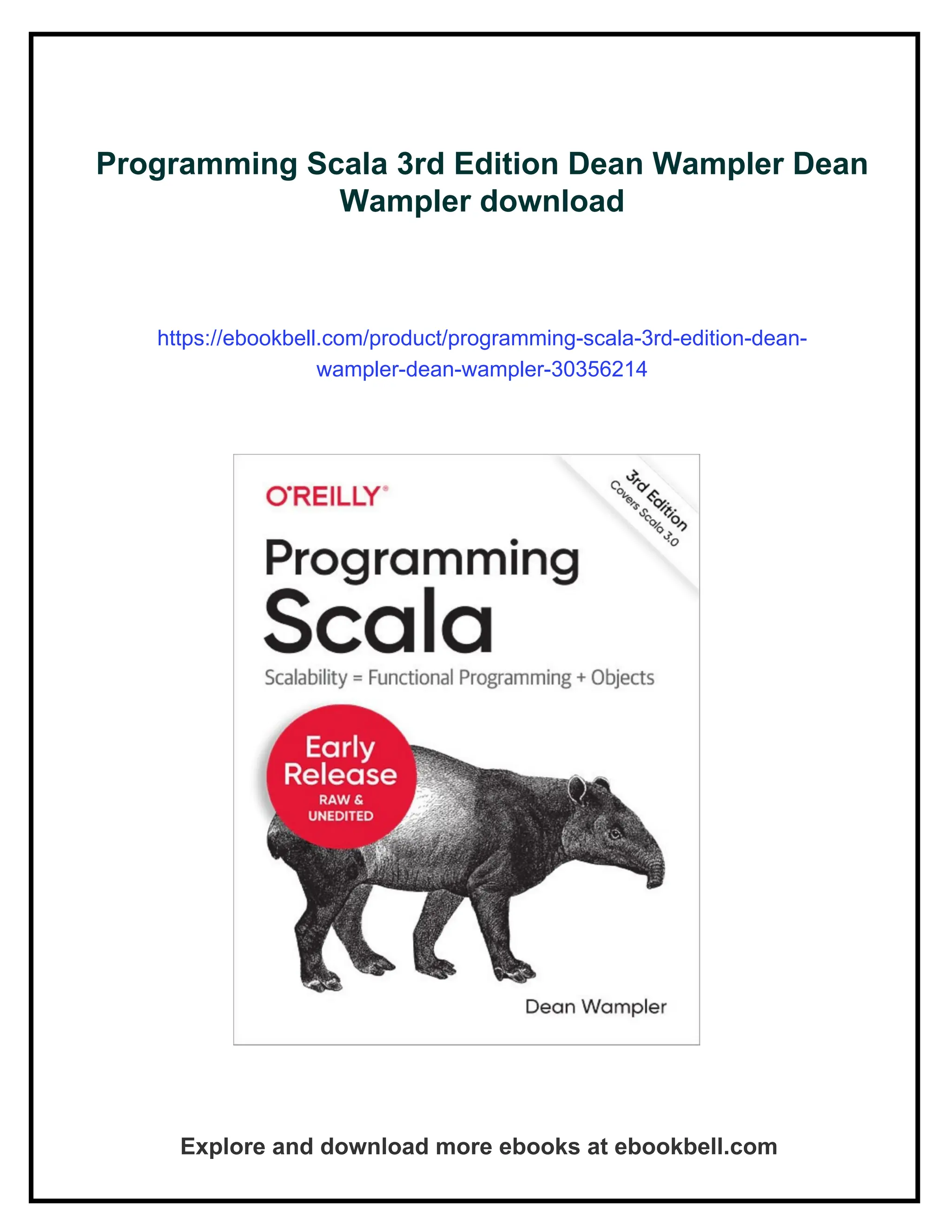

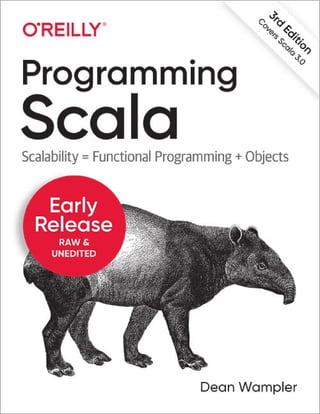
![2020-11-26: Third release
2021-02-09: Fourth release
See http://oreilly.com/catalog/errata.csp?isbn=9781491949856 for
release details.
The O’Reilly logo is a registered trademark of O’Reilly Media, Inc.
Programming Scala, the cover image, and related trade dress are
trademarks of O’Reilly Media, Inc.
While the publisher and the authors have used good faith efforts to
ensure that the information and instructions contained in this work
are accurate, the publisher and the authors disclaim all responsibility
for errors or omissions, including without limitation responsibility for
damages resulting from the use of or reliance on this work. Use of
the information and instructions contained in this work is at your own
risk. If any code samples or other technology this work contains or
describes is subject to open source licenses or the intellectual
property rights of others, it is your responsibility to ensure that your
use thereof complies with such licenses and/or rights.
978-1-492-07782-4
[LSI]](https://image.slidesharecdn.com/15178107-250610045710-7f7bfee9/85/Programming-Scala-3rd-Edition-Dean-Wampler-Dean-Wampler-8-320.jpg)

![The Scala team has worked hard to make migration to Scala 3 from
Scala 2 as painless as possible, while still allowing the language to
make improvements that require breaking changes. Scala 3 uses the
same collections library as Scala 2.13. Hence, if you are using a
Scala 2 version earlier than 2.13, I recommend upgrading to Scala
2.13 first, to update uses of the library, then upgrade to Scala 3.
However, to make this transition as painless as possible, there are
several ways to compile Scala code that allows or disallows
deprecated Scala 2 constructs. There are even compiler flags that
will do some rewrites for you. See later chapter [x] and the section
on the command line in Chapter 21 for details.
Installing Scala
Let’s learn how to install the command-line tools that you need to
work with the book’s code examples. The examples used in this
book were written and compiled using Scala version 3.0, the latest
release at the time of this writing.
All the examples will use Scala on the JVM. See the Scala.js and
Scala Native websites for information on targeting those platforms.
At a minimum, you need to install a recent Java JDK and the de
facto build tool for Scala, SBT. Then you can use the sbt command
to bootstrap everything else for the examples. However, the following
sections go into more details about tools you might want to install
and how to install them.
The Scala website Getting Started page discusses even more
options to get started with Scala.
Coursier
Coursier (get-coursier.io) is a new dependency resolver and tool
manager. It replaces Maven and Ivy, the traditional dependency
2](https://image.slidesharecdn.com/15178107-250610045710-7f7bfee9/85/Programming-Scala-3rd-Edition-Dean-Wampler-Dean-Wampler-30-320.jpg)
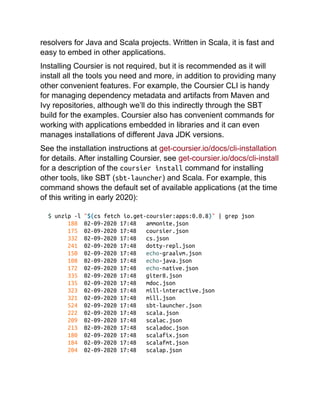
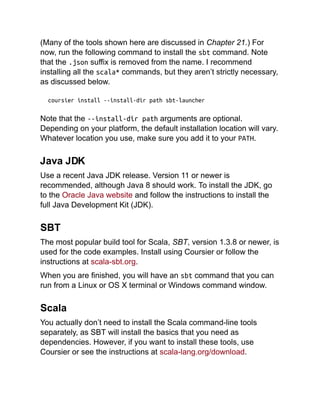
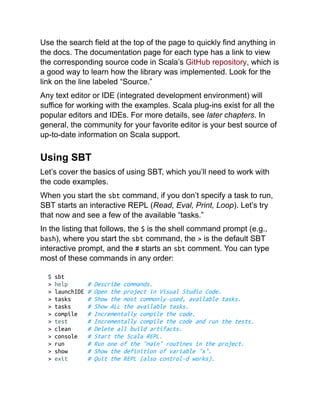
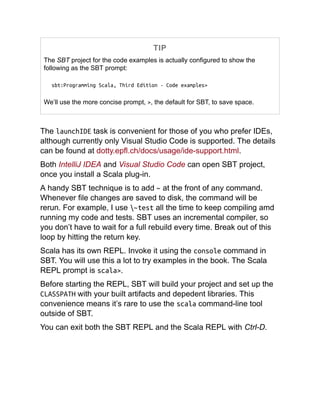
![TIP
Using the Scala REPL is a very effective way to experiment with code idioms
and to learn an API, even Java APIs. Invoking it from SBT using the console
task conveniently adds project dependencies and the compiled project code to
the classpath for the REPL.
Running the Scala Command-Line Tools
If you installed the Scala command-line tools separately, the Scala
compiler is called scalac, analogous to the Java compiler javac. We
will let SBT run it for us, but the command syntax is straightforward if
you’ve ever run javac. Use scalac -help to see the options.
Similarly, the scala command, which is similar to java, is used to run
programs, but it also supports the interactive REPL mode we just
discussed and the ability to run Scala “scripts”. Consider this
example script from the code examples:
// src/script/scala/progscala3/introscala/Upper1.scala
class Upper1:
def convert(strings: Seq[String]): Seq[String] =
strings.map((s: String) => s.toUpperCase())
val up = new Upper1()
println(up.convert(List("Hello", "World!")))
Let’s run it with the scala command. Change your current working
directory to the root of the code examples. For Windows, use
backslashes in the next command:
$ scala src/script/scala/progscala3/introscala/Upper1.scala
List(HELLO, WORLD!)
...
And thus we have satisfied the Prime Directive of the Programming
Book Authors Guild, which states that our first program must print](https://image.slidesharecdn.com/15178107-250610045710-7f7bfee9/85/Programming-Scala-3rd-Edition-Dean-Wampler-Dean-Wampler-36-320.jpg)
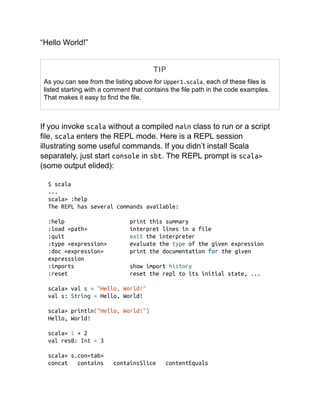
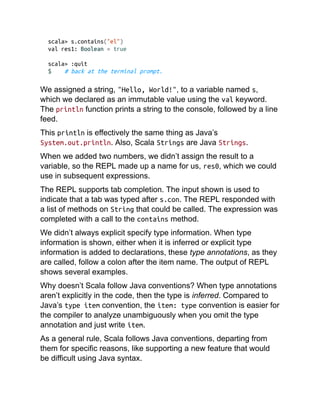
![cross line boundaries. Scaladoc comments follow Java conventions,
/** comment */.
When the path starts with src/script, use scala to run the script, as
follows:
$ scala src/script/scala/progscala3/introscala/Upper1.scala
However, this may not work if the script uses libraries. Instead, run
the SBT console, then use the :load command:
scala> :load src/script/scala/progscala3/introscala/Upper1.scala
Finally, you can also copy code and paste it at the scala> prompt.
Files named src/test/scala/.../*Suite.scala are tests written
using MUnit (see later chapters). To run all the tests, use the sbt
command test. To run just one particular test, use testOnly path,
where path is the fully-qualified type name for the test.
> testOnly progscala3.objectsystem.equality.EqualitySuite
[info] Compiling 1 Scala source to ...
progscala3.objectsystem.equality.EqualitySuite:
+ The == operator is implemented with the equals method 0.01s
+ The != operator is implemented with the equals method 0.001s
...
[info] Passed: Total 14, Failed 0, Errors 0, Passed 14
[success] Total time: 1 s, completed Feb 29, 2020, 5:00:41 PM
>
The corresponding source file is
src/test/scala/progscala3/objectsystem/equality/EqualitySuite
.scala. SBT follows Maven conventions that directories for compiled
source code go under src/main/scala and tests go under
src/test/scala. So, in this example, the package definition for this
test is progscala3.objectsystem.equality. The compiled class
name is EqualitySuite.](https://image.slidesharecdn.com/15178107-250610045710-7f7bfee9/85/Programming-Scala-3rd-Edition-Dean-Wampler-Dean-Wampler-40-320.jpg)
![NOTE
Java requires that package and file names must match the declared package
and public class declared within the file. Scala doesn’t require this practice.
However, I follow these conventions most of the time for compiled code (less
often for scripts) and I recommend you do this, too, for your production code.
Finally, many of the files under the src/main/scala define a main
method that you can execute in one of several ways.
First, use SBT’s run command. It will find all the classes with main
methods and prompt you to pick which one. Note that SBT will only
search src/main/scala and src/main/java directories, ignoring the
other directories under src, including src/script.
Let’s use another example we’ll study later in the chapter,
src/main/scala/progscala3/introscala/UpperMain1.scala. Invoke
run hello world, then enter the number shown for
progscala3.introscala.UpperMain1. Note we are passing
arguments to run, hello world, which will be passed to the program
to convert to upper case:
> run hello world
...
Multiple main classes detected, select one to run:
...
[20] progscala3.introscala.UpperMain1
...
20
[info] running progscala3.introscala.UpperMain1 hello world
HELLO WORLD
[success] Total time: 2 s, completed Feb 29, 2020, 5:08:18 PM](https://image.slidesharecdn.com/15178107-250610045710-7f7bfee9/85/Programming-Scala-3rd-Edition-Dean-Wampler-Dean-Wampler-41-320.jpg)
![The second way to run this program is to use runMain and specify
the specific program class name. This skips the prompt:
> runMain progscala3.introscala.UpperMain1 hello world
[warn] Multiple main classes detected. Run 'show
discoveredMainClasses' ...
[info] running progscala3.introscala.UpperMain1
HELLO WORLD
[success] Total time: 0 s, completed Feb 29, 2020, 5:18:05 PM
>
Finally, once your program is ready for production runs, you’ll use
the scala command, similar to how java is used. Now the correct
classpath must be defined, including all dependencies. This
example is relatively easy; we just point to the output directory for
the compiled code:
$ scala -cp target/scala-3.0.0/classes/
progscala3.introscala.UpperMain1 words
Let’s explore other differences between scripts, like the Upper1 script
we’ve used, and compiled code, like the UpperMain1 example we just
executed.
Here is the script again:
// src/script/scala/progscala3/introscala/Upper1.scala
class Upper1:
def convert(strings: Seq[String]): Seq[String] =
strings.map((s: String) => s.toUpperCase())
val up = new Upper1()
println(up.convert(List("Hello", "World!")))
We declare a class, Upper1, using the class keyword. The entire
class body is indented on the subsequent lines (or inside curly
braces {…} if you use that syntax instead).](https://image.slidesharecdn.com/15178107-250610045710-7f7bfee9/85/Programming-Scala-3rd-Edition-Dean-Wampler-Dean-Wampler-42-320.jpg)
![Upper1 contains a method called convert. Method definitions start
with the def keyword, followed by the method name and an optional
parameter list. The method signature ends with an optional return
type. The return type can be inferred in many cases, but adding the
return type explicitly, as shown, provides useful documentation and
also avoids occasional surprises from the type inference process.
NOTE
I’ll use parameters to refer to the things a method or function is defined as
accepting when you call it. I’ll use arguments to refer to values you actually pass
to it when making the call.
Type annotations are specified using name: type. This is used here
for both the parameter list and the return type of the method, the last
Seq[String] before the equals sign.
An equals sign (=) separates the signature from the method body.
Why an equals sign?
One reason is to reduce ambiguity. Scala infers the return type if the
colon and type are omitted. If the method takes no parameters, you
can omit the parentheses, too. So, the equal sign makes parsing
unambiguous when either or both of these features are omitted. It’s
clear where the signature ends and the method body begins.
The equals sign also reminds us of the functional programming
principle that variables and functions are treated uniformly. As we
saw in the invocation of map, functions can be passed as arguments
to other functions, just like values. They can also be returned from
functions, and assigned to variables. In fact, it’s correct to say that
functions are values.
This method takes a sequence (Seq) of zero or more input strings
and returns a new sequence, where each of the input strings is
converted to uppercase. Seq is an abstraction for collections that you](https://image.slidesharecdn.com/15178107-250610045710-7f7bfee9/85/Programming-Scala-3rd-Edition-Dean-Wampler-Dean-Wampler-43-320.jpg)
![can iterate through. The actual type returned by this method will be
the same concrete type that was passed into it as an argument, like
Vector or List (both of which are immutable collections).
Collection types like Seq are parameterized types, very similar to
generic types in Java. They are a “collection of something,” in this
example a sequence of strings. Scala uses square brackets ([…]) for
parameterized types, whereas Java uses angle brackets (<…>).
NOTE
Scala allows angle brackets to be used in identifiers, like method and variable
names. For example, defining a “less than” method and naming it < is common
and allowed by Scala, whereas Java doesn’t allow characters like that in
identifiers. So, to avoid ambiguity, Scala uses square brackets instead for
parameterized types and disallows them in identifiers.
Inside the body, we use one of the powerful methods available for
most collections, map, which iterates through the collection, calls the
provided method on each element, and returns a new collection with
the transformed elements.
The function passed to map is an unnamed function literal
(parameters) => body, similar to Java’s lambda syntax:
(s: String) => s.toUpperCase()
It takes a parameter list with a single String named s. The body of
the function literal is after the “arrow,” =>. (The UTF8 ⇒ characters
was also allowed in Scala 2, but is now deprecated.) The body calls
toUpperCase() on s. The result of this call is automatically returned
by the function literal. In Scala, the last expression in a function or
method is the return value. The return keyword exists in Scala, but it
can only be used in methods, not in anonymous functions like this
one. In fact, it is rarely used in methods.](https://image.slidesharecdn.com/15178107-250610045710-7f7bfee9/85/Programming-Scala-3rd-Edition-Dean-Wampler-Dean-Wampler-44-320.jpg)
![METHODS VERSUS FUNCTIONS
Following the convention in most object-oriented programming
languages, the term method is used to refer to a function defined
within a class. Methods have an implied this reference to the
object as an additional argument when they are called. Like most
OO languages, the syntax used is this.method_name(other_
args). We’ll use the term method this way. We’ll use the term
function to refer to non-methods, but also sometimes use it
generically to include methods. The context will indicate the
distinction.
The expression (s: String) => s.toUpperCase() in
Upper1.scala is an example of a function that is not a method.
On the JVM, functions are implemented using JVM lambdas:
scala> (s: String) => s.toUpperCase()
val res0: String => String = Lambda$7775/0x00000008035fc040@7673711e=
The last two lines create an instance of Upper1, named up, and use it
to convert two strings to uppercase and finally print the resulting Seq.
As in Java, the syntax new Upper1() creates a new instance. The up
variable is declared as a read-only “value” using the val keyword. It
behaves like a final variable in Java.
Now lets look at the compiled example, where I added Main to the
name. Note the path to the source file now contains src/main,
instead of src/script:
// src/main/scala/progscala3/introscala/UpperMain1.scala
package progscala3.introscala
object UpperMain1:
def main(params: Array[String]): Unit =
params.map(s => s.toUpperCase()).foreach(s => printf("%s ",s))
println("")](https://image.slidesharecdn.com/15178107-250610045710-7f7bfee9/85/Programming-Scala-3rd-Edition-Dean-Wampler-Dean-Wampler-45-320.jpg)
![end main
@main def hello(params: String*) = main(params.toArray)
end UpperMain1
Declare the package location.
Declare a main method, the program entry point.
For long methods (unlike this one), you can use end name, but
this is optional.
An alternative way to define an entry point method.
Optional end to the object definition.
Packages work much like they do in Java. Packages provide a
“namespace” for scoping. Here we specify that this class exists in
the progscala3.introscala package.
To declare a main method in Java, you would put it in a class and
declare it static, meaning not tied to any one instance. You can
then call it with the syntax MyClass.main. This pattern is so
pervasive, that Scala builds it into the language. We instead declare
an object, named UpperMain1, using the object keyword, then
declare main as we would any other method. At the JVM level, it
looks like a static method. When running this program like we did
above, this main method is invoked.
Note the parameter list is an Array[String] and it returns Unit,
which is analogous to void in programs like Java, where nothing
useful is returned.
You use end name with all of the constructs like method and type
definitions, if, while expressions, etc. that support the braceless,
indentation-based structure. It is optional, intended for long
definitions where it can be hard to see the beginning and end at the](https://image.slidesharecdn.com/15178107-250610045710-7f7bfee9/85/Programming-Scala-3rd-Edition-Dean-Wampler-Dean-Wampler-46-320.jpg)
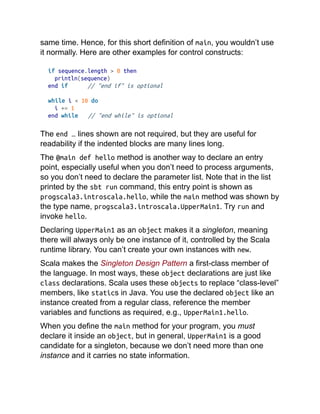
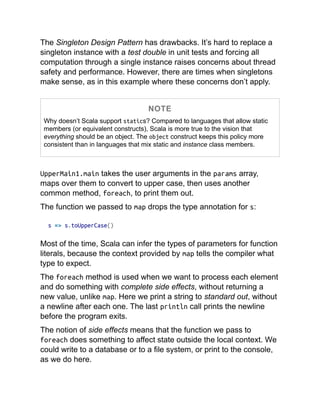
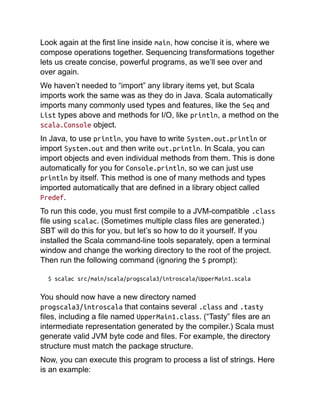
![$ scala -cp . progscala3.introscala.UpperMain1 Hello World!
HELLO WORLD!
The -cp . option adds the current directory to the search classpath,
although this is actually the default behavior.
Allowing SBT to compile it for us instead, we can run it at the SBT
prompt using this command:
> runMain progscala3.introscala.UpperMain1 Hello World!
For completeness, if you compile with SBT, but run it using the scala
command outside SBT, then set the classpath to point to the correct
directory where SBT writes class files:
$ scala -cp target/scala-3.0.0/classes
progscala3.introscala.UpperMain1 hello
HELLO
INTERPRETING VERSUS COMPILING AND RUNNING
SCALA CODE
To summarize, if you type scala on the command line without a
file argument, the REPL is started. You type in commands,
expressions, and statements that are evaluated on the fly. If you
give the scala command a Scala source file argument, it
compiles and runs the file as a script. Otherwise, if you provide a
JAR file or the name of class with a main routine, scala executes
it just like the java command.
Returning to the script version, we can actually simplify it even more.
Consider this simplified version:
// src/script/scala/progscala3/introscala/Upper2.scala
object Upper2:
def convert(strings: Seq[String]) = strings.map(_.toUpperCase())](https://image.slidesharecdn.com/15178107-250610045710-7f7bfee9/85/Programming-Scala-3rd-Edition-Dean-Wampler-Dean-Wampler-50-320.jpg)
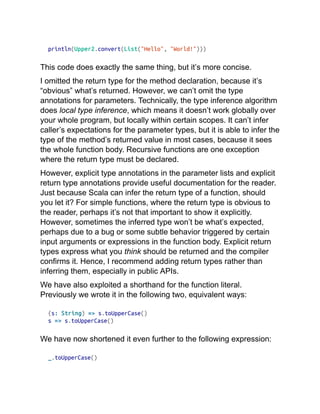
![The map method takes a single function parameter, where the
function itself takes a single parameter. In this case, the function
body only uses the parameter once, so we can use the anonymous
variable _ instead of a named parameter. The string parameter will
be assigned to it before toUpperCase is called.
Finally, using an object instead of a class simplifies the invocation,
because we don’t need to first create an instance with new. We just
call Upper2.convert directly.
Let’s do one last version of the compiled code (under
src/main/scala) to show another way of working with collections for
this situation:
// src/main/scala/progscala3/introscala/UpperMain2.scala
package progscala3.introscala
object UpperMain2:
def main(params: Array[String]): Unit =
val output = params.map(_.toUpperCase()).mkString(" ")
println(output)
Instead of using foreach to print each transformed word as before,
we map the array to a new array of strings, then call a convenience
method to concatenate the strings into a final string. There are two
mkString methods. One takes a single parameter to specify the
delimiter between the collection elements. The second version that
takes three parameters, a leftmost prefix string, the delimiter, and a
rightmost suffix string. Try changing the code to use mkString("[",
", ", "]").
As a little exercise, return to the script Upper2.scala and try
simplifying it further. Eliminate the Upper2 object completely and just
call map on the list of words directly. You should have just one line of
code when you’re done! (See the code examples for one
implementation.)](https://image.slidesharecdn.com/15178107-250610045710-7f7bfee9/85/Programming-Scala-3rd-Edition-Dean-Wampler-Dean-Wampler-52-320.jpg)
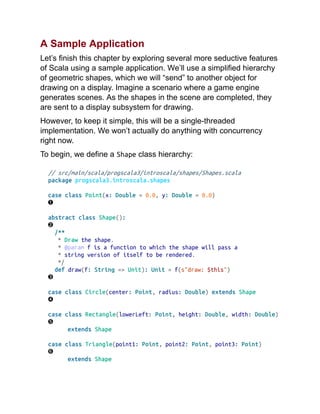
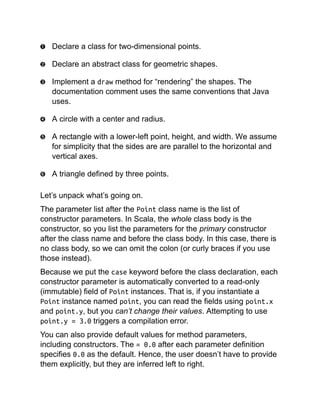

![seen on the south face of the pass, nor did the dwarf Rhododendron
and little Andromeda appear till the summit had been gained,
though they were abundant on the northern face. Rhododendron
campanulatum was the next plant observed, forming bushes four or
five feet in height, and growing in large green patches, along with
the willow, which I had found on the top, and the same rose
common on the southern side. About 1200 feet below the summit,
that is, about 12,000 feet above the sea, pine-trees commenced—
Pinus excelsa and Picea making their appearance together, the
deodar not till a considerably lower level had been reached. The
trees of silver fir were small, with smaller and shorter leaves than
the common tree of the forests in the outer Himalaya, and were
therefore the true Picea Webbiana of Royle, the more common long-
leaved form being the Picea Pindrow of that author[5].
At an elevation of 11,000 feet, at a rough estimate, we passed the
first deodars, and at the same height cultivation commenced. The
first fields were wheat, now nearly ripe. With the cultivation many
plants of lower elevation began to appear, which had disappeared on
the upper part of the mountain, but many were missed which had
been common, and the general aspect of the vegetation was
strikingly altered, the diminution affecting at once the number, the
abundance, and the luxuriance of the plants. Juniper was frequent
till some time after the first corn-fields were passed, and Gerard's
pine was common on the lower part of the descent. Throughout the
whole distance from the crest to the Lipa stream, the road lay along
a ravine, which was very rough and uneven, and covered with
numerous and often very large boulders of granite[6] scattered
irregularly over the surface of the valley. Towards the end of the
day's march, we reached the Lipa stream, which was of large size;
and we continued along its right bank, through a dry fir-wood, till
close to the village, when we crossed by a substantial wooden
bridge to enter Lipa, which is situate on a flattish piece of ground on
the left bank of the stream, and very little above its level. It is a
small village, with some cultivation, and a rather odd-looking little](https://image.slidesharecdn.com/15178107-250610045710-7f7bfee9/85/Programming-Scala-3rd-Edition-Dean-Wampler-Dean-Wampler-56-320.jpg)
![HANGO.
August, 1847.
another, the furthest evidently at a great distance, and covered with
heavy snow[7].
The vegetation at the summit of the ridge was even more scanty
than on the Runang pass. There was, however, more novelty in
species than I had met with there. A grass, several saxifrages,
Potentillæ and Seda, a little Thermopsis, an Anemone, and a
beautiful Delphinium (D. Brunonianum, Royle), were the new species
observed; and these, I believe, (as was indeed to be expected from
the minuteness with which the country had been investigated by Dr.
Royle's collectors,) were all previously described species.
From the pass the descent was pretty steep all the
way to Hango, a small village, elevated 11,500
feet. The road lay on the side of a ravine, keeping
the hills on the left hand, and the channel of the stream on the
right. The Dama, which had disappeared at the summit, was again
plentiful on the northern slope; and a shrubby species of Potentilla,
quite new to me, was exceedingly common. Otherwise, little change
was visible. The road was good, but the hills were dry and stony.
The village of Hango, notwithstanding its great elevation, has a
considerable extent of cultivation, though I think the corn was less
luxuriant than at lower levels. The wheat was still green, and rather
scanty, a good deal of a wild oat (perhaps Avena fatua) being mixed
with it; but the barley was stronger and more productive. There was
also a number of fields of Hordeum Ægiceras, that curious awnless
monstrous barley, which seems peculiar to the higher regions of
Tibet, where it is very frequently cultivated. This grain was much
further advanced than the wheat, being nearly ripe. The arable lands
of Hango are nearly destitute of trees, a few willows being the only
arboreous vegetation. They are abundantly supplied with water,
circulating in copious rills among the different fields, which are
disposed in terraces one above another, faced by walls about three
feet in height. On the margins of the cultivation, stimulated by the
moisture derived from the irrigation, there was a very abundant](https://image.slidesharecdn.com/15178107-250610045710-7f7bfee9/85/Programming-Scala-3rd-Edition-Dean-Wampler-Dean-Wampler-67-320.jpg)
![CHANGAR.
August, 1847.
through districts which are included within the Chinese frontier. It
was our wish to proceed by the most expeditious route, and at the
same time that nearest the line of boundary, to Hanle. It was,
therefore, our object to effect, if possible, a passage up the
Zungsam river, though, as we knew that Captain Gerard and M.
Jacquemont had both been stopped upon the frontier, we had no
reason to anticipate any more favourable result.
We therefore took, on leaving Chango, a north-easterly direction,
proceeding, on the 27th of August, to a village on the left bank of
the Parang or Zungsam river, called Changar, the same place which,
by Gerard and Jacquemont, is named Changrezing. Leaving the
cultivated lands of Chango, and crossing the stream which skirts the
plain, we immediately commenced a steep zigzag ascent over a
barren shingly road, to the heights which overhang the village to the
north-east. After a very fatiguing climb of not less than 1300 feet,
we attained the summit of the ridge, and advanced along it for some
distance without much change of level, but still gradually ascending
among low-topped gravelly hills. A very steep ascent followed to the
summit of the pass, which was called Changrang La[8], and could
not be much under 13,000 feet. The whole ascent was extremely
barren, the arid slopes producing a minimum of vegetation. A fleshy
Cruciferous plant, with a strong pungent taste not unlike horse-
radish (Christolea of Decaisne in Jacquemont), a fine Nepeta (N.
floccosa, Benth.), and a little Stipa, were the only novelties; and
these, with the Ephedra, a little Lactuca, an aromatic species of
Chenopodium (C. Botrys), the Tibetan Euphorbia, and a shrubby
white-flowered spinous Astragalus, were almost all the plants
observed.
From the summit of the pass, the road descended
abruptly into a deep ravine, which originated in a
snowy mountain to the south. At the bottom of
this ravine, between rocky precipitous banks, ran a considerable
torrent, which was crossed by a very frail wooden bridge.
Immediately after crossing, the road began to ascend rapidly, rising](https://image.slidesharecdn.com/15178107-250610045710-7f7bfee9/85/Programming-Scala-3rd-Edition-Dean-Wampler-Dean-Wampler-76-320.jpg)
![CHINESE
FRONTIER.
August, 1847.
fruit was quite black, and had the size and flavour of the common
black currant, with, however, a considerable degree of acidity.
About three miles from Changar, an abrupt descent led from the
platform on which we had been travelling, to the level of the banks
of the river, more than 1000 feet lower. The path by which we
descended was steep, rocky, and difficult. The rock was still clay-
slate, with granite veins. The granite in general very much exceeded
in quantity the rock into which it had been injected, as was well seen
on several precipitous cliffs along the course of the stream, in which
the stratification of the slaty rock and the ramifications of the granite
could be examined in detail. The banks of the river were adorned
with a species of Myricaria, a small tree, with very delicate graceful
foliage and beautiful rose-coloured flowers.
On reaching the small streamlet which forms the
frontier of the Chinese dominions, we found, as
indeed we expected, that there was no intention
of permitting us to proceed by the direct road to
Hanle; and all arguments to induce a compliance with our wish
proving ineffectual, we agreed to take the route up the Piti river by
Dankar, and were then permitted to proceed about a mile, to the
village of Kyuri, where we encamped for the day. I have now no
doubt that if we had resolutely advanced, no serious opposition to
our progress would have been made; but our instructions were so
precise that we should not have been justified in using the smallest
degree of force, or incurring any risk of a collision.
To reach Kyuri[9], we crossed the Zungsam river by a very
remarkable natural bridge, composed of an enormous block of
granite, which has in some way been placed across the stream, at a
spot where it is much contracted in width, flowing in a deep rocky
fissure from fifteen to twenty-five feet in width, evidently of great
depth. At this point a considerable number of boulders of large size
are piled on both banks, of which the one that spans the channel is
eighty-five feet in length and probably not less than forty in width](https://image.slidesharecdn.com/15178107-250610045710-7f7bfee9/85/Programming-Scala-3rd-Edition-Dean-Wampler-Dean-Wampler-78-320.jpg)
![DANKAR.
September, 1847.
RANGRIG.
September, 1847.
being certainly the case in many other similar instances. The
limestone was very compact, of a blue or grey colour, and many of
the fragments were almost full of coralline remains. I collected many
fossiliferous specimens, which were afterwards despatched from
Hanle to Simla by a messenger, on whom we thought we could rely,
but they never reached their destination[10].
We encamped at Dankar, after travelling ten miles.
This place is the principal village of the Piti valley,
and is 13,000 feet above the level of the sea. The
valley of the Piti is here very wide, and divided into numerous
channels, which are separated by low gravelly islands, the whole
width of the river being not less than half a mile. Here the alluvium
is very highly developed, lying in patches on the face of the steep
hills. The village of Dankar, though 1000 feet above the river,
occupies both sides of a steep ridge entirely composed of alluvium.
Nor is this its utmost limit; for several hundred feet above the
houses, similar alluvial masses occur. These beds are not, however,
continuous from these great elevations, down to the level of the
river: they rest, on the contrary, on the ancient rocks, which are
here very steep, and the clay may be seen in isolated projecting
masses, capping the most prominent ridges[11].
The village of Dankar is built on arid barren soil,
but the cultivated lands stretch from about the
level of the village almost to the river, on a very
steep slope. Thickets of Hippophaë were scattered among the
cultivation, where the ground was swampy; and notwithstanding the
great altitude, the exposure being favourable, the crops seemed
good, and the wild plants were more luxuriant than usual. One of
the new species observed was a pretty gentian (G. Moorcroftiana,
Wall.), interesting as having been one of the few plants sent from
the Tibetan country by the unfortunate traveller whose name it
bears. It is also a common species in the valley of Dras, in which,
perhaps, Mr. Moorcroft's specimens were collected, unless, indeed,](https://image.slidesharecdn.com/15178107-250610045710-7f7bfee9/85/Programming-Scala-3rd-Edition-Dean-Wampler-Dean-Wampler-85-320.jpg)