2
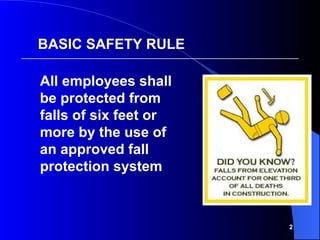
All employees shall
beprotected from
falls of six feet or
more by the use of
an approved fall
protection system
BASIC SAFETY RULE
3.
3
What are approvedFall Protection Systems?
Fall Arrest Systems
• full body harness/ lanyard/ lifeline
Ladders
Scaffold System
• Structural system
• Guardrail system
• Planking
APPROVED FALL PROTECTION SYSTEMS
4.
4
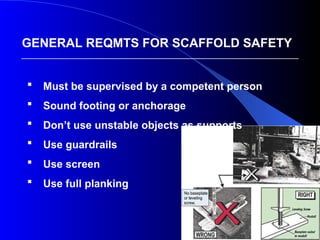
Must besupervised by a competent person
Sound footing or anchorage
Don’t use unstable objects as supports
Use guardrails
Use screen
Use full planking
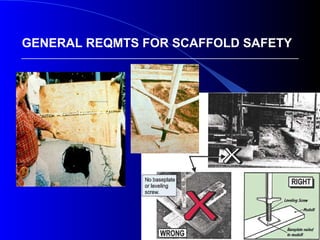
GENERAL REQMTS FOR SCAFFOLD SAFETY
6
Legs shouldbe plumb
Eliminate slippery conditions
Post safety rules
Scaffold shall be tied and fully braced
Shall be capable of supporting 4x the design load
Plan or drawing approved by Structural Engineer
GENERAL REQMTS FOR SCAFFOLD SAFETY
7.
7
Avoid powerlines
Approval for multiple usage
Ladders should have landing
Use outrigger or outboard safety
support
Provide independent safety lines
GENERAL REQMTS FOR SCAFFOLD SAFETY
8.
8
Must besupervised
Provide access ladder or equivalent
Work during severe weather condition is
prohibited
Extend and overlap planks
Do not ride on rolling scaffold
PERSONNEL REQUIREMENTS
10
Personnel shallhave a secured safety
lanyard
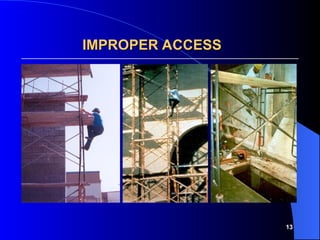
Provide safe means of ingress/egress
Area should be fully barricaded
Temporary work platforms/Walkways
(Scaffolds and boards)
INTERSTITIAL WORK
14
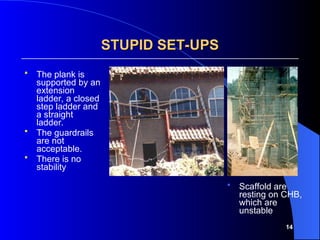
STUPID SET-UPS
STUPID SET-UPS
The plank is
supported by an
extension
ladder, a closed
step ladder and
a straight
ladder.
The guardrails
are not
acceptable.
There is no
stability
Scaffold are
resting on CHB,
which are
unstable
15.
15
SCAFFOLD REQUIREMENTS
SCAFFOLD REQUIREMENTS
Be on a firm foundation with base plates
Be plumb, square and adequately braced
Have a fully planked work deck
Have guardrails over 10 feet
Be tied in over 4 Vert./1 Horiz. high
Have an adequate means of access
16.
SCAFFOLD CAPACITY
SCAFFOLD CAPACITY
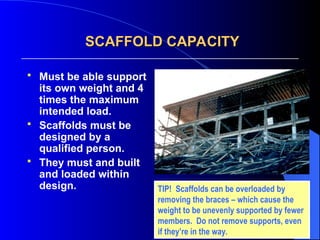
Must be able support
its own weight and 4
times the maximum
intended load.
Scaffolds must be
designed by a
qualified person.
They must and built
and loaded within
design. TIP! Scaffolds can be overloaded by
removing the braces – which cause the
weight to be unevenly supported by fewer
members. Do not remove supports, even
if they’re in the way.
19
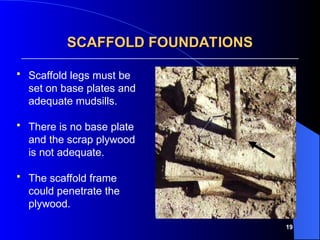
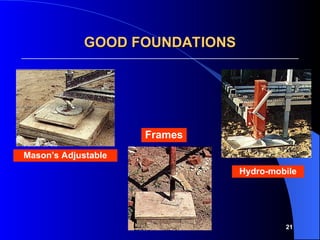
Scaffold legsmust be
set on base plates and
adequate mudsills.
There is no base plate
and the scrap plywood
is not adequate.
The scaffold frame
could penetrate the
plywood.
SCAFFOLD FOUNDATIONS
SCAFFOLD FOUNDATIONS
20.
20
NEVER ON MASONRY!
NEVERON MASONRY!
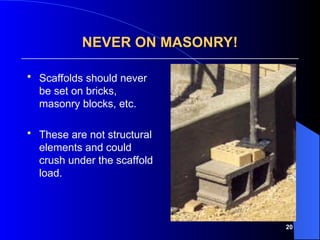
Scaffolds should never
be set on bricks,
masonry blocks, etc.
These are not structural
elements and could
crush under the scaffold
load.
22
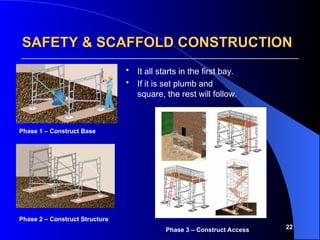
SAFETY & SCAFFOLDCONSTRUCTION
SAFETY & SCAFFOLD CONSTRUCTION
It all starts in the first bay.
If it is set plumb and
square, the rest will follow.
Phase 3 – Construct Access
Phase 2 – Construct Structure
Phase 1 – Construct Base
23.
23
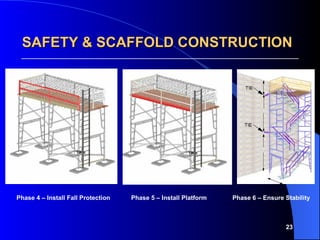
Phase 4 –Install Fall Protection Phase 5 – Install Platform Phase 6 – Ensure Stability
SAFETY & SCAFFOLD CONSTRUCTION
SAFETY & SCAFFOLD CONSTRUCTION
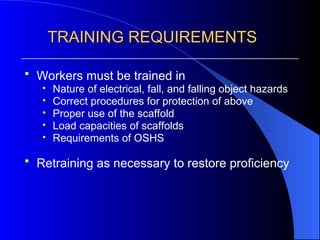
TRAINING REQUIREMENTS
TRAINING REQUIREMENTS
Workers must be trained in
• Nature of electrical, fall, and falling object hazards
• Correct procedures for protection of above
• Proper use of the scaffold
• Load capacities of scaffolds
• Requirements of OSHS
Retraining as necessary to restore proficiency
27
NOTHING IS SOURGENT THAT IT
CAN NOT BE DONE SAFELY !!!
IF IT CAN’T BE DONE SAFELY,
DON’T DO IT AT ALL
WORKING FROM ELEVATED SURFACES
WORKING FROM ELEVATED SURFACES
Editor's Notes
#2 State that all employees shall be protected from falls of 6 ft. or more by the use of an approved fall protection system
#3 State that all employees shall be protected from falls of 6 ft. or more by the use of an approved fall protection system
#4 States that;
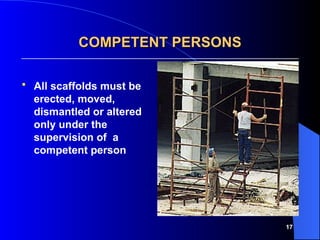
No scaffold shall be erected, moved dismantled or altered except under the supervision of a competent person
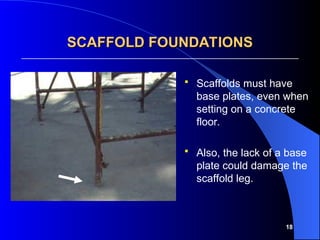
The footing or anchorage for scaffolds shall be rigid, level, sound and capable of carrying the maximum intended load without settling or displacement
Unstable objects such as drums, boxes, loose CHB or concrete blocks are not to be used to support scaffolds or planks
Guardrails, mid-rails , and toeboards shall be installed on all open sides and ends of platforms more than 6 ft. above the working surface. It shall be 2” nominal diameter or its equivalent, between 36-42 inches high, supports shall be at intervals not to exceed 8 ft. Toeboards shall be at least 4 inches in height.
Where persons are required to work or pass under the scaffold, it shall be provided with a screen between the toeboard and guardrail
The entire work platform of a scaffold must be fully covered. If a ladder obstruct full planking, an equivalent fall protection shall be put in place.
#5 States that;
No scaffold shall be erected, moved dismantled or altered except under the supervision of a competent person
The footing or anchorage for scaffolds shall be rigid, level, sound and capable of carrying the maximum intended load without settling or displacement
Unstable objects such as drums, boxes, loose CHB or concrete blocks are not to be used to support scaffolds or planks
Guardrails, mid-rails , and toeboards shall be installed on all open sides and ends of platforms more than 6 ft. above the working surface. It shall be 2” nominal diameter or its equivalent, between 36-42 inches high, supports shall be at intervals not to exceed 8 ft. Toeboards shall be at least 4 inches in height.
Where persons are required to work or pass under the scaffold, it shall be provided with a screen between the toeboard and guardrail
The entire work platform of a scaffold must be fully covered. If a ladder obstruct full planking, an equivalent fall protection shall be put in place.
#6 Poles, legs of scaffolds shall be plumb and securely braced to prevent swaying and displacement.
Slippery conditions on scaffold must be eliminated as soon as they occur.
Scaffolding safety rules shall be posted in a conspicuous place and make sure people follow them. Barricade at least 1 meter around the scaffold or the entire floor area where interstitial work is going on
The entire scaffold shall be tied to and securely braced against the building at intervals not to exceed 30 ft horizontally and 26 ft. vertically
Shall be constructed to support 4x the max load expected
Any scaffold that exceed 20 ft. in length and 10 ft. in height requires a scaffold plan or drawing approved/signed by a Civil or Structural Engineer prior to erection.
#7 Never erect a scaffold within 10 ft. of power lines
Use of scaffold by multiple contractor must be approved by a competent person. Each contractor must be responsible to inspect and ensure the scaffolding is in safe condition prior to any employee working on scaffold
Straight access ladders attached to scaffolding shall not exceed 20 ft. without a break or offset (landing) that would limit the potential fall exposure
Outrigger should be used/installed when scaffold is more than 4x higher than the narrowest base dimension
All suspended scaffolds require independent safety line for each employee. Employee must use full body harness when working from any suspended scaffold.
#8 Requirements for personnel working on scaffolds or other work platforms;
All scaffolds and other work platforms must be installed under the supervision of a competent person
Access ladder or equivalent means of safe access must be provided on all scaffolds
External work on scaffold during severe weather condition is prohibited
Planks used on scaffolding work platforms must extend between 6-18 inches from the end support; overlap at least 12 inches; and be secured to prevent movement
Do not ride on rolling scaffold.
#9 Requirements for personnel working on scaffolds or other work platforms;
All scaffolds and other work platforms must be installed under the supervision of a competent person
Access ladder or equivalent means of safe access must be provided on all scaffolds
External work on scaffold during severe weather condition is prohibited
Planks used on scaffolding work platforms must extend between 6-18 inches from the end support; overlap at least 12 inches; and be secured to prevent movement
Do not ride on rolling scaffold.
#10 Personnel working from temporary platforms or travelling on temporary catwalks shall have their safety lanyard secured at all times to a lifeline or structure capable of supporting a min of 5400 lbs.
Every temporary work platform or walkway must be provided with a safe means of access/egress which allows personnel to remain tied off all times. Retractable lifelines can be used to achieve fall protection for ascending/descending
When working overhead or interstitial, the entire floor area below the interstitial work being done must be fully barricaded.