




SSBMG presentation – April 2016
Introduction
Entrepreneur & social :
total incompatibility or
a converging possibility?
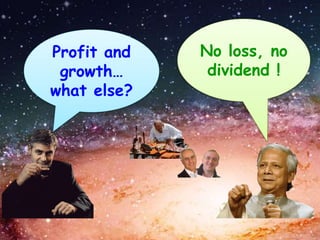
Profit and
growth…
what else?
No loss, no
dividend !
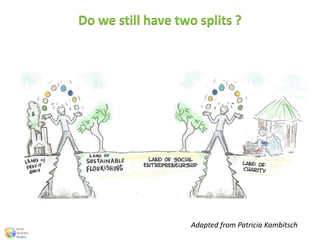
Do we still have two splits ?
Adapted from Patricia Kambitsch
Social Business Models
in short
January 2016
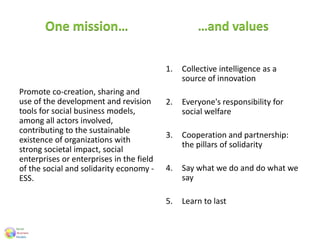
One mission…
Promote co-creation, sharing and
use of the development and revision
tools for social business models,
among all actors involved,
contributing to the sustainable
existence of organizations with
strong societal impact, social
enterprises or enterprises in the field
of the social and solidarity economy -
ESS.
1. Collective intelligence as a
source of innovation
2. Everyone's responsibility for
social welfare
3. Cooperation and partnership:
the pillars of solidarity
4. Say what we do and do what we
say
5. Learn to last
…and values
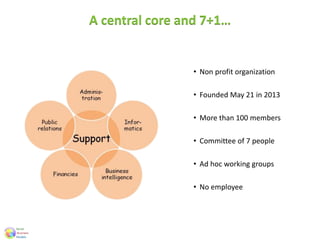
A central core and 7+1…
• Non profit organization
• Founded May 21 in 2013
• More than 100 members
• Committee of 7 people
• Ad hoc working groups
• No employee
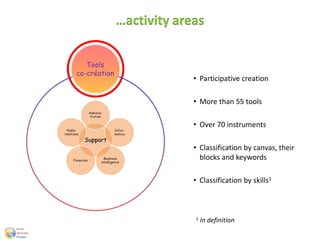
Tools
co-création
…activity areas
• Participative creation
• More than 55 tools
• Over 70 instruments
• Classification by canvas, their
blocks and keywords
• Classification by skills1
1 In definition
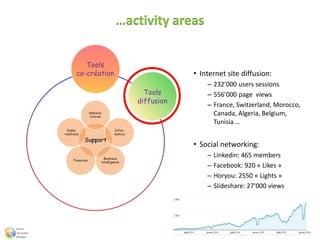
Tools
co-création
Tools
diffusion
…activity areas
• Internet site diffusion:
– 232’000 users sessions
– 556’000 page views
– France, Switzerland, Morocco,
Canada, Algeria, Belgium,
Tunisia …
• Social networking:
– Linkedin: 465 members
– Facebook: 920 « Likes »
– Horyou: 2550 « Lights »
– Slideshare: 27’000 views
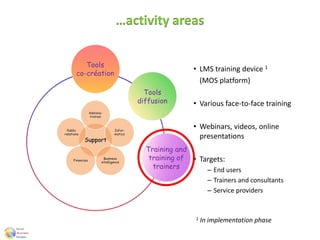
Tools
co-création
Training and
training of
trainers
Tools
diffusion
…activity areas
• LMS training device 1
(MOS platform)
• Various face-to-face training
• Webinars, videos, online
presentations
• Targets:
– End users
– Trainers and consultants
– Service providers
1 In implementation phase
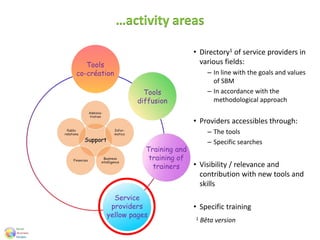
Tools
co-création
Training and
training of
trainers
Tools
diffusion
Service
providers
yellow pages
…activity areas
• Directory1 of service providers in
various fields:
– In line with the goals and values
of SBM
– In accordance with the
methodological approach
• Providers accessibles through:
– The tools
– Specific searches
• Visibility / relevance and
contribution with new tools and
skills
• Specific training
1 Bêta version
Tools
co-création
Training and
training of
trainers
Tools
diffusion
Service
providers
yellow pages
Red threads
and specific
guides
…activity areas
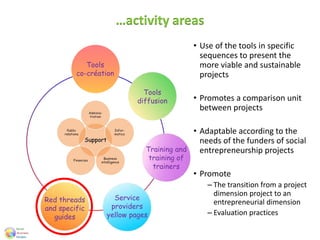
• Use of the tools in specific
sequences to present the
more viable and sustainable
projects
• Promotes a comparison unit
between projects
• Adaptable according to the
needs of the funders of social
entrepreneurship projects
• Promote
– The transition from a project
dimension project to an
entrepreneurial dimension
– Evaluation practices
Tools
co-création
Training and
training of
trainers
Tools
diffusion
Service
providers
yellow pages
Red threads
and specific
guides
Open source
social
business
models
…activity areas
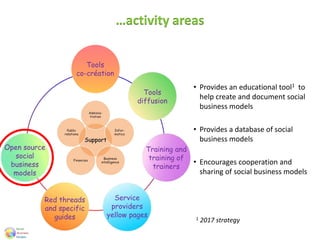
• Provides an educational tool1 to
help create and document social
business models
• Provides a database of social
business models
• Encourages cooperation and
sharing of social business models
1 2017 strategy
Tools
co-création
Training and
training of
trainers
Tools
diffusion
Service
providers
yellow pages
Red threads
and specific
guides
Open source
social
business
models
Alliances and
partnerships
…activity areas
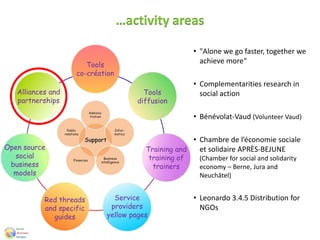
• "Alone we go faster, together we
achieve more“
• Complementarities research in
social action
• Bénévolat-Vaud (Volunteer Vaud)
• Chambre de l’économie sociale
et solidaire APRÈS-BEJUNE
(Chamber for social and solidarity
economy – Berne, Jura and
Neuchâtel)
• Leonardo 3.4.5 Distribution for
NGOs
…activity areas
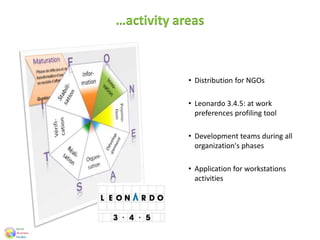
• Distribution for NGOs
• Leonardo 3.4.5: at work
preferences profiling tool
• Development teams during all
organization's phases
• Application for workstations
activities
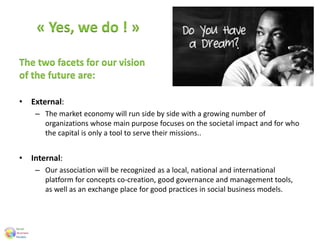
« Yes, we do ! »
The two facets for our vision
of the future are:
• External:
– The market economy will run side by side with a growing number of
organizations whose main purpose focuses on the societal impact and for who
the capital is only a tool to serve their missions..
• Internal:
– Our association will be recognized as a local, national and international
platform for concepts co-creation, good governance and management tools,
as well as an exchange place for good practices in social business models.
The dance of the business
model canvas…
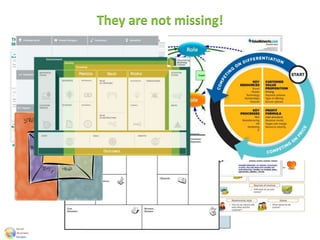
They are not missing!
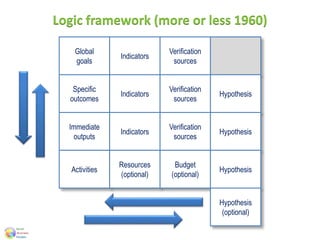
Logic framework (more or less 1960)
Banque mondiale, USAID…
Global
goals
Indicators
Verification
sources
Specific
outcomes
Indicators
Verification
sources
Hypothesis
Immediate
outputs
Indicators
Verification
sources
Hypothesis
Activities
Resources
(optional)
Budget
(optional)
Hypothesis
Hypothesis
(optional)
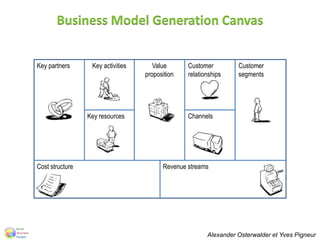
Business Model Generation Canvas
Key partners Customer
segments
Key activities
Key resources
Value
proposition
Customer
relationships
Channels
Revenue streamsCost structure
Alexander Osterwalder et Yves Pigneur
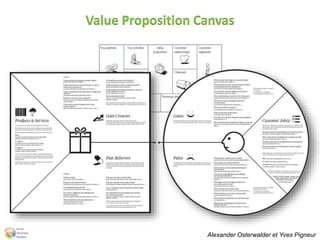
Value Proposition Canvas
Alexander Osterwalder et Yves Pigneur
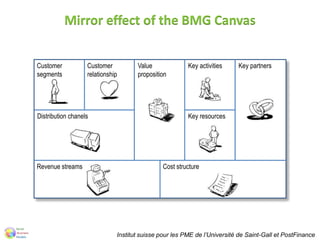
Mirror effect of the BMG Canvas
Distribution chanels Key resources
Cost structureRevenue streams
Customer
segments
Key partnersCustomer
relationship
Value
proposition
Key activities
Institut suisse pour les PME de l’Université de Saint-Gall et PostFinance
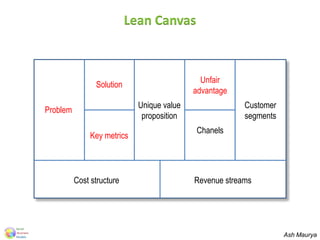
Lean Canvas
Problem
Customer
segments
Solution
Key metrics
Unique value
proposition
Unfair
advantage
Chanels
Revenue streamsCost structure
Ash Maurya
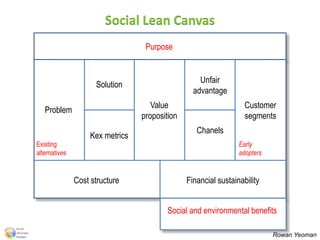
Social Lean Canvas
Problem
Customer
segments
Solution
Kex metrics
Value
proposition
Unfair
advantage
Chanels
Financial sustainabilityCost structure
Rowan Yeoman
Social and environmental benefits
Purpose
Existing
alternatives
Early
adopters
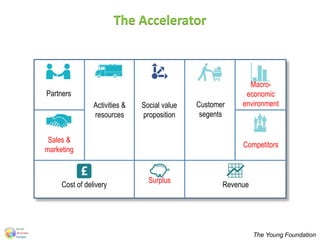
The Accelerator
Partners
Customer
segents
Social value
proposition
Macro-
economic
environmentActivities &
resources
RevenueCost of delivery
The Young Foundation
Competitors
Surplus
Sales &
marketing
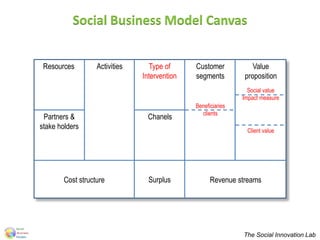
Social Business Model Canvas
Resources Customer
segments
Type of
Intervention
Value
proposition
Activities
Revenue streamsCost structure
The Social Innovation Lab
Surplus
Partners &
stake holders
Chanels
Beneficiaries
clients
Social value
Impact measure
Client value
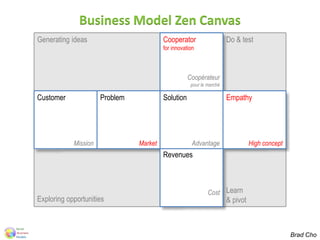
Exploring opportunities
Generating ideas Do & test
Learn
& pivot
Business Model Zen Canvas
Brad Cho
SolutionCustomer Problem
Mission Market Advantage
Empathy
Revenues
Cost
Cooperator
for innovation
Coopérateur
pour le marché
High concept
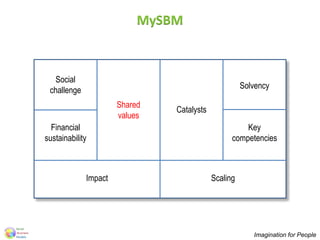
MySBM
Social
challenge
Imagination for People
Financial
sustainability
Solvency
Key
competencies
Shared
values
Catalysts
Impact Scaling
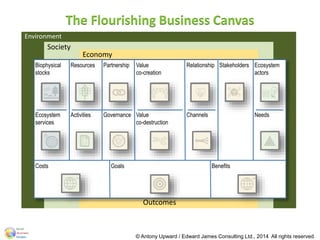
Environment
Society
Economy
Outcomes
The Flourishing Business Canvas
Biophysical
stocks
Resources Partnership Value
co-creation
Relationship Stakeholders Ecosystem
actors
Ecosystem
services
Activities Governance Value
co-destruction
Channels Needs
Costs Goals Benefits
© Antony Upward / Edward James Consulting Ltd., 2014 All rights reserved.
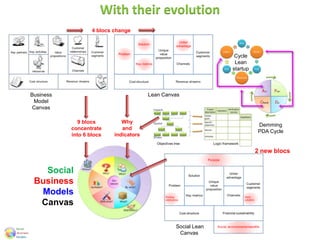
With their evolution
Social
Business
Models
Canvas
9 blocs
concentrate
into 6 blocs
Why
and
indicators
Business
Model
Canvas
Lean Canvas
4 blocs change
Cycle
Lean
startup
Demming
PDA Cycle
Social Lean
Canvas
2 new blocs
Methodology and canvas
March 2016
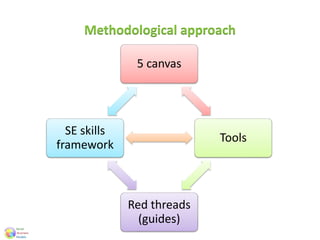
Methodological approach
5 canvas
Tools
Red threads
(guides)
SE skills
framework
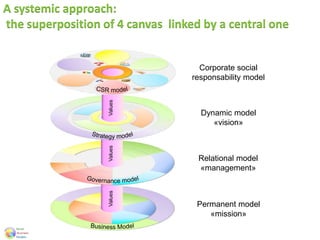
A systemic approach:
the superposition of 4 canvas linked by a central one
Permanent model
«mission»
Relational model
«management»
Values
Dynamic model
«vision»
ValuesValues
Corporate social
responsability model
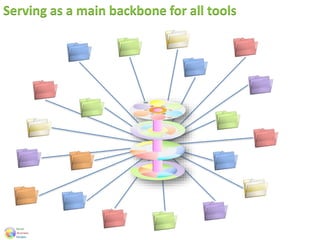
Serving as a main backbone for all tools
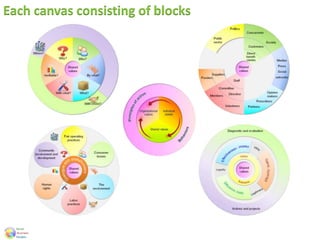
Each canvas consisting of blocks
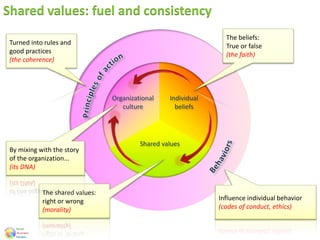
Shared values: fuel and consistency
Individual
beliefs
Organizational
culture
Shared values
The beliefs:
True or false
(the faith)
The shared values:
right or wrong
(morality)
By mixing with the story
of the organization...
(its DNA)
Influence individual behavior
(codes of conduct, ethics)
Turned into rules and
good practices
(the coherence)
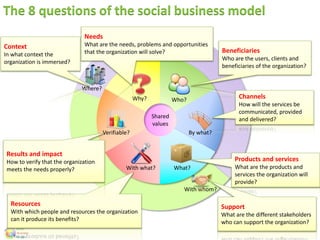
With whom?
Why?
Verifiable?
Who?
With what? What?
By what?
Shared
values
Where?
The 8 questions of the social business model
Context
In what context the
organization is immersed?
Needs
What are the needs, problems and opportunities
that the organization will solve? Beneficiaries
Who are the users, clients and
beneficiaries of the organization?
Channels
How will the services be
communicated, provided
and delivered?
Products and services
What are the products and
services the organization will
provide?
Support
What are the different stakeholders
who can support the organization?
Resources
With which people and resources the organization
can it produce its benefits?
Results and impact
How to verify that the organization
meets the needs properly?
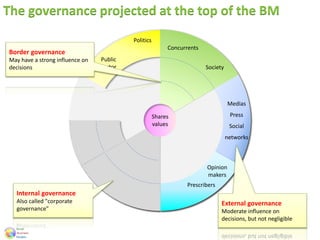
The governance projected at the top of the BM
Committee
Members
Volunteers
Direction
Staff
Our
values
Funders
Suppliers
Customers
Direct
benefi-
ciaries
Partners
Shares
values
Public
sector
Politics
Concurrents
Society
Medias
Press
Social
networks
Prescribers
Opinion
makers
Shares
values
External governance
Moderate influence on
decisions, but not negligible
Internal governance
Also called "corporate
governance"
Border governance
May have a strong influence on
decisions
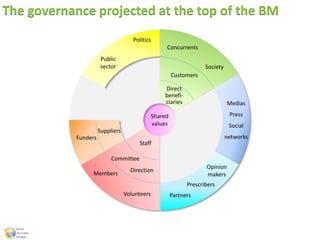
The governance projected at the top of the BM
Public
sector
Politics
Funders
Suppliers
Concurrents
Society
Customers
Direct
benefi-
ciaries Medias
Press
Social
networks
Committee
Members
Volunteers
Direction
Staff
Partners
Prescribers
Opinion
makers
Shared
values
Shared
values
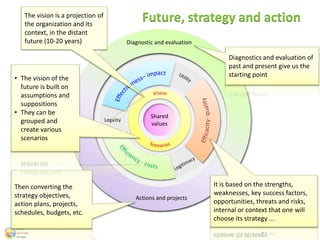
Future, strategy and action
Diagnostic et evaluation
Legality
Actions and projects
Diagnostic and evaluation
Then converting the
strategy objectives,
action plans, projects,
schedules, budgets, etc.
The vision is a projection of
the organization and its
context, in the distant
future (10-20 years)
Diagnostics and evaluation of
past and present give us the
starting point
It is based on the strengths,
weaknesses, key success factors,
opportunities, threats and risks,
internal or context that one will
choose its strategy ...
• The vision of the
future is built on
assumptions and
suppositions
• They can be
grouped and
create various
scenarios
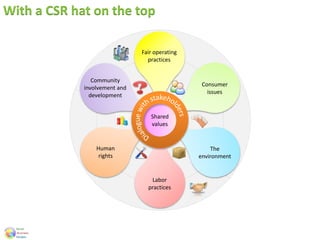
Fair operating
practices
Community
involvement and
development
Consumer
issues
Human
rights
The
environment
Labor
practices
Shared
values
With a CSR hat on the top
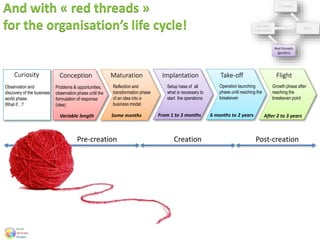
And with « red threads »
for the organisation’s life cycle!
Curiosity
Observation and
discovery of the business
world phase:
What if…?
Conception
Problems & opportunities,
observation phase until the
formulation of response
(idea)
Variable length
Maturation
Reflection and
transformation phase
of an idea into a
business model
Some months
Implantation
Setup hase of all
what is necessary to
start the operations
From 1 to 3 months
Take-off
Operation launching
phase until reaching the
breakeven
6 months to 2 years
Flight
Growth phase after
reaching the
breakeven point
After 2 to 3 years
Post-creationCreationPre-creation
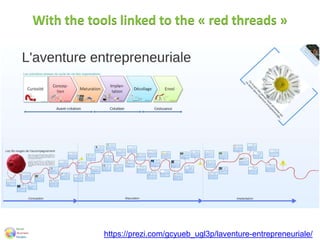
With the tools linked to the « red threads »
https://prezi.com/gcyueb_ugl3p/laventure-entrepreneuriale/
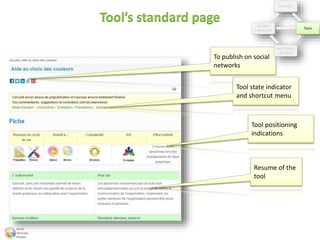
Tool’s standard page
To publish on social
networks
Tool state indicator
and shortcut menu
Tool positioning
indications
Resume of the
tool
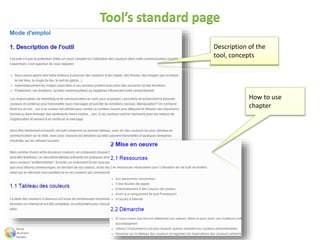
Tool’s standard page
Description of the
tool, concepts
How to use
chapter
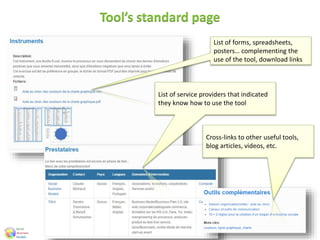
Tool’s standard page
List of forms, spreadsheets,
posters… complementing the
use of the tool, download links
List of service providers that indicated
they know how to use the tool
Cross-links to other useful tools,
blog articles, videos, etc.
The canvas also have their « card »…
Some of the canvas can be used as collective thinking tools, such as the
business model canvas, while others are more used as conceptual reference
and classification purpose :
• Canevas des valeurs
• Canevas de modèle d'affaires social - 1er niveau
• Canevas de modèle d’affaires social - 2ème niveau
• Identification de la gouvernance (canevas)
• Canevas de la stratégie
• Canevas de la RSE
• Canevas de création de projets (pratiquement identique au canevas de
modèle d’affaires)
Some cross-cutting tools
Some tools are not directly related to the canvas and their blocks, but rather
to project leaders or owners:
• Référentiel de compétences entrepreneuriales et sociétales
• Compétences et qualités entrepreneuriales
• Les métiers de l'entrepreneur-se social-e
• Quel est votre profil d’entrepreneur social ?
• Quel est votre équilibre de préférences au travail ?
• Boussole d'innovation sociétale
Tools related to the organization's values
Few for now, the first of them is more convenient while the second is mostly
descriptive:
• Valeurs organisationnelles - aide au choix
• Valeurs et conscience organisationnelle
Business model related tools
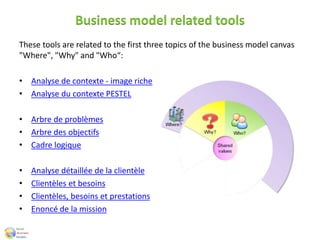
These tools are related to the first three topics of the business model canvas
"Where", "Why" and "Who“:
• Analyse de contexte - image riche
• Analyse du contexte PESTEL
• Arbre de problèmes
• Arbre des objectifs
• Cadre logique
• Analyse détaillée de la clientèle
• Clientèles et besoins
• Clientèles, besoins et prestations
• Enoncé de la mission
Business model related tools
These tools are focused on analysis and validation of initial thoughts and a
more thorough search. They also relate to other matters of the canvas.
• Tableaux de gestion de l’information
• Validation des hypothèses du canevas – partie 1
• Elaboration de sondages
• Pitch de sondage - quelques astuces
• Marché et niches
• Analyse de la concurrence
• Aide au choix des couleurs
• Canaux et outils de communication
• De l'organisation aux activités
Business (economic) model related tools
Directly related to the business model, they are nevertheless
indispensable!:
• Evaluation préliminaire de la viabilité financière
• Plan prévisionnel financier et trésorerie
• Plan d'affaires - Business plan
Tools related to governance canvas
Indirectly related to the business model, they are nevertheless
indispensable!:
• Choix de la forme juridique
• Matrice de délégation de responsabilités
• Elevator pitch
Strategy tools
The first tools of the strategy canvas are specifically dedicated to the
diagnosis:
• Repositionnement stratégique 01: pré-diagnostic organisationnel
• Repositionnement stratégique 02: pré-diagnostic des valeurs
• Repositionnement stratégique 03: pré-diagnostic du modèle d'affaires
• Repositionnement stratégique 04: pré-diagnostic de la gouvernance
• Strategy Short Track 01 - Vision du succès
• Facteurs clés de succès
• Analyse des risques
• Opportunités et menaces - évaluation
• SWOT: Forces et faiblesses, opportunités et menaces
• SEPO: Succès, Echecs, Potentialités, Obstacles
• Urgent versus important
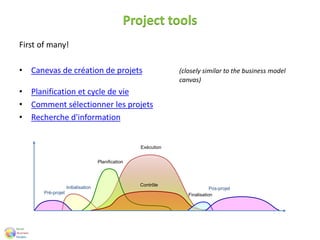
Project tools
First of many!
• Canevas de création de projets (closely similar to the business model
canvas)
• Planification et cycle de vie
• Comment sélectionner les projets
• Recherche d'information
Exécution
Initialisation
Planification
Contrôle
FinalisationPré-projet
Pos-projet
Thanks for your attention!
March 2016
www.socialbusinessmodels.ch

SBM presentation on April 2016 for the SSBMG

  • 1.
    SSBMG presentation –April 2016 Introduction
  • 2.
    Entrepreneur & social: total incompatibility or a converging possibility?
  • 11.
  • 13.
    Do we stillhave two splits ? Adapted from Patricia Kambitsch
  • 14.
    Social Business Models inshort January 2016
  • 15.
    One mission… Promote co-creation,sharing and use of the development and revision tools for social business models, among all actors involved, contributing to the sustainable existence of organizations with strong societal impact, social enterprises or enterprises in the field of the social and solidarity economy - ESS. 1. Collective intelligence as a source of innovation 2. Everyone's responsibility for social welfare 3. Cooperation and partnership: the pillars of solidarity 4. Say what we do and do what we say 5. Learn to last …and values
  • 16.
    A central coreand 7+1… • Non profit organization • Founded May 21 in 2013 • More than 100 members • Committee of 7 people • Ad hoc working groups • No employee
  • 17.
    Tools co-création …activity areas • Participativecreation • More than 55 tools • Over 70 instruments • Classification by canvas, their blocks and keywords • Classification by skills1 1 In definition
  • 18.
    Tools co-création Tools diffusion …activity areas • Internetsite diffusion: – 232’000 users sessions – 556’000 page views – France, Switzerland, Morocco, Canada, Algeria, Belgium, Tunisia … • Social networking: – Linkedin: 465 members – Facebook: 920 « Likes » – Horyou: 2550 « Lights » – Slideshare: 27’000 views
  • 19.
    Tools co-création Training and training of trainers Tools diffusion …activityareas • LMS training device 1 (MOS platform) • Various face-to-face training • Webinars, videos, online presentations • Targets: – End users – Trainers and consultants – Service providers 1 In implementation phase
  • 20.
    Tools co-création Training and training of trainers Tools diffusion Service providers yellowpages …activity areas • Directory1 of service providers in various fields: – In line with the goals and values of SBM – In accordance with the methodological approach • Providers accessibles through: – The tools – Specific searches • Visibility / relevance and contribution with new tools and skills • Specific training 1 Bêta version
  • 21.
    Tools co-création Training and training of trainers Tools diffusion Service providers yellowpages Red threads and specific guides …activity areas • Use of the tools in specific sequences to present the more viable and sustainable projects • Promotes a comparison unit between projects • Adaptable according to the needs of the funders of social entrepreneurship projects • Promote – The transition from a project dimension project to an entrepreneurial dimension – Evaluation practices
  • 22.
    Tools co-création Training and training of trainers Tools diffusion Service providers yellowpages Red threads and specific guides Open source social business models …activity areas • Provides an educational tool1 to help create and document social business models • Provides a database of social business models • Encourages cooperation and sharing of social business models 1 2017 strategy
  • 23.
    Tools co-création Training and training of trainers Tools diffusion Service providers yellowpages Red threads and specific guides Open source social business models Alliances and partnerships …activity areas • "Alone we go faster, together we achieve more“ • Complementarities research in social action • Bénévolat-Vaud (Volunteer Vaud) • Chambre de l’économie sociale et solidaire APRÈS-BEJUNE (Chamber for social and solidarity economy – Berne, Jura and Neuchâtel) • Leonardo 3.4.5 Distribution for NGOs
  • 24.
    …activity areas • Distributionfor NGOs • Leonardo 3.4.5: at work preferences profiling tool • Development teams during all organization's phases • Application for workstations activities
  • 25.
    « Yes, wedo ! » The two facets for our vision of the future are: • External: – The market economy will run side by side with a growing number of organizations whose main purpose focuses on the societal impact and for who the capital is only a tool to serve their missions.. • Internal: – Our association will be recognized as a local, national and international platform for concepts co-creation, good governance and management tools, as well as an exchange place for good practices in social business models.
  • 26.
    The dance ofthe business model canvas…
  • 27.
    They are notmissing!
  • 28.
    Logic framework (moreor less 1960) Banque mondiale, USAID… Global goals Indicators Verification sources Specific outcomes Indicators Verification sources Hypothesis Immediate outputs Indicators Verification sources Hypothesis Activities Resources (optional) Budget (optional) Hypothesis Hypothesis (optional)
  • 29.
    Business Model GenerationCanvas Key partners Customer segments Key activities Key resources Value proposition Customer relationships Channels Revenue streamsCost structure Alexander Osterwalder et Yves Pigneur
  • 30.
    Value Proposition Canvas AlexanderOsterwalder et Yves Pigneur
  • 31.
    Mirror effect ofthe BMG Canvas Distribution chanels Key resources Cost structureRevenue streams Customer segments Key partnersCustomer relationship Value proposition Key activities Institut suisse pour les PME de l’Université de Saint-Gall et PostFinance
  • 32.
    Lean Canvas Problem Customer segments Solution Key metrics Uniquevalue proposition Unfair advantage Chanels Revenue streamsCost structure Ash Maurya
  • 33.
    Social Lean Canvas Problem Customer segments Solution Kexmetrics Value proposition Unfair advantage Chanels Financial sustainabilityCost structure Rowan Yeoman Social and environmental benefits Purpose Existing alternatives Early adopters
  • 34.
    The Accelerator Partners Customer segents Social value proposition Macro- economic environmentActivities& resources RevenueCost of delivery The Young Foundation Competitors Surplus Sales & marketing
  • 35.
    Social Business ModelCanvas Resources Customer segments Type of Intervention Value proposition Activities Revenue streamsCost structure The Social Innovation Lab Surplus Partners & stake holders Chanels Beneficiaries clients Social value Impact measure Client value
  • 36.
    Exploring opportunities Generating ideasDo & test Learn & pivot Business Model Zen Canvas Brad Cho SolutionCustomer Problem Mission Market Advantage Empathy Revenues Cost Cooperator for innovation Coopérateur pour le marché High concept
  • 37.
  • 38.
    Environment Society Economy Outcomes The Flourishing BusinessCanvas Biophysical stocks Resources Partnership Value co-creation Relationship Stakeholders Ecosystem actors Ecosystem services Activities Governance Value co-destruction Channels Needs Costs Goals Benefits © Antony Upward / Edward James Consulting Ltd., 2014 All rights reserved.
  • 39.
    With their evolution Social Business Models Canvas 9blocs concentrate into 6 blocs Why and indicators Business Model Canvas Lean Canvas 4 blocs change Cycle Lean startup Demming PDA Cycle Social Lean Canvas 2 new blocs
  • 40.
  • 41.
    Methodological approach 5 canvas Tools Redthreads (guides) SE skills framework
  • 42.
    A systemic approach: thesuperposition of 4 canvas linked by a central one Permanent model «mission» Relational model «management» Values Dynamic model «vision» ValuesValues Corporate social responsability model
  • 43.
    Serving as amain backbone for all tools
  • 44.
  • 45.
    Shared values: fueland consistency Individual beliefs Organizational culture Shared values The beliefs: True or false (the faith) The shared values: right or wrong (morality) By mixing with the story of the organization... (its DNA) Influence individual behavior (codes of conduct, ethics) Turned into rules and good practices (the coherence)
  • 46.
    With whom? Why? Verifiable? Who? With what?What? By what? Shared values Where? The 8 questions of the social business model Context In what context the organization is immersed? Needs What are the needs, problems and opportunities that the organization will solve? Beneficiaries Who are the users, clients and beneficiaries of the organization? Channels How will the services be communicated, provided and delivered? Products and services What are the products and services the organization will provide? Support What are the different stakeholders who can support the organization? Resources With which people and resources the organization can it produce its benefits? Results and impact How to verify that the organization meets the needs properly?
  • 47.
    The governance projectedat the top of the BM Committee Members Volunteers Direction Staff Our values Funders Suppliers Customers Direct benefi- ciaries Partners Shares values Public sector Politics Concurrents Society Medias Press Social networks Prescribers Opinion makers Shares values External governance Moderate influence on decisions, but not negligible Internal governance Also called "corporate governance" Border governance May have a strong influence on decisions
  • 48.
    The governance projectedat the top of the BM Public sector Politics Funders Suppliers Concurrents Society Customers Direct benefi- ciaries Medias Press Social networks Committee Members Volunteers Direction Staff Partners Prescribers Opinion makers Shared values
  • 49.
    Shared values Future, strategy andaction Diagnostic et evaluation Legality Actions and projects Diagnostic and evaluation Then converting the strategy objectives, action plans, projects, schedules, budgets, etc. The vision is a projection of the organization and its context, in the distant future (10-20 years) Diagnostics and evaluation of past and present give us the starting point It is based on the strengths, weaknesses, key success factors, opportunities, threats and risks, internal or context that one will choose its strategy ... • The vision of the future is built on assumptions and suppositions • They can be grouped and create various scenarios
  • 50.
  • 51.
    And with «red threads » for the organisation’s life cycle! Curiosity Observation and discovery of the business world phase: What if…? Conception Problems & opportunities, observation phase until the formulation of response (idea) Variable length Maturation Reflection and transformation phase of an idea into a business model Some months Implantation Setup hase of all what is necessary to start the operations From 1 to 3 months Take-off Operation launching phase until reaching the breakeven 6 months to 2 years Flight Growth phase after reaching the breakeven point After 2 to 3 years Post-creationCreationPre-creation
  • 52.
    With the toolslinked to the « red threads » https://prezi.com/gcyueb_ugl3p/laventure-entrepreneuriale/
  • 53.
    Tool’s standard page Topublish on social networks Tool state indicator and shortcut menu Tool positioning indications Resume of the tool
  • 54.
    Tool’s standard page Descriptionof the tool, concepts How to use chapter
  • 55.
    Tool’s standard page Listof forms, spreadsheets, posters… complementing the use of the tool, download links List of service providers that indicated they know how to use the tool Cross-links to other useful tools, blog articles, videos, etc.
  • 56.
    The canvas alsohave their « card »… Some of the canvas can be used as collective thinking tools, such as the business model canvas, while others are more used as conceptual reference and classification purpose : • Canevas des valeurs • Canevas de modèle d'affaires social - 1er niveau • Canevas de modèle d’affaires social - 2ème niveau • Identification de la gouvernance (canevas) • Canevas de la stratégie • Canevas de la RSE • Canevas de création de projets (pratiquement identique au canevas de modèle d’affaires)
  • 57.
    Some cross-cutting tools Sometools are not directly related to the canvas and their blocks, but rather to project leaders or owners: • Référentiel de compétences entrepreneuriales et sociétales • Compétences et qualités entrepreneuriales • Les métiers de l'entrepreneur-se social-e • Quel est votre profil d’entrepreneur social ? • Quel est votre équilibre de préférences au travail ? • Boussole d'innovation sociétale
  • 58.
    Tools related tothe organization's values Few for now, the first of them is more convenient while the second is mostly descriptive: • Valeurs organisationnelles - aide au choix • Valeurs et conscience organisationnelle
  • 59.
    Business model relatedtools These tools are related to the first three topics of the business model canvas "Where", "Why" and "Who“: • Analyse de contexte - image riche • Analyse du contexte PESTEL • Arbre de problèmes • Arbre des objectifs • Cadre logique • Analyse détaillée de la clientèle • Clientèles et besoins • Clientèles, besoins et prestations • Enoncé de la mission
  • 60.
    Business model relatedtools These tools are focused on analysis and validation of initial thoughts and a more thorough search. They also relate to other matters of the canvas. • Tableaux de gestion de l’information • Validation des hypothèses du canevas – partie 1 • Elaboration de sondages • Pitch de sondage - quelques astuces • Marché et niches • Analyse de la concurrence • Aide au choix des couleurs • Canaux et outils de communication • De l'organisation aux activités
  • 61.
    Business (economic) modelrelated tools Directly related to the business model, they are nevertheless indispensable!: • Evaluation préliminaire de la viabilité financière • Plan prévisionnel financier et trésorerie • Plan d'affaires - Business plan
  • 62.
    Tools related togovernance canvas Indirectly related to the business model, they are nevertheless indispensable!: • Choix de la forme juridique • Matrice de délégation de responsabilités • Elevator pitch
  • 63.
    Strategy tools The firsttools of the strategy canvas are specifically dedicated to the diagnosis: • Repositionnement stratégique 01: pré-diagnostic organisationnel • Repositionnement stratégique 02: pré-diagnostic des valeurs • Repositionnement stratégique 03: pré-diagnostic du modèle d'affaires • Repositionnement stratégique 04: pré-diagnostic de la gouvernance • Strategy Short Track 01 - Vision du succès • Facteurs clés de succès • Analyse des risques • Opportunités et menaces - évaluation • SWOT: Forces et faiblesses, opportunités et menaces • SEPO: Succès, Echecs, Potentialités, Obstacles • Urgent versus important
  • 64.
    Project tools First ofmany! • Canevas de création de projets (closely similar to the business model canvas) • Planification et cycle de vie • Comment sélectionner les projets • Recherche d'information Exécution Initialisation Planification Contrôle FinalisationPré-projet Pos-projet
  • 65.
    Thanks for yourattention! March 2016 www.socialbusinessmodels.ch