Submitted to : Submitted by:
Dept. of Business Sahil Monga
Administration M.B.A 2.1
Roll No. 34
 Insurance is a contract between the insurance company
(insurer) and the policyholder(insured). In return for a
consideration (the premium), the insurance company
promises to pay a specified amount to the insured on the
happening of a specific event. In layman term Insurance is
the mechanism of transfer of risk wherein the person taking
out insurance transfers their risk to the insurance company
in return for a payment (known as the premium). Insurance
is necessary because no one foresees the event which may
happen in future. If anybody can see their future then there
was no need of Insurance. In case of future events risk like
Accident/Death, Insurance comes to rescue where the
financial gap due to these risks is compensated upon.
Insurance is generally divided into two parts:-
 (1) Life Insurance: - Life insurance companies cover risks that relate to
human lives. They offer different benefits under different types of products
and cover the risk of early death, as well as the risk of living into old age.
Under traditional plans, like term insurance plans, insurance companies
provide death cover. If the insured person dies within the term of the policy
then the nominee/beneficiary is paid a specified amount (also known as the
sum insured).
 (2) Non-Life Insurance (General Insurance): - Non-life insurance
companies generally cover risks other than those relating to human lives.
Any asset either gives a monetary return (e.g. a house given on rent), or
offers convenience (e.g. a car which can be used to travel from one place to
another) can be insured.. If the asset is damaged by any of these risks, the
owner will be at a disadvantage and they will lose the income or the
convenience the asset provided. It is a product from this type of company
that an individual would buy to protect their assets, for example, their
home against fire etc.
 Role 1: Life insurance as "Investment"
 Role 2: Life insurance as "Risk cover"
 Role 3: Life insurance as "Tax planning"
 Role 4: Life insurance as "Financial Planning
 Role 5: Role of Insurance as "Economic Development."
 SBI Life Insurance is a joint venture between the State Bank of India and
Cardif SA of France. SBI Life Insurance is registered with an authorised
capital of Rs 500 crore and a paid up capital of Rs 350 crores. SBI owns
74% of the total capital and Cardif the remaining 26%. SBI Life has
already covered more than 8 lacs group lives with an additional 2.5 lacs
lives through individual policies. State Bank of India enjoys the largest
banking franchise in India, Along with its Associate Banks . SBI Group
has the unrivalled strength of over 20000 branches across the country, the
largest in the world.
 Cardif is a wholly owned subsidiary of BNP Paribas, which is The Euro
Zone’s leading Bank. BNP is one of the oldest foreign banks with a
presence in India dating back to 1860. It has 9 branches in the metros and
other major towns in the country. Cardif has also been a pioneer in the art
of selling insurance products through commercial banks in France and 29
more countries.
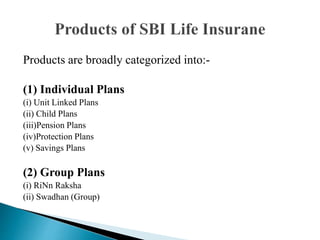
Products are broadly categorized into:-
(1) Individual Plans
(i) Unit Linked Plans
(ii) Child Plans
(iii)Pension Plans
(iv)Protection Plans
(v) Savings Plans
(2) Group Plans
(i) RiNn Raksha
(ii) Swadhan (Group)
 Meaning Of Distribution :- Distribution means to spread the product or
services through out the market place such that a large number of people
can buy it.
 Distribution channel is the life blood of insurance business. Insurance
distribution is strewn with opportunities and challenges . To make most of
opportunities in growing market like india we have to overcome
challenges while enchasing opportunities .
 Traditional distribution channel of agency still rules the roost in life
insurance in india .alternative distribution channel which came up after the
opening up of six years back have huge potential which need to be tapped .
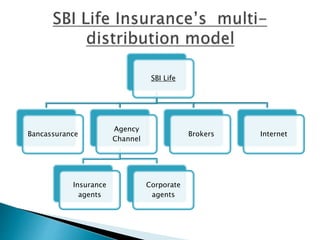
SBI Life
Bancassurance
Agency
Channel
Insurance
agents
Corporate
agents
Brokers Internet
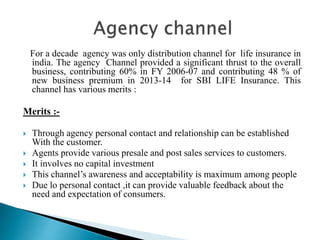
For a decade agency was only distribution channel for life insurance in
india. The agency Channel provided a significant thrust to the overall
business, contributing 60% in FY 2006-07 and contributing 48 % of
new business premium in 2013-14 for SBI LIFE Insurance. This
channel has various merits :
Merits :-
 Through agency personal contact and relationship can be established
With the customer.
 Agents provide various presale and post sales services to customers.
 It involves no capital investment
 This channel’s awareness and acceptability is maximum among people
 Due lo personal contact ,it can provide valuable feedback about the
need and expectation of consumers.
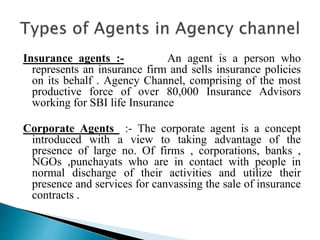
Insurance agents :- An agent is a person who
represents an insurance firm and sells insurance policies
on its behalf . Agency Channel, comprising of the most
productive force of over 80,000 Insurance Advisors
working for SBI life Insurance
Corporate Agents :- The corporate agent is a concept
introduced with a view to taking advantage of the
presence of large no. Of firms , corporations, banks ,
NGOs ,punchayats who are in contact with people in
normal discharge of their activities and utilize their
presence and services for canvassing the sale of insurance
contracts .
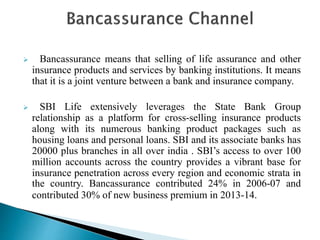
 Bancassurance means that selling of life assurance and other
insurance products and services by banking institutions. It means
that it is a joint venture between a bank and insurance company.
 SBI Life extensively leverages the State Bank Group
relationship as a platform for cross-selling insurance products
along with its numerous banking product packages such as
housing loans and personal loans. SBI and its associate banks has
20000 plus branches in all over india . SBI’s access to over 100
million accounts across the country provides a vibrant base for
insurance penetration across every region and economic strata in
the country. Bancassurance contributed 24% in 2006-07 and
contributed 30% of new business premium in 2013-14.
 The broker acts as an intermediary between the companies and
insurers and represents insurance buyer. Insurance brokers differ
from agents. Agents represent the insurer but insurance broker
represent the clients .This channel is new experience for the life
insurance customer .Brokers have a fiduciary responsibility
towards the customer. A fiduciary responsibility is a legal
relationship of trust and confidence between two parties. Brokers
as fiduciary legally promise you to keep your interest paramount.
So as brokers they understand your needs and browse through
several insurers to get you the best-fit product. The Company has
garnered a business of 2% through this channel. Insurance broker
are of following two types :
1) Retail insurance brokers
2) Commercial insurance brokers
 Internet has become one of the most important channel for
insurance companies. Internet provide online insurance
market place.
 With the changing customer needs, the Company has
introduced online products for its tech savvy young
generation potential client base. The direct business also
includes business generated by Company’s Corporate
Solution & Cross Selling departments dealing directly with
corporate & individuals as per their needs. The Company
has garnered a business of 20% as Direct Business in FY
2014-15 which grew from 12% of FY 2006-07
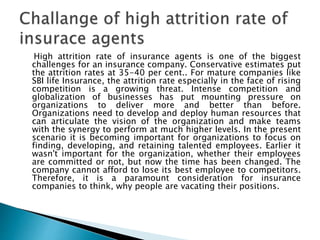
High attrition rate of insurance agents is one of the biggest
challenges for an insurance company. Conservative estimates put
the attrition rates at 35-40 per cent.. For mature companies like
SBI life Insurance, the attrition rate especially in the face of rising
competition is a growing threat. Intense competition and
globalization of businesses has put mounting pressure on
organizations to deliver more and better than before.
Organizations need to develop and deploy human resources that
can articulate the vision of the organization and make teams
with the synergy to perform at much higher levels. In the present
scenario it is becoming important for organizations to focus on
finding, developing, and retaining talented employees. Earlier it
wasn't important for the organization, whether their employees
are committed or not, but now the time has been changed. The
company cannot afford to lose its best employee to competitors.
Therefore, it is a paramount consideration for insurance
companies to think, why people are vacating their positions.
 Being an insurance agent in India is seen as a societal stigma as
there is uncertainty of job and income attached to it. People join
insurance companies as a part time job or a gap filler occupation
and not as a long – term career. Very few competent people want
to become agents owing to low social status attached to it.
 It is a high pressure job. It is expected from an agent to
understand the customer’s needs and sell the products
accordingly. This process involves a high level of persuasion and
a sustained effort for a long period of time.
 The expectation achievement gap adds to the turnover. Many
people are lured to the profession with a high earning potential.
However, to earn a decent income, agents require a lot of
patience, perseverance, and persuasion in the field. During early
phase, the earnings of the agents are low despite hard work.
This expectation achievement gap leads many of them to break
down in the initial period of joining the profession.
According to a survey conducted by an Individual researcher
following variables are considered for high turnover rate :
1) Better Job Opportunity
2) Better Salary
3) Target Pressures
4) No Time for the Family
5) Job Insecurity
6) Bad Work Culture
Data Presentation and Findings :-
The survey reveals that 60% of the employees left the insurance sector
in less than 1 year; 22% employees remained in the same sector for 1-3
years; 8% of employees worked in this sector for at least 4-6 years; 5%
of employees remained in the same sector for 10 years, and 5% had
been in the insurance industry for more than 10 years.
 An individual's motive for working may vary according to the nature and
potency of the unsatisfied portion of his/her individual hierarchies of
needs. It is evident that individuals do not join an insurance company
only for Fair compensation and Employment; instead they also look for
job security, ease of working in flexible timing, and career advancement.
They look to satisfy multiple levels of needs simultaneously and aspire
for a job which offers a good mix of primary, social and esteem needs.
The survey reveals a similar mix which may lead to job satisfaction.
Individuals leave an organization if they are not satisfied with the job, e.
g. factors like stress, career advancement and environment which forced
the respondents to leave the organization. Insurance companies may
consider offering a distinct proposition to successfully attract and retain
the sales force. Managers may design systematic strategies rather than
taking a random approach of hit and trial. Researchers conceptualized
certain strategies based on the findings of the survey. Different needs of
the employees could be addressed from the suggestions mentioned
below. According to the survey 60% of the sales force leaves the
company in less than one year. The occurrence leads to incurring a huge
cost in recruiting and training of the employees. Companies may focus
on retention for a specified period of time (break even period) so as to
recover the cost incurred on the employee.
Sbi life insurane distribution channel

Sbi life insurane distribution channel

  • 1.
    Submitted to :Submitted by: Dept. of Business Sahil Monga Administration M.B.A 2.1 Roll No. 34
  • 2.
     Insurance isa contract between the insurance company (insurer) and the policyholder(insured). In return for a consideration (the premium), the insurance company promises to pay a specified amount to the insured on the happening of a specific event. In layman term Insurance is the mechanism of transfer of risk wherein the person taking out insurance transfers their risk to the insurance company in return for a payment (known as the premium). Insurance is necessary because no one foresees the event which may happen in future. If anybody can see their future then there was no need of Insurance. In case of future events risk like Accident/Death, Insurance comes to rescue where the financial gap due to these risks is compensated upon. Insurance is generally divided into two parts:-
  • 3.
     (1) LifeInsurance: - Life insurance companies cover risks that relate to human lives. They offer different benefits under different types of products and cover the risk of early death, as well as the risk of living into old age. Under traditional plans, like term insurance plans, insurance companies provide death cover. If the insured person dies within the term of the policy then the nominee/beneficiary is paid a specified amount (also known as the sum insured).  (2) Non-Life Insurance (General Insurance): - Non-life insurance companies generally cover risks other than those relating to human lives. Any asset either gives a monetary return (e.g. a house given on rent), or offers convenience (e.g. a car which can be used to travel from one place to another) can be insured.. If the asset is damaged by any of these risks, the owner will be at a disadvantage and they will lose the income or the convenience the asset provided. It is a product from this type of company that an individual would buy to protect their assets, for example, their home against fire etc.
  • 4.
     Role 1:Life insurance as "Investment"  Role 2: Life insurance as "Risk cover"  Role 3: Life insurance as "Tax planning"  Role 4: Life insurance as "Financial Planning  Role 5: Role of Insurance as "Economic Development."
  • 5.
     SBI LifeInsurance is a joint venture between the State Bank of India and Cardif SA of France. SBI Life Insurance is registered with an authorised capital of Rs 500 crore and a paid up capital of Rs 350 crores. SBI owns 74% of the total capital and Cardif the remaining 26%. SBI Life has already covered more than 8 lacs group lives with an additional 2.5 lacs lives through individual policies. State Bank of India enjoys the largest banking franchise in India, Along with its Associate Banks . SBI Group has the unrivalled strength of over 20000 branches across the country, the largest in the world.  Cardif is a wholly owned subsidiary of BNP Paribas, which is The Euro Zone’s leading Bank. BNP is one of the oldest foreign banks with a presence in India dating back to 1860. It has 9 branches in the metros and other major towns in the country. Cardif has also been a pioneer in the art of selling insurance products through commercial banks in France and 29 more countries.
  • 6.
    Products are broadlycategorized into:- (1) Individual Plans (i) Unit Linked Plans (ii) Child Plans (iii)Pension Plans (iv)Protection Plans (v) Savings Plans (2) Group Plans (i) RiNn Raksha (ii) Swadhan (Group)
  • 7.
     Meaning OfDistribution :- Distribution means to spread the product or services through out the market place such that a large number of people can buy it.  Distribution channel is the life blood of insurance business. Insurance distribution is strewn with opportunities and challenges . To make most of opportunities in growing market like india we have to overcome challenges while enchasing opportunities .  Traditional distribution channel of agency still rules the roost in life insurance in india .alternative distribution channel which came up after the opening up of six years back have huge potential which need to be tapped .
  • 8.
  • 9.
    For a decadeagency was only distribution channel for life insurance in india. The agency Channel provided a significant thrust to the overall business, contributing 60% in FY 2006-07 and contributing 48 % of new business premium in 2013-14 for SBI LIFE Insurance. This channel has various merits : Merits :-  Through agency personal contact and relationship can be established With the customer.  Agents provide various presale and post sales services to customers.  It involves no capital investment  This channel’s awareness and acceptability is maximum among people  Due lo personal contact ,it can provide valuable feedback about the need and expectation of consumers.
  • 10.
    Insurance agents :-An agent is a person who represents an insurance firm and sells insurance policies on its behalf . Agency Channel, comprising of the most productive force of over 80,000 Insurance Advisors working for SBI life Insurance Corporate Agents :- The corporate agent is a concept introduced with a view to taking advantage of the presence of large no. Of firms , corporations, banks , NGOs ,punchayats who are in contact with people in normal discharge of their activities and utilize their presence and services for canvassing the sale of insurance contracts .
  • 11.
     Bancassurance meansthat selling of life assurance and other insurance products and services by banking institutions. It means that it is a joint venture between a bank and insurance company.  SBI Life extensively leverages the State Bank Group relationship as a platform for cross-selling insurance products along with its numerous banking product packages such as housing loans and personal loans. SBI and its associate banks has 20000 plus branches in all over india . SBI’s access to over 100 million accounts across the country provides a vibrant base for insurance penetration across every region and economic strata in the country. Bancassurance contributed 24% in 2006-07 and contributed 30% of new business premium in 2013-14.
  • 12.
     The brokeracts as an intermediary between the companies and insurers and represents insurance buyer. Insurance brokers differ from agents. Agents represent the insurer but insurance broker represent the clients .This channel is new experience for the life insurance customer .Brokers have a fiduciary responsibility towards the customer. A fiduciary responsibility is a legal relationship of trust and confidence between two parties. Brokers as fiduciary legally promise you to keep your interest paramount. So as brokers they understand your needs and browse through several insurers to get you the best-fit product. The Company has garnered a business of 2% through this channel. Insurance broker are of following two types : 1) Retail insurance brokers 2) Commercial insurance brokers
  • 13.
     Internet hasbecome one of the most important channel for insurance companies. Internet provide online insurance market place.  With the changing customer needs, the Company has introduced online products for its tech savvy young generation potential client base. The direct business also includes business generated by Company’s Corporate Solution & Cross Selling departments dealing directly with corporate & individuals as per their needs. The Company has garnered a business of 20% as Direct Business in FY 2014-15 which grew from 12% of FY 2006-07
  • 14.
    High attrition rateof insurance agents is one of the biggest challenges for an insurance company. Conservative estimates put the attrition rates at 35-40 per cent.. For mature companies like SBI life Insurance, the attrition rate especially in the face of rising competition is a growing threat. Intense competition and globalization of businesses has put mounting pressure on organizations to deliver more and better than before. Organizations need to develop and deploy human resources that can articulate the vision of the organization and make teams with the synergy to perform at much higher levels. In the present scenario it is becoming important for organizations to focus on finding, developing, and retaining talented employees. Earlier it wasn't important for the organization, whether their employees are committed or not, but now the time has been changed. The company cannot afford to lose its best employee to competitors. Therefore, it is a paramount consideration for insurance companies to think, why people are vacating their positions.
  • 15.
     Being aninsurance agent in India is seen as a societal stigma as there is uncertainty of job and income attached to it. People join insurance companies as a part time job or a gap filler occupation and not as a long – term career. Very few competent people want to become agents owing to low social status attached to it.  It is a high pressure job. It is expected from an agent to understand the customer’s needs and sell the products accordingly. This process involves a high level of persuasion and a sustained effort for a long period of time.  The expectation achievement gap adds to the turnover. Many people are lured to the profession with a high earning potential. However, to earn a decent income, agents require a lot of patience, perseverance, and persuasion in the field. During early phase, the earnings of the agents are low despite hard work. This expectation achievement gap leads many of them to break down in the initial period of joining the profession.
  • 16.
    According to asurvey conducted by an Individual researcher following variables are considered for high turnover rate : 1) Better Job Opportunity 2) Better Salary 3) Target Pressures 4) No Time for the Family 5) Job Insecurity 6) Bad Work Culture Data Presentation and Findings :- The survey reveals that 60% of the employees left the insurance sector in less than 1 year; 22% employees remained in the same sector for 1-3 years; 8% of employees worked in this sector for at least 4-6 years; 5% of employees remained in the same sector for 10 years, and 5% had been in the insurance industry for more than 10 years.
  • 17.
     An individual'smotive for working may vary according to the nature and potency of the unsatisfied portion of his/her individual hierarchies of needs. It is evident that individuals do not join an insurance company only for Fair compensation and Employment; instead they also look for job security, ease of working in flexible timing, and career advancement. They look to satisfy multiple levels of needs simultaneously and aspire for a job which offers a good mix of primary, social and esteem needs. The survey reveals a similar mix which may lead to job satisfaction. Individuals leave an organization if they are not satisfied with the job, e. g. factors like stress, career advancement and environment which forced the respondents to leave the organization. Insurance companies may consider offering a distinct proposition to successfully attract and retain the sales force. Managers may design systematic strategies rather than taking a random approach of hit and trial. Researchers conceptualized certain strategies based on the findings of the survey. Different needs of the employees could be addressed from the suggestions mentioned below. According to the survey 60% of the sales force leaves the company in less than one year. The occurrence leads to incurring a huge cost in recruiting and training of the employees. Companies may focus on retention for a specified period of time (break even period) so as to recover the cost incurred on the employee.