SAP MM Introduction
How ERP system works
PROS and CONS of ERP system
 PROS
 All information are available in system
 Easier for audit purpose
 Less paperwork
 Better Productivity
 Better Inventory management
 Ability to interface to and fro external parties
 CONS
 Expensive
 Security of data as all information are available in the system
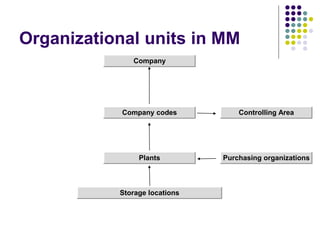
Organizational units in MM
Company
Purchasing organizations
Company codes
Plants
Storage locations
Controlling Area
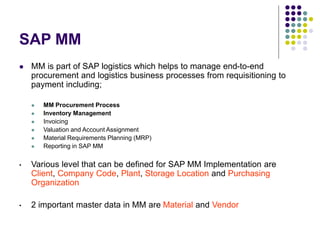
SAP MM
 MM is part of SAP logistics which helps to manage end-to-end
procurement and logistics business processes from requisitioning to
payment including;
 MM Procurement Process
 Inventory Management
 Invoicing
 Valuation and Account Assignment
 Material Requirements Planning (MRP)
 Reporting in SAP MM
• Various level that can be defined for SAP MM Implementation are
Client, Company Code, Plant, Storage Location and Purchasing
Organization
• 2 important master data in MM are Material and Vendor
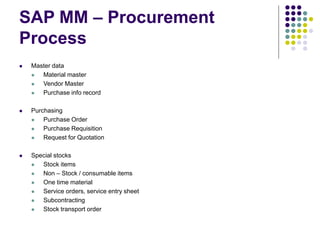
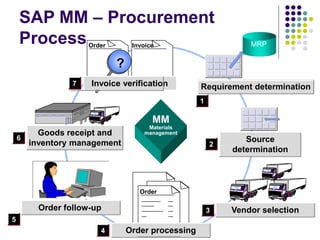
SAP MM – Procurement
Process
 Master data
 Material master
 Vendor Master
 Purchase info record
 Purchasing
 Purchase Order
 Purchase Requisition
 Request for Quotation
 Special stocks
 Stock items
 Non – Stock / consumable items
 One time material
 Service orders, service entry sheet
 Subcontracting
 Stock transport order
 Source Determination
 Source List
 Source Determination
 Release procedures for purchasing documents (with/without classification)
 Creation of characteristics
 Creation of class
 Release groups, code, indicator, pre-requisites
 Release strategies
SAP MM – Procurement
Process
 Goods Receipt
 Goods issue
 Transfer posting
 Reservation
 Physical inventory
SAP MM – Inventory
Management
SAP MM – Invoicing
 Invoice posting
 Variances and blocking reasons
 Release block invoices
 Automatic settlements – Evaluated Receipt Settlement (ERS)
SAP MM – Materials
Requirements Planning (MRP)
 Planning Requirements
 Over all Procedures
 Planning Run
SAP MM – Valuation and
Account Assignment
 Material price change
 Material valuation type
 Configure automatic account determination
Inventory
management
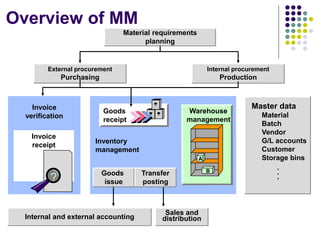
Overview of MM
Invoice
verification
Invoice
receipt
?
A
B
Warehouse
management
Goods
receipt
Sales and
distribution
Internal and external accounting
Goods
issue
Transfer
posting
Material requirements
planning
External procurement
Purchasing
Internal procurement
Production
Master data
Material
Batch
Vendor
G/L accounts
Customer
Storage bins
.
.
.
SAP MM – Procurement
Process
Order
Order processing
Order follow-up
Goods receipt and
inventory management
MM
Materials
management
6
4
Source
determination
2
Vendor selection
3
Invoice
Order
?
Invoice verification
7
Requirement determination
1
MRP
5
RFQ
Purchase order
Purch.order
Quotation
Quotation
A
Quotation
B
?
Purchase requisition
Purchase
requisition
Release order
Contract
RFQ
?
Purchasing documents
 Procurement for stock
 Procurement for stock is characterized by the fact that the material is stored after goods
receipt, and the consumption of the material is entered in a separate step.
If material is procured for stock, the warehouse stock level of the material is increased by
entering goods receipt and reduced by entering goods issue.
 Procurement for consumption
 In the case of procurement for consumption, the material is regarded as consumed at
the time of goods receipt.
If a material is procured for consumption, the consumption purpose is defined by
purchasing (an account assignment category and further specifications such as cost
center or project number are entered).
If material is procured directly for consumption, no warehouse stock is created when
goods receipt is entered (and the stock value is not increased) but the consumption
statistics (and the consumption accounts in the accounting department) are updated
directly.
SAP MM – Inventory
Management
Plants
Storage
locations
Warehouse numbers
Storage types
Storage bins
A001 AS01
AS40 HUAV
HAAB
AA40
A40
005
001
05-04-04
05-04-03
Company Code
Inventory management is concerned with the flow of materials
within a company.
Goods movements are divided into goods receipts, goods issues, and
transfer postings.
When you enter a goods movement, the stock situation is updated both
on a quantity and value basis . In addition, material documents are
created to record each transaction.
SAP MM – Invoicing
Purchase
order
Purchase
order
?
Invoice verification
Vendor
invoice
Goods receipt
or or
In the case of order-based invoice verification, the
items in a purchase order are settled. A prerequisite for this is that
goods receipt has not yet been entered for the quantity invoiced when
invoice verification is carried out. Items from different purchase orders
can be settled together.
With invoice verification based on goods receipt, each
goods receipt is settled individually. The goods receipt must already
have been entered for the quantity invoiced. Different goods receipts
can be settled together. GR-based invoice verification must be
specified in the order item.
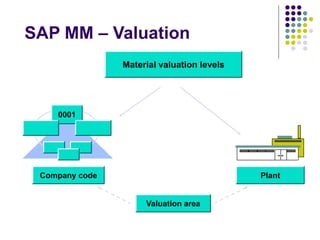
SAP MM – Valuation
Plant
Valuation area
Material valuation levels
Company code
0001
In the material master for a material with price control S, the
'Moving average price' is also displayed so you can determine the
difference between the acquisition price and the standard price.
Receipts are posted to the stock account with the receipt value Quantity *
Purchase order price. The moving average price is recalculated after every
transaction to correspond to the acquisition price.
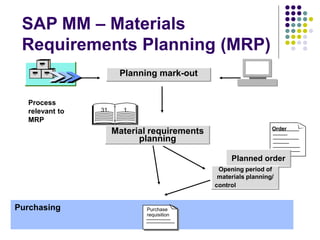
SAP MM – Materials
Requirements Planning (MRP)
Purchasing
Order
Planned order
31. 1.
Opening period of
materials planning/
control
Material requirements
planning
Planning mark-out
Purchase
requisition
Process
relevant to
MRP
If a material requirement is automatically planned and
requirements planning is active in the plant, planning mark-outs are
automatically created when transactions relevant for materials planning
are carried out (goods issue, reservations, changes to the materials
planning data…)
Requirements planning can be carried out online or using
background processing.
Planned orders are proposals for the issue of purchase orders to satisfy
a requirement. In a separate step, they are converted into purchase
requisitions.

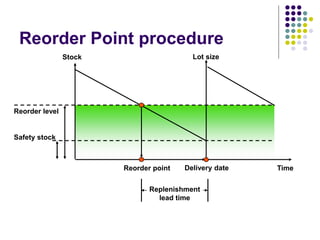
Replenishment
lead time
Stock Lot size
Reorder level
Safety stock
Reorder point Delivery date Time
Reorder Point procedure
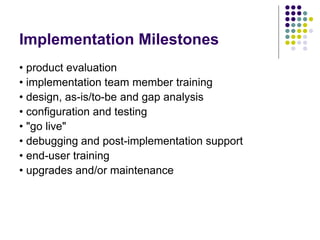
Implementation Milestones
• product evaluation
• implementation team member training
• design, as-is/to-be and gap analysis
• configuration and testing
• "go live"
• debugging and post-implementation support
• end-user training
• upgrades and/or maintenance
Commonly asked questions
 What is a Material Type?
 How do you create a material?
 How do you create a vendor?
 How do you define a Release Procedure for
PRs and POs?
 How are materials assigned to vendors
Useful links.
• www.sap-img.com
• www.sapfans.com
• www.erpgenie.com
The End

SAP_MM_Introduction.ppt

  • 1.
  • 2.
  • 3.
    PROS and CONSof ERP system  PROS  All information are available in system  Easier for audit purpose  Less paperwork  Better Productivity  Better Inventory management  Ability to interface to and fro external parties  CONS  Expensive  Security of data as all information are available in the system
  • 4.
    Organizational units inMM Company Purchasing organizations Company codes Plants Storage locations Controlling Area
  • 5.
    SAP MM  MMis part of SAP logistics which helps to manage end-to-end procurement and logistics business processes from requisitioning to payment including;  MM Procurement Process  Inventory Management  Invoicing  Valuation and Account Assignment  Material Requirements Planning (MRP)  Reporting in SAP MM • Various level that can be defined for SAP MM Implementation are Client, Company Code, Plant, Storage Location and Purchasing Organization • 2 important master data in MM are Material and Vendor
  • 6.
    SAP MM –Procurement Process  Master data  Material master  Vendor Master  Purchase info record  Purchasing  Purchase Order  Purchase Requisition  Request for Quotation  Special stocks  Stock items  Non – Stock / consumable items  One time material  Service orders, service entry sheet  Subcontracting  Stock transport order
  • 7.
     Source Determination Source List  Source Determination  Release procedures for purchasing documents (with/without classification)  Creation of characteristics  Creation of class  Release groups, code, indicator, pre-requisites  Release strategies SAP MM – Procurement Process
  • 8.
     Goods Receipt Goods issue  Transfer posting  Reservation  Physical inventory SAP MM – Inventory Management SAP MM – Invoicing  Invoice posting  Variances and blocking reasons  Release block invoices  Automatic settlements – Evaluated Receipt Settlement (ERS)
  • 9.
    SAP MM –Materials Requirements Planning (MRP)  Planning Requirements  Over all Procedures  Planning Run SAP MM – Valuation and Account Assignment  Material price change  Material valuation type  Configure automatic account determination
  • 10.
    Inventory management Overview of MM Invoice verification Invoice receipt ? A B Warehouse management Goods receipt Salesand distribution Internal and external accounting Goods issue Transfer posting Material requirements planning External procurement Purchasing Internal procurement Production Master data Material Batch Vendor G/L accounts Customer Storage bins . . .
  • 11.
    SAP MM –Procurement Process Order Order processing Order follow-up Goods receipt and inventory management MM Materials management 6 4 Source determination 2 Vendor selection 3 Invoice Order ? Invoice verification 7 Requirement determination 1 MRP 5
  • 12.
  • 13.
     Procurement forstock  Procurement for stock is characterized by the fact that the material is stored after goods receipt, and the consumption of the material is entered in a separate step. If material is procured for stock, the warehouse stock level of the material is increased by entering goods receipt and reduced by entering goods issue.  Procurement for consumption  In the case of procurement for consumption, the material is regarded as consumed at the time of goods receipt. If a material is procured for consumption, the consumption purpose is defined by purchasing (an account assignment category and further specifications such as cost center or project number are entered). If material is procured directly for consumption, no warehouse stock is created when goods receipt is entered (and the stock value is not increased) but the consumption statistics (and the consumption accounts in the accounting department) are updated directly.
  • 14.
    SAP MM –Inventory Management Plants Storage locations Warehouse numbers Storage types Storage bins A001 AS01 AS40 HUAV HAAB AA40 A40 005 001 05-04-04 05-04-03 Company Code
  • 15.
    Inventory management isconcerned with the flow of materials within a company. Goods movements are divided into goods receipts, goods issues, and transfer postings. When you enter a goods movement, the stock situation is updated both on a quantity and value basis . In addition, material documents are created to record each transaction.
  • 16.
    SAP MM –Invoicing Purchase order Purchase order ? Invoice verification Vendor invoice Goods receipt or or
  • 17.
    In the caseof order-based invoice verification, the items in a purchase order are settled. A prerequisite for this is that goods receipt has not yet been entered for the quantity invoiced when invoice verification is carried out. Items from different purchase orders can be settled together. With invoice verification based on goods receipt, each goods receipt is settled individually. The goods receipt must already have been entered for the quantity invoiced. Different goods receipts can be settled together. GR-based invoice verification must be specified in the order item.
  • 18.
    SAP MM –Valuation Plant Valuation area Material valuation levels Company code 0001
  • 19.
    In the materialmaster for a material with price control S, the 'Moving average price' is also displayed so you can determine the difference between the acquisition price and the standard price. Receipts are posted to the stock account with the receipt value Quantity * Purchase order price. The moving average price is recalculated after every transaction to correspond to the acquisition price.
  • 20.
    SAP MM –Materials Requirements Planning (MRP) Purchasing Order Planned order 31. 1. Opening period of materials planning/ control Material requirements planning Planning mark-out Purchase requisition Process relevant to MRP
  • 21.
    If a materialrequirement is automatically planned and requirements planning is active in the plant, planning mark-outs are automatically created when transactions relevant for materials planning are carried out (goods issue, reservations, changes to the materials planning data…) Requirements planning can be carried out online or using background processing. Planned orders are proposals for the issue of purchase orders to satisfy a requirement. In a separate step, they are converted into purchase requisitions.
  • 22.
    Replenishment lead time Stock Lotsize Reorder level Safety stock Reorder point Delivery date Time Reorder Point procedure
  • 23.
    Implementation Milestones • productevaluation • implementation team member training • design, as-is/to-be and gap analysis • configuration and testing • "go live" • debugging and post-implementation support • end-user training • upgrades and/or maintenance
  • 24.
    Commonly asked questions What is a Material Type?  How do you create a material?  How do you create a vendor?  How do you define a Release Procedure for PRs and POs?  How are materials assigned to vendors
  • 25.
    Useful links. • www.sap-img.com •www.sapfans.com • www.erpgenie.com
  • 26.