By Ashley Chimhanda
OVERVIEW
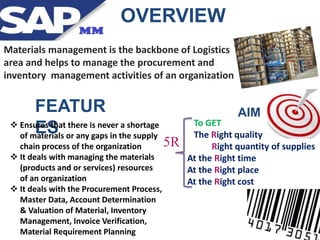
Materials management is the backbone of Logistics
area and helps to manage the procurement and
inventory management activities of an organization
To GET
The Right quality
Right quantity of supplies
At the Right time
At the Right place
At the Right cost
5R
FEATUR
ES
AIM
 Ensures that there is never a shortage
of materials or any gaps in the supply
chain process of the organization
 It deals with managing the materials
(products and or services) resources
of an organization
 It deals with the Procurement Process,
Master Data, Account Determination
& Valuation of Material, Inventory
Management, Invoice Verification,
Material Requirement Planning
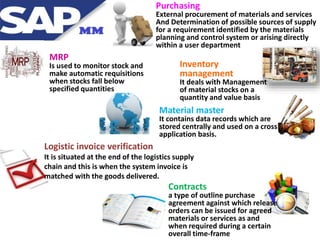
Purchasing
External procurement of materials and services
And Determination of possible sources of supply
for a requirement identified by the materials
planning and control system or arising directly
within a user department
Contracts
a type of outline purchase
agreement against which release
orders can be issued for agreed
materials or services as and
when required during a certain
overall time-frame
Inventory
management
It deals with Management
of material stocks on a
quantity and value basis
Material master
It contains data records which are
stored centrally and used on a cross
application basis.
Logistic invoice verification
It is situated at the end of the logistics supply
chain and this is when the system invoice is
matched with the goods delivered.
MRP
Is used to monitor stock and
make automatic requisitions
when stocks fall below
specified quantities
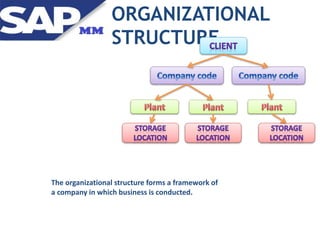
ORGANIZATIONAL
STRUCTURE
The organizational structure forms a framework of
a company in which business is conducted.
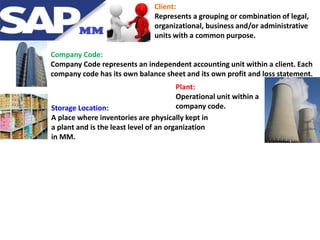
Client:
Represents a grouping or combination of legal,
organizational, business and/or administrative
units with a common purpose.
Storage Location:
A place where inventories are physically kept in
a plant and is the least level of an organization
in MM.
Plant:
Operational unit within a
company code.
Company Code:
Company Code represents an independent accounting unit within a client. Each
company code has its own balance sheet and its own profit and loss statement.
MASTER DATA
This is a collection of data about an object or
person which is referenced whenever it is used
in an entry field.
Types of Master Data:-
 Material Master: Is the main source of
material specific data in an enterprise.
 Vendor Master: Contains all required
information on a vendor and is maintained by
FI & Purchasing dept.
 Service Master: Contains the description of a
service and serves as a source of data for you
to draw upon when creating service
specifications
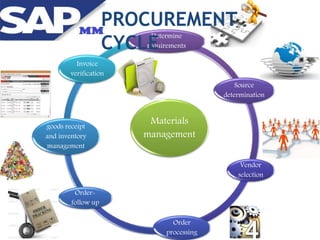
Materials
management
Determine
requirements
Source
determination
Vendor
selection
Order
processing
Order-
follow up
goods receipt
and inventory
management
Invoice
verification
PROCUREMENT
CYCLE
PURCHASING
Purchasing refers to a business or organization
attempting to acquire goods or services to
accomplish the goals of its enterprise.
Task of Purchasing as following :-
 External procurement of material & services
 Determination of possible source of supply
 Monitoring deliveries from and payment to
vendors.
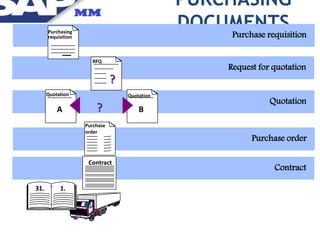
PURCHASING
DOCUMENTSPurchase requisition
Request for quotation
Purchase order
Contract
Quotation
31. 1.
Contract
Purchase
order
?
Quotation
B
Quotation
A
RFQ
?
Purchasing
requisition
INVENTORY
MANAGEMENT
Inventory Management is used to manage stocks of
merchandise on a quantity and value basis.
Task of Inventory Management as include :-
Plan, enter and provide evidence of all goods
movements.
Creation of a document for every goods movement
 Division of the stock into categories (such as
unrestricted-use stock, stock in quality inspection, or
blocked stock)
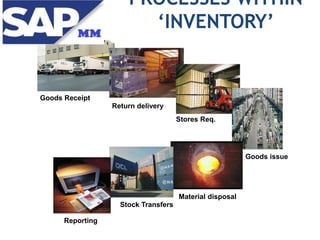
PROCESSES WITHIN
‘INVENTORY’
Goods Receipt
Return delivery
Stores Req.
Goods issue
Material disposal
Stock Transfers
Reporting
MRP
MRP: It’s main function is to guarantee
material availability, i.e. it is used to procure or
produce the requirement quantities on time
both for internal purposes and for sales and
distribution.
MRP involves:-
 the monitoring of stocks
 the automatic creation of procurement
proposals for purchasing
 Monitoring deliveries from and payment to
vendors.
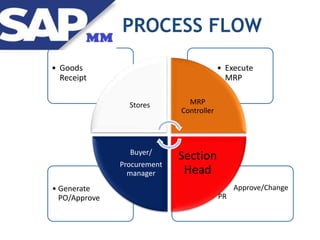
PROCESS FLOW
• A Approve/Change
PR
• Generate
PO/Approve
• Execute
MRP
• Goods
Receipt
Stores MRP
Controller
Section
Head
Buyer/
Procurement
manager
CONTRACTS
In MM, a contract is a type of outline purchase
agreement against which release orders
(releases) can be issued for agreed materials or
services as and when required during a certain
overall time-frame.
Contracts can be :-
 Centrally Agreed: For an entire company
code.
 Distributed: For one particular plant
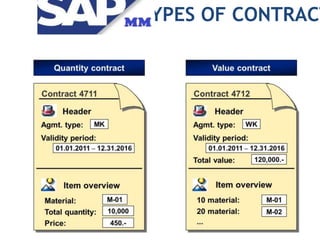
TY TYPES OF CONTRACT
INTEGRATION
How the SAP MM
module integrates
with some other
SAP modules
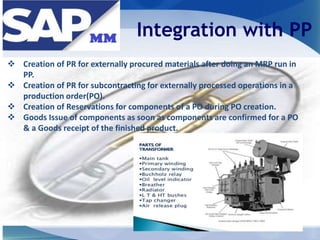
Integration with PP
 Creation of PR for externally procured materials after doing an MRP run in
PP.
 Creation of PR for subcontracting for externally processed operations in a
production order(PO).
 Creation of Reservations for components of a PO during PO creation.
 Goods Issue of components as soon as components are confirmed for a PO
& a Goods receipt of the finished product.
Integration with FI
 When a PR for a non stock item is created, the system goes on to update
the correct cost center in FI.
 After a stores req, the system assigns the cost to the relevant cost centre
and updates the relevant accounts(giver & given).
 When a material document is created, postings are done to the relevant
accounts and for every mat doc there is a corresponding FI doc.
 In general any transaction with a monetary value is catered for in FI.
Integration with SD
 Third party sales order processing.
 When you create a delivery for SD sales order then goods issue takes place
in the background using movement type 601.
Integration with PM
 In the event of a maintenance(breakdown/preventative), a maintenance
order is created where there’ll be a GI(MM).
By Ashley Chimhanda

SAP MM module presentation by Ashley Chimhanda

  • 1.
  • 2.
    OVERVIEW Materials management isthe backbone of Logistics area and helps to manage the procurement and inventory management activities of an organization To GET The Right quality Right quantity of supplies At the Right time At the Right place At the Right cost 5R FEATUR ES AIM  Ensures that there is never a shortage of materials or any gaps in the supply chain process of the organization  It deals with managing the materials (products and or services) resources of an organization  It deals with the Procurement Process, Master Data, Account Determination & Valuation of Material, Inventory Management, Invoice Verification, Material Requirement Planning
  • 3.
    Purchasing External procurement ofmaterials and services And Determination of possible sources of supply for a requirement identified by the materials planning and control system or arising directly within a user department Contracts a type of outline purchase agreement against which release orders can be issued for agreed materials or services as and when required during a certain overall time-frame Inventory management It deals with Management of material stocks on a quantity and value basis Material master It contains data records which are stored centrally and used on a cross application basis. Logistic invoice verification It is situated at the end of the logistics supply chain and this is when the system invoice is matched with the goods delivered. MRP Is used to monitor stock and make automatic requisitions when stocks fall below specified quantities
  • 4.
    ORGANIZATIONAL STRUCTURE The organizational structureforms a framework of a company in which business is conducted.
  • 5.
    Client: Represents a groupingor combination of legal, organizational, business and/or administrative units with a common purpose. Storage Location: A place where inventories are physically kept in a plant and is the least level of an organization in MM. Plant: Operational unit within a company code. Company Code: Company Code represents an independent accounting unit within a client. Each company code has its own balance sheet and its own profit and loss statement.
  • 6.
    MASTER DATA This isa collection of data about an object or person which is referenced whenever it is used in an entry field. Types of Master Data:-  Material Master: Is the main source of material specific data in an enterprise.  Vendor Master: Contains all required information on a vendor and is maintained by FI & Purchasing dept.  Service Master: Contains the description of a service and serves as a source of data for you to draw upon when creating service specifications
  • 7.
  • 8.
    PURCHASING Purchasing refers toa business or organization attempting to acquire goods or services to accomplish the goals of its enterprise. Task of Purchasing as following :-  External procurement of material & services  Determination of possible source of supply  Monitoring deliveries from and payment to vendors.
  • 9.
    PURCHASING DOCUMENTSPurchase requisition Request forquotation Purchase order Contract Quotation 31. 1. Contract Purchase order ? Quotation B Quotation A RFQ ? Purchasing requisition
  • 10.
    INVENTORY MANAGEMENT Inventory Management isused to manage stocks of merchandise on a quantity and value basis. Task of Inventory Management as include :- Plan, enter and provide evidence of all goods movements. Creation of a document for every goods movement  Division of the stock into categories (such as unrestricted-use stock, stock in quality inspection, or blocked stock)
  • 11.
    PROCESSES WITHIN ‘INVENTORY’ Goods Receipt Returndelivery Stores Req. Goods issue Material disposal Stock Transfers Reporting
  • 12.
    MRP MRP: It’s mainfunction is to guarantee material availability, i.e. it is used to procure or produce the requirement quantities on time both for internal purposes and for sales and distribution. MRP involves:-  the monitoring of stocks  the automatic creation of procurement proposals for purchasing  Monitoring deliveries from and payment to vendors.
  • 13.
    PROCESS FLOW • AApprove/Change PR • Generate PO/Approve • Execute MRP • Goods Receipt Stores MRP Controller Section Head Buyer/ Procurement manager
  • 14.
    CONTRACTS In MM, acontract is a type of outline purchase agreement against which release orders (releases) can be issued for agreed materials or services as and when required during a certain overall time-frame. Contracts can be :-  Centrally Agreed: For an entire company code.  Distributed: For one particular plant
  • 15.
    TY TYPES OFCONTRACT
  • 16.
    INTEGRATION How the SAPMM module integrates with some other SAP modules
  • 17.
    Integration with PP Creation of PR for externally procured materials after doing an MRP run in PP.  Creation of PR for subcontracting for externally processed operations in a production order(PO).  Creation of Reservations for components of a PO during PO creation.  Goods Issue of components as soon as components are confirmed for a PO & a Goods receipt of the finished product.
  • 18.
    Integration with FI When a PR for a non stock item is created, the system goes on to update the correct cost center in FI.  After a stores req, the system assigns the cost to the relevant cost centre and updates the relevant accounts(giver & given).  When a material document is created, postings are done to the relevant accounts and for every mat doc there is a corresponding FI doc.  In general any transaction with a monetary value is catered for in FI.
  • 19.
    Integration with SD Third party sales order processing.  When you create a delivery for SD sales order then goods issue takes place in the background using movement type 601.
  • 20.
    Integration with PM In the event of a maintenance(breakdown/preventative), a maintenance order is created where there’ll be a GI(MM).
  • 21.

Editor's Notes

  • #3 Definition of the materials management module and its scope, The aim of this module is we can indicate with 5R’s those are, To achieve right quality and quantity at right time, right place, with right cost.
  • #4 These are the components and functions of MATERIALS MANAGEMENT module in SAP, it includes Purchasing Valuation Inventory management Foreign trade Material master Logistic invoice verification MRP(materials requirement planning) Product catalog and Service master.
  • #5 This is the structure of an organization in MM module and sub modules of MM.
  • #6 This is the explanation of each factor in organizational structure of module MM in SAP.
  • #8 One topic explanation: MM process flow This is the typical procurement cycle for a service or material consists of the following phases Determination of Requirements Materials requirements are identified either in the user departments or via materials planning and control. This can cover both MRP proper and the demand-based approach to inventory control. The regular checking of stock levels of materials defined by master records, use of the order-point method, and forecasting on the basis of past usage are important aspects of the latter. we can enter purchase requisitions our self, or they can be generated automatically by the materials planning and control system. 2. Source Determination The Purchasing component helps to identify potential sources of supply based on past orders and existing longer-term purchase agreements. This speeds the process of creating requests for quotation (RFQs), which can be sent to vendors electronically via SAP EDI, if desired. 3. Vendor Selection and Comparison of Quotations The system is capable of simulating pricing scenarios, allowing us to compare a number of different quotations. Rejection letters can be sent automatically. 4. Purchase Order Processing The Purchasing system adopts information from the requisition and the quotation to help you create a purchase order. As with purchase requisitions, we can generate Pos our self or have the system generate them automatically. Vendor scheduling agreements and contracts are also supported. 5. Purchase Order Follow-Up The system checks the reminder periods we have specified and - if necessary - automatically prints reminders or expediters at the predefined intervals. It also provides us with an up-to-date status of all purchase requisitions, quotations, and purchase orders. 6. Goods Receiving and Inventory Management Goods Receiving personnel can confirm the receipt of goods simply by entering the Po number. By specifying permissible tolerances, buyers can limit over- and under deliveries of ordered goods. 7. Invoice Verification The system supports the checking and matching of invoices. The accounts payable clerk is notified of quantity and price variances because the system has access to PO and goods receipt data. This speeds the process of auditing and clearing invoices for payment.  
  • #12 A smooth material flow requires good communication between all participants in the process. The required flow of information is ensured by the fact that Inventory Management is fully integrated in the R/3 System and communicates with other R/3 modules. Within the stores, goods are firstly received, then moved to there respective areas and if required reports are generated. The smooth flow of materials within an organization ensures stock availability.