SAP HCM Online And
Remote Based Training in
usa,uk,india
Online | classroom| Corporate
Training | certifications | placements|
support
CONTACT US:
MAGNIFIC TRAINING
INDIA +91-9052666559
USA : +1-678-693-3475
info@magnifictraining.com
www.magnifictraining.com
Agenda
 Overview: General / Structural / Context Authorisation Check
 How to reduce the number of roles
 Avoid these pitfalls
 How to approach a redesign
slide: 2
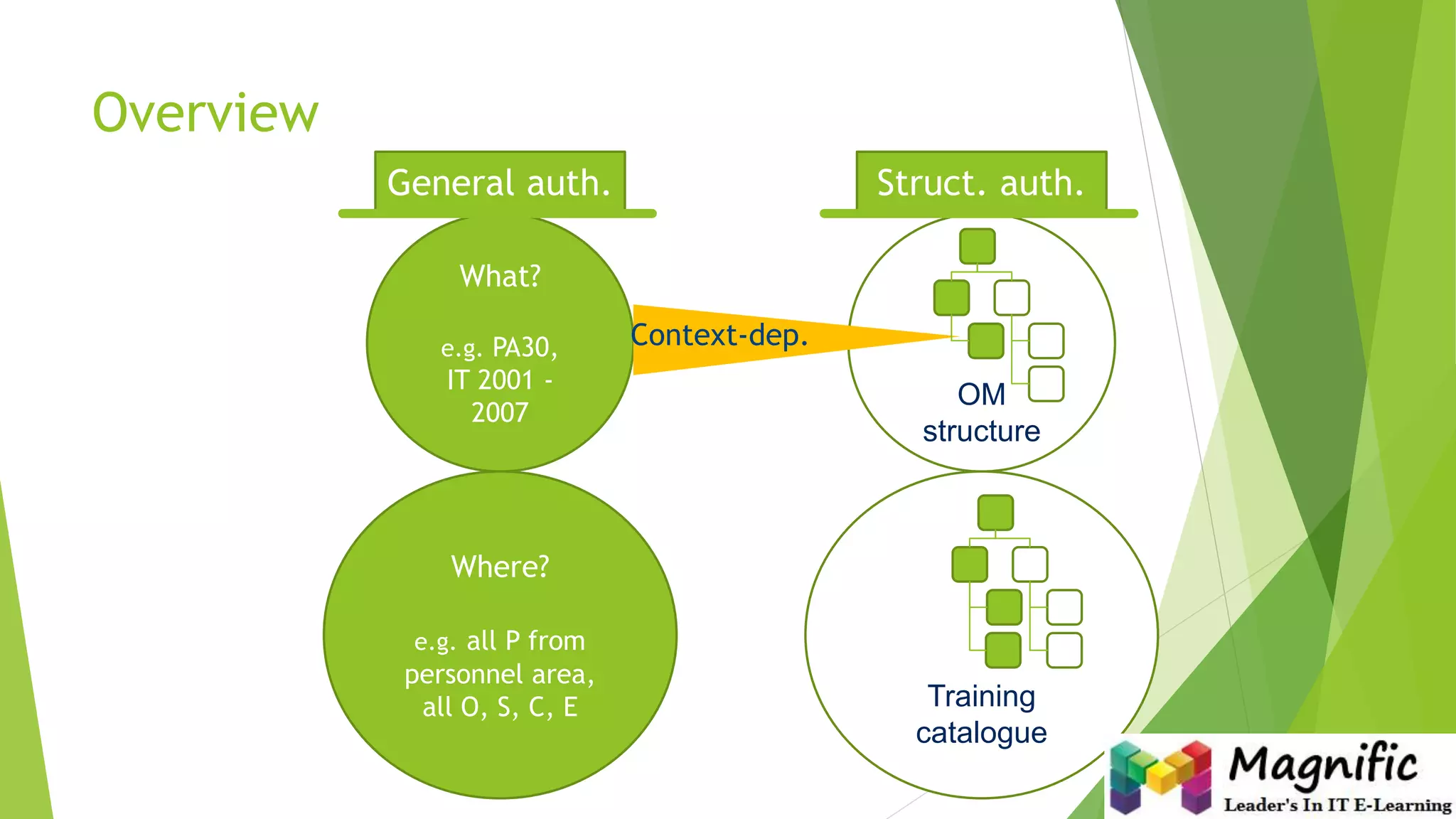
Overview
slide: 3
Where?
e.g. all P from
personnel area,
all O, S, C, E
What?
e.g. PA30,
IT 2001 -
2007
General auth.
Training
catalogue
OM
structure
Struct. auth.
Context-dep.
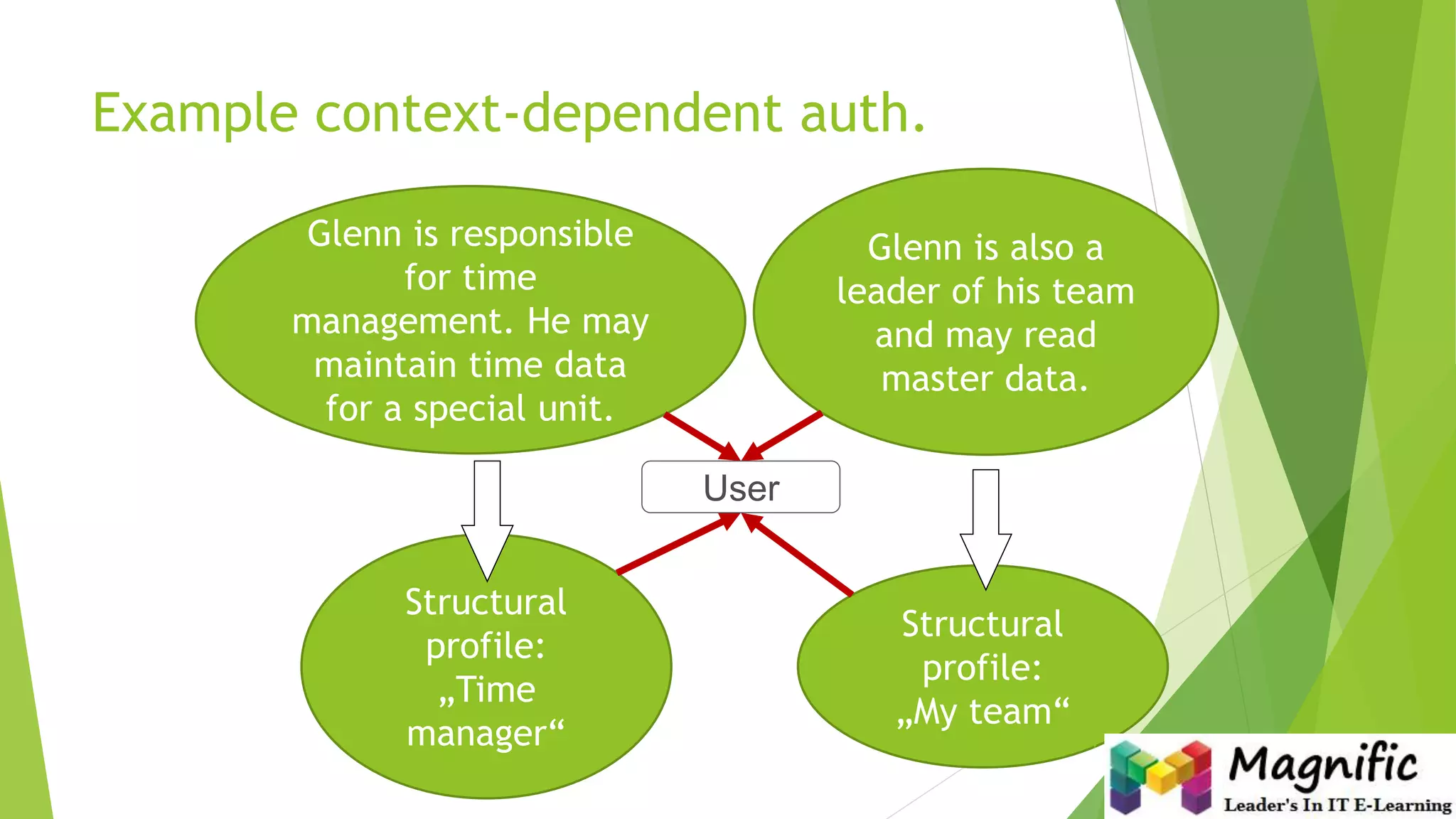
Example context-dependent auth.
Structural
profile:
„Time
manager“
Glenn is responsible
for time
management. He may
maintain time data
for a special unit.
Glenn is also a
leader of his team
and may read
master data.
Structural
profile:
„My team“
User
slide: 4
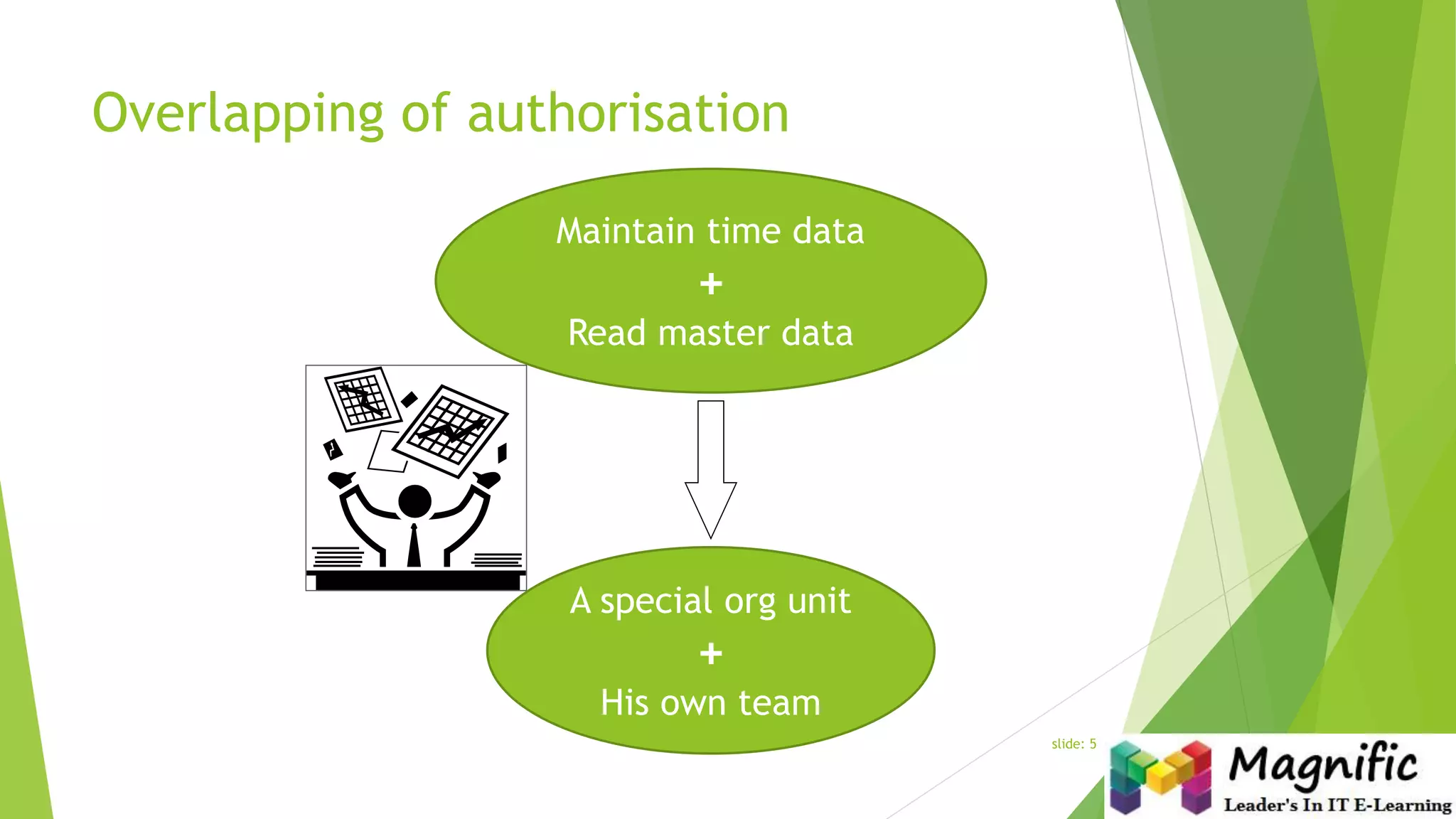
Overlapping of authorisation
Maintain time data
+
Read master data
A special org unit
+
His own team
slide: 5
Structural
profile „Time
manager“
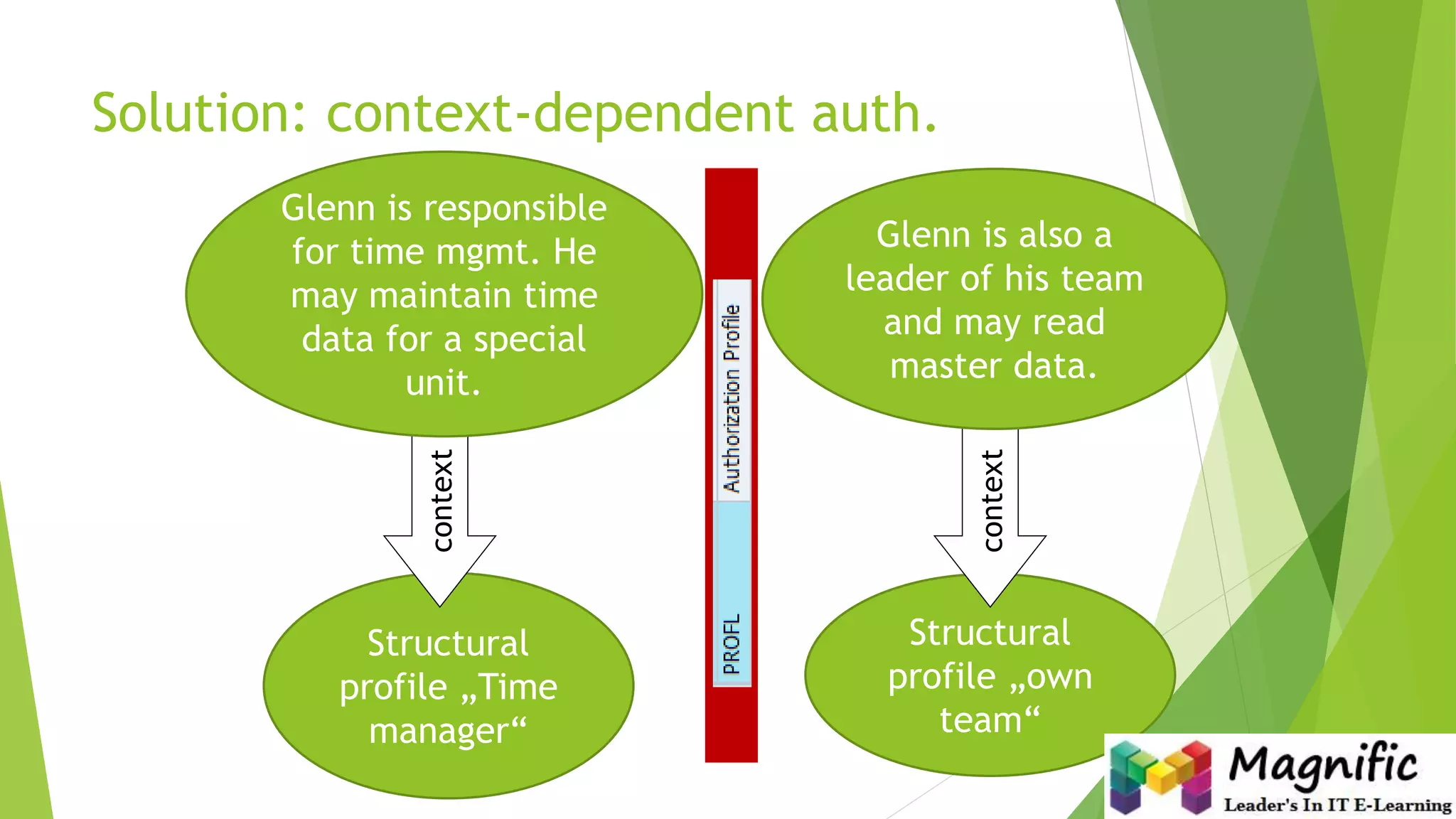
Solution: context-dependent auth.
Structural
profile „own
team“ slide: 6
Glenn is also a
leader of his team
and may read
master data.
context
context
Glenn is responsible
for time mgmt. He
may maintain time
data for a special
unit.
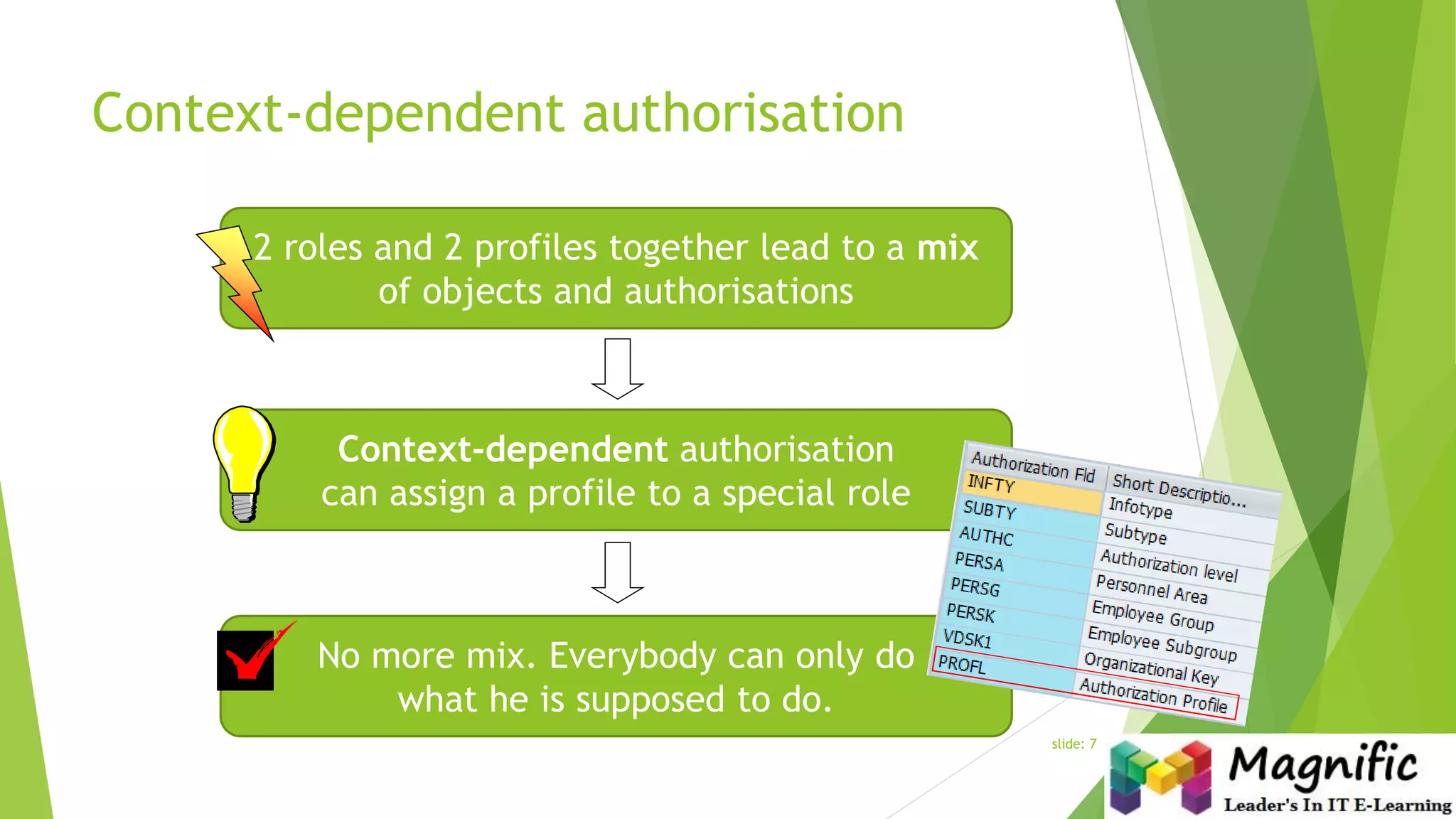
No more mix. Everybody can only do
what he is supposed to do.
Context-dependent authorisation
can assign a profile to a special role
2 roles and 2 profiles together lead to a mix
of objects and authorisations
Context-dependent authorisation
Tip
slide: 7
Agenda
 Overview: General / Structural / Context Authorisation Check
 How to reduce the number of roles
 Avoid these pitfalls
 How to approach a redesign
slide: 8
Why do we have so many roles?
slide: 9
General authorisation can restrict both:
access to data and access to persons
Functional range of SAP HCM
applications increases
Functions are becoming decentralised –
more users need different access
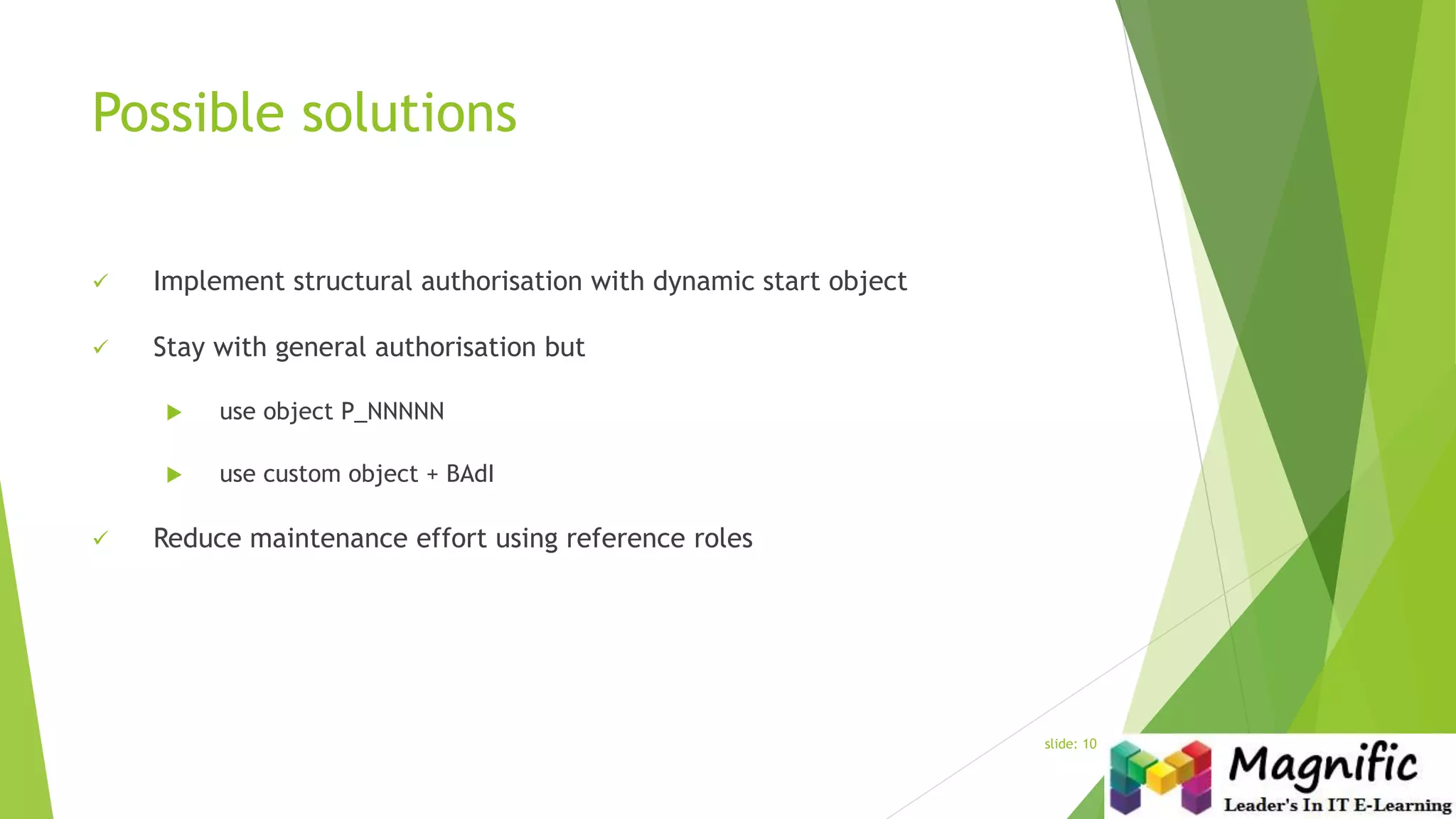
Possible solutions
 Implement structural authorisation with dynamic start object
 Stay with general authorisation but
 use object P_NNNNN
 use custom object + BAdI
 Reduce maintenance effort using reference roles
slide: 10
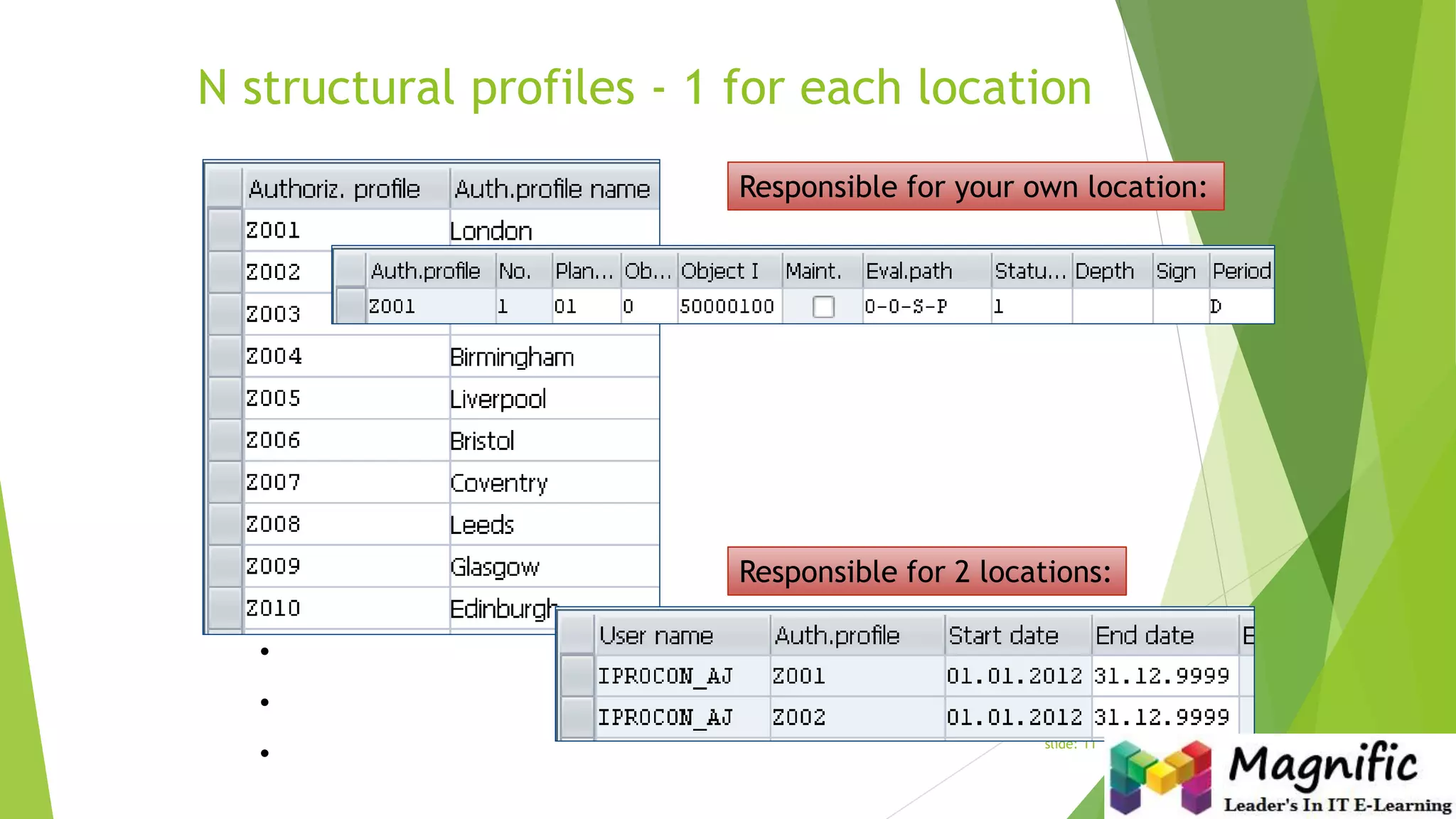
N structural profiles - 1 for each location
slide: 11
Responsible for 2 locations:
Responsible for your own location:
.
.
.
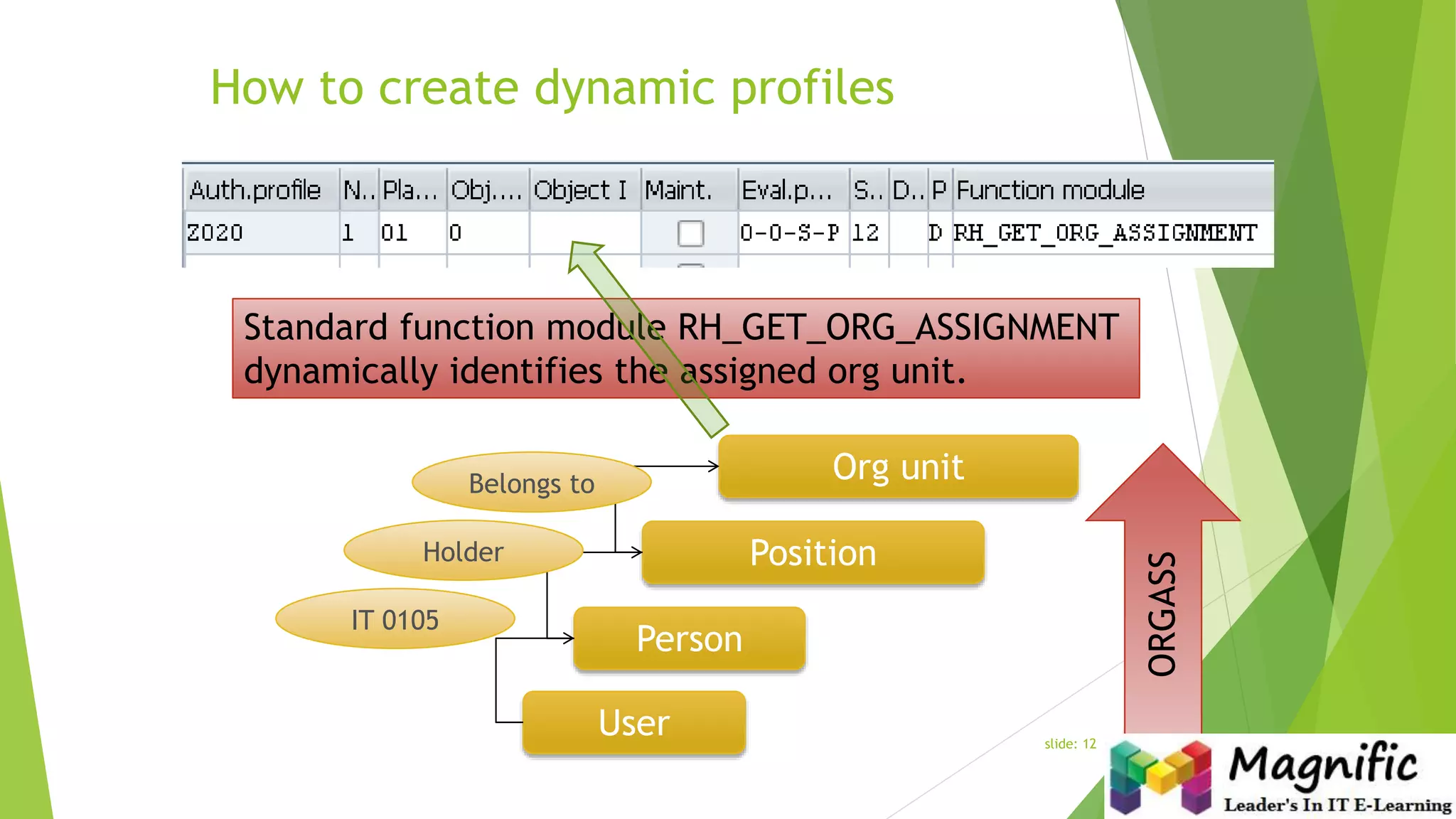
How to create dynamic profiles
slide: 12
Standard function module RH_GET_ORG_ASSIGNMENT
dynamically identifies the assigned org unit.
User
Person
Position
Org unit
IT 0105
Holder
Belongs to
ORGASS
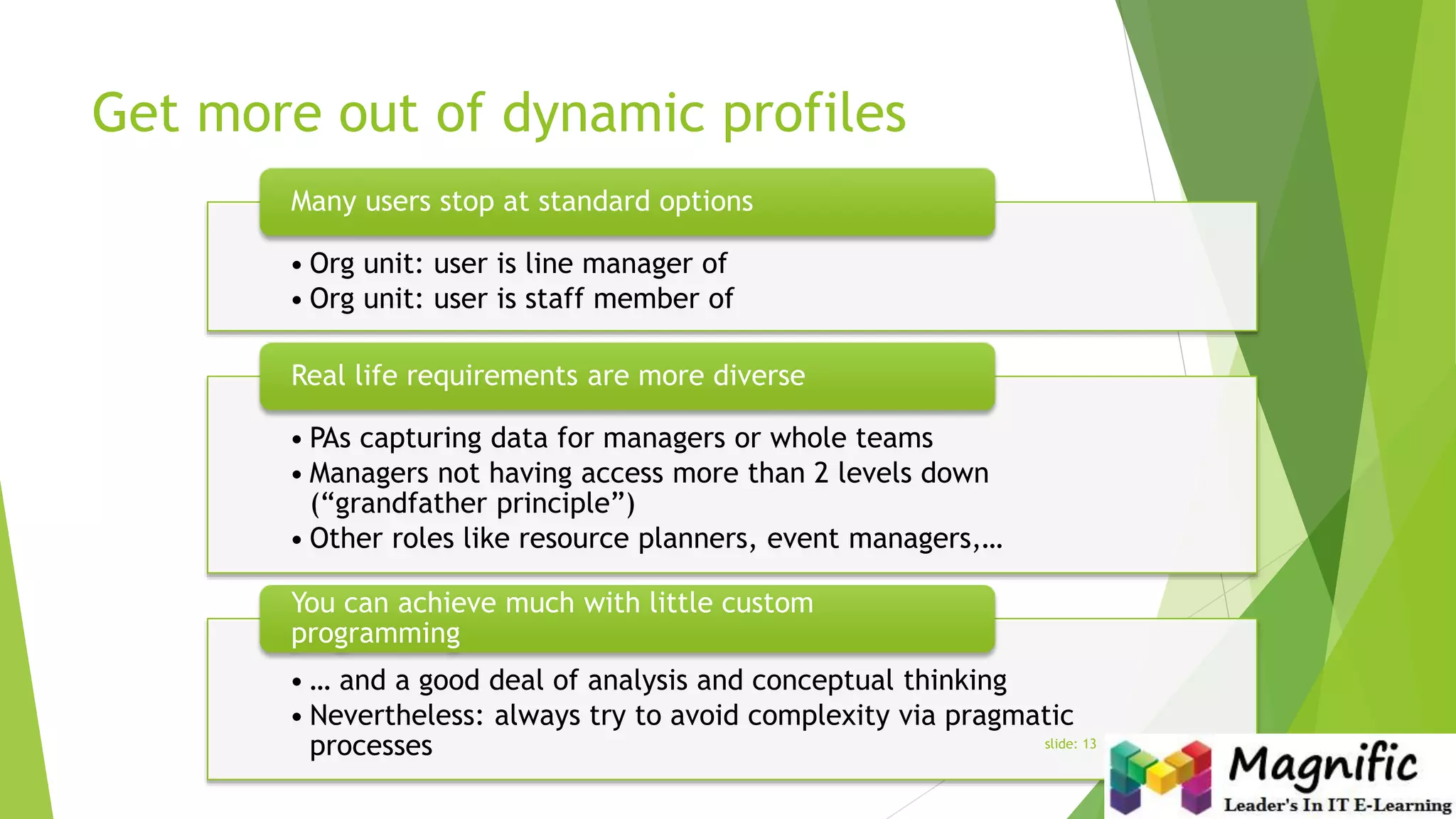
Get more out of dynamic profiles
• Org unit: user is line manager of
• Org unit: user is staff member of
Many users stop at standard options
• PAs capturing data for managers or whole teams
• Managers not having access more than 2 levels down
(“grandfather principle”)
• Other roles like resource planners, event managers,…
Real life requirements are more diverse
• … and a good deal of analysis and conceptual thinking
• Nevertheless: always try to avoid complexity via pragmatic
processes
You can achieve much with little custom
programming
slide: 13
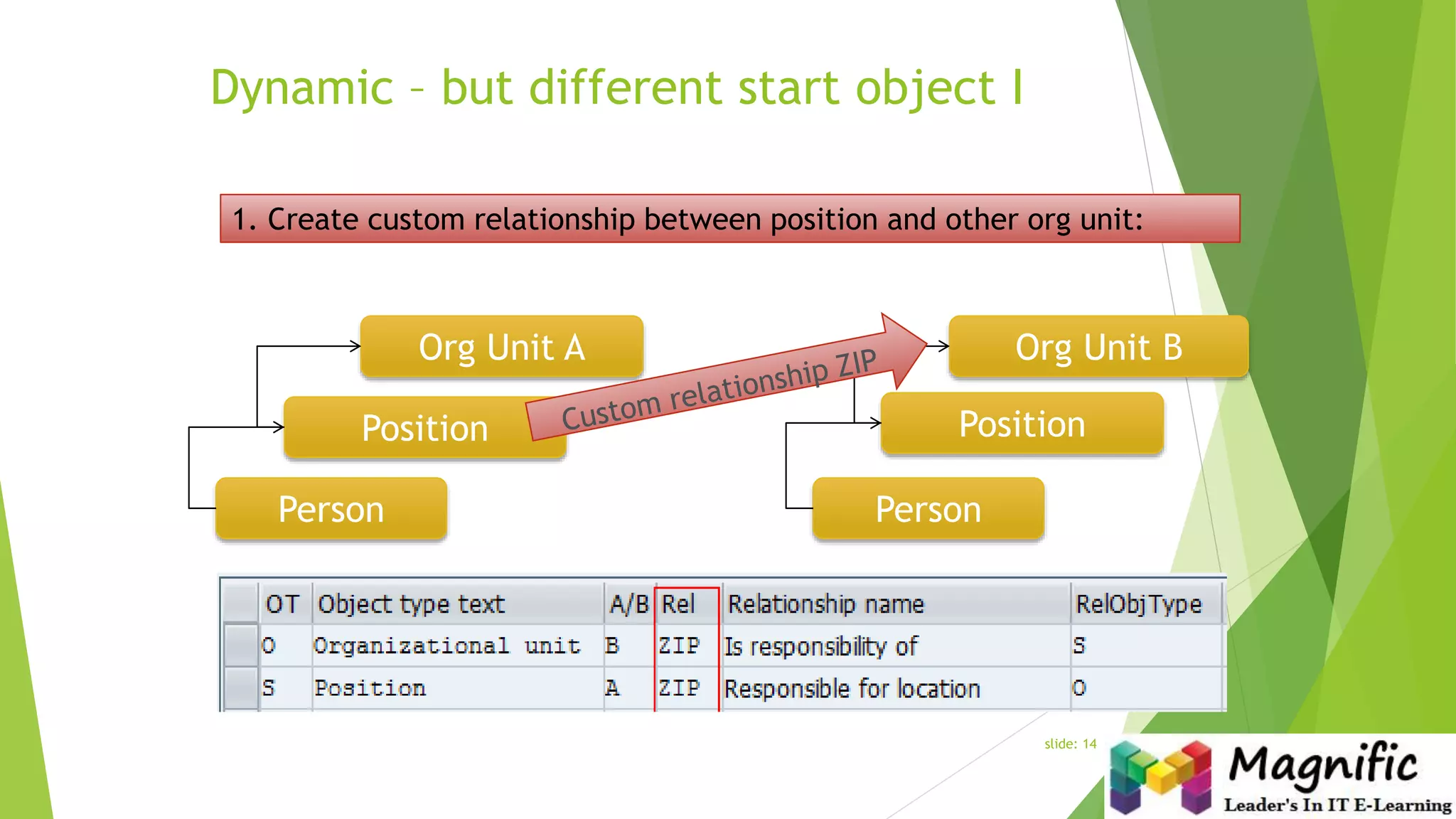
Dynamic – but different start object I
slide: 14
Person
Position
Org Unit A
Person
Position
Org Unit B
1. Create custom relationship between position and other org unit:
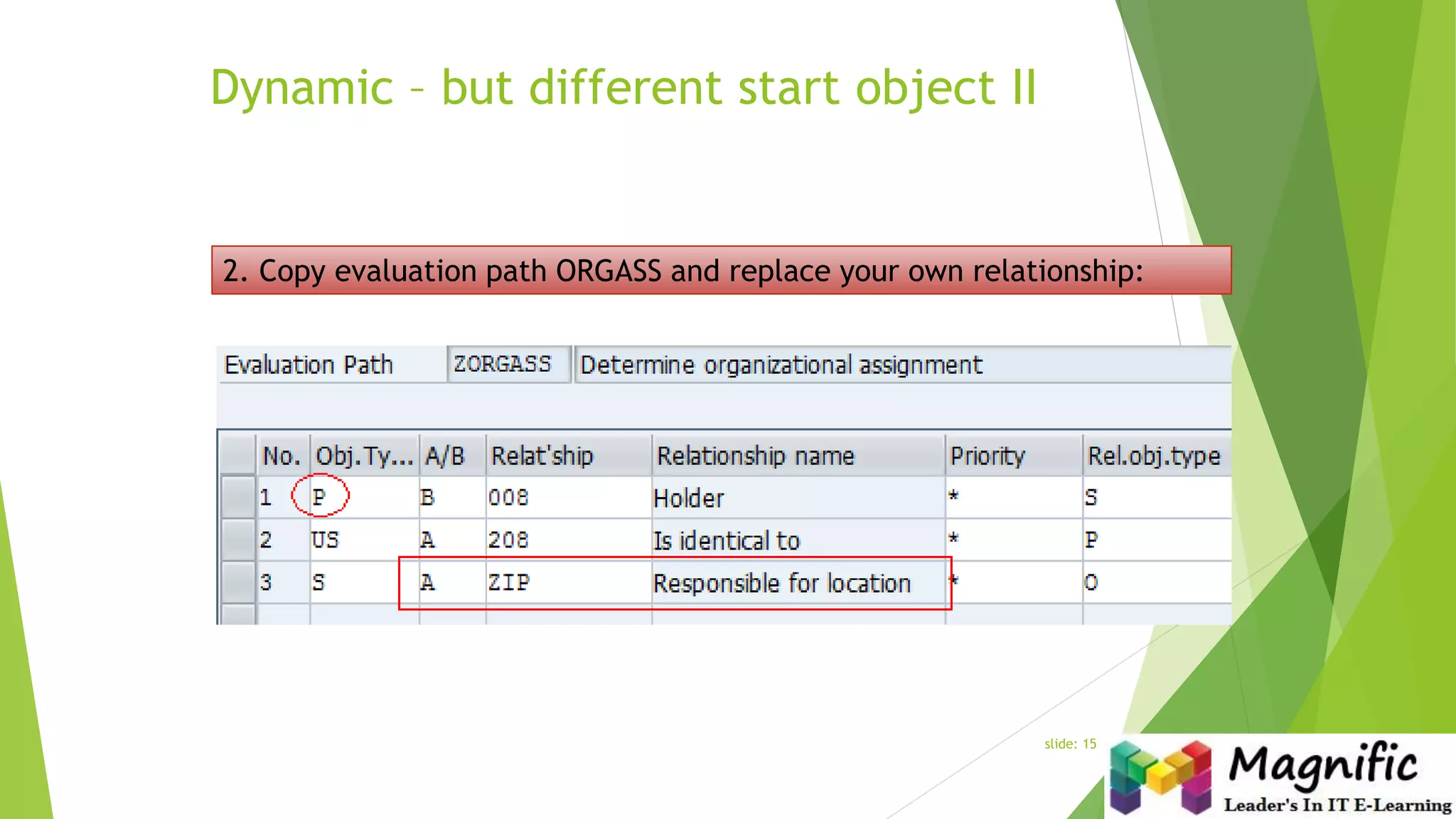
Dynamic – but different start object II
slide: 15
2. Copy evaluation path ORGASS and replace your own relationship:
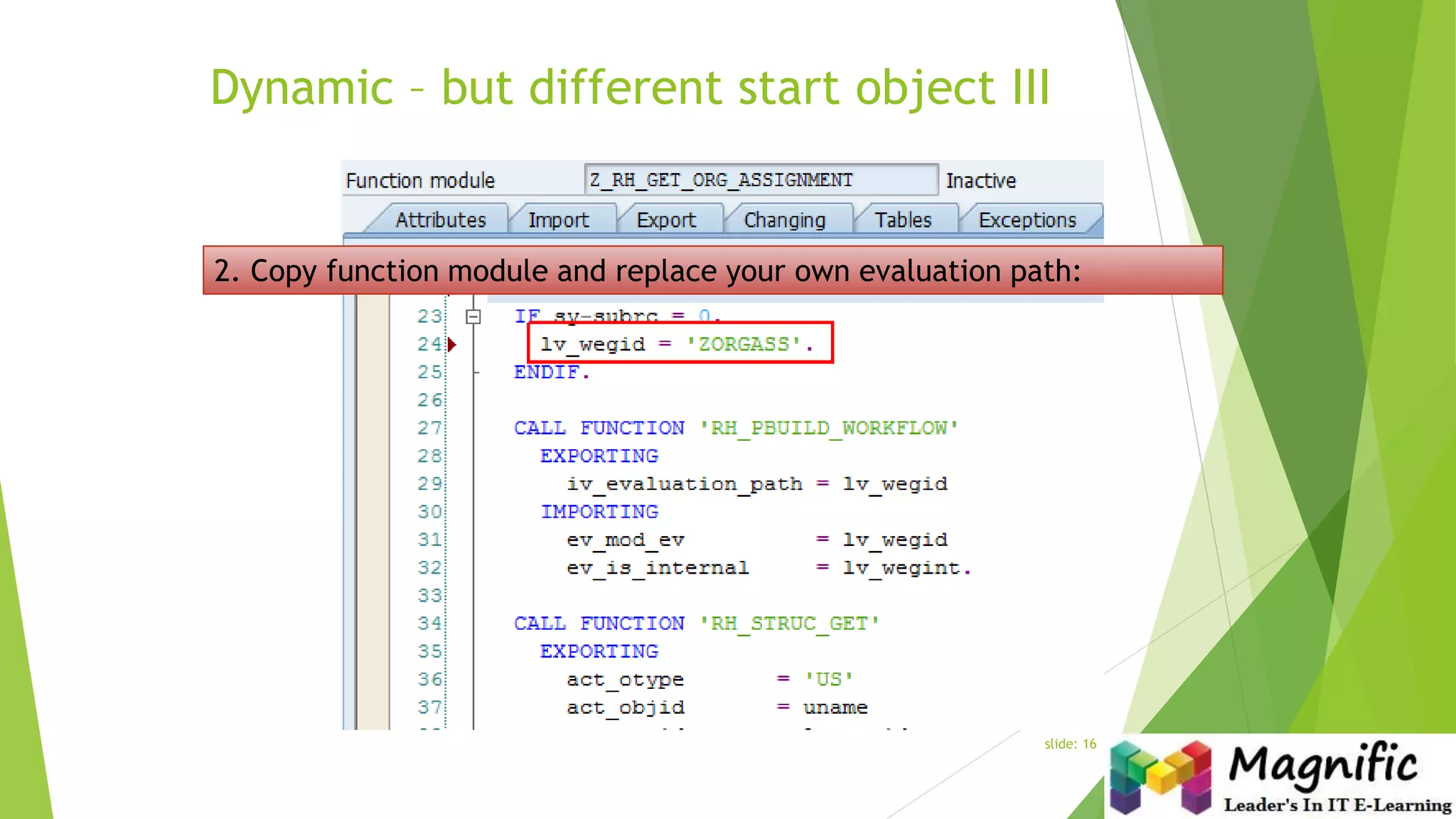
Dynamic – but different start object III
slide: 16
2. Copy function module and replace your own evaluation path:
Tip for enhanced use
slide: 17
■ If the access to persons can‘t be determined from
org structure you can also develop a custom
function module that may identify relevant persons
by
► user parameter
► master data
► customizing
► …
■ In this case evaluation path and start object remain
empty.
How to reduce number of roles
 Dynamic start object
 Dynamic in general auhorization through custom object or
P_NNNNN or BAdI
 Reference role
slide: 18
P_NNNNN
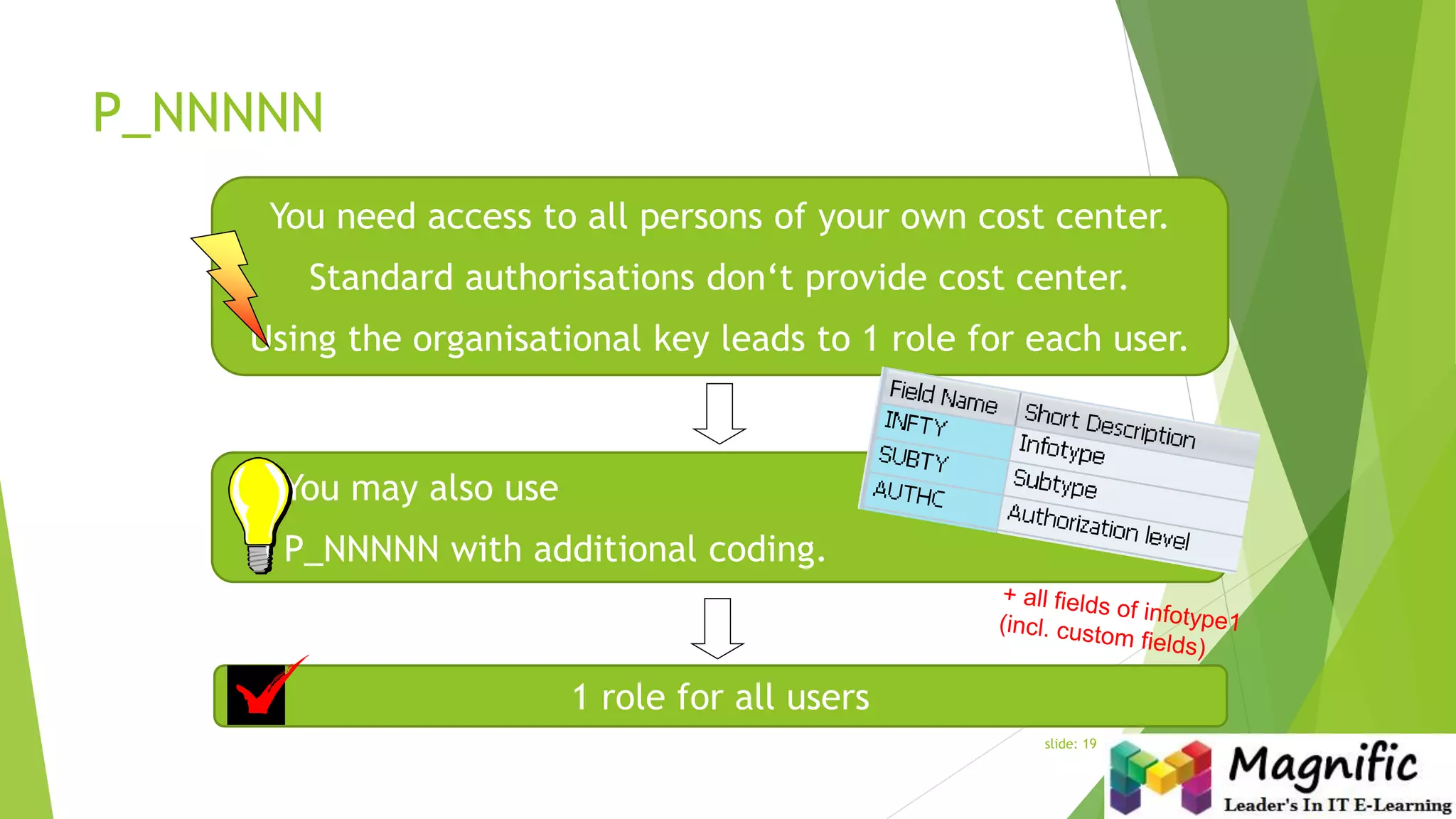
You need access to all persons of your own cost center.
Standard authorisations don‘t provide cost center.
Using the organisational key leads to 1 role for each user.
You may also use
P_NNNNN with additional coding.
Tip
1 role for all users
slide: 19
Additional coding for P_NNNNN
 The report RPUACG00 generates coding in program MPPAUTZZ
 Here you can add your own coding.
 Note! After every regeneration the custom code gets lost.
slide: 20
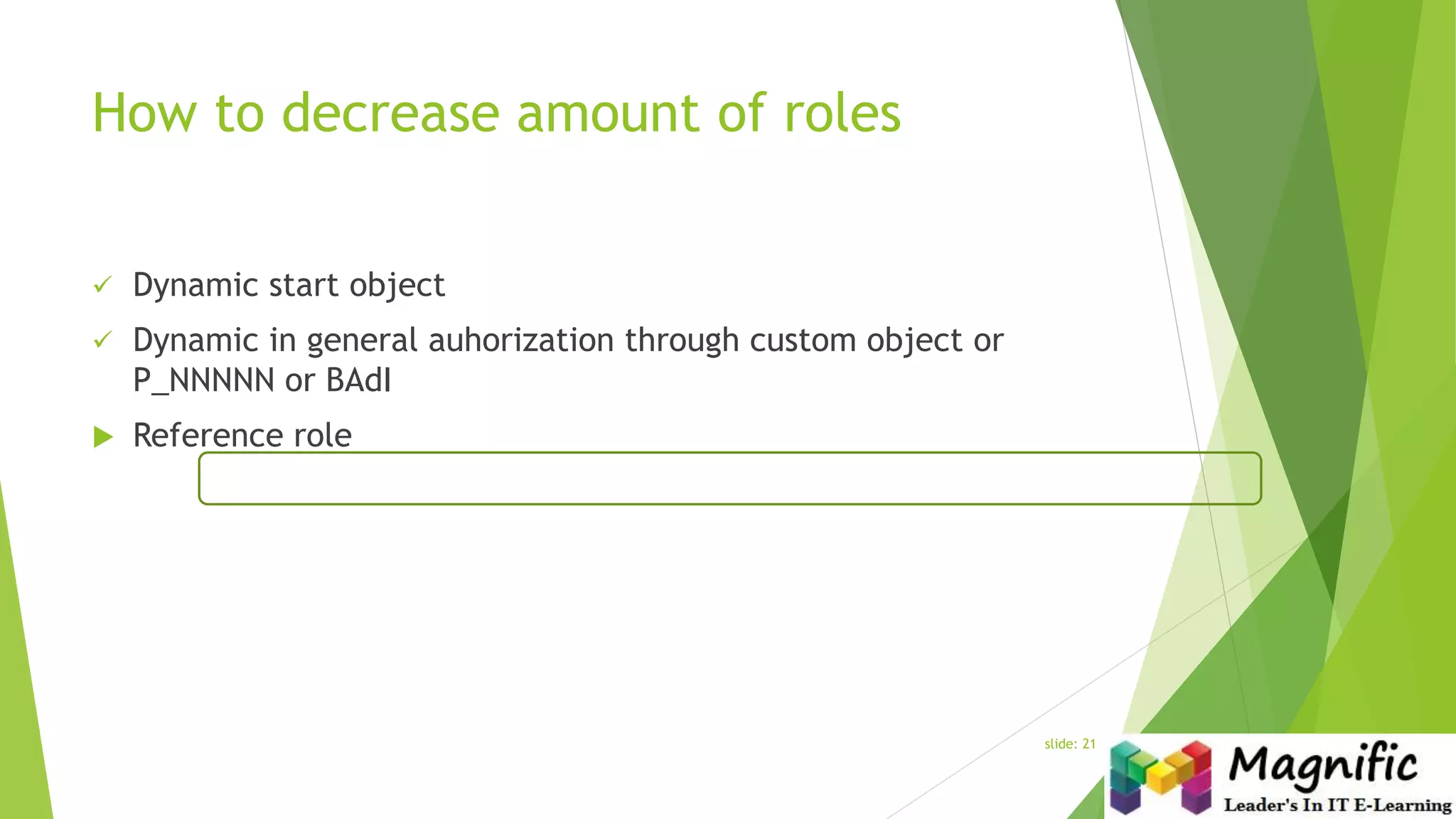
How to decrease amount of roles
 Dynamic start object
 Dynamic in general auhorization through custom object or
P_NNNNN or BAdI
 Reference role
slide: 21
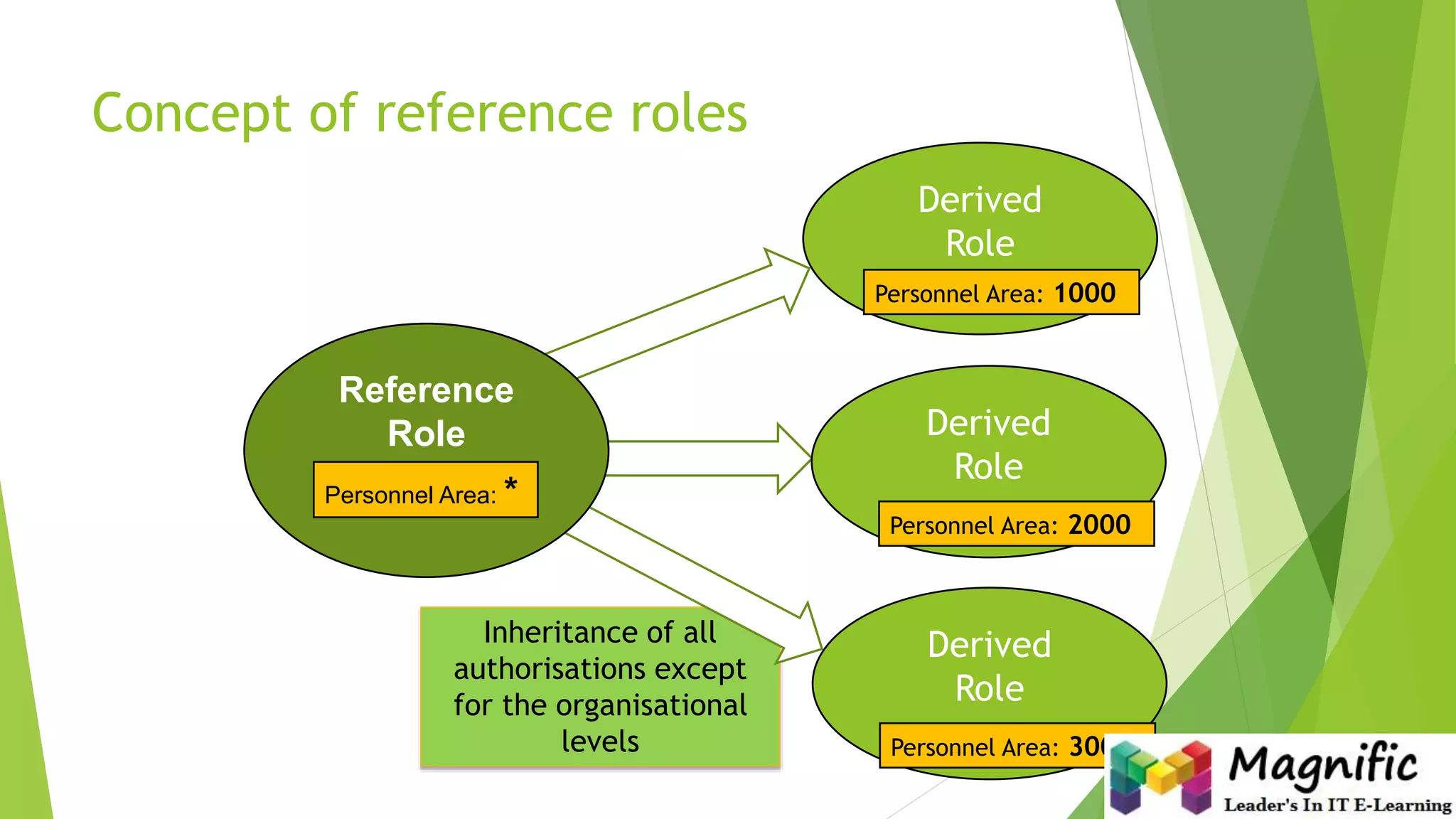
Concept of reference roles
Inheritance of all
authorisations except
for the organisational
levels slide: 22
Reference
Role
Personnel Area: *
Derived
Role
Personnel Area: 2000
Derived
Role
Personnel Area: 1000
Derived
Role
Personnel Area: 3000
Question & Answers
Should you require any further
information please do not
hesitate to
contact us
 http://www.saponlinetrainings.net
 -sap hcm online training
contact us:
 info@magnifictraining.com or
+919052666559
 By Real Time Experts from Hyderabad,
 Bangalore
 ,India,USA,Canada,UK, Australia,South
 Africa.
Thank you !

Sap hcm online and remote based training in usa,uk,india

  • 1.
    SAP HCM OnlineAnd Remote Based Training in usa,uk,india Online | classroom| Corporate Training | certifications | placements| support CONTACT US: MAGNIFIC TRAINING INDIA +91-9052666559 USA : +1-678-693-3475 info@magnifictraining.com www.magnifictraining.com
  • 2.
    Agenda  Overview: General/ Structural / Context Authorisation Check  How to reduce the number of roles  Avoid these pitfalls  How to approach a redesign slide: 2
  • 3.
    Overview slide: 3 Where? e.g. allP from personnel area, all O, S, C, E What? e.g. PA30, IT 2001 - 2007 General auth. Training catalogue OM structure Struct. auth. Context-dep.
  • 4.
    Example context-dependent auth. Structural profile: „Time manager“ Glennis responsible for time management. He may maintain time data for a special unit. Glenn is also a leader of his team and may read master data. Structural profile: „My team“ User slide: 4
  • 5.
    Overlapping of authorisation Maintaintime data + Read master data A special org unit + His own team slide: 5
  • 6.
    Structural profile „Time manager“ Solution: context-dependentauth. Structural profile „own team“ slide: 6 Glenn is also a leader of his team and may read master data. context context Glenn is responsible for time mgmt. He may maintain time data for a special unit.
  • 7.
    No more mix.Everybody can only do what he is supposed to do. Context-dependent authorisation can assign a profile to a special role 2 roles and 2 profiles together lead to a mix of objects and authorisations Context-dependent authorisation Tip slide: 7
  • 8.
    Agenda  Overview: General/ Structural / Context Authorisation Check  How to reduce the number of roles  Avoid these pitfalls  How to approach a redesign slide: 8
  • 9.
    Why do wehave so many roles? slide: 9 General authorisation can restrict both: access to data and access to persons Functional range of SAP HCM applications increases Functions are becoming decentralised – more users need different access
  • 10.
    Possible solutions  Implementstructural authorisation with dynamic start object  Stay with general authorisation but  use object P_NNNNN  use custom object + BAdI  Reduce maintenance effort using reference roles slide: 10
  • 11.
    N structural profiles- 1 for each location slide: 11 Responsible for 2 locations: Responsible for your own location: . . .
  • 12.
    How to createdynamic profiles slide: 12 Standard function module RH_GET_ORG_ASSIGNMENT dynamically identifies the assigned org unit. User Person Position Org unit IT 0105 Holder Belongs to ORGASS
  • 13.
    Get more outof dynamic profiles • Org unit: user is line manager of • Org unit: user is staff member of Many users stop at standard options • PAs capturing data for managers or whole teams • Managers not having access more than 2 levels down (“grandfather principle”) • Other roles like resource planners, event managers,… Real life requirements are more diverse • … and a good deal of analysis and conceptual thinking • Nevertheless: always try to avoid complexity via pragmatic processes You can achieve much with little custom programming slide: 13
  • 14.
    Dynamic – butdifferent start object I slide: 14 Person Position Org Unit A Person Position Org Unit B 1. Create custom relationship between position and other org unit:
  • 15.
    Dynamic – butdifferent start object II slide: 15 2. Copy evaluation path ORGASS and replace your own relationship:
  • 16.
    Dynamic – butdifferent start object III slide: 16 2. Copy function module and replace your own evaluation path:
  • 17.
    Tip for enhanceduse slide: 17 ■ If the access to persons can‘t be determined from org structure you can also develop a custom function module that may identify relevant persons by ► user parameter ► master data ► customizing ► … ■ In this case evaluation path and start object remain empty.
  • 18.
    How to reducenumber of roles  Dynamic start object  Dynamic in general auhorization through custom object or P_NNNNN or BAdI  Reference role slide: 18
  • 19.
    P_NNNNN You need accessto all persons of your own cost center. Standard authorisations don‘t provide cost center. Using the organisational key leads to 1 role for each user. You may also use P_NNNNN with additional coding. Tip 1 role for all users slide: 19
  • 20.
    Additional coding forP_NNNNN  The report RPUACG00 generates coding in program MPPAUTZZ  Here you can add your own coding.  Note! After every regeneration the custom code gets lost. slide: 20
  • 21.
    How to decreaseamount of roles  Dynamic start object  Dynamic in general auhorization through custom object or P_NNNNN or BAdI  Reference role slide: 21
  • 22.
    Concept of referenceroles Inheritance of all authorisations except for the organisational levels slide: 22 Reference Role Personnel Area: * Derived Role Personnel Area: 2000 Derived Role Personnel Area: 1000 Derived Role Personnel Area: 3000
  • 23.
  • 24.
    Should you requireany further information please do not hesitate to contact us  http://www.saponlinetrainings.net  -sap hcm online training contact us:  info@magnifictraining.com or +919052666559  By Real Time Experts from Hyderabad,  Bangalore  ,India,USA,Canada,UK, Australia,South  Africa.
  • 25.