The population
Number = N
Mean = m
Standard deviation = s
The Population vs. The Sample
Cannot afford to measure
parameters of the whole population
We will likely never know these
(population parameters - these
are things that we want to know
about in the population)
3 General Kinds of Sampling
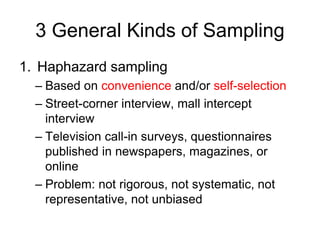
1. Haphazard sampling
– Based on convenience and/or self-selection
– Street-corner interview, mall intercept
interview
– Television call-in surveys, questionnaires
published in newspapers, magazines, or
online
– Problem: not rigorous, not systematic, not
representative, not unbiased
3 General Kinds of Sampling
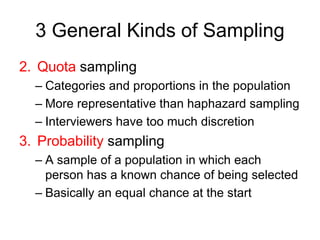
2. Quota sampling
– Categories and proportions in the population
– More representative than haphazard sampling
– Interviewers have too much discretion
3. Probability sampling
– A sample of a population in which each
person has a known chance of being selected
– Basically an equal chance at the start
Size of a Probability Sample
• Depends on:
– Accuracy (margin of error) typically +/-3%
– Confidence level: probability that the results
are outside the specified level of accuracy
– Variability: researchers usually assume
maximum variability for a binomial variable
• Does not depend on
– Size of the total population
Sampling Technique in Surveys
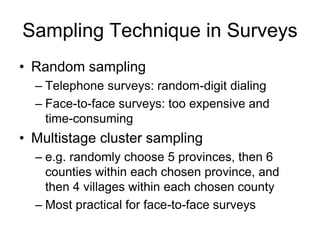
• Random sampling
– Telephone surveys: random-digit dialing
– Face-to-face surveys: too expensive and
time-consuming
• Multistage cluster sampling
– e.g. randomly choose 5 provinces, then 6
counties within each chosen province, and
then 4 villages within each chosen county
– Most practical for face-to-face surveys
We will likely never know these
(population parameters - these
are things that we want to know
about in the population)
The Population vs. The Sample
The population
Number = N
Mean = m
Standard deviation = s
Cannot afford to measure
parameters of the whole population
So we draw a random sample.
The Population vs. The Sample
The sample
Sample size = n
Sample mean = x
Sample standard
deviation = s
Cannot afford to measure
parameters of the whole population
So we draw a random sample.
The sample
Sample size = n
Sample mean = x
Sample standard
deviation = s
The population
Number = N
Mean = m
Standard deviation = s
The Population vs. The Sample
Does m = x? Probably not. We
need to be confident that x does a
good job of representing m.
The sample
Sample size = n
Sample mean = x
Sample standard
deviation = s
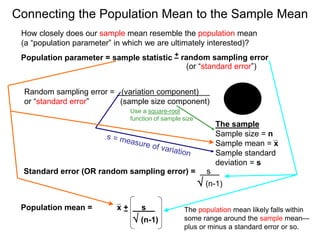
Connecting the Population Mean to the Sample Mean
How closely does our sample mean resemble the population mean
(a “population parameter” in which we are ultimately interested)?
Population parameter = sample statistic + random sampling error
Random sampling error = (variation component) .
or “standard error” (sample size component)
Use a square-root
function of sample size
Standard error (OR random sampling error) = s .
 (n-1)
Population mean = x + s .
(n-1)
The population mean likely falls within
some range around the sample mean—
plus or minus a standard error or so.
(or “standard error”)
To Compute Standard Deviation
• Population standard deviation
• Sample standard deviation
Why Use Squared Deviations?
• Why not just use differences?
– Student A’s exam scores/(Stock A’s prices):
– 94, 86, 94, 86
• Why not just use absolute values?
– Student B’s exam scores/(Stock B’s prices):
– 97, 84, 91, 88
– Which one is more spread out /unstable /risky
/volatile?
is the formula for:
A.Population standard deviation
B.Sample standard deviation
C.Standard error
D.Random sampling error
E.Population mean

sampling&SD.ppt

  • 1.
    The population Number =N Mean = m Standard deviation = s The Population vs. The Sample Cannot afford to measure parameters of the whole population We will likely never know these (population parameters - these are things that we want to know about in the population)
  • 2.
    3 General Kindsof Sampling 1. Haphazard sampling – Based on convenience and/or self-selection – Street-corner interview, mall intercept interview – Television call-in surveys, questionnaires published in newspapers, magazines, or online – Problem: not rigorous, not systematic, not representative, not unbiased
  • 3.
    3 General Kindsof Sampling 2. Quota sampling – Categories and proportions in the population – More representative than haphazard sampling – Interviewers have too much discretion 3. Probability sampling – A sample of a population in which each person has a known chance of being selected – Basically an equal chance at the start
  • 4.
    Size of aProbability Sample • Depends on: – Accuracy (margin of error) typically +/-3% – Confidence level: probability that the results are outside the specified level of accuracy – Variability: researchers usually assume maximum variability for a binomial variable • Does not depend on – Size of the total population
  • 5.
    Sampling Technique inSurveys • Random sampling – Telephone surveys: random-digit dialing – Face-to-face surveys: too expensive and time-consuming • Multistage cluster sampling – e.g. randomly choose 5 provinces, then 6 counties within each chosen province, and then 4 villages within each chosen county – Most practical for face-to-face surveys
  • 6.
    We will likelynever know these (population parameters - these are things that we want to know about in the population) The Population vs. The Sample The population Number = N Mean = m Standard deviation = s Cannot afford to measure parameters of the whole population So we draw a random sample.
  • 7.
    The Population vs.The Sample The sample Sample size = n Sample mean = x Sample standard deviation = s Cannot afford to measure parameters of the whole population So we draw a random sample.
  • 8.
    The sample Sample size= n Sample mean = x Sample standard deviation = s The population Number = N Mean = m Standard deviation = s The Population vs. The Sample Does m = x? Probably not. We need to be confident that x does a good job of representing m.
  • 9.
    The sample Sample size= n Sample mean = x Sample standard deviation = s Connecting the Population Mean to the Sample Mean How closely does our sample mean resemble the population mean (a “population parameter” in which we are ultimately interested)? Population parameter = sample statistic + random sampling error Random sampling error = (variation component) . or “standard error” (sample size component) Use a square-root function of sample size Standard error (OR random sampling error) = s .  (n-1) Population mean = x + s . (n-1) The population mean likely falls within some range around the sample mean— plus or minus a standard error or so. (or “standard error”)
  • 10.
    To Compute StandardDeviation • Population standard deviation • Sample standard deviation
  • 11.
    Why Use SquaredDeviations? • Why not just use differences? – Student A’s exam scores/(Stock A’s prices): – 94, 86, 94, 86 • Why not just use absolute values? – Student B’s exam scores/(Stock B’s prices): – 97, 84, 91, 88 – Which one is more spread out /unstable /risky /volatile?
  • 13.
    is the formulafor: A.Population standard deviation B.Sample standard deviation C.Standard error D.Random sampling error E.Population mean