SAMPLING TECHNIQUES
BY: Dr VANI H C
GUIDE: Dr LALITHA K
CONTENTS
 Introduction
 Definitions
 Need for sampling
 Major requirements for a sample
• Generalisation/ External validity
• Sample size & precision
 Reliable sample
SAMPLING TECHNIQUES
CONTENTS
Sampling techniques
Sampling errors
Advantages & limitations of sampling
Conclusion
References
SAMPLING TECHNIQUES
Introduction
 A major reason for having an insight into the science of
epidemiology & research methodology is that we
always study a ‘sample’
 Concerned with the selection of representative sample,
especially for the purposes of statistical inference.
 Idea of sampling is very old & from time immemorial,
people have used it in day-to-day life. For example:
SAMPLING TECHNIQUES
Introduction
On the basis of a sample study, we can predict
& generalise the behaviour of the population.
Most researchers come to a conclusion of their
study by studying a small sample from the
huge population or universe.
Census VS sampling
SAMPLING TECHNIQUES
DEFINITIONS
 Population- aggregate of units of observations either animate
or inanimate about which certain information is required.
 Sample-word used to describe a portion chosen from the
population
 For sampling purpose, the population has to be divided into
smaller units - sampling unit
URL:http
://www.google.co.in/images?rls=ig&hl=en&source=imghp&biw=1024&bih=651&q=population+and+sample&gbv=2&aq=4&aqi=g1&aql=
&oq=population+and+sam&gs_rfai=
SAMPLING TECHNIQUES
DEFINITIONS
 Sample size-number of units in a sample
 Sampling frame - list of each and every individual in
the population
 Variable: any quality or quantity liable to show
variation from one individual to the next in the same
population
 Variate: individual observations of any variable
SAMPLING TECHNIQUES
DEFINITIONS
 Statistic / datum - measured or counted fact or piece of
information stated as a figure
 Statistics/ data - field of study concerned with techniques of
collection of data, classification, summarising, interpretation,
drawing inferences, testing of hypothesis, making
recommendations etc when only a part of data is used
 Biostatistics- when tools of statistics are applied to the data
that is derived from biological sciences such as medicine.
SAMPLING TECHNIQUES
DEFINITIONS
Distinction Population Sample
Definition Collection of items under
consideration.
Part of the population
selected for study.
Characteristics Parameter Statistics
Symbols N= population
µ = population mean
σ = population standard
deviation
π = population percentage
n = sample size
x = sample mean
s = sample standard
deviation
p = sample percentage
SAMPLING TECHNIQUES
10/16/2024
10
Need for sampling
 Complete enumerations are practically impossible
when the population is infinite.
 When the results are required in a short time.
 When the area of survey is wide.
 When resources for survey are limited particularly
in respect of money and trained persons.
SAMPLING TECHNIQUES
Major requirements for a sample
To draw conclusions about population from
sample, there are two major requirements for a
sample.
• Sample has to be selected appropriately so that it is
representative of the population. It should have all the
characteristics of the population.
• The sample size should be adequately large
SAMPLING TECHNIQUES
Sampling Terminology
SAMPLING TECHNIQUES
10/16/2024
13
Sampling & representativeness
SAMPLING TECHNIQUES
10/16/2024
SAMPLING TECHNIQUES
14
How Do We Generalize?
Population
Sample
draw
sample
draw
sample
generalize
back
generalize
back
PROBLEMS OF GENERALISATION
Calculating the sample size : depends upon
precision which in turn depends upon
significance level & allowable error.
Depends upon the kind of data:
Problems with very large or small sample size
Qualitative data
n = 4pq/ L2
Quantitative data
n= 4 σ2
L2
SAMPLING TECHNIQUES
10/16/2024
16
Reliable sample
 There are 8 basic requisites for a reliable sample:
 1. Efficiency
 2. Representativeness
 3. Measurability
 4. Size
 5. Coverage
 6. Goal orientation
 7. Feasibility
 8. Economy and cost efficiency
SAMPLING TECHNIQUES
SOURCE:World Health Organization.Health Research Methodology – a guide for training
in research methods.First edition.New Delhi:Oxford university press;1993.p.77-94.
10/16/2024
17
Types of Sampling Methods
Cluster
Sampling
Non-Probability
Sampling
Convenience
Probability Sampling
Simple
Random
Systematic
Stratified
Purposive
SAMPLING TECHNIQUES
Simple Random Sampling (SRS)
 Here each unit in the population has equal chance or probability
to be selected in the sample.
 Two types: SRS with replacement & SRS without replacement.
 Situations where random sampling can be done:
• Sampling frame is available.
• When the population is small.
• Parameters to be estimated -homogeneously distributed in population.
• Units should be readily available- ex: patients in wards
SAMPLING TECHNIQUES
Simple Random Sampling (SRS)
 The procedure involved in Random Sampling:
• Preparing a sampling frame
• Deciding the size of the sample to be chosen.
• To select the required number of units at random
 Random samples can be drawn by:
• lottery method -
• random number tables-
• using calculators or computers-
SAMPLING TECHNIQUES
RANDOM NUMBER TABLE
•Standard tables
•Steps to use table
SOURCE: Training for mid-level managers. 7. The EPI coverage survey. [Serial online] 2008 [Cited
2013 June 6] Available from URL: http://whqlibdoc.who.int/hq/2008/WHO_IVB_08.07_eng.pdf
SAMPLING TECHNIQUES
10/16/2024
21
1 2 3 4 5 6 7 8 9 10
Simple Random Sampling ex:
11 12 13 14 15 16 17 18 19 20
21 22 23 24 25 26 27 28 29 30
N =30
n = 10
SAMPLING TECHNIQUES
10/16/2024
22
 Merits of using random numbers:
1. Personal bias is eliminated
2. It is in general a representative sample for a homogenous
population.
3. There is no need for the thorough knowledge of the units of
the population.
4. The accuracy of a sample can be tested by examining
another sample from the same universe when the universe is
unknown.
5. This method is also used in other methods of sampling.
SAMPLING TECHNIQUES
10/16/2024
23
 Limitations of SRS:
1. Preparing lots or using random number tables is tedious when the
population is large.
2. When there is large difference between the units of population,
the simple random sampling may not be a representative sample.
3. The size of the sample required under this method is more than
that required by stratified random sampling.
4. It is generally seen that the units of a simple random sample lie
apart geographically. The cost and time of collection of data are
more.
SAMPLING TECHNIQUES
10/16/2024
24
SYSTEMATIC RANDOM SAMPLING
 Commonly employed technique, when complete and up to date list of
sampling units is available.
 Procedure: 1.Prepare the list of population (sampling units) 1 to N.
2. Decide on the n (sample size) that you want or need.
3. Calculate sampling fraction/ sampling interval (k)
k= N/n where N = population size & n = sample size
4. Randomly select an integer between 1 to kth
.
5. Add to this the sampling interval to get required sample. Then take every
kth
unit.
SAMPLING TECHNIQUES
10/16/2024
25
SYSTEMATIC
RANDOM SAMPLING
Example: systematic sampling
Ex: in PPI 15 out of
150 houses have to be
selected
SAMPLING TECHNIQUES
10/16/2024
26
SYSTEMATIC RANDOM SAMPLING
 Merits :
 Simple and convenient to adopt.
 Time and labour involved in the collection of sample is relatively small.
 If the population is sufficiently large, homogenous & each unit is numbered, this
method can yield accurate results.
 Limitations:
 The sample may exhibit a pattern or periodicity
 Systematic sampling may not represent the whole population.
 There is a chance of personal bias of the investigators.
SAMPLING TECHNIQUES
10/16/2024
27
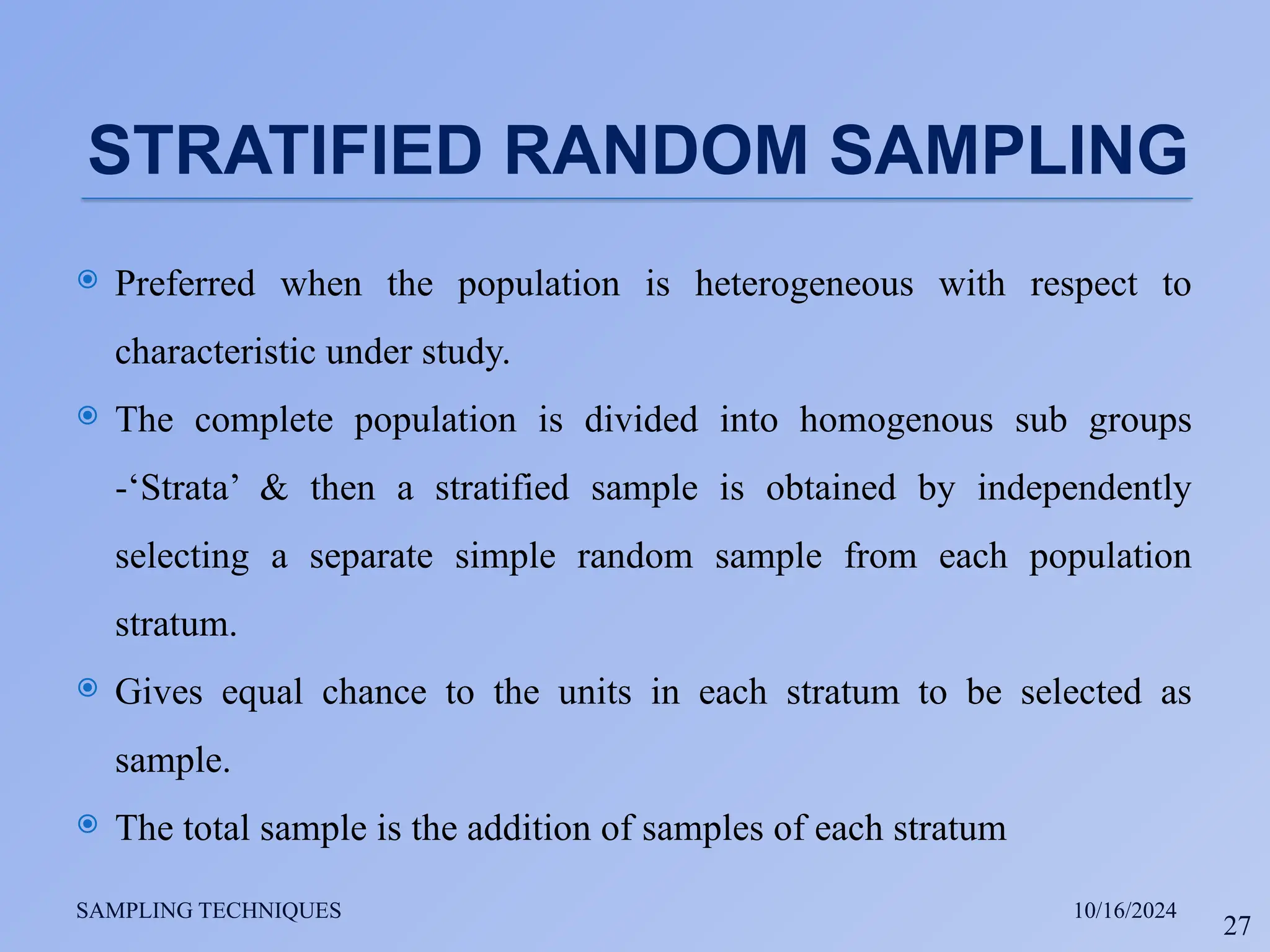
STRATIFIED RANDOM SAMPLING
 Preferred when the population is heterogeneous with respect to
characteristic under study.
 The complete population is divided into homogenous sub groups
-‘Strata’ & then a stratified sample is obtained by independently
selecting a separate simple random sample from each population
stratum.
 Gives equal chance to the units in each stratum to be selected as
sample.
 The total sample is the addition of samples of each stratum
SAMPLING TECHNIQUES
10/16/2024
28
Stratified random sampling: Ex:
STAFF
PG
OTHER
SAMPLING TECHNIQUES
10/16/2024
29
1 2 3 4 5 6 7 8 9 10 11 12 13 14 15 16 17 18
1 2 3 4 5 6 7 8 9 10 11 12
1 2 3 4 5 6
10 2 8 4 1 6 12 8 4 2 1 6
Non-Proportional
stratified sampling
SAMPLING TECHNIQUES
10/16/2024
30
1 2 3 4 5 6 7 8 9 10 11 12 13 14 15 16 17 18
1 2 3 4 5 6 7 8 9 10 11 12
1 2 3 4 5 6
10 2 8 4 1 6 12 8 4 2 1 6
Proportional
stratified sampling
SAMPLING TECHNIQUES
10/16/2024
31
STRATIFIED RANDOM SAMPLING
 Merits:
1. It is more representative.
2. It ensures greater accuracy
3. It is easy to administer as the universe is sub - divided.
4. Greater geographical concentration reduces time and expenses.
5. When the original population is badly skewed, this method is
appropriate.
6. For non – homogeneous population, it may yield good results.
SAMPLING TECHNIQUES
10/16/2024
32
STRATIFIED RANDOM SAMPLING
 Limitations:
1. To divide the population into homogeneous strata, it
requires more money, time and statistical experience
which are a difficult one.
2. Improper stratification leads to bias, if the different
strata overlap such a sample will not be a
representative one
SAMPLING TECHNIQUES
10/16/2024
33
LOT QUALITY ASSURANCE
SAMPLING
 Originated in manufacturing industry for quality control purposes
 Only outcome - “acceptable” or “not acceptable”
 Two types of risk
(i) Risk of accepting a “bad” lot - Type I Error,
(ii) Risk of not accepting a “good” lot - Type II Error
 The advantage over a traditional stratified sampling design: the
response for each lot is binary (acceptable or not) & therefore
smaller sample sizes can be used
SAMPLING TECHNIQUES
10/16/2024
34
CLUSTER SAMPLING
 Used when the population is heterogeneous & when sampling frame is
not available at individual level
 Clusters are formed by grouping units on the basis of their geographical
locations.
 Obtained by selecting clusters from population on the basis of SRS
 From the selected clusters each and every unit is included for study
 Special form of cluster sampling - “30 cluster sampling” for field
studies in assessing vaccination coverage
SAMPLING TECHNIQUES
10/16/2024
SAMPLING TECHNIQUES
35
CLUSTER SAMPLING
Section 4
Section 5
Section 3
Section 2
Section 1
10/16/2024
SAMPLING TECHNIQUES
36
10/16/2024
SAMPLING TECHNIQUES
37
•The immunization
coverage in the target
area to be evaluated
(coastal region of a
hypothetical country)
•All cities, towns and
villages of the coastal
region have been listed.
•The cumulative
population given.
•Calculate sampling
interval & identify 1-5
clusters given the random
number= 12,762
10/16/2024
SAMPLING TECHNIQUES
38
•Total population to be
surveyed / 30 clusters =
Sampling interval
•800000/30 = 26666.66=
Sampling interval
•random number= 12,762
•1st cluster= cumulative
population of 12,762 (village 1)
•2nd cluster = 12,762+26666.66=
39428.66 (village 9)
•Next cluster = Number which
identified the location of the
previous cluster + Sampling
interval
•3rd cluster=
39428.66+26666.66= 66095.32
(village 14)
10/16/2024
39
CLUSTER SAMPLING
 Design effect- loss of variation in a sample that occurs as a
consequence of using cluster sampling, as opposed to any other
probability method
 Advantages:
- Only need to obtain list of units in the selected clusters.
- Cost-effective.
 Disadvantages:
- Not intended for calculation of estimates from individual clusters.
- Less precise than simple random sample.
SAMPLING TECHNIQUES
10/16/2024
40
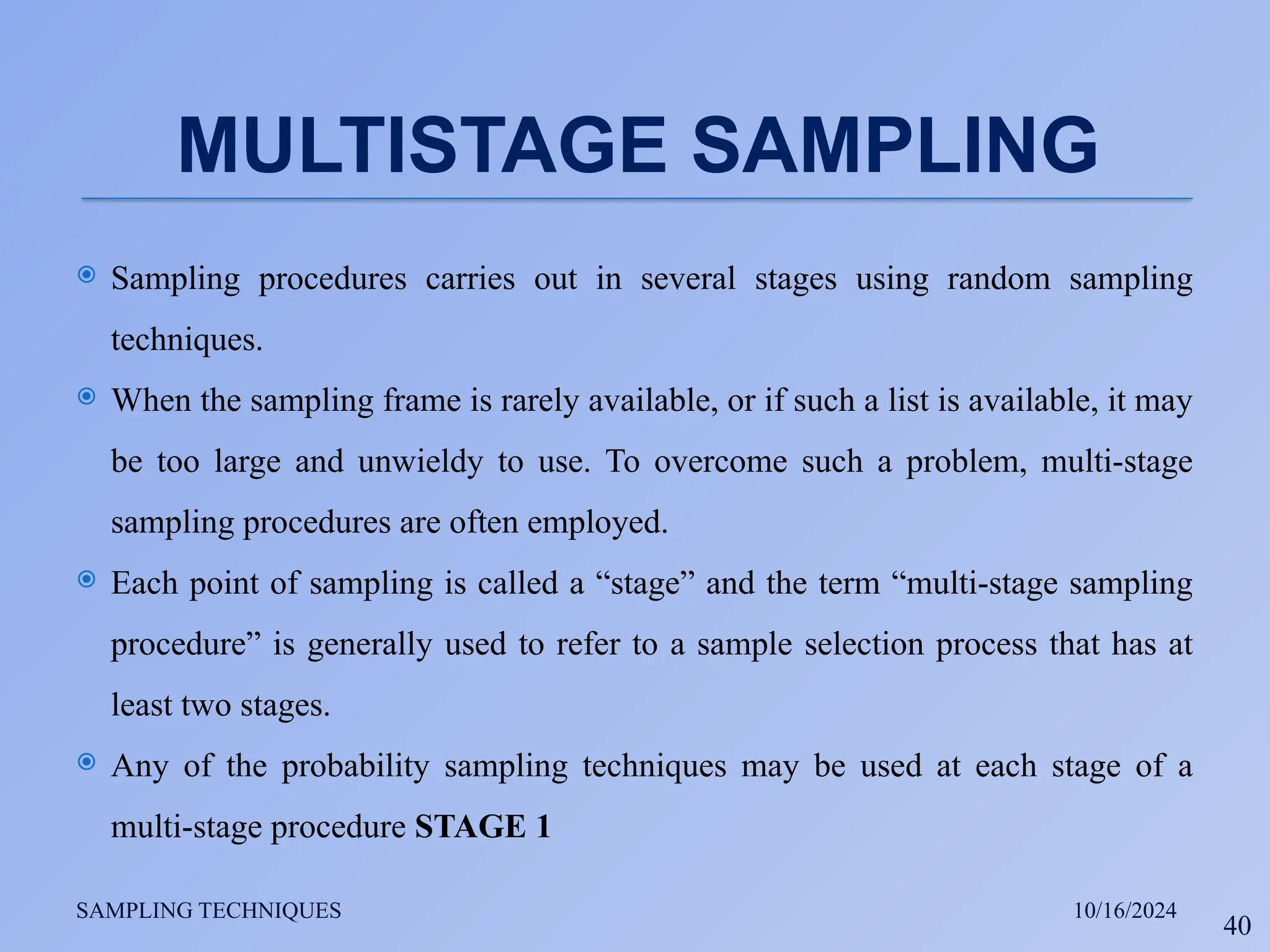
MULTISTAGE SAMPLING
 Sampling procedures carries out in several stages using random sampling
techniques.
 When the sampling frame is rarely available, or if such a list is available, it may
be too large and unwieldy to use. To overcome such a problem, multi-stage
sampling procedures are often employed.
 Each point of sampling is called a “stage” and the term “multi-stage sampling
procedure” is generally used to refer to a sample selection process that has at
least two stages.
 Any of the probability sampling techniques may be used at each stage of a
multi-stage procedure STAGE 1
SAMPLING TECHNIQUES
41
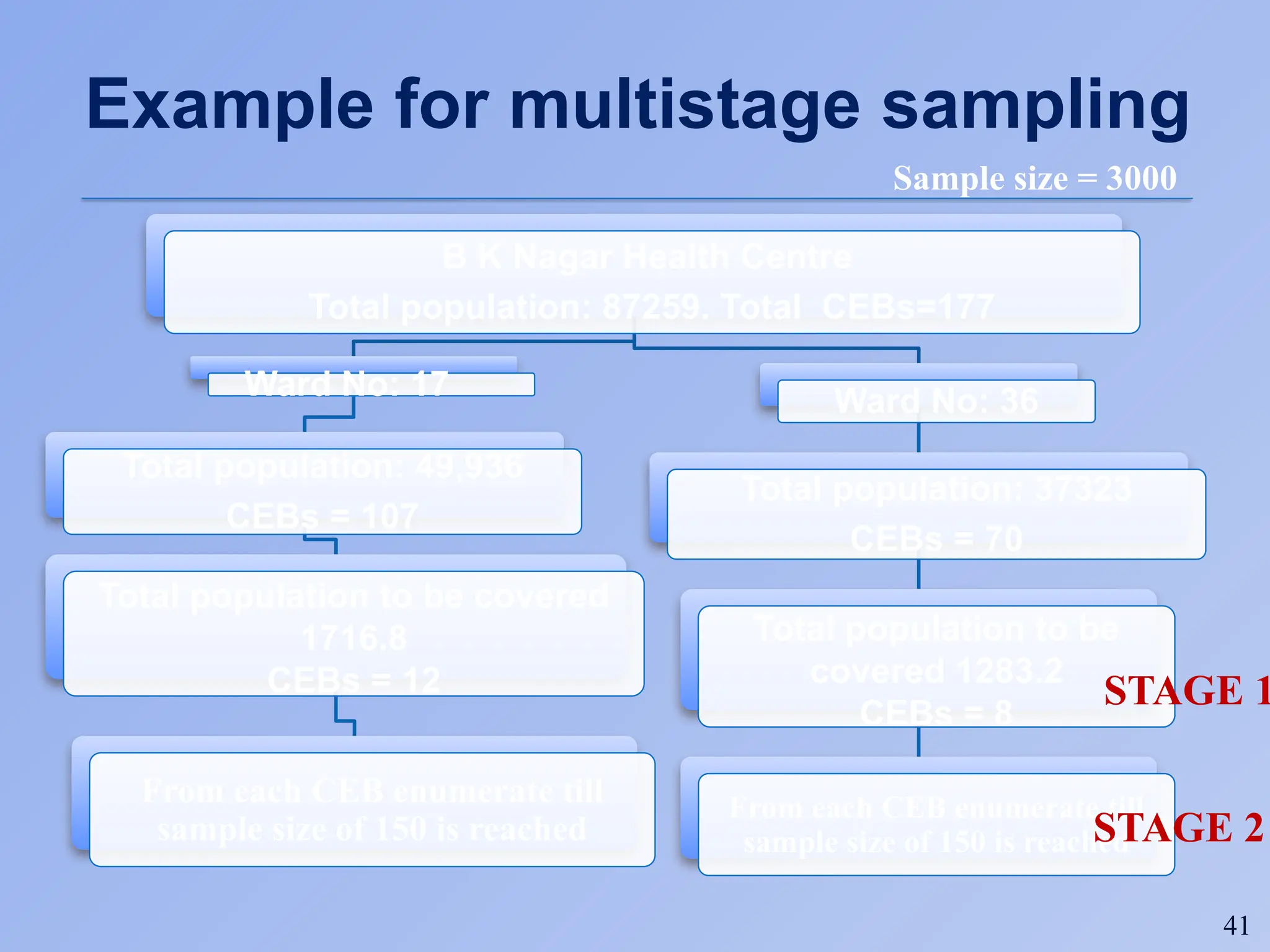
Example for multistage sampling
B K Nagar Health Centre
Total population: 87259. Total CEBs=177
Ward No: 17
Total population: 49,936
CEBs = 107
Total population to be covered
1716.8
CEBs = 12
From each CEB enumerate till
sample size of 150 is reached
Ward No: 36
Total population: 37323
CEBs = 70
Total population to be
covered 1283.2
CEBs = 8
From each CEB enumerate till
sample size of 150 is reached
Sample size = 3000
STAGE 1
STAGE 2
10/16/2024
42
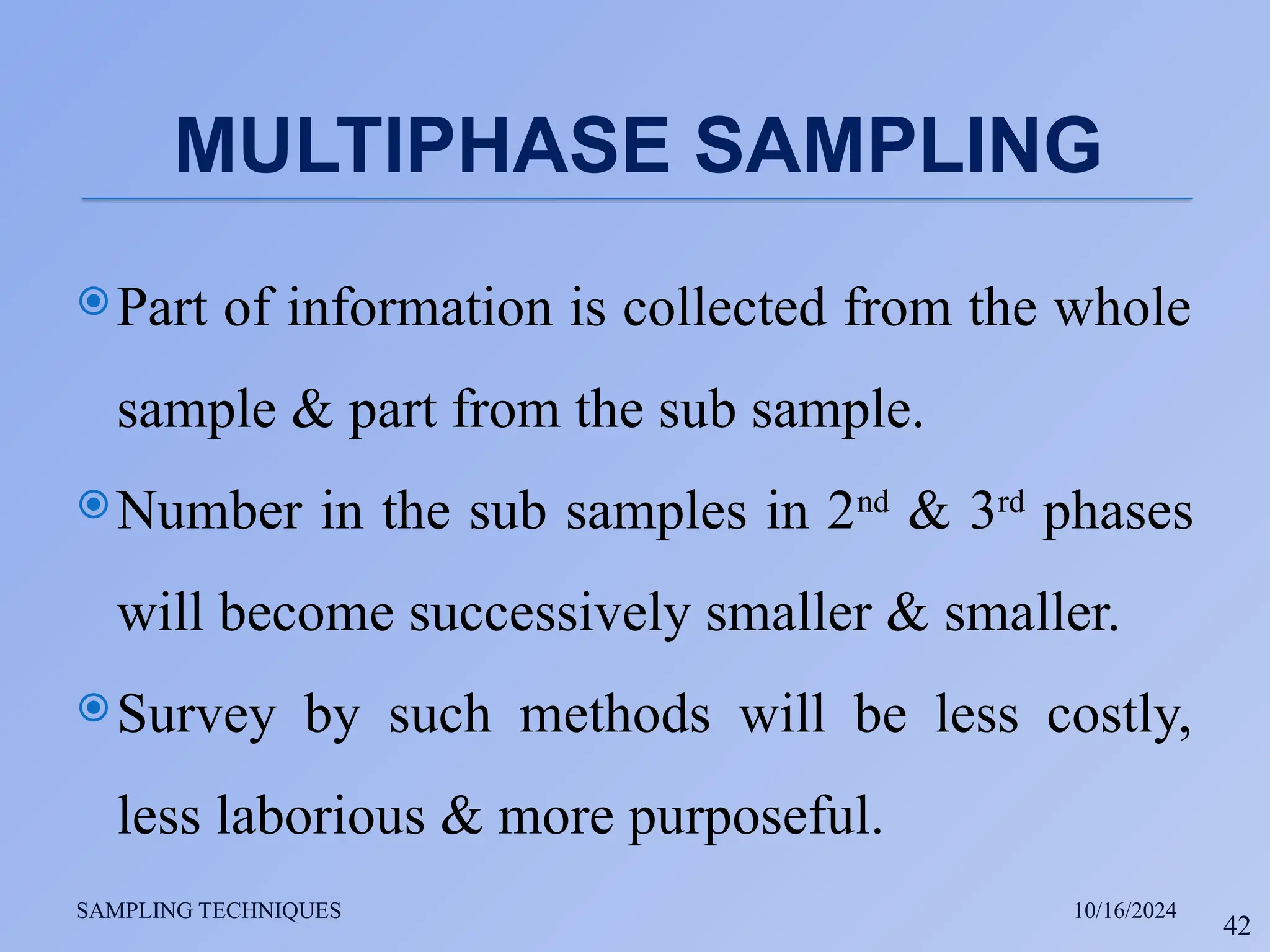
MULTIPHASE SAMPLING
Part of information is collected from the whole
sample & part from the sub sample.
Number in the sub samples in 2nd
& 3rd
phases
will become successively smaller & smaller.
Survey by such methods will be less costly,
less laborious & more purposeful.
SAMPLING TECHNIQUES
10/16/2024
43
MULTIPHASE SAMPLING
Ex: In a tuberculosis survey
First phase- physical examination or mantoux test done in all
cases of the sample
Second phase-x-ray of the chest done in mantoux positive
cases & in those with clinical symptoms
Third phase -sputum may be examined in X-ray positive cases
SAMPLING TECHNIQUES
10/16/2024
44
TABLE: COMPARITIVE PERFORMANCE OF
VARIOUS RANDOM SAMPLING METHODS
Method of
random
sampling
Desired size
of target
population
Reliability of
conclusions
for fixed
sample size
Economy Remarks
Simple Small Very good Expensive Requires full sampling
frame
Systematic Small Good Economical sampling frame not needed
but the size of the target
population is needed
Stratified Medium Good Expensive Good for non-homogenous
population
Cluster Large Poor Very
economical
Very convenient for
geographically diverse
population
Multi stage Very large Medium economical Requires sampling frame
only for each nested unit
SOURCE: Indrayan A, Satyanarayana L. Simple biostatistics. `3rd
ed. Academia publishers:
SAMPLING TECHNIQUES
10/16/2024
45
NON RANDOM SAMPLING
 The sampling is purposive when cases that serve specific
purpose are chosen.
 Results based on non-random samples are not generalizable yet
are useful in some situations in providing a clue about the
status of a phenomenon.
Non-Probability
Sampling
Convenient sampling
•Snowball sampling
•Convenient groups
Purposive sampling
• Volunteers for phase 1 of a trial
•Delphi method
•Pilot study & pre-testing
SAMPLING TECHNIQUES
10/16/2024
46
 Snowball sampling:
 A few identified members of a rare population are asked to identify
other members of the population, those so identified are asked to
identify others
 Hard-to-reach, or equivalently hidden populations.
 Constructing sampling frame using methods such as household
surveys is infeasible
• when the population is small relative to the general population
• geographically dispersed
• when population membership involves stigma
• group has networks that are difficult for outsiders to penetrate
 Ex: people exposed to sex workers or those injecting drugs in the
context of HIV.
SAMPLING TECHNIQUES
10/16/2024
47
Convenient groups: many studies are done on
medical students just because they are
available in captivity & would generally
provide correct response.
Ex: Famous Doll & Hill study on smoking and
lung cancer done on physicians
SAMPLING TECHNIQUES
10/16/2024
48
Purposive sampling
 Volunteers for phase 1 trial: generally done on volunteers to
provide useful information regarding the safety and side effects
of a treatment regimen
 Delphi method: the least expensive method to generate data is
to ask colleagues as to what do they think about a particular
problem. They will narrate their experience which will vary
from person to person
 Pilot study & pre-testing: small scale study as a forerunner
SAMPLING TECHNIQUES
10/16/2024
49
Differences b/w Non-probability samples
& probability samples
SAMPLING TECHNIQUES
URL:http://www.chsbs.cmich.edu/fattah/courses/empirical/22.html
Key terms Non-probability
samples
Probability samples
Sampling frame Does not exist or
inaccurate
Accurate and up-to-
date
Sampling error Cannot be
calculated
Can be calculated
Sample size Matter of
convenience
Determined by
sampling theory
Level of
generalizability
Illustrative Representative.
10/16/2024
50
Errors in sampling
Sampling errors
-definition
-how is it measured
-how can it be reduced
Non sampling
errors
Coverage errors
Observational
errors
Processing errors
SAMPLING TECHNIQUES
10/16/2024
51
Advantages of Sampling
 There are many advantages of sampling methods over census
method. They are:
1. Saves time and labour.
2. Results in reduction of cost in terms of money and man-hour.
3. Ends up with greater accuracy of results.
4. Has greater scope.
5. Has greater adaptability.
6. If the population is too large, or hypothetical sampling is the only method
to be used.
SAMPLING TECHNIQUES
10/16/2024
52
Limitation of Sampling
 Sampling is to be done by qualified and experienced
persons. Otherwise, the information will be
unbelievable.
 Sample method may sometimes give the extreme
values
 There is the possibility of sampling errors. Census
survey is free from sampling error
SAMPLING TECHNIQUES
10/16/2024
53
CONCLUSION
 Whenever a scientific study is planned it may not always be
feasible to study the entire population. In such situations we need to
apply some sampling technique to select our samples and it’s better
to select probability sampling techniques. Selecting a sampling
method depends upon:
• Population to be studied ( size & heterogeneity with respect to variables)
• Level of precision required
• Resources available
• Importance of having a precise estimate of the sampling error
SAMPLING TECHNIQUES
10/16/2024
54
REFERENCES
 Bhalwar R, Vaidya R, Tilak R, Gupta R, Kunte R. Text book of
public health and community medicine. Pune: Department of
Community Medicine Armed Forces Medical College; 2009
 Rao NSN, Murthy NS. Applied statistics in health sciences. 2nd
ed. New Delhi: Jaypee; 2010.
 Mahajan BK. Methods in biostatistics. 6th
ed. New Delhi:
Jaypee; 2006
 Abramson JH. Survey method in community medicine.
Edinburg: Churchill Livingstone: 1974
SAMPLING TECHNIQUES
10/16/2024
55
REFERENCES
 Indrayan A, Satyanarayana L. biostatistics for medical, nursing
and pharmacy students. New Delhi: Prentice-Hall of India; 2006
 Varalakshmi V, Suseela N, Sundaram TG, Ezhilarasi S & Indrani
B. Statistics. HIGHER SECONDARY – FIRST YEAR. Chennai:
TAMILNADU TEXTBOOK CORPORATION; 2005
 Training for mid-level managers. 7. The EPI coverage survey.
[Serial online] 2008 [Cited 2013 June 6] Available from URL:
http://whqlibdoc.who.int/hq/2008/WHO_IVB_08.07_eng.pdf
SAMPLING TECHNIQUES
10/16/2024
56
REFERENCES
 Woodard SH. Description and comparison of the methods of
cluster sampling and lot quality assurance sampling to assess
immunization coverage. [Serial online] 200 [Cited 2013 June 6]
Available from URL:
http://www.who.int/vaccines-documents/DocsPDF01/www592.p
df
 Heckathorn DD Snowball versus respondent driven sampling.
[Serial online] 2005 [Cited 2013 June 6] Available from
URL:http://www.ncbi.nlm.nih.gov/pmc/articles/PMC3250988/
SAMPLING TECHNIQUES
10/16/2024
57
REFERENCES
 Handcock MS, Gile KJ. On the concept of snowball sampling. [Serial
online] 2011 [Cited 2013 June 6] Available from URL:http://arxiv.org/
pdf/1108.0301.pdf
 Sethi D, Habibula S, McGee K, Peden M, Bennett S, Hyder AA,
Klevens J, Odero W, Suriyawongpaisal P. Guidelines on conducting
community surveys on injuries and violence. [Serial online] 2004
[Cited 2011 Aug 21]. Available from URL:
http://www.bvsde.paho.org/bvsacd/cd20/conducting.pdf. Accessed on
21/08/11
 Seminar notes on sampling techniques by Dr Gautam S.
 Seminar notes on sampling techniques by Dr Chetana T
SAMPLING TECHNIQUES
10/16/2024
58
Thank you
SAMPLING TECHNIQUES

sampling technique-ppt -3 powerpoint presentation

  • 1.
    SAMPLING TECHNIQUES BY: DrVANI H C GUIDE: Dr LALITHA K
  • 2.
    CONTENTS  Introduction  Definitions Need for sampling  Major requirements for a sample • Generalisation/ External validity • Sample size & precision  Reliable sample SAMPLING TECHNIQUES
  • 3.
    CONTENTS Sampling techniques Sampling errors Advantages& limitations of sampling Conclusion References SAMPLING TECHNIQUES
  • 4.
    Introduction  A majorreason for having an insight into the science of epidemiology & research methodology is that we always study a ‘sample’  Concerned with the selection of representative sample, especially for the purposes of statistical inference.  Idea of sampling is very old & from time immemorial, people have used it in day-to-day life. For example: SAMPLING TECHNIQUES
  • 5.
    Introduction On the basisof a sample study, we can predict & generalise the behaviour of the population. Most researchers come to a conclusion of their study by studying a small sample from the huge population or universe. Census VS sampling SAMPLING TECHNIQUES
  • 6.
    DEFINITIONS  Population- aggregateof units of observations either animate or inanimate about which certain information is required.  Sample-word used to describe a portion chosen from the population  For sampling purpose, the population has to be divided into smaller units - sampling unit URL:http ://www.google.co.in/images?rls=ig&hl=en&source=imghp&biw=1024&bih=651&q=population+and+sample&gbv=2&aq=4&aqi=g1&aql= &oq=population+and+sam&gs_rfai= SAMPLING TECHNIQUES
  • 7.
    DEFINITIONS  Sample size-numberof units in a sample  Sampling frame - list of each and every individual in the population  Variable: any quality or quantity liable to show variation from one individual to the next in the same population  Variate: individual observations of any variable SAMPLING TECHNIQUES
  • 8.
    DEFINITIONS  Statistic /datum - measured or counted fact or piece of information stated as a figure  Statistics/ data - field of study concerned with techniques of collection of data, classification, summarising, interpretation, drawing inferences, testing of hypothesis, making recommendations etc when only a part of data is used  Biostatistics- when tools of statistics are applied to the data that is derived from biological sciences such as medicine. SAMPLING TECHNIQUES
  • 9.
    DEFINITIONS Distinction Population Sample DefinitionCollection of items under consideration. Part of the population selected for study. Characteristics Parameter Statistics Symbols N= population µ = population mean σ = population standard deviation π = population percentage n = sample size x = sample mean s = sample standard deviation p = sample percentage SAMPLING TECHNIQUES
  • 10.
    10/16/2024 10 Need for sampling Complete enumerations are practically impossible when the population is infinite.  When the results are required in a short time.  When the area of survey is wide.  When resources for survey are limited particularly in respect of money and trained persons. SAMPLING TECHNIQUES
  • 11.
    Major requirements fora sample To draw conclusions about population from sample, there are two major requirements for a sample. • Sample has to be selected appropriately so that it is representative of the population. It should have all the characteristics of the population. • The sample size should be adequately large SAMPLING TECHNIQUES
  • 12.
  • 13.
  • 14.
    10/16/2024 SAMPLING TECHNIQUES 14 How DoWe Generalize? Population Sample draw sample draw sample generalize back generalize back PROBLEMS OF GENERALISATION
  • 15.
    Calculating the samplesize : depends upon precision which in turn depends upon significance level & allowable error. Depends upon the kind of data: Problems with very large or small sample size Qualitative data n = 4pq/ L2 Quantitative data n= 4 σ2 L2 SAMPLING TECHNIQUES
  • 16.
    10/16/2024 16 Reliable sample  Thereare 8 basic requisites for a reliable sample:  1. Efficiency  2. Representativeness  3. Measurability  4. Size  5. Coverage  6. Goal orientation  7. Feasibility  8. Economy and cost efficiency SAMPLING TECHNIQUES SOURCE:World Health Organization.Health Research Methodology – a guide for training in research methods.First edition.New Delhi:Oxford university press;1993.p.77-94.
  • 17.
    10/16/2024 17 Types of SamplingMethods Cluster Sampling Non-Probability Sampling Convenience Probability Sampling Simple Random Systematic Stratified Purposive SAMPLING TECHNIQUES
  • 18.
    Simple Random Sampling(SRS)  Here each unit in the population has equal chance or probability to be selected in the sample.  Two types: SRS with replacement & SRS without replacement.  Situations where random sampling can be done: • Sampling frame is available. • When the population is small. • Parameters to be estimated -homogeneously distributed in population. • Units should be readily available- ex: patients in wards SAMPLING TECHNIQUES
  • 19.
    Simple Random Sampling(SRS)  The procedure involved in Random Sampling: • Preparing a sampling frame • Deciding the size of the sample to be chosen. • To select the required number of units at random  Random samples can be drawn by: • lottery method - • random number tables- • using calculators or computers- SAMPLING TECHNIQUES
  • 20.
    RANDOM NUMBER TABLE •Standardtables •Steps to use table SOURCE: Training for mid-level managers. 7. The EPI coverage survey. [Serial online] 2008 [Cited 2013 June 6] Available from URL: http://whqlibdoc.who.int/hq/2008/WHO_IVB_08.07_eng.pdf SAMPLING TECHNIQUES
  • 21.
    10/16/2024 21 1 2 34 5 6 7 8 9 10 Simple Random Sampling ex: 11 12 13 14 15 16 17 18 19 20 21 22 23 24 25 26 27 28 29 30 N =30 n = 10 SAMPLING TECHNIQUES
  • 22.
    10/16/2024 22  Merits ofusing random numbers: 1. Personal bias is eliminated 2. It is in general a representative sample for a homogenous population. 3. There is no need for the thorough knowledge of the units of the population. 4. The accuracy of a sample can be tested by examining another sample from the same universe when the universe is unknown. 5. This method is also used in other methods of sampling. SAMPLING TECHNIQUES
  • 23.
    10/16/2024 23  Limitations ofSRS: 1. Preparing lots or using random number tables is tedious when the population is large. 2. When there is large difference between the units of population, the simple random sampling may not be a representative sample. 3. The size of the sample required under this method is more than that required by stratified random sampling. 4. It is generally seen that the units of a simple random sample lie apart geographically. The cost and time of collection of data are more. SAMPLING TECHNIQUES
  • 24.
    10/16/2024 24 SYSTEMATIC RANDOM SAMPLING Commonly employed technique, when complete and up to date list of sampling units is available.  Procedure: 1.Prepare the list of population (sampling units) 1 to N. 2. Decide on the n (sample size) that you want or need. 3. Calculate sampling fraction/ sampling interval (k) k= N/n where N = population size & n = sample size 4. Randomly select an integer between 1 to kth . 5. Add to this the sampling interval to get required sample. Then take every kth unit. SAMPLING TECHNIQUES
  • 25.
    10/16/2024 25 SYSTEMATIC RANDOM SAMPLING Example: systematicsampling Ex: in PPI 15 out of 150 houses have to be selected SAMPLING TECHNIQUES
  • 26.
    10/16/2024 26 SYSTEMATIC RANDOM SAMPLING Merits :  Simple and convenient to adopt.  Time and labour involved in the collection of sample is relatively small.  If the population is sufficiently large, homogenous & each unit is numbered, this method can yield accurate results.  Limitations:  The sample may exhibit a pattern or periodicity  Systematic sampling may not represent the whole population.  There is a chance of personal bias of the investigators. SAMPLING TECHNIQUES
  • 27.
    10/16/2024 27 STRATIFIED RANDOM SAMPLING Preferred when the population is heterogeneous with respect to characteristic under study.  The complete population is divided into homogenous sub groups -‘Strata’ & then a stratified sample is obtained by independently selecting a separate simple random sample from each population stratum.  Gives equal chance to the units in each stratum to be selected as sample.  The total sample is the addition of samples of each stratum SAMPLING TECHNIQUES
  • 28.
    10/16/2024 28 Stratified random sampling:Ex: STAFF PG OTHER SAMPLING TECHNIQUES
  • 29.
    10/16/2024 29 1 2 34 5 6 7 8 9 10 11 12 13 14 15 16 17 18 1 2 3 4 5 6 7 8 9 10 11 12 1 2 3 4 5 6 10 2 8 4 1 6 12 8 4 2 1 6 Non-Proportional stratified sampling SAMPLING TECHNIQUES
  • 30.
    10/16/2024 30 1 2 34 5 6 7 8 9 10 11 12 13 14 15 16 17 18 1 2 3 4 5 6 7 8 9 10 11 12 1 2 3 4 5 6 10 2 8 4 1 6 12 8 4 2 1 6 Proportional stratified sampling SAMPLING TECHNIQUES
  • 31.
    10/16/2024 31 STRATIFIED RANDOM SAMPLING Merits: 1. It is more representative. 2. It ensures greater accuracy 3. It is easy to administer as the universe is sub - divided. 4. Greater geographical concentration reduces time and expenses. 5. When the original population is badly skewed, this method is appropriate. 6. For non – homogeneous population, it may yield good results. SAMPLING TECHNIQUES
  • 32.
    10/16/2024 32 STRATIFIED RANDOM SAMPLING Limitations: 1. To divide the population into homogeneous strata, it requires more money, time and statistical experience which are a difficult one. 2. Improper stratification leads to bias, if the different strata overlap such a sample will not be a representative one SAMPLING TECHNIQUES
  • 33.
    10/16/2024 33 LOT QUALITY ASSURANCE SAMPLING Originated in manufacturing industry for quality control purposes  Only outcome - “acceptable” or “not acceptable”  Two types of risk (i) Risk of accepting a “bad” lot - Type I Error, (ii) Risk of not accepting a “good” lot - Type II Error  The advantage over a traditional stratified sampling design: the response for each lot is binary (acceptable or not) & therefore smaller sample sizes can be used SAMPLING TECHNIQUES
  • 34.
    10/16/2024 34 CLUSTER SAMPLING  Usedwhen the population is heterogeneous & when sampling frame is not available at individual level  Clusters are formed by grouping units on the basis of their geographical locations.  Obtained by selecting clusters from population on the basis of SRS  From the selected clusters each and every unit is included for study  Special form of cluster sampling - “30 cluster sampling” for field studies in assessing vaccination coverage SAMPLING TECHNIQUES
  • 35.
    10/16/2024 SAMPLING TECHNIQUES 35 CLUSTER SAMPLING Section4 Section 5 Section 3 Section 2 Section 1
  • 36.
  • 37.
    10/16/2024 SAMPLING TECHNIQUES 37 •The immunization coveragein the target area to be evaluated (coastal region of a hypothetical country) •All cities, towns and villages of the coastal region have been listed. •The cumulative population given. •Calculate sampling interval & identify 1-5 clusters given the random number= 12,762
  • 38.
    10/16/2024 SAMPLING TECHNIQUES 38 •Total populationto be surveyed / 30 clusters = Sampling interval •800000/30 = 26666.66= Sampling interval •random number= 12,762 •1st cluster= cumulative population of 12,762 (village 1) •2nd cluster = 12,762+26666.66= 39428.66 (village 9) •Next cluster = Number which identified the location of the previous cluster + Sampling interval •3rd cluster= 39428.66+26666.66= 66095.32 (village 14)
  • 39.
    10/16/2024 39 CLUSTER SAMPLING  Designeffect- loss of variation in a sample that occurs as a consequence of using cluster sampling, as opposed to any other probability method  Advantages: - Only need to obtain list of units in the selected clusters. - Cost-effective.  Disadvantages: - Not intended for calculation of estimates from individual clusters. - Less precise than simple random sample. SAMPLING TECHNIQUES
  • 40.
    10/16/2024 40 MULTISTAGE SAMPLING  Samplingprocedures carries out in several stages using random sampling techniques.  When the sampling frame is rarely available, or if such a list is available, it may be too large and unwieldy to use. To overcome such a problem, multi-stage sampling procedures are often employed.  Each point of sampling is called a “stage” and the term “multi-stage sampling procedure” is generally used to refer to a sample selection process that has at least two stages.  Any of the probability sampling techniques may be used at each stage of a multi-stage procedure STAGE 1 SAMPLING TECHNIQUES
  • 41.
    41 Example for multistagesampling B K Nagar Health Centre Total population: 87259. Total CEBs=177 Ward No: 17 Total population: 49,936 CEBs = 107 Total population to be covered 1716.8 CEBs = 12 From each CEB enumerate till sample size of 150 is reached Ward No: 36 Total population: 37323 CEBs = 70 Total population to be covered 1283.2 CEBs = 8 From each CEB enumerate till sample size of 150 is reached Sample size = 3000 STAGE 1 STAGE 2
  • 42.
    10/16/2024 42 MULTIPHASE SAMPLING Part ofinformation is collected from the whole sample & part from the sub sample. Number in the sub samples in 2nd & 3rd phases will become successively smaller & smaller. Survey by such methods will be less costly, less laborious & more purposeful. SAMPLING TECHNIQUES
  • 43.
    10/16/2024 43 MULTIPHASE SAMPLING Ex: Ina tuberculosis survey First phase- physical examination or mantoux test done in all cases of the sample Second phase-x-ray of the chest done in mantoux positive cases & in those with clinical symptoms Third phase -sputum may be examined in X-ray positive cases SAMPLING TECHNIQUES
  • 44.
    10/16/2024 44 TABLE: COMPARITIVE PERFORMANCEOF VARIOUS RANDOM SAMPLING METHODS Method of random sampling Desired size of target population Reliability of conclusions for fixed sample size Economy Remarks Simple Small Very good Expensive Requires full sampling frame Systematic Small Good Economical sampling frame not needed but the size of the target population is needed Stratified Medium Good Expensive Good for non-homogenous population Cluster Large Poor Very economical Very convenient for geographically diverse population Multi stage Very large Medium economical Requires sampling frame only for each nested unit SOURCE: Indrayan A, Satyanarayana L. Simple biostatistics. `3rd ed. Academia publishers: SAMPLING TECHNIQUES
  • 45.
    10/16/2024 45 NON RANDOM SAMPLING The sampling is purposive when cases that serve specific purpose are chosen.  Results based on non-random samples are not generalizable yet are useful in some situations in providing a clue about the status of a phenomenon. Non-Probability Sampling Convenient sampling •Snowball sampling •Convenient groups Purposive sampling • Volunteers for phase 1 of a trial •Delphi method •Pilot study & pre-testing SAMPLING TECHNIQUES
  • 46.
    10/16/2024 46  Snowball sampling: A few identified members of a rare population are asked to identify other members of the population, those so identified are asked to identify others  Hard-to-reach, or equivalently hidden populations.  Constructing sampling frame using methods such as household surveys is infeasible • when the population is small relative to the general population • geographically dispersed • when population membership involves stigma • group has networks that are difficult for outsiders to penetrate  Ex: people exposed to sex workers or those injecting drugs in the context of HIV. SAMPLING TECHNIQUES
  • 47.
    10/16/2024 47 Convenient groups: manystudies are done on medical students just because they are available in captivity & would generally provide correct response. Ex: Famous Doll & Hill study on smoking and lung cancer done on physicians SAMPLING TECHNIQUES
  • 48.
    10/16/2024 48 Purposive sampling  Volunteersfor phase 1 trial: generally done on volunteers to provide useful information regarding the safety and side effects of a treatment regimen  Delphi method: the least expensive method to generate data is to ask colleagues as to what do they think about a particular problem. They will narrate their experience which will vary from person to person  Pilot study & pre-testing: small scale study as a forerunner SAMPLING TECHNIQUES
  • 49.
    10/16/2024 49 Differences b/w Non-probabilitysamples & probability samples SAMPLING TECHNIQUES URL:http://www.chsbs.cmich.edu/fattah/courses/empirical/22.html Key terms Non-probability samples Probability samples Sampling frame Does not exist or inaccurate Accurate and up-to- date Sampling error Cannot be calculated Can be calculated Sample size Matter of convenience Determined by sampling theory Level of generalizability Illustrative Representative.
  • 50.
    10/16/2024 50 Errors in sampling Samplingerrors -definition -how is it measured -how can it be reduced Non sampling errors Coverage errors Observational errors Processing errors SAMPLING TECHNIQUES
  • 51.
    10/16/2024 51 Advantages of Sampling There are many advantages of sampling methods over census method. They are: 1. Saves time and labour. 2. Results in reduction of cost in terms of money and man-hour. 3. Ends up with greater accuracy of results. 4. Has greater scope. 5. Has greater adaptability. 6. If the population is too large, or hypothetical sampling is the only method to be used. SAMPLING TECHNIQUES
  • 52.
    10/16/2024 52 Limitation of Sampling Sampling is to be done by qualified and experienced persons. Otherwise, the information will be unbelievable.  Sample method may sometimes give the extreme values  There is the possibility of sampling errors. Census survey is free from sampling error SAMPLING TECHNIQUES
  • 53.
    10/16/2024 53 CONCLUSION  Whenever ascientific study is planned it may not always be feasible to study the entire population. In such situations we need to apply some sampling technique to select our samples and it’s better to select probability sampling techniques. Selecting a sampling method depends upon: • Population to be studied ( size & heterogeneity with respect to variables) • Level of precision required • Resources available • Importance of having a precise estimate of the sampling error SAMPLING TECHNIQUES
  • 54.
    10/16/2024 54 REFERENCES  Bhalwar R,Vaidya R, Tilak R, Gupta R, Kunte R. Text book of public health and community medicine. Pune: Department of Community Medicine Armed Forces Medical College; 2009  Rao NSN, Murthy NS. Applied statistics in health sciences. 2nd ed. New Delhi: Jaypee; 2010.  Mahajan BK. Methods in biostatistics. 6th ed. New Delhi: Jaypee; 2006  Abramson JH. Survey method in community medicine. Edinburg: Churchill Livingstone: 1974 SAMPLING TECHNIQUES
  • 55.
    10/16/2024 55 REFERENCES  Indrayan A,Satyanarayana L. biostatistics for medical, nursing and pharmacy students. New Delhi: Prentice-Hall of India; 2006  Varalakshmi V, Suseela N, Sundaram TG, Ezhilarasi S & Indrani B. Statistics. HIGHER SECONDARY – FIRST YEAR. Chennai: TAMILNADU TEXTBOOK CORPORATION; 2005  Training for mid-level managers. 7. The EPI coverage survey. [Serial online] 2008 [Cited 2013 June 6] Available from URL: http://whqlibdoc.who.int/hq/2008/WHO_IVB_08.07_eng.pdf SAMPLING TECHNIQUES
  • 56.
    10/16/2024 56 REFERENCES  Woodard SH.Description and comparison of the methods of cluster sampling and lot quality assurance sampling to assess immunization coverage. [Serial online] 200 [Cited 2013 June 6] Available from URL: http://www.who.int/vaccines-documents/DocsPDF01/www592.p df  Heckathorn DD Snowball versus respondent driven sampling. [Serial online] 2005 [Cited 2013 June 6] Available from URL:http://www.ncbi.nlm.nih.gov/pmc/articles/PMC3250988/ SAMPLING TECHNIQUES
  • 57.
    10/16/2024 57 REFERENCES  Handcock MS,Gile KJ. On the concept of snowball sampling. [Serial online] 2011 [Cited 2013 June 6] Available from URL:http://arxiv.org/ pdf/1108.0301.pdf  Sethi D, Habibula S, McGee K, Peden M, Bennett S, Hyder AA, Klevens J, Odero W, Suriyawongpaisal P. Guidelines on conducting community surveys on injuries and violence. [Serial online] 2004 [Cited 2011 Aug 21]. Available from URL: http://www.bvsde.paho.org/bvsacd/cd20/conducting.pdf. Accessed on 21/08/11  Seminar notes on sampling techniques by Dr Gautam S.  Seminar notes on sampling techniques by Dr Chetana T SAMPLING TECHNIQUES
  • 58.