Unit Cover 
 
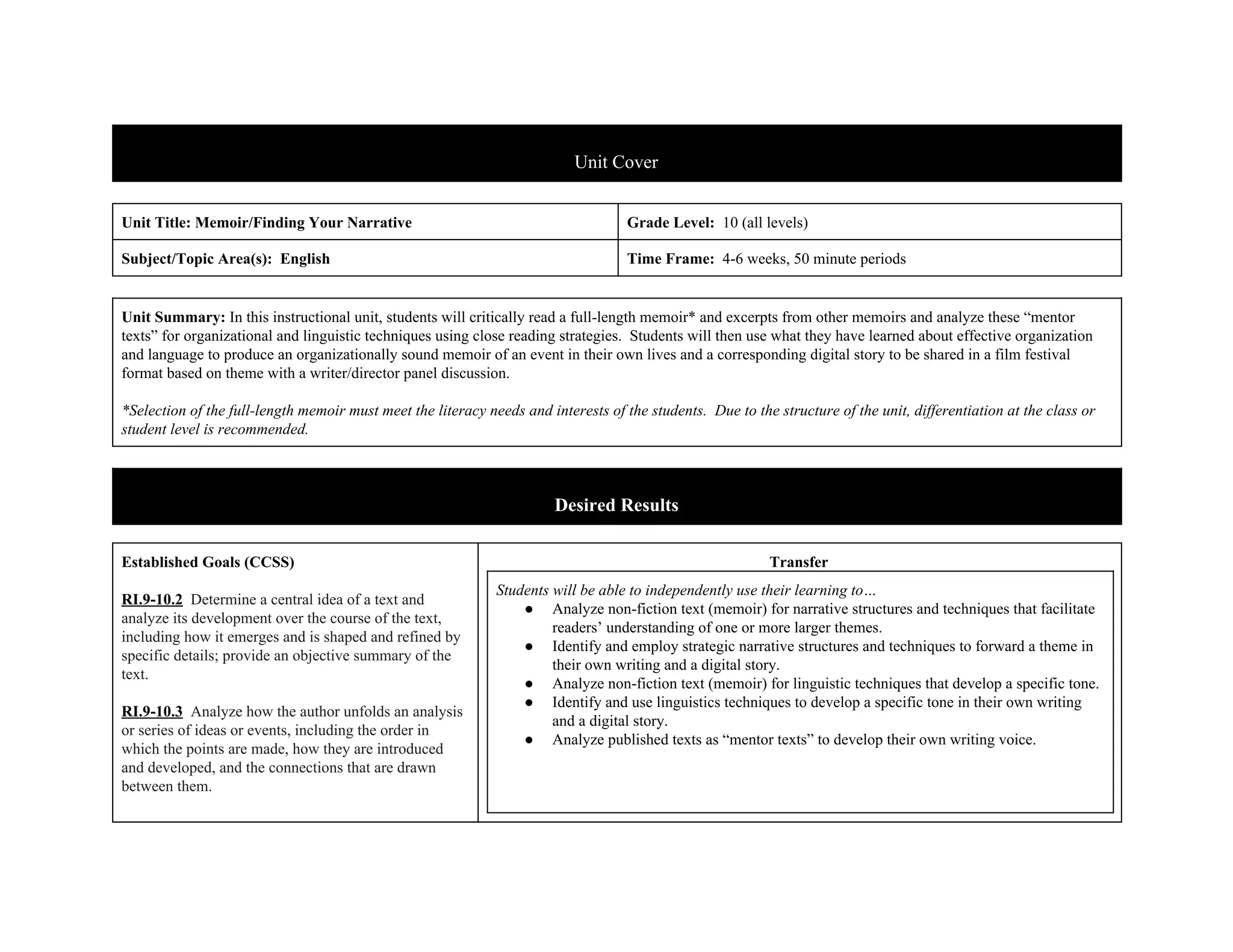
Unit Title: Memoir/Finding Your Narrative  Grade Level:​  10 (all levels) 
Subject/Topic Area(s):  English  Time Frame:  ​4­6 weeks, 50 minute periods 
 
Unit Summary: ​In this instructional unit, students will critically read a full­length memoir* and excerpts from other memoirs and analyze these “mentor 
texts” for organizational and linguistic techniques using close reading strategies.  Students will then use what they have learned about effective organization 
and language to produce an organizationally sound memoir of an event in their own lives and a corresponding digital story to be shared in a film festival 
format based on theme with a writer/director panel discussion. 
 
*Selection of the full­length memoir must meet the literacy needs and interests of the students.  Due to the structure of the unit, differentiation at the class or 
student level is recommended.   
 
Desired Results 
Established Goals (CCSS) 
 
RI.9­10.2​  ​Determine a central idea of a text and 
analyze its development over the course of the text, 
including how it emerges and is shaped and refined by 
specific details; provide an objective summary of the 
text. 
 
RI.9­10.3​  ​Analyze how the author unfolds an analysis 
or series of ideas or events, including the order in 
which the points are made, how they are introduced 
and developed, and the connections that are drawn 
between them. 
 
Transfer 
Students will be able to independently use their learning to… 
● Analyze non­fiction text (memoir) for narrative structures and techniques that facilitate 
readers’ understanding of one or more larger themes. 
● Identify and employ strategic narrative structures and techniques to forward a theme in 
their own writing and a digital story. 
● Analyze non­fiction text (memoir) for linguistic techniques that develop a specific tone. 
● Identify and use linguistics techniques to develop a specific tone in their own writing 
and a digital story. 
● Analyze published texts as “mentor texts” to develop their own writing voice. 


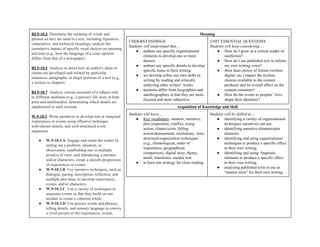
RI.9­10.4​  ​Determine the meaning of words and 
phrases as they are used in a text, including figurative, 
connotative, and technical meanings; analyze the 
cumulative impact of specific word choices on meaning 
and tone (e.g., how the language of a court opinion 
differs from that of a newspaper). 
 
RI.9­10.5​  ​Analyze in detail how an author's ideas or 
claims are developed and refined by particular 
sentences, paragraphs, or larger portions of a text (e.g., 
a section or chapter). 
 
RI.9­10.7​  ​Analyze various accounts of a subject told 
in different mediums (e.g., a person's life story in both 
print and multimedia), determining which details are 
emphasized in each account. 
 
W.9­10.3​  ​Write narratives to develop real or imagined 
experiences or events using effective technique, 
well­chosen details, and well­structured event 
sequences. 
● W.9­10.3.A​  Engage and orient the reader by 
setting out a problem, situation, or 
observation, establishing one or multiple 
point(s) of view, and introducing a narrator 
and/or characters; create a smooth progression 
of experiences or events. 
● W.9­10.3.B​  Use narrative techniques, such as 
dialogue, pacing, description, reflection, and 
multiple plot lines, to develop experiences, 
events, and/or characters. 
● W.9­10.3.C​  Use a variety of techniques to 
sequence events so that they build on one 
another to create a coherent whole. 
● W.9­10.3.D​  Use precise words and phrases, 
telling details, and sensory language to convey 
a vivid picture of the experiences, events, 
Meaning 
UNDERSTANDINGS
Students will understand that… 
● authors use specific organizational 
elements to develop one or more 
themes. 
● authors use specific details to develop 
specific tones in their writing. 
● we develop refine our own skills in 
writing by reading and critically 
analyzing other writers’ works. 
● memoirs differ from biographies and 
autobiographies in that they are more 
focused and more subjective. 
UNIT ESSENTIAL QUESTIONS 
Students will keep considering…. 
● How do I grow as a critical reader of 
nonfiction? 
● How do I use published text to inform 
my own writing voice? 
● How does choice of format (written, 
digital, etc.) impact the stylistic 
choices available to the content 
producer and its overall effect on the 
content consumer? 
● How do the events in peoples’ lives 
shape their identities? 
Acquisition of Knowledge and Skill 
Students will know… 
● Key vocabulary​: memoir, narrative, 
plot (exposition, conflict, rising 
action, climax/crisis, falling 
action/denouement, resolution),  tone, 
structural/organization techniques 
(e.g., chronological, order of 
importance, geographical, 
comparison), digital story, theme, 
motif, transitions, mentor text 
● at least one strategy for close reading 
Students will be skilled at… 
● identifying a variety of organizational 
techniques narratives can use. 
● identifying narrative elements/plot 
elements. 
● identifying and using organizational 
techniques to produce a specific effect 
in their own writing. 
● identifying and using  linguistic 
elements to produce a specific effect 
in their own writing. 
● analyzing published texts to use as 
“mentor texts” for their own writing. 
 
 
setting, and/or characters. 
● W.9­10.3.E​  Provide a conclusion that follows 
from and reflects on what is experienced, 
observed, or resolved over the course of the 
narrative. 
W.9­10.6​  ​Use technology, including the Internet, to 
produce, publish, and update individual or shared 
writing products, taking advantage of technology's 
capacity to link to other information and to display 
information flexibly and dynamically. 
 
Assessment Evidence 
 
 
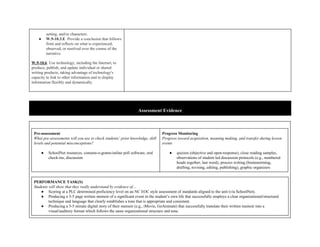
Pre­assessment 
What pre­assessments will you use to check students’ prior knowledge, skill 
levels and potential misconceptions? 
 
● SchoolNet resources, consens­o­grams/online poll software, oral 
check­ins, discussion 
 
Progress Monitoring 
Progress toward acquisition, meaning making, and transfer during lesson 
events 
 
● quizzes (objective and open­response), close reading samples, 
observations of student led discussion protocols (e.g., numbered 
heads together, last word), process writing (brainstorming, 
drafting, revising, editing, publishing), graphic organizers 
 
PERFORMANCE TASK(S) 
Students will show that they really understand by evidence of… 
● Scoring at a PLC determined proficiency level on an NC EOC style assessment of standards aligned to the unit (via SchoolNet). 
● Producing a 3­5 page written memoir of a significant event in the student’s own life that successfully employs a clear organizational/structural 
technique and language that clearly establishes a tone that is appropriate and consistent. 
● Producing a 3­5 minute digital story of their memoir (e.g., iMovie, GoAnimate) that successfully translate their written memoir into a 
visual/auditory format which follows the same organizational structure and tone. 


Sample Lesson Arc 
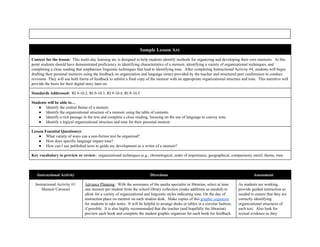
Context for the lesson:  ​This multi­day learning arc is designed to help students identify methods for organizing and developing their own memoirs.  At this 
point students should have demonstrated proficiency in identifying characteristics of a memoir, identifying a variety of organizational techniques, and 
completing a close reading that emphasizes linguistic techniques that lead to identifying tone.  After completing Instructional Activity #4, students will begin 
drafting their personal memoirs using the feedback on organization and language (tone) provided by the teacher and structured peer conferences to conduct 
revisions. They will use both forms of feedback to submit a final copy of the memoir with an appropriate organizational structure and tone.  This narrative will 
provide the basis for their digital story later on.  
Standards Addressed:  ​RI.9­10.2, RI.9­10.3, RI.9­10.4, RI.9­10.5 
Students will be able to… 
● Identify the central theme of a memoir. 
● Identify the organizational structure of a memoir using the table of contents. 
● Identify a rich passage in the text and complete a close reading, focusing on the use of language to convey tone. 
● Identify a logical organizational structure and tone for their personal memoir. 
Lesson Essential Question(s): 
● What variety of ways can a non­fiction text be organized? 
● How does specific language impact tone? 
● How can I use published texts to guide my development as a writer of a memoir? 
Key vocabulary to preview or review:  ​organizational techniques (e.g., chronological, order of importance, geographical, comparison), motif, theme, tone 
 
Instructional Activity  Directions  Assessment 
Instructional Activity #1: 
Memoir Carousel 
Advance Planning​:  With the assistance of the media specialist or librarian, select at least 
one memoir per student from the school library collection (make additions as needed) to 
allow for a variety of organizational and linguistic styles indicating tone. On the day of 
instruction place on memoir on each student desk.  Make copies of this ​graphic organizer 
for students to take notes.  It will be helpful to arrange desks or tables in a circular fashion, 
if possible.  It is also highly recommended that the teacher (and hopefully the librarian) 
preview each book and complete the student graphic organizer for each book for feedback.  
As students are working, 
provide guided instruction as 
needed to ensure that they are 
correctly identifying 
organizational structures of 
each text.  Also look for 
textual evidence as they 
 
Instructional Method​:   
1. At the beginning of class, review key vocabulary (PowerPoint, quiz game with 
online polling, etc.).   
2. Provide each student with a copy* of the ​graphic organizer ​to take notes on the 
organizational structure and language of the memoirs they will examine.   
3. Instruct students to examine the memoir on their desk and complete the graphic 
organizer and select a passage of around 100­150 to close read.  Remind students 
as needed of the various organizational structures and linguistic features they will 
encounter.  Inform students that they will have two class periods to examine four 
memoirs (adjust as needed, depending on reading level; honors student might be 
able to complete more, and literacy challenged/EC students might complete fewer. 
Edit the graphic organizer as required). 
4. Designate approximately 15 minutes per book for student examination (adjust as 
needed based on students).  Monitor students and provide guidance as needed for 
them to use the title, table of contents, and close reading to complete the graphic 
organizer. 
5. At the designated time, instruct students to pass their book to the person on their 
right.  Continue the process until students have examined the requisite number of 
books. It is recommended that the teacher use a timer (YouTube video, stopwatch, 
etc.) to help students monitor their time.  
6. Continue to monitor student progress through each exchange. 
7. When student have examined the required number of books, collect the graphic 
organizers and assess student understanding of the organizational structure and 
language of each book for feedback only.  Use school appropriate remediation 
methods for students who need additional instruction. 
8. Return graphic organizers to students 
 
*Districts with access to file sharing systems, such as Google Classroom, may find 
electronic sharing more suitable for their classrooms.   
  
identify linguistic features that 
indicate tone in their close 
readings.  This can be done as 
students are working (with 
corrective feedback) and after 
collection of the graphic 
organizers.  Feedback must be 
given prior to Instructional 
Activity #2. 
Instructional Activity #2: 
Give One, Get One 
1. Review key vocabulary as needed. 
2. Instruct students in the “Give One, Get One” protocol.  As students have examined 
a number of different memoirs, they will share with each other their analyses of 
the texts they examined in Learning Activity #1.  Allow approximately one period 
for students to mingle and share the information on their graphic organizers 
(minimum of four, of course making adjustments based on the students) with other 
students.  They must provide a quick review of the memoir, the organizational 
Collect the graphic organizers 
once more to ascertain student 
interactions by comparing 
random samples of graphic 
organizers.  If students have 
not adequately shared, it is 
recommended that the teacher 
 
structure, and their assessment of the tone with textual evidence.  Students may not 
“get one” for a book they have already examined.  Again, use a timer of some sort 
to moderate conversations.   
3. At the end of the “Get One, Give One” protocol, collect the graphic organizers 
again. 
use 3­5 titles as examples to 
elucidate their organizational 
structures and tones.  Give 
narrative feedback based on 
the teacher/library analysis.   
Instructional Activity #3: 
Debrief/Discussion 
1. Instruct students that in this lesson they will be expected to provide textually based 
assessments of the memoirs they examined.  
2. Present to students a graphic of the organizer they have been using to analyze and 
assess the memoirs they examined. 
3. Ask students to describe what makes a compelling and effective memoir in terms 
of organization and language.  Make a list of 5­6 criteria on the whiteboard or 
chart paper.   
4. Assess through a show of hands, online polling, or other appropriate means the 4­5 
most compelling and/or effective memoirs examined in the carousel. 
5. Discuss with students how each of their selections meets the aforementioned 
criteria.   
6. Complete the exit card assessment. 
Use an exit card, such as an 
index card or sticky note to 
have students state their 
memoir topics,  identify which 
memoir(s) they will likely 
mimic in their personal 
memoir and why, specifically 
mentioning the organizational 
structure and the tone.  Give 
feedback on your assessment 
of the effectiveness of the 
organizational structure and 
tone based on their topics. 
Determine appropriate graphic 
organizers to collect student 
ideas. 
Instructional Activity #4: 
Determination of 
Organizational Structure 
and Tone 
1. Return the exit cards from instructional activity #3.   
2. Provide graphic organizers for students based on their organizational structures. 
3. Instruct students to complete the graphic organizers to being outlining their 
personal memoirs.  On the back, they will defend their choice of tone in 
well­written paragraph of 5­7 sentences.  
4. At the end of the allotted time, students will submit their organizers for feedback. 
 
Student graphic organizers 
should include specific details 
for how they will structure and 
establish a tone for their 
personal memoirs with 
credible evidence.  Teachers 
should be wary of the role of 
memory in the specific events, 
but they should look for a 
credible line of narrative and 
provide feedback on the 
effectiveness of the structure 
and tone of the proposal. 
 

SampleUnit