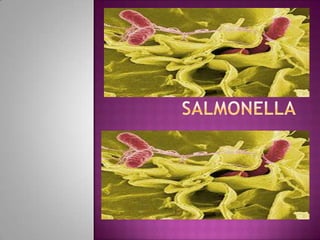
Salmonella is a bacterium that causes one of the most common
enteric (intestinal) infections in the United States


Salmonella is a bacteria and a disease that can kill living things
The process of the salmonella
disease
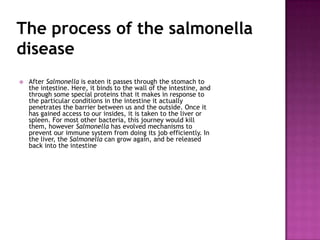
   After Salmonella is eaten it passes through the stomach to
    the intestine. Here, it binds to the wall of the intestine, and
    through some special proteins that it makes in response to
    the particular conditions in the intestine it actually
    penetrates the barrier between us and the outside. Once it
    has gained access to our insides, it is taken to the liver or
    spleen. For most other bacteria, this journey would kill
    them, however Salmonella has evolved mechanisms to
    prevent our immune system from doing its job efficiently. In
    the liver, the Salmonella can grow again, and be released
    back into the intestine
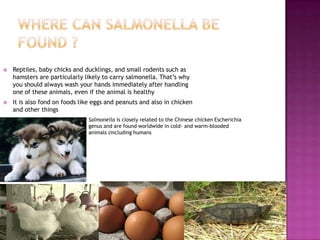
   Reptiles, baby chicks and ducklings, and small rodents such as
    hamsters are particularly likely to carry salmonella. That’s why
    you should always wash your hands immediately after handling
    one of these animals, even if the animal is healthy
   It is also fond on foods like eggs and peanuts and also in chicken
    and other things
                               Salmonella is closely related to the Chinese chicken Escherichia
                               genus and are found worldwide in cold- and warm-blooded
                               animals (including humans

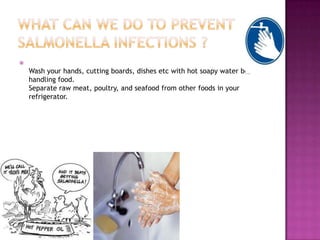
    Wash your hands, cutting boards, dishes etc with hot soapy water before
    handling food.
    Separate raw meat, poultry, and seafood from other foods in your
    refrigerator.
Total monthly counts of salmonella
notifications, May 2006 to May 2011
Salmonella
Salmonella

Salmonella

  • 2.
    Salmonella is abacterium that causes one of the most common enteric (intestinal) infections in the United States Salmonella is a bacteria and a disease that can kill living things
  • 3.
    The process ofthe salmonella disease  After Salmonella is eaten it passes through the stomach to the intestine. Here, it binds to the wall of the intestine, and through some special proteins that it makes in response to the particular conditions in the intestine it actually penetrates the barrier between us and the outside. Once it has gained access to our insides, it is taken to the liver or spleen. For most other bacteria, this journey would kill them, however Salmonella has evolved mechanisms to prevent our immune system from doing its job efficiently. In the liver, the Salmonella can grow again, and be released back into the intestine
  • 4.
    Reptiles, baby chicks and ducklings, and small rodents such as hamsters are particularly likely to carry salmonella. That’s why you should always wash your hands immediately after handling one of these animals, even if the animal is healthy  It is also fond on foods like eggs and peanuts and also in chicken and other things Salmonella is closely related to the Chinese chicken Escherichia genus and are found worldwide in cold- and warm-blooded animals (including humans
  • 5.
    Wash your hands, cutting boards, dishes etc with hot soapy water before handling food. Separate raw meat, poultry, and seafood from other foods in your refrigerator.
  • 6.
    Total monthly countsof salmonella notifications, May 2006 to May 2011