BL Digital Scholarship
and its impact on Latin American studies
Aquiles Alencar-Brayner
@AquilesBrayner
www.bl.uk 2
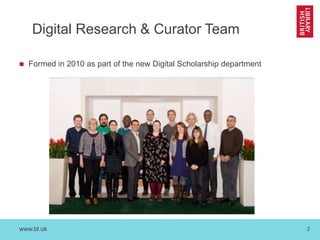
Digital Research & Curator Team
 Formed in 2010 as part of the new Digital Scholarship department
www.bl.uk 3
Our Mission
• Support the BL to adopt clear strategies and operating models for
Digital Scholarship
• Develop innovative models for Digital Scholarship exploiting
digital content and new technologies
• Offer training and support to BL staff on Digital Scholarship
practices and resources
• Involvement with various digital programmes (internal and
external) involving digitisation, born-digital materials, publication
on the Web, etc.
• Engage with new and existing user communities
• Strengthen the BL capabilities
www.bl.uk 4
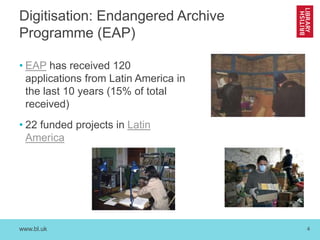
Digitisation: Endangered Archive
Programme (EAP)
• EAP has received 120
applications from Latin America in
the last 10 years (15% of total
received)
• 22 funded projects in Latin
America
www.bl.uk 5
Engagement with users:
BL Labs (Launched March 2013)
• The BL Labs project, sponsored by A. Mellon Foundation, designed to support
the BL to provide access to its digital resources and enable scholars to research
entire collections rather than just individual items by:
• 1. Reviewing the BL’s approach to licensing: moving towards a coherent licence
framework and setting the standard for access to catalogue metadata and out-
of-copyright materials in digital form.
• 2. Enabling scholars to use and implement novel services; to access, download,
and analyse digital content; and to link data to other data and digital collections
in order to allow research that analyses entire collections. This will be achieved
by providing access to catalogue and digital materials through simple open
protocols and semantic linking.
• 3. Creating BL Labs so that scholars can work intensively with the Library’s
digital collections to collaboratively define and implement the services that they
need in the digital age.
www.bl.uk 6
Experiment: 19th Century Microsoft Books
• Background
• 68,000 titles digitised by
Microsoft – no clear selection
policy
• Identified 1,400 Latin American
titles
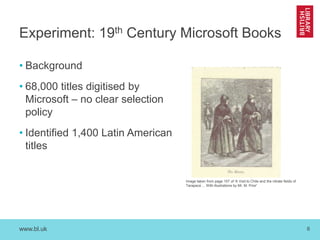
Image taken from page 157 of 'A Visit to Chile and the nitrate fields of
Tarapacá ... With illustrations by Mr. M. Prior'
www.bl.uk 7
New Discoveries
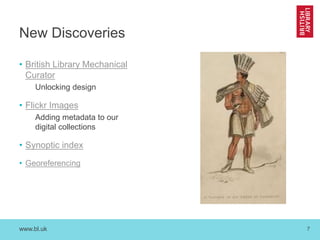
• British Library Mechanical
Curator
Unlocking design
• Flickr Images
Adding metadata to our
digital collections
• Synoptic index
• Georeferencing
www.bl.uk 8
BL Labs Competition: Previous
winners
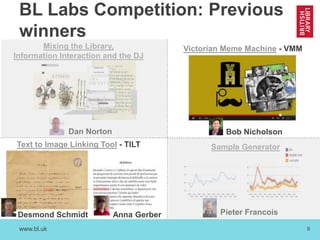
Desmond Schmidt
Text to Image Linking Tool - TILT
Mixing the Library,
Information Interaction and the DJ
Dan Norton
Victorian Meme Machine - VMM
Bob Nicholson
Sample Generator
Pieter FrancoisAnna Gerber
www.bl.uk 9
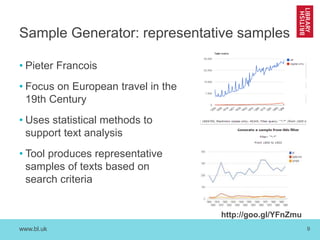
Sample Generator: representative samples
• Pieter Francois
• Focus on European travel in the
19th Century
• Uses statistical methods to
support text analysis
• Tool produces representative
samples of texts based on
search criteria
http://goo.gl/YFnZmu
www.bl.uk 10
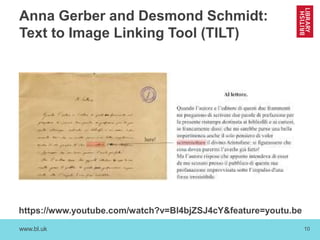
Anna Gerber and Desmond Schmidt:
Text to Image Linking Tool (TILT)
https://www.youtube.com/watch?v=Bl4bjZSJ4cY&feature=youtu.be
www.bl.uk 11
BL Labs 2015 Winners
• The Crowdsourcing Arcade
• Political Meetings Mapper
www.bl.uk 12
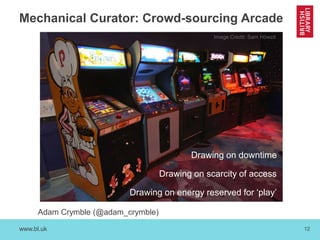
Mechanical Curator: Crowd-sourcing Arcade
Adam Crymble (@adam_crymble)
Image Credit: Sam Howzit
Drawing on downtime
Drawing on scarcity of access
Drawing on energy reserved for ‘play’
www.bl.uk 13
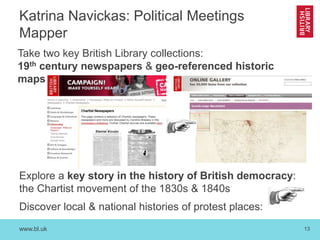
Take two key British Library collections:
19th century newspapers & geo-referenced historic
maps
Explore a key story in the history of British democracy:
the Chartist movement of the 1830s & 1840s
Discover local & national histories of protest places:
Katrina Navickas: Political Meetings
Mapper
www.bl.uk 14
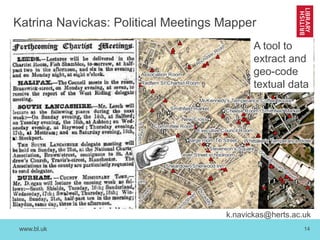
Katrina Navickas: Political Meetings Mapper
k.navickas@herts.ac.uk
A tool to
extract and
geo-code
textual data
www.bl.uk 15
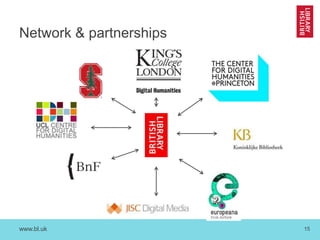
Network & partnerships
www.bl.uk 16
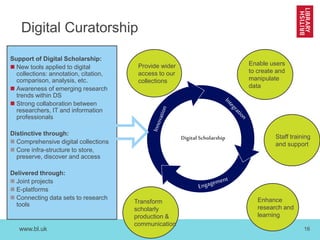
Provide wider
access to our
collections
Enable users
to create and
manipulate
data
Enhance
research and
learning
Support of Digital Scholarship:
 New tools applied to digital
collections: annotation, citation,
comparison, analysis, etc.
 Awareness of emerging research
trends within DS
 Strong collaboration between
researchers, IT and information
professionals
Distinctive through:
 Comprehensive digital collections
 Core infra-structure to store,
preserve, discover and access
Delivered through:
 Joint projects
 E-platforms
 Connecting data sets to research
tools Transform
scholarly
production &
communication
Digital Scholarship

Digital Curatorship
Staff training
and support
www.bl.uk 17
Thank you

Salalm 2015 Princeton

  • 1.
    BL Digital Scholarship andits impact on Latin American studies Aquiles Alencar-Brayner @AquilesBrayner
  • 2.
    www.bl.uk 2 Digital Research& Curator Team  Formed in 2010 as part of the new Digital Scholarship department
  • 3.
    www.bl.uk 3 Our Mission •Support the BL to adopt clear strategies and operating models for Digital Scholarship • Develop innovative models for Digital Scholarship exploiting digital content and new technologies • Offer training and support to BL staff on Digital Scholarship practices and resources • Involvement with various digital programmes (internal and external) involving digitisation, born-digital materials, publication on the Web, etc. • Engage with new and existing user communities • Strengthen the BL capabilities
  • 4.
    www.bl.uk 4 Digitisation: EndangeredArchive Programme (EAP) • EAP has received 120 applications from Latin America in the last 10 years (15% of total received) • 22 funded projects in Latin America
  • 5.
    www.bl.uk 5 Engagement withusers: BL Labs (Launched March 2013) • The BL Labs project, sponsored by A. Mellon Foundation, designed to support the BL to provide access to its digital resources and enable scholars to research entire collections rather than just individual items by: • 1. Reviewing the BL’s approach to licensing: moving towards a coherent licence framework and setting the standard for access to catalogue metadata and out- of-copyright materials in digital form. • 2. Enabling scholars to use and implement novel services; to access, download, and analyse digital content; and to link data to other data and digital collections in order to allow research that analyses entire collections. This will be achieved by providing access to catalogue and digital materials through simple open protocols and semantic linking. • 3. Creating BL Labs so that scholars can work intensively with the Library’s digital collections to collaboratively define and implement the services that they need in the digital age.
  • 6.
    www.bl.uk 6 Experiment: 19thCentury Microsoft Books • Background • 68,000 titles digitised by Microsoft – no clear selection policy • Identified 1,400 Latin American titles Image taken from page 157 of 'A Visit to Chile and the nitrate fields of Tarapacá ... With illustrations by Mr. M. Prior'
  • 7.
    www.bl.uk 7 New Discoveries •British Library Mechanical Curator Unlocking design • Flickr Images Adding metadata to our digital collections • Synoptic index • Georeferencing
  • 8.
    www.bl.uk 8 BL LabsCompetition: Previous winners Desmond Schmidt Text to Image Linking Tool - TILT Mixing the Library, Information Interaction and the DJ Dan Norton Victorian Meme Machine - VMM Bob Nicholson Sample Generator Pieter FrancoisAnna Gerber
  • 9.
    www.bl.uk 9 Sample Generator:representative samples • Pieter Francois • Focus on European travel in the 19th Century • Uses statistical methods to support text analysis • Tool produces representative samples of texts based on search criteria http://goo.gl/YFnZmu
  • 10.
    www.bl.uk 10 Anna Gerberand Desmond Schmidt: Text to Image Linking Tool (TILT) https://www.youtube.com/watch?v=Bl4bjZSJ4cY&feature=youtu.be
  • 11.
    www.bl.uk 11 BL Labs2015 Winners • The Crowdsourcing Arcade • Political Meetings Mapper
  • 12.
    www.bl.uk 12 Mechanical Curator:Crowd-sourcing Arcade Adam Crymble (@adam_crymble) Image Credit: Sam Howzit Drawing on downtime Drawing on scarcity of access Drawing on energy reserved for ‘play’
  • 13.
    www.bl.uk 13 Take twokey British Library collections: 19th century newspapers & geo-referenced historic maps Explore a key story in the history of British democracy: the Chartist movement of the 1830s & 1840s Discover local & national histories of protest places: Katrina Navickas: Political Meetings Mapper
  • 14.
    www.bl.uk 14 Katrina Navickas:Political Meetings Mapper k.navickas@herts.ac.uk A tool to extract and geo-code textual data
  • 15.
  • 16.
    www.bl.uk 16 Provide wider accessto our collections Enable users to create and manipulate data Enhance research and learning Support of Digital Scholarship:  New tools applied to digital collections: annotation, citation, comparison, analysis, etc.  Awareness of emerging research trends within DS  Strong collaboration between researchers, IT and information professionals Distinctive through:  Comprehensive digital collections  Core infra-structure to store, preserve, discover and access Delivered through:  Joint projects  E-platforms  Connecting data sets to research tools Transform scholarly production & communication Digital Scholarship  Digital Curatorship Staff training and support
  • 17.

Editor's Notes

  • #9 applying the intuitions of a DJ to working with digital collections (Dan Norton's Mixing the Library, Information Interaction and the DJ) linking digitised handwritten manuscripts to transcribed texts creating a database of Victorian humour and attempting to make Victorian jokes funny again (Bob Nicholson's Victorian Meme Machine) creating statistically representative samples from our book collections using metadata (Pieter Francois's Sample Generator)
  • #10 70 seconds <click1>Pieter’s project was the “The Sample Generator” which was a tool to help a researcher by providing representative digitised samples (as well as physical) of materials they were interested in researching about. This is opposed to being faced with the daunting task of sifting through thousands of records to find a representative sample to start working on. Pieter’s area of interest was <click2> European travel but the idea of the sample generator could work for any subject. We gained a deeper understanding of the distribution of digitised material to date Pieter’s analysis showed that, while extensive, digitised material is not representative of published output. As a consequence, researchers must take additional care when trying to sample representative content using <click3>. statistical methods, <click4> a problem which The Sample Generator starts to address <click5>From this screen shot you can the distribution of all the books the 19th Century. The blue represents the physical collection. The red line is the digital collection (around 2.7 %) <click6>This screen shot show the distribution of books about travel routes. The blue indicates all the physical items, the red line the digital and the orange line the sample. What’s key is the orange line mimics the frequency of items in the total collection. Ben will talk about this project in more detail later.
  • #14 The British Library has key collections which are vital to historical research of popular protest and the democracy movement of the 19th century: 19th century newspapers Historic map collection, now increasingly digitised and geo-referenced through crowd-sourcing Historians want to know where and when the Chartist movement - which was the first and largest movement for democracy in 19th century Britain - held thousands of meetings and demonstrations to campaign for the vote. Yet we have so far only been able to plot the locations of small numbers of political meetings manually.
  • #15 Political Meetings Mapper is a tool to extract notices of meetings from historical newspapers and plot them on layers of historical maps in the British Library's collections. Political Meetings Mapper will develop a tool for text-mining and geo-locating the records of political meetings, and enable anyone to access the maps and data on an interactive website. By plotting the meetings listed in the Chartist newspaper, The Northern Star, from 1838 to 1844, it hopes to discover new spatial patterns in where their meetings happened, and in so doing, help answer the questions of how and why the movement happened. It will then aim to make the tool eventually adaptable to enable scholars to plot any form of event and spatial information using historical texts and maps. Political Meetings Mapper will demonstrate the relevance and legacy of the history of democracy for today’s society. Regions, towns, even streets will find a longer sense of their political heritage, enabling them to find out what meetings or events occurred in their area, and therefore encourage a continued engagement with politics among local communities.