Sakai Project Overview Charles Severance University of Michigan Feb 12, 2004
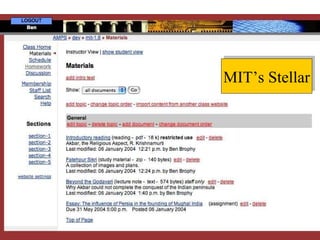
Pre-Sakai History Many “competing” mature production, well-liked course management systems  MIT Stellar (JAVA) Indiana University OnCourse (ASP) University of Michigan CTNG (Java/Jetspeed) Stanford CourseWorks (Java) Differing approaches to Portals Indiana University (JAVA - home grown) UM CTNG - Jetspeed
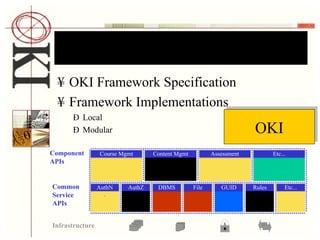
More History Different outreach approaches UM Workshops since 2002 - 30 sites attended CourseWorks adopted at 5 sites Mellon-funded technology projects nearing completion uPortal - highly successful - 300 installations OKI - Community development of LMS API specifications
OKI - Specifications (not an LMS) Strengths Specifications complete  Community built Test implementations progressing Excellent “brand recognition” Weaknesses Specifications too abstract - not enough detail to write truly portable code No production implementations by the end of the project and nothing on the horizon
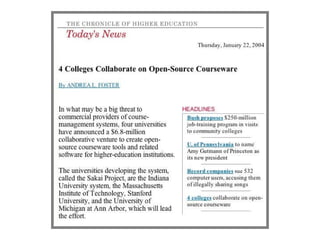
More History Indiana was itchin’ to rewrite their OnCourse in JAVA Michigan was demonstrating the possibility of connecting the teaching/learning world to the research/small group collaboration world (NEESgrid, NMI and WTNG) IU / Michigan / Stanford work on the Navigo project - got to know one another but not able to produce unified code because of the conflict between shared goals and local timelines and resources. UM / CHEF and uPortal were getting to know one another by going to each other’s meetings, enocouraged quietly by the Mellon Foundation
Things were tranquil… The world of locally developed course management systems seems pretty quiet and contented..  Except for that small cloud on the horizon.
Then a Butterfly  Flaps its Wings The JSR-168 Portlet Specification was  released It solved the portable GUI problem for OKI It made Jetspeed/CTNG, OneStart, and uPortal instant antiques as software frameworks Everyone had to rethink their strategies at about the same time because of JSR-168 But this time - something was (or at least could be) different…
Sakai: A Perfect Storm Because of a combination of JSR-168 release and the ending of the OKI and uPortal funding, five projects were forced to think strategically all about the same time Because they already knew one another, they thought strategically  together
Sakai: A Perfect Storm Because of a combination of JSR-168 release and the ending of the OKI and uPortal funding, five projects were forced to think strategically all about the same time Because they already knew one another, they thought strategically  together They put their magic administrator rings together and became the “learning management superteam”
Sakai: A Perfect Storm Because of a combination of JSR-168 release and the ending of the OKI and uPortal funding, five projects were forced to think strategically all about the same time Because they already knew one another, they thought strategically  together They put their magic administrator rings together and became the “learning management superteam” First thought: “lets have a meeting about some funding”
MIT’s Stellar
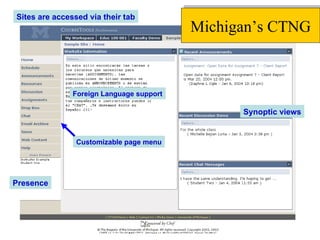
Sites are accessed via their tab Synoptic views Foreign Language support Customizable page menu Presence Michigan’s CTNG
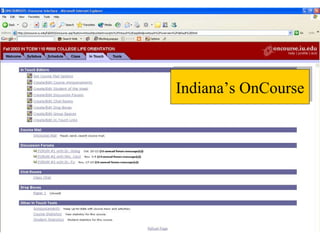
Indiana’s OnCourse
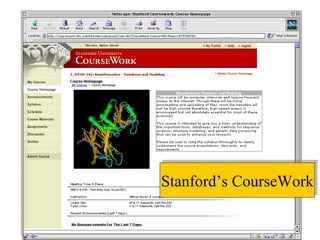
Stanford’s CourseWork
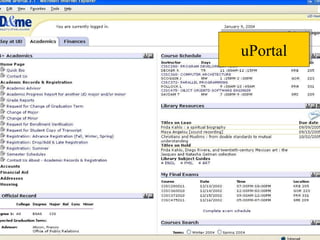
uPortal
OKI
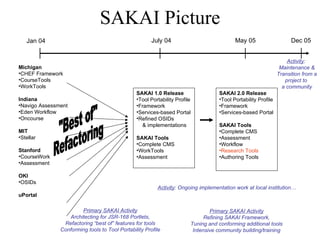
SAKAI Picture Jan 04 July 04 May 05 Michigan CHEF Framework CourseTools WorkTools Indiana Navigo Assessment Eden Workflow Oncourse MIT Stellar Stanford CourseWork Assessment OKI OSIDs uPortal SAKAI 1.0 Release Tool Portability Profile Framework Services-based Portal Refined OSIDs    & implementations SAKAI Tools Complete CMS WorkTools Assessment SAKAI 2.0 Release Tool Portability Profile Framework Services-based Portal SAKAI Tools Complete CMS Assessment Workflow Research Tools Authoring Tools Primary SAKAI Activity Architecting for JSR-168 Portlets, Refactoring “best of” features for tools Conforming tools to Tool Portability Profile Primary SAKAI Activity Refining SAKAI Framework, Tuning and conforming additional tools Intensive community building/training Activity : Ongoing implementation work at local institution… Dec 05 Activity :  Maintenance & Transition from a project to  a community "Best of" Refactoring
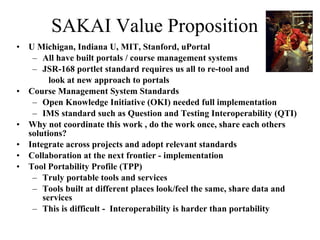
SAKAI Value Proposition U Michigan, Indiana U, MIT, Stanford, uPortal All have built portals / course management systems JSR-168 portlet standard requires us all to re-tool and  look at new approach to portals Course Management System Standards Open Knowledge Initiative (OKI) needed full implementation IMS standard such as Question and Testing Interoperability (QTI) Why not coordinate this work , do the work once, share each others solutions?  Integrate across projects and adopt relevant standards Collaboration at the next frontier - implementation Tool Portability Profile (TPP) Truly portable tools and services Tools built at different places look/feel the same, share data and services This is difficult -  Interoperability is harder than portability
 
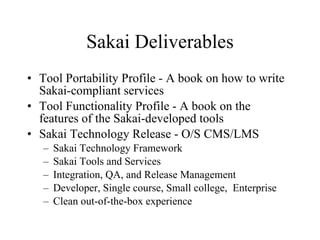
Sakai Deliverables Tool Portability Profile - A book on how to write Sakai-compliant services Tool Functionality Profile - A book on the features of the Sakai-developed tools Sakai Technology Release - O/S CMS/LMS Sakai Technology Framework Sakai Tools and Services Integration, QA, and Release Management Developer, Single course, Small college,  Enterprise Clean out-of-the-box experience
Sakai Organization To some, the real innovation is the organization To get these schools/institutions to adopt a central authority (Sakai Board) for resource allocation of  internal  as well as grant resources Goes beyond resources from grant Required for closely coupled open source development (the ‘seed’ software?) Part of the open source experimentation
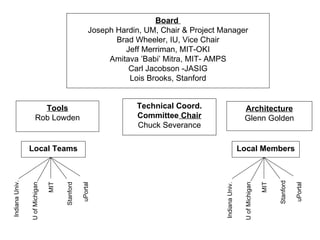
Board  Joseph Hardin, UM, Chair & Project Manager Brad Wheeler, IU, Vice Chair Jeff Merriman, MIT-OKI Amitava ’Babi’ Mitra, MIT- AMPS Carl Jacobson -JASIG Lois Brooks, Stanford Technical Coord. Committee  Chair Chuck Severance Local Teams Tools Rob Lowden Architecture Glenn Golden Local Members Indiana Univ. U of Michigan MIT Stanford uPortal Indiana Univ. U of Michigan MIT Stanford uPortal
Sakai Project Core Universities Each Makes Commitments 5+ developers/architects, etc. under project leadership – no local responsibility for 2 years Public commitment to implement Sakai Open/Open licensing Project $4.4M in institutional staff (27 FTE) $2.4M Mellon Foundation Additional investment through partners
Open/Open Licensing “..all work products under the scope of the Sakai initiative for which a member is counting matching contribution and any Mellon Sakai funding” will be open source software and documentation licensed for both education and commercial use without licensing fees. Significant difference between a “product” and a “component” Unlimited redistribution is an important aspect of a license.
 
Sakai Educational Partner’s Program Membership Fee: US$10K per year, 3 years Access to SEPP staff Community development manager SEPP developers, documentation writers Knowledgebase Developer training for the TPP Exchange for partner-developed tools Strategy and implementation workshops Early access to pre-release code
Hewlett Grant Announcement  Partners – Feb 9, 2004 Carnegie Mellon University Columbia University Cornell University  Foothill-DeAnza Community Colleges Harvard University Northwestern University Princeton University Tufts University University of Colorado University of California-Berkeley University of California-Davis University of California-LA University of California-Merced University of Hawaii University of Oklahoma University of Virginia University of Washington University of Wisconsin-Madison Yale University sakaiproject.org
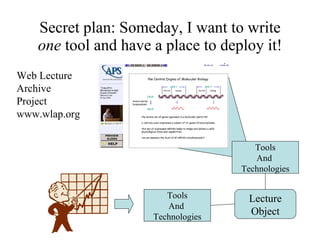
Secret plan: Someday, I want to write  one  tool and have a place to deploy it! Web Lecture  Archive Project www.wlap.org Lecture Object Tools And  Technologies Tools And  Technologies
Summary We have a long way to go and a short time to get there… The team we have assembled is the key - each institution brings deep and complimentary skills to the table Previous collaboration (Navigo, OKI) over the past few years has developed respect, teamwork, and trust from the first day of Sakai We are taking some time at the beginning to insure genuine consensus and that we truly make the right choices in the framework area. We understand that we may make mistakes along the way and have factored this into our approach and resource allocation. So far everyone has had an open mind and understands the “good of the many…”
A Vision We will create a open-source learning management system which is competitive with commercial offerings, but at the same time create a framework, market, clearinghouse, cadre of skilled programmers, and documentation necessary to enable many organizations to focus their energy in developing capabilities/tools which advance the pedagogy and effectiveness of technology-enhanced teaching, learning, and collaboration rather than just building another threaded discussion tool as a LMS.

Sakai Overview 02-12-2004

  • 1.
    Sakai Project OverviewCharles Severance University of Michigan Feb 12, 2004
  • 2.
    Pre-Sakai History Many“competing” mature production, well-liked course management systems MIT Stellar (JAVA) Indiana University OnCourse (ASP) University of Michigan CTNG (Java/Jetspeed) Stanford CourseWorks (Java) Differing approaches to Portals Indiana University (JAVA - home grown) UM CTNG - Jetspeed
  • 3.
    More History Differentoutreach approaches UM Workshops since 2002 - 30 sites attended CourseWorks adopted at 5 sites Mellon-funded technology projects nearing completion uPortal - highly successful - 300 installations OKI - Community development of LMS API specifications
  • 4.
    OKI - Specifications(not an LMS) Strengths Specifications complete Community built Test implementations progressing Excellent “brand recognition” Weaknesses Specifications too abstract - not enough detail to write truly portable code No production implementations by the end of the project and nothing on the horizon
  • 5.
    More History Indianawas itchin’ to rewrite their OnCourse in JAVA Michigan was demonstrating the possibility of connecting the teaching/learning world to the research/small group collaboration world (NEESgrid, NMI and WTNG) IU / Michigan / Stanford work on the Navigo project - got to know one another but not able to produce unified code because of the conflict between shared goals and local timelines and resources. UM / CHEF and uPortal were getting to know one another by going to each other’s meetings, enocouraged quietly by the Mellon Foundation
  • 6.
    Things were tranquil…The world of locally developed course management systems seems pretty quiet and contented.. Except for that small cloud on the horizon.
  • 7.
    Then a Butterfly Flaps its Wings The JSR-168 Portlet Specification was released It solved the portable GUI problem for OKI It made Jetspeed/CTNG, OneStart, and uPortal instant antiques as software frameworks Everyone had to rethink their strategies at about the same time because of JSR-168 But this time - something was (or at least could be) different…
  • 8.
    Sakai: A PerfectStorm Because of a combination of JSR-168 release and the ending of the OKI and uPortal funding, five projects were forced to think strategically all about the same time Because they already knew one another, they thought strategically together
  • 9.
    Sakai: A PerfectStorm Because of a combination of JSR-168 release and the ending of the OKI and uPortal funding, five projects were forced to think strategically all about the same time Because they already knew one another, they thought strategically together They put their magic administrator rings together and became the “learning management superteam”
  • 10.
    Sakai: A PerfectStorm Because of a combination of JSR-168 release and the ending of the OKI and uPortal funding, five projects were forced to think strategically all about the same time Because they already knew one another, they thought strategically together They put their magic administrator rings together and became the “learning management superteam” First thought: “lets have a meeting about some funding”
  • 11.
  • 12.
    Sites are accessedvia their tab Synoptic views Foreign Language support Customizable page menu Presence Michigan’s CTNG
  • 13.
  • 14.
  • 15.
  • 16.
  • 17.
    SAKAI Picture Jan04 July 04 May 05 Michigan CHEF Framework CourseTools WorkTools Indiana Navigo Assessment Eden Workflow Oncourse MIT Stellar Stanford CourseWork Assessment OKI OSIDs uPortal SAKAI 1.0 Release Tool Portability Profile Framework Services-based Portal Refined OSIDs & implementations SAKAI Tools Complete CMS WorkTools Assessment SAKAI 2.0 Release Tool Portability Profile Framework Services-based Portal SAKAI Tools Complete CMS Assessment Workflow Research Tools Authoring Tools Primary SAKAI Activity Architecting for JSR-168 Portlets, Refactoring “best of” features for tools Conforming tools to Tool Portability Profile Primary SAKAI Activity Refining SAKAI Framework, Tuning and conforming additional tools Intensive community building/training Activity : Ongoing implementation work at local institution… Dec 05 Activity : Maintenance & Transition from a project to a community "Best of" Refactoring
  • 18.
    SAKAI Value PropositionU Michigan, Indiana U, MIT, Stanford, uPortal All have built portals / course management systems JSR-168 portlet standard requires us all to re-tool and look at new approach to portals Course Management System Standards Open Knowledge Initiative (OKI) needed full implementation IMS standard such as Question and Testing Interoperability (QTI) Why not coordinate this work , do the work once, share each others solutions? Integrate across projects and adopt relevant standards Collaboration at the next frontier - implementation Tool Portability Profile (TPP) Truly portable tools and services Tools built at different places look/feel the same, share data and services This is difficult - Interoperability is harder than portability
  • 19.
  • 20.
    Sakai Deliverables ToolPortability Profile - A book on how to write Sakai-compliant services Tool Functionality Profile - A book on the features of the Sakai-developed tools Sakai Technology Release - O/S CMS/LMS Sakai Technology Framework Sakai Tools and Services Integration, QA, and Release Management Developer, Single course, Small college, Enterprise Clean out-of-the-box experience
  • 21.
    Sakai Organization Tosome, the real innovation is the organization To get these schools/institutions to adopt a central authority (Sakai Board) for resource allocation of internal as well as grant resources Goes beyond resources from grant Required for closely coupled open source development (the ‘seed’ software?) Part of the open source experimentation
  • 22.
    Board JosephHardin, UM, Chair & Project Manager Brad Wheeler, IU, Vice Chair Jeff Merriman, MIT-OKI Amitava ’Babi’ Mitra, MIT- AMPS Carl Jacobson -JASIG Lois Brooks, Stanford Technical Coord. Committee Chair Chuck Severance Local Teams Tools Rob Lowden Architecture Glenn Golden Local Members Indiana Univ. U of Michigan MIT Stanford uPortal Indiana Univ. U of Michigan MIT Stanford uPortal
  • 23.
    Sakai Project CoreUniversities Each Makes Commitments 5+ developers/architects, etc. under project leadership – no local responsibility for 2 years Public commitment to implement Sakai Open/Open licensing Project $4.4M in institutional staff (27 FTE) $2.4M Mellon Foundation Additional investment through partners
  • 24.
    Open/Open Licensing “..allwork products under the scope of the Sakai initiative for which a member is counting matching contribution and any Mellon Sakai funding” will be open source software and documentation licensed for both education and commercial use without licensing fees. Significant difference between a “product” and a “component” Unlimited redistribution is an important aspect of a license.
  • 25.
  • 26.
    Sakai Educational Partner’sProgram Membership Fee: US$10K per year, 3 years Access to SEPP staff Community development manager SEPP developers, documentation writers Knowledgebase Developer training for the TPP Exchange for partner-developed tools Strategy and implementation workshops Early access to pre-release code
  • 27.
    Hewlett Grant Announcement Partners – Feb 9, 2004 Carnegie Mellon University Columbia University Cornell University Foothill-DeAnza Community Colleges Harvard University Northwestern University Princeton University Tufts University University of Colorado University of California-Berkeley University of California-Davis University of California-LA University of California-Merced University of Hawaii University of Oklahoma University of Virginia University of Washington University of Wisconsin-Madison Yale University sakaiproject.org
  • 28.
    Secret plan: Someday,I want to write one tool and have a place to deploy it! Web Lecture Archive Project www.wlap.org Lecture Object Tools And Technologies Tools And Technologies
  • 29.
    Summary We havea long way to go and a short time to get there… The team we have assembled is the key - each institution brings deep and complimentary skills to the table Previous collaboration (Navigo, OKI) over the past few years has developed respect, teamwork, and trust from the first day of Sakai We are taking some time at the beginning to insure genuine consensus and that we truly make the right choices in the framework area. We understand that we may make mistakes along the way and have factored this into our approach and resource allocation. So far everyone has had an open mind and understands the “good of the many…”
  • 30.
    A Vision Wewill create a open-source learning management system which is competitive with commercial offerings, but at the same time create a framework, market, clearinghouse, cadre of skilled programmers, and documentation necessary to enable many organizations to focus their energy in developing capabilities/tools which advance the pedagogy and effectiveness of technology-enhanced teaching, learning, and collaboration rather than just building another threaded discussion tool as a LMS.

Editor's Notes

  • #27 Official launch date for SEPP services is 1 March 2004. The Core Sakai institutions will develop ensure the project deliverables are met during the 2 years of the Sakai Project. The SEPP is the long-term community to ensure Sakai’s continuing evolution and value. Over a dozen partner institution commitments already committed to SEPP as of January 2004 (announcements soon). Note that some estimate licensing costs of a course management system are approximately 20% of the total cost of ownership. The open source nature of Sakai means that any institution can use the Sakai software with no licensing costs or any fees whatsoever for the code. The Sakai Educational Partner’s Program provides a community to help address the other 80% of the cost of a CMS or other Sakai tool.