Digital strategy
during the
coronavirus crisis.
A L L C R E D I T G O E S T O
M C K I N S E Y . C O M
c o m p i l e d b y
5 J u n e 2 0 2 0
BySimonBlackburn,LauraLaBerge,ClaytonO’Toole,andJeremySchneider
Businesses that once mapped digital strategy in 1-3-yearphases must now
scale their initiatives in a matter of days or weeks.
The COVID-19 crisis seemingly provides a sudden glimpse into a future
world.
- A world in which digital channels become the primary customer-
engagement model
- Automated processes become a primary driver of productivity
- Flexible, transparent, and stable supply chains
In this unique moment, companies can learn and progress more quickly
than ever before, as the falling barriers to improvisation and
experimentation that have emerged among customers, markets,
regulators, and organizations
The ways they learn from and adjust to today’s crisis will deeply influence
their performance in tomorrow, providing the opportunity to retain
greater agility as well as closer ties with customers, employees, and
suppliers.
Now is the time to reassess digital initiatives
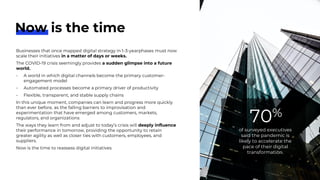
of surveyed executives
said the pandemic is
likely to accelerate the
pace of their digital
transformation.
70%
Now is the time
A crisis demands
boldness and
learning.
D I G I T A L
T R A N S -
F O R M A T I O N
atimeforacceleration
covid-19
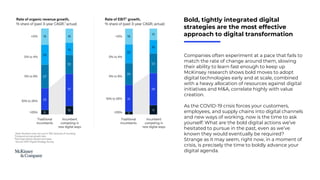
Companies often experiment at a pace that fails to
match the rate of change around them, slowing
their ability to learn fast enough to keep up
McKinsey research shows bold moves to adopt
digital technologies early and at scale, combined
with a heavy allocation of resources against digital
initiatives and M&A, correlate highly with value
creation.
As the COVID-19 crisis forces your customers,
employees, and supply chains into digital channels
and new ways of working, now is the time to ask
yourself: What are the bold digital actions we’ve
hesitated to pursue in the past, even as we’ve
known they would eventually be required?
Strange as it may seem, right now, in a moment of
crisis, is precisely the time to boldly advance your
digital agenda.
Bold, tightly integrated digital
strategies are the most effective
approach to digital transformation
A mandate
to be bold.
D I G I T A L
T R A N S -
F O R M A T I O N
atimeforacceleration
covid-19
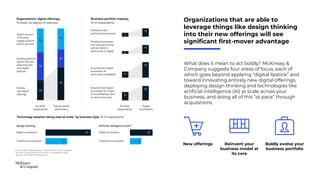
What does it mean to act boldly? McKinsey &
Company suggests four areas of focus, each of
which goes beyond applying “digital lipstick” and
toward innovating entirely new digital offerings,
deploying design thinking and technologies like
artificial intelligence (AI) at scale across your
business, and doing all of this “at pace” through
acquisitions.
Organizations that are able to
leverage things like design thinking
into their new offerings will see
significant first-mover advantage
New offerings Reinvent your
business model at
its core
Boldly evolve your
business portfolio
New offerings
By now you’ve likely built the minimally viable nerve center which
provides a natural gathering point for crucial strategic information. But
now it also should afford looking forward in time at bigger issues
and opportunities—those that could drive significant disruption as the
crisis continues. The COVID-19 crisis will set similar “ecosystem”-level
changes in motion—not just changes in economics but new ways of
serving customers and working with suppliers across traditional
industry boundaries.
Most organizations are looking for virtual replacements for their
previously physical offerings, or at least new ways of making them
accessible with minimal physical contact. The new offerings that result
can often involve new partnerships or the need to access new
platforms and digital marketplaces in which your company has yet to
participate. As you engage with new partners and platforms, look for
opportunities to move beyond your organization’s comfort zones, while
getting visibility into the places you can confidently invest valuable
time, people, and funds to their best effect. Design thinking, which
involves using systemic reasoning and intuition to address complex
problems and explore ideal future states, will be crucial. A design-
centric approach focuses first and foremost on end users or customers.
But it also helps make real-time sense of how suppliers, channel
partners, and competitors are responding to the crisis, and how the
ecosystem that includes them all is evolving for the next normal
emerging after the immediate crisis fades.
Reinvent your business model at its core
Going beyond comfort zones requires taking an end-to-end view of
your business and operating models. Even though your resources are
necessarily limited, the experience of leading companies suggests that
focusing on areas that touch more of the core of your business will give
you the best chance of success, in both the near and the longer term,
than will making minor improvements to noncore areas. Organizations
that make minor changes to the edges of their business model nearly
always fall short of their goals. In particular, organizations rapidly
adopting AI tools and algorithms, as well as design thinking, and using
those to redefine their business at scale have been outperforming their
peers. This will be increasingly true as companies deal with large
amounts of data in a rapidly evolving landscape and look to make
rapid, accurate course corrections compared with their peers.
While the outcomes will vary significantly by industry, a few common
themes are emerging across sectors that suggest “next normal”
changes to cost structures and operating models going forward.
Supply-chain
transparency and
flexibility
Data security Remote
workforces and
automation
Boldly evolve your business portfolio
No company can accelerate the delivery of all its strategic imperatives
without looking to mergers and acquisitions (M&A) to speed them
along. This is particularly true with digital strategy, where M&A can
help companies gain talent and build capabilities, even as it offers
access to new products, services, and solutions, and to new market
and customer segments.
More broadly, we know from research into economic downturns that
companies that invest when valuations are low outperform those that
do not. These companies divested underperforming businesses 10
percent faster than their peers early on in a crisis (or sometimes in
anticipation of a crisis) and then shifted gears into M&A at the first sign
of recovery.
In more normal times, one of the main challenges companies face in
their digital transformations is the need to acquire digital talent and
capabilities through acquisitions of tech companies that are typically
valued at multiples that capital markets might view as dilutive to the
acquirer. The current downturn could remove this critical roadblock,
especially with companies temporarily free from the tyranny of
quarterly earnings expectations. Because valuations are down, the
crisis and its immediate aftermath may prove an opportune time to
pick up assets that were previously out of reach. We are already seeing
many private-equity firms actively looking to deploy large swaths of
capital.
Learning at
the pace
of crisis
D I G I T A L
T R A N S -
F O R M A T I O N
atimeforacceleration
covid-19
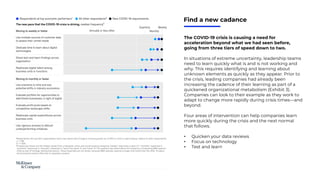
The COVID-19 crisis is causing a need for
acceleration beyond what we had seen before,
going from three tiers of speed down to two.
In situations of extreme uncertainty, leadership teams
need to learn quickly what is and is not working and
why. This requires identifying and learning about
unknown elements as quickly as they appear. Prior to
the crisis, leading companies had already been
increasing the cadence of their learning as part of a
quickened organizational metabolism (Exhibit 3).
Companies can look to their example as they work to
adapt to change more rapidly during crisis times—and
beyond.
Four areas of intervention can help companies learn
more quickly during the crisis and the next normal
that follows.
• Quicken your data reviews
• Focus on technology
• Test and learn
Find a new cadance
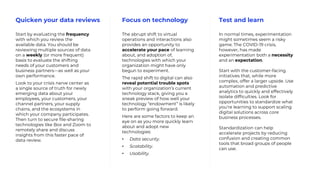
Test and learnQuicken your data reviews Focus on technology
Start by evaluating the frequency
with which you review the
available data. You should be
reviewing multiple sources of data
on a weekly (or more frequent)
basis to evaluate the shifting
needs of your customers and
business partners—as well as your
own performance.
Look to your crisis nerve center as
a single source of truth for newly
emerging data about your
employees, your customers, your
channel partners, your supply
chains, and the ecosystems in
which your company participates.
Then turn to secure file-sharing
technologies like Box and Zoom to
remotely share and discuss
insights from this faster pace of
data review.
The abrupt shift to virtual
operations and interactions also
provides an opportunity to
accelerate your pace of learning
about, and adoption of,
technologies with which your
organization might have only
begun to experiment.
The rapid shift to digital can also
reveal potential trouble spots
with your organization’s current
technology stack, giving you a
sneak preview of how well your
technology “endowment” is likely
to perform going forward.
Here are some factors to keep an
eye on as you more quickly learn
about and adopt new
technologies:
• Data security.
• Scalability.
• Usability.
In normal times, experimentation
might sometimes seem a risky
game. The COVID-19 crisis,
however, has made
experimentation both a necessity
and an expectation.
Start with the customer-facing
initiatives that, while more
complex, offer a larger upside. Use
automation and predictive
analytics to quickly and effectively
isolate difficulties. Look for
opportunities to standardize what
you’re learning to support scaling
digital solutions across core
business processes.
Standardization can help
accelerate projects by reducing
confusion and creating common
tools that broad groups of people
can use.
“Greatest lessons emerge from the
most devastating times of crises.”

Digital strategy during coronavirus crisis

  • 1.
    Digital strategy during the coronaviruscrisis. A L L C R E D I T G O E S T O M C K I N S E Y . C O M c o m p i l e d b y 5 J u n e 2 0 2 0 BySimonBlackburn,LauraLaBerge,ClaytonO’Toole,andJeremySchneider
  • 2.
    Businesses that oncemapped digital strategy in 1-3-yearphases must now scale their initiatives in a matter of days or weeks. The COVID-19 crisis seemingly provides a sudden glimpse into a future world. - A world in which digital channels become the primary customer- engagement model - Automated processes become a primary driver of productivity - Flexible, transparent, and stable supply chains In this unique moment, companies can learn and progress more quickly than ever before, as the falling barriers to improvisation and experimentation that have emerged among customers, markets, regulators, and organizations The ways they learn from and adjust to today’s crisis will deeply influence their performance in tomorrow, providing the opportunity to retain greater agility as well as closer ties with customers, employees, and suppliers. Now is the time to reassess digital initiatives of surveyed executives said the pandemic is likely to accelerate the pace of their digital transformation. 70% Now is the time
  • 3.
    A crisis demands boldnessand learning. D I G I T A L T R A N S - F O R M A T I O N atimeforacceleration covid-19
  • 4.
    Companies often experimentat a pace that fails to match the rate of change around them, slowing their ability to learn fast enough to keep up McKinsey research shows bold moves to adopt digital technologies early and at scale, combined with a heavy allocation of resources against digital initiatives and M&A, correlate highly with value creation. As the COVID-19 crisis forces your customers, employees, and supply chains into digital channels and new ways of working, now is the time to ask yourself: What are the bold digital actions we’ve hesitated to pursue in the past, even as we’ve known they would eventually be required? Strange as it may seem, right now, in a moment of crisis, is precisely the time to boldly advance your digital agenda. Bold, tightly integrated digital strategies are the most effective approach to digital transformation
  • 5.
    A mandate to bebold. D I G I T A L T R A N S - F O R M A T I O N atimeforacceleration covid-19
  • 6.
    What does itmean to act boldly? McKinsey & Company suggests four areas of focus, each of which goes beyond applying “digital lipstick” and toward innovating entirely new digital offerings, deploying design thinking and technologies like artificial intelligence (AI) at scale across your business, and doing all of this “at pace” through acquisitions. Organizations that are able to leverage things like design thinking into their new offerings will see significant first-mover advantage New offerings Reinvent your business model at its core Boldly evolve your business portfolio
  • 7.
    New offerings By nowyou’ve likely built the minimally viable nerve center which provides a natural gathering point for crucial strategic information. But now it also should afford looking forward in time at bigger issues and opportunities—those that could drive significant disruption as the crisis continues. The COVID-19 crisis will set similar “ecosystem”-level changes in motion—not just changes in economics but new ways of serving customers and working with suppliers across traditional industry boundaries. Most organizations are looking for virtual replacements for their previously physical offerings, or at least new ways of making them accessible with minimal physical contact. The new offerings that result can often involve new partnerships or the need to access new platforms and digital marketplaces in which your company has yet to participate. As you engage with new partners and platforms, look for opportunities to move beyond your organization’s comfort zones, while getting visibility into the places you can confidently invest valuable time, people, and funds to their best effect. Design thinking, which involves using systemic reasoning and intuition to address complex problems and explore ideal future states, will be crucial. A design- centric approach focuses first and foremost on end users or customers. But it also helps make real-time sense of how suppliers, channel partners, and competitors are responding to the crisis, and how the ecosystem that includes them all is evolving for the next normal emerging after the immediate crisis fades.
  • 8.
    Reinvent your businessmodel at its core Going beyond comfort zones requires taking an end-to-end view of your business and operating models. Even though your resources are necessarily limited, the experience of leading companies suggests that focusing on areas that touch more of the core of your business will give you the best chance of success, in both the near and the longer term, than will making minor improvements to noncore areas. Organizations that make minor changes to the edges of their business model nearly always fall short of their goals. In particular, organizations rapidly adopting AI tools and algorithms, as well as design thinking, and using those to redefine their business at scale have been outperforming their peers. This will be increasingly true as companies deal with large amounts of data in a rapidly evolving landscape and look to make rapid, accurate course corrections compared with their peers. While the outcomes will vary significantly by industry, a few common themes are emerging across sectors that suggest “next normal” changes to cost structures and operating models going forward. Supply-chain transparency and flexibility Data security Remote workforces and automation
  • 9.
    Boldly evolve yourbusiness portfolio No company can accelerate the delivery of all its strategic imperatives without looking to mergers and acquisitions (M&A) to speed them along. This is particularly true with digital strategy, where M&A can help companies gain talent and build capabilities, even as it offers access to new products, services, and solutions, and to new market and customer segments. More broadly, we know from research into economic downturns that companies that invest when valuations are low outperform those that do not. These companies divested underperforming businesses 10 percent faster than their peers early on in a crisis (or sometimes in anticipation of a crisis) and then shifted gears into M&A at the first sign of recovery. In more normal times, one of the main challenges companies face in their digital transformations is the need to acquire digital talent and capabilities through acquisitions of tech companies that are typically valued at multiples that capital markets might view as dilutive to the acquirer. The current downturn could remove this critical roadblock, especially with companies temporarily free from the tyranny of quarterly earnings expectations. Because valuations are down, the crisis and its immediate aftermath may prove an opportune time to pick up assets that were previously out of reach. We are already seeing many private-equity firms actively looking to deploy large swaths of capital.
  • 10.
    Learning at the pace ofcrisis D I G I T A L T R A N S - F O R M A T I O N atimeforacceleration covid-19
  • 11.
    The COVID-19 crisisis causing a need for acceleration beyond what we had seen before, going from three tiers of speed down to two. In situations of extreme uncertainty, leadership teams need to learn quickly what is and is not working and why. This requires identifying and learning about unknown elements as quickly as they appear. Prior to the crisis, leading companies had already been increasing the cadence of their learning as part of a quickened organizational metabolism (Exhibit 3). Companies can look to their example as they work to adapt to change more rapidly during crisis times—and beyond. Four areas of intervention can help companies learn more quickly during the crisis and the next normal that follows. • Quicken your data reviews • Focus on technology • Test and learn Find a new cadance
  • 12.
    Test and learnQuickenyour data reviews Focus on technology Start by evaluating the frequency with which you review the available data. You should be reviewing multiple sources of data on a weekly (or more frequent) basis to evaluate the shifting needs of your customers and business partners—as well as your own performance. Look to your crisis nerve center as a single source of truth for newly emerging data about your employees, your customers, your channel partners, your supply chains, and the ecosystems in which your company participates. Then turn to secure file-sharing technologies like Box and Zoom to remotely share and discuss insights from this faster pace of data review. The abrupt shift to virtual operations and interactions also provides an opportunity to accelerate your pace of learning about, and adoption of, technologies with which your organization might have only begun to experiment. The rapid shift to digital can also reveal potential trouble spots with your organization’s current technology stack, giving you a sneak preview of how well your technology “endowment” is likely to perform going forward. Here are some factors to keep an eye on as you more quickly learn about and adopt new technologies: • Data security. • Scalability. • Usability. In normal times, experimentation might sometimes seem a risky game. The COVID-19 crisis, however, has made experimentation both a necessity and an expectation. Start with the customer-facing initiatives that, while more complex, offer a larger upside. Use automation and predictive analytics to quickly and effectively isolate difficulties. Look for opportunities to standardize what you’re learning to support scaling digital solutions across core business processes. Standardization can help accelerate projects by reducing confusion and creating common tools that broad groups of people can use.
  • 13.
    “Greatest lessons emergefrom the most devastating times of crises.”