BRAND MANAGEMENT
GROUP ASSIGNMENT
SAFFOLA
SWARNIMA KHANNA
MOHIT RASAD
ROHAN NEGI
DIKSHANT BASHAMBHU
YASH JHUNJUNUWALA
PRAKRITI AWASTEE
Introduction
Marico industry


Marico Industries, a well-known Indian Fast Moving Consumer Goods (FMCG) company, offers unique and
ethnic Indian products. Marico is famous for its „Parachute‟ and „Saffola‟ brands.
India is one of the fastest growing economies in the world. Currently, India is the world's capital in cardio-
vascular diseases & diabetes and in years to come the prevalence of these lifestyle disorders is only
expected to increase.
Today, 4 Indians die every minute due to a heart ailment, Saffola's reasons for existence is to lower this
statistic.
Saffola offers products which are designed to enable consumers to manage their heart health without a
change in their lifestyle.
Saffola's products are the first in your line of defence against heart diseases, making your transition to a
healthier lifestyle a lot easier
IS THE BRANDS STRATEGY IN SYNC WITH ITS ECOSYSTEM?


Saffola Oil as a Brand
It was one of the first brands in the country to equate health consciousness with cooking oil.
In order to stay in tune with the changing tastes and preferences of the customer, Saffola also
came in four variants
Line Extension
Saffola Gold
New Saffola
Saffola Tasty blend SaffolaActive
Satisfying health needs
Saffola satisfying Health Needs:
Saffola “The Heart of a healthy family”
All Saffola oils come with‟ 'LoSorb Technology‟.
Saffola oils fats' are 'Free of trans‟
Pricing strategy of Saffola
Saffola has different products to suit different customers.
The company wanted to leverage the Saffola brand equity through brand extension.
Saffola Gold – Rs 105
Saffola Tasty – Rs 85
Saffola Active – Rs 87
The brand is in sync with the current market trends like other brands that are trying to bring in
new healthy ingredients into their products and trying to focus on the new trends.In the case of
Saffola, it has remained very strong and focused on its core ideas by trying to build a better
brand and not start another brand. Its products offerings are very simple but with added
benefits that are in sync with its ecosystem and they are trying to stay updated with the current
market trends. It made a Prominent image for saffola thus ensuring various brand extensions.
It avoided the cost of developing the Brand extensions.
Created a whole new niche for Saffola Brand.
Extending the Saffola franchise into new categories is expected to help it in maintaining its
margins with input and media costs on the rise. Eg Saffola Salt, Saffola Atta. Saffola salt was a
huge success and acted like the appropriate extension needed to further elevate and sustain the
Brand Name and the distinctive features of the Parent Brand. Atta came after salt and played
well in the “health conscious” sector. It became an instant hit thereby serving as a further boon
to Saffola as a health care Brand. It had tremendous impact on saffola and penetrated well into
the market of atta thereby increasing its market share manifold. It has stuck to its core ideas
which is providing Healthy Alternatives for an active lifestyle, keeping in mind consumer
preferences and has launched different types of products in the new brand category to suit
consumer preferences.
Appreciating saffola's Brand campaigns.
Campaign 1
This campaign took place during the 90s and during this time Saffola had been focussing on the health aspect of the cooking oil to market to consumers. Most
of its customers had switched to Saffola due to the recommendation of their doctors after suffering from heart related ailments. Due to this Saffola decided to
market its product to this audience as a brand for the healthy heart. In the advertisement of the campaign released in 2000, the patient’s wife was shown to be
in shock and helpless as her husband was being taken to the hospital in an ambulance. The advert had a very serious tone as the background score was of a
siren and an electrocardiogram monitor. It focused on the fact that Safola had the highest PUFA content that reduces cholesterol buildup and that Saffola
cooking oil is like a life insurance.
Campaign 2
The previous campaign worked very well for its target audience but that was just a narrow market. Sales had begun to stagnate and hence Saffola needed to
adopt a new approach of marketing its products to capture a wider audience. The previous campaign positioned Saffola as a health- oriented cooking oil for
people with heart problems due to which people not falling in this category refrained from purchasing it. Although this approach was working well for the
target audience, the “heart association” was working negatively for the rest of the market. Saffola was expensive compared to other cooking oils and hence
people not having heart conditions may be trying to avoid the additional cost. Saffola’s distinction was based on its health benefits and not its taste which non-
patients may not want to compromise on. Also as the product was of a medicinal nature, Saffola may be perceived to be a threat to healthy people consuming
it. The company also conducted a consumer study to reinforce this. To change this perception the company launched a new campaign titled “Sehat Se Jeena
Hai”. It was a happy video montage of people belonging to different age groups engaging in various physical activities. It tried to shift the communication of
the company to a cooking oil suitable for the entire family. Saffola also launched a new product, Saffola Nutriblend to communicate this repositioning.
Campaign 3
Although the initial response of the campaign was good, it was temporary. After the initial 15% growth, sales started to dip again and went back to pre-
campaign levels. The new product did not work well as the growth was mostly due to the existing consumers trying the new product. The company again
conducted research to understand what went wrong and they realised that around 35-40% of volumes were due to doctor prescriptions. Of a random sample,
17 out of 20 families used Saffola as they had a member suffering from a heart ailment. Saffola Healthy Heart Foundation also found that India had a high
number of people suffering from heart ailments. The company’s decision to stray away from its positioning as a heart oriented product seemed a little
miscalculated and the company now faced a dilemma as it tried to increase its consumer base but didn’t find much success.
The company now tried to include the “hopefully healthy” lifestyle segment into its marketing plans. They now focused on busy executives in the age group of
25 - 45 who wanted to live healthy but easily gave in to temptations or simply didn’t have the time for it. The company wanted to keep the “heart” narrative but
shifted from the negative aspects like heart attacks, ailments, etc to positive connotations like healthy living, etc. It launched the product “Saffola Gold” which
combined the product-related benefits of its parent brand with intangible emotional benefits for the new generation of consumers. The company launched the
campaign titled “Kal Se” whereby a 30 second ad was released by Saffola which showed a procrastinating husband failing to live a healthy life and always
promising his wife to start again from the next day (Kal Se). The wife then takes matters into her own hands and shifts to Saffola Gold as an easy insurance for
husband’s healthy heart from that day itself (Aaj Se).
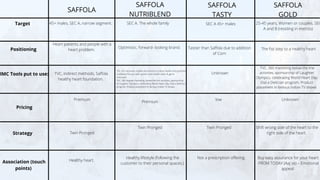
SAFFOLA
SAFFOLA
NUTRIBLEND
SAFFOLA
TASTY
SAFFOLA
GOLD


45+ males, SEC A, narrow segment.


SEC A. The whole family


SEC A 45+ males


25-45 years, Women or couples, SEC
A and B (residing in metros)


Heart patients and people with a
heart problem.


TVC, indirect methods, Saffola
healthy heart foundation.


Premium
Twin Pronged
Healthy heart.


Optimistic, forward- looking brand.


TVC, BTL Activities, Expert and doctors to drive health and promote
credibility/Tie ups with sports clubs health clubs & gyms.
Unknown.
TVC, 360 degree marketing, below the line activities, sponsorship
of Laughter Olympics, celebrating World Heart Day, Dial a Dietician
program, Product placement in famous Indian TV shows.


Premium
Twin Pronged
Healthy lifestyle (following the
customer to their personal spaces.)


Tastier than Saffola due to addition
of Corn
Unknown
low
Twin Pronged
Not a prescription offering.


The fist step to a healthy heart
TVC, 360 marketing below the line
activities, sponsorship of Laughter
Olympics, celebrating World Heart Day,
Dial a Dietician program, Product
placement in famous Indian TV shows


Unknown
Shift wrong side of the heart to the
right side of the heart.


Buy easy assurance for your heart
FROM TODAY (Aaj se) – Emotional
appeal.


Target


Positioning


IMC Tools put to use:


Pricing


Strategy


Association (touch
points)
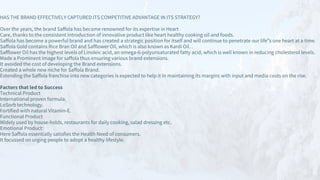
HAS THE BRAND EFFECTIVELY CAPTURED ITS COMPETITIVE ADVANTAGE IN ITS STRATEGY?
Over the years, the brand Saffola has become renowned for its expertise in Heart
Care, thanks to the consistent introduction of innovative product like heart healthy cooking oil and foods.
Saffola has become a powerful brand and has created a strategic position for itself and will continue to penetrate our life‟s one heart at a time.
Saffola Gold contains Rice Bran Oil and Safflower Oil, which is also known as Kardi Oil. .
Safflower Oil has the highest levels of Linoleic acid, an omega-6-polyunsaturated fatty acid, which is well known in reducing cholesterol levels.
Made a Prominent image for saffola thus ensuring various brand extensions.
It avoided the cost of developing the Brand extensions.
Created a whole new niche for Saffola Brand.
Extending the Saffola franchise into new categories is expected to help it in maintaining its margins with input and media costs on the rise.
Factors that led to Success
Technical Product
International proven formula.
LoSorb technology.
Fortified with natural Vitamin-E.
Functional Product
Widely used by house-holds, restaurants for daily cooking, salad dressing etc.
Emotional Product:
Here Saffola essentially satisfies the Health Need of consumers.
It focussed on urging people to adopt a healthy lifestyle.
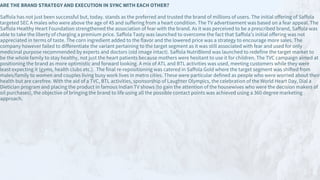
ARE THE BRAND STRATEGY AND EXECUTION IN SYNC WITH EACH OTHER?
Saffola has not just been successful but, today. stands as the preferred and trusted the brand of millions of users. The initial offering of Saffola
targeted SEC A males who were above the age of 45 and suffering from a heart condition. The TV advertisement was based on a fear appeal. The
Saffola Healthy Heart Foundation strengthened the association of fear with the brand. As it was perceived to be a prescribed brand, Saffola was
able to take the liberty of charging a premium price. Saffola Tasty was launched to overcome the fact that Saffola’s initial offering was not
appreciated in terms of taste. The corn ingredient added to the flavor and the lowered price was a strategy to encourage more sales. The
company however failed to differentiate the variant pertaining to the target segment as it was still associated with fear and used for only
medicinal purpose recommended by experts and doctors (old image intact). Saffola NutriBlend was launched to redefine the target market to
be the whole family to stay healthy, not just the heart patients because mothers were hesitant to use it for children. The TVC campaign aimed at
positioning the brand as more optimistic and forward looking. A mix of ATL and BTL activities was used, meeting customers while they were
least expecting it (gyms, health clubs etc.). The final re-repositioning was catered in Saffola Gold where the target segment was shifted from
males/family to women and couples living busy work lives in metro cities. These were particular defined as people who were worried about their
health but are carefree. With the aid of a TVC, BTL activities, sponsorship of Laughter Olympics, the celebration of the World Heart Day, Dial a
Dietician program and placing the product in famous Indian TV shows (to gain the attention of the housewives who were the decision makers of
oil purchases), the objective of bringing the brand to life using all the possible contact points was achieved using a 360 degree marketing
approach.
SAFFOLA MARKET STRATEGY:
1990s: The healthy decade for Saffola
Positioning: Saffola’s ‘higher PuFA (poly unsaturated fatty acid) content made it healthier than regular cooking oils Target Segment: Urban dweller, 45+ years, male,
belonging to socio-economic classification (SEC) A
Many users suffering from heart ailments switched to Saffola on
doctor’s recommendations
Due to strong heart links, Saffola could command premium along with maintaining market share
The brand played on the fear factor in patients, giving them a sense of security and a feeling that they were avoiding another encounter with a heart-related condition
Strengthen its position within the “heart patient” group and to broaden its user base to include potential heart patients as well
Saffola established the Saffola Healthy Heart Foundation, which was a path-breaking marketing effort at that time.
Challenges of the New Century
Retrospective Perspective: Transforming a brand known for its health benefits for heart patients into an cooking OIL brand that will be consumed by all people of all age
groups.
The sales had begun to stagnate
Competition had intensified
Sundrop increased its advertising expenditures
Gold Winner was a strong competitor at a lower price point
Consumers were upgrading from heavier oils to lighter healthier oils but only few switched to Saffola
Saffola was seen as a prescription brand and was not known for taste – led to selective consumption
At this stage, it was necessary to understand how consumers viewed the various offerings in the market through primary research
qualitative research was undertaken these were the findings.
Saffola A light, refined, and healthy cooking oil
An expensive, problem solution brand that did not taste/smell good Key usage drivers
Doctor’s recommendation Health or weight problem
Saffola Tasty
Low advertising recall
Ingredients overshadowed by original Saffola oil Perceived as original Saffola oil at a cheaper price
Saffola used for heart patients and another brand for rest of the family To reduce additional expenditure as saffola charged price premium
Saffola had a strong positioning but that was very limited
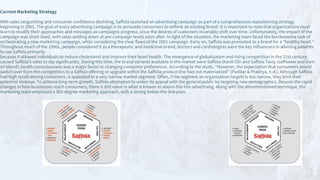
Current Marketing Strategy
With sales languishing and consumer confidence declining, Saffola launched an advertising campaign as part of a comprehensive repositioning strategy
beginning in 2001. The goal of every advertising campaign is to persuade consumers to rethink an existing brand. It is important to note that organizations must
learn to modify their approaches and messages as campaigns progress, since the desires of customers invariably shift over time. Unfortunately, the impact of the
campaign was short-lived, with sales settling down at pre-campaign levels soon after. In light of the situation, the marketing team faced the burdensome task of
orchestrating a new marketing campaign, while considering the clear flaws of the 2001 campaign. Early on, Saffola was promoted as a brand for a “healthy heart.”
Throughout much of the 1990s, people considered it as a therapeutic and medicinal brand; doctors and cardiologists were the key influencers in advising patients
to use Saffola primarily
because it allowed individuals to reduce cholesterol and improve their heart health. The emergence of globalization and rising competition in the 21st century
caused Saffola’s sales to dip significantly. During this time, the brand variants available in the market were Saffola (Kardi Oil) and Saffola Tasty (safflower and corn
oil blend); health consciousness was a major factor in changing consumer preferences. According to the study, “However, the expectation that consumers would
switch over from the competitors to a Saffola offering or upgrade within the Saffola product line had not materialized” (Poddar & Prakhya, n.d.). Although Saffola
had high recall among consumers, it appealed to a very narrow market segment. Often, if the segment an organization targets is too narrow, they limit their
potential revenue. To achieve long-term growth, Saffola attempted to widen its appeal with the general public by targeting new demographics. Despite the rapid
changes in how businesses reach consumers, there is still value in what is known as above-the-line advertising. Along with the aforementioned technique, the
marketing team employed a 360-degree marketing approach, with a strong below-the-line plan.
PROPOSED STRATEGY
Saffola SWOT Analysis
The purpose of SWOT analysis is to study the internal and external environments of a company, through the identification and analysis of the strengths and
weaknesses of the organization, and the opportunities and threats to which it is exposed. First, brand recall is the likelihood of instant recollection of the name of a
brand by a consumer when prompted with a product or close association. In this situation, Saffola came in a close second, only behind rival Sundrop in terms of
being a light, refined, and healthy cooking oil. Customers had opted for Suffola owing to their doctor’s recommendation or a health/weight problem, despite the
higher cost. According to the study, “Tracing the brand conversation pathway, users of the heavy oils, seeking an upgrade, were most likely to change to the high
recall brand Sundrop, except in instances wherein their doctor had specifically recommended Saffola” (Poddar & Prakhya, n.d.). Another apparent strength for the
brand was the ability to accurately reflect consumers, while understanding the nuances of the customer’s projected self-image. Companies use innovative content
to show their audience that the brand is relatable and personable. Identifying and understanding everything about the target audience is crucial for success. “The
brand audit [revealed] that Saffola had done well with reflecting its customers, as well as understanding the nuances of the customer’s projected self-image.
Physical facets such as the heart imagery and strong brand name benefitted Saffola” (Poddar & Prakhya, n.d.). Regrettably, Saffola struggled with emotional
involvement with consumers. Emotional involvement translates to brand loyalty, brand advocacy, and brand guardianship that money can't buy. Word-of-mouth
marketing is highly effective for customers who are emotionally attached to a brand. Additionally, brand personalities reflect the collection of experiences that the
public has with the brand. The brand personality was viewed as detached and authoritative, comparable to the customers’ referral source. As mentioned in the
study, “The brand relationship was that of a savior and solution provider, thereby lacking direct emotional involvement with the customer” (Poddar & Prakhya,
n.d.). Sales growth shows the increase in sales over a specific period of time. Although Saffola experienced nearly 15% sales growth during the advertising
campaign, the burst of momentum quickly evaporated. Once the campaign ended, sales started to fall and eventually settled at pre- campaign levels. The growth
was in large part due to optimistic consumers within the existing user base. For a business to expand their customer base, they must recognize their audience,
examine current trends in the market, and consider innovative marketing strategies. As far as opportunities are concerned, Saffola has the ability to increase their
market share by reaching out to older customer segments. Older consumers prefer traditional methods of multi-channel marketing with a personalized experience.
According to author Larry Alton, “When brands offer someone a personalized customer experience, they remember it for a long time. Since baby boomers are used
to that personal touch, [companies should] incorporate some personalization into [their] efforts. This can be as simple as having a live person respond to customer
service inquiries with a simple phone call” (Alton, 2017). In advertising, keeping the idea and
communication as simple as possible is necessary to maintain customer retention and attract disengaged consumers. Most marketers inundate their customers
with a barrage of information, causing the customer(s) to feel perplexed and overwhelmed. I believe simplifying the brand message will reduce the likelihood of
individuals feeling confused and shifting their attention to competitors. Consequently, Saffola’s biggest threat remains close competitors. Sundrop, Saffola’s main
competitor, was able to achieve a competitive advantage by sustaining a near-perfect balance of price and performance. According to the study, Saffola’s image in
the market was that of an expensive, problem-solution brand with an unsavory taste and limited to a few market segments. Broad market strategies are needed to
appeal to a vast range of consumers. During the decision-making process, Saffola’s marketing team must first analyze and assess whether the company will be able
to effectively connect with consumers on an appropriate and relevant level; marketers must have a thorough understanding of what motivates loyalty from their
customers. The purpose of a 360-degree marketing plan is to reach customers at all possible points of contact. For further quantitative research, the marketing
team should conduct a focus group to learn how diverse market segments feel about the brand and the company’s recent advertising strategies.

Saffola

  • 1.
    BRAND MANAGEMENT GROUP ASSIGNMENT SAFFOLA SWARNIMAKHANNA MOHIT RASAD ROHAN NEGI DIKSHANT BASHAMBHU YASH JHUNJUNUWALA PRAKRITI AWASTEE
  • 2.
    Introduction Marico industry Marico Industries,a well-known Indian Fast Moving Consumer Goods (FMCG) company, offers unique and ethnic Indian products. Marico is famous for its „Parachute‟ and „Saffola‟ brands. India is one of the fastest growing economies in the world. Currently, India is the world's capital in cardio- vascular diseases & diabetes and in years to come the prevalence of these lifestyle disorders is only expected to increase. Today, 4 Indians die every minute due to a heart ailment, Saffola's reasons for existence is to lower this statistic. Saffola offers products which are designed to enable consumers to manage their heart health without a change in their lifestyle. Saffola's products are the first in your line of defence against heart diseases, making your transition to a healthier lifestyle a lot easier
  • 3.
    IS THE BRANDSSTRATEGY IN SYNC WITH ITS ECOSYSTEM? Saffola Oil as a Brand It was one of the first brands in the country to equate health consciousness with cooking oil. In order to stay in tune with the changing tastes and preferences of the customer, Saffola also came in four variants Line Extension Saffola Gold New Saffola Saffola Tasty blend SaffolaActive Satisfying health needs Saffola satisfying Health Needs: Saffola “The Heart of a healthy family” All Saffola oils come with‟ 'LoSorb Technology‟. Saffola oils fats' are 'Free of trans‟ Pricing strategy of Saffola Saffola has different products to suit different customers. The company wanted to leverage the Saffola brand equity through brand extension. Saffola Gold – Rs 105 Saffola Tasty – Rs 85 Saffola Active – Rs 87
  • 4.
    The brand isin sync with the current market trends like other brands that are trying to bring in new healthy ingredients into their products and trying to focus on the new trends.In the case of Saffola, it has remained very strong and focused on its core ideas by trying to build a better brand and not start another brand. Its products offerings are very simple but with added benefits that are in sync with its ecosystem and they are trying to stay updated with the current market trends. It made a Prominent image for saffola thus ensuring various brand extensions. It avoided the cost of developing the Brand extensions. Created a whole new niche for Saffola Brand. Extending the Saffola franchise into new categories is expected to help it in maintaining its margins with input and media costs on the rise. Eg Saffola Salt, Saffola Atta. Saffola salt was a huge success and acted like the appropriate extension needed to further elevate and sustain the Brand Name and the distinctive features of the Parent Brand. Atta came after salt and played well in the “health conscious” sector. It became an instant hit thereby serving as a further boon to Saffola as a health care Brand. It had tremendous impact on saffola and penetrated well into the market of atta thereby increasing its market share manifold. It has stuck to its core ideas which is providing Healthy Alternatives for an active lifestyle, keeping in mind consumer preferences and has launched different types of products in the new brand category to suit consumer preferences. Appreciating saffola's Brand campaigns.
  • 5.
    Campaign 1 This campaigntook place during the 90s and during this time Saffola had been focussing on the health aspect of the cooking oil to market to consumers. Most of its customers had switched to Saffola due to the recommendation of their doctors after suffering from heart related ailments. Due to this Saffola decided to market its product to this audience as a brand for the healthy heart. In the advertisement of the campaign released in 2000, the patient’s wife was shown to be in shock and helpless as her husband was being taken to the hospital in an ambulance. The advert had a very serious tone as the background score was of a siren and an electrocardiogram monitor. It focused on the fact that Safola had the highest PUFA content that reduces cholesterol buildup and that Saffola cooking oil is like a life insurance. Campaign 2 The previous campaign worked very well for its target audience but that was just a narrow market. Sales had begun to stagnate and hence Saffola needed to adopt a new approach of marketing its products to capture a wider audience. The previous campaign positioned Saffola as a health- oriented cooking oil for people with heart problems due to which people not falling in this category refrained from purchasing it. Although this approach was working well for the target audience, the “heart association” was working negatively for the rest of the market. Saffola was expensive compared to other cooking oils and hence people not having heart conditions may be trying to avoid the additional cost. Saffola’s distinction was based on its health benefits and not its taste which non- patients may not want to compromise on. Also as the product was of a medicinal nature, Saffola may be perceived to be a threat to healthy people consuming it. The company also conducted a consumer study to reinforce this. To change this perception the company launched a new campaign titled “Sehat Se Jeena Hai”. It was a happy video montage of people belonging to different age groups engaging in various physical activities. It tried to shift the communication of the company to a cooking oil suitable for the entire family. Saffola also launched a new product, Saffola Nutriblend to communicate this repositioning. Campaign 3 Although the initial response of the campaign was good, it was temporary. After the initial 15% growth, sales started to dip again and went back to pre- campaign levels. The new product did not work well as the growth was mostly due to the existing consumers trying the new product. The company again conducted research to understand what went wrong and they realised that around 35-40% of volumes were due to doctor prescriptions. Of a random sample, 17 out of 20 families used Saffola as they had a member suffering from a heart ailment. Saffola Healthy Heart Foundation also found that India had a high number of people suffering from heart ailments. The company’s decision to stray away from its positioning as a heart oriented product seemed a little miscalculated and the company now faced a dilemma as it tried to increase its consumer base but didn’t find much success. The company now tried to include the “hopefully healthy” lifestyle segment into its marketing plans. They now focused on busy executives in the age group of 25 - 45 who wanted to live healthy but easily gave in to temptations or simply didn’t have the time for it. The company wanted to keep the “heart” narrative but shifted from the negative aspects like heart attacks, ailments, etc to positive connotations like healthy living, etc. It launched the product “Saffola Gold” which combined the product-related benefits of its parent brand with intangible emotional benefits for the new generation of consumers. The company launched the campaign titled “Kal Se” whereby a 30 second ad was released by Saffola which showed a procrastinating husband failing to live a healthy life and always promising his wife to start again from the next day (Kal Se). The wife then takes matters into her own hands and shifts to Saffola Gold as an easy insurance for husband’s healthy heart from that day itself (Aaj Se).
  • 6.
    SAFFOLA SAFFOLA NUTRIBLEND SAFFOLA TASTY SAFFOLA GOLD 45+ males, SECA, narrow segment. SEC A. The whole family SEC A 45+ males 25-45 years, Women or couples, SEC A and B (residing in metros) Heart patients and people with a heart problem. TVC, indirect methods, Saffola healthy heart foundation. Premium Twin Pronged Healthy heart. Optimistic, forward- looking brand. TVC, BTL Activities, Expert and doctors to drive health and promote credibility/Tie ups with sports clubs health clubs & gyms. Unknown. TVC, 360 degree marketing, below the line activities, sponsorship of Laughter Olympics, celebrating World Heart Day, Dial a Dietician program, Product placement in famous Indian TV shows. Premium Twin Pronged Healthy lifestyle (following the customer to their personal spaces.) Tastier than Saffola due to addition of Corn Unknown low Twin Pronged Not a prescription offering. The fist step to a healthy heart TVC, 360 marketing below the line activities, sponsorship of Laughter Olympics, celebrating World Heart Day, Dial a Dietician program, Product placement in famous Indian TV shows Unknown Shift wrong side of the heart to the right side of the heart. Buy easy assurance for your heart FROM TODAY (Aaj se) – Emotional appeal. Target Positioning IMC Tools put to use: Pricing Strategy Association (touch points)
  • 7.
    HAS THE BRANDEFFECTIVELY CAPTURED ITS COMPETITIVE ADVANTAGE IN ITS STRATEGY? Over the years, the brand Saffola has become renowned for its expertise in Heart Care, thanks to the consistent introduction of innovative product like heart healthy cooking oil and foods. Saffola has become a powerful brand and has created a strategic position for itself and will continue to penetrate our life‟s one heart at a time. Saffola Gold contains Rice Bran Oil and Safflower Oil, which is also known as Kardi Oil. . Safflower Oil has the highest levels of Linoleic acid, an omega-6-polyunsaturated fatty acid, which is well known in reducing cholesterol levels. Made a Prominent image for saffola thus ensuring various brand extensions. It avoided the cost of developing the Brand extensions. Created a whole new niche for Saffola Brand. Extending the Saffola franchise into new categories is expected to help it in maintaining its margins with input and media costs on the rise. Factors that led to Success Technical Product International proven formula. LoSorb technology. Fortified with natural Vitamin-E. Functional Product Widely used by house-holds, restaurants for daily cooking, salad dressing etc. Emotional Product: Here Saffola essentially satisfies the Health Need of consumers. It focussed on urging people to adopt a healthy lifestyle.
  • 8.
    ARE THE BRANDSTRATEGY AND EXECUTION IN SYNC WITH EACH OTHER? Saffola has not just been successful but, today. stands as the preferred and trusted the brand of millions of users. The initial offering of Saffola targeted SEC A males who were above the age of 45 and suffering from a heart condition. The TV advertisement was based on a fear appeal. The Saffola Healthy Heart Foundation strengthened the association of fear with the brand. As it was perceived to be a prescribed brand, Saffola was able to take the liberty of charging a premium price. Saffola Tasty was launched to overcome the fact that Saffola’s initial offering was not appreciated in terms of taste. The corn ingredient added to the flavor and the lowered price was a strategy to encourage more sales. The company however failed to differentiate the variant pertaining to the target segment as it was still associated with fear and used for only medicinal purpose recommended by experts and doctors (old image intact). Saffola NutriBlend was launched to redefine the target market to be the whole family to stay healthy, not just the heart patients because mothers were hesitant to use it for children. The TVC campaign aimed at positioning the brand as more optimistic and forward looking. A mix of ATL and BTL activities was used, meeting customers while they were least expecting it (gyms, health clubs etc.). The final re-repositioning was catered in Saffola Gold where the target segment was shifted from males/family to women and couples living busy work lives in metro cities. These were particular defined as people who were worried about their health but are carefree. With the aid of a TVC, BTL activities, sponsorship of Laughter Olympics, the celebration of the World Heart Day, Dial a Dietician program and placing the product in famous Indian TV shows (to gain the attention of the housewives who were the decision makers of oil purchases), the objective of bringing the brand to life using all the possible contact points was achieved using a 360 degree marketing approach.
  • 9.
    SAFFOLA MARKET STRATEGY: 1990s:The healthy decade for Saffola Positioning: Saffola’s ‘higher PuFA (poly unsaturated fatty acid) content made it healthier than regular cooking oils Target Segment: Urban dweller, 45+ years, male, belonging to socio-economic classification (SEC) A Many users suffering from heart ailments switched to Saffola on doctor’s recommendations Due to strong heart links, Saffola could command premium along with maintaining market share The brand played on the fear factor in patients, giving them a sense of security and a feeling that they were avoiding another encounter with a heart-related condition Strengthen its position within the “heart patient” group and to broaden its user base to include potential heart patients as well Saffola established the Saffola Healthy Heart Foundation, which was a path-breaking marketing effort at that time. Challenges of the New Century Retrospective Perspective: Transforming a brand known for its health benefits for heart patients into an cooking OIL brand that will be consumed by all people of all age groups. The sales had begun to stagnate Competition had intensified Sundrop increased its advertising expenditures Gold Winner was a strong competitor at a lower price point Consumers were upgrading from heavier oils to lighter healthier oils but only few switched to Saffola Saffola was seen as a prescription brand and was not known for taste – led to selective consumption At this stage, it was necessary to understand how consumers viewed the various offerings in the market through primary research qualitative research was undertaken these were the findings. Saffola A light, refined, and healthy cooking oil An expensive, problem solution brand that did not taste/smell good Key usage drivers Doctor’s recommendation Health or weight problem Saffola Tasty Low advertising recall Ingredients overshadowed by original Saffola oil Perceived as original Saffola oil at a cheaper price Saffola used for heart patients and another brand for rest of the family To reduce additional expenditure as saffola charged price premium Saffola had a strong positioning but that was very limited
  • 10.
    Current Marketing Strategy Withsales languishing and consumer confidence declining, Saffola launched an advertising campaign as part of a comprehensive repositioning strategy beginning in 2001. The goal of every advertising campaign is to persuade consumers to rethink an existing brand. It is important to note that organizations must learn to modify their approaches and messages as campaigns progress, since the desires of customers invariably shift over time. Unfortunately, the impact of the campaign was short-lived, with sales settling down at pre-campaign levels soon after. In light of the situation, the marketing team faced the burdensome task of orchestrating a new marketing campaign, while considering the clear flaws of the 2001 campaign. Early on, Saffola was promoted as a brand for a “healthy heart.” Throughout much of the 1990s, people considered it as a therapeutic and medicinal brand; doctors and cardiologists were the key influencers in advising patients to use Saffola primarily because it allowed individuals to reduce cholesterol and improve their heart health. The emergence of globalization and rising competition in the 21st century caused Saffola’s sales to dip significantly. During this time, the brand variants available in the market were Saffola (Kardi Oil) and Saffola Tasty (safflower and corn oil blend); health consciousness was a major factor in changing consumer preferences. According to the study, “However, the expectation that consumers would switch over from the competitors to a Saffola offering or upgrade within the Saffola product line had not materialized” (Poddar & Prakhya, n.d.). Although Saffola had high recall among consumers, it appealed to a very narrow market segment. Often, if the segment an organization targets is too narrow, they limit their potential revenue. To achieve long-term growth, Saffola attempted to widen its appeal with the general public by targeting new demographics. Despite the rapid changes in how businesses reach consumers, there is still value in what is known as above-the-line advertising. Along with the aforementioned technique, the marketing team employed a 360-degree marketing approach, with a strong below-the-line plan.
  • 11.
    PROPOSED STRATEGY Saffola SWOTAnalysis The purpose of SWOT analysis is to study the internal and external environments of a company, through the identification and analysis of the strengths and weaknesses of the organization, and the opportunities and threats to which it is exposed. First, brand recall is the likelihood of instant recollection of the name of a brand by a consumer when prompted with a product or close association. In this situation, Saffola came in a close second, only behind rival Sundrop in terms of being a light, refined, and healthy cooking oil. Customers had opted for Suffola owing to their doctor’s recommendation or a health/weight problem, despite the higher cost. According to the study, “Tracing the brand conversation pathway, users of the heavy oils, seeking an upgrade, were most likely to change to the high recall brand Sundrop, except in instances wherein their doctor had specifically recommended Saffola” (Poddar & Prakhya, n.d.). Another apparent strength for the brand was the ability to accurately reflect consumers, while understanding the nuances of the customer’s projected self-image. Companies use innovative content to show their audience that the brand is relatable and personable. Identifying and understanding everything about the target audience is crucial for success. “The brand audit [revealed] that Saffola had done well with reflecting its customers, as well as understanding the nuances of the customer’s projected self-image. Physical facets such as the heart imagery and strong brand name benefitted Saffola” (Poddar & Prakhya, n.d.). Regrettably, Saffola struggled with emotional involvement with consumers. Emotional involvement translates to brand loyalty, brand advocacy, and brand guardianship that money can't buy. Word-of-mouth marketing is highly effective for customers who are emotionally attached to a brand. Additionally, brand personalities reflect the collection of experiences that the public has with the brand. The brand personality was viewed as detached and authoritative, comparable to the customers’ referral source. As mentioned in the study, “The brand relationship was that of a savior and solution provider, thereby lacking direct emotional involvement with the customer” (Poddar & Prakhya, n.d.). Sales growth shows the increase in sales over a specific period of time. Although Saffola experienced nearly 15% sales growth during the advertising campaign, the burst of momentum quickly evaporated. Once the campaign ended, sales started to fall and eventually settled at pre- campaign levels. The growth was in large part due to optimistic consumers within the existing user base. For a business to expand their customer base, they must recognize their audience, examine current trends in the market, and consider innovative marketing strategies. As far as opportunities are concerned, Saffola has the ability to increase their market share by reaching out to older customer segments. Older consumers prefer traditional methods of multi-channel marketing with a personalized experience. According to author Larry Alton, “When brands offer someone a personalized customer experience, they remember it for a long time. Since baby boomers are used to that personal touch, [companies should] incorporate some personalization into [their] efforts. This can be as simple as having a live person respond to customer service inquiries with a simple phone call” (Alton, 2017). In advertising, keeping the idea and communication as simple as possible is necessary to maintain customer retention and attract disengaged consumers. Most marketers inundate their customers with a barrage of information, causing the customer(s) to feel perplexed and overwhelmed. I believe simplifying the brand message will reduce the likelihood of individuals feeling confused and shifting their attention to competitors. Consequently, Saffola’s biggest threat remains close competitors. Sundrop, Saffola’s main competitor, was able to achieve a competitive advantage by sustaining a near-perfect balance of price and performance. According to the study, Saffola’s image in the market was that of an expensive, problem-solution brand with an unsavory taste and limited to a few market segments. Broad market strategies are needed to appeal to a vast range of consumers. During the decision-making process, Saffola’s marketing team must first analyze and assess whether the company will be able to effectively connect with consumers on an appropriate and relevant level; marketers must have a thorough understanding of what motivates loyalty from their customers. The purpose of a 360-degree marketing plan is to reach customers at all possible points of contact. For further quantitative research, the marketing team should conduct a focus group to learn how diverse market segments feel about the brand and the company’s recent advertising strategies.