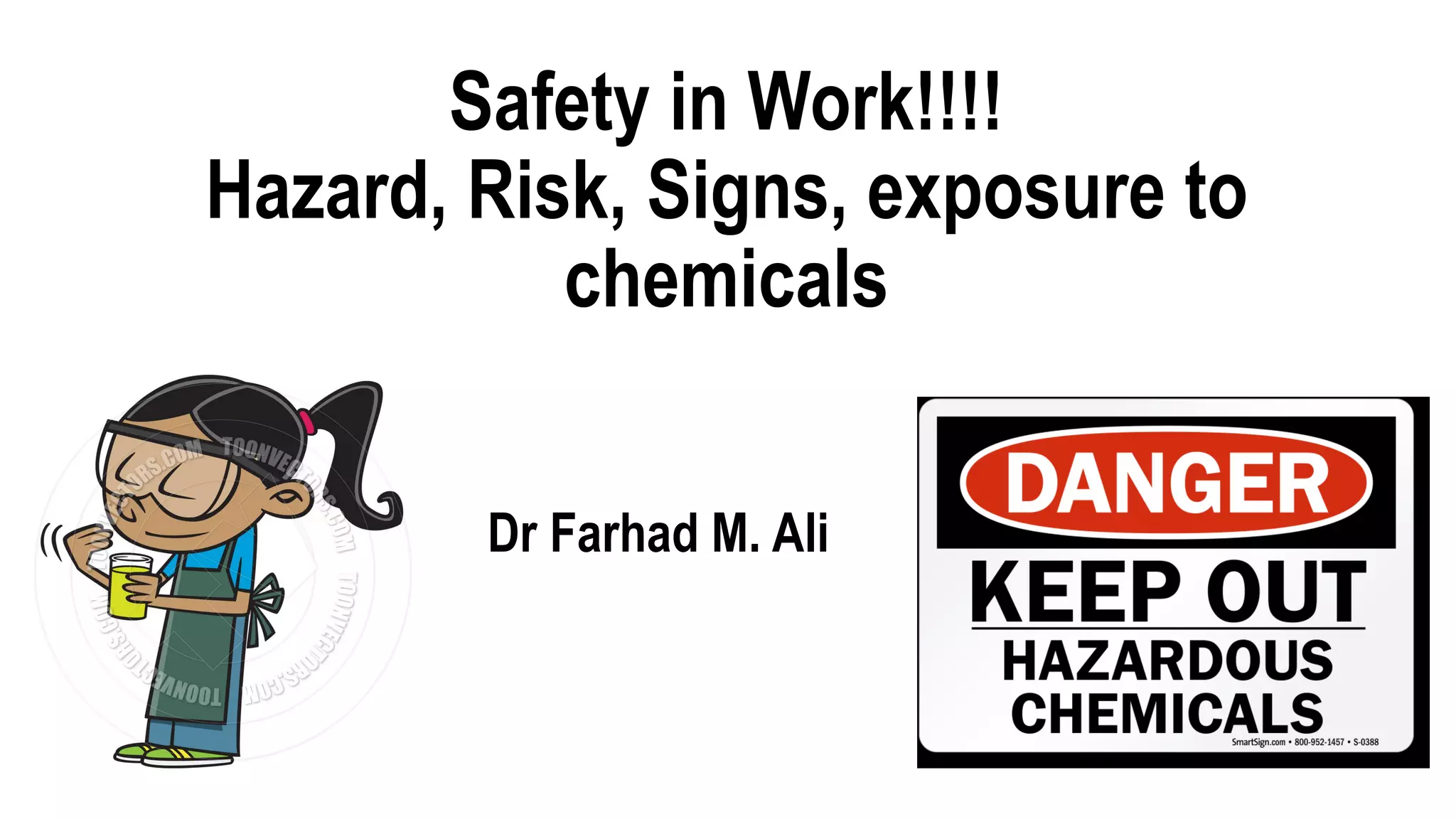
Safety in Work!!!!
Hazard, Risk, Signs, exposure to
chemicals
Dr Farhad M. Ali
Outline
 Safety
 Hazard
 Risk
 Routes to exposure to chemicals
What is safety?
 Safety means keeping yourself and others free from harm or danger.
 It means taking care not to fall or bump or run into things.
 It also means to avoid accidents by being careful with what you are
doing.
 The condition of being protected from or unlikely to cause danger, risk,
or injury.
Safety
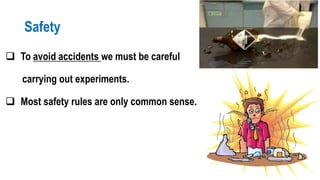
 To avoid accidents we must be careful
carrying out experiments.
 Most safety rules are only common sense.
• Do you feel you are safe at your work?
Why not?
Group to talk about their safety at work
Do we should have a safety manager?
Safety Manager responsibilities include:
 Developing and executing health and safety plans in
the workplace according to legal guidelines
 Preparing and enforcing policies to establish a
culture of health and safety
 Evaluating practices, procedures and facilities to
assess risk and adherence to the law
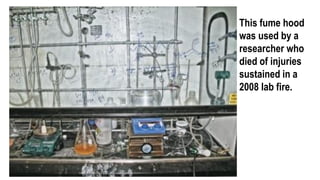
This fume hood
was used by a
researcher who
died of injuries
sustained in a
2008 lab fire.
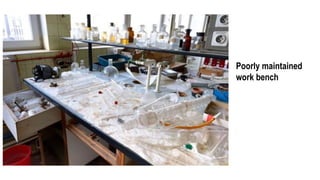
Poorly maintained
work bench
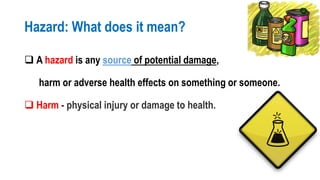
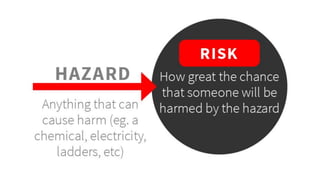
Hazard: What does it mean?
 A hazard is any source of potential damage,
harm or adverse health effects on something or someone.
 Harm - physical injury or damage to health.
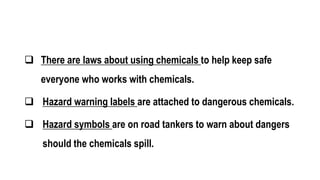
 There are laws about using chemicals to help keep safe
everyone who works with chemicals.
 Hazard warning labels are attached to dangerous chemicals.
 Hazard symbols are on road tankers to warn about dangers
should the chemicals spill.
What types of hazards are there?
A common way to classify hazards is by category:
 Biological - bacteria, viruses, insects, plants, birds, animals, and
humans, etc.,
 Chemical - depends on the physical, chemical and toxic properties of
the chemical,
 Ergonomic - repetitive movements, improper set up of workstation,
etc.,
What types of hazards are there?
A common way to classify hazards is by category:
 Physical - radiation, magnetic fields, pressure extremes (high
pressure or vacuum), noise, etc.,
 Psychosocial - stress, violence, etc.,
 Safety - slipping/tripping hazards, inappropriate machine
guarding, equipment malfunctions or breakdowns.
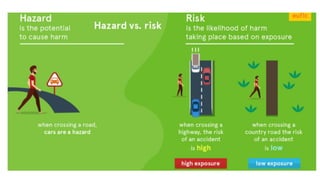
Risk: What does it mean?
 Risk is the chance or probability high or low that a person
will be harmed or experience an adverse health effect if
exposed to a hazard.
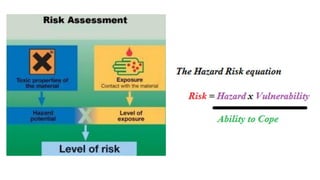
 Risk is a function of toxicity and exposure.
 Every workplace has a certain amount of risk.
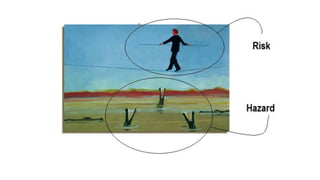
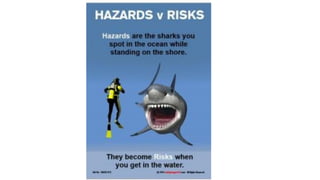
 Hazards and risks are not the same thing.
 Risks are expressed as a probability or likelihood of
developing a disease or getting injured,
 whereas hazards refer to the possible consequences.
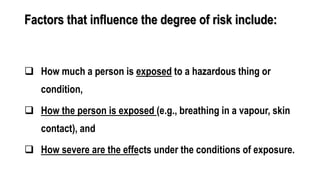
Factors that influence the degree of risk include:
 How much a person is exposed to a hazardous thing or
condition,
 How the person is exposed (e.g., breathing in a vapour, skin
contact), and
 How severe are the effects under the conditions of exposure.
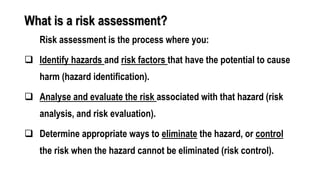
What is a risk assessment?
Risk assessment is the process where you:
 Identify hazards and risk factors that have the potential to cause
harm (hazard identification).
 Analyse and evaluate the risk associated with that hazard (risk
analysis, and risk evaluation).
 Determine appropriate ways to eliminate the hazard, or control
the risk when the hazard cannot be eliminated (risk control).
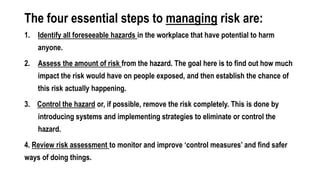
The four essential steps to managing risk are:
1. Identify all foreseeable hazards in the workplace that have potential to harm
anyone.
2. Assess the amount of risk from the hazard. The goal here is to find out how much
impact the risk would have on people exposed, and then establish the chance of
this risk actually happening.
3. Control the hazard or, if possible, remove the risk completely. This is done by
introducing systems and implementing strategies to eliminate or control the
hazard.
4. Review risk assessment to monitor and improve ‘control measures’ and find safer
ways of doing things.
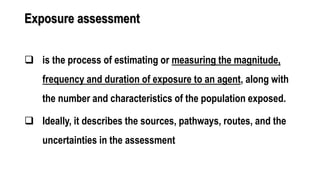
Exposure assessment
 is the process of estimating or measuring the magnitude,
frequency and duration of exposure to an agent, along with
the number and characteristics of the population exposed.
 Ideally, it describes the sources, pathways, routes, and the
uncertainties in the assessment
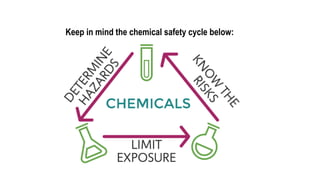
Keep in mind the chemical safety cycle below:
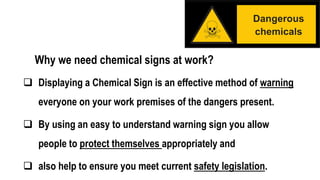
Why we need chemical signs at work?
 Displaying a Chemical Sign is an effective method of warning
everyone on your work premises of the dangers present.
 By using an easy to understand warning sign you allow
people to protect themselves appropriately and
 also help to ensure you meet current safety legislation.
Chemical Warning Signs
 Chemical warning signs are designed to alert those in your
workplace or facility of any chemicals or materials that present a
physical or health hazard when used.
 These safety signs help remind workers of proper handling
procedures, and often times, chemical hazard signs are the only
thing keeping the workplace accident free.
• Each hazard which is toxic, corrosive, flammable, harmful or
irritant is given a simple symbol which can be easily
recognised.
Safety signs
Categories of safety signs
 Safety signs are divided into categories according to the type
of message they are intended to convey.
 Each category is assigned a specific format and set of
colours.
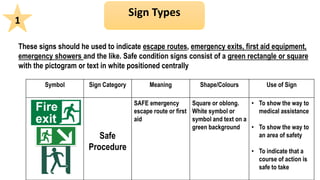
Symbol Sign Category Meaning Shape/Colours Use of Sign
Safe
Procedure
SAFE emergency
escape route or first
aid
Square or oblong.
White symbol or
symbol and text on a
green background
• To show the way to
medical assistance
• To show the way to
an area of safety
• To indicate that a
course of action is
safe to take
Sign Types
1
These signs should he used to indicate escape routes, emergency exits, first aid equipment,
emergency showers and the like. Safe condition signs consist of a green rectangle or square
with the pictogram or text in white positioned centrally
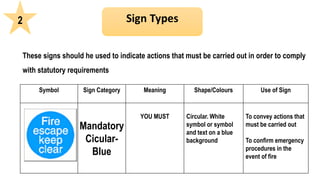
Symbol Sign Category Meaning Shape/Colours Use of Sign
Mandatory
Cicular-
Blue
YOU MUST Circular. White
symbol or symbol
and text on a blue
background
To convey actions that
must be carried out
To confirm emergency
procedures in the
event of fire
2
These signs should he used to indicate actions that must be carried out in order to comply
with statutory requirements
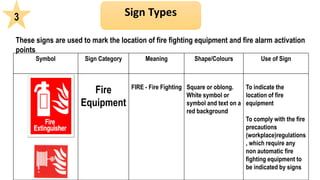
Symbol Sign Category Meaning Shape/Colours Use of Sign
Fire
Equipment
FIRE - Fire Fighting Square or oblong.
White symbol or
symbol and text on a
red background
To indicate the
location of fire
equipment
To comply with the fire
precautions
(workplace)regulations
, which require any
non automatic fire
fighting equipment to
be indicated by signs
3
These signs are used to mark the location of fire fighting equipment and fire alarm activation
points.
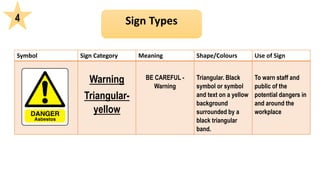
Symbol Sign Category Meaning Shape/Colours Use of Sign
Warning
Triangular-
yellow
BE CAREFUL -
Warning
Triangular. Black
symbol or symbol
and text on a yellow
background
surrounded by a
black triangular
band.
To warn staff and
public of the
potential dangers in
and around the
workplace
4
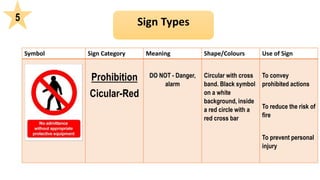
Symbol Sign Category Meaning Shape/Colours Use of Sign
Prohibition
Cicular-Red
DO NOT - Danger,
alarm
Circular with cross
band. Black symbol
on a white
background, inside
a red circle with a
red cross bar
To convey
prohibited actions
To reduce the risk of
fire
To prevent personal
injury
5
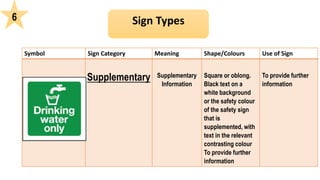
Symbol Sign Category Meaning Shape/Colours Use of Sign
Supplementary Supplementary
Information
Square or oblong.
Black text on a
white background
or the safety colour
of the safety sign
that is
supplemented, with
text in the relevant
contrasting colour
To provide further
information
To provide further
information
6
Chemical Identification Signs
 Chemical identification signs are of vital importance when it
comes to keeping employees and visitors safe from harmful
chemicals in your facility.
 Chemical identification signs identify the chemical being
used or stored
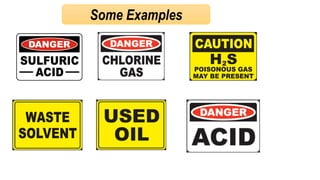
Some Examples
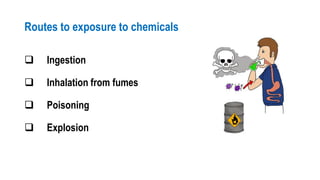
Routes to exposure to chemicals
 Ingestion
 Inhalation from fumes
 Poisoning
 Explosion
Transitioning to safer chemicals
 OSHA’ Form a team to develop a plan.
1. Form a team to develop a plan.
2. Examine the current chemical use. This will help prioritize
chemicals that need to be phased out of the supply chain.
3. Identify safer alternatives to get a clear overview of your
options.
Transitioning to safer chemicals (continued)
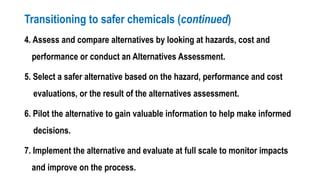
4. Assess and compare alternatives by looking at hazards, cost and
performance or conduct an Alternatives Assessment.
5. Select a safer alternative based on the hazard, performance and cost
evaluations, or the result of the alternatives assessment.
6. Pilot the alternative to gain valuable information to help make informed
decisions.
7. Implement the alternative and evaluate at full scale to monitor impacts
and improve on the process.

Safety in work part 1-release

  • 1.
    Safety in Work!!!! Hazard,Risk, Signs, exposure to chemicals Dr Farhad M. Ali
  • 2.
    Outline  Safety  Hazard Risk  Routes to exposure to chemicals
  • 3.
    What is safety? Safety means keeping yourself and others free from harm or danger.  It means taking care not to fall or bump or run into things.  It also means to avoid accidents by being careful with what you are doing.  The condition of being protected from or unlikely to cause danger, risk, or injury.
  • 4.
    Safety  To avoidaccidents we must be careful carrying out experiments.  Most safety rules are only common sense.
  • 5.
    • Do youfeel you are safe at your work? Why not? Group to talk about their safety at work
  • 6.
    Do we shouldhave a safety manager? Safety Manager responsibilities include:  Developing and executing health and safety plans in the workplace according to legal guidelines  Preparing and enforcing policies to establish a culture of health and safety  Evaluating practices, procedures and facilities to assess risk and adherence to the law
  • 7.
    This fume hood wasused by a researcher who died of injuries sustained in a 2008 lab fire.
  • 8.
  • 9.
    Hazard: What doesit mean?  A hazard is any source of potential damage, harm or adverse health effects on something or someone.  Harm - physical injury or damage to health.
  • 10.
     There arelaws about using chemicals to help keep safe everyone who works with chemicals.  Hazard warning labels are attached to dangerous chemicals.  Hazard symbols are on road tankers to warn about dangers should the chemicals spill.
  • 11.
    What types ofhazards are there? A common way to classify hazards is by category:  Biological - bacteria, viruses, insects, plants, birds, animals, and humans, etc.,  Chemical - depends on the physical, chemical and toxic properties of the chemical,  Ergonomic - repetitive movements, improper set up of workstation, etc.,
  • 12.
    What types ofhazards are there? A common way to classify hazards is by category:  Physical - radiation, magnetic fields, pressure extremes (high pressure or vacuum), noise, etc.,  Psychosocial - stress, violence, etc.,  Safety - slipping/tripping hazards, inappropriate machine guarding, equipment malfunctions or breakdowns.
  • 13.
    Risk: What doesit mean?  Risk is the chance or probability high or low that a person will be harmed or experience an adverse health effect if exposed to a hazard.  Risk is a function of toxicity and exposure.  Every workplace has a certain amount of risk.
  • 14.
     Hazards andrisks are not the same thing.  Risks are expressed as a probability or likelihood of developing a disease or getting injured,  whereas hazards refer to the possible consequences.
  • 19.
    Factors that influencethe degree of risk include:  How much a person is exposed to a hazardous thing or condition,  How the person is exposed (e.g., breathing in a vapour, skin contact), and  How severe are the effects under the conditions of exposure.
  • 20.
    What is arisk assessment? Risk assessment is the process where you:  Identify hazards and risk factors that have the potential to cause harm (hazard identification).  Analyse and evaluate the risk associated with that hazard (risk analysis, and risk evaluation).  Determine appropriate ways to eliminate the hazard, or control the risk when the hazard cannot be eliminated (risk control).
  • 22.
    The four essentialsteps to managing risk are: 1. Identify all foreseeable hazards in the workplace that have potential to harm anyone. 2. Assess the amount of risk from the hazard. The goal here is to find out how much impact the risk would have on people exposed, and then establish the chance of this risk actually happening. 3. Control the hazard or, if possible, remove the risk completely. This is done by introducing systems and implementing strategies to eliminate or control the hazard. 4. Review risk assessment to monitor and improve ‘control measures’ and find safer ways of doing things.
  • 23.
    Exposure assessment  isthe process of estimating or measuring the magnitude, frequency and duration of exposure to an agent, along with the number and characteristics of the population exposed.  Ideally, it describes the sources, pathways, routes, and the uncertainties in the assessment
  • 24.
    Keep in mindthe chemical safety cycle below:
  • 25.
    Why we needchemical signs at work?  Displaying a Chemical Sign is an effective method of warning everyone on your work premises of the dangers present.  By using an easy to understand warning sign you allow people to protect themselves appropriately and  also help to ensure you meet current safety legislation.
  • 26.
    Chemical Warning Signs Chemical warning signs are designed to alert those in your workplace or facility of any chemicals or materials that present a physical or health hazard when used.  These safety signs help remind workers of proper handling procedures, and often times, chemical hazard signs are the only thing keeping the workplace accident free.
  • 27.
    • Each hazardwhich is toxic, corrosive, flammable, harmful or irritant is given a simple symbol which can be easily recognised.
  • 28.
    Safety signs Categories ofsafety signs  Safety signs are divided into categories according to the type of message they are intended to convey.  Each category is assigned a specific format and set of colours.
  • 29.
    Symbol Sign CategoryMeaning Shape/Colours Use of Sign Safe Procedure SAFE emergency escape route or first aid Square or oblong. White symbol or symbol and text on a green background • To show the way to medical assistance • To show the way to an area of safety • To indicate that a course of action is safe to take Sign Types 1 These signs should he used to indicate escape routes, emergency exits, first aid equipment, emergency showers and the like. Safe condition signs consist of a green rectangle or square with the pictogram or text in white positioned centrally
  • 30.
    Symbol Sign CategoryMeaning Shape/Colours Use of Sign Mandatory Cicular- Blue YOU MUST Circular. White symbol or symbol and text on a blue background To convey actions that must be carried out To confirm emergency procedures in the event of fire 2 These signs should he used to indicate actions that must be carried out in order to comply with statutory requirements
  • 31.
    Symbol Sign CategoryMeaning Shape/Colours Use of Sign Fire Equipment FIRE - Fire Fighting Square or oblong. White symbol or symbol and text on a red background To indicate the location of fire equipment To comply with the fire precautions (workplace)regulations , which require any non automatic fire fighting equipment to be indicated by signs 3 These signs are used to mark the location of fire fighting equipment and fire alarm activation points.
  • 32.
    Symbol Sign CategoryMeaning Shape/Colours Use of Sign Warning Triangular- yellow BE CAREFUL - Warning Triangular. Black symbol or symbol and text on a yellow background surrounded by a black triangular band. To warn staff and public of the potential dangers in and around the workplace 4
  • 33.
    Symbol Sign CategoryMeaning Shape/Colours Use of Sign Prohibition Cicular-Red DO NOT - Danger, alarm Circular with cross band. Black symbol on a white background, inside a red circle with a red cross bar To convey prohibited actions To reduce the risk of fire To prevent personal injury 5
  • 34.
    Symbol Sign CategoryMeaning Shape/Colours Use of Sign Supplementary Supplementary Information Square or oblong. Black text on a white background or the safety colour of the safety sign that is supplemented, with text in the relevant contrasting colour To provide further information To provide further information 6
  • 35.
    Chemical Identification Signs Chemical identification signs are of vital importance when it comes to keeping employees and visitors safe from harmful chemicals in your facility.  Chemical identification signs identify the chemical being used or stored
  • 36.
  • 37.
    Routes to exposureto chemicals  Ingestion  Inhalation from fumes  Poisoning  Explosion
  • 38.
    Transitioning to saferchemicals  OSHA’ Form a team to develop a plan. 1. Form a team to develop a plan. 2. Examine the current chemical use. This will help prioritize chemicals that need to be phased out of the supply chain. 3. Identify safer alternatives to get a clear overview of your options.
  • 39.
    Transitioning to saferchemicals (continued) 4. Assess and compare alternatives by looking at hazards, cost and performance or conduct an Alternatives Assessment. 5. Select a safer alternative based on the hazard, performance and cost evaluations, or the result of the alternatives assessment. 6. Pilot the alternative to gain valuable information to help make informed decisions. 7. Implement the alternative and evaluate at full scale to monitor impacts and improve on the process.