1
Safety Implications of Managed Lane
Cross Sectional Elements
(Buffer Width vs. Shoulder Width vs. Lane Width)
Raul Avelar, Ph.D., P.E.
Kay Fitzpatrick, Ph.D., P.E.
1
2016 Traffic Safety Conference
June 7, 2016
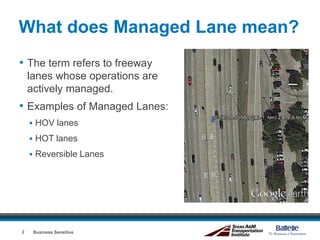
What does Managed Lane mean?
• The term refers to freeway
lanes whose operations are
actively managed.
• Examples of Managed Lanes:
 HOV lanes
 HOT lanes
 Reversible Lanes
Business Sensitive2
Project Objectives
• Evaluate managed lane facilities that are currently used in
the U.S. to inform decisions about lane, buffer, and
shoulder (inside and outside) widths.
• To assess the safety impacts of using of narrow widths.
Business Sensitive3
Previous Findings – Freeways
• Freeway crash prediction equations available in Highway
Safety Manual
• Reduction in freeway shoulder width  increase crashes
• Reduction in freeway lane width  increase crashes
• Increase in crashes may be offset if reductions are done
to increase number of freeway lanes
Business Sensitive4
Previous Findings – Managed Lanes
• Florida study  crash prediction equations for HOV /
HOT lanes
 Left shoulder width and 2-3 ft buffer (10 lane freeways) found to
influence safety
• California study
 Wider HOV lane width associated with fewer HOV crashes
 Wider left shoulder width associated with fewer HOV crashes
• Texas study (narratives) identify following contributors
 Reduced HOV cross section, location of GP ramps, speed
differential
Business Sensitive5
Identify Potential Sites
• Gather geometric information for a sample of existing
managed lanes
 Review aerial photographs of several sites in several states (focus
on states with available crash data)
 Key variables
− Number of managed lanes
− Managed lane – left shoulder width
− Managed lane – lane width
− Separation – barrier, buffer, and width
Business Sensitive6
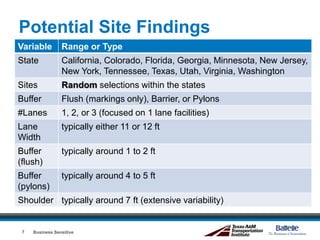
Potential Site Findings
Variable Range or Type
State California, Colorado, Florida, Georgia, Minnesota, New Jersey,
New York, Tennessee, Texas, Utah, Virginia, Washington
Sites Random selections within the states
Buffer Flush (markings only), Barrier, or Pylons
#Lanes 1, 2, or 3 (focused on 1 lane facilities)
Lane
Width
typically either 11 or 12 ft
Buffer
(flush)
typically around 1 to 2 ft
Buffer
(pylons)
typically around 4 to 5 ft
Shoulder typically around 7 ft (extensive variability)
Business Sensitive7
Crash Data
• Determine availability of suitable crash data
 Highway Safety Information System databases
− California
− Washington
− Minnesota
− North Carolina
− Ohio
− Illinois
 Texas
Business Sensitive8
Crash Data – Promising Leads
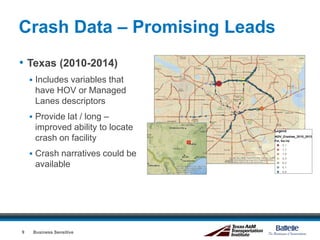
• Texas (2010-2014)
 Includes variables that
have HOV or Managed
Lanes descriptors
 Provide lat / long –
improved ability to locate
crash on facility
 Crash narratives could be
available
Business Sensitive9
Crash Data – Promising Leads
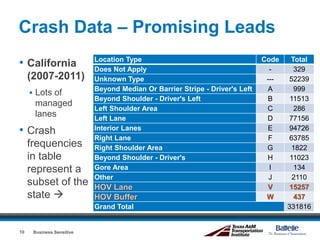
• California
(2007-2011)
 Lots of
managed
lanes
• Crash
frequencies
in table
represent a
subset of the
state 
Location Type Code Total
Does Not Apply - 329
Unknown Type --- 52239
Beyond Median Or Barrier Stripe - Driver's Left A 999
Beyond Shoulder - Driver's Left B 11513
Left Shoulder Area C 286
Left Lane D 77156
Interior Lanes E 94726
Right Lane F 63785
Right Shoulder Area G 1822
Beyond Shoulder - Driver's H 11023
Gore Area I 134
Other J 2110
HOV Lane V 15257
HOV Buffer W 437
Grand Total 331816
Business Sensitive10
Site Selection
• Focus on sites with 1 managed lane (rather than 2 lanes)
• Eliminate sites w/ reversible ops or concrete barrier
separation
• Prefer managed lanes that are operational 24/7
• Want range of buffer widths, shoulder widths, lane widths
Business Sensitive11
Managed Lane Sections
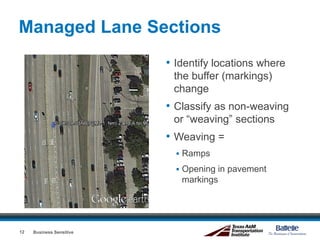
• Identify locations where
the buffer (markings)
change
• Classify as non-weaving
or “weaving” sections
• Weaving =
 Ramps
 Opening in pavement
markings
Business Sensitive12
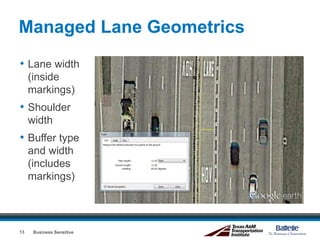
Managed Lane Geometrics
• Lane width
(inside
markings)
• Shoulder
width
• Buffer type
and width
(includes
markings)
Business Sensitive13
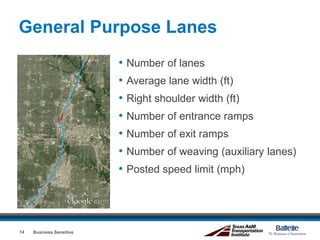
General Purpose Lanes
• Number of lanes
• Average lane width (ft)
• Right shoulder width (ft)
• Number of entrance ramps
• Number of exit ramps
• Number of weaving (auxiliary lanes)
• Posted speed limit (mph)
Business Sensitive14
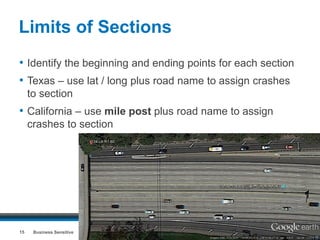
Limits of Sections
• Identify the beginning and ending points for each section
• Texas – use lat / long plus road name to assign crashes
to section
• California – use mile post plus road name to assign
crashes to section
Business Sensitive15
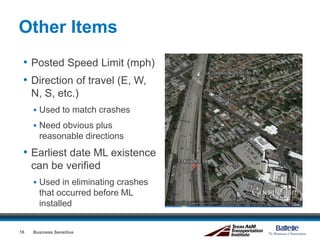
Other Items
• Posted Speed Limit (mph)
• Direction of travel (E, W,
N, S, etc.)
 Used to match crashes
 Need obvious plus
reasonable directions
• Earliest date ML existence
can be verified
 Used in eliminating crashes
that occurred before ML
installed
Business Sensitive16
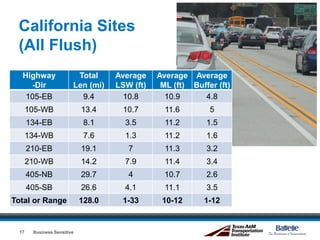
California Sites
(All Flush)
Business Sensitive
Highway
-Dir
Total
Len (mi)
Average
LSW (ft)
Average
ML (ft)
Average
Buffer (ft)
105-EB 9.4 10.8 10.9 4.8
105-WB 13.4 10.7 11.6 5
134-EB 8.1 3.5 11.2 1.5
134-WB 7.6 1.3 11.2 1.6
210-EB 19.1 7 11.3 3.2
210-WB 14.2 7.9 11.4 3.4
405-NB 29.7 4 10.7 2.6
405-SB 26.6 4.1 11.1 3.5
Total or Range 128.0 1-33 10-12 1-12
17
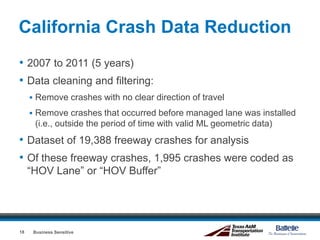
California Crash Data Reduction
• 2007 to 2011 (5 years)
• Data cleaning and filtering:
 Remove crashes with no clear direction of travel
 Remove crashes that occurred before managed lane was installed
(i.e., outside the period of time with valid ML geometric data)
• Dataset of 19,388 freeway crashes for analysis
• Of these freeway crashes, 1,995 crashes were coded as
“HOV Lane” or “HOV Buffer”
Business Sensitive18
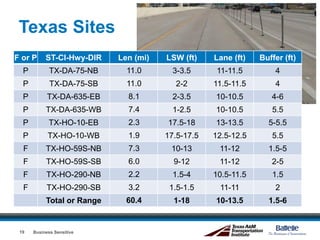
Texas Sites
Business Sensitive
F or P ST-CI-Hwy-DIR Len (mi) LSW (ft) Lane (ft) Buffer (ft)
P TX-DA-75-NB 11.0 3-3.5 11-11.5 4
P TX-DA-75-SB 11.0 2-2 11.5-11.5 4
P TX-DA-635-EB 8.1 2-3.5 10-10.5 4-6
P TX-DA-635-WB 7.4 1-2.5 10-10.5 5.5
P TX-HO-10-EB 2.3 17.5-18 13-13.5 5-5.5
P TX-HO-10-WB 1.9 17.5-17.5 12.5-12.5 5.5
F TX-HO-59S-NB 7.3 10-13 11-12 1.5-5
F TX-HO-59S-SB 6.0 9-12 11-12 2-5
F TX-HO-290-NB 2.2 1.5-4 10.5-11.5 1.5
F TX-HO-290-SB 3.2 1.5-1.5 11-11 2
Total or Range 60.4 1-18 10-13.5 1.5-6
19
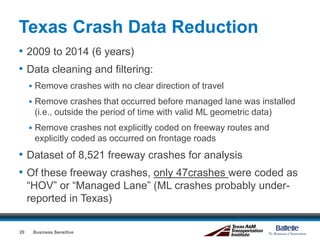
Texas Crash Data Reduction
Business Sensitive20
• 2009 to 2014 (6 years)
• Data cleaning and filtering:
 Remove crashes with no clear direction of travel
 Remove crashes that occurred before managed lane was installed
(i.e., outside the period of time with valid ML geometric data)
 Remove crashes not explicitly coded on freeway routes and
explicitly coded as occurred on frontage roads
• Dataset of 8,521 freeway crashes for analysis
• Of these freeway crashes, only 47crashes were coded as
“HOV” or “Managed Lane” (ML crashes probably under-
reported in Texas)
Evaluations
• Managed-lane related crashes  California only
 All severity levels
 Fatal and injury severity levels
 AADT = volume on managed lane
• Freeway crashes  both California and Texas
 All severity levels
 Fatal and injury severity levels
 AADT = volume on freeway
Business Sensitive21
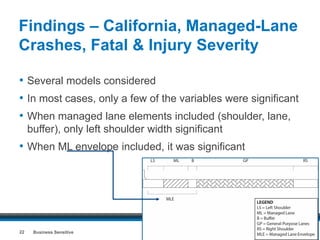
Findings – California, Managed-Lane
Crashes, Fatal & Injury Severity
• Several models considered
• In most cases, only a few of the variables were significant
• When managed lane elements included (shoulder, lane,
buffer), only left shoulder width significant
• When ML envelope included, it was significant
Business Sensitive22
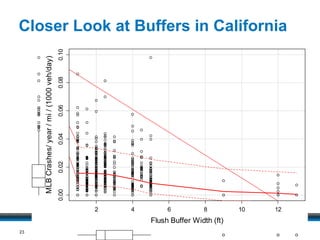
Closer Look at Buffers in California
Business Sensitive23
2 4 6 8 10 12
0.000.020.040.060.080.10
Flush Buffer Width (ft)
MLBCrashes/year/mi/(1000veh/day)
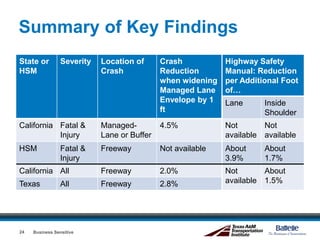
Summary of Key Findings
State or
HSM
Severity Location of
Crash
Crash
Reduction
when widening
Managed Lane
Envelope by 1
ft
Highway Safety
Manual: Reduction
per Additional Foot
of…
Lane Inside
Shoulder
California Fatal &
Injury
Managed-
Lane or Buffer
4.5% Not
available
Not
available
HSM Fatal &
Injury
Freeway Not available About
3.9%
About
1.7%
California All Freeway 2.0% Not
available
About
1.5%Texas All Freeway 2.8%
Business Sensitive24
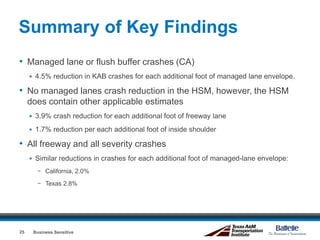
Summary of Key Findings
Business Sensitive25
• Managed lane or flush buffer crashes (CA)
 4.5% reduction in KAB crashes for each additional foot of managed lane envelope.
• No managed lanes crash reduction in the HSM, however, the HSM
does contain other applicable estimates
 3.9% crash reduction for each additional foot of freeway lane
 1.7% reduction per each additional foot of inside shoulder
• All freeway and all severity crashes
 Similar reductions in crashes for each additional foot of managed-lane envelope:
− California, 2.0%
− Texas 2.8%
26
Synthesis of Operational Aspects and Safety
Implications of Reduced Cross Sectional Elements
(Buffer Width vs. Shoulder Width vs. Lane Width)
Raul Avelar, Ph.D., P.E.
Kay Fitzpatrick, Ph.D., P.E.
26
DISCUSSION

Safety Implications of Managed Lane Cross-Sectional Elements

  • 1.
    1 Safety Implications ofManaged Lane Cross Sectional Elements (Buffer Width vs. Shoulder Width vs. Lane Width) Raul Avelar, Ph.D., P.E. Kay Fitzpatrick, Ph.D., P.E. 1 2016 Traffic Safety Conference June 7, 2016
  • 2.
    What does ManagedLane mean? • The term refers to freeway lanes whose operations are actively managed. • Examples of Managed Lanes:  HOV lanes  HOT lanes  Reversible Lanes Business Sensitive2
  • 3.
    Project Objectives • Evaluatemanaged lane facilities that are currently used in the U.S. to inform decisions about lane, buffer, and shoulder (inside and outside) widths. • To assess the safety impacts of using of narrow widths. Business Sensitive3
  • 4.
    Previous Findings –Freeways • Freeway crash prediction equations available in Highway Safety Manual • Reduction in freeway shoulder width  increase crashes • Reduction in freeway lane width  increase crashes • Increase in crashes may be offset if reductions are done to increase number of freeway lanes Business Sensitive4
  • 5.
    Previous Findings –Managed Lanes • Florida study  crash prediction equations for HOV / HOT lanes  Left shoulder width and 2-3 ft buffer (10 lane freeways) found to influence safety • California study  Wider HOV lane width associated with fewer HOV crashes  Wider left shoulder width associated with fewer HOV crashes • Texas study (narratives) identify following contributors  Reduced HOV cross section, location of GP ramps, speed differential Business Sensitive5
  • 6.
    Identify Potential Sites •Gather geometric information for a sample of existing managed lanes  Review aerial photographs of several sites in several states (focus on states with available crash data)  Key variables − Number of managed lanes − Managed lane – left shoulder width − Managed lane – lane width − Separation – barrier, buffer, and width Business Sensitive6
  • 7.
    Potential Site Findings VariableRange or Type State California, Colorado, Florida, Georgia, Minnesota, New Jersey, New York, Tennessee, Texas, Utah, Virginia, Washington Sites Random selections within the states Buffer Flush (markings only), Barrier, or Pylons #Lanes 1, 2, or 3 (focused on 1 lane facilities) Lane Width typically either 11 or 12 ft Buffer (flush) typically around 1 to 2 ft Buffer (pylons) typically around 4 to 5 ft Shoulder typically around 7 ft (extensive variability) Business Sensitive7
  • 8.
    Crash Data • Determineavailability of suitable crash data  Highway Safety Information System databases − California − Washington − Minnesota − North Carolina − Ohio − Illinois  Texas Business Sensitive8
  • 9.
    Crash Data –Promising Leads • Texas (2010-2014)  Includes variables that have HOV or Managed Lanes descriptors  Provide lat / long – improved ability to locate crash on facility  Crash narratives could be available Business Sensitive9
  • 10.
    Crash Data –Promising Leads • California (2007-2011)  Lots of managed lanes • Crash frequencies in table represent a subset of the state  Location Type Code Total Does Not Apply - 329 Unknown Type --- 52239 Beyond Median Or Barrier Stripe - Driver's Left A 999 Beyond Shoulder - Driver's Left B 11513 Left Shoulder Area C 286 Left Lane D 77156 Interior Lanes E 94726 Right Lane F 63785 Right Shoulder Area G 1822 Beyond Shoulder - Driver's H 11023 Gore Area I 134 Other J 2110 HOV Lane V 15257 HOV Buffer W 437 Grand Total 331816 Business Sensitive10
  • 11.
    Site Selection • Focuson sites with 1 managed lane (rather than 2 lanes) • Eliminate sites w/ reversible ops or concrete barrier separation • Prefer managed lanes that are operational 24/7 • Want range of buffer widths, shoulder widths, lane widths Business Sensitive11
  • 12.
    Managed Lane Sections •Identify locations where the buffer (markings) change • Classify as non-weaving or “weaving” sections • Weaving =  Ramps  Opening in pavement markings Business Sensitive12
  • 13.
    Managed Lane Geometrics •Lane width (inside markings) • Shoulder width • Buffer type and width (includes markings) Business Sensitive13
  • 14.
    General Purpose Lanes •Number of lanes • Average lane width (ft) • Right shoulder width (ft) • Number of entrance ramps • Number of exit ramps • Number of weaving (auxiliary lanes) • Posted speed limit (mph) Business Sensitive14
  • 15.
    Limits of Sections •Identify the beginning and ending points for each section • Texas – use lat / long plus road name to assign crashes to section • California – use mile post plus road name to assign crashes to section Business Sensitive15
  • 16.
    Other Items • PostedSpeed Limit (mph) • Direction of travel (E, W, N, S, etc.)  Used to match crashes  Need obvious plus reasonable directions • Earliest date ML existence can be verified  Used in eliminating crashes that occurred before ML installed Business Sensitive16
  • 17.
    California Sites (All Flush) BusinessSensitive Highway -Dir Total Len (mi) Average LSW (ft) Average ML (ft) Average Buffer (ft) 105-EB 9.4 10.8 10.9 4.8 105-WB 13.4 10.7 11.6 5 134-EB 8.1 3.5 11.2 1.5 134-WB 7.6 1.3 11.2 1.6 210-EB 19.1 7 11.3 3.2 210-WB 14.2 7.9 11.4 3.4 405-NB 29.7 4 10.7 2.6 405-SB 26.6 4.1 11.1 3.5 Total or Range 128.0 1-33 10-12 1-12 17
  • 18.
    California Crash DataReduction • 2007 to 2011 (5 years) • Data cleaning and filtering:  Remove crashes with no clear direction of travel  Remove crashes that occurred before managed lane was installed (i.e., outside the period of time with valid ML geometric data) • Dataset of 19,388 freeway crashes for analysis • Of these freeway crashes, 1,995 crashes were coded as “HOV Lane” or “HOV Buffer” Business Sensitive18
  • 19.
    Texas Sites Business Sensitive For P ST-CI-Hwy-DIR Len (mi) LSW (ft) Lane (ft) Buffer (ft) P TX-DA-75-NB 11.0 3-3.5 11-11.5 4 P TX-DA-75-SB 11.0 2-2 11.5-11.5 4 P TX-DA-635-EB 8.1 2-3.5 10-10.5 4-6 P TX-DA-635-WB 7.4 1-2.5 10-10.5 5.5 P TX-HO-10-EB 2.3 17.5-18 13-13.5 5-5.5 P TX-HO-10-WB 1.9 17.5-17.5 12.5-12.5 5.5 F TX-HO-59S-NB 7.3 10-13 11-12 1.5-5 F TX-HO-59S-SB 6.0 9-12 11-12 2-5 F TX-HO-290-NB 2.2 1.5-4 10.5-11.5 1.5 F TX-HO-290-SB 3.2 1.5-1.5 11-11 2 Total or Range 60.4 1-18 10-13.5 1.5-6 19
  • 20.
    Texas Crash DataReduction Business Sensitive20 • 2009 to 2014 (6 years) • Data cleaning and filtering:  Remove crashes with no clear direction of travel  Remove crashes that occurred before managed lane was installed (i.e., outside the period of time with valid ML geometric data)  Remove crashes not explicitly coded on freeway routes and explicitly coded as occurred on frontage roads • Dataset of 8,521 freeway crashes for analysis • Of these freeway crashes, only 47crashes were coded as “HOV” or “Managed Lane” (ML crashes probably under- reported in Texas)
  • 21.
    Evaluations • Managed-lane relatedcrashes  California only  All severity levels  Fatal and injury severity levels  AADT = volume on managed lane • Freeway crashes  both California and Texas  All severity levels  Fatal and injury severity levels  AADT = volume on freeway Business Sensitive21
  • 22.
    Findings – California,Managed-Lane Crashes, Fatal & Injury Severity • Several models considered • In most cases, only a few of the variables were significant • When managed lane elements included (shoulder, lane, buffer), only left shoulder width significant • When ML envelope included, it was significant Business Sensitive22
  • 23.
    Closer Look atBuffers in California Business Sensitive23 2 4 6 8 10 12 0.000.020.040.060.080.10 Flush Buffer Width (ft) MLBCrashes/year/mi/(1000veh/day)
  • 24.
    Summary of KeyFindings State or HSM Severity Location of Crash Crash Reduction when widening Managed Lane Envelope by 1 ft Highway Safety Manual: Reduction per Additional Foot of… Lane Inside Shoulder California Fatal & Injury Managed- Lane or Buffer 4.5% Not available Not available HSM Fatal & Injury Freeway Not available About 3.9% About 1.7% California All Freeway 2.0% Not available About 1.5%Texas All Freeway 2.8% Business Sensitive24
  • 25.
    Summary of KeyFindings Business Sensitive25 • Managed lane or flush buffer crashes (CA)  4.5% reduction in KAB crashes for each additional foot of managed lane envelope. • No managed lanes crash reduction in the HSM, however, the HSM does contain other applicable estimates  3.9% crash reduction for each additional foot of freeway lane  1.7% reduction per each additional foot of inside shoulder • All freeway and all severity crashes  Similar reductions in crashes for each additional foot of managed-lane envelope: − California, 2.0% − Texas 2.8%
  • 26.
    26 Synthesis of OperationalAspects and Safety Implications of Reduced Cross Sectional Elements (Buffer Width vs. Shoulder Width vs. Lane Width) Raul Avelar, Ph.D., P.E. Kay Fitzpatrick, Ph.D., P.E. 26 DISCUSSION