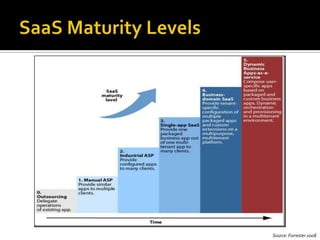
Source: Forrester 2008
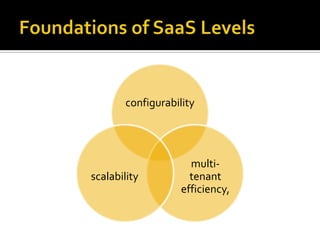
configurability


                     multi-
scalability          tenant
                   efficiency,
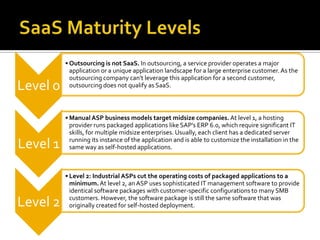
• Outsourcing is not SaaS. In outsourcing, a service provider operates a major
            application or a unique application landscape for a large enterprise customer. As the
            outsourcing company can't leverage this application for a second customer,
Level 0     outsourcing does not qualify as SaaS.


          • Manual ASP business models target midsize companies. At level 1, a hosting
            provider runs packaged applications like SAP's ERP 6.0, which require significant IT
            skills, for multiple midsize enterprises. Usually, each client has a dedicated server
            running its instance of the application and is able to customize the installation in the
Level 1     same way as self-hosted applications.


          • Level 2: Industrial ASPs cut the operating costs of packaged applications to a
            minimum. At level 2, an ASP uses sophisticated IT management software to provide
            identical software packages with customer-specific configurations to many SMB
            customers. However, the software package is still the same software that was
Level 2     originally created for self-hosted deployment.
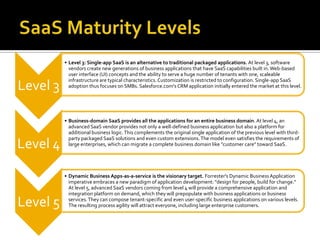
• Level 3: Single-app SaaS is an alternative to traditional packaged applications. At level 3, software
            vendors create new generations of business applications that have SaaS capabilities built in. Web-based
            user interface (UI) concepts and the ability to serve a huge number of tenants with one, scaleable
            infrastructure are typical characteristics. Customization is restricted to configuration. Single-app SaaS
Level 3     adoption thus focuses on SMBs. Salesforce.com's CRM application initially entered the market at this level.


          • Business-domain SaaS provides all the applications for an entire business domain. At level 4, an
            advanced SaaS vendor provides not only a well-defined business application but also a platform for
            additional business logic. This complements the original single application of the previous level with third-
            party packaged SaaS solutions and even custom extensions. The model even satisfies the requirements of
Level 4     large enterprises, which can migrate a complete business domain like "customer care" toward SaaS.


          • Dynamic Business Apps-as-a-service is the visionary target. Forrester's Dynamic Business Application
            imperative embraces a new paradigm of application development: "design for people, build for change."
            At level 5, advanced SaaS vendors coming from level 4 will provide a comprehensive application and
            integration platform on demand, which they will prepopulate with business applications or business

Level 5     services. They can compose tenant-specific and even user-specific business applications on various levels.
            The resulting process agility will attract everyone, including large enterprise customers.
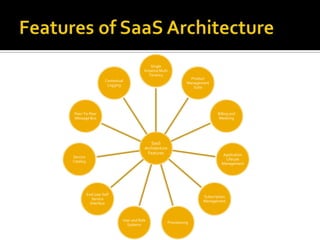
Single
                                          Instance Multi
                                             Tenancy
                                                                      Product
                     Contextual
                                                                    Management
                      Logging
                                                                       Suite


Peer-To-Peer                                                                      Billing and
Message Bus                                                                       Metering


                                             SaaS
                                          Architecture
                                           Features                                  Application
Service
                                                                                      Lifecyle
Catalog
                                                                                    Management


          End User Self
                                                                           Subscription
             Service
                                                                           Management
            Interface


                              User and Role
                                                         Provisioning
                                Systems
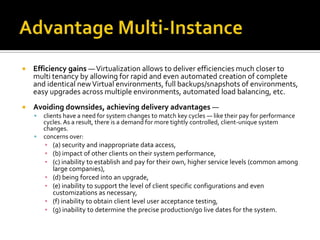
   Efficiency gains — Virtualization allows to deliver efficiencies much closer to
    multi tenancy by allowing for rapid and even automated creation of complete
    and identical new Virtual environments, full backups/snapshots of environments,
    easy upgrades across multiple environments, automated load balancing, etc.
   Avoiding downsides, achieving delivery advantages —
       clients have a need for system changes to match key cycles — like their pay for performance
        cycles. As a result, there is a demand for more tightly controlled, client-unique system
        changes.
       concerns over:
        ▪ (a) security and inappropriate data access,
        ▪ (b) impact of other clients on their system performance,
        ▪ (c) inability to establish and pay for their own, higher service levels (common among
          large companies),
        ▪ (d) being forced into an upgrade,
        ▪ (e) inability to support the level of client specific configurations and even
          customizations as necessary,
        ▪ (f) inability to obtain client level user acceptance testing,
        ▪ (g) inability to determine the precise production/go live dates for the system.
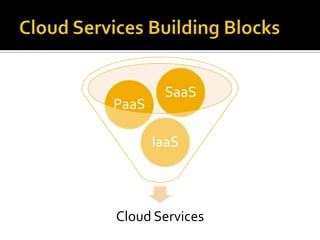
SaaS
PaaS

       IaaS


Cloud Services
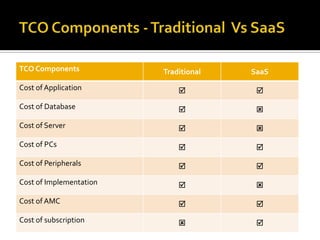
TCO Components           Traditional   SaaS
Cost of Application                    
Cost of Database                       
Cost of Server                         
Cost of PCs                            
Cost of Peripherals                    
Cost of Implementation                 
Cost of AMC                            
Cost of subscription                   
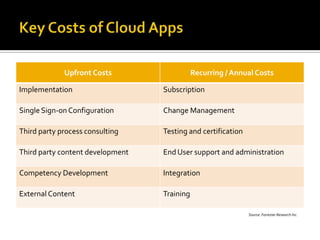
Upfront Costs                   Recurring / Annual Costs

Implementation                    Subscription

Single Sign-on Configuration      Change Management

Third party process consulting    Testing and certification

Third party content development   End User support and administration

Competency Development            Integration

External Content                  Training

                                                              Source: Forrester Research Inc.
THE DISRUPTIVE APPROACH
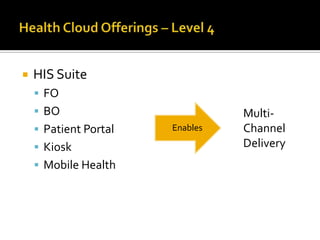
   HIS Suite
     FO
     BO                         Multi-
     Patient Portal   Enables   Channel
     Kiosk                      Delivery
     Mobile Health
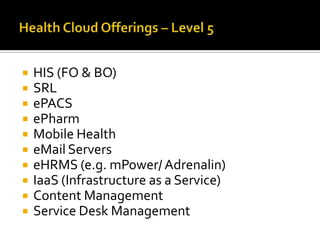
   HIS (FO & BO)
   SRL
   ePACS
   ePharm
   Mobile Health
   eMail Servers
   eHRMS (e.g. mPower/ Adrenalin)
   IaaS (Infrastructure as a Service)
   Content Management
   Service Desk Management

SaaS, Cloud Demystified

  • 2.
  • 3.
    configurability multi- scalability tenant efficiency,
  • 4.
    • Outsourcing isnot SaaS. In outsourcing, a service provider operates a major application or a unique application landscape for a large enterprise customer. As the outsourcing company can't leverage this application for a second customer, Level 0 outsourcing does not qualify as SaaS. • Manual ASP business models target midsize companies. At level 1, a hosting provider runs packaged applications like SAP's ERP 6.0, which require significant IT skills, for multiple midsize enterprises. Usually, each client has a dedicated server running its instance of the application and is able to customize the installation in the Level 1 same way as self-hosted applications. • Level 2: Industrial ASPs cut the operating costs of packaged applications to a minimum. At level 2, an ASP uses sophisticated IT management software to provide identical software packages with customer-specific configurations to many SMB customers. However, the software package is still the same software that was Level 2 originally created for self-hosted deployment.
  • 5.
    • Level 3:Single-app SaaS is an alternative to traditional packaged applications. At level 3, software vendors create new generations of business applications that have SaaS capabilities built in. Web-based user interface (UI) concepts and the ability to serve a huge number of tenants with one, scaleable infrastructure are typical characteristics. Customization is restricted to configuration. Single-app SaaS Level 3 adoption thus focuses on SMBs. Salesforce.com's CRM application initially entered the market at this level. • Business-domain SaaS provides all the applications for an entire business domain. At level 4, an advanced SaaS vendor provides not only a well-defined business application but also a platform for additional business logic. This complements the original single application of the previous level with third- party packaged SaaS solutions and even custom extensions. The model even satisfies the requirements of Level 4 large enterprises, which can migrate a complete business domain like "customer care" toward SaaS. • Dynamic Business Apps-as-a-service is the visionary target. Forrester's Dynamic Business Application imperative embraces a new paradigm of application development: "design for people, build for change." At level 5, advanced SaaS vendors coming from level 4 will provide a comprehensive application and integration platform on demand, which they will prepopulate with business applications or business Level 5 services. They can compose tenant-specific and even user-specific business applications on various levels. The resulting process agility will attract everyone, including large enterprise customers.
  • 6.
    Single Instance Multi Tenancy Product Contextual Management Logging Suite Peer-To-Peer Billing and Message Bus Metering SaaS Architecture Features Application Service Lifecyle Catalog Management End User Self Subscription Service Management Interface User and Role Provisioning Systems
  • 7.
    Efficiency gains — Virtualization allows to deliver efficiencies much closer to multi tenancy by allowing for rapid and even automated creation of complete and identical new Virtual environments, full backups/snapshots of environments, easy upgrades across multiple environments, automated load balancing, etc.  Avoiding downsides, achieving delivery advantages —  clients have a need for system changes to match key cycles — like their pay for performance cycles. As a result, there is a demand for more tightly controlled, client-unique system changes.  concerns over: ▪ (a) security and inappropriate data access, ▪ (b) impact of other clients on their system performance, ▪ (c) inability to establish and pay for their own, higher service levels (common among large companies), ▪ (d) being forced into an upgrade, ▪ (e) inability to support the level of client specific configurations and even customizations as necessary, ▪ (f) inability to obtain client level user acceptance testing, ▪ (g) inability to determine the precise production/go live dates for the system.
  • 8.
    SaaS PaaS IaaS Cloud Services
  • 9.
    TCO Components Traditional SaaS Cost of Application   Cost of Database   Cost of Server   Cost of PCs   Cost of Peripherals   Cost of Implementation   Cost of AMC   Cost of subscription  
  • 10.
    Upfront Costs Recurring / Annual Costs Implementation Subscription Single Sign-on Configuration Change Management Third party process consulting Testing and certification Third party content development End User support and administration Competency Development Integration External Content Training Source: Forrester Research Inc.
  • 11.
  • 12.
    HIS Suite  FO  BO Multi-  Patient Portal Enables Channel  Kiosk Delivery  Mobile Health
  • 13.
    HIS (FO & BO)  SRL  ePACS  ePharm  Mobile Health  eMail Servers  eHRMS (e.g. mPower/ Adrenalin)  IaaS (Infrastructure as a Service)  Content Management  Service Desk Management