Chapter 1 -
Introduction
• Security Violations
• OSI Security Architecture
• Network Security Model
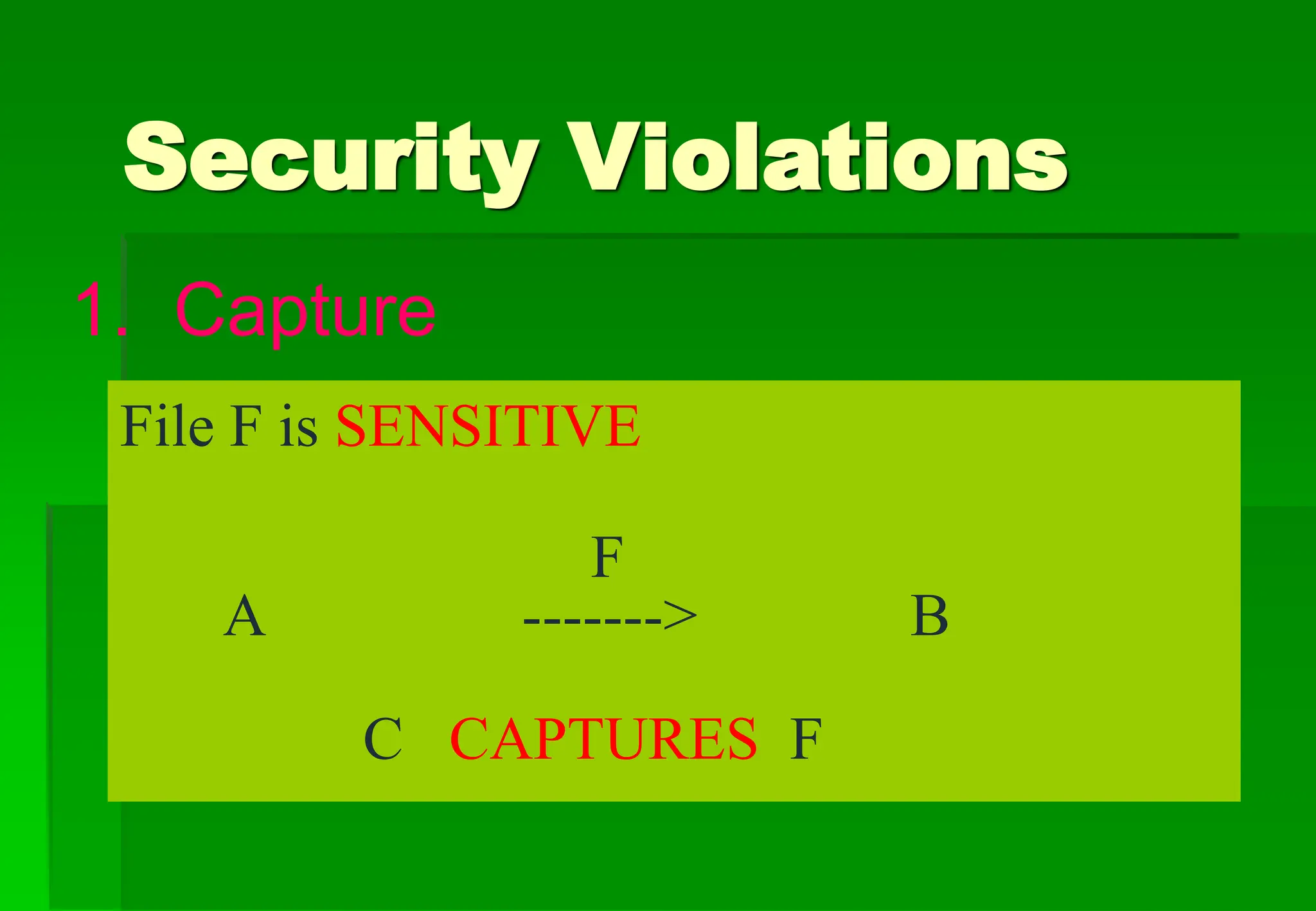
Security Violations
File F is SENSITIVE
F
A -------> B
C CAPTURES F
1. Capture
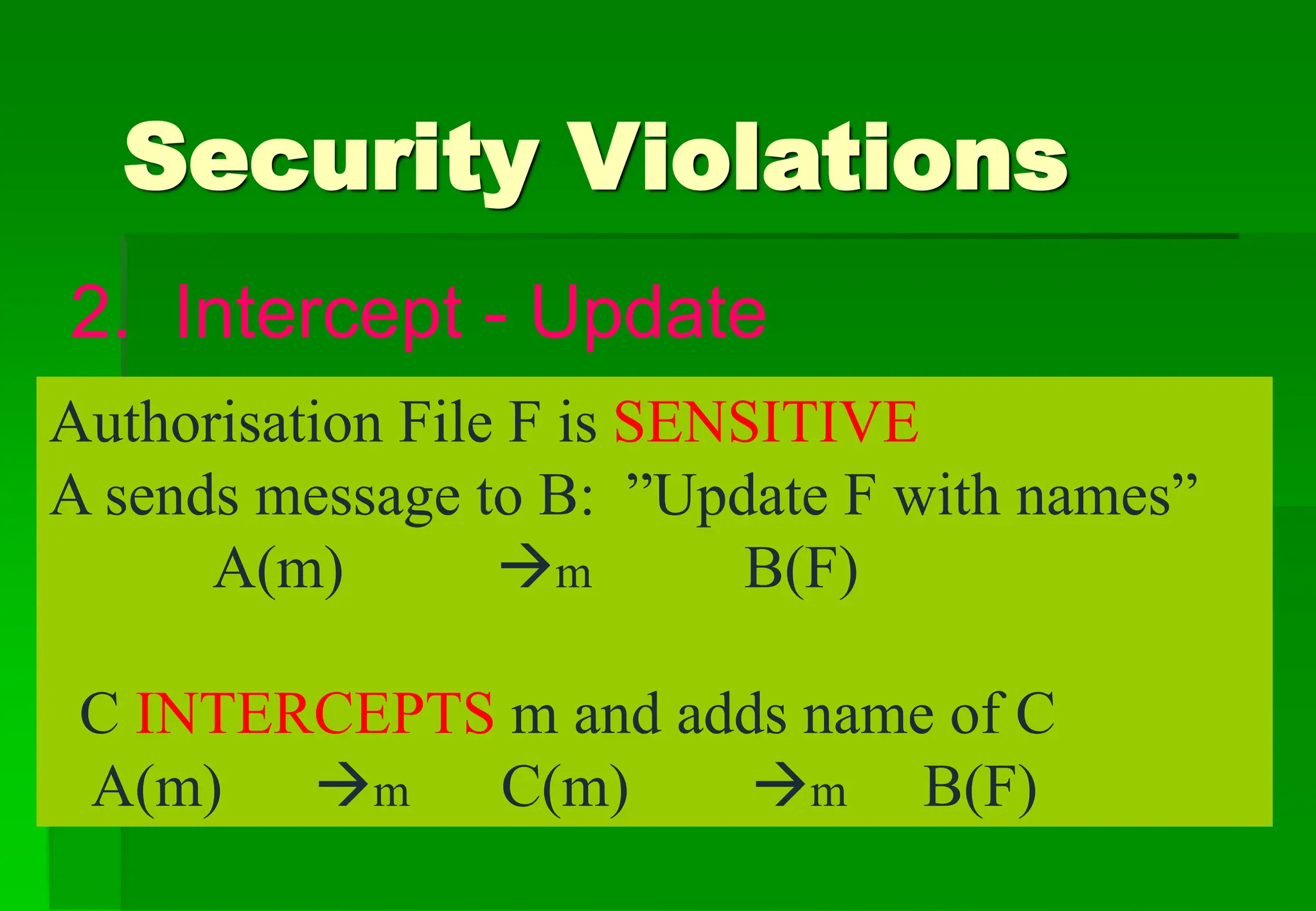
Security Violations
Authorisation File F is SENSITIVE
A sends message to B: ”Update F with names”
A(m) m B(F)
C INTERCEPTS m and adds name of C
A(m) m C(m) m B(F)
2. Intercept - Update
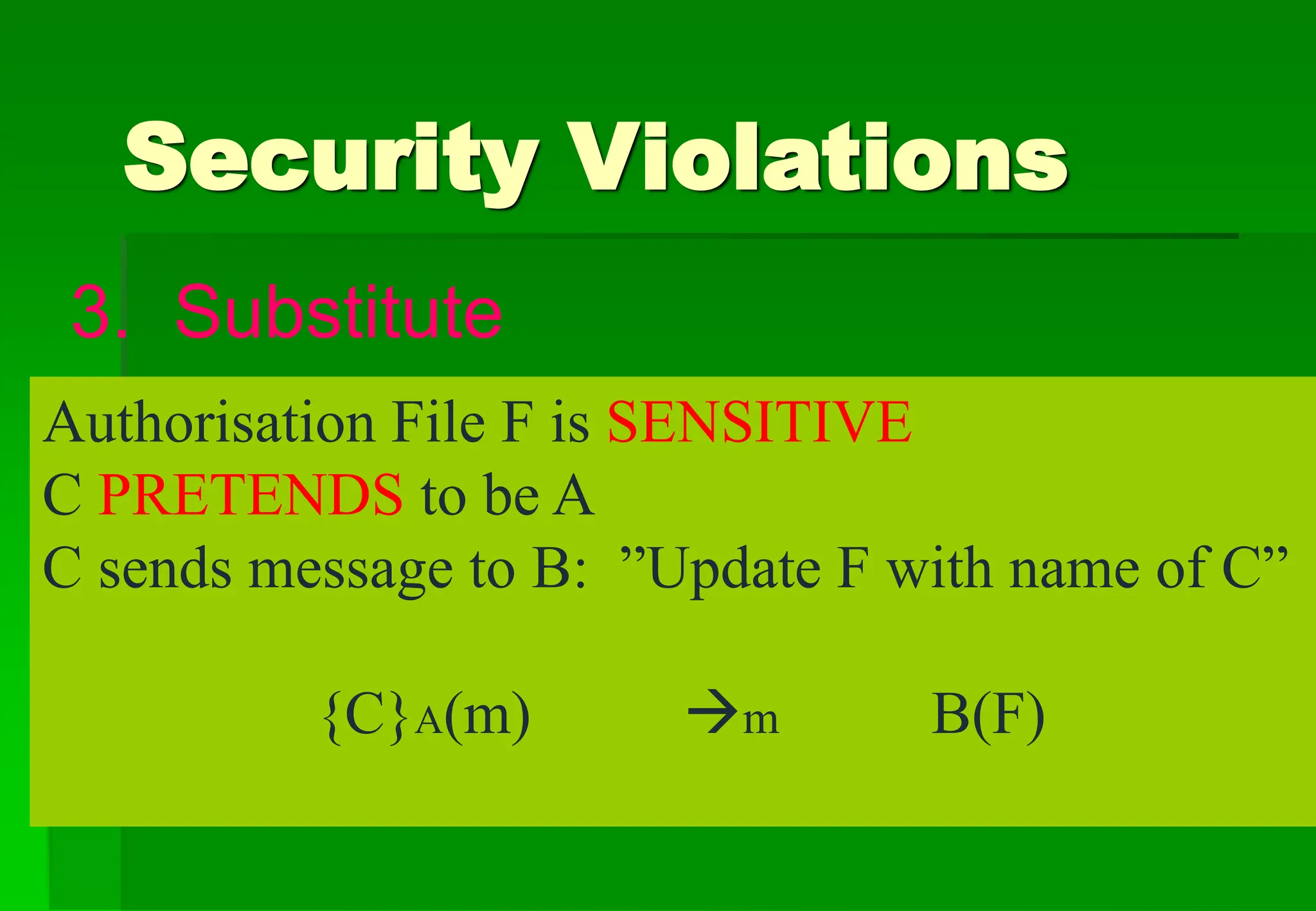
Security Violations
Authorisation File F is SENSITIVE
C PRETENDS to be A
C sends message to B: ”Update F with name of C”
{C}A(m) m B(F)
3. Substitute
Security Violations
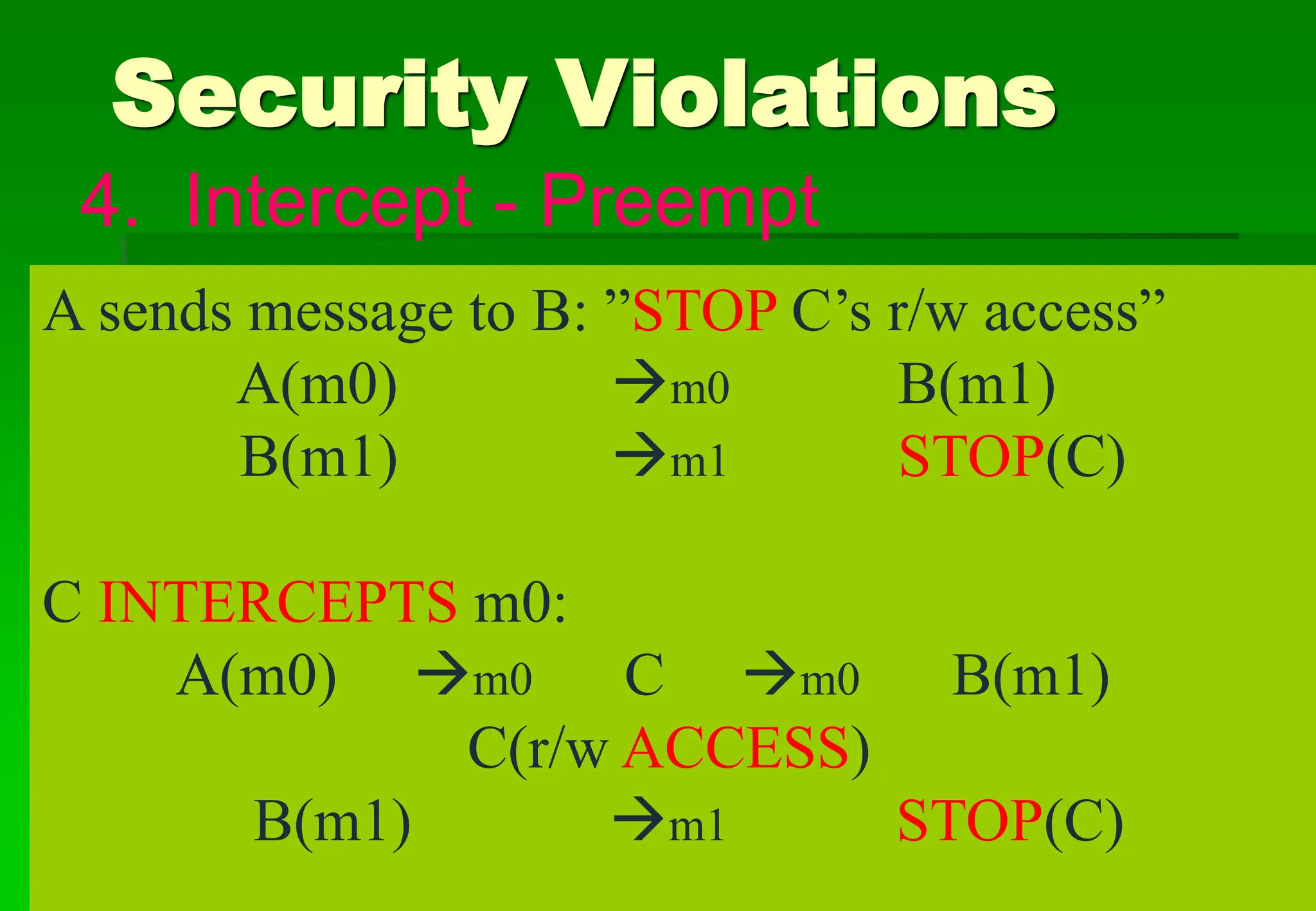
A sends message to B: ”STOP C’s r/w access”
A(m0) m0 B(m1)
B(m1) m1 STOP(C)
C INTERCEPTS m0:
A(m0) m0 C m0 B(m1)
C(r/w ACCESS)
B(m1) m1 STOP(C)
4. Intercept - Preempt
Security Violations
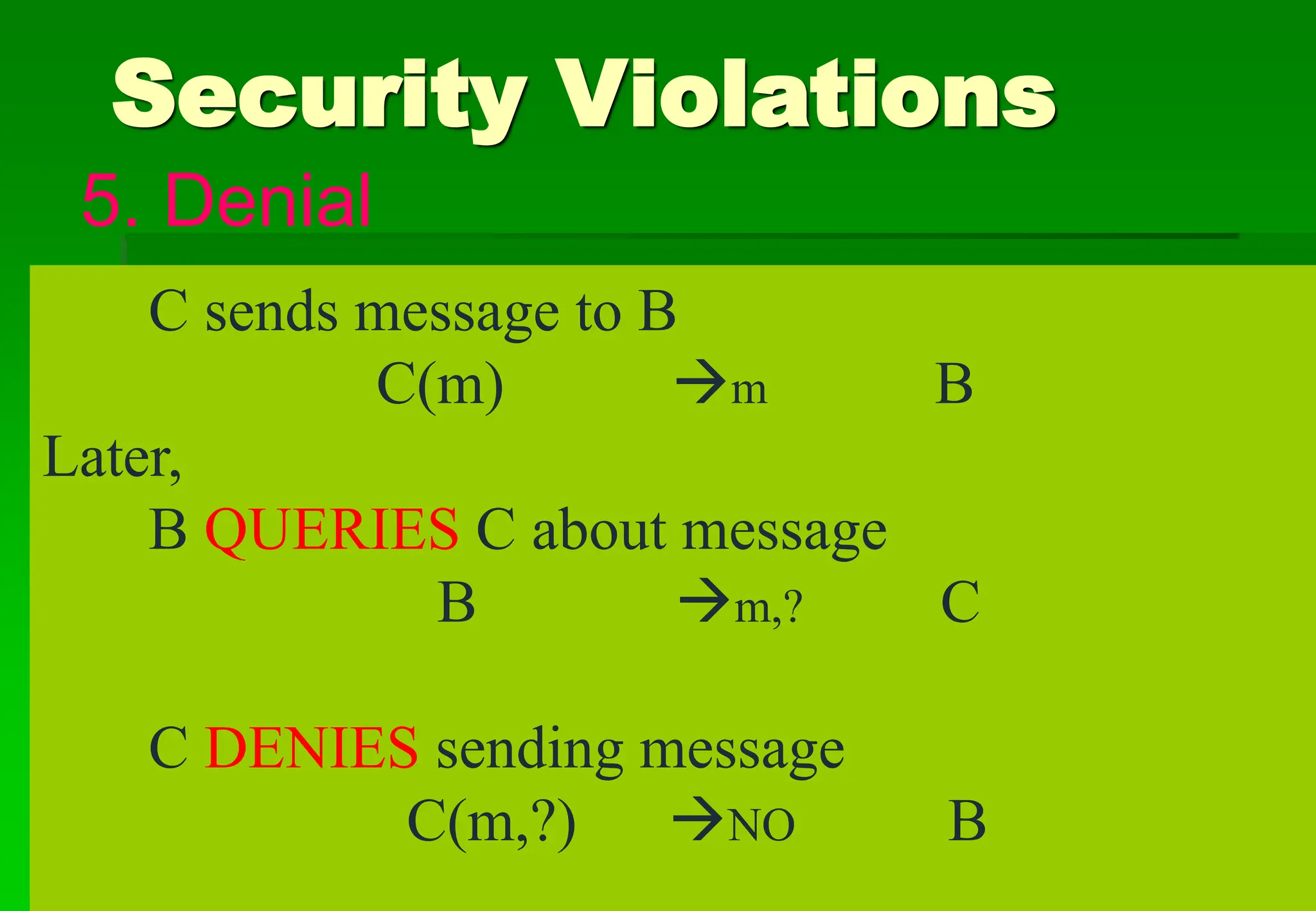
C sends message to B
C(m) m B
Later,
B QUERIES C about message
B m,? C
C DENIES sending message
C(m,?) NO B
5. Denial
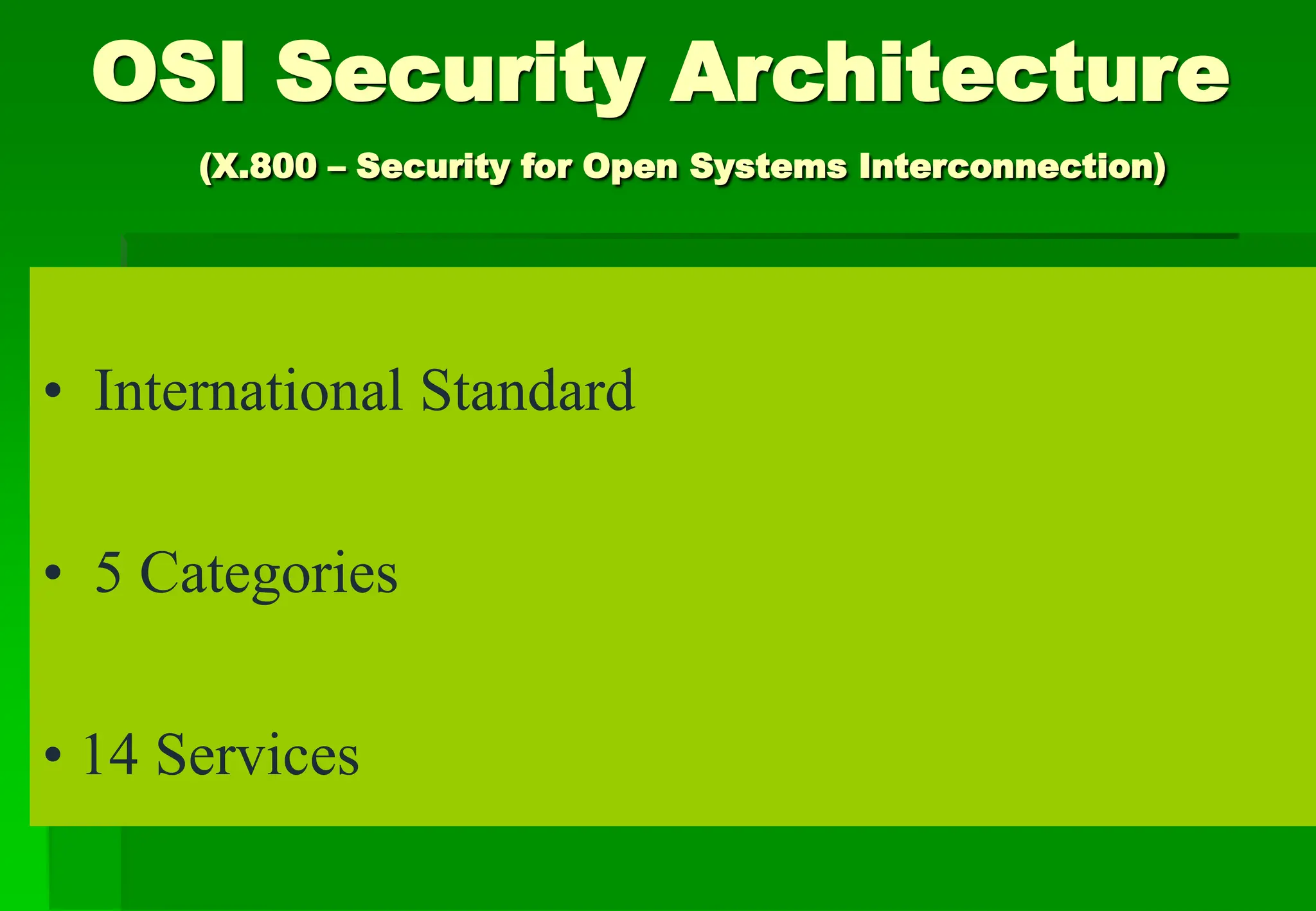
OSI Security Architecture
(X.800 – Security for Open Systems Interconnection)
• International Standard
• 5 Categories
• 14 Services
OSI Security Architecture
Categories(services)
• Authentication (peer-entity, data-origin)
• Access Control
• Data Confidentiality (connection,
connectionless, selective-field, traffic-flow)
• Data Integrity (connection[recovery,
no-recovery, selective-field],
connectionless[no-recovery,selective-field])
• NonRepudiation (origin, destination)
OSI Security Architecture
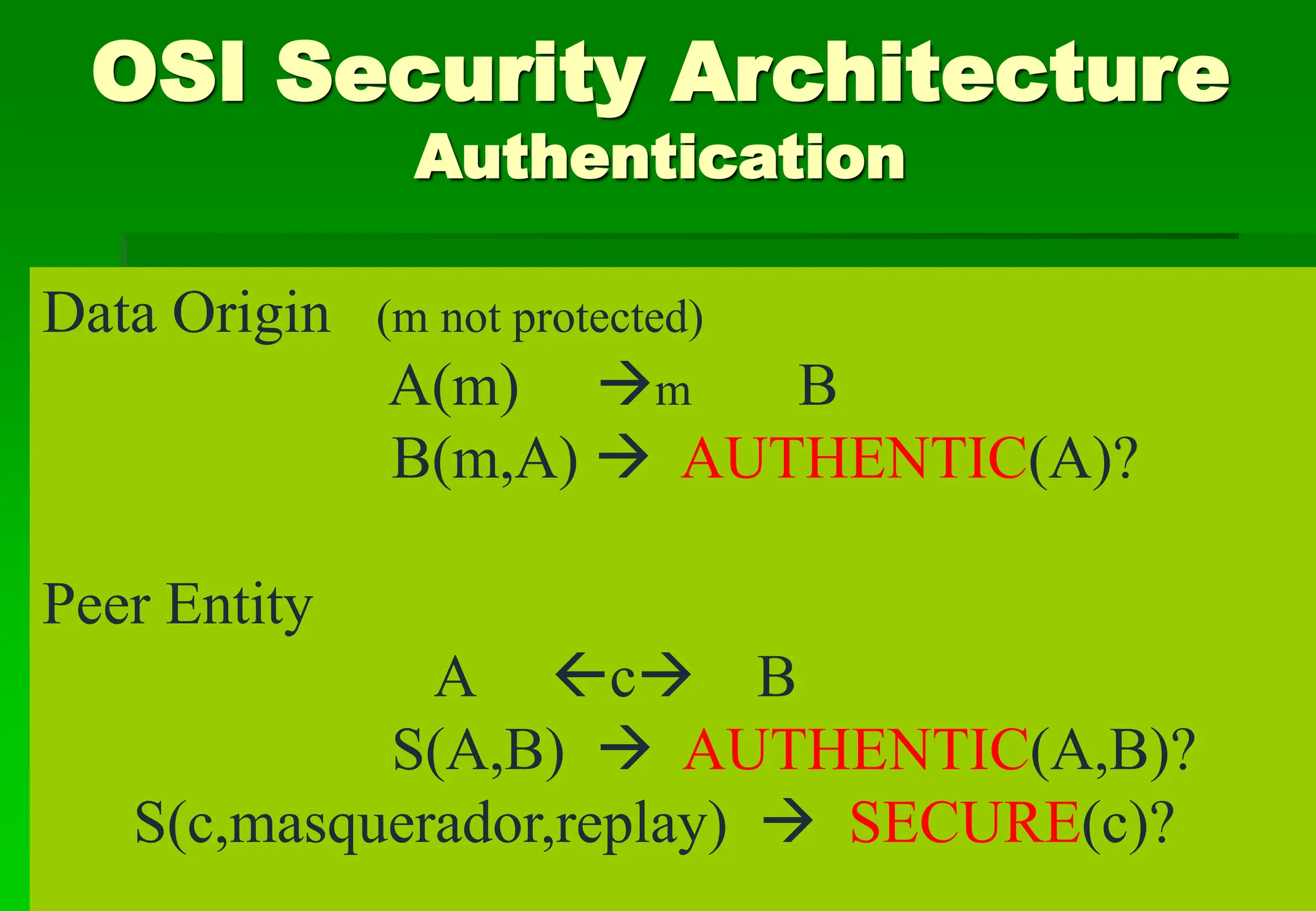
Authentication
Data Origin (m not protected)
A(m) m B
B(m,A)  AUTHENTIC(A)?
Peer Entity
A c B
S(A,B)  AUTHENTIC(A,B)?
S(c,masquerador,replay)  SECURE(c)?
OSI Security Architecture
Access Control
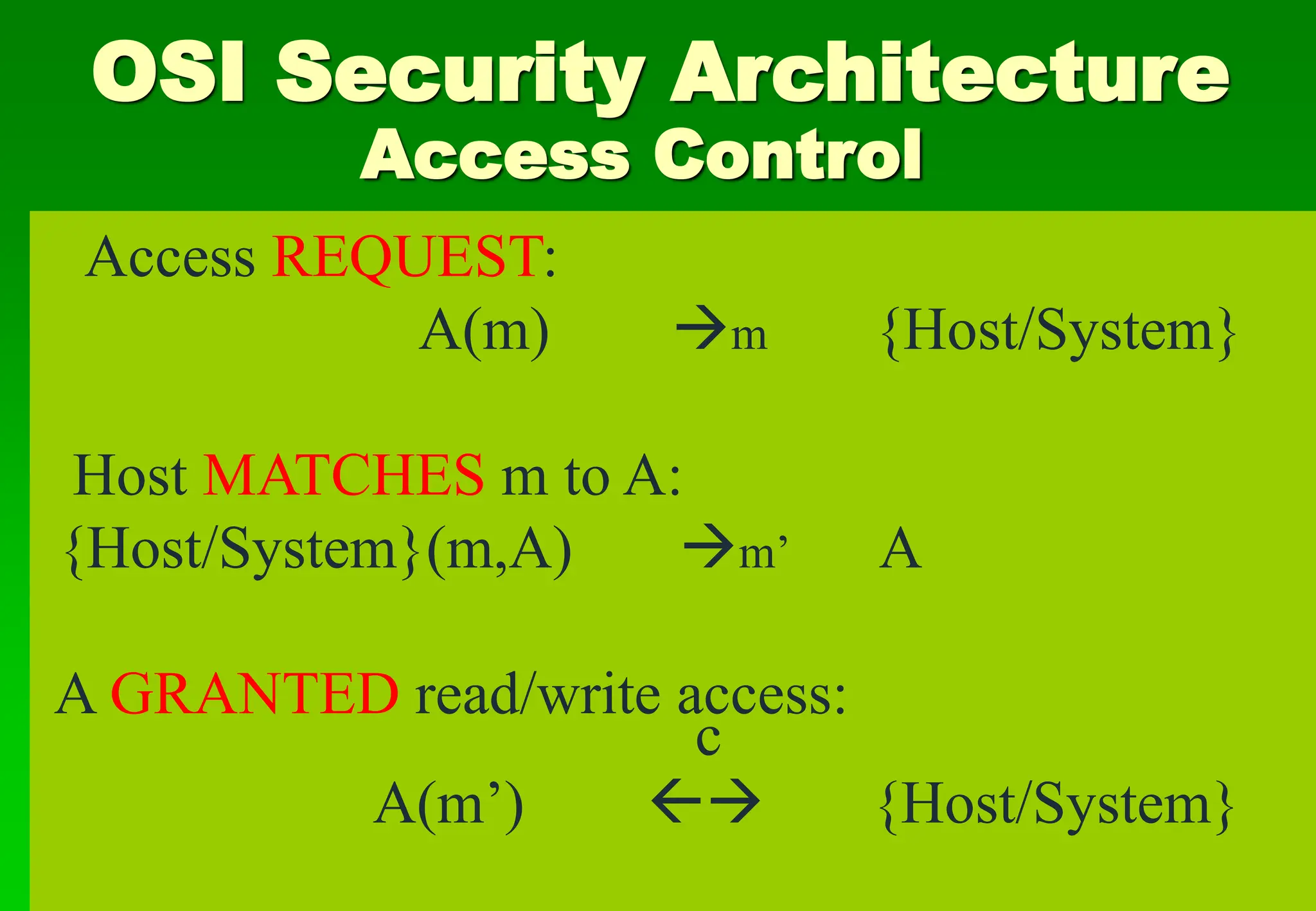
Access REQUEST:
A(m) m {Host/System}
Host MATCHES m to A:
{Host/System}(m,A) m’ A
A GRANTED read/write access:
c
A(m’)  {Host/System}
OSI Security Architecture
Confidentiality
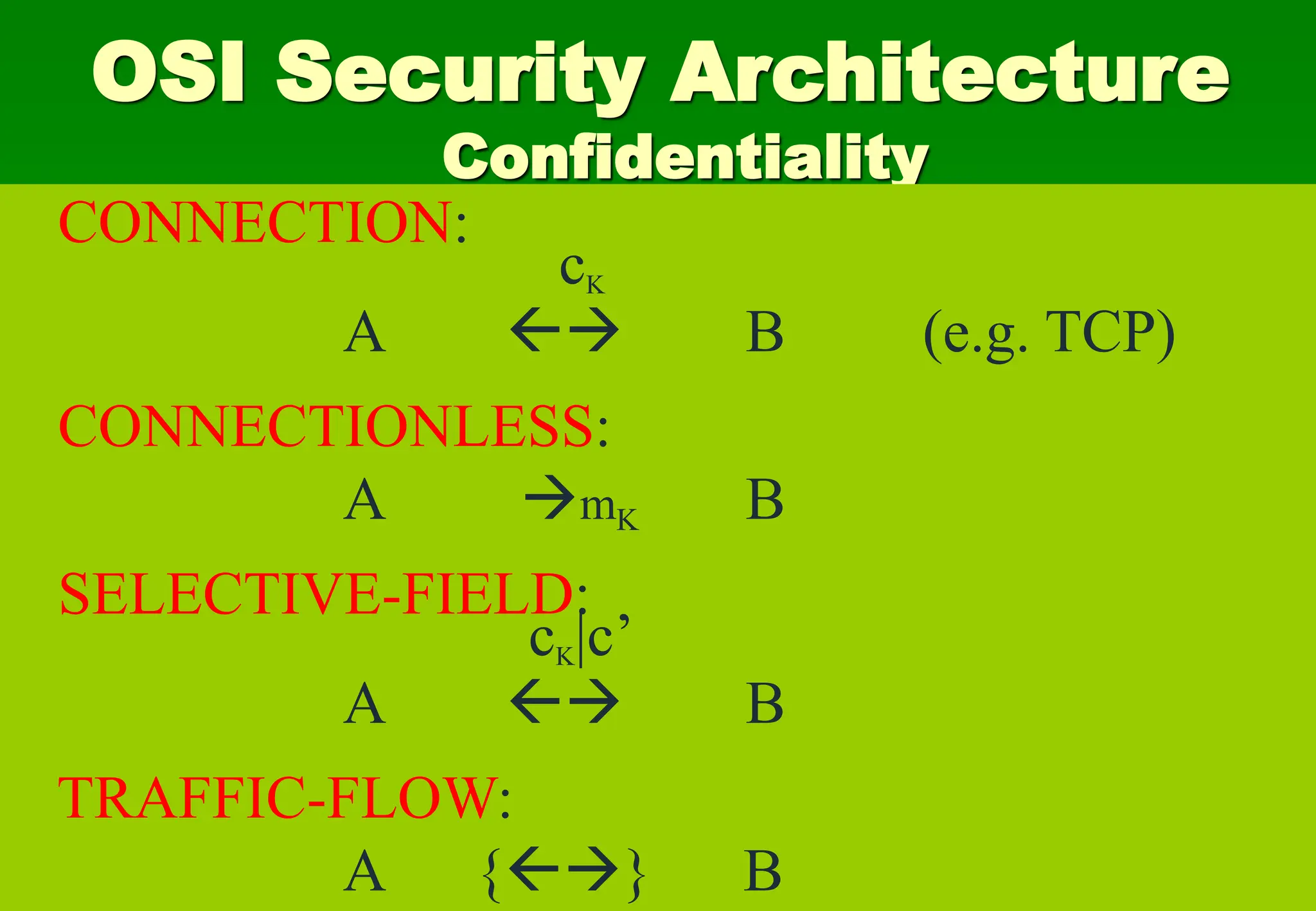
CONNECTION:
cK
A  B (e.g. TCP)
CONNECTIONLESS:
A mK B
SELECTIVE-FIELD:
cK|c’
A  B
TRAFFIC-FLOW:
A {} B
OSI Security Architecture
Integrity
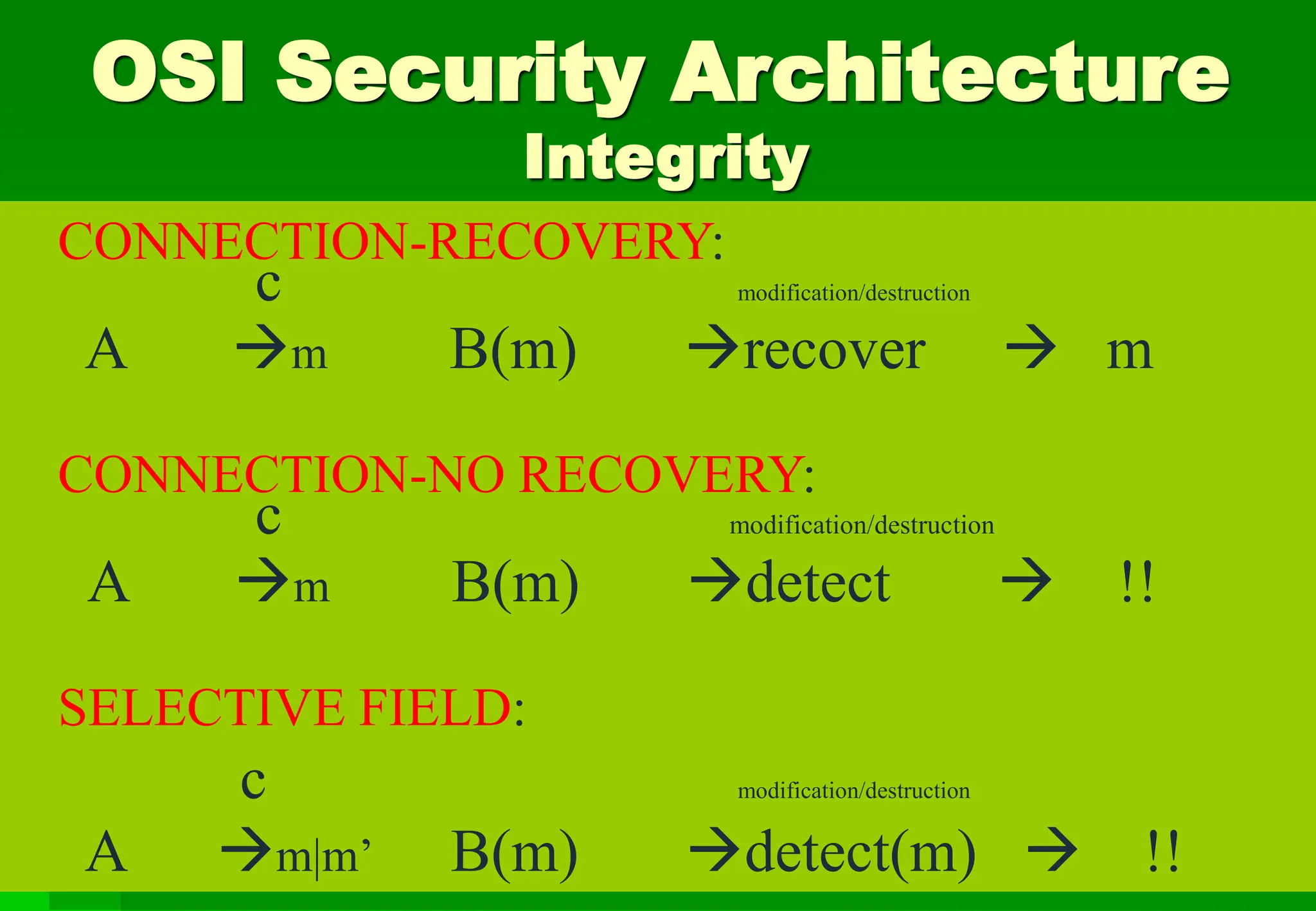
CONNECTION-RECOVERY:
c modification/destruction
A m B(m) recover  m
CONNECTION-NO RECOVERY:
c modification/destruction
A m B(m) detect  !!
SELECTIVE FIELD:
c modification/destruction
A m|m’ B(m) detect(m)  !!
OSI Security Architecture
Non-Repudiation
SENDER VERIFICATION:
A m,[A] B(m,[A])  mA
RECEIVER VERIFICATION:
A m B
B [m],[B] A([m],[B])  mB
OSI Security Architecture
Availability
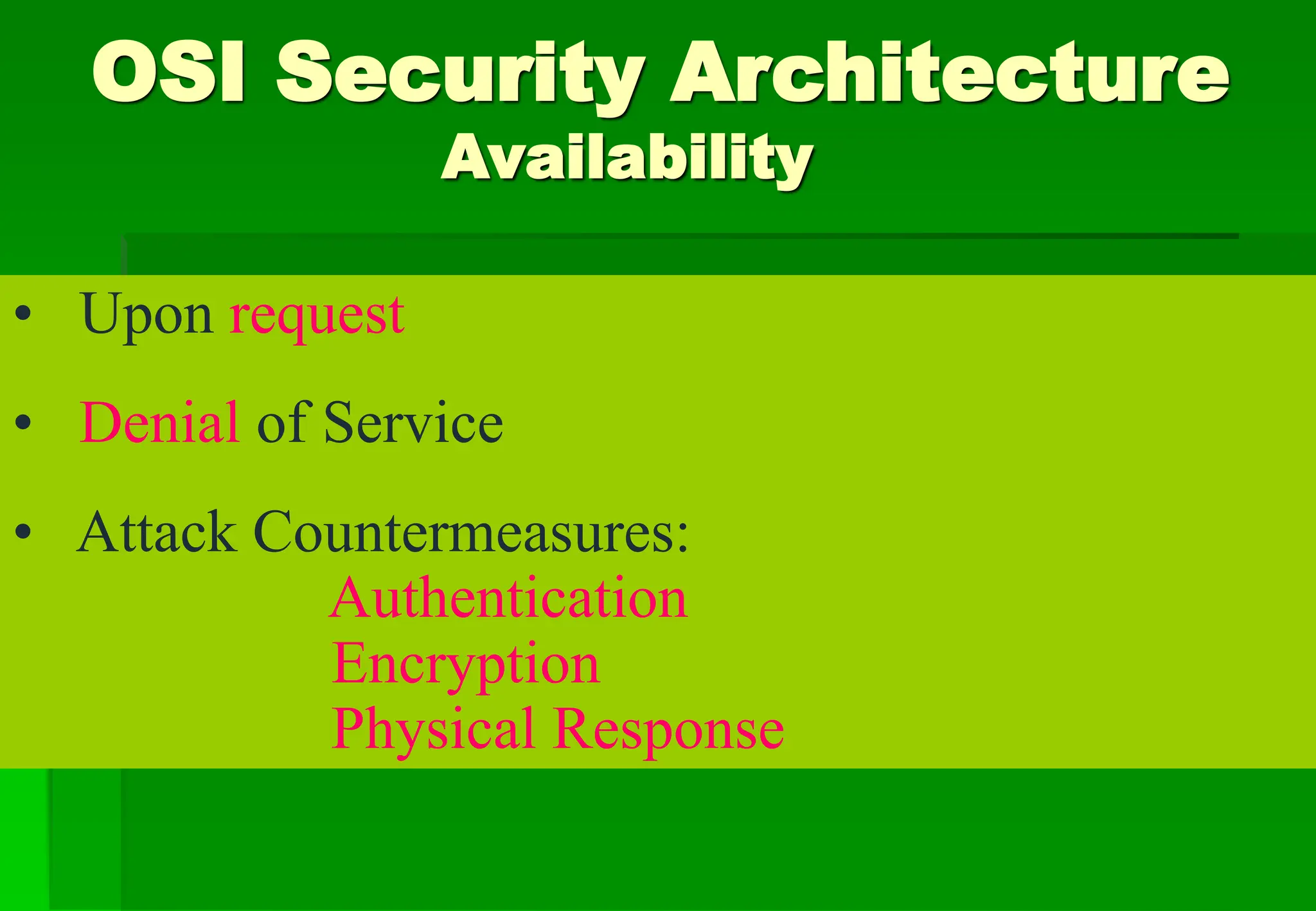
• Upon request
• Denial of Service
• Attack Countermeasures:
Authentication
Encryption
Physical Response
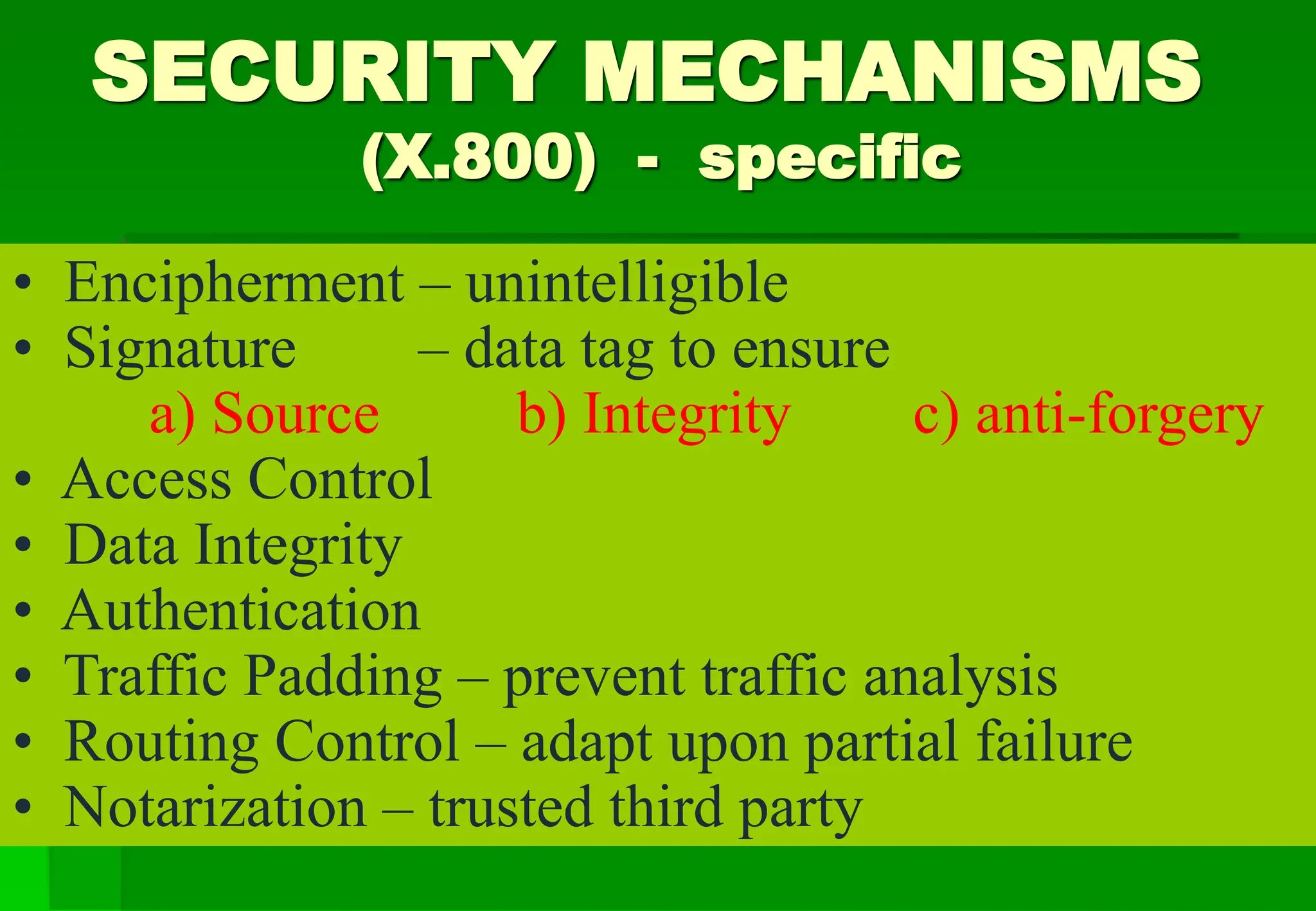
SECURITY MECHANISMS
(X.800) - specific
• Encipherment – unintelligible
• Signature – data tag to ensure
a) Source b) Integrity c) anti-forgery
• Access Control
• Data Integrity
• Authentication
• Traffic Padding – prevent traffic analysis
• Routing Control – adapt upon partial failure
• Notarization – trusted third party
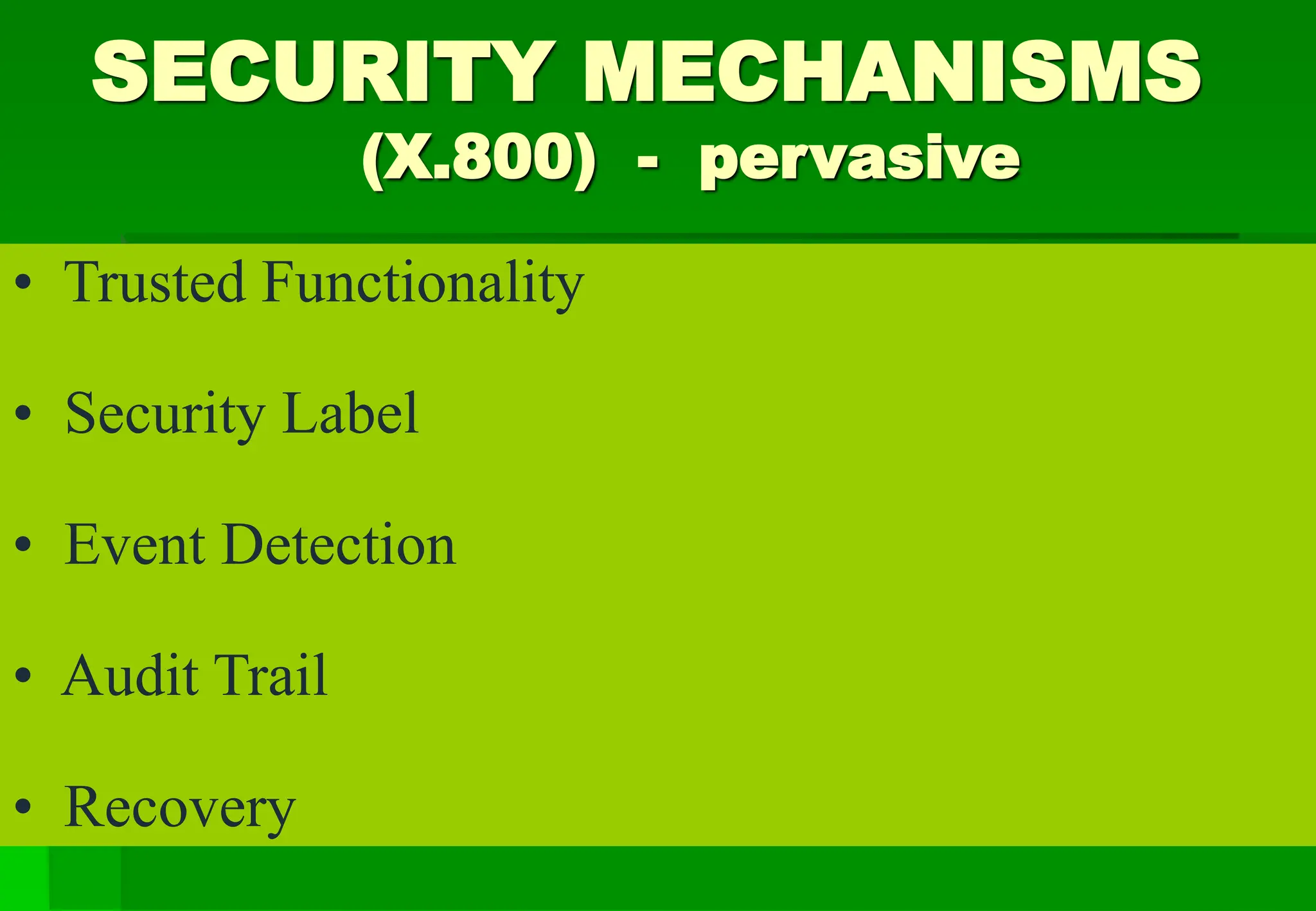
SECURITY MECHANISMS
(X.800) - pervasive
• Trusted Functionality
• Security Label
• Event Detection
• Audit Trail
• Recovery
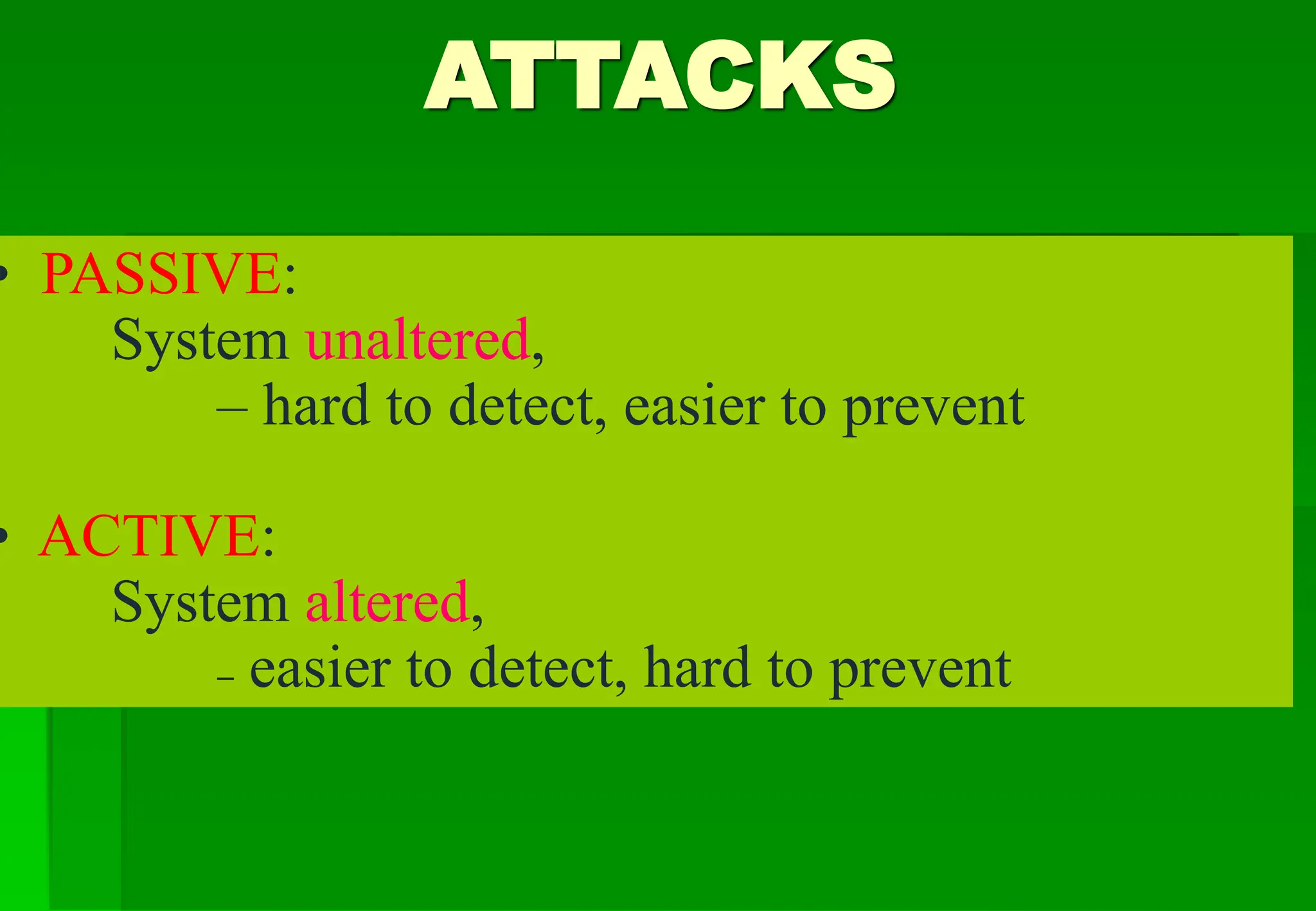
ATTACKS
• PASSIVE:
System unaltered,
– hard to detect, easier to prevent
• ACTIVE:
System altered,
– easier to detect, hard to prevent
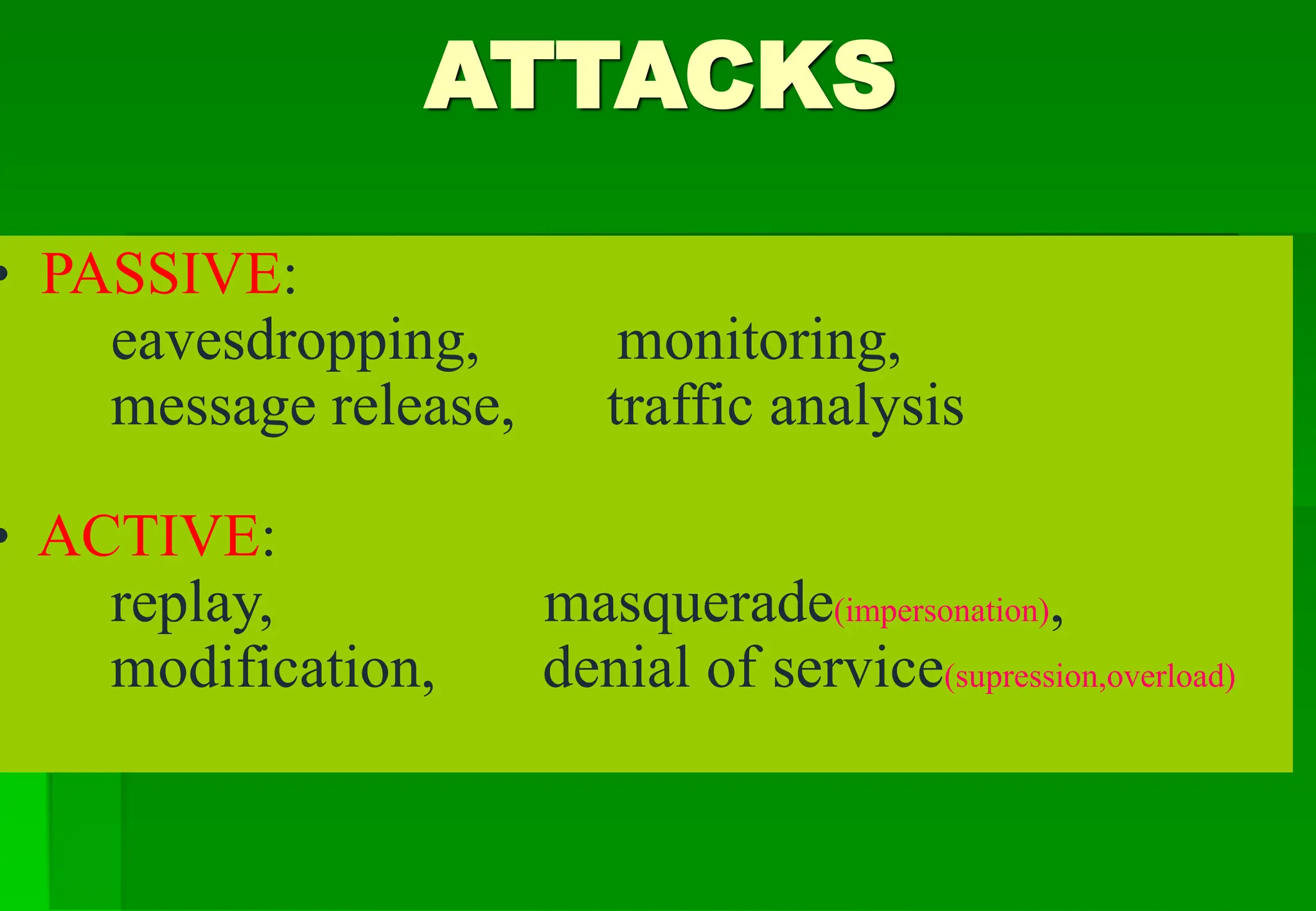
ATTACKS
• PASSIVE:
eavesdropping, monitoring,
message release, traffic analysis
• ACTIVE:
replay, masquerade(impersonation),
modification, denial of service(supression,overload)
Block Ciphers 19
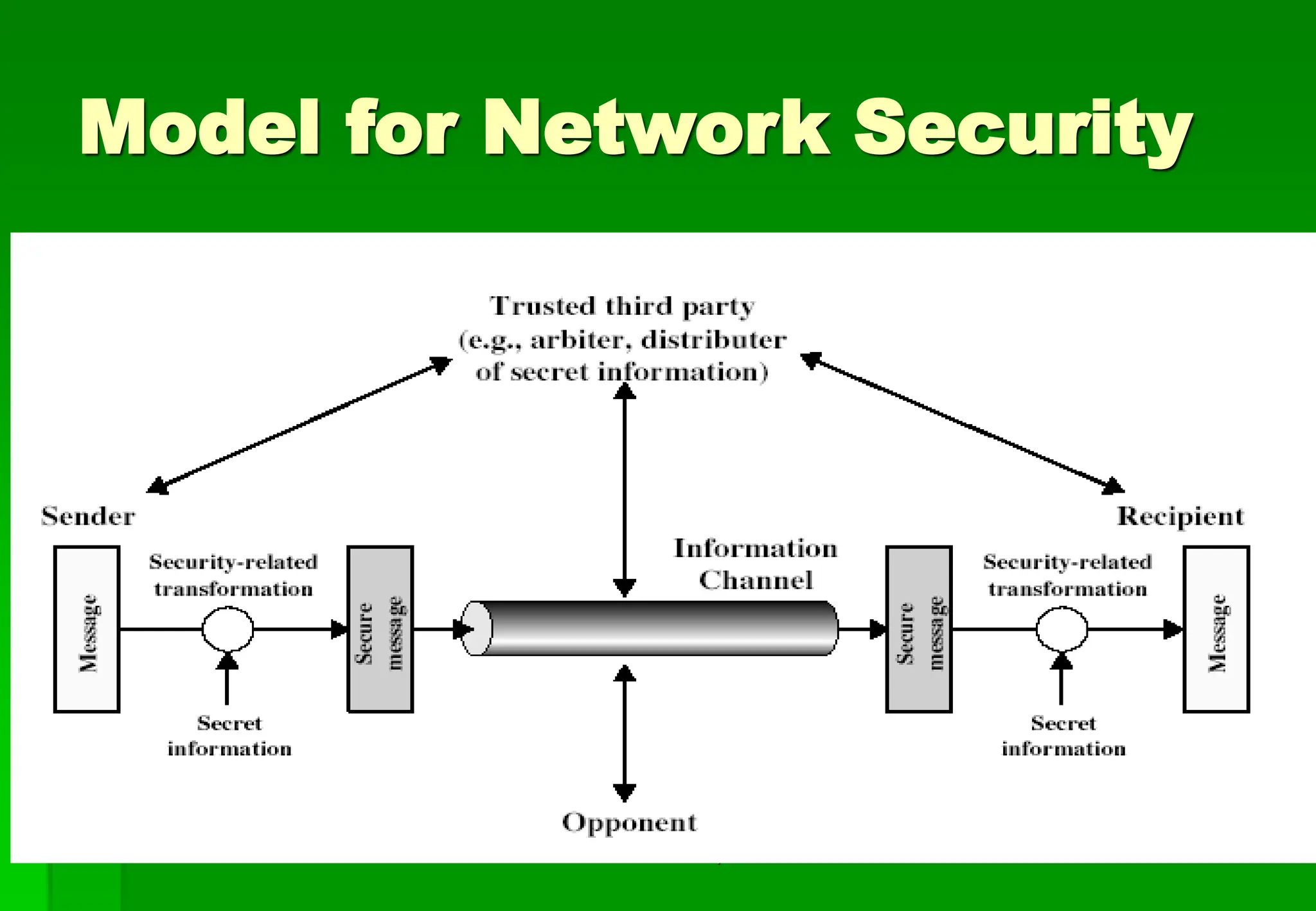
Model for Network Security
Block Ciphers 20
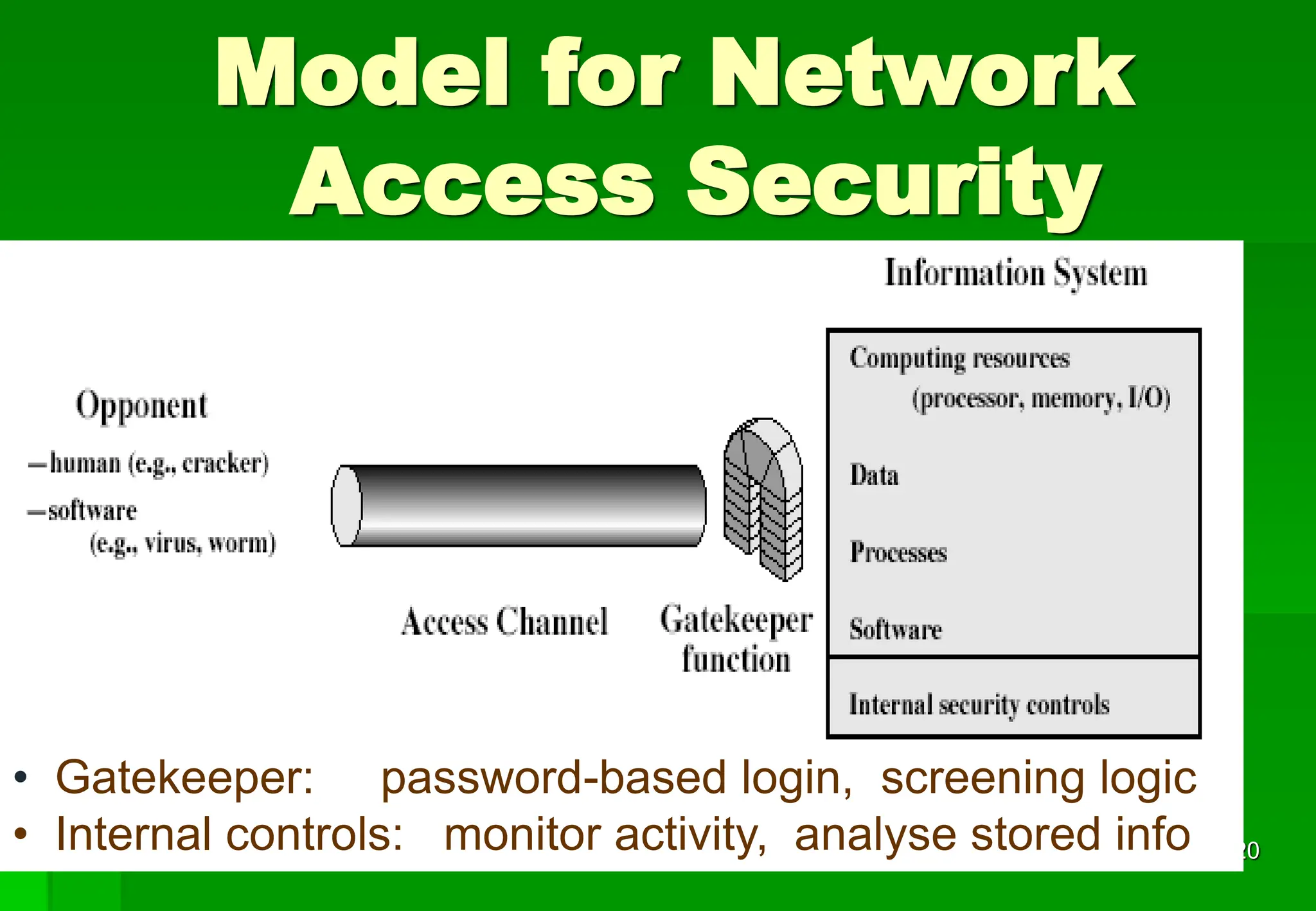
Model for Network
Access Security
• Gatekeeper: password-based login, screening logic
• Internal controls: monitor activity, analyse stored info

SA Access Control Security Violations; OSI Security Architecture; Network Security Model Security Violations.