COPYRIGHT PAGE FOR UNIFIED LEARNING ACTIVITY SHEETS
Science-Grade 8
Learner Activity Sheets
Quarter 1- Week 1: Force and Motion
First Edition, 2021
Republic Act 8293, section 176 states that: No copyright shall subsist in any work
of Government of the Philippines. However, prior approval of the government agency
or office wherein the work is created shall be necessary for the exploitation of such
work for a profit. Such agency or office may, among other things, impose as a
condition the payment of royalties.
Borrowed materials (e.g., songs, stories, poems, pictures, photos, brand names,
trademarks, etc.) included in the activity sheets are owned by their respective
copyright holders. Every effort has been exerted to locate and seek permission to use
these materials from their respective copyright owners. The authors do not represent
nor claim ownership over them.
Writers:
Development Team of the Learners’ Activity Sheets
Chery Lou A. Alceso
Sanita G. Baser
Regional Validators: Edna E. Trinidad, EdD
Jomel C. Montero
Ma. Cristina G. Ballesteros
Lovie Kim P. Ocura
Eugene D. Manulat
Division Validators: Gersim S. Lumintac, PhD.
Elena M. Navallo, PhD.
Alberto M. Orias, Jr.
Management Team
Ma. Teresa M. Real, Schools Division Superintendent
Leonevee V. Silvosa, CESE, Asst. Schools Division Superintendent
Dominico P. Larong, Jr., CID Chief
Gemma L. Pullos, PhD., LR Manager
Gersim S. Lumintac, PhD., Science Education Program Supervisor
Author: Chery Lou A. Alceso and Sanita G. Baser
School/Station: Surigao del Norte National High School
Division: Surigao del Norte
Email address: cherylou.alceso@deped.gov.ph/sanita.baser@deped.gov.ph
Page 1
Author: Chery Lou A. Alceso and Sanita G. Baser
School/Station: Surigao del Norte National High School
Division: Surigao del Norte
Email address: cherylou.alceso@deped.gov.ph/sanita.baser@deped.gov.ph
WEEKLY LEARNING ACTIVITY SHEETS
Science 8, Quarter 1, Week 1
FORCE AND MOTION
Name of Learner: Section: _____________
Most Essential Learning Competency:
Investigate the relationship between the amount of force applied and the
mass of the object to the amount of change in the object’s motion (S8FE-Ia-15)
Learning Objectives:
The learners shall be able to:
1. identify the forces acting on an object at rest and construct a free body
diagram of forces acting on an object;
2. examine conditions when two forces are balanced;
3. demonstrate Newton’s Law of Inertia;
4. expound how an unbalanced (net) force affects the acceleration of a
moving object; and
5. interpret Newton’s Laws of Motion (Law of Inertia and Law of
Acceleration).
Time Allotment: 4 hours
Key Concepts:
 Force is a push or a pull. It can make objects move, stop, or change their
direction of motion.
 An object maybe acted upon by several forces. For example, an object may
be pushed and pulled in different directions at the same time. To identify
which of these forces would be able to cause change in the motion of the
object, it is important to identify all the forces acting on it.
 Forces are described in terms of magnitude. Magnitude refers to the size or
strength of the force which is commonly expressed in Newton (N); direction
of the force, point of application and line of action.
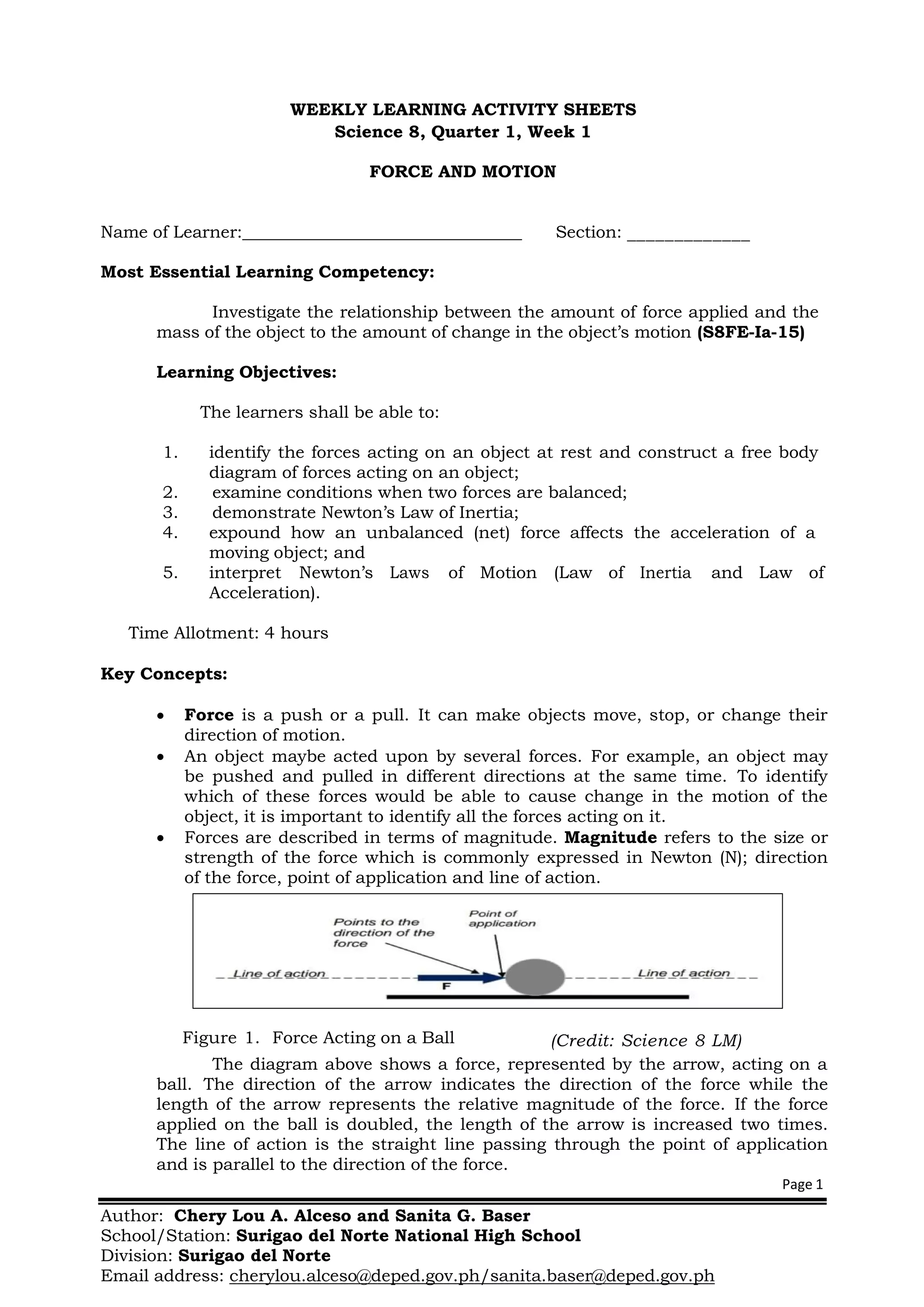
Figure 1. Force Acting on a Ball
The diagram above shows a force, represented by the arrow, acting on a
ball. The direction of the arrow indicates the direction of the force while the
length of the arrow represents the relative magnitude of the force. If the force
applied on the ball is doubled, the length of the arrow is increased two times.
The line of action is the straight line passing through the point of application
and is parallel to the direction of the force.
(Credit: Science 8 LM)
Page 2
Author: Chery Lou A. Alceso and Sanita G. Baser
School/Station: Surigao del Norte National High School
Division: Surigao del Norte
Email address: cherylou.alceso@deped.gov.ph/sanita.baser@deped.gov.ph
 Types of force are contact and non-contact forces
 Contact forces are forces where objects touch or contact with each other.
Examples of Contact forces:
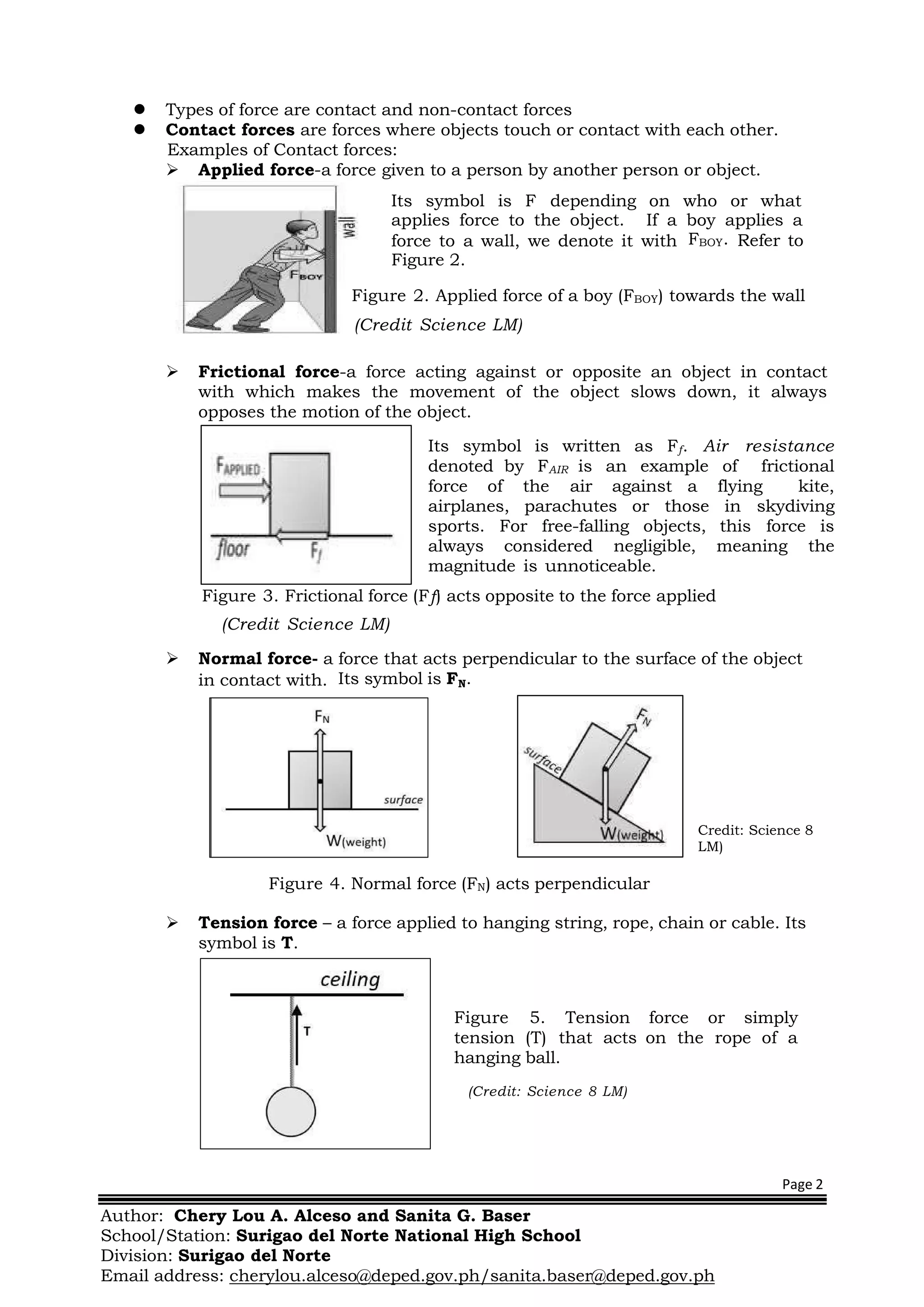
 Applied force-a force given to a person by another person or object.
Its symbol is F depending on who or what
applies force to the object. If a boy applies a
force to a wall, we denote it with
Figure 2.
FBOY. Refer to
Figure 2. Applied force of a boy (FBOY) towards the wall
(Credit Science LM)
 Frictional force-a force acting against or opposite an object in contact
with which makes the movement of the object slows down, it always
opposes the motion of the object.
Its symbol is written as Ff. Air resistance
denoted by FAIR is an example of frictional
force of the air against a flying kite,
airplanes, parachutes or those in skydiving
sports. For free-falling objects, this force is
always considered negligible, meaning the
magnitude is unnoticeable.
Figure 3. Frictional force (Ff) acts opposite to the force applied
(Credit Science LM)
 Normal force- a force that acts perpendicular to the surface of the object
in contact with. Its symbol is FN.
 Tension force – a force applied to hanging string, rope, chain or cable. Its
symbol is T.
Figure 4. Normal force (FN) acts perpendicular
Figure 5. Tension force or simply
tension (T) that acts on the rope of a
hanging ball.
(Credit: Science 8 LM)
Credit: Science 8
LM)
Page 3
Author: Chery Lou A. Alceso and Sanita G. Baser
School/Station: Surigao del Norte National High School
Division: Surigao del Norte
Email address: cherylou.alceso@deped.gov.ph/sanita.baser@deped.gov.ph
 Non-contact forces are forces where objects do not touch or contact with
each other. These forces act over a zone or area called field.
Examples of Non-contact forces:
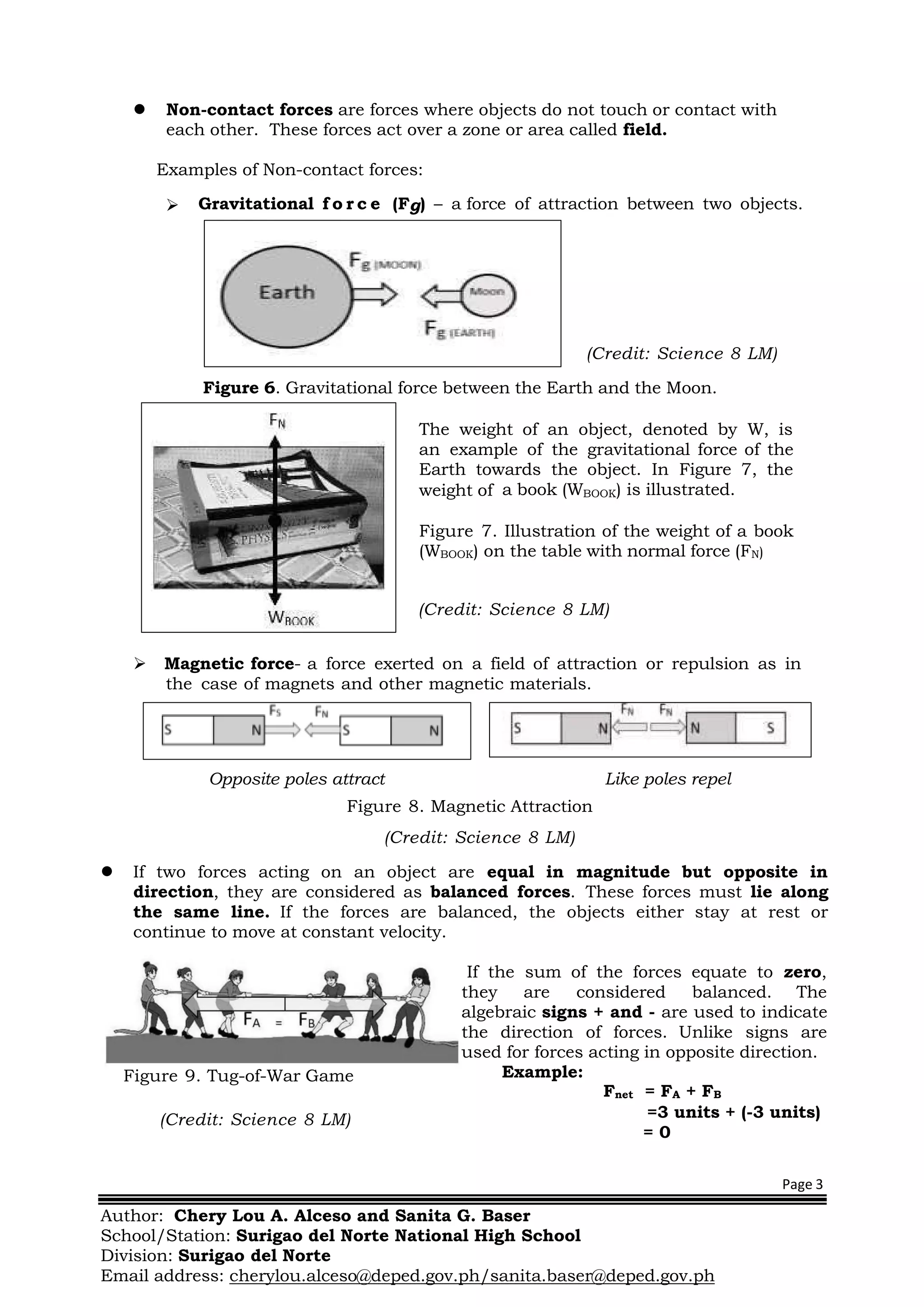
 Gravitational f o r c e (Fg) – a force of attraction between two objects.
(Credit: Science 8 LM)
Figure 6. Gravitational force between the Earth and the Moon.
 Magnetic force- a force exerted on a field of attraction or repulsion as in
the case of magnets and other magnetic materials.
Opposite poles attract Like poles repel
Figure 8. Magnetic Attraction
(Credit: Science 8 LM)
 If two forces acting on an object are equal in magnitude but opposite in
direction, they are considered as balanced forces. These forces must lie along
the same line. If the forces are balanced, the objects either stay at rest or
continue to move at constant velocity.
Figure 9. Tug-of-War Game
If the sum of the forces equate to zero,
they are considered balanced. The
algebraic signs + and - are used to indicate
the direction of forces. Unlike signs are
used for forces acting in opposite direction.
Example:
(Credit: Science 8 LM)
Fnet = FA + FB
=3 units + (-3 units)
= 0
The weight of an object, denoted by W, is
an example of the gravitational force of the
Earth towards the object. In Figure 7, the
weight of a book (WBOOK) is illustrated.
Figure 7. Illustration of the weight of a book
(WBOOK) on the table with normal force (FN)
(Credit: Science 8 LM)
Page 4
Author: Chery Lou A. Alceso and Sanita G. Baser
School/Station: Surigao del Norte National High School
Division: Surigao del Norte
Email address: cherylou.alceso@deped.gov.ph/sanita.baser@deped.gov.ph
 Forces that cause a change in the motion of an object are unbalanced
forces. Unbalanced forces are not equal and in opposite direction. Suppose
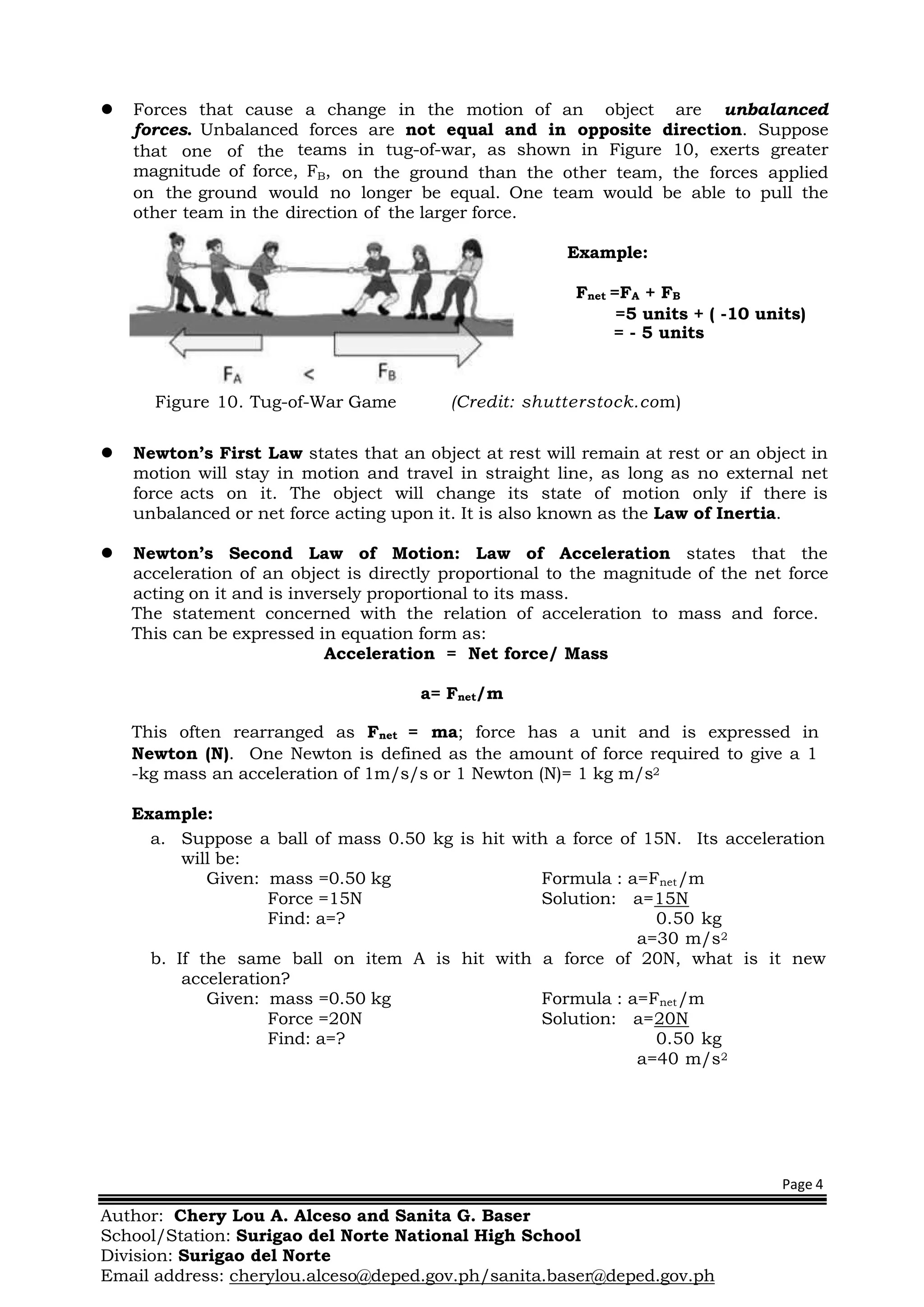
that one of the teams in tug-of-war, as shown in Figure 10, exerts greater
magnitude of force, FB, on the ground than the other team, the forces applied
on the ground would no longer be equal. One team would be able to pull the
other team in the direction of the larger force.
Example:
Fnet =FA + FB
=5 units + ( -10 units)
= - 5 units
Figure 10. Tug-of-War Game (Credit: shutterstock.com)
 Newton’s First Law states that an object at rest will remain at rest or an object in
motion will stay in motion and travel in straight line, as long as no external net
force acts on it. The object will change its state of motion only if there is
unbalanced or net force acting upon it. It is also known as the Law of Inertia.
 Newton’s Second Law of Motion: Law of Acceleration states that the
acceleration of an object is directly proportional to the magnitude of the net force
acting on it and is inversely proportional to its mass.
The statement concerned with the relation of acceleration to mass and force.
This can be expressed in equation form as:
Acceleration = Net force/ Mass
a= Fnet/m
This often rearranged as Fnet = ma; force has a unit and is expressed in
Newton (N). One Newton is defined as the amount of force required to give a 1
-kg mass an acceleration of 1m/s/s or 1 Newton (N)= 1 kg m/s2
Example:
a. Suppose a ball of mass 0.50 kg is hit with a force of 15N. Its acceleration
will be:
Given: mass =0.50 kg Formula : a=Fnet/m
Force =15N Solution: a=15N
Find: a=? 0.50 kg
a=30 m/s2
b. If the same ball on item A is hit with a force of 20N, what is it new
acceleration?
Given: mass =0.50 kg Formula : a=Fnet/m
Force =20N Solution: a=20N
Find: a=? 0.50 kg
a=40 m/s2
Page 5
Author: Chery Lou A. Alceso and Sanita G. Baser
School/Station: Surigao del Norte National High School
Division: Surigao del Norte
Email address: cherylou.alceso@deped.gov.ph/sanita.baser@deped.gov.ph
Activity 1:
Exploring, Investigating Invisible Forces!
Objective:
Identify the forces acting on an object at rest and construct a free body
diagram of forces acting on an object.
What you need:
Pictures of a hanging pen and book lying on the table.
What to do:
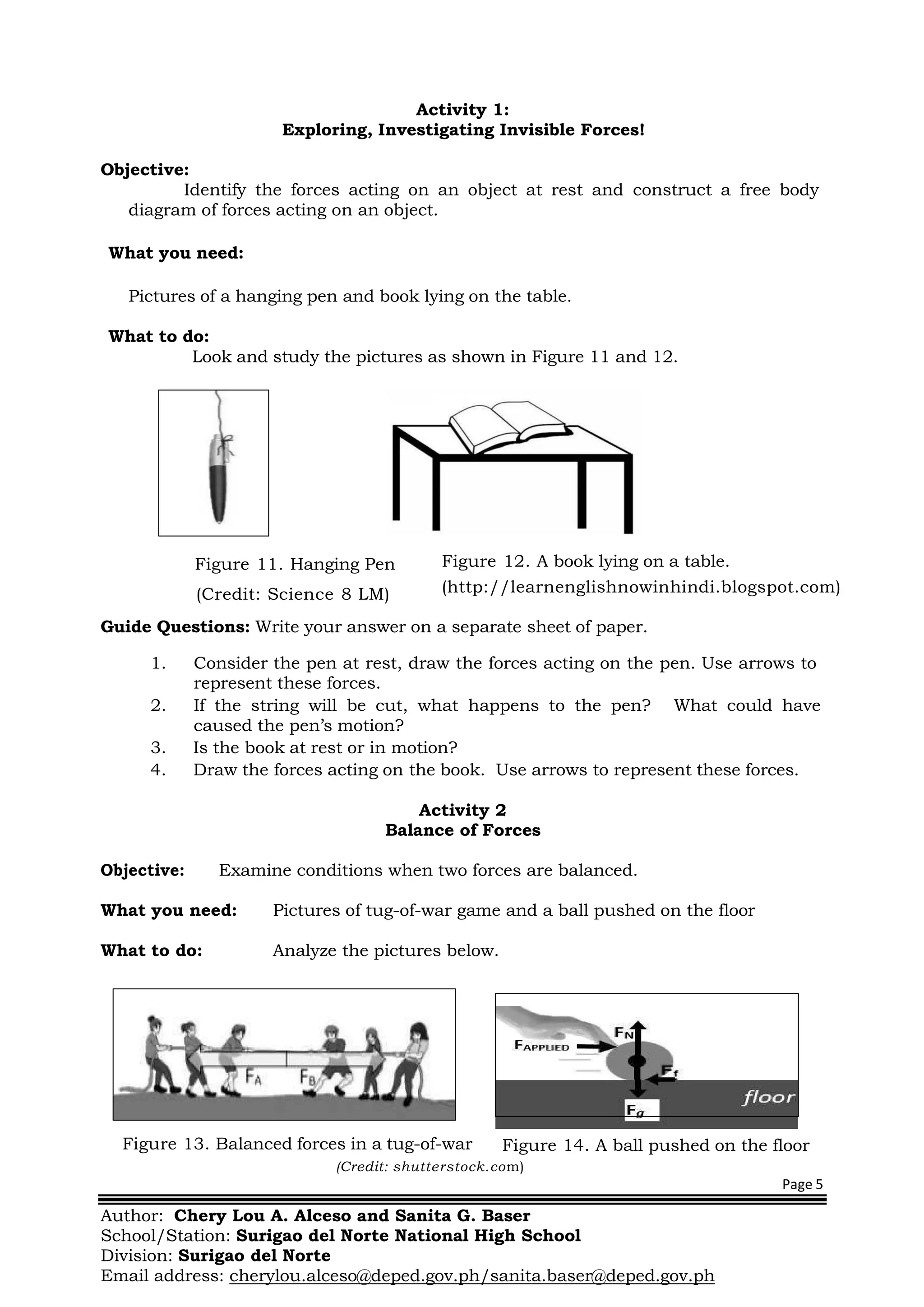
Look and study the pictures as shown in Figure 11 and 12.
Figure 11. Hanging Pen
(Credit: Science 8 LM)
Guide Questions: Write your answer on a separate sheet of paper.
1. Consider the pen at rest, draw the forces acting on the pen. Use arrows to
represent these forces.
2. If the string will be cut, what happens to the pen? What could have
caused the pen’s motion?
3. Is the book at rest or in motion?
4. Draw the forces acting on the book. Use arrows to represent these forces.
Activity 2
Balance of Forces
Objective: Examine conditions when two forces are balanced.
What you need: Pictures of tug-of-war game and a ball pushed on the floor
What to do: Analyze the pictures below.
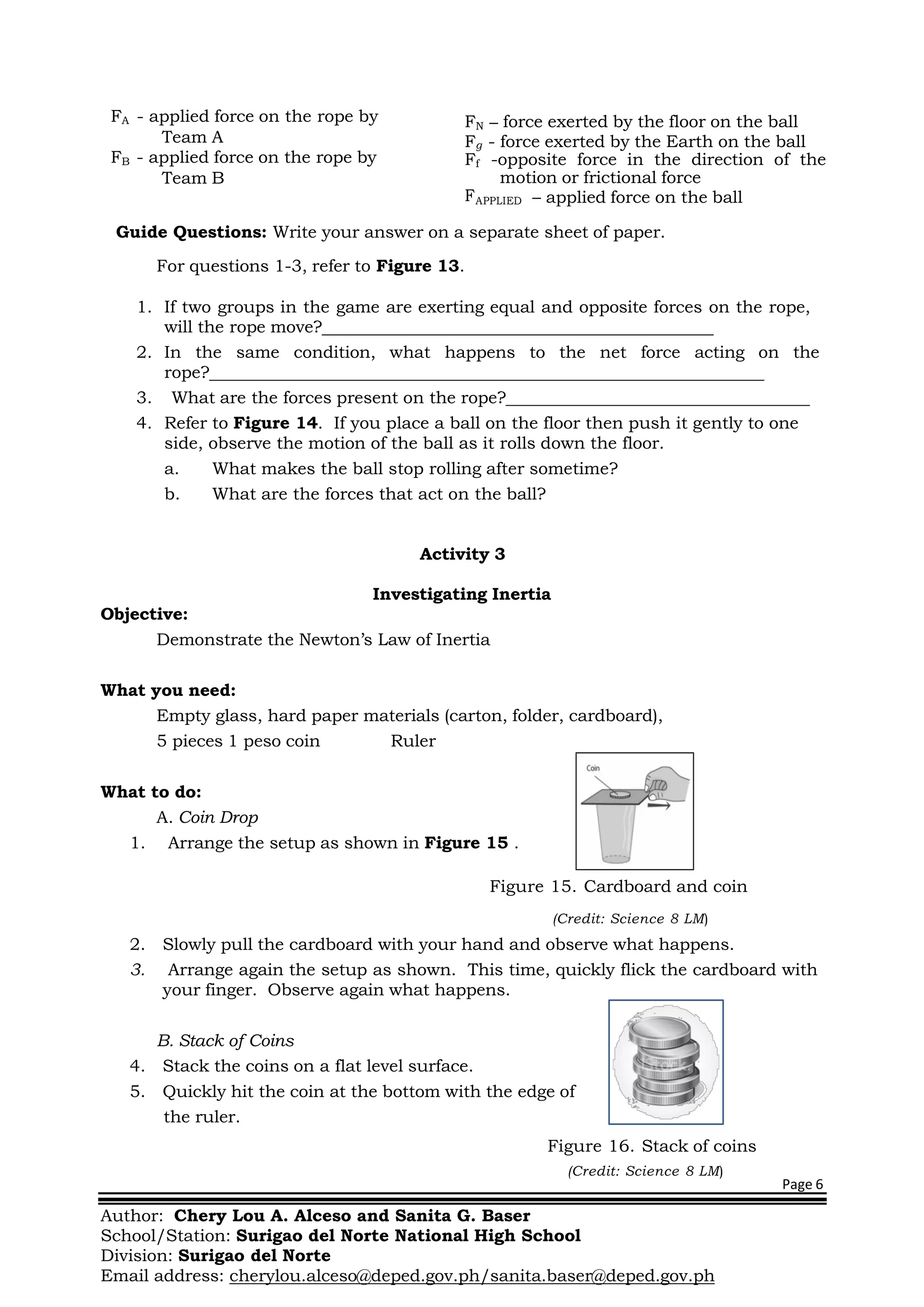
Figure 13. Balanced forces in a tug-of-war Figure 14. A ball pushed on the floor
(Credit: shutterstock.com)
Figure 12. A book lying on a table.
(http://learnenglishnowinhindi.blogspot.com)
Page 6
Author: Chery Lou A. Alceso and Sanita G. Baser
School/Station: Surigao del Norte National High School
Division: Surigao del Norte
Email address: cherylou.alceso@deped.gov.ph/sanita.baser@deped.gov.ph
FA - applied force on the rope by
Team A
FB - applied force on the rope by
Team B
FN – force exerted by the floor on the ball
Fg - force exerted by the Earth on the ball
Ff -opposite force in the direction of the
motion or frictional force
FAPPLIED – applied force on the ball
Guide Questions: Write your answer on a separate sheet of paper.
For questions 1-3, refer to Figure 13.
1. If two groups in the game are exerting equal and opposite forces on the rope,
will the rope move?
2. In the same condition, what happens to the net force acting on the
rope?
3. What are the forces present on the rope?
4. Refer to Figure 14. If you place a ball on the floor then push it gently to one
side, observe the motion of the ball as it rolls down the floor.
a. What makes the ball stop rolling after sometime?
b. What are the forces that act on the ball?
Activity 3
Objective:
Investigating Inertia
Demonstrate the Newton’s Law of Inertia
What you need:
Empty glass, hard paper materials (carton, folder, cardboard),
5 pieces 1 peso coin Ruler
What to do:
A. Coin Drop
1. Arrange the setup as shown in Figure 15 .
Figure 15. Cardboard and coin
(Credit: Science 8 LM)
2. Slowly pull the cardboard with your hand and observe what happens.
3. Arrange again the setup as shown. This time, quickly flick the cardboard with
your finger. Observe again what happens.
B. Stack of Coins
4. Stack the coins on a flat level surface.
5. Quickly hit the coin at the bottom with the edge of
the ruler.
Figure 16. Stack of coins
(Credit: Science 8 LM)
Page 7
Author: Chery Lou A. Alceso and Sanita G. Baser
School/Station: Surigao del Norte National High School
Division: Surigao del Norte
Email address: cherylou.alceso@deped.gov.ph/sanita.baser@deped.gov.ph
Guide Questions: Write your answer on a separate sheet of paper.
1. What happened when you slowly pulled the cardboard?
2. What happened when you flicked the cardboard?
3. What happened when you hit the coin at the bottom? Why is this so?
Activity 4
Data Analysis
Objectives:
Expound how an unbalanced (net) force affects the acceleration of a
moving object.
What you need: paper and pen
What to do:
Study the table below.
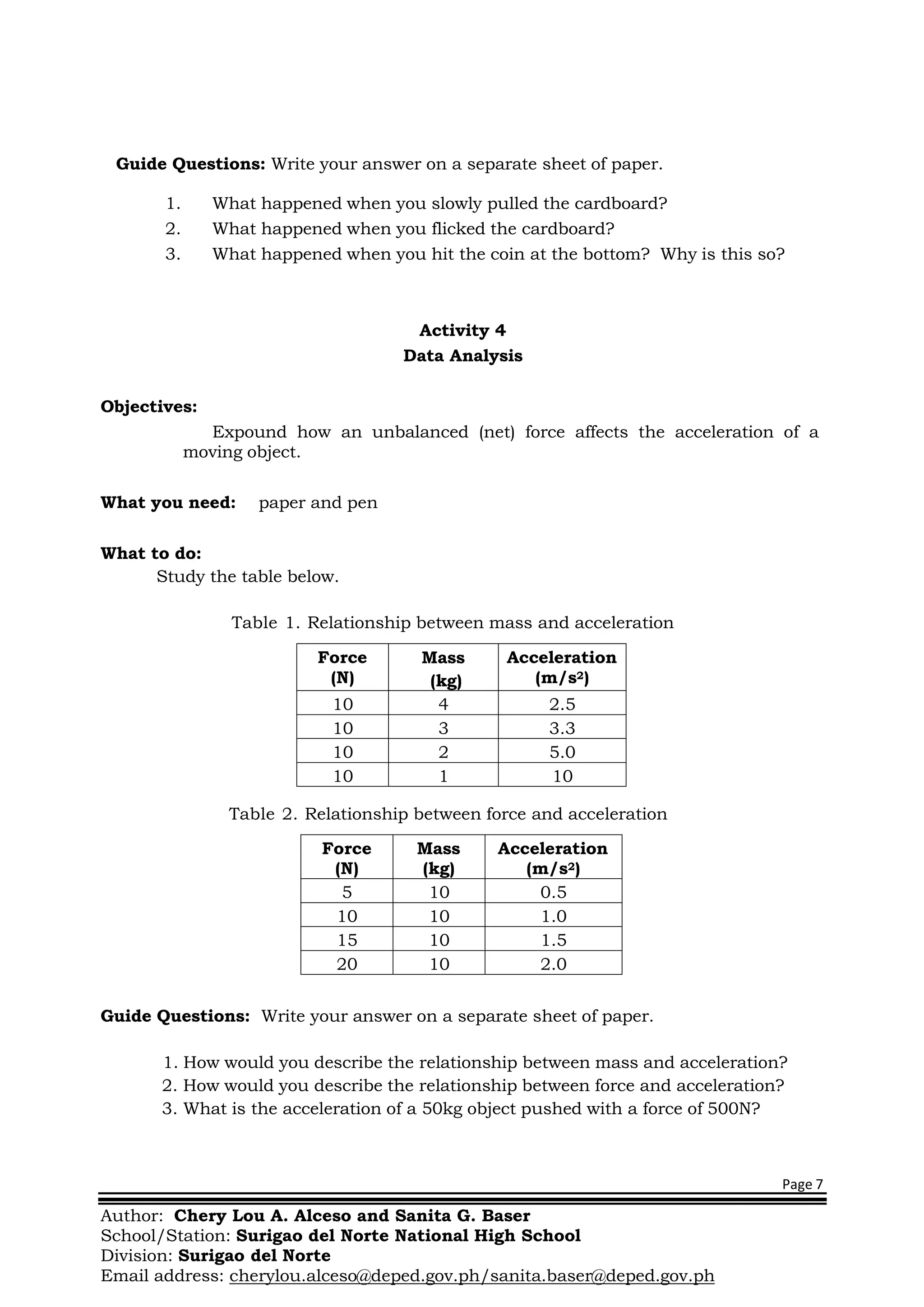
Table 1. Relationship between mass and acceleration
Force
(N)
Mass
(kg)
Acceleration
(m/s2)
10 4 2.5
10 3 3.3
10 2 5.0
10 1 10
Table 2. Relationship between force and acceleration
Force
(N)
Mass
(kg)
Acceleration
(m/s2)
5 10 0.5
10 10 1.0
15 10 1.5
20 10 2.0
Guide Questions: Write your answer on a separate sheet of paper.
1. How would you describe the relationship between mass and acceleration?
2. How would you describe the relationship between force and acceleration?
3. What is the acceleration of a 50kg object pushed with a force of 500N?
Page 8
Author: Chery Lou A. Alceso and Sanita G. Baser
School/Station: Surigao del Norte National High School
Division: Surigao del Norte
Email address: cherylou.alceso@deped.gov.ph/sanita.baser@deped.gov.ph
Reflection
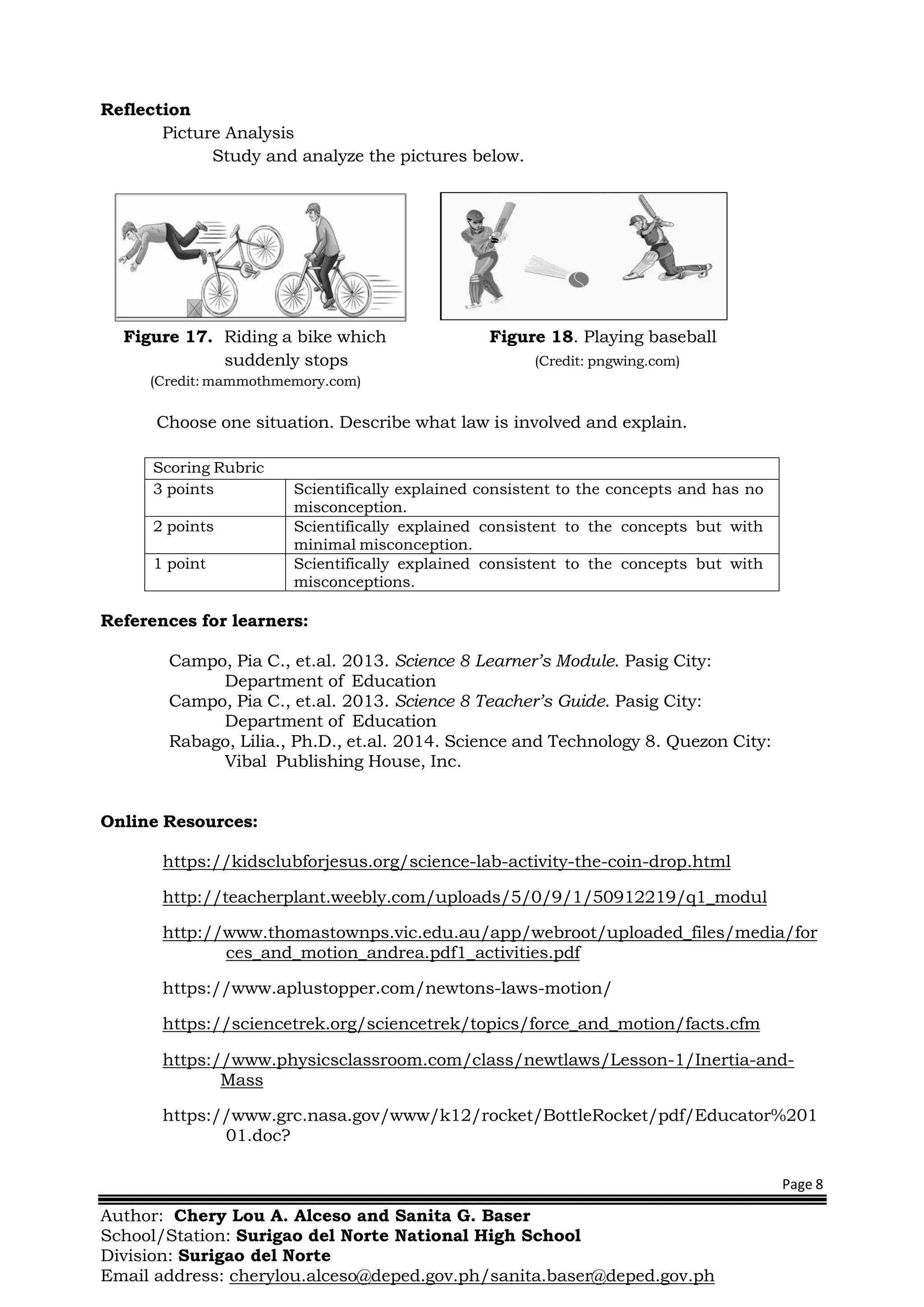
Picture Analysis
Study and analyze the pictures below.
Figure 17. Riding a bike which Figure 18. Playing baseball
suddenly stops (Credit: pngwing.com)
(Credit: mammothmemory.com)
Choose one situation. Describe what law is involved and explain.
Scoring Rubric
3 points Scientifically explained consistent to the concepts and has no
misconception.
2 points Scientifically explained consistent to the concepts but with
minimal misconception.
1 point Scientifically explained consistent to the concepts but with
misconceptions.
References for learners:
Campo, Pia C., et.al. 2013. Science 8 Learner’s Module. Pasig City:
Department of Education
Campo, Pia C., et.al. 2013. Science 8 Teacher’s Guide. Pasig City:
Department of Education
Rabago, Lilia., Ph.D., et.al. 2014. Science and Technology 8. Quezon City:
Vibal Publishing House, Inc.
Online Resources:
https://kidsclubforjesus.org/science-lab-activity-the-coin-drop.html
http://teacherplant.weebly.com/uploads/5/0/9/1/50912219/q1_modul
http://www.thomastownps.vic.edu.au/app/webroot/uploaded_files/media/for
ces_and_motion_andrea.pdf1_activities.pdf
https://www.aplustopper.com/newtons-laws-motion/
https://sciencetrek.org/sciencetrek/topics/force_and_motion/facts.cfm
https://www.physicsclassroom.com/class/newtlaws/Lesson-1/Inertia-and-
Mass
https://www.grc.nasa.gov/www/k12/rocket/BottleRocket/pdf/Educator%201
01.doc?
Page 9
Author: Chery Lou A. Alceso and Sanita G. Baser
School/Station: Surigao del Norte National High School
Division: Surigao del Norte
Email address: cherylou.alceso@deped.gov.ph/sanita.baser@deped.gov.ph
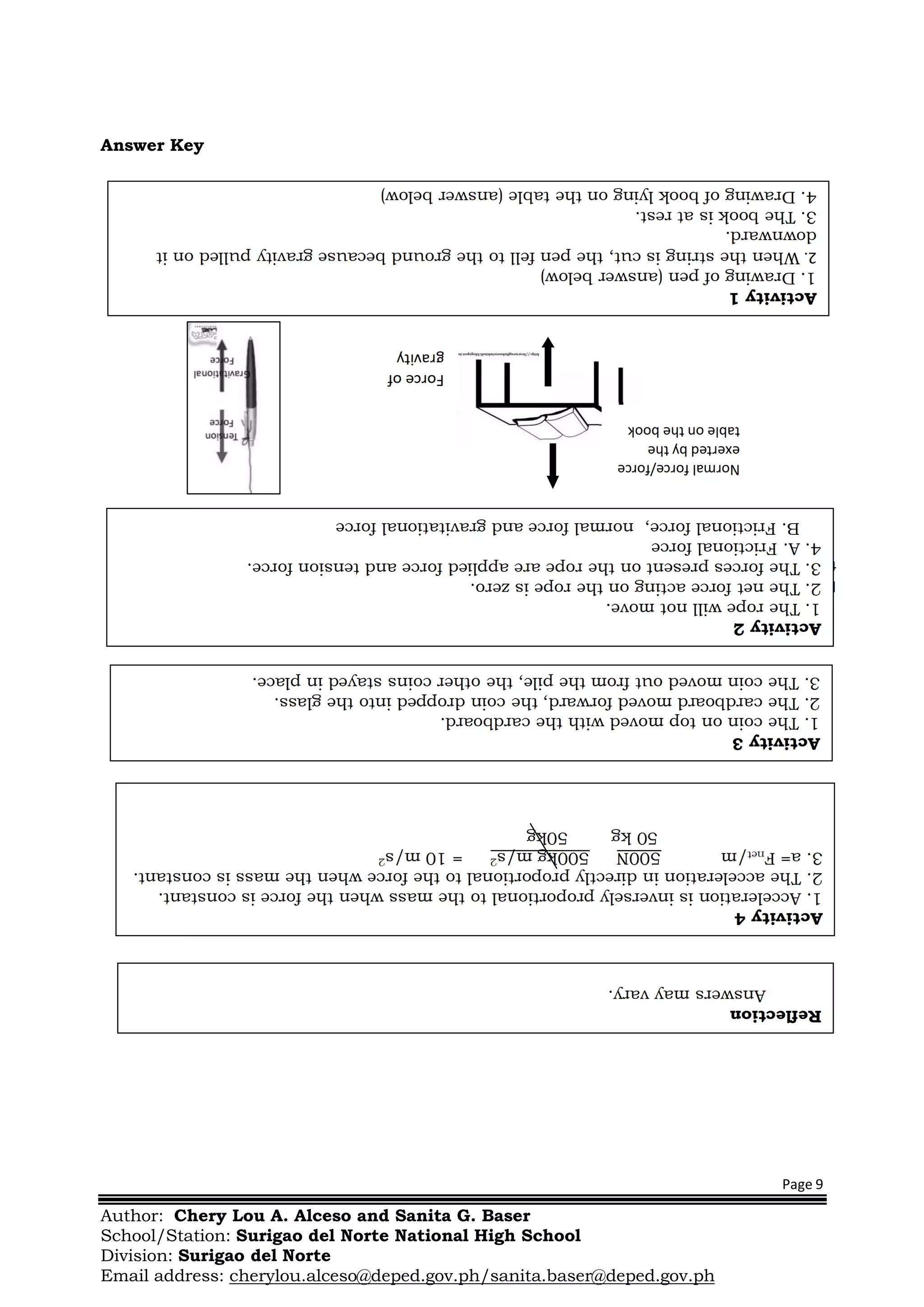
Answer Key

S8 q1 week 1

  • 1.
    COPYRIGHT PAGE FORUNIFIED LEARNING ACTIVITY SHEETS Science-Grade 8 Learner Activity Sheets Quarter 1- Week 1: Force and Motion First Edition, 2021 Republic Act 8293, section 176 states that: No copyright shall subsist in any work of Government of the Philippines. However, prior approval of the government agency or office wherein the work is created shall be necessary for the exploitation of such work for a profit. Such agency or office may, among other things, impose as a condition the payment of royalties. Borrowed materials (e.g., songs, stories, poems, pictures, photos, brand names, trademarks, etc.) included in the activity sheets are owned by their respective copyright holders. Every effort has been exerted to locate and seek permission to use these materials from their respective copyright owners. The authors do not represent nor claim ownership over them. Writers: Development Team of the Learners’ Activity Sheets Chery Lou A. Alceso Sanita G. Baser Regional Validators: Edna E. Trinidad, EdD Jomel C. Montero Ma. Cristina G. Ballesteros Lovie Kim P. Ocura Eugene D. Manulat Division Validators: Gersim S. Lumintac, PhD. Elena M. Navallo, PhD. Alberto M. Orias, Jr. Management Team Ma. Teresa M. Real, Schools Division Superintendent Leonevee V. Silvosa, CESE, Asst. Schools Division Superintendent Dominico P. Larong, Jr., CID Chief Gemma L. Pullos, PhD., LR Manager Gersim S. Lumintac, PhD., Science Education Program Supervisor Author: Chery Lou A. Alceso and Sanita G. Baser School/Station: Surigao del Norte National High School Division: Surigao del Norte Email address: cherylou.alceso@deped.gov.ph/sanita.baser@deped.gov.ph
  • 2.
    Page 1 Author: CheryLou A. Alceso and Sanita G. Baser School/Station: Surigao del Norte National High School Division: Surigao del Norte Email address: cherylou.alceso@deped.gov.ph/sanita.baser@deped.gov.ph WEEKLY LEARNING ACTIVITY SHEETS Science 8, Quarter 1, Week 1 FORCE AND MOTION Name of Learner: Section: _____________ Most Essential Learning Competency: Investigate the relationship between the amount of force applied and the mass of the object to the amount of change in the object’s motion (S8FE-Ia-15) Learning Objectives: The learners shall be able to: 1. identify the forces acting on an object at rest and construct a free body diagram of forces acting on an object; 2. examine conditions when two forces are balanced; 3. demonstrate Newton’s Law of Inertia; 4. expound how an unbalanced (net) force affects the acceleration of a moving object; and 5. interpret Newton’s Laws of Motion (Law of Inertia and Law of Acceleration). Time Allotment: 4 hours Key Concepts:  Force is a push or a pull. It can make objects move, stop, or change their direction of motion.  An object maybe acted upon by several forces. For example, an object may be pushed and pulled in different directions at the same time. To identify which of these forces would be able to cause change in the motion of the object, it is important to identify all the forces acting on it.  Forces are described in terms of magnitude. Magnitude refers to the size or strength of the force which is commonly expressed in Newton (N); direction of the force, point of application and line of action. Figure 1. Force Acting on a Ball The diagram above shows a force, represented by the arrow, acting on a ball. The direction of the arrow indicates the direction of the force while the length of the arrow represents the relative magnitude of the force. If the force applied on the ball is doubled, the length of the arrow is increased two times. The line of action is the straight line passing through the point of application and is parallel to the direction of the force. (Credit: Science 8 LM)
  • 3.
    Page 2 Author: CheryLou A. Alceso and Sanita G. Baser School/Station: Surigao del Norte National High School Division: Surigao del Norte Email address: cherylou.alceso@deped.gov.ph/sanita.baser@deped.gov.ph  Types of force are contact and non-contact forces  Contact forces are forces where objects touch or contact with each other. Examples of Contact forces:  Applied force-a force given to a person by another person or object. Its symbol is F depending on who or what applies force to the object. If a boy applies a force to a wall, we denote it with Figure 2. FBOY. Refer to Figure 2. Applied force of a boy (FBOY) towards the wall (Credit Science LM)  Frictional force-a force acting against or opposite an object in contact with which makes the movement of the object slows down, it always opposes the motion of the object. Its symbol is written as Ff. Air resistance denoted by FAIR is an example of frictional force of the air against a flying kite, airplanes, parachutes or those in skydiving sports. For free-falling objects, this force is always considered negligible, meaning the magnitude is unnoticeable. Figure 3. Frictional force (Ff) acts opposite to the force applied (Credit Science LM)  Normal force- a force that acts perpendicular to the surface of the object in contact with. Its symbol is FN.  Tension force – a force applied to hanging string, rope, chain or cable. Its symbol is T. Figure 4. Normal force (FN) acts perpendicular Figure 5. Tension force or simply tension (T) that acts on the rope of a hanging ball. (Credit: Science 8 LM) Credit: Science 8 LM)
  • 4.
    Page 3 Author: CheryLou A. Alceso and Sanita G. Baser School/Station: Surigao del Norte National High School Division: Surigao del Norte Email address: cherylou.alceso@deped.gov.ph/sanita.baser@deped.gov.ph  Non-contact forces are forces where objects do not touch or contact with each other. These forces act over a zone or area called field. Examples of Non-contact forces:  Gravitational f o r c e (Fg) – a force of attraction between two objects. (Credit: Science 8 LM) Figure 6. Gravitational force between the Earth and the Moon.  Magnetic force- a force exerted on a field of attraction or repulsion as in the case of magnets and other magnetic materials. Opposite poles attract Like poles repel Figure 8. Magnetic Attraction (Credit: Science 8 LM)  If two forces acting on an object are equal in magnitude but opposite in direction, they are considered as balanced forces. These forces must lie along the same line. If the forces are balanced, the objects either stay at rest or continue to move at constant velocity. Figure 9. Tug-of-War Game If the sum of the forces equate to zero, they are considered balanced. The algebraic signs + and - are used to indicate the direction of forces. Unlike signs are used for forces acting in opposite direction. Example: (Credit: Science 8 LM) Fnet = FA + FB =3 units + (-3 units) = 0 The weight of an object, denoted by W, is an example of the gravitational force of the Earth towards the object. In Figure 7, the weight of a book (WBOOK) is illustrated. Figure 7. Illustration of the weight of a book (WBOOK) on the table with normal force (FN) (Credit: Science 8 LM)
  • 5.
    Page 4 Author: CheryLou A. Alceso and Sanita G. Baser School/Station: Surigao del Norte National High School Division: Surigao del Norte Email address: cherylou.alceso@deped.gov.ph/sanita.baser@deped.gov.ph  Forces that cause a change in the motion of an object are unbalanced forces. Unbalanced forces are not equal and in opposite direction. Suppose that one of the teams in tug-of-war, as shown in Figure 10, exerts greater magnitude of force, FB, on the ground than the other team, the forces applied on the ground would no longer be equal. One team would be able to pull the other team in the direction of the larger force. Example: Fnet =FA + FB =5 units + ( -10 units) = - 5 units Figure 10. Tug-of-War Game (Credit: shutterstock.com)  Newton’s First Law states that an object at rest will remain at rest or an object in motion will stay in motion and travel in straight line, as long as no external net force acts on it. The object will change its state of motion only if there is unbalanced or net force acting upon it. It is also known as the Law of Inertia.  Newton’s Second Law of Motion: Law of Acceleration states that the acceleration of an object is directly proportional to the magnitude of the net force acting on it and is inversely proportional to its mass. The statement concerned with the relation of acceleration to mass and force. This can be expressed in equation form as: Acceleration = Net force/ Mass a= Fnet/m This often rearranged as Fnet = ma; force has a unit and is expressed in Newton (N). One Newton is defined as the amount of force required to give a 1 -kg mass an acceleration of 1m/s/s or 1 Newton (N)= 1 kg m/s2 Example: a. Suppose a ball of mass 0.50 kg is hit with a force of 15N. Its acceleration will be: Given: mass =0.50 kg Formula : a=Fnet/m Force =15N Solution: a=15N Find: a=? 0.50 kg a=30 m/s2 b. If the same ball on item A is hit with a force of 20N, what is it new acceleration? Given: mass =0.50 kg Formula : a=Fnet/m Force =20N Solution: a=20N Find: a=? 0.50 kg a=40 m/s2
  • 6.
    Page 5 Author: CheryLou A. Alceso and Sanita G. Baser School/Station: Surigao del Norte National High School Division: Surigao del Norte Email address: cherylou.alceso@deped.gov.ph/sanita.baser@deped.gov.ph Activity 1: Exploring, Investigating Invisible Forces! Objective: Identify the forces acting on an object at rest and construct a free body diagram of forces acting on an object. What you need: Pictures of a hanging pen and book lying on the table. What to do: Look and study the pictures as shown in Figure 11 and 12. Figure 11. Hanging Pen (Credit: Science 8 LM) Guide Questions: Write your answer on a separate sheet of paper. 1. Consider the pen at rest, draw the forces acting on the pen. Use arrows to represent these forces. 2. If the string will be cut, what happens to the pen? What could have caused the pen’s motion? 3. Is the book at rest or in motion? 4. Draw the forces acting on the book. Use arrows to represent these forces. Activity 2 Balance of Forces Objective: Examine conditions when two forces are balanced. What you need: Pictures of tug-of-war game and a ball pushed on the floor What to do: Analyze the pictures below. Figure 13. Balanced forces in a tug-of-war Figure 14. A ball pushed on the floor (Credit: shutterstock.com) Figure 12. A book lying on a table. (http://learnenglishnowinhindi.blogspot.com)
  • 7.
    Page 6 Author: CheryLou A. Alceso and Sanita G. Baser School/Station: Surigao del Norte National High School Division: Surigao del Norte Email address: cherylou.alceso@deped.gov.ph/sanita.baser@deped.gov.ph FA - applied force on the rope by Team A FB - applied force on the rope by Team B FN – force exerted by the floor on the ball Fg - force exerted by the Earth on the ball Ff -opposite force in the direction of the motion or frictional force FAPPLIED – applied force on the ball Guide Questions: Write your answer on a separate sheet of paper. For questions 1-3, refer to Figure 13. 1. If two groups in the game are exerting equal and opposite forces on the rope, will the rope move? 2. In the same condition, what happens to the net force acting on the rope? 3. What are the forces present on the rope? 4. Refer to Figure 14. If you place a ball on the floor then push it gently to one side, observe the motion of the ball as it rolls down the floor. a. What makes the ball stop rolling after sometime? b. What are the forces that act on the ball? Activity 3 Objective: Investigating Inertia Demonstrate the Newton’s Law of Inertia What you need: Empty glass, hard paper materials (carton, folder, cardboard), 5 pieces 1 peso coin Ruler What to do: A. Coin Drop 1. Arrange the setup as shown in Figure 15 . Figure 15. Cardboard and coin (Credit: Science 8 LM) 2. Slowly pull the cardboard with your hand and observe what happens. 3. Arrange again the setup as shown. This time, quickly flick the cardboard with your finger. Observe again what happens. B. Stack of Coins 4. Stack the coins on a flat level surface. 5. Quickly hit the coin at the bottom with the edge of the ruler. Figure 16. Stack of coins (Credit: Science 8 LM)
  • 8.
    Page 7 Author: CheryLou A. Alceso and Sanita G. Baser School/Station: Surigao del Norte National High School Division: Surigao del Norte Email address: cherylou.alceso@deped.gov.ph/sanita.baser@deped.gov.ph Guide Questions: Write your answer on a separate sheet of paper. 1. What happened when you slowly pulled the cardboard? 2. What happened when you flicked the cardboard? 3. What happened when you hit the coin at the bottom? Why is this so? Activity 4 Data Analysis Objectives: Expound how an unbalanced (net) force affects the acceleration of a moving object. What you need: paper and pen What to do: Study the table below. Table 1. Relationship between mass and acceleration Force (N) Mass (kg) Acceleration (m/s2) 10 4 2.5 10 3 3.3 10 2 5.0 10 1 10 Table 2. Relationship between force and acceleration Force (N) Mass (kg) Acceleration (m/s2) 5 10 0.5 10 10 1.0 15 10 1.5 20 10 2.0 Guide Questions: Write your answer on a separate sheet of paper. 1. How would you describe the relationship between mass and acceleration? 2. How would you describe the relationship between force and acceleration? 3. What is the acceleration of a 50kg object pushed with a force of 500N?
  • 9.
    Page 8 Author: CheryLou A. Alceso and Sanita G. Baser School/Station: Surigao del Norte National High School Division: Surigao del Norte Email address: cherylou.alceso@deped.gov.ph/sanita.baser@deped.gov.ph Reflection Picture Analysis Study and analyze the pictures below. Figure 17. Riding a bike which Figure 18. Playing baseball suddenly stops (Credit: pngwing.com) (Credit: mammothmemory.com) Choose one situation. Describe what law is involved and explain. Scoring Rubric 3 points Scientifically explained consistent to the concepts and has no misconception. 2 points Scientifically explained consistent to the concepts but with minimal misconception. 1 point Scientifically explained consistent to the concepts but with misconceptions. References for learners: Campo, Pia C., et.al. 2013. Science 8 Learner’s Module. Pasig City: Department of Education Campo, Pia C., et.al. 2013. Science 8 Teacher’s Guide. Pasig City: Department of Education Rabago, Lilia., Ph.D., et.al. 2014. Science and Technology 8. Quezon City: Vibal Publishing House, Inc. Online Resources: https://kidsclubforjesus.org/science-lab-activity-the-coin-drop.html http://teacherplant.weebly.com/uploads/5/0/9/1/50912219/q1_modul http://www.thomastownps.vic.edu.au/app/webroot/uploaded_files/media/for ces_and_motion_andrea.pdf1_activities.pdf https://www.aplustopper.com/newtons-laws-motion/ https://sciencetrek.org/sciencetrek/topics/force_and_motion/facts.cfm https://www.physicsclassroom.com/class/newtlaws/Lesson-1/Inertia-and- Mass https://www.grc.nasa.gov/www/k12/rocket/BottleRocket/pdf/Educator%201 01.doc?
  • 10.
    Page 9 Author: CheryLou A. Alceso and Sanita G. Baser School/Station: Surigao del Norte National High School Division: Surigao del Norte Email address: cherylou.alceso@deped.gov.ph/sanita.baser@deped.gov.ph Answer Key