LEGAL DEFINITIONS
SED433A
COLORADO CHRISTIAN UNIVERSITY
Definition: A Child with Emotional
Disturbance under IDEA
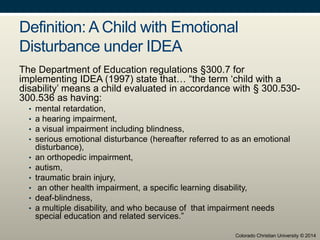
The Department of Education regulations §300.7 for
implementing IDEA (1997) state that… “the term ‘child with a
disability’ means a child evaluated in accordance with § 300.530-
300.536 as having:
• mental retardation,
• a hearing impairment,
• a visual impairment including blindness,
• serious emotional disturbance (hereafter referred to as an emotional
disturbance),
• an orthopedic impairment,
• autism,
• traumatic brain injury,
• an other health impairment, a specific learning disability,
• deaf-blindness,
• a multiple disability, and who because of that impairment needs
special education and related services.”
Colorado Christian University © 2014
Definition: A Child with Emotional
Disturbance under IDEA
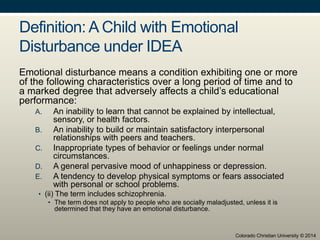
Emotional disturbance means a condition exhibiting one or more
of the following characteristics over a long period of time and to
a marked degree that adversely affects a child’s educational
performance:
A. An inability to learn that cannot be explained by intellectual,
sensory, or health factors.
B. An inability to build or maintain satisfactory interpersonal
relationships with peers and teachers.
C. Inappropriate types of behavior or feelings under normal
circumstances.
D. A general pervasive mood of unhappiness or depression.
E. A tendency to develop physical symptoms or fears associated
with personal or school problems.
• (ii) The term includes schizophrenia.
• The term does not apply to people who are socially maladjusted, unless it is
determined that they have an emotional disturbance.
Colorado Christian University © 2014
Definition: A Child with Emotional
Disturbance under IDEA and 504
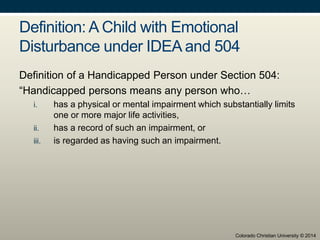
Definition of a Handicapped Person under Section 504:
“Handicapped persons means any person who…
i. has a physical or mental impairment which substantially limits
one or more major life activities,
ii. has a record of such an impairment, or
iii. is regarded as having such an impairment.
Colorado Christian University © 2014
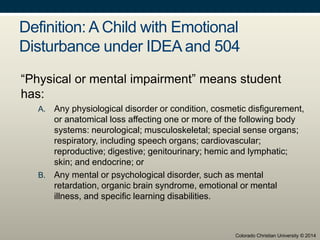
Definition: A Child with Emotional
Disturbance under IDEA and 504
“Physical or mental impairment” means student
has:
A. Any physiological disorder or condition, cosmetic disfigurement,
or anatomical loss affecting one or more of the following body
systems: neurological; musculoskeletal; special sense organs;
respiratory, including speech organs; cardiovascular;
reproductive; digestive; genitourinary; hemic and lymphatic;
skin; and endocrine; or
B. Any mental or psychological disorder, such as mental
retardation, organic brain syndrome, emotional or mental
illness, and specific learning disabilities.
Colorado Christian University © 2014
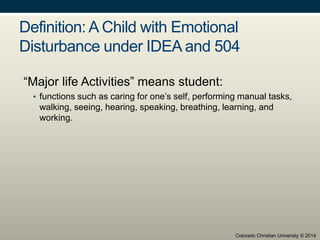
Definition: A Child with Emotional
Disturbance under IDEA and 504
“Major life Activities” means student:
• functions such as caring for one’s self, performing manual tasks,
walking, seeing, hearing, speaking, breathing, learning, and
working.
Colorado Christian University © 2014
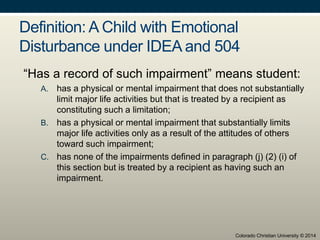
Definition: A Child with Emotional
Disturbance under IDEA and 504
“Has a record of such impairment” means student:
A. has a physical or mental impairment that does not substantially
limit major life activities but that is treated by a recipient as
constituting such a limitation;
B. has a physical or mental impairment that substantially limits
major life activities only as a result of the attitudes of others
toward such impairment;
C. has none of the impairments defined in paragraph (j) (2) (i) of
this section but is treated by a recipient as having such an
impairment.
Colorado Christian University © 2014
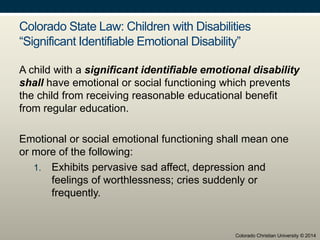
Colorado State Law: Children with Disabilities
“Significant Identifiable Emotional Disability”
A child with a significant identifiable emotional disability
shall have emotional or social functioning which prevents
the child from receiving reasonable educational benefit
from regular education.
Emotional or social emotional functioning shall mean one
or more of the following:
1. Exhibits pervasive sad affect, depression and
feelings of worthlessness; cries suddenly or
frequently.
Colorado Christian University © 2014
Colorado State Law: Children with Disabilities
“Significant Identifiable Emotional Disability”
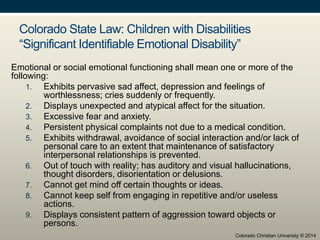
Emotional or social emotional functioning shall mean one or more of the
following:
1. Exhibits pervasive sad affect, depression and feelings of
worthlessness; cries suddenly or frequently.
2. Displays unexpected and atypical affect for the situation.
3. Excessive fear and anxiety.
4. Persistent physical complaints not due to a medical condition.
5. Exhibits withdrawal, avoidance of social interaction and/or lack of
personal care to an extent that maintenance of satisfactory
interpersonal relationships is prevented.
6. Out of touch with reality; has auditory and visual hallucinations,
thought disorders, disorientation or delusions.
7. Cannot get mind off certain thoughts or ideas.
8. Cannot keep self from engaging in repetitive and/or useless
actions.
9. Displays consistent pattern of aggression toward objects or
persons.
Colorado Christian University © 2014
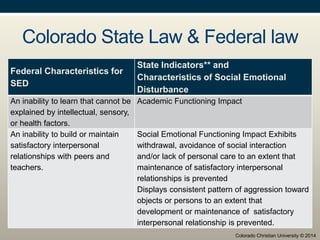
Colorado State Law & Federal law
Federal Characteristics for
SED
State Indicators** and
Characteristics of Social Emotional
Disturbance
An inability to learn that cannot be
explained by intellectual, sensory,
or health factors.
Academic Functioning Impact
An inability to build or maintain
satisfactory interpersonal
relationships with peers and
teachers.
Social Emotional Functioning Impact Exhibits
withdrawal, avoidance of social interaction
and/or lack of personal care to an extent that
maintenance of satisfactory interpersonal
relationships is prevented
Displays consistent pattern of aggression toward
objects or persons to an extent that
development or maintenance of satisfactory
interpersonal relationship is prevented.
Colorado Christian University © 2014
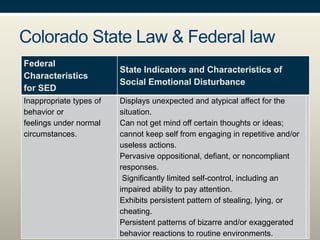
Colorado State Law & Federal law
Federal
Characteristics
for SED
State Indicators and Characteristics of
Social Emotional Disturbance
Inappropriate types of
behavior or
feelings under normal
circumstances.
Displays unexpected and atypical affect for the
situation.
Can not get mind off certain thoughts or ideas;
cannot keep self from engaging in repetitive and/or
useless actions.
Pervasive oppositional, defiant, or noncompliant
responses.
Significantly limited self-control, including an
impaired ability to pay attention.
Exhibits persistent pattern of stealing, lying, or
cheating.
Persistent patterns of bizarre and/or exaggerated
behavior reactions to routine environments.
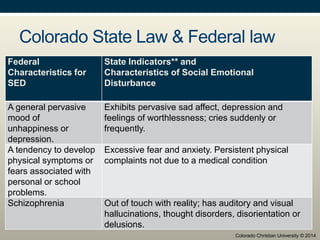
Colorado State Law & Federal law
Federal
Characteristics for
SED
State Indicators** and
Characteristics of Social Emotional
Disturbance
A general pervasive
mood of
unhappiness or
depression.
Exhibits pervasive sad affect, depression and
feelings of worthlessness; cries suddenly or
frequently.
A tendency to develop
physical symptoms or
fears associated with
personal or school
problems.
Excessive fear and anxiety. Persistent physical
complaints not due to a medical condition
Schizophrenia Out of touch with reality; has auditory and visual
hallucinations, thought disorders, disorientation or
delusions.
Colorado Christian University © 2014

S5.legal definitions.2014

  • 1.
  • 2.
    Definition: A Childwith Emotional Disturbance under IDEA The Department of Education regulations §300.7 for implementing IDEA (1997) state that… “the term ‘child with a disability’ means a child evaluated in accordance with § 300.530- 300.536 as having: • mental retardation, • a hearing impairment, • a visual impairment including blindness, • serious emotional disturbance (hereafter referred to as an emotional disturbance), • an orthopedic impairment, • autism, • traumatic brain injury, • an other health impairment, a specific learning disability, • deaf-blindness, • a multiple disability, and who because of that impairment needs special education and related services.” Colorado Christian University © 2014
  • 3.
    Definition: A Childwith Emotional Disturbance under IDEA Emotional disturbance means a condition exhibiting one or more of the following characteristics over a long period of time and to a marked degree that adversely affects a child’s educational performance: A. An inability to learn that cannot be explained by intellectual, sensory, or health factors. B. An inability to build or maintain satisfactory interpersonal relationships with peers and teachers. C. Inappropriate types of behavior or feelings under normal circumstances. D. A general pervasive mood of unhappiness or depression. E. A tendency to develop physical symptoms or fears associated with personal or school problems. • (ii) The term includes schizophrenia. • The term does not apply to people who are socially maladjusted, unless it is determined that they have an emotional disturbance. Colorado Christian University © 2014
  • 4.
    Definition: A Childwith Emotional Disturbance under IDEA and 504 Definition of a Handicapped Person under Section 504: “Handicapped persons means any person who… i. has a physical or mental impairment which substantially limits one or more major life activities, ii. has a record of such an impairment, or iii. is regarded as having such an impairment. Colorado Christian University © 2014
  • 5.
    Definition: A Childwith Emotional Disturbance under IDEA and 504 “Physical or mental impairment” means student has: A. Any physiological disorder or condition, cosmetic disfigurement, or anatomical loss affecting one or more of the following body systems: neurological; musculoskeletal; special sense organs; respiratory, including speech organs; cardiovascular; reproductive; digestive; genitourinary; hemic and lymphatic; skin; and endocrine; or B. Any mental or psychological disorder, such as mental retardation, organic brain syndrome, emotional or mental illness, and specific learning disabilities. Colorado Christian University © 2014
  • 6.
    Definition: A Childwith Emotional Disturbance under IDEA and 504 “Major life Activities” means student: • functions such as caring for one’s self, performing manual tasks, walking, seeing, hearing, speaking, breathing, learning, and working. Colorado Christian University © 2014
  • 7.
    Definition: A Childwith Emotional Disturbance under IDEA and 504 “Has a record of such impairment” means student: A. has a physical or mental impairment that does not substantially limit major life activities but that is treated by a recipient as constituting such a limitation; B. has a physical or mental impairment that substantially limits major life activities only as a result of the attitudes of others toward such impairment; C. has none of the impairments defined in paragraph (j) (2) (i) of this section but is treated by a recipient as having such an impairment. Colorado Christian University © 2014
  • 8.
    Colorado State Law:Children with Disabilities “Significant Identifiable Emotional Disability” A child with a significant identifiable emotional disability shall have emotional or social functioning which prevents the child from receiving reasonable educational benefit from regular education. Emotional or social emotional functioning shall mean one or more of the following: 1. Exhibits pervasive sad affect, depression and feelings of worthlessness; cries suddenly or frequently. Colorado Christian University © 2014
  • 9.
    Colorado State Law:Children with Disabilities “Significant Identifiable Emotional Disability” Emotional or social emotional functioning shall mean one or more of the following: 1. Exhibits pervasive sad affect, depression and feelings of worthlessness; cries suddenly or frequently. 2. Displays unexpected and atypical affect for the situation. 3. Excessive fear and anxiety. 4. Persistent physical complaints not due to a medical condition. 5. Exhibits withdrawal, avoidance of social interaction and/or lack of personal care to an extent that maintenance of satisfactory interpersonal relationships is prevented. 6. Out of touch with reality; has auditory and visual hallucinations, thought disorders, disorientation or delusions. 7. Cannot get mind off certain thoughts or ideas. 8. Cannot keep self from engaging in repetitive and/or useless actions. 9. Displays consistent pattern of aggression toward objects or persons. Colorado Christian University © 2014
  • 10.
    Colorado State Law& Federal law Federal Characteristics for SED State Indicators** and Characteristics of Social Emotional Disturbance An inability to learn that cannot be explained by intellectual, sensory, or health factors. Academic Functioning Impact An inability to build or maintain satisfactory interpersonal relationships with peers and teachers. Social Emotional Functioning Impact Exhibits withdrawal, avoidance of social interaction and/or lack of personal care to an extent that maintenance of satisfactory interpersonal relationships is prevented Displays consistent pattern of aggression toward objects or persons to an extent that development or maintenance of satisfactory interpersonal relationship is prevented. Colorado Christian University © 2014
  • 11.
    Colorado State Law& Federal law Federal Characteristics for SED State Indicators and Characteristics of Social Emotional Disturbance Inappropriate types of behavior or feelings under normal circumstances. Displays unexpected and atypical affect for the situation. Can not get mind off certain thoughts or ideas; cannot keep self from engaging in repetitive and/or useless actions. Pervasive oppositional, defiant, or noncompliant responses. Significantly limited self-control, including an impaired ability to pay attention. Exhibits persistent pattern of stealing, lying, or cheating. Persistent patterns of bizarre and/or exaggerated behavior reactions to routine environments.
  • 12.
    Colorado State Law& Federal law Federal Characteristics for SED State Indicators** and Characteristics of Social Emotional Disturbance A general pervasive mood of unhappiness or depression. Exhibits pervasive sad affect, depression and feelings of worthlessness; cries suddenly or frequently. A tendency to develop physical symptoms or fears associated with personal or school problems. Excessive fear and anxiety. Persistent physical complaints not due to a medical condition Schizophrenia Out of touch with reality; has auditory and visual hallucinations, thought disorders, disorientation or delusions. Colorado Christian University © 2014