TRAINING ON HIGHER-ORDER THINKING
SKILLS PROFESSIONAL LEARNING PACKAGE
(HOTS-PLP) FOR ENGLISH TEACHERS
JANUARY 29- FEBRUARY 1, 2024
SAMOIKI VALLEY INN
BONTOC, MT. PROVINCE
FELOMINA L. DASKEO
Presenter
Supporting Classroom Teaching-and-
Learning through Learning Approaches
2
FELOMINA L. DASKEO
3
🔥 Training on Higher-Order Thinking Skills PLP 3
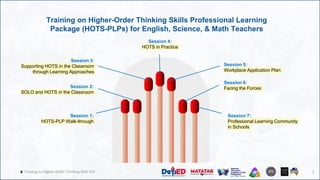
Session 1:
HOTS-PLP Walk-through
Session 6:
Facing the Forces
Session 5:
Workplace Application Plan
Session 2:
SOLO and HOTS in the Classroom
Session 7:
Professional Learning Community
in Schools
Session 3:
Supporting HOTS in the Classroom
through Learning Approaches
Session 4:
HOTS in Practice
Training on Higher-Order Thinking Skills Professional Learning
Package (HOTS-PLPs) for English, Science, & Math Teachers
🔥 Training on Higher-Order Thinking Skills PLP
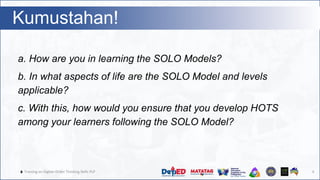
Kumustahan!
4
a. How are you in learning the SOLO Models?
b. In what aspects of life are the SOLO Model and levels
applicable?
c. With this, how would you ensure that you develop HOTS
among your learners following the SOLO Model?
🔥 Training on Higher-Order Thinking Skills PLP
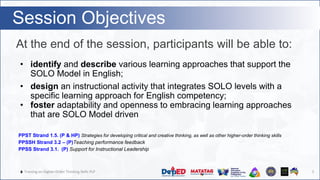
Session Objectives
At the end of the session, participants will be able to:
5
• identify and describe various learning approaches that support the
SOLO Model in English;
• design an instructional activity that integrates SOLO levels with a
specific learning approach for English competency;
• foster adaptability and openness to embracing learning approaches
that are SOLO Model driven
PPST Strand 1.5. (P & HP) Strategies for developing critical and creative thinking, as well as other higher-order thinking skills
PPSSH Strand 3.2 – (P)Teaching performance feedback
PPSS Strand 3.1. (P) Support for Instructional Leadership
🔥 Training on Higher-Order Thinking Skills PLP
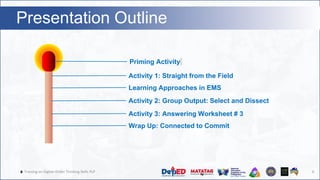
Presentation Outline
6
Priming Activity
Activity 1: Straight from the Field
Learning Approaches in EMS
Activity 2: Group Output: Select and Dissect
Activity 3: Answering Worksheet # 3
Wrap Up: Connected to Commit
🔥 Training on Higher-Order Thinking Skills PLP
Activity 1: Straight from the Field
7
🔥 Training on Higher-Order Thinking Skills PLP
Activity 1: Straight from the Field
8
1. The participants will be grouped according to their division or subject area.
This activity has two parts: group discussion and group presentation.
A. Group Discussion
● Discuss and describe common learning approaches you utilized in
the field. Descriptions may be written in bullet points only.
● Give remarks on the utilization of learning approaches by citing
percentage or how often you use these learning approaches.

🔥 Training on Higher-Order Thinking Skills PLP
Activity 1: Straight from the Field
9
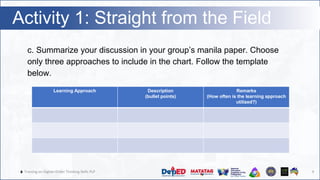
Learning Approach Description
(bullet points)
Remarks
(How often is the learning approach
utilized?)
c. Summarize your discussion in your group’s manila paper. Choose
only three approaches to include in the chart. Follow the template
below.
🔥 Training on Higher-Order Thinking Skills PLP
Activity 1: Straight from the Field
10
B. Group Presentation
● Share the three learning approaches like how field reporting is done on
radio and television. Your group will be given a maximum of three
minutes only for the presentation.
C. Time Allotment
● Your group is given 15 minutes to discuss, make the summary chart,
and plan for your presentation.
🔥 Training on Higher-Order Thinking Skills PLP
Activity 1: Straight from the Field
11
<Insert>
15 minute timer
🔥 Training on Higher-Order Thinking Skills PLP
Activity 1: Straight from the Field
12
Group
Presentations
🔥 Training on Higher-Order Thinking Skills PLP
Activity 1: Straight from the Field
13
Processing
Questions
🔥 Training on Higher-Order Thinking Skills PLP
Activity 1: Straight from the Field
14
1. Looking at the tables of each group titled “straight from the field”,
● how did your group choose or narrow down the three
approaches that you included in the chart?
● are the identified learning approaches SOLO Model driven? If
yes, why? And if No, why not?
1. Based on the given description of the learning approaches, which
do you think would be most applicable in teaching English?
.
🔥 Training on Higher-Order Thinking Skills PLP
Activity 1: Straight from the Field
15
3. From the given description of the identified learning
approaches, how could these learning approaches help in
developing the higher order thinking skills of the learners?
🔥 Training on Higher-Order Thinking Skills PLP
Learning Approaches
16
🔥 Training on Higher-Order Thinking Skills PLP
What is a learning approach?
17
• an element used by teachers to help students understand the
information in depth
Aflalo, E., & Gabay, E. (2013)
• primary focus is not on the amount of how much is learned,
but on the way people learn
Urhahne, D. (2020)
Aflalo, E., & Gabay, E. (2013). Learning approach and learning: Exploring a new technological learning system. International Journal for the Scholarship of Teaching and
Learning, 7(1). doi.org/10.20429/ijsotl.2013.070114
Urhahne, D. (2020). Learning approaches. Educational Psychology, 40(5), 533-534. https://doi.org/10.1080/01443410.2020.1755503
🔥 Training on Higher-Order Thinking Skills PLP 18
The HOTS PLPs deal with varied
stems, questions, or activities that
you may integrate into your lesson
using different approaches.
🔥 Training on Higher-Order Thinking Skills PLP 19
Learning Approaches in Teaching
English/Reading
❑ Question–Answer Relationship (QAR)
Strategy
❑ Text Structure Strategy
❑ Metacognitive Approach
🔥 Training on Higher-Order Thinking Skills PLP 20
Learning Approaches in Teaching English/Reading
1. Question–Answer Relationship (QAR) Strategy
✔ allows learners to determine the relationship between the question
and the answer
✔ shows learners how to recognize and then answer questions that
may either be located in the book or in their heads
🔥 Training on Higher-Order Thinking Skills PLP 21
🔥 Training on Higher-Order Thinking Skills PLP
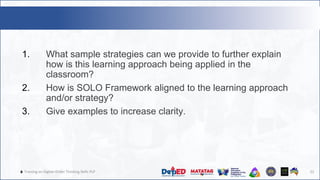
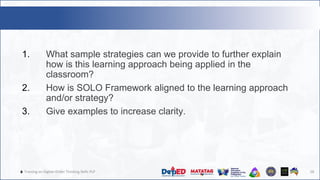
1. What sample strategies can we provide to further explain
how is this learning approach being applied in the
classroom?
2. How is SOLO Framework aligned to the learning approach
and/or strategy?
3. Give examples to increase clarity.
22
🔥 Training on Higher-Order Thinking Skills PLP 23
2. Text Structure Strategy
✔ originated from studies that revealed that the content of most texts is
organized using a hierarchical structure
✔ hierarchical structure of texts fits into one or a combination of two or
more of five specific text structures: comparison and contrast, cause and
effect, problem and solution, sequence, and description
Learning Approaches in Teaching English/Reading
🔥 Training on Higher-Order Thinking Skills PLP
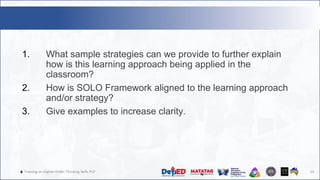
1. What sample strategies can we provide to further explain
how is this learning approach being applied in the
classroom?
2. How is SOLO Framework aligned to the learning approach
and/or strategy?
3. Give examples to increase clarity.
24
🔥 Training on Higher-Order Thinking Skills PLP 25
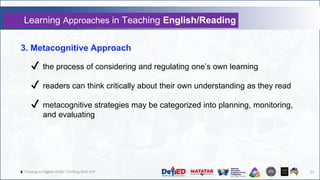
3. Metacognitive Approach
✔ the process of considering and regulating one’s own learning
✔ readers can think critically about their own understanding as they read
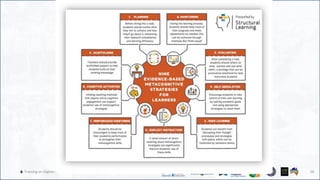
✔ metacognitive strategies may be categorized into planning, monitoring,
and evaluating
Learning Approaches in Teaching English/Reading
🔥 Training on Higher-Order Thinking Skills PLP 26
🔥 Training on Higher-Order Thinking Skills PLP 27
🔥 Training on Higher-Order Thinking Skills PLP
1. What sample strategies can we provide to further explain
how is this learning approach being applied in the
classroom?
2. How is SOLO Framework aligned to the learning approach
and/or strategy?
3. Give examples to increase clarity.
28
🔥 Training on Higher-Order Thinking Skills PLP
Activity 2: Select and Dissect!
29
🔥 Training on Higher-Order Thinking Skills PLP 30
Activity 2: Select and Dissect!
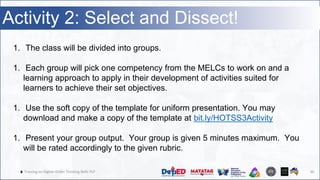
1. The class will be divided into groups.
1. Each group will pick one competency from the MELCs to work on and a
learning approach to apply in their development of activities suited for
learners to achieve their set objectives.
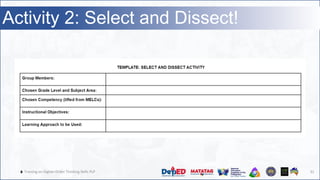
1. Use the soft copy of the template for uniform presentation. You may
download and make a copy of the template at bit.ly/HOTSS3Activity
1. Present your group output. Your group is given 5 minutes maximum. You
will be rated accordingly to the given rubric.
🔥 Training on Higher-Order Thinking Skills PLP 31
Activity 2: Select and Dissect!
🔥 Training on Higher-Order Thinking Skills PLP 32
Activity 2: Select and Dissect!
🔥 Training on Higher-Order Thinking Skills PLP 33
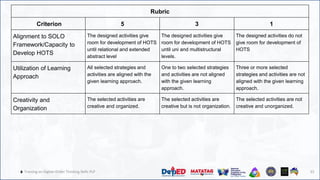
Rubric
Criterion 5 3 1
Alignment to SOLO
Framework/Capacity to
Develop HOTS
The designed activities give
room for development of HOTS
until relational and extended
abstract level
The designed activities give
room for development of HOTS
until uni and multistructural
levels.
The designed activities do not
give room for development of
HOTS
Utilization of Learning
Approach
All selected strategies and
activities are aligned with the
given learning approach.
One to two selected strategies
and activities are not aligned
with the given learning
approach.
Three or more selected
strategies and activities are not
aligned with the given learning
approach.
Creativity and
Organization
The selected activities are
creative and organized.
The selected activities are
creative but is not organization.
The selected activities are not
creative and unorganized.
🔥 Training on Higher-Order Thinking Skills PLP 34
Activity 2: Select and Dissect!
<Insert>
20-minute timer
🔥 Training on Higher-Order Thinking Skills PLP 35
Activity 2: Select and Dissect!
Group
Presentations
🔥 Training on Higher-Order Thinking Skills PLP 36
Activity 2: Select and Dissect!
Processing
Questions
🔥 Training on Higher-Order Thinking Skills PLP 37
Activity 2: Select and Dissect!
1.How do you find the activity?
2. Was it easy to craft a SOLO Model sensitive activity? Why or
why not?
3. Do you think the designed activity will ensure development of the
higher order thinking skills of the learner? In what way?
4. Can you cite specific examples based on the crafted activity that
shows development of HOTS for our learners?
🔥 Training on Higher-Order Thinking Skills PLP
Activity 3: Worksheet #3
38
🔥 Training on Higher-Order Thinking Skills PLP 39
Activity 3: Worksheet # 3
1. List 3 details you understand about each of the learning approaches
of your subject area.
2. List 3 questions or details for clarifications you might have on any of
the learning approaches.
40
🔥 Training on Higher-Order Thinking Skills PLP 40
41
🔥 Training on Higher-Order Thinking Skills PLP 41
🔥 Training on Higher-Order Thinking Skills PLP 42
Activity 3: Worksheet # 3
<Insert>
15-minute timer
🔥 Training on Higher-Order Thinking Skills PLP
Wrap up: Committed to Connect!
43
🔥 Training on Higher-Order Thinking Skills PLP 44
Wrap up: Committed to Connect!
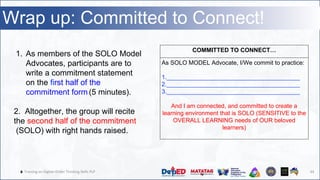
1. As members of the SOLO Model
Advocates, participants are to
write a commitment statement
on the first half of the
commitment form (5 minutes).
2. Altogether, the group will recite
the second half of the commitment
(SOLO) with right hands raised.
COMMITTED TO CONNECT…
As SOLO MODEL Advocate, I/We commit to practice:
1.________________________________________
2.________________________________________
3.________________________________________
And I am connected, and committed to create a
learning environment that is SOLO (SENSITIVE to the
OVERALL LEARNING needs of OUR beloved
learners)
🔥 Training on Higher-Order Thinking Skills PLP 45
Wrap up: Committed to Connect!
<Insert>
5-minute timer
46
🔥 Training on Higher-Order Thinking Skills PLP 46
“The hardest part of any task is staying committed to its
completion. One can think of several compelling reasons to
give up commitment. But living up to a commitment and being
committed reflects a person’s integrity and character.”
Simran Khurana
47
🔥 Training on Higher-Order Thinking Skills PLP
Thank you.
neap.pddu@deped.gov.ph
47
48
🔥 Training on Higher-Order Thinking Skills PLP 48
Training on Higher-Order Thinking Skills - Professional Learning Package
Program Management Team
Research Center for Teacher Quality (RCTQ)
National Educators Academy of the Philippines (NEAP)
Professional Development Division
Quality Assurance Division
NEAP in the Regions
Session Guide Writers and Presentation Deck Editors
1. Alson Rae Luna
2. Angelica B. Buaron
3. Angelo D. Uy
4. Analou O. Hermocilla
5. Arnel Jr. M. Camba
6. Eldefonso Jr. B. Natividad
7. Elsie Jane M. Mantilla
8. Fluellen L. Cos
9. Hera Paz B. Yamson
10. Jelly L. Sore
11. Jojiemar M. Obligar
12. Josephine P. Balasan
13. Mae Laarni M. Saporna
14. Marie Vic C. Velasco
15. Maripaz T. Mendoza
16. Mark Anthony A. Durana
17. Melvin Willy II B. Roque
18. Milaner R. Oyo-a
19. Rejulios M. Villenes
20. Renante Juanillo
21. Renato N. Pacpakin
22. Rosalyn C. Gadiano
23. Sally A. Palomo
24. Wilma S. Carrera
NEAP Central Office
1. Abdul Haiy A. Sali
2. Guillermo Nikus Telan
3. Dir. Leah B. Apao
4. Jerson R. Capuyan
5. Richie Carla Vesagas

LEARNING APPROACHES to learnning [Autosaved].pptx

  • 1.
    TRAINING ON HIGHER-ORDERTHINKING SKILLS PROFESSIONAL LEARNING PACKAGE (HOTS-PLP) FOR ENGLISH TEACHERS JANUARY 29- FEBRUARY 1, 2024 SAMOIKI VALLEY INN BONTOC, MT. PROVINCE FELOMINA L. DASKEO Presenter
  • 2.
    Supporting Classroom Teaching-and- Learningthrough Learning Approaches 2 FELOMINA L. DASKEO
  • 3.
    3 🔥 Training onHigher-Order Thinking Skills PLP 3 Session 1: HOTS-PLP Walk-through Session 6: Facing the Forces Session 5: Workplace Application Plan Session 2: SOLO and HOTS in the Classroom Session 7: Professional Learning Community in Schools Session 3: Supporting HOTS in the Classroom through Learning Approaches Session 4: HOTS in Practice Training on Higher-Order Thinking Skills Professional Learning Package (HOTS-PLPs) for English, Science, & Math Teachers
  • 4.
    🔥 Training onHigher-Order Thinking Skills PLP Kumustahan! 4 a. How are you in learning the SOLO Models? b. In what aspects of life are the SOLO Model and levels applicable? c. With this, how would you ensure that you develop HOTS among your learners following the SOLO Model?
  • 5.
    🔥 Training onHigher-Order Thinking Skills PLP Session Objectives At the end of the session, participants will be able to: 5 • identify and describe various learning approaches that support the SOLO Model in English; • design an instructional activity that integrates SOLO levels with a specific learning approach for English competency; • foster adaptability and openness to embracing learning approaches that are SOLO Model driven PPST Strand 1.5. (P & HP) Strategies for developing critical and creative thinking, as well as other higher-order thinking skills PPSSH Strand 3.2 – (P)Teaching performance feedback PPSS Strand 3.1. (P) Support for Instructional Leadership
  • 6.
    🔥 Training onHigher-Order Thinking Skills PLP Presentation Outline 6 Priming Activity Activity 1: Straight from the Field Learning Approaches in EMS Activity 2: Group Output: Select and Dissect Activity 3: Answering Worksheet # 3 Wrap Up: Connected to Commit
  • 7.
    🔥 Training onHigher-Order Thinking Skills PLP Activity 1: Straight from the Field 7
  • 8.
    🔥 Training onHigher-Order Thinking Skills PLP Activity 1: Straight from the Field 8 1. The participants will be grouped according to their division or subject area. This activity has two parts: group discussion and group presentation. A. Group Discussion ● Discuss and describe common learning approaches you utilized in the field. Descriptions may be written in bullet points only. ● Give remarks on the utilization of learning approaches by citing percentage or how often you use these learning approaches.
  • 9.
    🔥 Training onHigher-Order Thinking Skills PLP Activity 1: Straight from the Field 9 Learning Approach Description (bullet points) Remarks (How often is the learning approach utilized?) c. Summarize your discussion in your group’s manila paper. Choose only three approaches to include in the chart. Follow the template below.
  • 10.
    🔥 Training onHigher-Order Thinking Skills PLP Activity 1: Straight from the Field 10 B. Group Presentation ● Share the three learning approaches like how field reporting is done on radio and television. Your group will be given a maximum of three minutes only for the presentation. C. Time Allotment ● Your group is given 15 minutes to discuss, make the summary chart, and plan for your presentation.
  • 11.
    🔥 Training onHigher-Order Thinking Skills PLP Activity 1: Straight from the Field 11 <Insert> 15 minute timer
  • 12.
    🔥 Training onHigher-Order Thinking Skills PLP Activity 1: Straight from the Field 12 Group Presentations
  • 13.
    🔥 Training onHigher-Order Thinking Skills PLP Activity 1: Straight from the Field 13 Processing Questions
  • 14.
    🔥 Training onHigher-Order Thinking Skills PLP Activity 1: Straight from the Field 14 1. Looking at the tables of each group titled “straight from the field”, ● how did your group choose or narrow down the three approaches that you included in the chart? ● are the identified learning approaches SOLO Model driven? If yes, why? And if No, why not? 1. Based on the given description of the learning approaches, which do you think would be most applicable in teaching English? .
  • 15.
    🔥 Training onHigher-Order Thinking Skills PLP Activity 1: Straight from the Field 15 3. From the given description of the identified learning approaches, how could these learning approaches help in developing the higher order thinking skills of the learners?
  • 16.
    🔥 Training onHigher-Order Thinking Skills PLP Learning Approaches 16
  • 17.
    🔥 Training onHigher-Order Thinking Skills PLP What is a learning approach? 17 • an element used by teachers to help students understand the information in depth Aflalo, E., & Gabay, E. (2013) • primary focus is not on the amount of how much is learned, but on the way people learn Urhahne, D. (2020) Aflalo, E., & Gabay, E. (2013). Learning approach and learning: Exploring a new technological learning system. International Journal for the Scholarship of Teaching and Learning, 7(1). doi.org/10.20429/ijsotl.2013.070114 Urhahne, D. (2020). Learning approaches. Educational Psychology, 40(5), 533-534. https://doi.org/10.1080/01443410.2020.1755503
  • 18.
    🔥 Training onHigher-Order Thinking Skills PLP 18 The HOTS PLPs deal with varied stems, questions, or activities that you may integrate into your lesson using different approaches.
  • 19.
    🔥 Training onHigher-Order Thinking Skills PLP 19 Learning Approaches in Teaching English/Reading ❑ Question–Answer Relationship (QAR) Strategy ❑ Text Structure Strategy ❑ Metacognitive Approach
  • 20.
    🔥 Training onHigher-Order Thinking Skills PLP 20 Learning Approaches in Teaching English/Reading 1. Question–Answer Relationship (QAR) Strategy ✔ allows learners to determine the relationship between the question and the answer ✔ shows learners how to recognize and then answer questions that may either be located in the book or in their heads
  • 21.
    🔥 Training onHigher-Order Thinking Skills PLP 21
  • 22.
    🔥 Training onHigher-Order Thinking Skills PLP 1. What sample strategies can we provide to further explain how is this learning approach being applied in the classroom? 2. How is SOLO Framework aligned to the learning approach and/or strategy? 3. Give examples to increase clarity. 22
  • 23.
    🔥 Training onHigher-Order Thinking Skills PLP 23 2. Text Structure Strategy ✔ originated from studies that revealed that the content of most texts is organized using a hierarchical structure ✔ hierarchical structure of texts fits into one or a combination of two or more of five specific text structures: comparison and contrast, cause and effect, problem and solution, sequence, and description Learning Approaches in Teaching English/Reading
  • 24.
    🔥 Training onHigher-Order Thinking Skills PLP 1. What sample strategies can we provide to further explain how is this learning approach being applied in the classroom? 2. How is SOLO Framework aligned to the learning approach and/or strategy? 3. Give examples to increase clarity. 24
  • 25.
    🔥 Training onHigher-Order Thinking Skills PLP 25 3. Metacognitive Approach ✔ the process of considering and regulating one’s own learning ✔ readers can think critically about their own understanding as they read ✔ metacognitive strategies may be categorized into planning, monitoring, and evaluating Learning Approaches in Teaching English/Reading
  • 26.
    🔥 Training onHigher-Order Thinking Skills PLP 26
  • 27.
    🔥 Training onHigher-Order Thinking Skills PLP 27
  • 28.
    🔥 Training onHigher-Order Thinking Skills PLP 1. What sample strategies can we provide to further explain how is this learning approach being applied in the classroom? 2. How is SOLO Framework aligned to the learning approach and/or strategy? 3. Give examples to increase clarity. 28
  • 29.
    🔥 Training onHigher-Order Thinking Skills PLP Activity 2: Select and Dissect! 29
  • 30.
    🔥 Training onHigher-Order Thinking Skills PLP 30 Activity 2: Select and Dissect! 1. The class will be divided into groups. 1. Each group will pick one competency from the MELCs to work on and a learning approach to apply in their development of activities suited for learners to achieve their set objectives. 1. Use the soft copy of the template for uniform presentation. You may download and make a copy of the template at bit.ly/HOTSS3Activity 1. Present your group output. Your group is given 5 minutes maximum. You will be rated accordingly to the given rubric.
  • 31.
    🔥 Training onHigher-Order Thinking Skills PLP 31 Activity 2: Select and Dissect!
  • 32.
    🔥 Training onHigher-Order Thinking Skills PLP 32 Activity 2: Select and Dissect!
  • 33.
    🔥 Training onHigher-Order Thinking Skills PLP 33 Rubric Criterion 5 3 1 Alignment to SOLO Framework/Capacity to Develop HOTS The designed activities give room for development of HOTS until relational and extended abstract level The designed activities give room for development of HOTS until uni and multistructural levels. The designed activities do not give room for development of HOTS Utilization of Learning Approach All selected strategies and activities are aligned with the given learning approach. One to two selected strategies and activities are not aligned with the given learning approach. Three or more selected strategies and activities are not aligned with the given learning approach. Creativity and Organization The selected activities are creative and organized. The selected activities are creative but is not organization. The selected activities are not creative and unorganized.
  • 34.
    🔥 Training onHigher-Order Thinking Skills PLP 34 Activity 2: Select and Dissect! <Insert> 20-minute timer
  • 35.
    🔥 Training onHigher-Order Thinking Skills PLP 35 Activity 2: Select and Dissect! Group Presentations
  • 36.
    🔥 Training onHigher-Order Thinking Skills PLP 36 Activity 2: Select and Dissect! Processing Questions
  • 37.
    🔥 Training onHigher-Order Thinking Skills PLP 37 Activity 2: Select and Dissect! 1.How do you find the activity? 2. Was it easy to craft a SOLO Model sensitive activity? Why or why not? 3. Do you think the designed activity will ensure development of the higher order thinking skills of the learner? In what way? 4. Can you cite specific examples based on the crafted activity that shows development of HOTS for our learners?
  • 38.
    🔥 Training onHigher-Order Thinking Skills PLP Activity 3: Worksheet #3 38
  • 39.
    🔥 Training onHigher-Order Thinking Skills PLP 39 Activity 3: Worksheet # 3 1. List 3 details you understand about each of the learning approaches of your subject area. 2. List 3 questions or details for clarifications you might have on any of the learning approaches.
  • 40.
    40 🔥 Training onHigher-Order Thinking Skills PLP 40
  • 41.
    41 🔥 Training onHigher-Order Thinking Skills PLP 41
  • 42.
    🔥 Training onHigher-Order Thinking Skills PLP 42 Activity 3: Worksheet # 3 <Insert> 15-minute timer
  • 43.
    🔥 Training onHigher-Order Thinking Skills PLP Wrap up: Committed to Connect! 43
  • 44.
    🔥 Training onHigher-Order Thinking Skills PLP 44 Wrap up: Committed to Connect! 1. As members of the SOLO Model Advocates, participants are to write a commitment statement on the first half of the commitment form (5 minutes). 2. Altogether, the group will recite the second half of the commitment (SOLO) with right hands raised. COMMITTED TO CONNECT… As SOLO MODEL Advocate, I/We commit to practice: 1.________________________________________ 2.________________________________________ 3.________________________________________ And I am connected, and committed to create a learning environment that is SOLO (SENSITIVE to the OVERALL LEARNING needs of OUR beloved learners)
  • 45.
    🔥 Training onHigher-Order Thinking Skills PLP 45 Wrap up: Committed to Connect! <Insert> 5-minute timer
  • 46.
    46 🔥 Training onHigher-Order Thinking Skills PLP 46 “The hardest part of any task is staying committed to its completion. One can think of several compelling reasons to give up commitment. But living up to a commitment and being committed reflects a person’s integrity and character.” Simran Khurana
  • 47.
    47 🔥 Training onHigher-Order Thinking Skills PLP Thank you. neap.pddu@deped.gov.ph 47
  • 48.
    48 🔥 Training onHigher-Order Thinking Skills PLP 48 Training on Higher-Order Thinking Skills - Professional Learning Package Program Management Team Research Center for Teacher Quality (RCTQ) National Educators Academy of the Philippines (NEAP) Professional Development Division Quality Assurance Division NEAP in the Regions Session Guide Writers and Presentation Deck Editors 1. Alson Rae Luna 2. Angelica B. Buaron 3. Angelo D. Uy 4. Analou O. Hermocilla 5. Arnel Jr. M. Camba 6. Eldefonso Jr. B. Natividad 7. Elsie Jane M. Mantilla 8. Fluellen L. Cos 9. Hera Paz B. Yamson 10. Jelly L. Sore 11. Jojiemar M. Obligar 12. Josephine P. Balasan 13. Mae Laarni M. Saporna 14. Marie Vic C. Velasco 15. Maripaz T. Mendoza 16. Mark Anthony A. Durana 17. Melvin Willy II B. Roque 18. Milaner R. Oyo-a 19. Rejulios M. Villenes 20. Renante Juanillo 21. Renato N. Pacpakin 22. Rosalyn C. Gadiano 23. Sally A. Palomo 24. Wilma S. Carrera NEAP Central Office 1. Abdul Haiy A. Sali 2. Guillermo Nikus Telan 3. Dir. Leah B. Apao 4. Jerson R. Capuyan 5. Richie Carla Vesagas