Training on HOTS-PLP for English, Science, and Mathematics Teachers
Session 3 - Supporting Classroom Teaching-Learning through Learning Approaches
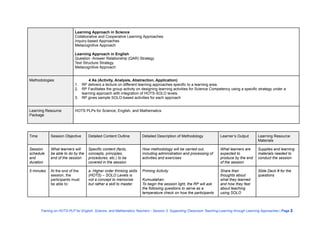
Title of Session Supporting Classroom Teaching-Learning through Learning Approaches
Session Objective At the end of the session, the participants will be able to:
1. Identify and describe various learning approaches that apply the SOLO Model in English, Mathematics and Science; (K)
2. Design an instructional activity that integrates SOLO levels with a learning approach for a specific English, Science and
Mathematics competency; (S) and,
3. Foster adaptability and openness to embracing learning approaches that are SOLO Model driven. (A)
Session Outputs
1. Crafted Instructional Plan (Daily Lesson Log) for Science, English, and Mathematics Competency using a specific strategy under
a learning approach with integration of HOTS-SOLO levels.
2. Worksheet #3
Session Duration and
Time
Specific time and number of hours and/or minutes allocated for the session
1:30PM - 2:30PM ; 3:00PM - 4:30PM
2.5 hours (150 mins)
Key Content Definition of Learning Approaches
Learning Approach in Mathematics
Mathematical Modelling Approach
Critical Thinking and Problem-Solving Based Approaches
Assessing Mathematical Literacy through Mathematical Reasoning & Computational Thinking
Training on HOTS-PLP for English, Science, and Mathematics Teachers - Session 3: Supporting Classroom Teaching-Learning through Learning Approaches | Page 1
Learning Approach in Science
Collaborative and Cooperative Learning Approaches
Inquiry-based Approaches
Metacognitive Approach
Learning Approach in English
Question -Answer Relationship (QAR) Strategy
Text Structure Strategy
Metacognitive Approach
Methodologies 4 As (Activity, Analysis, Abstraction, Application)
1. RP delivers a lecture on different learning approaches specific to a learning area.
2. RP Facilitates the group activity on designing learning activities for Science Competency using a specific strategy under a
learning approach with integration of HOTS-SOLO levels.
3. RP gives sample SOLO-based activities for each approach
Learning Resource
Package
HOTS PLPs for Science, English, and Mathematics
Time Session Objective Detailed Content Outline Detailed Description of Methodology Learner’s Output Learning Resource
Materials
Session
schedule
and
duration
What learners will
be able to do by the
end of the session
Specific content (facts,
concepts, principles,
procedures, etc.) to be
covered in the session
How methodology will be carried out,
including administration and processing of
activities and exercises
What learners are
expected to
produce by the end
of the session
Supplies and learning
materials needed to
conduct the session
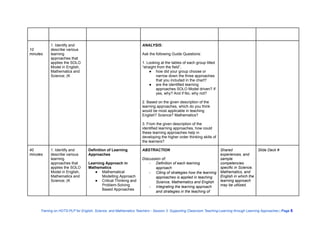
5 minutes At the end of the
session, the
participants must
be able to:
a. Higher order thinking skills
(HOTS) – SOLO Levels is
not a concept to memorize
but rather a skill to master.
Priming Activity
Kumustahan:
To begin the session light, the RP will ask
the following questions to serve as a
temperature check on how the participants
Share their
thoughts about
what they learned
and how they feel
about teaching
using SOLO
Slide Deck # for the
questions
Training on HOTS-PLP for English, Science, and Mathematics Teachers - Session 3: Supporting Classroom Teaching-Learning through Learning Approaches | Page 2
1. Identify and
describe various
learning
approaches that
applies the SOLO
Model in English,
Mathematics and
Science; (K)
b. It covers how the brain
processes thinking. And it is
not only applicable in
academics/school but rather
in all life activities (cooking,
driving, classroom
management, etc).
are learning as well as review the
participants on the content of the previous
session:
a. How are you in learning the SOLO
Models?
b. In what aspects of life is the SOLO Model
and levels applicable?
c. With this, how would you ensure that you
develop HOTS among your learners
following the SOLO Model?
Framework in the
classroom.
30
minutes
(15 mins -
group
discussio
n and
preparatio
n
15 mins -
presentati
ons)
c. In order to fully develop
HOTS-SOLO Levels among
our learners, teachers must
apply various teaching
strategies aligned to learning
approaches which are
aligned with the SOLO
Model.
ACTIVITY
Activity 1: Straight from the Field Report!
Instructions:
1. Organize participants by group. This can
be by division or school or subject area.
Note to the Facilitator: 15 minutes is given
for the groups to discuss and prepare for
their presentation, and the next 15 minutes
is allotted for all plenary presentations
(three minutes each group). This means it
is recommended to have only 5 groups for
this activity.
2. Give the following instructions:
This activity has two parts - group
discussion and group presentation.
A. Group Discussion
Group presentation
on the learning
approaches utilized
by teachers in their
division.
Reflection on the
presentation given.
Slide Deck #
Manila paper and
markers per group
Training on HOTS-PLP for English, Science, and Mathematics Teachers - Session 3: Supporting Classroom Teaching-Learning through Learning Approaches | Page 3
a. Discuss and describe common learning
approaches utilized by teachers in the field.
Descriptions may be written in bullet points
only.
b. Give remarks on the utilization of
learning approaches by citing percentage or
how often teachers use these learning
approaches.
c. In your group’s manila paper, follow the
template below. Choose only three
approaches to include in the chart.
Learning
Approach
Description
(bullet
points)
Remarks
(How often
is the
learning
approach
utilized?)
B. Group Presentation
a. Share the three learning approaches to
the plenary creatively like how field
reporting is done on radio and television.
Presentation should only be three minutes
long (maximum).
b. Your group is given 15 minutes to
discuss and plan for your presentation.
Training on HOTS-PLP for English, Science, and Mathematics Teachers - Session 3: Supporting Classroom Teaching-Learning through Learning Approaches | Page 4
10
minutes
1. Identify and
describe various
learning
approaches that
applies the SOLO
Model in English,
Mathematics and
Science; (K
ANALYSIS:
Ask the following Guide Questions:
1. Looking at the tables of each group titled
“straight from the field”,
● how did your group choose or
narrow down the three approaches
that you included in the chart?
● are the identified learning
approaches SOLO Model driven? If
yes, why? And if No, why not?
2. Based on the given description of the
learning approaches, which do you think
would be most applicable in teaching
English? Science? Mathematics?
3. From the given description of the
identified learning approaches, how could
these learning approaches help in
developing the higher order thinking skills of
the learners?
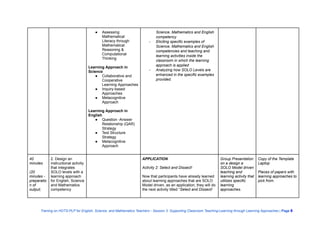
40
minutes
1. Identify and
describe various
learning
approaches that
applies the SOLO
Model in English,
Mathematics and
Science; (K
Definition of Learning
Approaches
Learning Approach in
Mathematics
● Mathematical
Modelling Approach
● Critical Thinking and
Problem-Solving
Based Approaches
ABSTRACTION
Discussion of:
- Definition of each learning
approach
- Citing of strategies how the learning
approaches is applied in teaching
Science, Mathematics and English
- Integrating the learning approach
and strategies in the teaching of
Shared
experiences, and
sample
competencies
specific in Science,
Mathematics, and
English in which the
learning approach
may be utilized.
Slide Deck #
Training on HOTS-PLP for English, Science, and Mathematics Teachers - Session 3: Supporting Classroom Teaching-Learning through Learning Approaches | Page 5
● Assessing
Mathematical
Literacy through
Mathematical
Reasoning &
Computational
Thinking
Learning Approach in
Science
● Collaborative and
Cooperative
Learning Approaches
● Inquiry-based
Approaches
● Metacognitive
Approach
Learning Approach in
English
● Question -Answer
Relationship (QAR)
Strategy
● Text Structure
Strategy
● Metacognitive
Approach
Science, Mathematics and English
competency
- Eliciting specific examples of
Science, Mathematics and English
competencies and teaching and
learning activities inside the
classroom in which the learning
approach is applied
- Analyzing how SOLO Levels are
enhanced in the specific examples
provided.
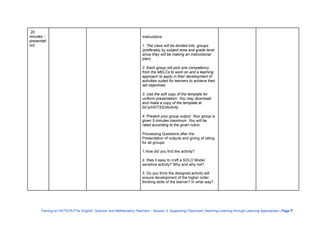
40
minutes
(20
minutes -
preparatio
n of
output;
2. Design an
instructional activity
that integrates
SOLO levels with a
learning approach
for English, Science
and Mathematics
competency
APPLICATION
Activity 2: Select and Dissect!
Now that participants have already learned
about learning approaches that are SOLO
Model driven, as an application, they will do
the next activity titled “Select and Dissect!
Group Presentation
on a design a
SOLO Model driven
teaching and
learning activity that
utilizes specific
learning
approaches.
Copy of the Template
Laptop
Pieces of papers with
learning approaches to
pick from.
Training on HOTS-PLP for English, Science, and Mathematics Teachers - Session 3: Supporting Classroom Teaching-Learning through Learning Approaches | Page 6
20
minutes -
presentati
on)
Instructions:
1. The class will be divided into groups
(preferably by subject area and grade level
since they will be making an instructional
plan).
2. Each group will pick one competency
from the MELCs to work on and a learning
approach to apply in their development of
activities suited for learners to achieve their
set objectives.
3. Use the soft copy of the template for
uniform presentation. You may download
and make a copy of the template at
bit.ly/HOTSS3Activity
4. Present your group output. Your group is
given 5 minutes maximum. You will be
rated according to the given rubric.
Processing Questions after the
Presentation of outputs and giving of rating
for all groups:
1.How did you find the activity?
2. Was it easy to craft a SOLO Model
sensitive activity? Why and why not?
3. Do you think the designed activity will
ensure development of the higher order
thinking skills of the learner? In what way?
Training on HOTS-PLP for English, Science, and Mathematics Teachers - Session 3: Supporting Classroom Teaching-Learning through Learning Approaches | Page 7
4. Can you cite specific examples based on
the crafted activity that shows development
of HOTS for our learners?
15
minutes
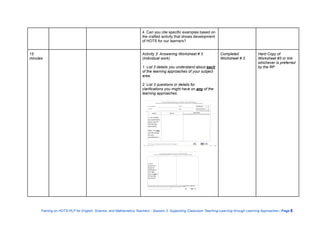
Activity 3: Answering Worksheet # 3
(Individual work)
1. List 3 details you understand about each
of the learning approaches of your subject
area.
2. List 3 questions or details for
clarifications you might have on any of the
learning approaches.
Completed
Worksheet # 3
Hard Copy of
Worksheet #3 or link
whichever is preferred
by the RP
Training on HOTS-PLP for English, Science, and Mathematics Teachers - Session 3: Supporting Classroom Teaching-Learning through Learning Approaches | Page 8
Before asking participants to submit their
worksheets, ask two to three volunteers to
share their answers.
10
minutes
3.Foster
adaptability and
openness to
embracing learning
approaches that
are SOLO Model
driven. (U)
Wrap up: Committed to Connect!
Instruction:
1. As members of the SOLO Model
Advocates, the participants are to write a
commitment statement on the first half of
the commitment form (5 minutes).
2. Altogether, the group will recite the
second half of the commitment (SOLO) with
right hands raised. This will be led by the
facilitator.
3. Ask the participants to keep their
commitment form in their training notebook
or kits or where it will be most visible as a
reminder of their commitment. .
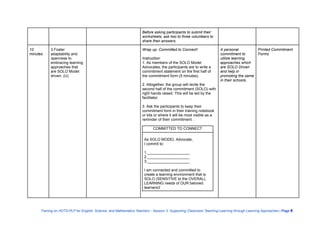
COMMITTED TO CONNECT
As SOLO MODEL Advocate,
I commit to:
1.____________________
2.____________________
3.____________________
I am connected and committed to
create a learning environment that is
SOLO (SENSITIVE to the OVERALL
LEARNING needs of OUR beloved
learners)!
A personal
commitment to
utilize learning
approaches which
are SOLO Driven
and help in
promoting the same
in their schools.
Printed Commitment
Forms
Training on HOTS-PLP for English, Science, and Mathematics Teachers - Session 3: Supporting Classroom Teaching-Learning through Learning Approaches | Page 9
End the session by challenging the
participants if they can be true to their
commitment.
Present this quotation: “The hardest part of
any task is staying committed to its
completion. One can think of several
compelling reasons to give up commitment.
But living up to a commitment and being
committed reflects a person’s integrity and
character.” - Simran Khurana
Training on HOTS-PLP for English, Science, and Mathematics Teachers - Session 3: Supporting Classroom Teaching-Learning through Learning Approaches | Page 10
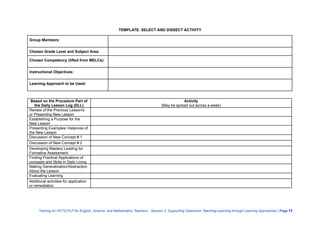
TEMPLATE: SELECT AND DISSECT ACTIVITY
Group Members:
Chosen Grade Level and Subject Area:
Chosen Competency (lifted from MELCs):
Instructional Objectives:
Learning Approach to be Used:
Based on the Procedure Part of
the Daily Lesson Log (DLL)
Activity
(May be spread out across a week)
Review of the Previous Lesson/s
or Presenting New Lesson
Establishing a Purpose for the
New Lesson
Presenting Examples/ Instances of
the New Lesson
Discussion of New Concept # 1
Discussion of New Concept # 2
Developing Mastery Leading for
Formative Assessment
Finding Practical Applications of
concepts and Skills in Daily Living
Making Generalization/Abstraction
About the Lesson
Evaluating Learning
Additional activities for application
or remediation
Training on HOTS-PLP for English, Science, and Mathematics Teachers - Session 3: Supporting Classroom Teaching-Learning through Learning Approaches | Page 11
For Facilitator: Rubric
Criteria 5 3 1
Alignment to SOLO
Framework/Capacity to
Develop HOTS
The designed activities give room for
development of HOTS until relational
and extended abstract level
The designed activities give room
for development of HOTS until uni
and multistructural levels.
The designed activities do not give room for
development of HOTS
Utilization of Learning
Approach
All selected strategies and activities
are aligned with the given learning
approach.
One to two selected strategies and
activities are not aligned with the
given learning approach.
Three or more selected strategies and
activities are not aligned with the given
learning approach.
Creativity and
Organization
The selected activities are creative
and organized.
The selected activities are creative
but are not organized.
The selected activities are not creative and
unorganized.
Training on HOTS-PLP for English, Science, and Mathematics Teachers - Session 3: Supporting Classroom Teaching-Learning through Learning Approaches | Page 12

S3_SG_Supporting Classroom Teaching-Learning through Learning Approaches.pdf

  • 1.
    Training on HOTS-PLPfor English, Science, and Mathematics Teachers Session 3 - Supporting Classroom Teaching-Learning through Learning Approaches Title of Session Supporting Classroom Teaching-Learning through Learning Approaches Session Objective At the end of the session, the participants will be able to: 1. Identify and describe various learning approaches that apply the SOLO Model in English, Mathematics and Science; (K) 2. Design an instructional activity that integrates SOLO levels with a learning approach for a specific English, Science and Mathematics competency; (S) and, 3. Foster adaptability and openness to embracing learning approaches that are SOLO Model driven. (A) Session Outputs 1. Crafted Instructional Plan (Daily Lesson Log) for Science, English, and Mathematics Competency using a specific strategy under a learning approach with integration of HOTS-SOLO levels. 2. Worksheet #3 Session Duration and Time Specific time and number of hours and/or minutes allocated for the session 1:30PM - 2:30PM ; 3:00PM - 4:30PM 2.5 hours (150 mins) Key Content Definition of Learning Approaches Learning Approach in Mathematics Mathematical Modelling Approach Critical Thinking and Problem-Solving Based Approaches Assessing Mathematical Literacy through Mathematical Reasoning & Computational Thinking Training on HOTS-PLP for English, Science, and Mathematics Teachers - Session 3: Supporting Classroom Teaching-Learning through Learning Approaches | Page 1
  • 2.
    Learning Approach inScience Collaborative and Cooperative Learning Approaches Inquiry-based Approaches Metacognitive Approach Learning Approach in English Question -Answer Relationship (QAR) Strategy Text Structure Strategy Metacognitive Approach Methodologies 4 As (Activity, Analysis, Abstraction, Application) 1. RP delivers a lecture on different learning approaches specific to a learning area. 2. RP Facilitates the group activity on designing learning activities for Science Competency using a specific strategy under a learning approach with integration of HOTS-SOLO levels. 3. RP gives sample SOLO-based activities for each approach Learning Resource Package HOTS PLPs for Science, English, and Mathematics Time Session Objective Detailed Content Outline Detailed Description of Methodology Learner’s Output Learning Resource Materials Session schedule and duration What learners will be able to do by the end of the session Specific content (facts, concepts, principles, procedures, etc.) to be covered in the session How methodology will be carried out, including administration and processing of activities and exercises What learners are expected to produce by the end of the session Supplies and learning materials needed to conduct the session 5 minutes At the end of the session, the participants must be able to: a. Higher order thinking skills (HOTS) – SOLO Levels is not a concept to memorize but rather a skill to master. Priming Activity Kumustahan: To begin the session light, the RP will ask the following questions to serve as a temperature check on how the participants Share their thoughts about what they learned and how they feel about teaching using SOLO Slide Deck # for the questions Training on HOTS-PLP for English, Science, and Mathematics Teachers - Session 3: Supporting Classroom Teaching-Learning through Learning Approaches | Page 2
  • 3.
    1. Identify and describevarious learning approaches that applies the SOLO Model in English, Mathematics and Science; (K) b. It covers how the brain processes thinking. And it is not only applicable in academics/school but rather in all life activities (cooking, driving, classroom management, etc). are learning as well as review the participants on the content of the previous session: a. How are you in learning the SOLO Models? b. In what aspects of life is the SOLO Model and levels applicable? c. With this, how would you ensure that you develop HOTS among your learners following the SOLO Model? Framework in the classroom. 30 minutes (15 mins - group discussio n and preparatio n 15 mins - presentati ons) c. In order to fully develop HOTS-SOLO Levels among our learners, teachers must apply various teaching strategies aligned to learning approaches which are aligned with the SOLO Model. ACTIVITY Activity 1: Straight from the Field Report! Instructions: 1. Organize participants by group. This can be by division or school or subject area. Note to the Facilitator: 15 minutes is given for the groups to discuss and prepare for their presentation, and the next 15 minutes is allotted for all plenary presentations (three minutes each group). This means it is recommended to have only 5 groups for this activity. 2. Give the following instructions: This activity has two parts - group discussion and group presentation. A. Group Discussion Group presentation on the learning approaches utilized by teachers in their division. Reflection on the presentation given. Slide Deck # Manila paper and markers per group Training on HOTS-PLP for English, Science, and Mathematics Teachers - Session 3: Supporting Classroom Teaching-Learning through Learning Approaches | Page 3
  • 4.
    a. Discuss anddescribe common learning approaches utilized by teachers in the field. Descriptions may be written in bullet points only. b. Give remarks on the utilization of learning approaches by citing percentage or how often teachers use these learning approaches. c. In your group’s manila paper, follow the template below. Choose only three approaches to include in the chart. Learning Approach Description (bullet points) Remarks (How often is the learning approach utilized?) B. Group Presentation a. Share the three learning approaches to the plenary creatively like how field reporting is done on radio and television. Presentation should only be three minutes long (maximum). b. Your group is given 15 minutes to discuss and plan for your presentation. Training on HOTS-PLP for English, Science, and Mathematics Teachers - Session 3: Supporting Classroom Teaching-Learning through Learning Approaches | Page 4
  • 5.
    10 minutes 1. Identify and describevarious learning approaches that applies the SOLO Model in English, Mathematics and Science; (K ANALYSIS: Ask the following Guide Questions: 1. Looking at the tables of each group titled “straight from the field”, ● how did your group choose or narrow down the three approaches that you included in the chart? ● are the identified learning approaches SOLO Model driven? If yes, why? And if No, why not? 2. Based on the given description of the learning approaches, which do you think would be most applicable in teaching English? Science? Mathematics? 3. From the given description of the identified learning approaches, how could these learning approaches help in developing the higher order thinking skills of the learners? 40 minutes 1. Identify and describe various learning approaches that applies the SOLO Model in English, Mathematics and Science; (K Definition of Learning Approaches Learning Approach in Mathematics ● Mathematical Modelling Approach ● Critical Thinking and Problem-Solving Based Approaches ABSTRACTION Discussion of: - Definition of each learning approach - Citing of strategies how the learning approaches is applied in teaching Science, Mathematics and English - Integrating the learning approach and strategies in the teaching of Shared experiences, and sample competencies specific in Science, Mathematics, and English in which the learning approach may be utilized. Slide Deck # Training on HOTS-PLP for English, Science, and Mathematics Teachers - Session 3: Supporting Classroom Teaching-Learning through Learning Approaches | Page 5
  • 6.
    ● Assessing Mathematical Literacy through Mathematical Reasoning& Computational Thinking Learning Approach in Science ● Collaborative and Cooperative Learning Approaches ● Inquiry-based Approaches ● Metacognitive Approach Learning Approach in English ● Question -Answer Relationship (QAR) Strategy ● Text Structure Strategy ● Metacognitive Approach Science, Mathematics and English competency - Eliciting specific examples of Science, Mathematics and English competencies and teaching and learning activities inside the classroom in which the learning approach is applied - Analyzing how SOLO Levels are enhanced in the specific examples provided. 40 minutes (20 minutes - preparatio n of output; 2. Design an instructional activity that integrates SOLO levels with a learning approach for English, Science and Mathematics competency APPLICATION Activity 2: Select and Dissect! Now that participants have already learned about learning approaches that are SOLO Model driven, as an application, they will do the next activity titled “Select and Dissect! Group Presentation on a design a SOLO Model driven teaching and learning activity that utilizes specific learning approaches. Copy of the Template Laptop Pieces of papers with learning approaches to pick from. Training on HOTS-PLP for English, Science, and Mathematics Teachers - Session 3: Supporting Classroom Teaching-Learning through Learning Approaches | Page 6
  • 7.
    20 minutes - presentati on) Instructions: 1. Theclass will be divided into groups (preferably by subject area and grade level since they will be making an instructional plan). 2. Each group will pick one competency from the MELCs to work on and a learning approach to apply in their development of activities suited for learners to achieve their set objectives. 3. Use the soft copy of the template for uniform presentation. You may download and make a copy of the template at bit.ly/HOTSS3Activity 4. Present your group output. Your group is given 5 minutes maximum. You will be rated according to the given rubric. Processing Questions after the Presentation of outputs and giving of rating for all groups: 1.How did you find the activity? 2. Was it easy to craft a SOLO Model sensitive activity? Why and why not? 3. Do you think the designed activity will ensure development of the higher order thinking skills of the learner? In what way? Training on HOTS-PLP for English, Science, and Mathematics Teachers - Session 3: Supporting Classroom Teaching-Learning through Learning Approaches | Page 7
  • 8.
    4. Can youcite specific examples based on the crafted activity that shows development of HOTS for our learners? 15 minutes Activity 3: Answering Worksheet # 3 (Individual work) 1. List 3 details you understand about each of the learning approaches of your subject area. 2. List 3 questions or details for clarifications you might have on any of the learning approaches. Completed Worksheet # 3 Hard Copy of Worksheet #3 or link whichever is preferred by the RP Training on HOTS-PLP for English, Science, and Mathematics Teachers - Session 3: Supporting Classroom Teaching-Learning through Learning Approaches | Page 8
  • 9.
    Before asking participantsto submit their worksheets, ask two to three volunteers to share their answers. 10 minutes 3.Foster adaptability and openness to embracing learning approaches that are SOLO Model driven. (U) Wrap up: Committed to Connect! Instruction: 1. As members of the SOLO Model Advocates, the participants are to write a commitment statement on the first half of the commitment form (5 minutes). 2. Altogether, the group will recite the second half of the commitment (SOLO) with right hands raised. This will be led by the facilitator. 3. Ask the participants to keep their commitment form in their training notebook or kits or where it will be most visible as a reminder of their commitment. . COMMITTED TO CONNECT As SOLO MODEL Advocate, I commit to: 1.____________________ 2.____________________ 3.____________________ I am connected and committed to create a learning environment that is SOLO (SENSITIVE to the OVERALL LEARNING needs of OUR beloved learners)! A personal commitment to utilize learning approaches which are SOLO Driven and help in promoting the same in their schools. Printed Commitment Forms Training on HOTS-PLP for English, Science, and Mathematics Teachers - Session 3: Supporting Classroom Teaching-Learning through Learning Approaches | Page 9
  • 10.
    End the sessionby challenging the participants if they can be true to their commitment. Present this quotation: “The hardest part of any task is staying committed to its completion. One can think of several compelling reasons to give up commitment. But living up to a commitment and being committed reflects a person’s integrity and character.” - Simran Khurana Training on HOTS-PLP for English, Science, and Mathematics Teachers - Session 3: Supporting Classroom Teaching-Learning through Learning Approaches | Page 10
  • 11.
    TEMPLATE: SELECT ANDDISSECT ACTIVITY Group Members: Chosen Grade Level and Subject Area: Chosen Competency (lifted from MELCs): Instructional Objectives: Learning Approach to be Used: Based on the Procedure Part of the Daily Lesson Log (DLL) Activity (May be spread out across a week) Review of the Previous Lesson/s or Presenting New Lesson Establishing a Purpose for the New Lesson Presenting Examples/ Instances of the New Lesson Discussion of New Concept # 1 Discussion of New Concept # 2 Developing Mastery Leading for Formative Assessment Finding Practical Applications of concepts and Skills in Daily Living Making Generalization/Abstraction About the Lesson Evaluating Learning Additional activities for application or remediation Training on HOTS-PLP for English, Science, and Mathematics Teachers - Session 3: Supporting Classroom Teaching-Learning through Learning Approaches | Page 11
  • 12.
    For Facilitator: Rubric Criteria5 3 1 Alignment to SOLO Framework/Capacity to Develop HOTS The designed activities give room for development of HOTS until relational and extended abstract level The designed activities give room for development of HOTS until uni and multistructural levels. The designed activities do not give room for development of HOTS Utilization of Learning Approach All selected strategies and activities are aligned with the given learning approach. One to two selected strategies and activities are not aligned with the given learning approach. Three or more selected strategies and activities are not aligned with the given learning approach. Creativity and Organization The selected activities are creative and organized. The selected activities are creative but are not organized. The selected activities are not creative and unorganized. Training on HOTS-PLP for English, Science, and Mathematics Teachers - Session 3: Supporting Classroom Teaching-Learning through Learning Approaches | Page 12