ACCESSPOINT • VOLUME 5 • ISSUE 10 PAGE 41
INSIGHTS COMMERCIAL & MARKET ACCESS
RWE: A new way to engage
Integrated Delivery Networks
As pharmaceutical manufacturers look for ways to build
stronger relationships with their Integrated Delivery Network
(IDN) clients, RWE is emerging as a desired infrastructure
capability, presenting a window of opportunity to support and
collaborate on IDN efforts. If done well, these RWE-related
partnerships should provide value for both parties involved
but require pharma to expand its mindset beyond
product-specific approaches.
The authors
marla Kessler, mbA
is Vice President, RWE Solutions, IMS Health
Mkessler@imshealth.com
Jon Resnick, mbA
is Vice President and General Manager, RWE Solutions, IMS Health
Jresnick@imshealth.com
PAGE 42 IMS HEALTH REAL-WORLD EVIDENCE SOLUTIONS
Capturing a window of opportunity for collaboration
The US healthcare industry is paying
increasing attention to the growing
importance of Integrated Delivery Networks
(IDNs). Although there is no single model of an
IDN, the term generally describes a linked
group of facilities and care providers and may
include a payer body as well. IDNs are
organized to provide patients with a
continuum of care, theoretically enabling them
to break down silos of incentives and
information sharing that plague disconnected
care models.
Pharmaceutical manufacturers recognize IDNs as a critical
customer group. Relative to other risk-bearing entities
without care delivery capabilities and objectives (eg, MCOs),
IDNs are uniquely interested in developing a holistic patient
view across settings of care. This increases their appeal as
potential collaborators on efforts to improve patient
outcomes. However, pharma is still trying to understand
how best to serve them. In a recent survey conducted by
IMS Healthi
, RWE emerged as a priority area for IDNs both
in terms of potentially generating value but also one where
they have notable internal skill gaps. They use patient-
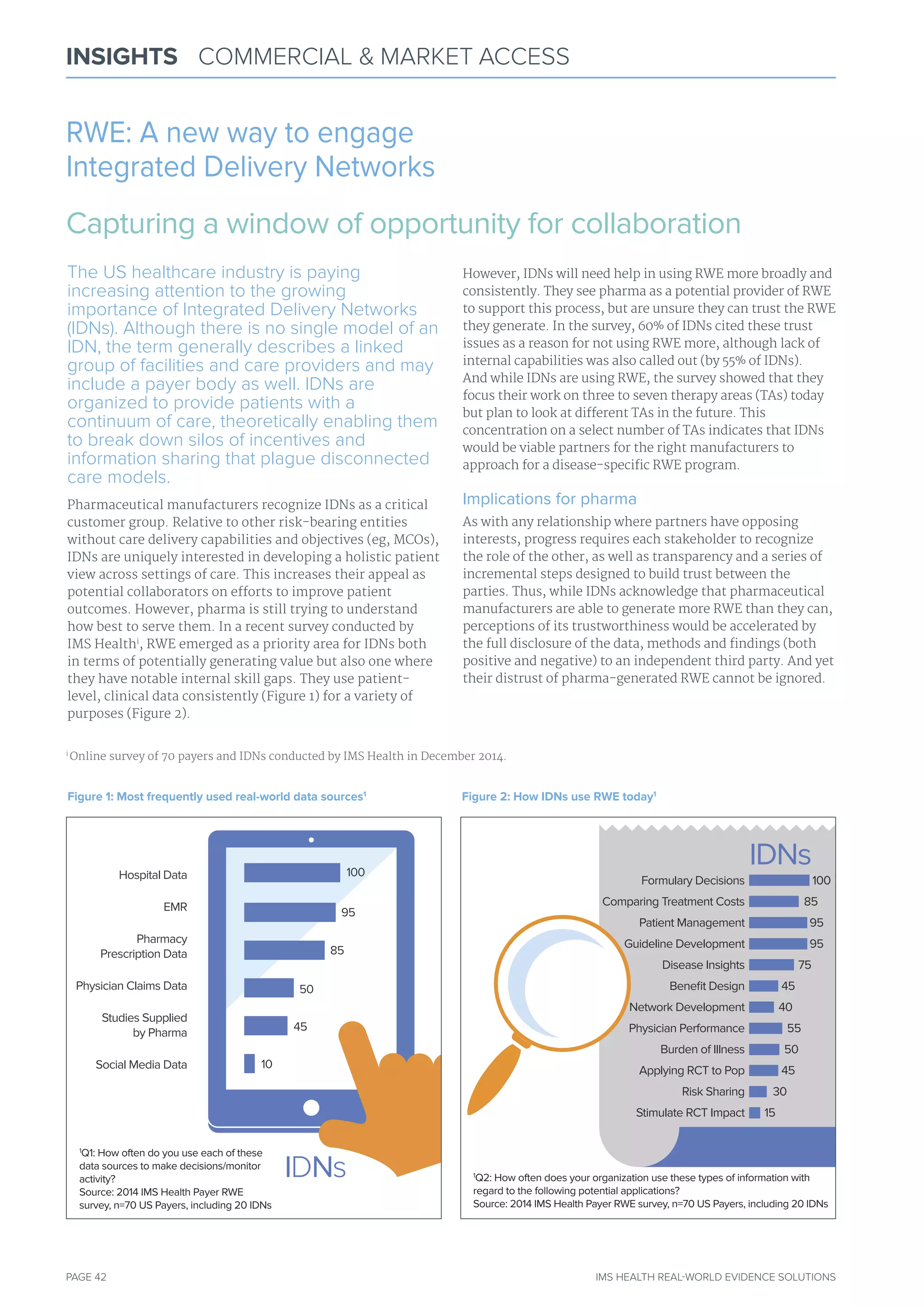
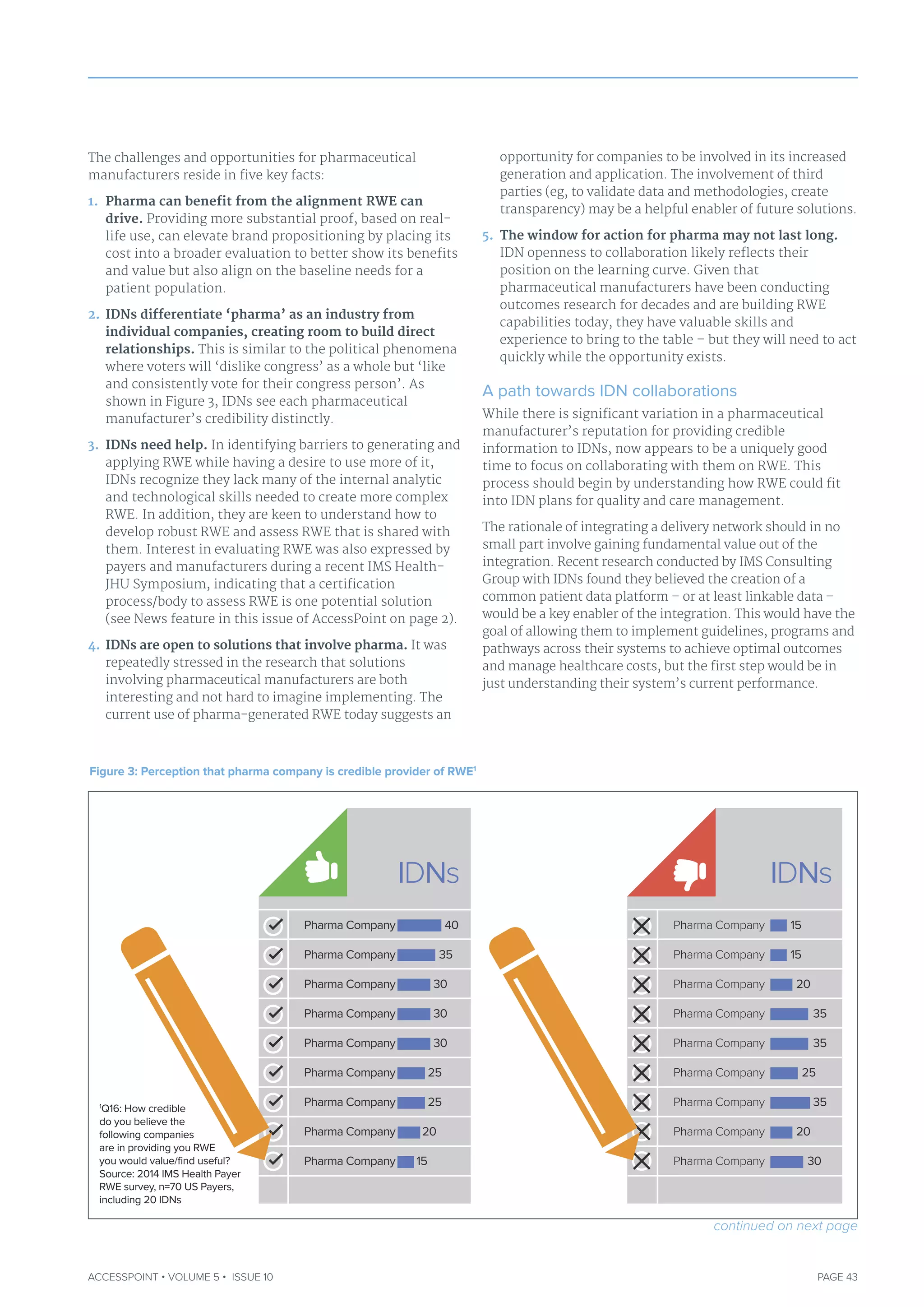
level, clinical data consistently (Figure 1) for a variety of
purposes (Figure 2).
However, IDNs will need help in using RWE more broadly and
consistently. They see pharma as a potential provider of RWE
to support this process, but are unsure they can trust the RWE
they generate. In the survey, 60% of IDNs cited these trust
issues as a reason for not using RWE more, although lack of
internal capabilities was also called out (by 55% of IDNs).
And while IDNs are using RWE, the survey showed that they
focus their work on three to seven therapy areas (TAs) today
but plan to look at different TAs in the future. This
concentration on a select number of TAs indicates that IDNs
would be viable partners for the right manufacturers to
approach for a disease-specific RWE program.
Implications for pharma
As with any relationship where partners have opposing
interests, progress requires each stakeholder to recognize
the role of the other, as well as transparency and a series of
incremental steps designed to build trust between the
parties. Thus, while IDNs acknowledge that pharmaceutical
manufacturers are able to generate more RWE than they can,
perceptions of its trustworthiness would be accelerated by
the full disclosure of the data, methods and findings (both
positive and negative) to an independent third party. And yet
their distrust of pharma-generated RWE cannot be ignored.
Hospital Data
EMR
Pharmacy
Prescription Data
Physician Claims Data
Studies Supplied
by Pharma
Social Media Data
100
95
85
50
45
10
IDNs
Figure 1: Most frequently used real-world data sources1
Formulary Decisions
Comparing Treatment Costs
Patient Management
Guideline Development
Disease Insights
Benefit Design
Network Development
Physician Performance
Burden of Illness
Applying RCT to Pop
Risk Sharing
Stimulate RCT Impact
IDNs
100
85
95
95
75
45
40
55
50
45
30
15
Figure 2: How IDNs use RWE today1
1
Q2: How often does your organization use these types of information with
regard to the following potential applications?
Source: 2014 ImS Health Payer RWE survey, n=70 US Payers, including 20 IDNs
1
Q1: How often do you use each of these
data sources to make decisions/monitor
activity?
Source: 2014 ImS Health Payer RWE
survey, n=70 US Payers, including 20 IDNs
INSIGHTS COMMERCIAL & MARKET ACCESS
RWE: A new way to engage
Integrated Delivery Networks
i
Online survey of 70 payers and IDNs conducted by IMS Health in December 2014.
ACCESSPOINT • VOLUME 5 • ISSUE 10 PAGE 43
Pharma Company
Pharma Company
Pharma Company
Pharma Company
Pharma Company
Pharma Company
Pharma Company
Pharma Company
Pharma Company
40
35
30
30
30
25
25
20
15
IDNs
Pharma Company
Pharma Company
Pharma Company
Pharma Company
Pharma Company
Pharma Company
Pharma Company
Pharma Company
Pharma Company
15
15
20
35
35
25
35
20
30
IDNs
The challenges and opportunities for pharmaceutical
manufacturers reside in five key facts:
1. Pharma can benefit from the alignment RWE can
drive. Providing more substantial proof, based on real-
life use, can elevate brand propositioning by placing its
cost into a broader evaluation to better show its benefits
and value but also align on the baseline needs for a
patient population.
2. IDNs differentiate ‘pharma’ as an industry from
individual companies, creating room to build direct
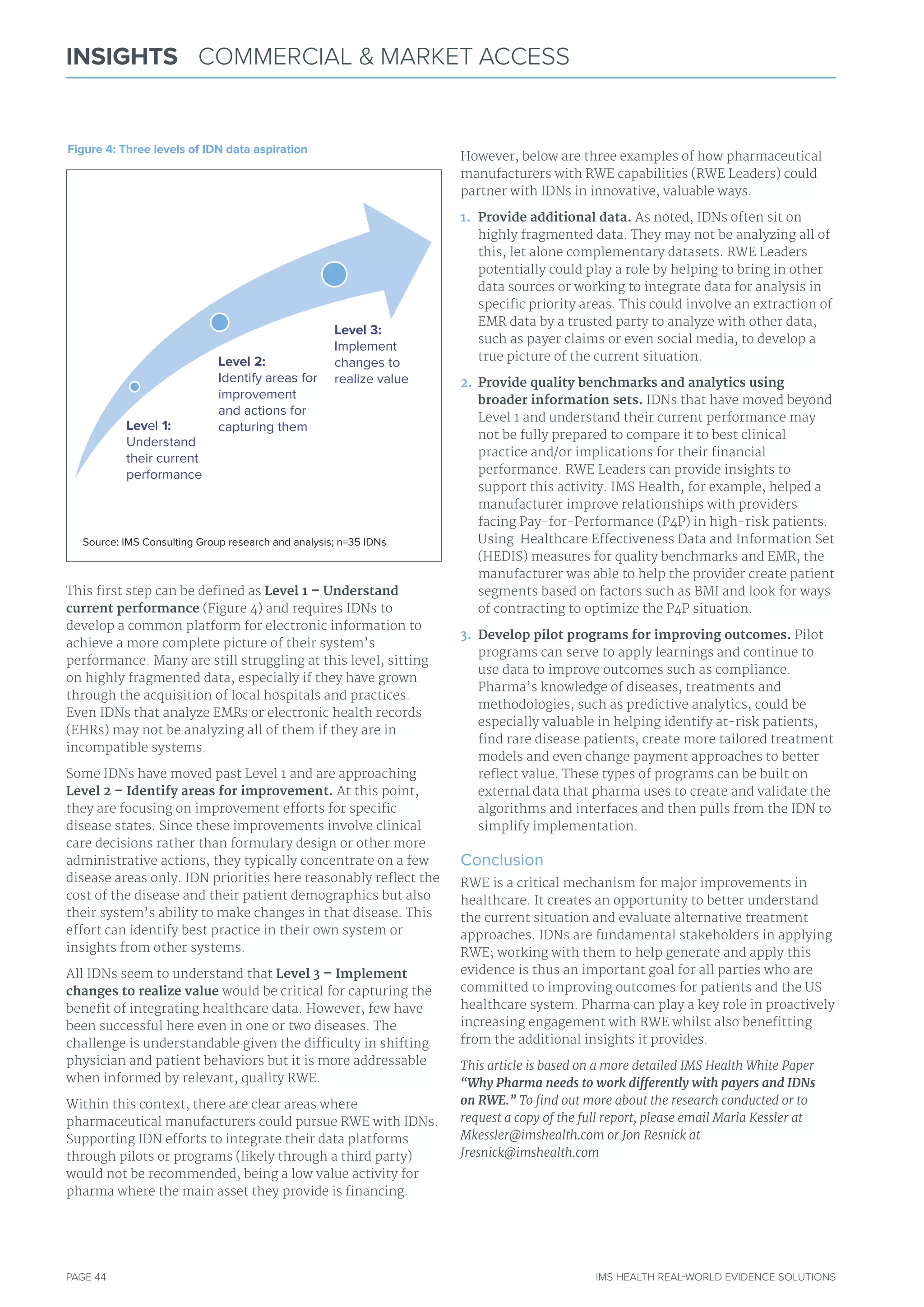
relationships. This is similar to the political phenomena
where voters will ‘dislike congress’ as a whole but ‘like
and consistently vote for their congress person’. As
shown in Figure 3, IDNs see each pharmaceutical
manufacturer’s credibility distinctly.
3. IDNs need help. In identifying barriers to generating and
applying RWE while having a desire to use more of it,
IDNs recognize they lack many of the internal analytic
and technological skills needed to create more complex
RWE. In addition, they are keen to understand how to
develop robust RWE and assess RWE that is shared with
them. Interest in evaluating RWE was also expressed by
payers and manufacturers during a recent IMS Health-
JHU Symposium, indicating that a certification
process/body to assess RWE is one potential solution
(see News feature in this issue of AccessPoint on page 2).
4. IDNs are open to solutions that involve pharma. It was
repeatedly stressed in the research that solutions
involving pharmaceutical manufacturers are both
interesting and not hard to imagine implementing. The
current use of pharma-generated RWE today suggests an
opportunity for companies to be involved in its increased
generation and application. The involvement of third
parties (eg, to validate data and methodologies, create
transparency) may be a helpful enabler of future solutions.
5. The window for action for pharma may not last long.
IDN openness to collaboration likely reflects their
position on the learning curve. Given that
pharmaceutical manufacturers have been conducting
outcomes research for decades and are building RWE
capabilities today, they have valuable skills and
experience to bring to the table – but they will need to act
quickly while the opportunity exists.
A path towards IDN collaborations
While there is significant variation in a pharmaceutical
manufacturer’s reputation for providing credible
information to IDNs, now appears to be a uniquely good
time to focus on collaborating with them on RWE. This
process should begin by understanding how RWE could fit
into IDN plans for quality and care management.
The rationale of integrating a delivery network should in no
small part involve gaining fundamental value out of the
integration. Recent research conducted by IMS Consulting
Group with IDNs found they believed the creation of a
common patient data platform – or at least linkable data –
would be a key enabler of the integration. This would have the
goal of allowing them to implement guidelines, programs and
pathways across their systems to achieve optimal outcomes
and manage healthcare costs, but the first step would be in
just understanding their system’s current performance.
Figure 3: Perception that pharma company is credible provider of RWE1
1
Q16: How credible
do you believe the
following companies
are in providing you RWE
you would value/find useful?
Source: 2014 ImS Health Payer
RWE survey, n=70 US Payers,
including 20 IDNs
continued on next page
PAGE 44 IMS HEALTH REAL-WORLD EVIDENCE SOLUTIONS
INSIGHTS COMMERCIAL & MARKET ACCESS
This first step can be defined as Level 1 – Understand
current performance (Figure 4) and requires IDNs to
develop a common platform for electronic information to
achieve a more complete picture of their system’s
performance. Many are still struggling at this level, sitting
on highly fragmented data, especially if they have grown
through the acquisition of local hospitals and practices.
Even IDNs that analyze EMRs or electronic health records
(EHRs) may not be analyzing all of them if they are in
incompatible systems.
Some IDNs have moved past Level 1 and are approaching
Level 2 – Identify areas for improvement. At this point,
they are focusing on improvement efforts for specific
disease states. Since these improvements involve clinical
care decisions rather than formulary design or other more
administrative actions, they typically concentrate on a few
disease areas only. IDN priorities here reasonably reflect the
cost of the disease and their patient demographics but also
their system’s ability to make changes in that disease. This
effort can identify best practice in their own system or
insights from other systems.
All IDNs seem to understand that Level 3 – Implement
changes to realize value would be critical for capturing the
benefit of integrating healthcare data. However, few have
been successful here even in one or two diseases. The
challenge is understandable given the difficulty in shifting
physician and patient behaviors but it is more addressable
when informed by relevant, quality RWE.
Within this context, there are clear areas where
pharmaceutical manufacturers could pursue RWE with IDNs.
Supporting IDN efforts to integrate their data platforms
through pilots or programs (likely through a third party)
would not be recommended, being a low value activity for
pharma where the main asset they provide is financing.
However, below are three examples of how pharmaceutical
manufacturers with RWE capabilities (RWE Leaders) could
partner with IDNs in innovative, valuable ways.
1. Provide additional data. As noted, IDNs often sit on
highly fragmented data. They may not be analyzing all of
this, let alone complementary datasets. RWE Leaders
potentially could play a role by helping to bring in other
data sources or working to integrate data for analysis in
specific priority areas. This could involve an extraction of
EMR data by a trusted party to analyze with other data,
such as payer claims or even social media, to develop a
true picture of the current situation.
2. Provide quality benchmarks and analytics using
broader information sets. IDNs that have moved beyond
Level 1 and understand their current performance may
not be fully prepared to compare it to best clinical
practice and/or implications for their financial
performance. RWE Leaders can provide insights to
support this activity. IMS Health, for example, helped a
manufacturer improve relationships with providers
facing Pay-for-Performance (P4P) in high-risk patients.
Using Healthcare Effectiveness Data and Information Set
(HEDIS) measures for quality benchmarks and EMR, the
manufacturer was able to help the provider create patient
segments based on factors such as BMI and look for ways
of contracting to optimize the P4P situation.
3. Develop pilot programs for improving outcomes. Pilot
programs can serve to apply learnings and continue to
use data to improve outcomes such as compliance.
Pharma’s knowledge of diseases, treatments and
methodologies, such as predictive analytics, could be
especially valuable in helping identify at-risk patients,
find rare disease patients, create more tailored treatment
models and even change payment approaches to better
reflect value. These types of programs can be built on
external data that pharma uses to create and validate the
algorithms and interfaces and then pulls from the IDN to
simplify implementation.
Conclusion
RWE is a critical mechanism for major improvements in
healthcare. It creates an opportunity to better understand
the current situation and evaluate alternative treatment
approaches. IDNs are fundamental stakeholders in applying
RWE; working with them to help generate and apply this
evidence is thus an important goal for all parties who are
committed to improving outcomes for patients and the US
healthcare system. Pharma can play a key role in proactively
increasing engagement with RWE whilst also benefitting
from the additional insights it provides.
This article is based on a more detailed IMS Health White Paper
“Why Pharma needs to work differently with payers and IDNs
on RWE.” To find out more about the research conducted or to
request a copy of the full report, please email Marla Kessler at
Mkessler@imshealth.com or Jon Resnick at
Jresnick@imshealth.com
Level 1:
Understand
their current
performance
Level 3:
Implement
changes to
realize value
Level 2:
Identify areas for
improvement
and actions for
capturing them
Figure 4: Three levels of IDN data aspiration
Source: ImS Consulting Group research and analysis; n=35 IDNs

RWE: A new way to engage IDNs

  • 1.
    ACCESSPOINT • VOLUME5 • ISSUE 10 PAGE 41 INSIGHTS COMMERCIAL & MARKET ACCESS RWE: A new way to engage Integrated Delivery Networks As pharmaceutical manufacturers look for ways to build stronger relationships with their Integrated Delivery Network (IDN) clients, RWE is emerging as a desired infrastructure capability, presenting a window of opportunity to support and collaborate on IDN efforts. If done well, these RWE-related partnerships should provide value for both parties involved but require pharma to expand its mindset beyond product-specific approaches. The authors marla Kessler, mbA is Vice President, RWE Solutions, IMS Health Mkessler@imshealth.com Jon Resnick, mbA is Vice President and General Manager, RWE Solutions, IMS Health Jresnick@imshealth.com
  • 2.
    PAGE 42 IMSHEALTH REAL-WORLD EVIDENCE SOLUTIONS Capturing a window of opportunity for collaboration The US healthcare industry is paying increasing attention to the growing importance of Integrated Delivery Networks (IDNs). Although there is no single model of an IDN, the term generally describes a linked group of facilities and care providers and may include a payer body as well. IDNs are organized to provide patients with a continuum of care, theoretically enabling them to break down silos of incentives and information sharing that plague disconnected care models. Pharmaceutical manufacturers recognize IDNs as a critical customer group. Relative to other risk-bearing entities without care delivery capabilities and objectives (eg, MCOs), IDNs are uniquely interested in developing a holistic patient view across settings of care. This increases their appeal as potential collaborators on efforts to improve patient outcomes. However, pharma is still trying to understand how best to serve them. In a recent survey conducted by IMS Healthi , RWE emerged as a priority area for IDNs both in terms of potentially generating value but also one where they have notable internal skill gaps. They use patient- level, clinical data consistently (Figure 1) for a variety of purposes (Figure 2). However, IDNs will need help in using RWE more broadly and consistently. They see pharma as a potential provider of RWE to support this process, but are unsure they can trust the RWE they generate. In the survey, 60% of IDNs cited these trust issues as a reason for not using RWE more, although lack of internal capabilities was also called out (by 55% of IDNs). And while IDNs are using RWE, the survey showed that they focus their work on three to seven therapy areas (TAs) today but plan to look at different TAs in the future. This concentration on a select number of TAs indicates that IDNs would be viable partners for the right manufacturers to approach for a disease-specific RWE program. Implications for pharma As with any relationship where partners have opposing interests, progress requires each stakeholder to recognize the role of the other, as well as transparency and a series of incremental steps designed to build trust between the parties. Thus, while IDNs acknowledge that pharmaceutical manufacturers are able to generate more RWE than they can, perceptions of its trustworthiness would be accelerated by the full disclosure of the data, methods and findings (both positive and negative) to an independent third party. And yet their distrust of pharma-generated RWE cannot be ignored. Hospital Data EMR Pharmacy Prescription Data Physician Claims Data Studies Supplied by Pharma Social Media Data 100 95 85 50 45 10 IDNs Figure 1: Most frequently used real-world data sources1 Formulary Decisions Comparing Treatment Costs Patient Management Guideline Development Disease Insights Benefit Design Network Development Physician Performance Burden of Illness Applying RCT to Pop Risk Sharing Stimulate RCT Impact IDNs 100 85 95 95 75 45 40 55 50 45 30 15 Figure 2: How IDNs use RWE today1 1 Q2: How often does your organization use these types of information with regard to the following potential applications? Source: 2014 ImS Health Payer RWE survey, n=70 US Payers, including 20 IDNs 1 Q1: How often do you use each of these data sources to make decisions/monitor activity? Source: 2014 ImS Health Payer RWE survey, n=70 US Payers, including 20 IDNs INSIGHTS COMMERCIAL & MARKET ACCESS RWE: A new way to engage Integrated Delivery Networks i Online survey of 70 payers and IDNs conducted by IMS Health in December 2014.
  • 3.
    ACCESSPOINT • VOLUME5 • ISSUE 10 PAGE 43 Pharma Company Pharma Company Pharma Company Pharma Company Pharma Company Pharma Company Pharma Company Pharma Company Pharma Company 40 35 30 30 30 25 25 20 15 IDNs Pharma Company Pharma Company Pharma Company Pharma Company Pharma Company Pharma Company Pharma Company Pharma Company Pharma Company 15 15 20 35 35 25 35 20 30 IDNs The challenges and opportunities for pharmaceutical manufacturers reside in five key facts: 1. Pharma can benefit from the alignment RWE can drive. Providing more substantial proof, based on real- life use, can elevate brand propositioning by placing its cost into a broader evaluation to better show its benefits and value but also align on the baseline needs for a patient population. 2. IDNs differentiate ‘pharma’ as an industry from individual companies, creating room to build direct relationships. This is similar to the political phenomena where voters will ‘dislike congress’ as a whole but ‘like and consistently vote for their congress person’. As shown in Figure 3, IDNs see each pharmaceutical manufacturer’s credibility distinctly. 3. IDNs need help. In identifying barriers to generating and applying RWE while having a desire to use more of it, IDNs recognize they lack many of the internal analytic and technological skills needed to create more complex RWE. In addition, they are keen to understand how to develop robust RWE and assess RWE that is shared with them. Interest in evaluating RWE was also expressed by payers and manufacturers during a recent IMS Health- JHU Symposium, indicating that a certification process/body to assess RWE is one potential solution (see News feature in this issue of AccessPoint on page 2). 4. IDNs are open to solutions that involve pharma. It was repeatedly stressed in the research that solutions involving pharmaceutical manufacturers are both interesting and not hard to imagine implementing. The current use of pharma-generated RWE today suggests an opportunity for companies to be involved in its increased generation and application. The involvement of third parties (eg, to validate data and methodologies, create transparency) may be a helpful enabler of future solutions. 5. The window for action for pharma may not last long. IDN openness to collaboration likely reflects their position on the learning curve. Given that pharmaceutical manufacturers have been conducting outcomes research for decades and are building RWE capabilities today, they have valuable skills and experience to bring to the table – but they will need to act quickly while the opportunity exists. A path towards IDN collaborations While there is significant variation in a pharmaceutical manufacturer’s reputation for providing credible information to IDNs, now appears to be a uniquely good time to focus on collaborating with them on RWE. This process should begin by understanding how RWE could fit into IDN plans for quality and care management. The rationale of integrating a delivery network should in no small part involve gaining fundamental value out of the integration. Recent research conducted by IMS Consulting Group with IDNs found they believed the creation of a common patient data platform – or at least linkable data – would be a key enabler of the integration. This would have the goal of allowing them to implement guidelines, programs and pathways across their systems to achieve optimal outcomes and manage healthcare costs, but the first step would be in just understanding their system’s current performance. Figure 3: Perception that pharma company is credible provider of RWE1 1 Q16: How credible do you believe the following companies are in providing you RWE you would value/find useful? Source: 2014 ImS Health Payer RWE survey, n=70 US Payers, including 20 IDNs continued on next page
  • 4.
    PAGE 44 IMSHEALTH REAL-WORLD EVIDENCE SOLUTIONS INSIGHTS COMMERCIAL & MARKET ACCESS This first step can be defined as Level 1 – Understand current performance (Figure 4) and requires IDNs to develop a common platform for electronic information to achieve a more complete picture of their system’s performance. Many are still struggling at this level, sitting on highly fragmented data, especially if they have grown through the acquisition of local hospitals and practices. Even IDNs that analyze EMRs or electronic health records (EHRs) may not be analyzing all of them if they are in incompatible systems. Some IDNs have moved past Level 1 and are approaching Level 2 – Identify areas for improvement. At this point, they are focusing on improvement efforts for specific disease states. Since these improvements involve clinical care decisions rather than formulary design or other more administrative actions, they typically concentrate on a few disease areas only. IDN priorities here reasonably reflect the cost of the disease and their patient demographics but also their system’s ability to make changes in that disease. This effort can identify best practice in their own system or insights from other systems. All IDNs seem to understand that Level 3 – Implement changes to realize value would be critical for capturing the benefit of integrating healthcare data. However, few have been successful here even in one or two diseases. The challenge is understandable given the difficulty in shifting physician and patient behaviors but it is more addressable when informed by relevant, quality RWE. Within this context, there are clear areas where pharmaceutical manufacturers could pursue RWE with IDNs. Supporting IDN efforts to integrate their data platforms through pilots or programs (likely through a third party) would not be recommended, being a low value activity for pharma where the main asset they provide is financing. However, below are three examples of how pharmaceutical manufacturers with RWE capabilities (RWE Leaders) could partner with IDNs in innovative, valuable ways. 1. Provide additional data. As noted, IDNs often sit on highly fragmented data. They may not be analyzing all of this, let alone complementary datasets. RWE Leaders potentially could play a role by helping to bring in other data sources or working to integrate data for analysis in specific priority areas. This could involve an extraction of EMR data by a trusted party to analyze with other data, such as payer claims or even social media, to develop a true picture of the current situation. 2. Provide quality benchmarks and analytics using broader information sets. IDNs that have moved beyond Level 1 and understand their current performance may not be fully prepared to compare it to best clinical practice and/or implications for their financial performance. RWE Leaders can provide insights to support this activity. IMS Health, for example, helped a manufacturer improve relationships with providers facing Pay-for-Performance (P4P) in high-risk patients. Using Healthcare Effectiveness Data and Information Set (HEDIS) measures for quality benchmarks and EMR, the manufacturer was able to help the provider create patient segments based on factors such as BMI and look for ways of contracting to optimize the P4P situation. 3. Develop pilot programs for improving outcomes. Pilot programs can serve to apply learnings and continue to use data to improve outcomes such as compliance. Pharma’s knowledge of diseases, treatments and methodologies, such as predictive analytics, could be especially valuable in helping identify at-risk patients, find rare disease patients, create more tailored treatment models and even change payment approaches to better reflect value. These types of programs can be built on external data that pharma uses to create and validate the algorithms and interfaces and then pulls from the IDN to simplify implementation. Conclusion RWE is a critical mechanism for major improvements in healthcare. It creates an opportunity to better understand the current situation and evaluate alternative treatment approaches. IDNs are fundamental stakeholders in applying RWE; working with them to help generate and apply this evidence is thus an important goal for all parties who are committed to improving outcomes for patients and the US healthcare system. Pharma can play a key role in proactively increasing engagement with RWE whilst also benefitting from the additional insights it provides. This article is based on a more detailed IMS Health White Paper “Why Pharma needs to work differently with payers and IDNs on RWE.” To find out more about the research conducted or to request a copy of the full report, please email Marla Kessler at Mkessler@imshealth.com or Jon Resnick at Jresnick@imshealth.com Level 1: Understand their current performance Level 3: Implement changes to realize value Level 2: Identify areas for improvement and actions for capturing them Figure 4: Three levels of IDN data aspiration Source: ImS Consulting Group research and analysis; n=35 IDNs