BA 7012: MBA Capstone
Leah Nguyen
4/7/2015
Nguyen, Leah
MBA Capstone
1
Table of Contents
Executive Summary & Recommendation …………………………………………… 2
Financial Analysis ……………………………………………………………………... 3
Industry Analysis ……………………………………………………………………… 7
Competitive Analysis …………………………………………………………………. 12
Future Prospects ……………………………………………………………………… 14
Appendix ……………………………………………………………………………… 17
References …………………………………………………………………………….. 21
Nguyen, Leah
MBA Capstone
2
Executive Summary & Recommendation
CVS Health Corporation is an international company that works in the
Pharmacy Benefit Management and retail pharmacy industry. They are one of the leaders
in Pharmacy Services, filling over 750 million prescriptions annually. For a full
description, see Exhibit 1.
Financially, CVS Health is a competent organization that exhibits strong
growth and a record net revenue of $139.4 billion. They are well-diversified with
multiple lines of business. However, they risk placing too much reliance on certain lines,
such as high-priced specialty drugs, for revenue. Opportunities for CVS Health’s
financial growth lie in expansion in size, services, and the aging population.
The industry overall is in a positive, yet pivotal point. Healthcare reform has
brought many changes to the industry. These changes have affected many players and
aspects of healthcare delivery, such as the move towards value-based care. As companies
grow through mergers and acquisitions, negotiating power with drug companies grows
due to the large economies of scale. Further reform and federal regulations threaten the
success of these companies. They must be prepared to accommodate these changes in
order to continue serving their markets.
As mentioned above, CVS Health is a leader in its industry. Competition is
extremely fierce for share of the growing market and it has taken steps to ensure its
sustained presence and growth through population health initiatives such as its tobacco
cessation program and its proprietary technology system for drug quality and safety.
These indicate CVS Health’s commitment to the public’s well-being where many others
Nguyen, Leah
MBA Capstone
3
cannot say quite so solidly. However, they are threatened by firms who can offer greater
discounts due to economies of scale and convenience.
CVS Health is poised to continue this success in the future. They are planning
to introduce new programs and grow their services to improve public health and
accommodate the changing healthcare system and consumer. Collaboration with major
medical centers support a tighter coordination of care. Finally, they are exploring new
advances and innovations in healthcare delivery to improve care and efficiency.
Based on the following analyses, it is recommended that investment should be
made in CVS Health. They are a market leader, conscious of the changing industry
landscape, and focused on improving the well-being of their consumers and the
population. Their past and current position indicate a positive future for continued growth
and success.
Financial Analysis
CVS Health has done very well in the last few years. Executives also project this
success to continue. With the changes from the Patient Protection and Affordable Care
Act (ACA), new innovations and new drugs, and the aging population, CVS Health is
positioned to remain a major player in the Pharmacy Services sector.
Two of CVS Health’s main competitors, UnitedHealth Group Inc. and Express
Scripts Holding Corporation, are involved with Pharmacy Benefits Management (PBM).
Both of these companies also have other lines of business, like CVS Health.
UnitedHealth is heavily involved with the management of health plans and Express
Nguyen, Leah
MBA Capstone
4
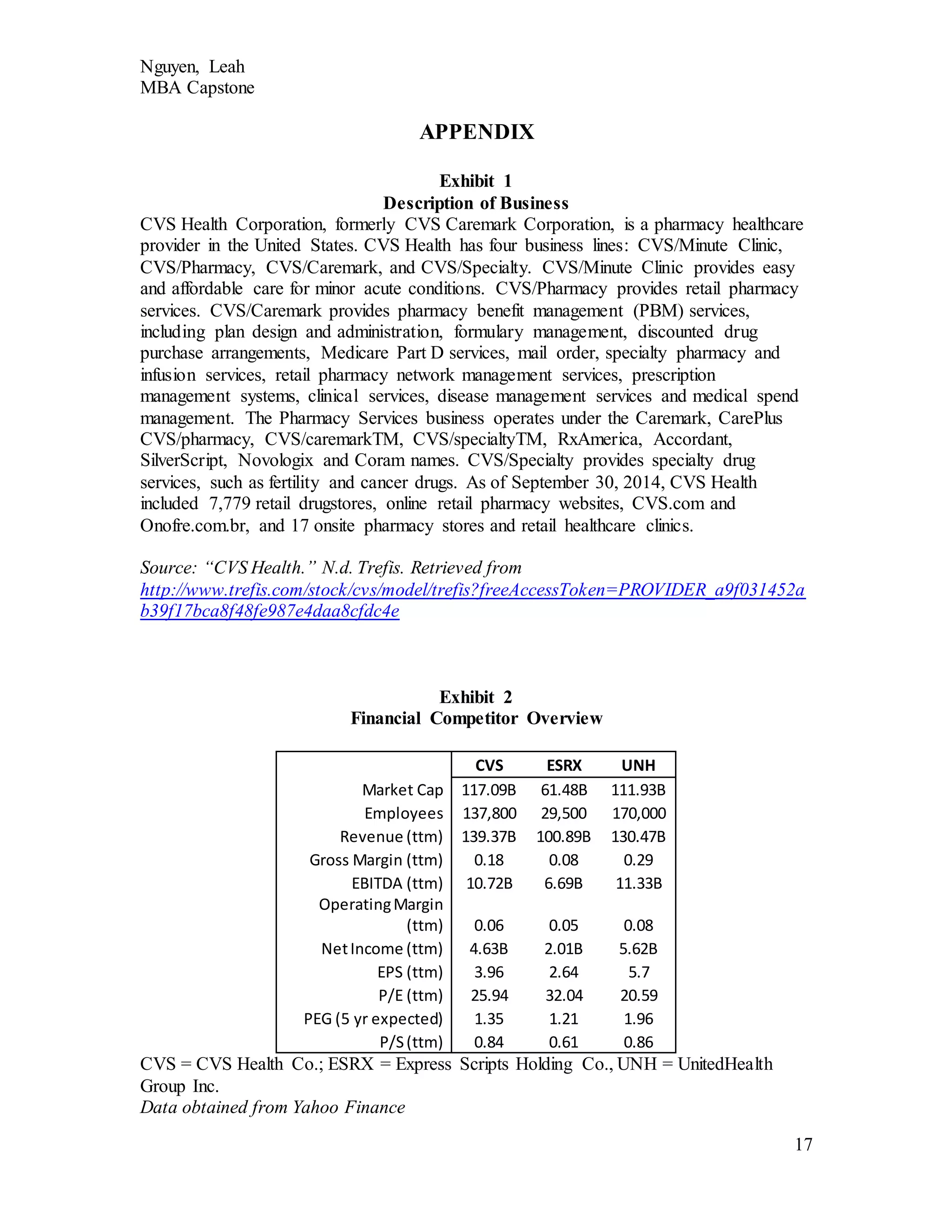
Scripts works with drug and equipment distribution, consulting, and case management. A
brief comparison of the three companies can be seen in Exhibit 2.
CVS Health has many financial strengths. They are a well-diversified company
with four different business lines: CVS/minute clinic, CVS/pharmacy, CVS/caremark,
and CVS/specialty. Each of these provides a separate function while working cohesively
to achieve improved patient and consumer well-being. For example, certain specialty
drugs are no longer being processed through the pharmacy store but instead through their
mail order capacity. While this lowered basis points for the pharmacy, it increased overall
revenues compared to prescription volumes due to the high price of specialty drugs
(“CVS Health Reports Strong Profits,” 2015). These high-priced specialty drugs are
growing in demand. In the last quarter, revenues for these drugs increased nearly 22
percent to $23.9 billion (Associated Press, 2015). CVS Health also benefitted from the
increase in patient access due to the ACA, as more patients were being treated and filling
prescriptions. UnitedHealth and Express Scripts also saw this increase, and this increase
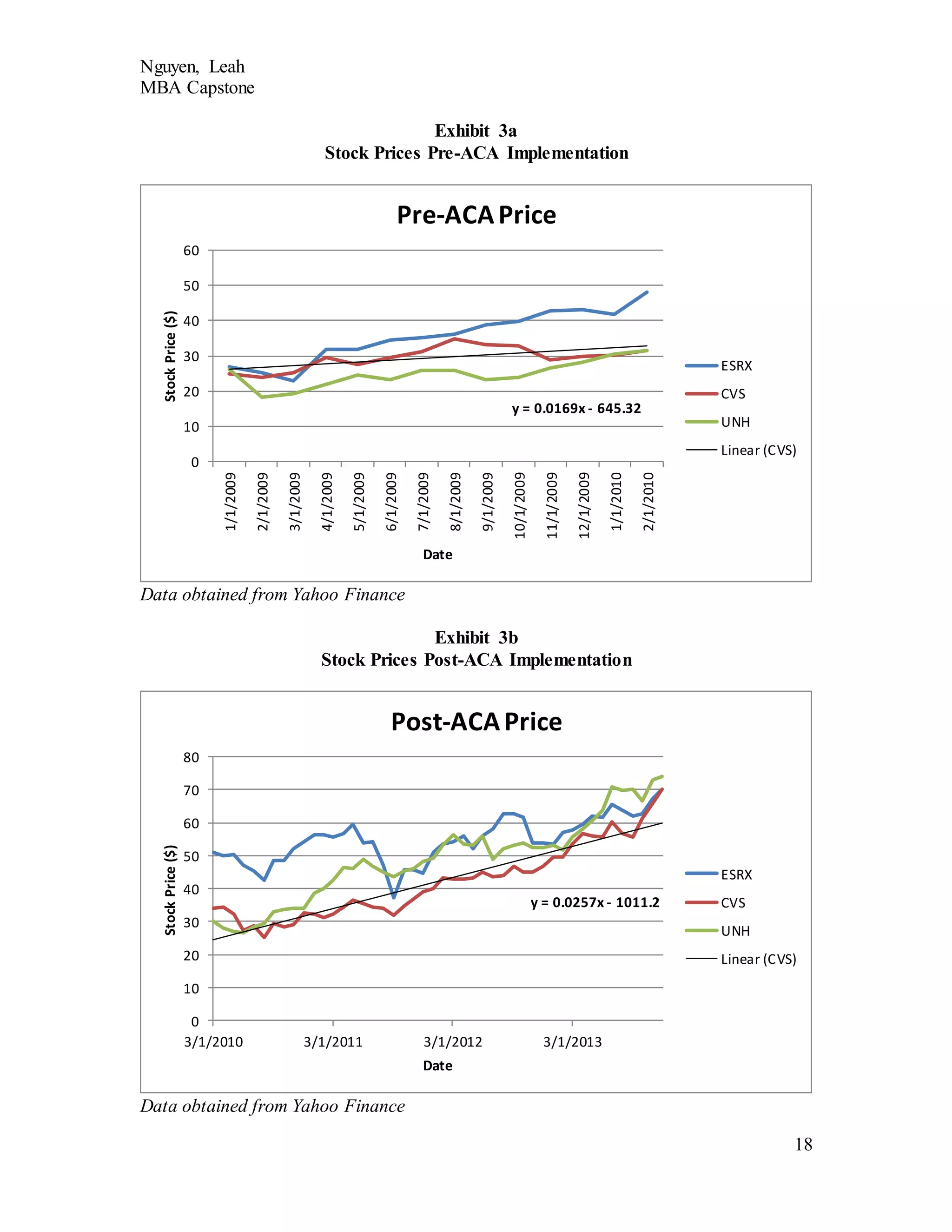
in value was translated into stock price. Exhibits 3a and 3b show the difference in rate of
stock price increase before and after the ACA of CVS Health, Express Scripts, and
UnitedHealth. As illustrated, the rate nearly doubles after implementation of the ACA.
In the last quarter, earnings rose 4 percent despite the “anticipated blow” from the
termination of sales from tobacco products (Associated Press, 2015). For the total year of
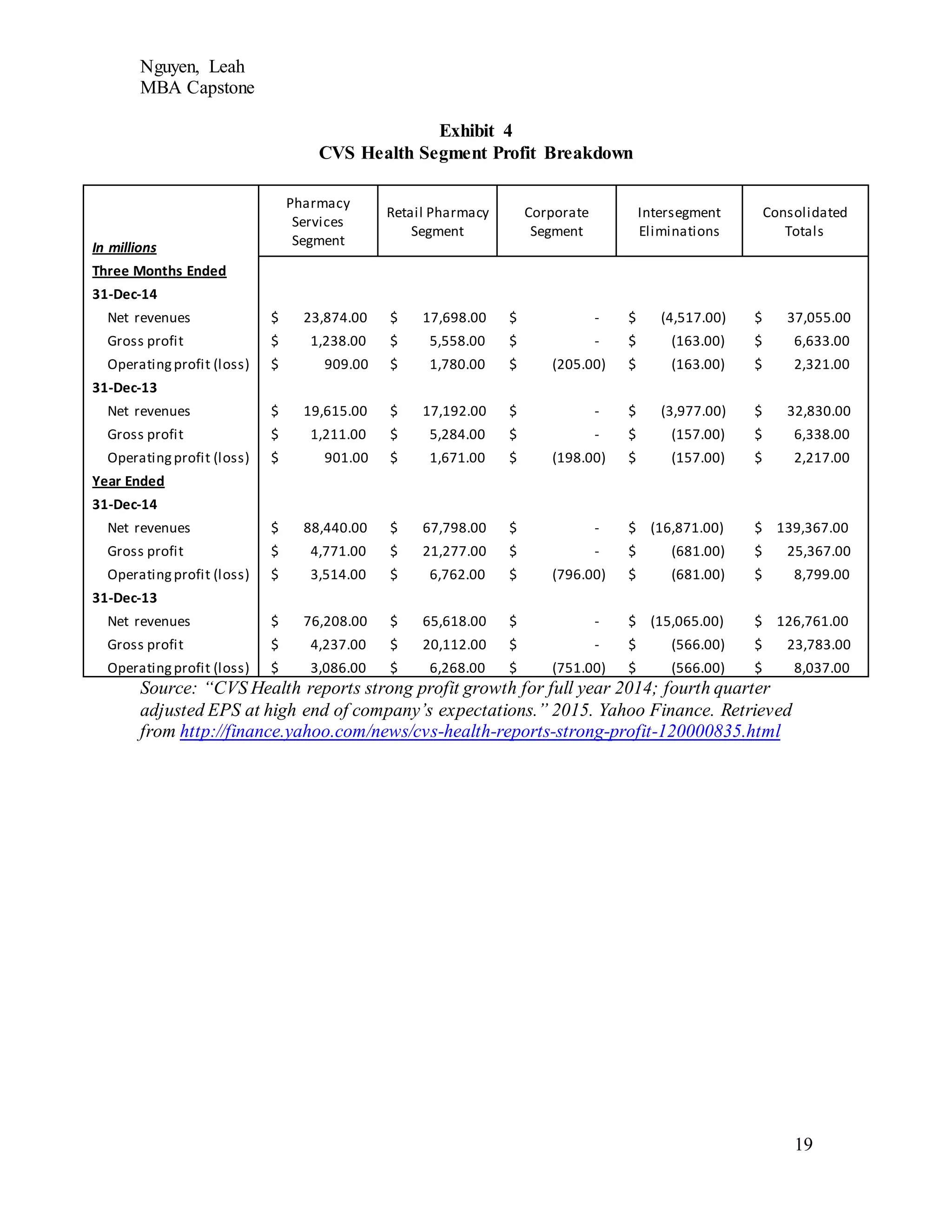
2014, net revenues increased 9.9 percent to a record $139.4 billion [Exhibit 4] and CVS
Health generated free cash flow of $6.5 billion and cash flow from operations of $8.1
billion (“CVS Health Reports Strong Profits,” 2015). This cash flow “exceeded” CVS
Nguyen, Leah
MBA Capstone
5
Executive expectations and supports their goal of solid, sustainable growth (“CVS Health
Reports Strong Profits,” 2015).
Despite this success, CVS Health does have weaknesses. Eliminating tobacco
products resulted in expected loss, but it also brought with it less traffic to their front
store sales. Customers who may have shopped for other goods while they purchased their
tobacco products are coming in less frequently for those goods, and instead purchasing
them elsewhere (i.e. with their groceries, at gas stations, etc.). With the loss that
accompanied tobacco sales comes a greater pressure on other departments, such as the
pharmacy. The pharmacy also earns less revenue from generics unless it can be made up
in volume. Therefore, CVS Health must rely more on the higher-priced specialty drugs to
help make up this deficit.
CVS Health, along with one of its competitors, Rite-Aid, is not accepting Apple
Pay. This is a weakness as it obviously excludes those consumers who are making the
switch to digital forms of payment. CVS Health is a member of MCX, Merchant
Customer Exchange, and part of this contract requires companies to work exclusively
with MCX (Tweedie & Kovach, 2014). MCX is developing its own system of digital
payment called CurrenC but it is far from being released. Breaking the contract, to offer
Apple Pay for example, results in steep fines (Tweedie & Kovach, 2014). As more
services become automated through mobile apps and online platforms that can be
accessed from the consumer’s smartphone, the appeal of paying for these services with
their smartphones increase. By not being open to new innovations is detrimental to CVS
Health and their competitors’ revenues and reputations.
Nguyen, Leah
MBA Capstone
6
There are several opportunities for CVS Health to take advantage. As has
happened throughout the industry, mergers and acquisitions of other PBMs and pharmacy
services companies is common. When UnitedHealth acquired Catamaran Corporation, it
became the third-largest pharmacy benefit manager with a market share of 20 percent
(“What the UnitedHealth-Catamaran Deal Means,” 2015). Before this, CVS Health and
Express Scripts controlled about 50 percent of the PBM market, with Express Scripts
filling over one billion prescriptions annually. The acquisition of Catamaran brings
UnitedHealth’s estimated fulfillment of prescriptions to mirror that of Express Scripts at a
billion. CVS Health has acquired several smaller companies in the past, such as Coram in
2013, a specialty infusion services unit, and Long Drug Stores in 2008 (Townsend,
2013). To maintain its market share, CVS Health should continue exploring these
opportunities to expand their expertise and services to provide lower-cost and more
accessible care.
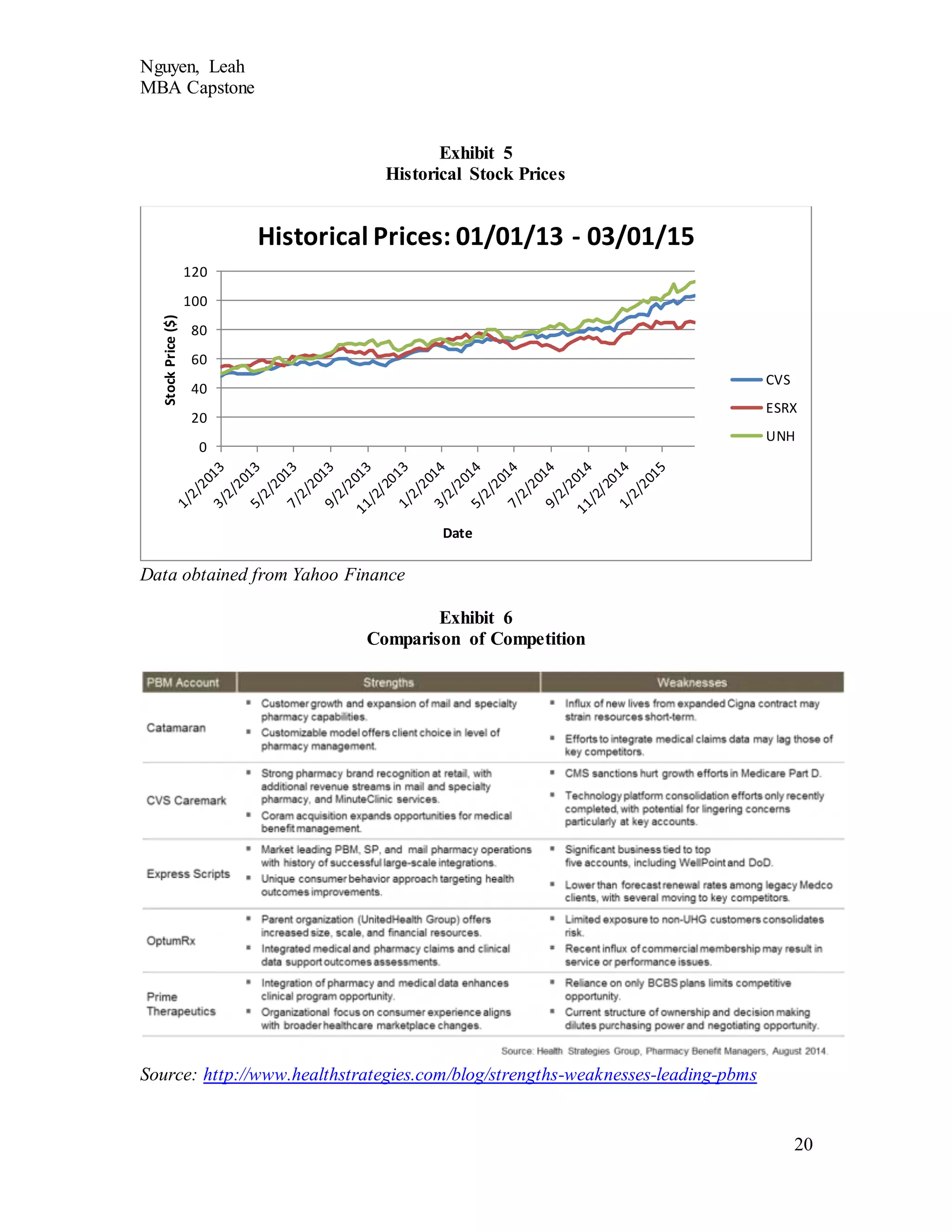
A final opportunity for CVS Health is to improve their stock price. Despite the
recent financial successes, CVS Health is not as strong as UnitedHealth. They are doing
much better than Express Scripts, but there is always opportunity for improvement
[Exhibit 5]. This could be achieved through increasing the value of the company to
increase demand for shares as well as buy back some of their shares to reduce the supply
of shares available.
Being a player in the healthcare system does not come without risks or threats.
CVS Health, UnitedHealth, and Express Scripts are threatened by litigation. As these
companies grow larger through acquisitions, the competition is effectively consolidated
into a few major players that have the potential for anti-trust law violations. Settlements
Nguyen, Leah
MBA Capstone
7
and any sort of litigation are costly. Between 2004 and 2008, players in the PBM market
were accused of “fraud; misrepresentation to plan sponsors, patients and providers; unjust
enrichment through secret kick-back schemes; and failure to meet ethical and safety
standards” (Balto, 2010). Such cases have resulted in over $371.9 million in damages to
states, plans and patients – and half of these were paid by Caremark and its parent
company AdvancePCS (Balto, 2010). Caremark was since acquired by CVS Health. It is
important for these companies to be aware of their actions and ensure their behavior
doesn't compromise the company in any way.
Industry Analysis
The healthcare industry as a whole is at a pivotal point. The United States has the
most expensive healthcare system in the world but falls significantly below in outcomes
in comparison to countries that spend similarly. The government, providers, payers,
pharmaceuticals, ancillary/retail services, and patients are acutely aware of the issues that
are facing the system. Fortunately, they are all making significant strides to improve the
healthcare system and are inherently connected in these decisions.
The pharmacy services segment maintains several strengths. CVS Health, as a
pharmacy benefits manager and a retail pharmacy, like other PBM players, is in direct
coordination with health plans, employers, unions, government employee groups, and
other sponsors of health benefit plans throughout the U.S. (“CVS Caremark,” n.d.). CVS
Health fills over 750 million prescriptions for beneficiaries of these clients and its retail
pharmacy customers. Because of this extensive reach, PBM players have significant
negotiating powers with drug companies. They are able to negotiate lower prices for
Nguyen, Leah
MBA Capstone
8
drugs, which is increasingly important as the costs of both specialty and generic drugs are
rising. Drug companies are making increasingly complex and sophisticated drugs that
require more complex administration (i.e. intravenously) and specific maintenance (i.e.
temperature controlled), which results in costs of over $3,000 per month to the patient.
Examples of these expensive drugs include cancer drugs, fertility drugs, and a cure for
Hepatitis C, which recently was released and cost over $1,000 a day, or $84,000-$94,000
for the whole round of treatment (Heitz, 2014). Because of the large scale PBM
companies have, they are able to negotiate these prices down.
Another strength of the industry is the positioning PBM players have. The
healthcare system is evolving, with the growth of patient-centered medical homes
(PCMHs) becoming the prominent model for care delivery. As a part of this, patients are
actively involved, more educated and empowered in their care. Instead of turning to
emergency rooms and hospitals, primary care physicians, pharmacists, and clinics are the
first line of access for minor acute conditions. Patients are shopping around and looking
for the best value. Because of the positioning of PBMs and retail pharmacies like CVS
Health, they are able to provide for this kind of care and the necessary products. Often,
pharmacists are the first and most easily-accessible healthcare professional for patients to
reach.
While the negotiating power is a strength for this industry, the high cost of drugs
continues to plague them, among other weaknesses. This weakness means that PBM
companies are constantly spending money and time dealing with these high costs that are
inevitably set by drug companies. However, PBMs are limited in their negotiations to an
extent. Many drugs are under patent which prevents other companies from developing
Nguyen, Leah
MBA Capstone
9
generics. These drugs remain expensive because the pharmaceutical companies only have
a short window to see a return on their multi-billion-dollar investments. However, one
opportunity that comes with patenting drugs is when their patents expire. Over the next
three years, $15 billion in products are expected to come off patents. These drugs will be
able to be produced generically, increasing access and affordability. Another weakness is
the overall lack of cost control throughout the industry. Eighteen percent of the U.S. GDP
is attributed to healthcare spending – and drug spending has increased 13.1 percent
(“What the UnitedHealth-Catamaran Deal Means for CVS Health and the General
Public,” 2015).
As mentioned above, the healthcare system is at a pivotal point. The
implementation of the Affordable Care Act brought many changes that present
opportunities for the healthcare industry and the PBM and retail pharmacy markets,
specifically. The goals of the ACA are to improve quality and affordability of care,
increase accessibility of care by expanding private and public insurance coverage, and
reduce costs of healthcare for individuals and the government (“Key Features of the
Affordable Care Act,” n.d.). At the end of the 2014 open enrollment period, fifteen
million people who were uninsured prior to the ACA’s implementation in 2010 were now
covered (“Obamacare Enrollment Numbers,” n.d.). That means that fifteen million more
people are able to receive care and fill prescriptions, and that the cost of this care is more
affordable. The opportunity associated with this expansion is significant and is not
something PBMs like CVS Health are going to overlook. In order to be more accessible,
CVS Health has a goal of placing a store within 3 miles of every person. Similarly,
Walgreens has a goal of store accessibility within 5 miles.
Nguyen, Leah
MBA Capstone
10
Another opportunity associated with the ACA is the push towards value-based
care and less fee-for-service. The Obama administration set a goal of 50 percent of
payments from the Centers for Medicare & Medicaid Services (CMS) to medical care
providers would be value-based by 2018 (Japsen, 2014). The government, providers, and
payers have recognized the value of performance and health outcomes instead of volume
as a measure of reimbursement. The PBM and retail pharmacy industry is included in
these efforts for value-based care. More and more, retail chains and pharmacies are
affiliating with major medical centers and accountable care organizations. CVS Health,
for example, has fifty affiliations across the country (Japsen, 2014). This supports tighter
coordination between pharmacists and providers to improve care. Retailers also have the
ability to collect and analyze the massive amount of patient data. Because of this,
providers will be better able to understand population health. Patient-specific information
will be able to be passed directly from the pharmacist to the provider and into the
patient’s electronic health record (EHR).
The demographics of the population pose a major opportunity for the PBM and
retail pharmacy industry. By 2030, one in five Americans will be aged 65 or older and
eligible for Medicaid (Matthews, 2013). Two-thirds of the aging population have
multiple chronic conditions that require ongoing treatment and medication. This care can
include as many as 15 medications or more daily. People are also living longer – life
expectancy has increased 30 years over the last century. Thus, people are dealing with
complex medical issues for much longer than they used to.
Adding to this issue is the lack of providers specializing in geriatrics and number
of at-home or nursing care providers available. There are currently only one-fourth of the
Nguyen, Leah
MBA Capstone
11
necessary providers available – by 2030, it is estimated the need for geriatric physicians
to increase to 30,000 from 7,500 (Matthews, 2013). This encourages more and more
people to turn to their pharmacists and clinics for care and guidance. The population is
also seeing an increase in public health efforts, such as programs for obesity, tobacco
cessation, drug abuse, and flu prevention. Similar to the aging population, people will
turn to the retail pharmacies for information. PBMs and retailers must be able to serve an
increasing market who demands an expansion of low-cost, high-quality services.
The major threat to the PBM industry is from federal regulations. As a plan
sponsor and participant in the Medicare Part D program, CVS Health and its peers are
subject to changes mandated by CMS. In 2011, CMS updated its regulations regarding
the Prescription Drug Benefits Program. The revisions, posted in the Federal Register,
required companies like CVS Health to update their prescription drug pricing standard
more frequently and also advised on coverage, payment processes in the Part D program,
and requirements governing the marketing of Part C and Part D plans (2011). If
organizations that participate in Medicare do not follow these regulations, they risk being
removed from the program and thus losing a substantial portion of patients and
reimbursements.
Competitive Analysis
The Pharmacy Services/PBM industry is extremely competitive. While there
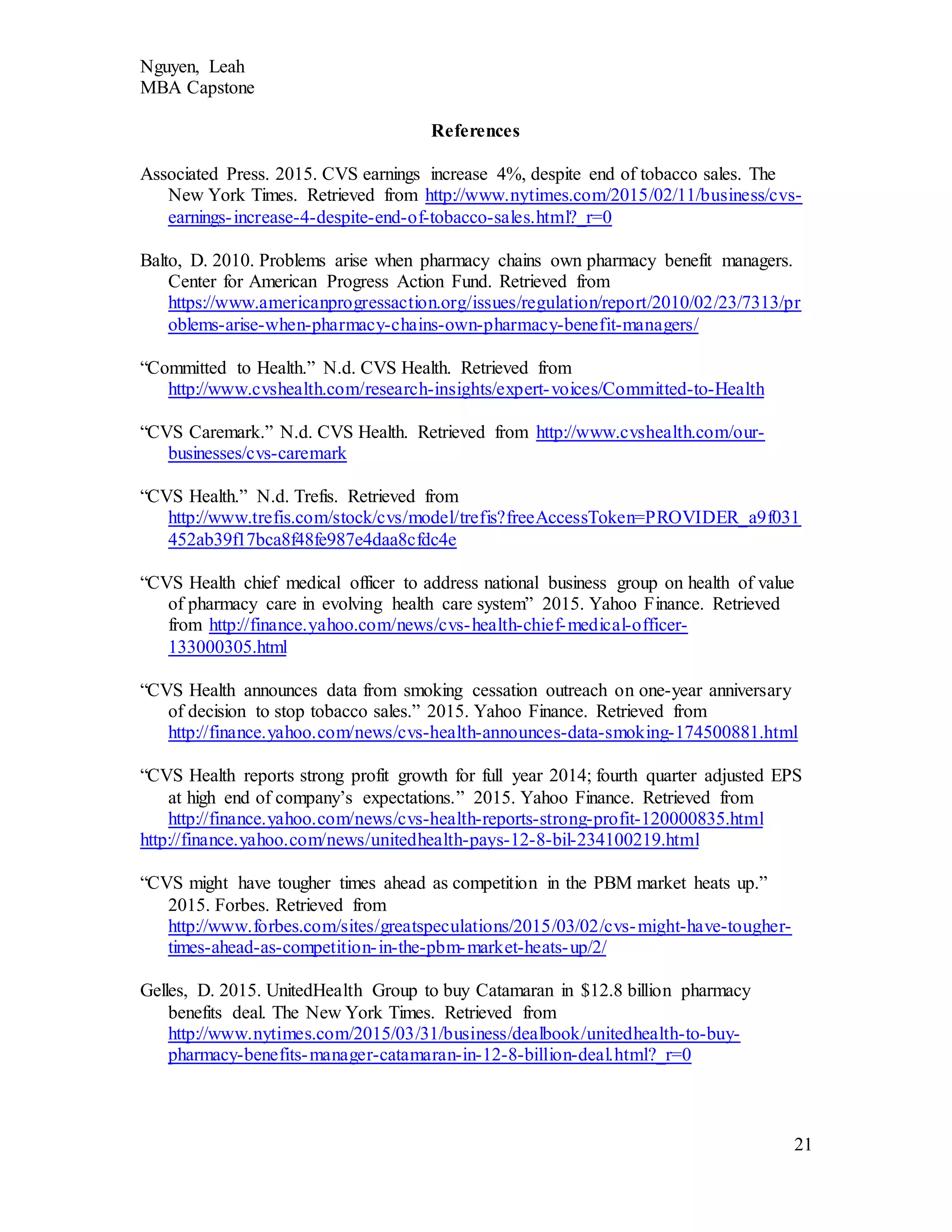
are as many as 100 different providers, the market is ruled by a select few. Besides CVS
Health, these include UnitedHealth, Express Scripts, Walgreens, and Wal-Mart [see
Nguyen, Leah
MBA Capstone
12
Exhibit 6 for an overall comparison – note that Catamaran and OptumRx are now part of
UnitedHealth].
In the face of these competitors, CVS Health has many strengths. By
eliminating tobacco products from their stores, they created a very strong marketing tool.
This well publicized action gave CVS Health a platform to further prove their
commitment to health and well-being. CVS Health’s Eileen Boone explained that
“cigarettes simply have no place in a setting where health care is delivered” and that
many conditions that pharmacies help manage are made worse by smoking (Kanani,
2014). In conjunction with this, they introduced a tobacco cessation program for their
customers that combined medication and coaching from the pharmacy staff. They also
rebranded from CVS Caremark to CVS Health in 2014 to emphasize their dedication to
health. CVS Health also has a separate Corporate Social Responsibility department that
operates several philanthropic efforts under the platform “Prescription for a Better
World.” These efforts prove to the public that CVS Health is committed to their mission
and may convince consumers to use their services instead.
Another strength of CVS Health’s is their proprietary technology. One use of
this technology is in the retail pharmacy. It is able to perform safety checks, interaction
screening, and substitutions for generic and brand drugs (“CVS Health,” n.d.). Their
technology also has the ability to deliver patient-specific information directly to EHRs to
the patients’ providers, integrating even more into the PCMH model. This improves
quality of care and safety for their patients.
The major weakness of CVS Health is the significant power that comes with
major acquisitions, like those of their competitors. As mentioned in the financial analysis,
Nguyen, Leah
MBA Capstone
13
UnitedHealth recently acquired Catamaran Corporation for $12.8 billion (Gelles, 2015).
Other examples include Rite Aid purchasing Envision Pharmaceutical Services for $2
billion and Express Scripts purchasing Medco Health Solutions for $29.1 billion
(“UnitedHealth Pays $12.8 Bil to Double Prescription Clients,” 2015). These mergers
create significant competition and gain greater portions of the market share. In 2014,
CVS Health and Express Scripts controlled nearly half of the PBM market, a total size of
$263 billion (“CVS Might Have Tougher Times Ahead,” 2015). With these additional
acquisitions, CVS Health’s share is reduced. It is difficult for CVS Health to sustain its
growth when the major players continue to consolidate market share and grow larger.
With competition and the spread of market share increasing, CVS Health still
has the opportunity to maintain an industry leader. To do so, they need to leverage their
unique position as a PBM and retail pharmacy. Because CVS Health has access to a vast
amount of customer data from their retail pharmacies, they are better able to forecast drug
supply needs. It can more accurately predict supply and demand, resulting in better
procurement from drug manufacturers (“What the UnitedHealth-Catamaran Deal Means
for CVS Health and the General Public,” 2015).
The threats that face CVS Health in the competitive PBM market are the
possibility of competitive advantage and market share loss. While CVS Health is
currently the only company to stop selling tobacco products, if other companies like
Walgreens and Rite Aid follow suit they may lose that competitive advantage.
Consumers who switched to CVS may return to their previous pharmacies, and new
customers may choose a competitor instead. Market share is threatened not only by major
companies, but the growth of smaller firms as well. Grocery stores and other discounters
Nguyen, Leah
MBA Capstone
14
have started in-house pharmacies and clinics. These would be a convenient option for
many consumers to combine trips and have prescriptions filled while they do their
weekly grocery shopping.
Future Prospects
CVS Health’s future looks bright. They are one of the leaders in the
Pharmacy Services market and have positioned themselves to continue to succeed. The
efforts CVS Health has made and will make should allow them to see growth for at least
the next ten years.
In the short-medium term, CVS Health’s Research Institute is looking to
implement various health programs. Like their tobacco cessation program, from which
they should expect to see an increase of cessation product purchasing (“CVS Health
Announces Data From Smoking Cessation,” 2015), they are implementing two other
programs by 2017 (“Committed to Health,” n.d.). These include a medical adherence
program to increase adherence by 5 percent up to 15 percent and a pharmacy
synchronization program. Medication non-adherence causes an estimated $300 billion in
avoidable costs in the U.S. healthcare system (“CVS Health Chief Medical Officer to
Address National Business Group,” 2015). The pharmacy synchronization program will
allow patients with multiple prescriptions to pick up their drugs all at once and
elimination inconvenience and confusion (“Committed to Health,” n.d.).
CVS Health is also looking to grow its physical presence. By 2017, CVS
Health plans to have 1,500 Minute Clinics in 35 states and that 50 percent of Americans
will have access to a Minute Clinic within 10 miles. This means that they are opening
Nguyen, Leah
MBA Capstone
15
nearly 3 new clinics a week to keep up with this demand (“Committed to Health,” n.d.).
Along with Minute Clinic growth, CVS Health is planning to expand its specialty
pharmacy services and the role of its pharmacists. There is a shortage of primary care
physicians and a growing population of people that have access to care. Patients are more
educated, empowered, and invested in their health care options and are making more
informed choices. The pharmacy will become the “go-to” for primary care and to a
degree, function as a healthcare concierge.
To ensure its sustainable growth, CVS Health also has plans for the long
term. The Affordable Care Act will continue to create waves in the healthcare industry
for years to come and CVS Health must be able to anticipate and adapt to the changes.
Part of the healthcare reform is to increase efforts for population health. This includes
more emphasis and support for preventative care and screenings, much of which can be
conducted by pharmacists and pharmacy staff. Collaboration with medical centers allows
increased coordination of care and greater collaboration between providers, pharmacies,
payers, and patients. CVS Health’s affiliations with two medical centers and fifty other
hospitals are an example of that. This collaboration will expand as it becomes
incentivized from all sides (government, payer, retailer, patient, etc.). This relationship
results in lower costs, increased operational efficiencies, better care, and improved health
outcomes.
CVS Health also understands the increased value in technology. Beyond their
current system, telemedicine and innovations that provide care (i.e. devices, drug-
administration equipment, web-based applications and platforms, etc.) are going to be the
future of healthcare. Healthcare costs are extremely high, and investing in technologies
Nguyen, Leah
MBA Capstone
16
that will not only expand care but improve the way it is delivered will enable long-term
cost reductions and sustainability.
Nguyen, Leah
MBA Capstone
17
APPENDIX
Exhibit 1
Description of Business
CVS Health Corporation, formerly CVS Caremark Corporation, is a pharmacy healthcare
provider in the United States. CVS Health has four business lines: CVS/Minute Clinic,
CVS/Pharmacy, CVS/Caremark, and CVS/Specialty. CVS/Minute Clinic provides easy
and affordable care for minor acute conditions. CVS/Pharmacy provides retail pharmacy
services. CVS/Caremark provides pharmacy benefit management (PBM) services,
including plan design and administration, formulary management, discounted drug
purchase arrangements, Medicare Part D services, mail order, specialty pharmacy and
infusion services, retail pharmacy network management services, prescription
management systems, clinical services, disease management services and medical spend
management. The Pharmacy Services business operates under the Caremark, CarePlus
CVS/pharmacy, CVS/caremarkTM, CVS/specialtyTM, RxAmerica, Accordant,
SilverScript, Novologix and Coram names. CVS/Specialty provides specialty drug
services, such as fertility and cancer drugs. As of September 30, 2014, CVS Health
included 7,779 retail drugstores, online retail pharmacy websites, CVS.com and
Onofre.com.br, and 17 onsite pharmacy stores and retail healthcare clinics.
Source: “CVS Health.” N.d. Trefis. Retrieved from
http://www.trefis.com/stock/cvs/model/trefis?freeAccessToken=PROVIDER_a9f031452a
b39f17bca8f48fe987e4daa8cfdc4e
Exhibit 2
Financial Competitor Overview
CVS ESRX UNH
Market Cap 117.09B 61.48B 111.93B
Employees 137,800 29,500 170,000
Revenue (ttm) 139.37B 100.89B 130.47B
Gross Margin (ttm) 0.18 0.08 0.29
EBITDA (ttm) 10.72B 6.69B 11.33B
OperatingMargin
(ttm) 0.06 0.05 0.08
NetIncome (ttm) 4.63B 2.01B 5.62B
EPS (ttm) 3.96 2.64 5.7
P/E (ttm) 25.94 32.04 20.59
PEG (5 yr expected) 1.35 1.21 1.96
P/S(ttm) 0.84 0.61 0.86
CVS = CVS Health Co.; ESRX = Express Scripts Holding Co., UNH = UnitedHealth
Group Inc.
Data obtained from Yahoo Finance
Nguyen, Leah
MBA Capstone
18
Exhibit 3a
Stock Prices Pre-ACA Implementation
Data obtained from Yahoo Finance
Exhibit 3b
Stock Prices Post-ACA Implementation
Data obtained from Yahoo Finance
y = 0.0169x - 645.32
0
10
20
30
40
50
60
1/1/2009
2/1/2009
3/1/2009
4/1/2009
5/1/2009
6/1/2009
7/1/2009
8/1/2009
9/1/2009
10/1/2009
11/1/2009
12/1/2009
1/1/2010
2/1/2010
StockPrice($)
Date
Pre-ACAPrice
ESRX
CVS
UNH
Linear (CVS)
y = 0.0257x - 1011.2
0
10
20
30
40
50
60
70
80
3/1/2010 3/1/2011 3/1/2012 3/1/2013
StockPrice($)
Date
Post-ACAPrice
ESRX
CVS
UNH
Linear (CVS)
Nguyen, Leah
MBA Capstone
19
Exhibit 4
CVS Health Segment Profit Breakdown
In millions
Pharmacy
Services
Segment
Retail Pharmacy
Segment
Corporate
Segment
Intersegment
Eliminations
Consolidated
Totals
Three Months Ended
31-Dec-14
Net revenues $ 23,874.00 $ 17,698.00 $ - $ (4,517.00) $ 37,055.00
Gross profit $ 1,238.00 $ 5,558.00 $ - $ (163.00) $ 6,633.00
Operatingprofit (loss) $ 909.00 $ 1,780.00 $ (205.00) $ (163.00) $ 2,321.00
31-Dec-13
Net revenues $ 19,615.00 $ 17,192.00 $ - $ (3,977.00) $ 32,830.00
Gross profit $ 1,211.00 $ 5,284.00 $ - $ (157.00) $ 6,338.00
Operatingprofit (loss) $ 901.00 $ 1,671.00 $ (198.00) $ (157.00) $ 2,217.00
Year Ended
31-Dec-14
Net revenues $ 88,440.00 $ 67,798.00 $ - $ (16,871.00) $ 139,367.00
Gross profit $ 4,771.00 $ 21,277.00 $ - $ (681.00) $ 25,367.00
Operatingprofit (loss) $ 3,514.00 $ 6,762.00 $ (796.00) $ (681.00) $ 8,799.00
31-Dec-13
Net revenues $ 76,208.00 $ 65,618.00 $ - $ (15,065.00) $ 126,761.00
Gross profit $ 4,237.00 $ 20,112.00 $ - $ (566.00) $ 23,783.00
Operatingprofit (loss) $ 3,086.00 $ 6,268.00 $ (751.00) $ (566.00) $ 8,037.00
Source: “CVS Health reports strong profit growth for full year 2014; fourth quarter
adjusted EPS at high end of company’s expectations.” 2015. Yahoo Finance. Retrieved
from http://finance.yahoo.com/news/cvs-health-reports-strong-profit-120000835.html
Nguyen, Leah
MBA Capstone
20
Exhibit 5
Historical Stock Prices
Data obtained from Yahoo Finance
Exhibit 6
Comparison of Competition
Source: http://www.healthstrategies.com/blog/strengths-weaknesses-leading-pbms
0
20
40
60
80
100
120
StockPrice($)
Date
Historical Prices: 01/01/13 - 03/01/15
CVS
ESRX
UNH
Nguyen, Leah
MBA Capstone
21
References
Associated Press. 2015. CVS earnings increase 4%, despite end of tobacco sales. The
New York Times. Retrieved from http://www.nytimes.com/2015/02/11/business/cvs-
earnings-increase-4-despite-end-of-tobacco-sales.html?_r=0
Balto, D. 2010. Problems arise when pharmacy chains own pharmacy benefit managers.
Center for American Progress Action Fund. Retrieved from
https://www.americanprogressaction.org/issues/regulation/report/2010/02/23/7313/pr
oblems-arise-when-pharmacy-chains-own-pharmacy-benefit-managers/
“Committed to Health.” N.d. CVS Health. Retrieved from
http://www.cvshealth.com/research-insights/expert-voices/Committed-to-Health
“CVS Caremark.” N.d. CVS Health. Retrieved from http://www.cvshealth.com/our-
businesses/cvs-caremark
“CVS Health.” N.d. Trefis. Retrieved from
http://www.trefis.com/stock/cvs/model/trefis?freeAccessToken=PROVIDER_a9f031
452ab39f17bca8f48fe987e4daa8cfdc4e
“CVS Health chief medical officer to address national business group on health of value
of pharmacy care in evolving health care system” 2015. Yahoo Finance. Retrieved
from http://finance.yahoo.com/news/cvs-health-chief-medical-officer-
133000305.html
“CVS Health announces data from smoking cessation outreach on one-year anniversary
of decision to stop tobacco sales.” 2015. Yahoo Finance. Retrieved from
http://finance.yahoo.com/news/cvs-health-announces-data-smoking-174500881.html
“CVS Health reports strong profit growth for full year 2014; fourth quarter adjusted EPS
at high end of company’s expectations.” 2015. Yahoo Finance. Retrieved from
http://finance.yahoo.com/news/cvs-health-reports-strong-profit-120000835.html
http://finance.yahoo.com/news/unitedhealth-pays-12-8-bil-234100219.html
“CVS might have tougher times ahead as competition in the PBM market heats up.”
2015. Forbes. Retrieved from
http://www.forbes.com/sites/greatspeculations/2015/03/02/cvs-might-have-tougher-
times-ahead-as-competition-in-the-pbm-market-heats-up/2/
Gelles, D. 2015. UnitedHealth Group to buy Catamaran in $12.8 billion pharmacy
benefits deal. The New York Times. Retrieved from
http://www.nytimes.com/2015/03/31/business/dealbook/unitedhealth-to-buy-
pharmacy-benefits-manager-catamaran-in-12-8-billion-deal.html?_r=0
Nguyen, Leah
MBA Capstone
22
Heitz, D. 2014. Harvoni takes the sting out of hepatitis C treatment. Healthline News.
Retrieved from http://www.healthline.com/health-news/harvoni-takes-sting-out-of-
hepatitis-c-treatment-102614#1
Japsen, B. 2015. As value-based care escalates CVS eclipses 50 hospital deals. Forbes.
Retrieved from http://www.forbes.com/sites/brucejapsen/2015/04/01/as-value-based-
care-escalates-cvs-eclipses-50-hospital-deals/
Kanani, Rahim. 2014. "Balancing Profit And Purpose: How CVS Caremark Is
Redefining Corporate Social Responsibility." Forbes. Retrieved from
http://www.forbes.com/sites/rahimkanani/2014/06/23/balancing-profit-and-purpose-
how-cvs-caremark-is-redefining-corporate-social-responsibility/
“Key features of the Affordable Care Act.” 2014. Retrieved from
http://www.hhs.gov/healthcare/facts/timeline/index.html
Matthews, S. 2013. How the aging population is changing the healthcare system.
Everyday Health. Retrieved from http://www.everydayhealth.com/senior-
health/aging-and-health/pressures-on-healthcare-from-booming-senior-
population.aspx
Medicare Program; Medicare Advantage and Prescription Drug Benefits, 76 Fed. Reg.
54600 (Sep 1, 2011)
“Obamacare enrollment numbers.” 2015. Retrieved from http://obamacarefacts.com/sign-
ups/obamacare-enrollment-numbers/
Townsend, M. 2013. CVS agrees to buy Apria’s Coram unit for $2.1 billion. Bloomberg
Business. Retrieved from http://www.bloomberg.com/news/articles/2013-11-27/cvs-
agrees-to-buy-apria-s-coram-unit-for-2-1-billion
Tweedie, S. & Kovach, S. 2014. Now we know the truth about why CVS and Rite Aid
blocked Apple Pay. Business Insider. Retrieved from
http://www.businessinsider.com/why-rite-aid-and-cvs-blocked-apple-pay-2014-10
“What the UnitedHealth-Catamaran deal means for CVS Health and the general public.”
2015. Forbes. Retrieved from
http://www.forbes.com/sites/greatspeculations/2015/04/01/what-the-unitedhealth-
catamaran-deal-means-for-cvs-health-and-the-general-public/
“UnitedHealth pays $12.8 Bil to double prescription clients.” 2015. Yahoo Finance.
Retrieved from http://finance.yahoo.com/news/unitedhealth-pays-12-8-bil-
234100219.html

Capstone PaperFinal

  • 1.
    BA 7012: MBACapstone Leah Nguyen 4/7/2015
  • 2.
    Nguyen, Leah MBA Capstone 1 Tableof Contents Executive Summary & Recommendation …………………………………………… 2 Financial Analysis ……………………………………………………………………... 3 Industry Analysis ……………………………………………………………………… 7 Competitive Analysis …………………………………………………………………. 12 Future Prospects ……………………………………………………………………… 14 Appendix ……………………………………………………………………………… 17 References …………………………………………………………………………….. 21
  • 3.
    Nguyen, Leah MBA Capstone 2 ExecutiveSummary & Recommendation CVS Health Corporation is an international company that works in the Pharmacy Benefit Management and retail pharmacy industry. They are one of the leaders in Pharmacy Services, filling over 750 million prescriptions annually. For a full description, see Exhibit 1. Financially, CVS Health is a competent organization that exhibits strong growth and a record net revenue of $139.4 billion. They are well-diversified with multiple lines of business. However, they risk placing too much reliance on certain lines, such as high-priced specialty drugs, for revenue. Opportunities for CVS Health’s financial growth lie in expansion in size, services, and the aging population. The industry overall is in a positive, yet pivotal point. Healthcare reform has brought many changes to the industry. These changes have affected many players and aspects of healthcare delivery, such as the move towards value-based care. As companies grow through mergers and acquisitions, negotiating power with drug companies grows due to the large economies of scale. Further reform and federal regulations threaten the success of these companies. They must be prepared to accommodate these changes in order to continue serving their markets. As mentioned above, CVS Health is a leader in its industry. Competition is extremely fierce for share of the growing market and it has taken steps to ensure its sustained presence and growth through population health initiatives such as its tobacco cessation program and its proprietary technology system for drug quality and safety. These indicate CVS Health’s commitment to the public’s well-being where many others
  • 4.
    Nguyen, Leah MBA Capstone 3 cannotsay quite so solidly. However, they are threatened by firms who can offer greater discounts due to economies of scale and convenience. CVS Health is poised to continue this success in the future. They are planning to introduce new programs and grow their services to improve public health and accommodate the changing healthcare system and consumer. Collaboration with major medical centers support a tighter coordination of care. Finally, they are exploring new advances and innovations in healthcare delivery to improve care and efficiency. Based on the following analyses, it is recommended that investment should be made in CVS Health. They are a market leader, conscious of the changing industry landscape, and focused on improving the well-being of their consumers and the population. Their past and current position indicate a positive future for continued growth and success. Financial Analysis CVS Health has done very well in the last few years. Executives also project this success to continue. With the changes from the Patient Protection and Affordable Care Act (ACA), new innovations and new drugs, and the aging population, CVS Health is positioned to remain a major player in the Pharmacy Services sector. Two of CVS Health’s main competitors, UnitedHealth Group Inc. and Express Scripts Holding Corporation, are involved with Pharmacy Benefits Management (PBM). Both of these companies also have other lines of business, like CVS Health. UnitedHealth is heavily involved with the management of health plans and Express
  • 5.
    Nguyen, Leah MBA Capstone 4 Scriptsworks with drug and equipment distribution, consulting, and case management. A brief comparison of the three companies can be seen in Exhibit 2. CVS Health has many financial strengths. They are a well-diversified company with four different business lines: CVS/minute clinic, CVS/pharmacy, CVS/caremark, and CVS/specialty. Each of these provides a separate function while working cohesively to achieve improved patient and consumer well-being. For example, certain specialty drugs are no longer being processed through the pharmacy store but instead through their mail order capacity. While this lowered basis points for the pharmacy, it increased overall revenues compared to prescription volumes due to the high price of specialty drugs (“CVS Health Reports Strong Profits,” 2015). These high-priced specialty drugs are growing in demand. In the last quarter, revenues for these drugs increased nearly 22 percent to $23.9 billion (Associated Press, 2015). CVS Health also benefitted from the increase in patient access due to the ACA, as more patients were being treated and filling prescriptions. UnitedHealth and Express Scripts also saw this increase, and this increase in value was translated into stock price. Exhibits 3a and 3b show the difference in rate of stock price increase before and after the ACA of CVS Health, Express Scripts, and UnitedHealth. As illustrated, the rate nearly doubles after implementation of the ACA. In the last quarter, earnings rose 4 percent despite the “anticipated blow” from the termination of sales from tobacco products (Associated Press, 2015). For the total year of 2014, net revenues increased 9.9 percent to a record $139.4 billion [Exhibit 4] and CVS Health generated free cash flow of $6.5 billion and cash flow from operations of $8.1 billion (“CVS Health Reports Strong Profits,” 2015). This cash flow “exceeded” CVS
  • 6.
    Nguyen, Leah MBA Capstone 5 Executiveexpectations and supports their goal of solid, sustainable growth (“CVS Health Reports Strong Profits,” 2015). Despite this success, CVS Health does have weaknesses. Eliminating tobacco products resulted in expected loss, but it also brought with it less traffic to their front store sales. Customers who may have shopped for other goods while they purchased their tobacco products are coming in less frequently for those goods, and instead purchasing them elsewhere (i.e. with their groceries, at gas stations, etc.). With the loss that accompanied tobacco sales comes a greater pressure on other departments, such as the pharmacy. The pharmacy also earns less revenue from generics unless it can be made up in volume. Therefore, CVS Health must rely more on the higher-priced specialty drugs to help make up this deficit. CVS Health, along with one of its competitors, Rite-Aid, is not accepting Apple Pay. This is a weakness as it obviously excludes those consumers who are making the switch to digital forms of payment. CVS Health is a member of MCX, Merchant Customer Exchange, and part of this contract requires companies to work exclusively with MCX (Tweedie & Kovach, 2014). MCX is developing its own system of digital payment called CurrenC but it is far from being released. Breaking the contract, to offer Apple Pay for example, results in steep fines (Tweedie & Kovach, 2014). As more services become automated through mobile apps and online platforms that can be accessed from the consumer’s smartphone, the appeal of paying for these services with their smartphones increase. By not being open to new innovations is detrimental to CVS Health and their competitors’ revenues and reputations.
  • 7.
    Nguyen, Leah MBA Capstone 6 Thereare several opportunities for CVS Health to take advantage. As has happened throughout the industry, mergers and acquisitions of other PBMs and pharmacy services companies is common. When UnitedHealth acquired Catamaran Corporation, it became the third-largest pharmacy benefit manager with a market share of 20 percent (“What the UnitedHealth-Catamaran Deal Means,” 2015). Before this, CVS Health and Express Scripts controlled about 50 percent of the PBM market, with Express Scripts filling over one billion prescriptions annually. The acquisition of Catamaran brings UnitedHealth’s estimated fulfillment of prescriptions to mirror that of Express Scripts at a billion. CVS Health has acquired several smaller companies in the past, such as Coram in 2013, a specialty infusion services unit, and Long Drug Stores in 2008 (Townsend, 2013). To maintain its market share, CVS Health should continue exploring these opportunities to expand their expertise and services to provide lower-cost and more accessible care. A final opportunity for CVS Health is to improve their stock price. Despite the recent financial successes, CVS Health is not as strong as UnitedHealth. They are doing much better than Express Scripts, but there is always opportunity for improvement [Exhibit 5]. This could be achieved through increasing the value of the company to increase demand for shares as well as buy back some of their shares to reduce the supply of shares available. Being a player in the healthcare system does not come without risks or threats. CVS Health, UnitedHealth, and Express Scripts are threatened by litigation. As these companies grow larger through acquisitions, the competition is effectively consolidated into a few major players that have the potential for anti-trust law violations. Settlements
  • 8.
    Nguyen, Leah MBA Capstone 7 andany sort of litigation are costly. Between 2004 and 2008, players in the PBM market were accused of “fraud; misrepresentation to plan sponsors, patients and providers; unjust enrichment through secret kick-back schemes; and failure to meet ethical and safety standards” (Balto, 2010). Such cases have resulted in over $371.9 million in damages to states, plans and patients – and half of these were paid by Caremark and its parent company AdvancePCS (Balto, 2010). Caremark was since acquired by CVS Health. It is important for these companies to be aware of their actions and ensure their behavior doesn't compromise the company in any way. Industry Analysis The healthcare industry as a whole is at a pivotal point. The United States has the most expensive healthcare system in the world but falls significantly below in outcomes in comparison to countries that spend similarly. The government, providers, payers, pharmaceuticals, ancillary/retail services, and patients are acutely aware of the issues that are facing the system. Fortunately, they are all making significant strides to improve the healthcare system and are inherently connected in these decisions. The pharmacy services segment maintains several strengths. CVS Health, as a pharmacy benefits manager and a retail pharmacy, like other PBM players, is in direct coordination with health plans, employers, unions, government employee groups, and other sponsors of health benefit plans throughout the U.S. (“CVS Caremark,” n.d.). CVS Health fills over 750 million prescriptions for beneficiaries of these clients and its retail pharmacy customers. Because of this extensive reach, PBM players have significant negotiating powers with drug companies. They are able to negotiate lower prices for
  • 9.
    Nguyen, Leah MBA Capstone 8 drugs,which is increasingly important as the costs of both specialty and generic drugs are rising. Drug companies are making increasingly complex and sophisticated drugs that require more complex administration (i.e. intravenously) and specific maintenance (i.e. temperature controlled), which results in costs of over $3,000 per month to the patient. Examples of these expensive drugs include cancer drugs, fertility drugs, and a cure for Hepatitis C, which recently was released and cost over $1,000 a day, or $84,000-$94,000 for the whole round of treatment (Heitz, 2014). Because of the large scale PBM companies have, they are able to negotiate these prices down. Another strength of the industry is the positioning PBM players have. The healthcare system is evolving, with the growth of patient-centered medical homes (PCMHs) becoming the prominent model for care delivery. As a part of this, patients are actively involved, more educated and empowered in their care. Instead of turning to emergency rooms and hospitals, primary care physicians, pharmacists, and clinics are the first line of access for minor acute conditions. Patients are shopping around and looking for the best value. Because of the positioning of PBMs and retail pharmacies like CVS Health, they are able to provide for this kind of care and the necessary products. Often, pharmacists are the first and most easily-accessible healthcare professional for patients to reach. While the negotiating power is a strength for this industry, the high cost of drugs continues to plague them, among other weaknesses. This weakness means that PBM companies are constantly spending money and time dealing with these high costs that are inevitably set by drug companies. However, PBMs are limited in their negotiations to an extent. Many drugs are under patent which prevents other companies from developing
  • 10.
    Nguyen, Leah MBA Capstone 9 generics.These drugs remain expensive because the pharmaceutical companies only have a short window to see a return on their multi-billion-dollar investments. However, one opportunity that comes with patenting drugs is when their patents expire. Over the next three years, $15 billion in products are expected to come off patents. These drugs will be able to be produced generically, increasing access and affordability. Another weakness is the overall lack of cost control throughout the industry. Eighteen percent of the U.S. GDP is attributed to healthcare spending – and drug spending has increased 13.1 percent (“What the UnitedHealth-Catamaran Deal Means for CVS Health and the General Public,” 2015). As mentioned above, the healthcare system is at a pivotal point. The implementation of the Affordable Care Act brought many changes that present opportunities for the healthcare industry and the PBM and retail pharmacy markets, specifically. The goals of the ACA are to improve quality and affordability of care, increase accessibility of care by expanding private and public insurance coverage, and reduce costs of healthcare for individuals and the government (“Key Features of the Affordable Care Act,” n.d.). At the end of the 2014 open enrollment period, fifteen million people who were uninsured prior to the ACA’s implementation in 2010 were now covered (“Obamacare Enrollment Numbers,” n.d.). That means that fifteen million more people are able to receive care and fill prescriptions, and that the cost of this care is more affordable. The opportunity associated with this expansion is significant and is not something PBMs like CVS Health are going to overlook. In order to be more accessible, CVS Health has a goal of placing a store within 3 miles of every person. Similarly, Walgreens has a goal of store accessibility within 5 miles.
  • 11.
    Nguyen, Leah MBA Capstone 10 Anotheropportunity associated with the ACA is the push towards value-based care and less fee-for-service. The Obama administration set a goal of 50 percent of payments from the Centers for Medicare & Medicaid Services (CMS) to medical care providers would be value-based by 2018 (Japsen, 2014). The government, providers, and payers have recognized the value of performance and health outcomes instead of volume as a measure of reimbursement. The PBM and retail pharmacy industry is included in these efforts for value-based care. More and more, retail chains and pharmacies are affiliating with major medical centers and accountable care organizations. CVS Health, for example, has fifty affiliations across the country (Japsen, 2014). This supports tighter coordination between pharmacists and providers to improve care. Retailers also have the ability to collect and analyze the massive amount of patient data. Because of this, providers will be better able to understand population health. Patient-specific information will be able to be passed directly from the pharmacist to the provider and into the patient’s electronic health record (EHR). The demographics of the population pose a major opportunity for the PBM and retail pharmacy industry. By 2030, one in five Americans will be aged 65 or older and eligible for Medicaid (Matthews, 2013). Two-thirds of the aging population have multiple chronic conditions that require ongoing treatment and medication. This care can include as many as 15 medications or more daily. People are also living longer – life expectancy has increased 30 years over the last century. Thus, people are dealing with complex medical issues for much longer than they used to. Adding to this issue is the lack of providers specializing in geriatrics and number of at-home or nursing care providers available. There are currently only one-fourth of the
  • 12.
    Nguyen, Leah MBA Capstone 11 necessaryproviders available – by 2030, it is estimated the need for geriatric physicians to increase to 30,000 from 7,500 (Matthews, 2013). This encourages more and more people to turn to their pharmacists and clinics for care and guidance. The population is also seeing an increase in public health efforts, such as programs for obesity, tobacco cessation, drug abuse, and flu prevention. Similar to the aging population, people will turn to the retail pharmacies for information. PBMs and retailers must be able to serve an increasing market who demands an expansion of low-cost, high-quality services. The major threat to the PBM industry is from federal regulations. As a plan sponsor and participant in the Medicare Part D program, CVS Health and its peers are subject to changes mandated by CMS. In 2011, CMS updated its regulations regarding the Prescription Drug Benefits Program. The revisions, posted in the Federal Register, required companies like CVS Health to update their prescription drug pricing standard more frequently and also advised on coverage, payment processes in the Part D program, and requirements governing the marketing of Part C and Part D plans (2011). If organizations that participate in Medicare do not follow these regulations, they risk being removed from the program and thus losing a substantial portion of patients and reimbursements. Competitive Analysis The Pharmacy Services/PBM industry is extremely competitive. While there are as many as 100 different providers, the market is ruled by a select few. Besides CVS Health, these include UnitedHealth, Express Scripts, Walgreens, and Wal-Mart [see
  • 13.
    Nguyen, Leah MBA Capstone 12 Exhibit6 for an overall comparison – note that Catamaran and OptumRx are now part of UnitedHealth]. In the face of these competitors, CVS Health has many strengths. By eliminating tobacco products from their stores, they created a very strong marketing tool. This well publicized action gave CVS Health a platform to further prove their commitment to health and well-being. CVS Health’s Eileen Boone explained that “cigarettes simply have no place in a setting where health care is delivered” and that many conditions that pharmacies help manage are made worse by smoking (Kanani, 2014). In conjunction with this, they introduced a tobacco cessation program for their customers that combined medication and coaching from the pharmacy staff. They also rebranded from CVS Caremark to CVS Health in 2014 to emphasize their dedication to health. CVS Health also has a separate Corporate Social Responsibility department that operates several philanthropic efforts under the platform “Prescription for a Better World.” These efforts prove to the public that CVS Health is committed to their mission and may convince consumers to use their services instead. Another strength of CVS Health’s is their proprietary technology. One use of this technology is in the retail pharmacy. It is able to perform safety checks, interaction screening, and substitutions for generic and brand drugs (“CVS Health,” n.d.). Their technology also has the ability to deliver patient-specific information directly to EHRs to the patients’ providers, integrating even more into the PCMH model. This improves quality of care and safety for their patients. The major weakness of CVS Health is the significant power that comes with major acquisitions, like those of their competitors. As mentioned in the financial analysis,
  • 14.
    Nguyen, Leah MBA Capstone 13 UnitedHealthrecently acquired Catamaran Corporation for $12.8 billion (Gelles, 2015). Other examples include Rite Aid purchasing Envision Pharmaceutical Services for $2 billion and Express Scripts purchasing Medco Health Solutions for $29.1 billion (“UnitedHealth Pays $12.8 Bil to Double Prescription Clients,” 2015). These mergers create significant competition and gain greater portions of the market share. In 2014, CVS Health and Express Scripts controlled nearly half of the PBM market, a total size of $263 billion (“CVS Might Have Tougher Times Ahead,” 2015). With these additional acquisitions, CVS Health’s share is reduced. It is difficult for CVS Health to sustain its growth when the major players continue to consolidate market share and grow larger. With competition and the spread of market share increasing, CVS Health still has the opportunity to maintain an industry leader. To do so, they need to leverage their unique position as a PBM and retail pharmacy. Because CVS Health has access to a vast amount of customer data from their retail pharmacies, they are better able to forecast drug supply needs. It can more accurately predict supply and demand, resulting in better procurement from drug manufacturers (“What the UnitedHealth-Catamaran Deal Means for CVS Health and the General Public,” 2015). The threats that face CVS Health in the competitive PBM market are the possibility of competitive advantage and market share loss. While CVS Health is currently the only company to stop selling tobacco products, if other companies like Walgreens and Rite Aid follow suit they may lose that competitive advantage. Consumers who switched to CVS may return to their previous pharmacies, and new customers may choose a competitor instead. Market share is threatened not only by major companies, but the growth of smaller firms as well. Grocery stores and other discounters
  • 15.
    Nguyen, Leah MBA Capstone 14 havestarted in-house pharmacies and clinics. These would be a convenient option for many consumers to combine trips and have prescriptions filled while they do their weekly grocery shopping. Future Prospects CVS Health’s future looks bright. They are one of the leaders in the Pharmacy Services market and have positioned themselves to continue to succeed. The efforts CVS Health has made and will make should allow them to see growth for at least the next ten years. In the short-medium term, CVS Health’s Research Institute is looking to implement various health programs. Like their tobacco cessation program, from which they should expect to see an increase of cessation product purchasing (“CVS Health Announces Data From Smoking Cessation,” 2015), they are implementing two other programs by 2017 (“Committed to Health,” n.d.). These include a medical adherence program to increase adherence by 5 percent up to 15 percent and a pharmacy synchronization program. Medication non-adherence causes an estimated $300 billion in avoidable costs in the U.S. healthcare system (“CVS Health Chief Medical Officer to Address National Business Group,” 2015). The pharmacy synchronization program will allow patients with multiple prescriptions to pick up their drugs all at once and elimination inconvenience and confusion (“Committed to Health,” n.d.). CVS Health is also looking to grow its physical presence. By 2017, CVS Health plans to have 1,500 Minute Clinics in 35 states and that 50 percent of Americans will have access to a Minute Clinic within 10 miles. This means that they are opening
  • 16.
    Nguyen, Leah MBA Capstone 15 nearly3 new clinics a week to keep up with this demand (“Committed to Health,” n.d.). Along with Minute Clinic growth, CVS Health is planning to expand its specialty pharmacy services and the role of its pharmacists. There is a shortage of primary care physicians and a growing population of people that have access to care. Patients are more educated, empowered, and invested in their health care options and are making more informed choices. The pharmacy will become the “go-to” for primary care and to a degree, function as a healthcare concierge. To ensure its sustainable growth, CVS Health also has plans for the long term. The Affordable Care Act will continue to create waves in the healthcare industry for years to come and CVS Health must be able to anticipate and adapt to the changes. Part of the healthcare reform is to increase efforts for population health. This includes more emphasis and support for preventative care and screenings, much of which can be conducted by pharmacists and pharmacy staff. Collaboration with medical centers allows increased coordination of care and greater collaboration between providers, pharmacies, payers, and patients. CVS Health’s affiliations with two medical centers and fifty other hospitals are an example of that. This collaboration will expand as it becomes incentivized from all sides (government, payer, retailer, patient, etc.). This relationship results in lower costs, increased operational efficiencies, better care, and improved health outcomes. CVS Health also understands the increased value in technology. Beyond their current system, telemedicine and innovations that provide care (i.e. devices, drug- administration equipment, web-based applications and platforms, etc.) are going to be the future of healthcare. Healthcare costs are extremely high, and investing in technologies
  • 17.
    Nguyen, Leah MBA Capstone 16 thatwill not only expand care but improve the way it is delivered will enable long-term cost reductions and sustainability.
  • 18.
    Nguyen, Leah MBA Capstone 17 APPENDIX Exhibit1 Description of Business CVS Health Corporation, formerly CVS Caremark Corporation, is a pharmacy healthcare provider in the United States. CVS Health has four business lines: CVS/Minute Clinic, CVS/Pharmacy, CVS/Caremark, and CVS/Specialty. CVS/Minute Clinic provides easy and affordable care for minor acute conditions. CVS/Pharmacy provides retail pharmacy services. CVS/Caremark provides pharmacy benefit management (PBM) services, including plan design and administration, formulary management, discounted drug purchase arrangements, Medicare Part D services, mail order, specialty pharmacy and infusion services, retail pharmacy network management services, prescription management systems, clinical services, disease management services and medical spend management. The Pharmacy Services business operates under the Caremark, CarePlus CVS/pharmacy, CVS/caremarkTM, CVS/specialtyTM, RxAmerica, Accordant, SilverScript, Novologix and Coram names. CVS/Specialty provides specialty drug services, such as fertility and cancer drugs. As of September 30, 2014, CVS Health included 7,779 retail drugstores, online retail pharmacy websites, CVS.com and Onofre.com.br, and 17 onsite pharmacy stores and retail healthcare clinics. Source: “CVS Health.” N.d. Trefis. Retrieved from http://www.trefis.com/stock/cvs/model/trefis?freeAccessToken=PROVIDER_a9f031452a b39f17bca8f48fe987e4daa8cfdc4e Exhibit 2 Financial Competitor Overview CVS ESRX UNH Market Cap 117.09B 61.48B 111.93B Employees 137,800 29,500 170,000 Revenue (ttm) 139.37B 100.89B 130.47B Gross Margin (ttm) 0.18 0.08 0.29 EBITDA (ttm) 10.72B 6.69B 11.33B OperatingMargin (ttm) 0.06 0.05 0.08 NetIncome (ttm) 4.63B 2.01B 5.62B EPS (ttm) 3.96 2.64 5.7 P/E (ttm) 25.94 32.04 20.59 PEG (5 yr expected) 1.35 1.21 1.96 P/S(ttm) 0.84 0.61 0.86 CVS = CVS Health Co.; ESRX = Express Scripts Holding Co., UNH = UnitedHealth Group Inc. Data obtained from Yahoo Finance
  • 19.
    Nguyen, Leah MBA Capstone 18 Exhibit3a Stock Prices Pre-ACA Implementation Data obtained from Yahoo Finance Exhibit 3b Stock Prices Post-ACA Implementation Data obtained from Yahoo Finance y = 0.0169x - 645.32 0 10 20 30 40 50 60 1/1/2009 2/1/2009 3/1/2009 4/1/2009 5/1/2009 6/1/2009 7/1/2009 8/1/2009 9/1/2009 10/1/2009 11/1/2009 12/1/2009 1/1/2010 2/1/2010 StockPrice($) Date Pre-ACAPrice ESRX CVS UNH Linear (CVS) y = 0.0257x - 1011.2 0 10 20 30 40 50 60 70 80 3/1/2010 3/1/2011 3/1/2012 3/1/2013 StockPrice($) Date Post-ACAPrice ESRX CVS UNH Linear (CVS)
  • 20.
    Nguyen, Leah MBA Capstone 19 Exhibit4 CVS Health Segment Profit Breakdown In millions Pharmacy Services Segment Retail Pharmacy Segment Corporate Segment Intersegment Eliminations Consolidated Totals Three Months Ended 31-Dec-14 Net revenues $ 23,874.00 $ 17,698.00 $ - $ (4,517.00) $ 37,055.00 Gross profit $ 1,238.00 $ 5,558.00 $ - $ (163.00) $ 6,633.00 Operatingprofit (loss) $ 909.00 $ 1,780.00 $ (205.00) $ (163.00) $ 2,321.00 31-Dec-13 Net revenues $ 19,615.00 $ 17,192.00 $ - $ (3,977.00) $ 32,830.00 Gross profit $ 1,211.00 $ 5,284.00 $ - $ (157.00) $ 6,338.00 Operatingprofit (loss) $ 901.00 $ 1,671.00 $ (198.00) $ (157.00) $ 2,217.00 Year Ended 31-Dec-14 Net revenues $ 88,440.00 $ 67,798.00 $ - $ (16,871.00) $ 139,367.00 Gross profit $ 4,771.00 $ 21,277.00 $ - $ (681.00) $ 25,367.00 Operatingprofit (loss) $ 3,514.00 $ 6,762.00 $ (796.00) $ (681.00) $ 8,799.00 31-Dec-13 Net revenues $ 76,208.00 $ 65,618.00 $ - $ (15,065.00) $ 126,761.00 Gross profit $ 4,237.00 $ 20,112.00 $ - $ (566.00) $ 23,783.00 Operatingprofit (loss) $ 3,086.00 $ 6,268.00 $ (751.00) $ (566.00) $ 8,037.00 Source: “CVS Health reports strong profit growth for full year 2014; fourth quarter adjusted EPS at high end of company’s expectations.” 2015. Yahoo Finance. Retrieved from http://finance.yahoo.com/news/cvs-health-reports-strong-profit-120000835.html
  • 21.
    Nguyen, Leah MBA Capstone 20 Exhibit5 Historical Stock Prices Data obtained from Yahoo Finance Exhibit 6 Comparison of Competition Source: http://www.healthstrategies.com/blog/strengths-weaknesses-leading-pbms 0 20 40 60 80 100 120 StockPrice($) Date Historical Prices: 01/01/13 - 03/01/15 CVS ESRX UNH
  • 22.
    Nguyen, Leah MBA Capstone 21 References AssociatedPress. 2015. CVS earnings increase 4%, despite end of tobacco sales. The New York Times. Retrieved from http://www.nytimes.com/2015/02/11/business/cvs- earnings-increase-4-despite-end-of-tobacco-sales.html?_r=0 Balto, D. 2010. Problems arise when pharmacy chains own pharmacy benefit managers. Center for American Progress Action Fund. Retrieved from https://www.americanprogressaction.org/issues/regulation/report/2010/02/23/7313/pr oblems-arise-when-pharmacy-chains-own-pharmacy-benefit-managers/ “Committed to Health.” N.d. CVS Health. Retrieved from http://www.cvshealth.com/research-insights/expert-voices/Committed-to-Health “CVS Caremark.” N.d. CVS Health. Retrieved from http://www.cvshealth.com/our- businesses/cvs-caremark “CVS Health.” N.d. Trefis. Retrieved from http://www.trefis.com/stock/cvs/model/trefis?freeAccessToken=PROVIDER_a9f031 452ab39f17bca8f48fe987e4daa8cfdc4e “CVS Health chief medical officer to address national business group on health of value of pharmacy care in evolving health care system” 2015. Yahoo Finance. Retrieved from http://finance.yahoo.com/news/cvs-health-chief-medical-officer- 133000305.html “CVS Health announces data from smoking cessation outreach on one-year anniversary of decision to stop tobacco sales.” 2015. Yahoo Finance. Retrieved from http://finance.yahoo.com/news/cvs-health-announces-data-smoking-174500881.html “CVS Health reports strong profit growth for full year 2014; fourth quarter adjusted EPS at high end of company’s expectations.” 2015. Yahoo Finance. Retrieved from http://finance.yahoo.com/news/cvs-health-reports-strong-profit-120000835.html http://finance.yahoo.com/news/unitedhealth-pays-12-8-bil-234100219.html “CVS might have tougher times ahead as competition in the PBM market heats up.” 2015. Forbes. Retrieved from http://www.forbes.com/sites/greatspeculations/2015/03/02/cvs-might-have-tougher- times-ahead-as-competition-in-the-pbm-market-heats-up/2/ Gelles, D. 2015. UnitedHealth Group to buy Catamaran in $12.8 billion pharmacy benefits deal. The New York Times. Retrieved from http://www.nytimes.com/2015/03/31/business/dealbook/unitedhealth-to-buy- pharmacy-benefits-manager-catamaran-in-12-8-billion-deal.html?_r=0
  • 23.
    Nguyen, Leah MBA Capstone 22 Heitz,D. 2014. Harvoni takes the sting out of hepatitis C treatment. Healthline News. Retrieved from http://www.healthline.com/health-news/harvoni-takes-sting-out-of- hepatitis-c-treatment-102614#1 Japsen, B. 2015. As value-based care escalates CVS eclipses 50 hospital deals. Forbes. Retrieved from http://www.forbes.com/sites/brucejapsen/2015/04/01/as-value-based- care-escalates-cvs-eclipses-50-hospital-deals/ Kanani, Rahim. 2014. "Balancing Profit And Purpose: How CVS Caremark Is Redefining Corporate Social Responsibility." Forbes. Retrieved from http://www.forbes.com/sites/rahimkanani/2014/06/23/balancing-profit-and-purpose- how-cvs-caremark-is-redefining-corporate-social-responsibility/ “Key features of the Affordable Care Act.” 2014. Retrieved from http://www.hhs.gov/healthcare/facts/timeline/index.html Matthews, S. 2013. How the aging population is changing the healthcare system. Everyday Health. Retrieved from http://www.everydayhealth.com/senior- health/aging-and-health/pressures-on-healthcare-from-booming-senior- population.aspx Medicare Program; Medicare Advantage and Prescription Drug Benefits, 76 Fed. Reg. 54600 (Sep 1, 2011) “Obamacare enrollment numbers.” 2015. Retrieved from http://obamacarefacts.com/sign- ups/obamacare-enrollment-numbers/ Townsend, M. 2013. CVS agrees to buy Apria’s Coram unit for $2.1 billion. Bloomberg Business. Retrieved from http://www.bloomberg.com/news/articles/2013-11-27/cvs- agrees-to-buy-apria-s-coram-unit-for-2-1-billion Tweedie, S. & Kovach, S. 2014. Now we know the truth about why CVS and Rite Aid blocked Apple Pay. Business Insider. Retrieved from http://www.businessinsider.com/why-rite-aid-and-cvs-blocked-apple-pay-2014-10 “What the UnitedHealth-Catamaran deal means for CVS Health and the general public.” 2015. Forbes. Retrieved from http://www.forbes.com/sites/greatspeculations/2015/04/01/what-the-unitedhealth- catamaran-deal-means-for-cvs-health-and-the-general-public/ “UnitedHealth pays $12.8 Bil to double prescription clients.” 2015. Yahoo Finance. Retrieved from http://finance.yahoo.com/news/unitedhealth-pays-12-8-bil- 234100219.html