Russian Ukraine
Conflict
BY MATTHEW GIBSON, MADDY HIGH, COLE HIZER, AND COLIN
WHITE
Why are Russia and Ukraine Fighting?
Ukraine Historical Background
10th and 11th century Kyivan Rus is the most powerful
state in Europe
◦ Is the basis of historical nationalism for Ukraine (“The World
Factbook”)
1654 – The Russian Empire under the Romanov Dynasty
annexed eastern Ukraine. (Suny 5).
3 partitions of Poland in 1772, 1793, and 1795
between Russia, Prussia, and Austria.
In the second partition of Poland in Jan 23, 1793, the
Russian Empire took the eastern territories of Poland
including Western Ukraine. (“Partitions of Poland -- Britannica Online
Encyclopedia”).
t
“Partitions of Poland -- Britannica Online Encyclopedia.” Web. 27 Apr. 2015. Suny, Ronald G. The Soviet
Experiment: Russia, the USSR, and the Successor States.2nd ed. Oxford: Oxford University Press, 2011. Print.
“The World Factbook.” Web. 30 Apr. 2015.
Ukraine Timeline
19th century : Parts of western Ukraine remain under
Austrian Rule
◦ Becomes center for Ukraine nationalism
◦ Russian Ukraine, territory controlled by many non-
Ukrainians had no real sense of nationalism before
20th century (Suny 117).
Jan. 1918 Ukrainian nationalists declared independence.
(Suny 86)
1920 Russo - Polish War (after WWI Poland is recreated.)
March 1921 Treaty of Riga - Western Ukraine becomes
part of Polish state (Suny 120).
Suny, Ronald G. The Soviet Experiment: Russia, the USSR, and the Successor States.2nd ed.
Oxford: Oxford University Press, 2011. Print.
Ukraine Timeline 1930's - 40's
1932 - Ukraine the breadbasket of USSR. 70 % of peasants were collectivized and supplied 38%
of all USSR grain deliveries (Suny 245).
1932-33: 5 million Ukrainians die in man made genocide by Russian leaders to eradicate Ukraine
nationalism (Suny 246).
1939 Germany invades Poland and western Ukraine is annexed into the USSR (Suny 328).
WWII - European part of USSR most notably Ukraine was the important grain producing regions
and heartland of Soviet industry.
◦ 70% iron, 90% aircraft, 84% sugar, 60% of pigs (Suny 347).
1946-1949 Ukraine suffers from another famine (Suny 392).
Suny, Ronald G. The Soviet Experiment: Russia, the USSR, and the Successor States.2nd ed. Oxford: Oxford University Press, 2011. Print.
Ukraine Dissidence, Soviet Crackdown
1944 - late 1940's Ukraine nationalists form the Organization of Ukrainian Nationalists (OUN)
primarily in western Ukraine.
◦ Organization opposed Soviet rule - killed 25,000 Soviet soldiers and 30,000 citizens
◦ Soviet government responded by deporting 66,000 families (over 200,00 people) from Western Ukraine
in the years 1944-1951." (Suny 392-393).
Khrushchev years: "Promoted Russian language and culture, particularly in the Baltic, Ukraine,
and Belorussia(Suny 436).
1965-66 : "Kremlin cracked down harder on Ukraine nationalists, 20 of whom were jailed." (Suny
457).
Suny, Ronald G. The Soviet Experiment: Russia, the USSR, and the Successor States.2nd ed. Oxford: Oxford University Press, 2011. Print.
Post Soviet Ukraine Relations
After the collapse of the Soviet Union, the Russian Federation worked to create the Near Abroad
which was their policy towards former Soviet states.
Russia wanted to police the neighborhoods to keep rivals from establishing influence in Russia's
sphere of influence.(Suny 529).
1997: Yeltsin signed accord with NATO to accept expansion into Eastern Europe. (Suny 529).
Putin's goal: establish Russia as a regional hegemony and prevent international interference from US,
EU,Turkey, and NATO. (Suny 543).
2004 Orange Revolution: Prime Minister, Viktor Yanukovych, who was supported by Putin and had a
stronghold in eastern Ukraine won the 2004 election against Yushchenko. People protested the
election was a fraud and wanted a re-election.(“Ukraine :: The Orange Revolution and the Yushchenko Presidency -- Britannica Online
Encyclopedia”) In the relection Yushchenko, the more democratic candidate took power. (Suny 544).
Suny, Ronald G. The Soviet Experiment: Russia, the USSR, and the Successor States.2nd ed. Oxford: Oxford University Press, 2011. Print.
“Ukraine :: The Orange Revolution and the Yushchenko Presidency -- Britannica Online Encyclopedia.” Web. 30 Apr. 2015.
Background of Crimea
Natives: Tatars
Under Ottoman control for several hundred years
Russia and Ottoman Empire engage in series of wars over the black
sea region(Under Peter I-the Great)
War of 1768-1774 resulted in the Treaty Kaynarca
I. Independent Crimean Tatar State
II. 1783- Catherine II (the Great) annexes Crimea
(1853-1856)-Crimean war
I. Siege of Sevastopol (British and French)-Result: Russia loses
Crimean war
II. (During War)-Russia: forcibly dispersed Tatars throughout
Russia.
Google Image
"Crimea." Encyclopedia Britannica.Encyclopedia Britannica Online Academics Edition.
Encyclopedia Britannica Inc, 2015. Web.
Under Soviet Control
REVOLUTION
Revolution of 1917-Tatars declare Crimea an
independent democratic republic
Russian Civil War (1918-20): Defeat of the White
army ended Independence for Crimea
◦ I. Becomes the Crimean Autonomous Soviet Socialist
Republic.
"Crimea." Encyclopedia Britannica.Encyclopedia Britannica Online Academics Edition. Encyclopedia
Britannica Inc, 2015. Web.
COLLECTIVIZATION
Under Stalin-Forced collectivization
◦ I. Tens of thousands of Tatars died during
collectivization
◦ II. After WWII, Tatars were deported to Siberia
and Central Asia for working with Nazi's
Crimea is downgraded from autonomous Republic
to region of RSFSR
Under Khrushchev
"...in 1954 it was transferred to Ukraine in commemoration of the 300th anniversary of the Pereyaslav
agreement, a treaty that submitted Ukraine to Russian rule. With the death of Stalin and the ascent
of Nikita Khrushchev as Soviet leader, other nationalities that had been subjected to internal
deportation were eventually allowed to return to their native regions. Although legally rehabilitated
in 1967, the Crimean Tatars were a notable exception to that rule" (Britannica)
"Crimea." Encyclopedia Britannica.Encyclopedia Britannica Online Academics Edition. Encyclopedia Britannica Inc, 2015. Web.
Collapse of U.S.S.R and the 1990's
Late 1980's, disintegration of Soviet Union resulted in Tatar's resettling in Crimea
1991- Ukraine was again made autonomous within USSR
December (1991)- dissolution of USSR: Crimea is under Ukraine's control after their
independence
Russian's make up most of the population in Crimea
◦ Resulted in an independence movement in 1994
◦ December (1994) - Budapest Memorandum: signed between Russia and Ukraine-Signed agreement that
allowed Russia an extended military lease on Sevastopol.
◦ Treaty of Friendship (1997)- Crimea becomes Ukrainian territory
"Crimea." Encyclopedia Britannica.Encyclopedia Britannica Online Academics Edition. Encyclopedia Britannica Inc, 2015. Web.
Present Day
Viktor Yanukovych becomes president (2010).
◦ a part of the Pro-Russian party
Extends the military-base lease of Sevastopol to 2042
◦ Allows 25,000 troops and a couple of air bases in Sevastopol
(2013) Yanukovych rejects an accord to strengthen ties with the EU, instead he strengthens relations with Russia-Protest
begin
2014-Yanukovych flees Kiev because of violent protests that toppled the government
◦ Masked gunmen seize the parliament building and Sergey Aksyonov(Pro-Russia) comes to power in Crimea as Prime
minister
◦ Pro-Russian demonstrations took place all throughout Crimea, but they were challenged by Pro-Ukrainian
demonstrations advocated by Native-Tatar Crimean's
◦ Vladimir Putin sends in troops to protect ethnic Russian's (de facto control of peninsula)
"Crimea." Encyclopedia Britannica.Encyclopedia Britannica Online Academics Edition. Encyclopedia Britannica Inc, 2015. Web.
"Ukraine Crisis In Maps", BBC News. 18 Feb. 2015. BBC News. 30 Apr. 2015.
Voting in Crimea
March-Crimean parliament votes unanimously to join Russian Federation
◦ Russian Reports say that 70-90 percent of Russians voted for secession from Ukraine
◦ Leaked documents show that only 50-60 percent supported the secession.
March 16, 2014- Referendum is called by Tatar community leaders.
◦ Referendum did not succeed
March 18, 2014- Putin signs treaty that incorporates Crimea into the Russian Federation.
Ukrainian troops withdraw from Crimea
"Ukraine Crisis In Maps", BBC News. 18 Feb. 2015. BBC News. 30 Apr. 2015.
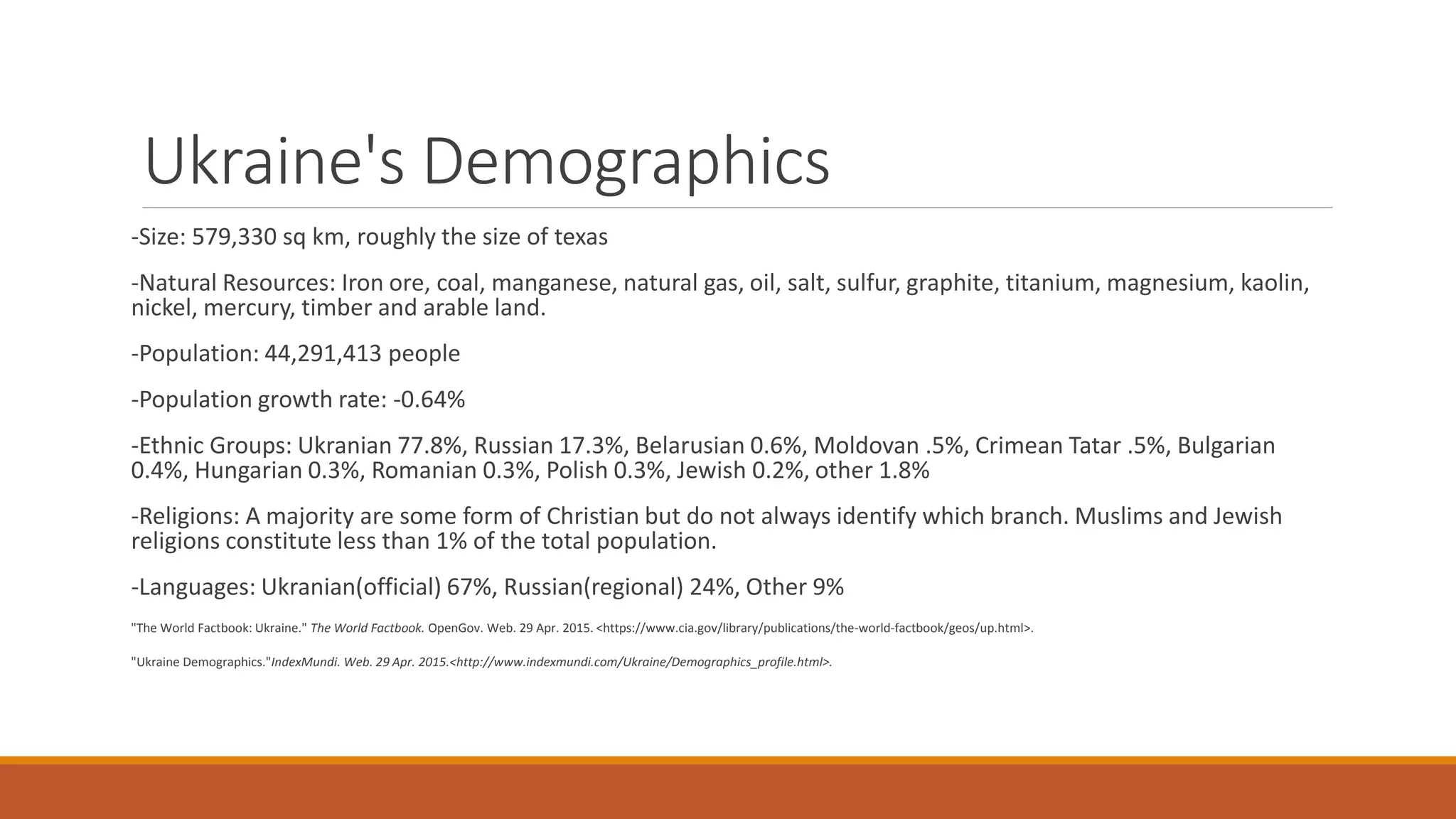
Ukraine's Demographics
-Size: 579,330 sq km, roughly the size of texas
-Natural Resources: Iron ore, coal, manganese, natural gas, oil, salt, sulfur, graphite, titanium, magnesium, kaolin,
nickel, mercury, timber and arable land.
-Population: 44,291,413 people
-Population growth rate: -0.64%
-Ethnic Groups: Ukranian 77.8%, Russian 17.3%, Belarusian 0.6%, Moldovan .5%, Crimean Tatar .5%, Bulgarian
0.4%, Hungarian 0.3%, Romanian 0.3%, Polish 0.3%, Jewish 0.2%, other 1.8%
-Religions: A majority are some form of Christian but do not always identify which branch. Muslims and Jewish
religions constitute less than 1% of the total population.
-Languages: Ukranian(official) 67%, Russian(regional) 24%, Other 9%
"The World Factbook: Ukraine." The World Factbook. OpenGov. Web. 29 Apr. 2015. <https://www.cia.gov/library/publications/the-world-factbook/geos/up.html>.
"Ukraine Demographics."IndexMundi. Web. 29 Apr. 2015.<http://www.indexmundi.com/Ukraine/Demographics_profile.html>.
Ethnics and Linguistics
- Crimea has a Russian ethnic majority in terms of
population as well as a mostly Russian speaking
population.
- Donetsk and Luhansk have significant Russian
speaking populations as well as significant ethnic
Russian populations.
-Kharkiv and Zaphorzia also have significant
ethnic Russian and Russian speaking
populations. Dniprovetsk, Kherson, Mikholaiv
and Odessa also have strong populations.
- Ukranian majorities are found in Lut'sk, L'viv,
Uzhgorod, Ivano-Frankivsk, ternopil, rivne,
chernivtsi, khmel'nyts, zhytomyr, kyiv, vinnytsia,
cherkassy, chernihiv, surny, poltava, and
kirovohrad.
Canvas
Political Demographics
- Provinces with strong Russian ethnic and
linguistic populations favored Viktor
Yanukovych.
- Provinces with strong Ukrainian ethnic and
linguistic populations favored Viktor
Yuschenko.
Canvas
Government
• Republic
- Made up of 24 administrative regions, including the autonomous Republic of Crimea.
• Capital is Kyiv with a population of 2.6 million inhabitants
• Executive Branch
- Current President Petro Poroshenko and Prime Minister Arseniy Yatsenyuk
• Legislative Branch
- Unicameral Supreme Coucil or Verkhovna Rada made up of 450 seats
• Judicial Branch
- Supreme Court of Ukraine(consisting of 95 judges) and the Constitutional Court(18 judges)
"The World Factbook: Ukraine." The World Factbook. Web. 29 Apr. 2015. <https://www.cia.gov/library/publications/the-world-factbook/geos/up.html>.
Ukraine Crisis Explained
https://www.youtube.com/watch?v=vdxG-fLv0vI
EU-US Sanctions Against Russia
(September 2014)
Since Russia's annexation of Crimea in March 2014 the EU and US have escalated their economic
sanctions against Russia by tightening restrictions on major Russian state banks and corporations.
Dozens of Senior Russian officials, separatist commanders, and Russian firms accused of undermining
the sovereignty of Ukraine have been black listed. They are now subject to Western asset freezes and
travel bans.
The EU sanctions target Russia's state finances, energy, and arms sectors that are controlled by a
powerful circle of elites that surround Putin.
EU sanctions exclude the gas industry, space technology, and nuclear energy.
http://www.bbc.com/news/world-europe-28541556
http://www.investopedia.com/articles/investing/011515/how-us-european-union-sanctions-impact-russia.asp
http://www.bbc.com/news/world-europe-32332433
Immediate Impact of Sanctions
Officials who have been black listed are subject to an asset freeze that affects their bank
accounts, shares, and economic resources such as property. Those listed are no longer able to
buy or sell their assets in the EU.The travel ban prevents them from entering an EU country.
It is important to note that the EU and US blacklists are not identical.
Russian State banks are now excluded from raising long term loans in the EU.
Exports of dual-use equipment for military use in Russia are banned.
EU-Russia arms deals are banned and the EU will not export a wide range of oil industry
technology.
Targeted banks and energy companies have much harder time accessing EU and US capital
markets.
Later Impact
Coupled with sliding oil prices, the EU-US sanctions have had the following effects.
Currency Collapse: In December 2014 the ruble's value dropped 20% causing the central bank to increase interest
rates which appears to have stopped the bleeding. Nonetheless the ruble has shed 41% of its value against the
dollar in 2014.
Higher interest rates
Inflation
Captial outflows:a plunging currency, a deep recession, and higher inflation have caused foreign investors to pull
out of Russia. Net capital outflows could exceed $130 billion in 2014, more than double the total for 2013.
Reduced consumer spending
Eventual debt default: As a result of the ruble's collapse, Russia's debt-to-GDP ratio has almost doubled to 70%, a
dangerously high level given the problems facing the economy.
Russia announced an embargo on Western foods which has caused Russia's own agricultural sector to grow to
replace lost imports.
Pros Cons
US would honor it's signatory status of the 1994 Budapest
Memorandum which has already been broken by Russia.
Displays security credibility.
Arming Ukraine would serve as a counter measure against any
aggressive Russian policies that threaten European security.
Lethal defensive systems could inflict significant damage to the
Russian military and deter them from further aggression.
The Kremlin will be far less tempted to challenge the security
or territorial integrity of other states, including NATO members
Estonia and Latvia.
Possible emergence of a prosperous and successful
Democratic state to ally with.
http://www.atlanticcouncil.org/images/files/UkraineReport_F
ebruary2015.pdf
US involvement could escalate tensions between
the U.S. and Russia.
Russia would likely view US involvement as
interference in their sphere of influence which
could lead to greater Russian military
involvement in Ukraine.
US involvement could potentially cause economic
retaliation by Russia against the EU. Europe relies
on Russian oil and their are many European
investors in Russia.
US involvement could further enhance anti-
American sentiments in Russia and worsen U.S.
Russian relations for the long term.
Saunders, Paul J. Costs of a New Cold War: The U.S. Russia confrontation over
Ukraine. Center for the National Interest. 2014. Web.
Conclusion: Suggestions for US Policy
Given the history of Ukraine and the demographics of the country, we believe U.S. Policy should be to
promote an election in Ukraine. The Ukraine provinces should have the opportunity to vote to
separate from Ukraine. They would vote to form East Ukraine. The U.N. would oversee the voting.
If they separate East Ukraine can decide to join Russia or be a sovereign state that partners with
Russia.
In the case of separation, West Ukraine would be a buffer zone that would remain neutral.
West Ukraine would not allow any military involvement from any other countries
West Ukraine would have a free trade agreement between Russia, U.S. and E.U.
The U.S. and EU should loosen sanction and the U.S. and E.U. should work with Russia to form
an economic plan to bring stability into West and East Ukraine.
◦ “Why the Ukraine Crisis Is the West’s Fault | Foreign Affairs.” Web. 1 May 2015.
Conclusion cont.
Ukraine would not be allowed to join NATO
Joining NATO would provoke military involvement in Russian because of security
fear.
If Ukraine votes to remain unified, the entire country would become neutral.
If Russia does not honor this agreement and uses military forces the U.S. should
reinstate economic sanctions.

Russo-Ukranian Crisis

  • 1.
    Russian Ukraine Conflict BY MATTHEWGIBSON, MADDY HIGH, COLE HIZER, AND COLIN WHITE
  • 2.
    Why are Russiaand Ukraine Fighting?
  • 3.
    Ukraine Historical Background 10thand 11th century Kyivan Rus is the most powerful state in Europe ◦ Is the basis of historical nationalism for Ukraine (“The World Factbook”) 1654 – The Russian Empire under the Romanov Dynasty annexed eastern Ukraine. (Suny 5). 3 partitions of Poland in 1772, 1793, and 1795 between Russia, Prussia, and Austria. In the second partition of Poland in Jan 23, 1793, the Russian Empire took the eastern territories of Poland including Western Ukraine. (“Partitions of Poland -- Britannica Online Encyclopedia”). t “Partitions of Poland -- Britannica Online Encyclopedia.” Web. 27 Apr. 2015. Suny, Ronald G. The Soviet Experiment: Russia, the USSR, and the Successor States.2nd ed. Oxford: Oxford University Press, 2011. Print. “The World Factbook.” Web. 30 Apr. 2015.
  • 4.
    Ukraine Timeline 19th century: Parts of western Ukraine remain under Austrian Rule ◦ Becomes center for Ukraine nationalism ◦ Russian Ukraine, territory controlled by many non- Ukrainians had no real sense of nationalism before 20th century (Suny 117). Jan. 1918 Ukrainian nationalists declared independence. (Suny 86) 1920 Russo - Polish War (after WWI Poland is recreated.) March 1921 Treaty of Riga - Western Ukraine becomes part of Polish state (Suny 120). Suny, Ronald G. The Soviet Experiment: Russia, the USSR, and the Successor States.2nd ed. Oxford: Oxford University Press, 2011. Print.
  • 5.
    Ukraine Timeline 1930's- 40's 1932 - Ukraine the breadbasket of USSR. 70 % of peasants were collectivized and supplied 38% of all USSR grain deliveries (Suny 245). 1932-33: 5 million Ukrainians die in man made genocide by Russian leaders to eradicate Ukraine nationalism (Suny 246). 1939 Germany invades Poland and western Ukraine is annexed into the USSR (Suny 328). WWII - European part of USSR most notably Ukraine was the important grain producing regions and heartland of Soviet industry. ◦ 70% iron, 90% aircraft, 84% sugar, 60% of pigs (Suny 347). 1946-1949 Ukraine suffers from another famine (Suny 392). Suny, Ronald G. The Soviet Experiment: Russia, the USSR, and the Successor States.2nd ed. Oxford: Oxford University Press, 2011. Print.
  • 6.
    Ukraine Dissidence, SovietCrackdown 1944 - late 1940's Ukraine nationalists form the Organization of Ukrainian Nationalists (OUN) primarily in western Ukraine. ◦ Organization opposed Soviet rule - killed 25,000 Soviet soldiers and 30,000 citizens ◦ Soviet government responded by deporting 66,000 families (over 200,00 people) from Western Ukraine in the years 1944-1951." (Suny 392-393). Khrushchev years: "Promoted Russian language and culture, particularly in the Baltic, Ukraine, and Belorussia(Suny 436). 1965-66 : "Kremlin cracked down harder on Ukraine nationalists, 20 of whom were jailed." (Suny 457). Suny, Ronald G. The Soviet Experiment: Russia, the USSR, and the Successor States.2nd ed. Oxford: Oxford University Press, 2011. Print.
  • 7.
    Post Soviet UkraineRelations After the collapse of the Soviet Union, the Russian Federation worked to create the Near Abroad which was their policy towards former Soviet states. Russia wanted to police the neighborhoods to keep rivals from establishing influence in Russia's sphere of influence.(Suny 529). 1997: Yeltsin signed accord with NATO to accept expansion into Eastern Europe. (Suny 529). Putin's goal: establish Russia as a regional hegemony and prevent international interference from US, EU,Turkey, and NATO. (Suny 543). 2004 Orange Revolution: Prime Minister, Viktor Yanukovych, who was supported by Putin and had a stronghold in eastern Ukraine won the 2004 election against Yushchenko. People protested the election was a fraud and wanted a re-election.(“Ukraine :: The Orange Revolution and the Yushchenko Presidency -- Britannica Online Encyclopedia”) In the relection Yushchenko, the more democratic candidate took power. (Suny 544). Suny, Ronald G. The Soviet Experiment: Russia, the USSR, and the Successor States.2nd ed. Oxford: Oxford University Press, 2011. Print. “Ukraine :: The Orange Revolution and the Yushchenko Presidency -- Britannica Online Encyclopedia.” Web. 30 Apr. 2015.
  • 8.
    Background of Crimea Natives:Tatars Under Ottoman control for several hundred years Russia and Ottoman Empire engage in series of wars over the black sea region(Under Peter I-the Great) War of 1768-1774 resulted in the Treaty Kaynarca I. Independent Crimean Tatar State II. 1783- Catherine II (the Great) annexes Crimea (1853-1856)-Crimean war I. Siege of Sevastopol (British and French)-Result: Russia loses Crimean war II. (During War)-Russia: forcibly dispersed Tatars throughout Russia. Google Image "Crimea." Encyclopedia Britannica.Encyclopedia Britannica Online Academics Edition. Encyclopedia Britannica Inc, 2015. Web.
  • 9.
    Under Soviet Control REVOLUTION Revolutionof 1917-Tatars declare Crimea an independent democratic republic Russian Civil War (1918-20): Defeat of the White army ended Independence for Crimea ◦ I. Becomes the Crimean Autonomous Soviet Socialist Republic. "Crimea." Encyclopedia Britannica.Encyclopedia Britannica Online Academics Edition. Encyclopedia Britannica Inc, 2015. Web. COLLECTIVIZATION Under Stalin-Forced collectivization ◦ I. Tens of thousands of Tatars died during collectivization ◦ II. After WWII, Tatars were deported to Siberia and Central Asia for working with Nazi's Crimea is downgraded from autonomous Republic to region of RSFSR
  • 10.
    Under Khrushchev "...in 1954it was transferred to Ukraine in commemoration of the 300th anniversary of the Pereyaslav agreement, a treaty that submitted Ukraine to Russian rule. With the death of Stalin and the ascent of Nikita Khrushchev as Soviet leader, other nationalities that had been subjected to internal deportation were eventually allowed to return to their native regions. Although legally rehabilitated in 1967, the Crimean Tatars were a notable exception to that rule" (Britannica) "Crimea." Encyclopedia Britannica.Encyclopedia Britannica Online Academics Edition. Encyclopedia Britannica Inc, 2015. Web.
  • 11.
    Collapse of U.S.S.Rand the 1990's Late 1980's, disintegration of Soviet Union resulted in Tatar's resettling in Crimea 1991- Ukraine was again made autonomous within USSR December (1991)- dissolution of USSR: Crimea is under Ukraine's control after their independence Russian's make up most of the population in Crimea ◦ Resulted in an independence movement in 1994 ◦ December (1994) - Budapest Memorandum: signed between Russia and Ukraine-Signed agreement that allowed Russia an extended military lease on Sevastopol. ◦ Treaty of Friendship (1997)- Crimea becomes Ukrainian territory "Crimea." Encyclopedia Britannica.Encyclopedia Britannica Online Academics Edition. Encyclopedia Britannica Inc, 2015. Web.
  • 12.
    Present Day Viktor Yanukovychbecomes president (2010). ◦ a part of the Pro-Russian party Extends the military-base lease of Sevastopol to 2042 ◦ Allows 25,000 troops and a couple of air bases in Sevastopol (2013) Yanukovych rejects an accord to strengthen ties with the EU, instead he strengthens relations with Russia-Protest begin 2014-Yanukovych flees Kiev because of violent protests that toppled the government ◦ Masked gunmen seize the parliament building and Sergey Aksyonov(Pro-Russia) comes to power in Crimea as Prime minister ◦ Pro-Russian demonstrations took place all throughout Crimea, but they were challenged by Pro-Ukrainian demonstrations advocated by Native-Tatar Crimean's ◦ Vladimir Putin sends in troops to protect ethnic Russian's (de facto control of peninsula) "Crimea." Encyclopedia Britannica.Encyclopedia Britannica Online Academics Edition. Encyclopedia Britannica Inc, 2015. Web. "Ukraine Crisis In Maps", BBC News. 18 Feb. 2015. BBC News. 30 Apr. 2015.
  • 13.
    Voting in Crimea March-Crimeanparliament votes unanimously to join Russian Federation ◦ Russian Reports say that 70-90 percent of Russians voted for secession from Ukraine ◦ Leaked documents show that only 50-60 percent supported the secession. March 16, 2014- Referendum is called by Tatar community leaders. ◦ Referendum did not succeed March 18, 2014- Putin signs treaty that incorporates Crimea into the Russian Federation. Ukrainian troops withdraw from Crimea "Ukraine Crisis In Maps", BBC News. 18 Feb. 2015. BBC News. 30 Apr. 2015.
  • 14.
    Ukraine's Demographics -Size: 579,330sq km, roughly the size of texas -Natural Resources: Iron ore, coal, manganese, natural gas, oil, salt, sulfur, graphite, titanium, magnesium, kaolin, nickel, mercury, timber and arable land. -Population: 44,291,413 people -Population growth rate: -0.64% -Ethnic Groups: Ukranian 77.8%, Russian 17.3%, Belarusian 0.6%, Moldovan .5%, Crimean Tatar .5%, Bulgarian 0.4%, Hungarian 0.3%, Romanian 0.3%, Polish 0.3%, Jewish 0.2%, other 1.8% -Religions: A majority are some form of Christian but do not always identify which branch. Muslims and Jewish religions constitute less than 1% of the total population. -Languages: Ukranian(official) 67%, Russian(regional) 24%, Other 9% "The World Factbook: Ukraine." The World Factbook. OpenGov. Web. 29 Apr. 2015. <https://www.cia.gov/library/publications/the-world-factbook/geos/up.html>. "Ukraine Demographics."IndexMundi. Web. 29 Apr. 2015.<http://www.indexmundi.com/Ukraine/Demographics_profile.html>.
  • 15.
    Ethnics and Linguistics -Crimea has a Russian ethnic majority in terms of population as well as a mostly Russian speaking population. - Donetsk and Luhansk have significant Russian speaking populations as well as significant ethnic Russian populations. -Kharkiv and Zaphorzia also have significant ethnic Russian and Russian speaking populations. Dniprovetsk, Kherson, Mikholaiv and Odessa also have strong populations. - Ukranian majorities are found in Lut'sk, L'viv, Uzhgorod, Ivano-Frankivsk, ternopil, rivne, chernivtsi, khmel'nyts, zhytomyr, kyiv, vinnytsia, cherkassy, chernihiv, surny, poltava, and kirovohrad. Canvas
  • 16.
    Political Demographics - Provinceswith strong Russian ethnic and linguistic populations favored Viktor Yanukovych. - Provinces with strong Ukrainian ethnic and linguistic populations favored Viktor Yuschenko. Canvas
  • 17.
    Government • Republic - Madeup of 24 administrative regions, including the autonomous Republic of Crimea. • Capital is Kyiv with a population of 2.6 million inhabitants • Executive Branch - Current President Petro Poroshenko and Prime Minister Arseniy Yatsenyuk • Legislative Branch - Unicameral Supreme Coucil or Verkhovna Rada made up of 450 seats • Judicial Branch - Supreme Court of Ukraine(consisting of 95 judges) and the Constitutional Court(18 judges) "The World Factbook: Ukraine." The World Factbook. Web. 29 Apr. 2015. <https://www.cia.gov/library/publications/the-world-factbook/geos/up.html>.
  • 18.
  • 19.
    EU-US Sanctions AgainstRussia (September 2014) Since Russia's annexation of Crimea in March 2014 the EU and US have escalated their economic sanctions against Russia by tightening restrictions on major Russian state banks and corporations. Dozens of Senior Russian officials, separatist commanders, and Russian firms accused of undermining the sovereignty of Ukraine have been black listed. They are now subject to Western asset freezes and travel bans. The EU sanctions target Russia's state finances, energy, and arms sectors that are controlled by a powerful circle of elites that surround Putin. EU sanctions exclude the gas industry, space technology, and nuclear energy. http://www.bbc.com/news/world-europe-28541556 http://www.investopedia.com/articles/investing/011515/how-us-european-union-sanctions-impact-russia.asp http://www.bbc.com/news/world-europe-32332433
  • 20.
    Immediate Impact ofSanctions Officials who have been black listed are subject to an asset freeze that affects their bank accounts, shares, and economic resources such as property. Those listed are no longer able to buy or sell their assets in the EU.The travel ban prevents them from entering an EU country. It is important to note that the EU and US blacklists are not identical. Russian State banks are now excluded from raising long term loans in the EU. Exports of dual-use equipment for military use in Russia are banned. EU-Russia arms deals are banned and the EU will not export a wide range of oil industry technology. Targeted banks and energy companies have much harder time accessing EU and US capital markets.
  • 21.
    Later Impact Coupled withsliding oil prices, the EU-US sanctions have had the following effects. Currency Collapse: In December 2014 the ruble's value dropped 20% causing the central bank to increase interest rates which appears to have stopped the bleeding. Nonetheless the ruble has shed 41% of its value against the dollar in 2014. Higher interest rates Inflation Captial outflows:a plunging currency, a deep recession, and higher inflation have caused foreign investors to pull out of Russia. Net capital outflows could exceed $130 billion in 2014, more than double the total for 2013. Reduced consumer spending Eventual debt default: As a result of the ruble's collapse, Russia's debt-to-GDP ratio has almost doubled to 70%, a dangerously high level given the problems facing the economy. Russia announced an embargo on Western foods which has caused Russia's own agricultural sector to grow to replace lost imports.
  • 22.
    Pros Cons US wouldhonor it's signatory status of the 1994 Budapest Memorandum which has already been broken by Russia. Displays security credibility. Arming Ukraine would serve as a counter measure against any aggressive Russian policies that threaten European security. Lethal defensive systems could inflict significant damage to the Russian military and deter them from further aggression. The Kremlin will be far less tempted to challenge the security or territorial integrity of other states, including NATO members Estonia and Latvia. Possible emergence of a prosperous and successful Democratic state to ally with. http://www.atlanticcouncil.org/images/files/UkraineReport_F ebruary2015.pdf US involvement could escalate tensions between the U.S. and Russia. Russia would likely view US involvement as interference in their sphere of influence which could lead to greater Russian military involvement in Ukraine. US involvement could potentially cause economic retaliation by Russia against the EU. Europe relies on Russian oil and their are many European investors in Russia. US involvement could further enhance anti- American sentiments in Russia and worsen U.S. Russian relations for the long term. Saunders, Paul J. Costs of a New Cold War: The U.S. Russia confrontation over Ukraine. Center for the National Interest. 2014. Web.
  • 23.
    Conclusion: Suggestions forUS Policy Given the history of Ukraine and the demographics of the country, we believe U.S. Policy should be to promote an election in Ukraine. The Ukraine provinces should have the opportunity to vote to separate from Ukraine. They would vote to form East Ukraine. The U.N. would oversee the voting. If they separate East Ukraine can decide to join Russia or be a sovereign state that partners with Russia. In the case of separation, West Ukraine would be a buffer zone that would remain neutral. West Ukraine would not allow any military involvement from any other countries West Ukraine would have a free trade agreement between Russia, U.S. and E.U. The U.S. and EU should loosen sanction and the U.S. and E.U. should work with Russia to form an economic plan to bring stability into West and East Ukraine. ◦ “Why the Ukraine Crisis Is the West’s Fault | Foreign Affairs.” Web. 1 May 2015.
  • 24.
    Conclusion cont. Ukraine wouldnot be allowed to join NATO Joining NATO would provoke military involvement in Russian because of security fear. If Ukraine votes to remain unified, the entire country would become neutral. If Russia does not honor this agreement and uses military forces the U.S. should reinstate economic sanctions.