Running Head: 9
Assessing and Planning Care for My Elderly Mom
NSG4067: Gerontological Nursing
My subject
I chose my …… as my subject. She is a 68-year-old woman,
who is still working full-time as the Vice President of a bank in
the small community that she lives in. She is still married to my
Dad, with whom she just celebrated her 47th wedding
anniversary and, in my opinion, is quite healthy. She has a solid
group of friends that regularly eat lunch together as well as take
trips together a couple of times a year. She does not take any
medications, nor has been diagnosed with any chronic health
issues. Although, exercise has never been something she has
indulged in, she is still leisurely active around the house and
likes to take walks with her dog. Mom loves wine, but has
never smoked cigarettes. She agreed to be the subject of my
gerontological assessment. Since my subject is not frail but
rather very robust for her age, I focused my assessments by
using tools that were meant to help gain a better understanding
of my subject’s health status and where improvements can be
made for optimal health management and disease prevention. In
combination with a comprehensive questionnaire, I utilized the
Tinetti Balance Assessment Tool to assess gait, and the Katz
Index to assess how well subject does with ADLs.
Subject questionnaire
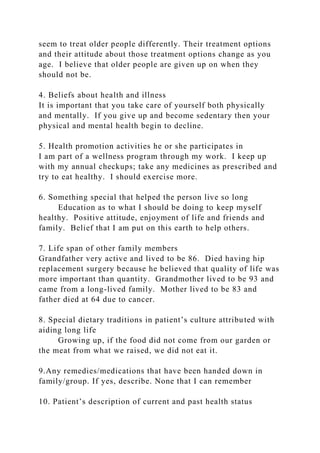
It seems that my subject is very healthy in contrast to other
people her age. She feels strong mentally and physically, and
has a great attitude towards the way one should live life. She
should concentrate on weight management, exercising more
regularly, and preventing osteoporosis by including enough
calcium in her diet. She should also be sure to have regular,
annual checkups such as vision and hearing checks, in addition
to her normal blood work.
Subject is not happy with the way she thinks the older
generation is treated by younger people or doctors even.
It would seem that the subject’s family has been predisposed to
living longer lives, with the exception of her father, who was a
heavy, lifelong smoker that died of cancer. So far, subject’s
genetics are working in her favor. See Appendix A.
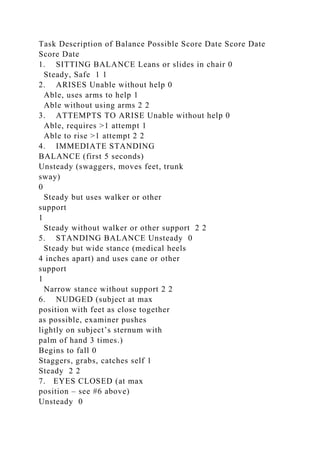
Tinetti Balance Assessment Tool
The Tinetti Gait and Balance Instrument is designed to
determine an elders risk for falls within the next year. The
higher the score, the better the performance. In performing the
balance and gait assessment for my subject, it was found that
subject scored as high in points as possible and therefore, has
no issues with either balance or gait and is a low risk for falls.
Katz Index
The Katz Index is a tool that assesses functional status as a
measure of the patient’s ability to perform activities of daily
living (ADLs) on a daily basis. “One of the best ways to
evaluate the health status of older adults is through functional
assessment which provides objective data that may indicate
future decline or improvement in health status, allowing the
nurse to intervene appropriately” (Katz, 2007). This tool
assesses bathing, dressing, toileting, eating, as well as
shopping, transportation, food preparation, and the ability to
handle finances, among other things. My subject, again, had a
perfect score on this assessment, which shows no signs of a
decline in her ability to take care of herself, independently.
INHOMESSS assessment
INHOMESSS stands for: immobility, nutrition, housing, others,
medication, examination, safety, spirituality, services, and
provides a framework for the evaluation of a patient's functional
status and home environment. The subject lives in a safe
environment, has no impairments or mobility issues that would
cause problems for her, eats fairly healthy, etc. During this
assessment, there were only a couple of issues identified. The
subject does not have an advanced directive and she admits to
needing to exercise more and lose weight.
My subject in relation to the average 68 year old
“Almost 50% of the population older than 65 have
osteoarthritis, 40% has hypertension, 33% has chronic heart
disease, and more than 25% suffer from hearing impairment”
(Barker, 2007, p. 177). My subject is a healthy older woman
that has minimal health-related issues. There were several
preliminary issues I identified that can be addressed to prevent
complications in the future: The subject needs to introduce an
exercise regimen into her routine that will help her maintain a
healthy heart. She also could benefit from losing some weight,
to ensure she maintains optimal cholesterol levels, with a
reduction in the amount of fat that sits around her organs. This
not only with help her heart and health, but will also have a
positive impact on the way she sees herself. In addition, subject
should be encouraged to maintain her social network so that she
continues to reap the benefits of such alliances.
Interventions for these issues include referring the subject
to weight loss resources and gyms in her area, educating the
subject on where to find information on nutritional diets,
encouraging continued, routine social interaction, and educating
subject on the importance of this. Subject also needs to be
educated on the importance of having an advanced directive in
place so that, in the event she cannot make decisions for herself,
her family does not make decisions she would not want for
herself.
Appendix A
Patient Questionnaire
INTERVIEW OF CHOSEN ELDER ADULT
Name: Pam Browning Age: 68
Brief Introduction (Background information):
Raised in a rural county in ……. My grandparents were part of
my everyday life and the importance of family was instilled at a
young age. I graduated from High School and completed some
College. I have been a banker all of my career and worked my
way up from a clerk to a Vice President and Sr Lender. My
father had many health issues starting at the early age of 48 and
died at 64. I took care of my mother from the time that I was
40, until she died at 83.
1. Philosophy on living a long life
Enjoy life. Be positive. Help others. Keep your mind and
body active and strong.
2. Thoughts about when a person is considered “too old”
I do not believe that a person is ever “too old” to make a
difference in other’s lives. I already see some younger people
looking at me or speaking to me in a condescending manner and
I do not like that. It is as if they do not see me as a viable
contributing member to society. You should always do anything
that you want without thinking of your age.
3. Opinion on the status and treatment of older adults
I do believe that older people are treated differently. Almost as
if they are children and need to be taken care of. Doctors even
seem to treat older people differently. Their treatment options
and their attitude about those treatment options change as you
age. I believe that older people are given up on when they
should not be.
4. Beliefs about health and illness
It is important that you take care of yourself both physically
and mentally. If you give up and become sedentary then your
physical and mental health begin to decline.
5. Health promotion activities he or she participates in
I am part of a wellness program through my work. I keep up
with my annual checkups; take any medicines as prescribed and
try to eat healthy. I should exercise more.
6. Something special that helped the person live so long
Education as to what I should be doing to keep myself
healthy. Positive attitude, enjoyment of life and friends and
family. Belief that I am put on this earth to help others.
7. Life span of other family members
Grandfather very active and lived to be 86. Died having hip
replacement surgery because he believed that quality of life was
more important than quantity. Grandmother lived to be 93 and
came from a long-lived family. Mother lived to be 83 and
father died at 64 due to cancer.
8. Special dietary traditions in patient’s culture attributed with
aiding long life
Growing up, if the food did not come from our garden or
the meat from what we raised, we did not eat it.
9.Any remedies/medications that have been handed down in
family/group. If yes, describe. None that I can remember
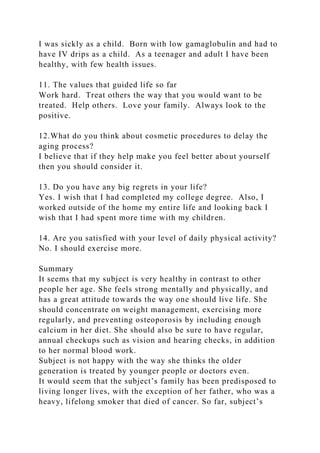
10. Patient’s description of current and past health status
I was sickly as a child. Born with low gamaglobulin and had to
have IV drips as a child. As a teenager and adult I have been
healthy, with few health issues.
11. The values that guided life so far
Work hard. Treat others the way that you would want to be
treated. Help others. Love your family. Always look to the
positive.
12.What do you think about cosmetic procedures to delay the
aging process?
I believe that if they help make you feel better about yourself
then you should consider it.
13. Do you have any big regrets in your life?
Yes. I wish that I had completed my college degree. Also, I
worked outside of the home my entire life and looking back I
wish that I had spent more time with my children.
14. Are you satisfied with your level of daily physical activity?
No. I should exercise more.
Summary
It seems that my subject is very healthy in contrast to other
people her age. She feels strong mentally and physically, and
has a great attitude towards the way one should live life. She
should concentrate on weight management, exercising more
regularly, and preventing osteoporosis by including enough
calcium in her diet. She should also be sure to have regular,
annual checkups such as vision and hearing checks, in addition
to her normal blood work.
Subject is not happy with the way she thinks the older
generation is treated by younger people or doctors even.
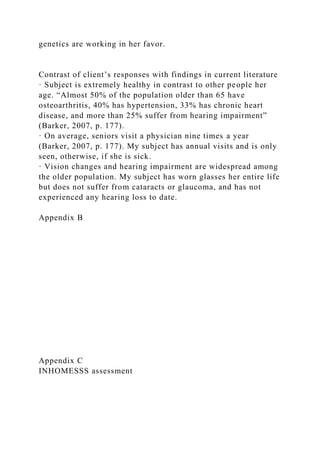
It would seem that the subject’s family has been predisposed to
living longer lives, with the exception of her father, who was a
heavy, lifelong smoker that died of cancer. So far, subject’s
genetics are working in her favor.
Contrast of client’s responses with findings in current literature
· Subject is extremely healthy in contrast to other people her
age. “Almost 50% of the population older than 65 have
osteoarthritis, 40% has hypertension, 33% has chronic heart
disease, and more than 25% suffer from hearing impairment”
(Barker, 2007, p. 177).
· On average, seniors visit a physician nine times a year
(Barker, 2007, p. 177). My subject has annual visits and is only
seen, otherwise, if she is sick.
· Vision changes and hearing impairment are widespread among
the older population. My subject has worn glasses her entire life
but does not suffer from cataracts or glaucoma, and has not
experienced any hearing loss to date.
Appendix B
Appendix C
INHOMESSS assessment
References:
Barker, L. R., Burton, J. R., Zieve, P. D., & Fiebach, N. H.
(2007). Barker, Burton, and Zieve's
principles of ambulatory medicine. [electronic resource].
Philadelphia, PA: Lippincott Williams & Wilkins, c2007.
Katz Index of Independence in Activities of Daily Living
(ADL). (2007). Urologic
Nursing, 27(1), 93-94.
15. TRUNK Marked sway or uses walking aid 0
No sway – but flexion of knees or back,
or spreads arms out while walking
1
No sway, no flexion, no use of arms, and
no use of walking aid
2 2
16. WALKING STANCE Heels apart 0
Heels almost touching while walking 1 1
SCORE – GAIT 13
SCORE – BALANCE 15
SCORE – BALANCE AND GAIT 29
Rate 1 Rate 2 Rate 3
Date of Assessment Assessor Signature and Title Location of
Subject During Assessment
1.Jan 01, 2018 Paige Shinn Home
2
3
TINETTI ASSESSMENT TOOL: BALANCE
Subject’s Name: Pam Browning
Initial Instructions: Subject is seated in a hard, armless chair.
The following maneuvers are tested.
Task Description of Balance Possible Score Date Score Date
Score Date
1. SITTING BALANCE Leans or slides in chair 0
Steady, Safe 1 1
2. ARISES Unable without help 0
Able, uses arms to help 1
Able without using arms 2 2
3. ATTEMPTS TO ARISE Unable without help 0
Able, requires >1 attempt 1
Able to rise >1 attempt 2 2
4. IMMEDIATE STANDING
BALANCE (first 5 seconds)
Unsteady (swaggers, moves feet, trunk
sway)
0
Steady but uses walker or other
support
1
Steady without walker or other support 2 2
5. STANDING BALANCE Unsteady 0
Steady but wide stance (medical heels
4 inches apart) and uses cane or other
support
1
Narrow stance without support 2 2
6. NUDGED (subject at max
position with feet as close together
as possible, examiner pushes
lightly on subject’s sternum with
palm of hand 3 times.)
Begins to fall 0
Staggers, grabs, catches self 1
Steady 2 2
7. EYES CLOSED (at max
position – see #6 above)
Unsteady 0
Steady 1 1
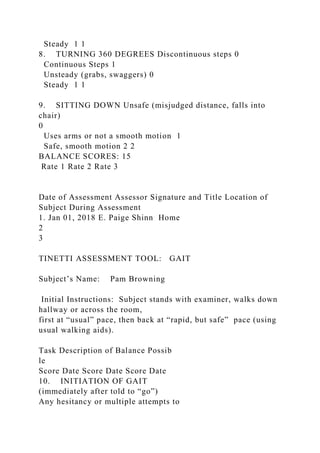
8. TURNING 360 DEGREES Discontinuous steps 0
Continuous Steps 1
Unsteady (grabs, swaggers) 0
Steady 1 1
9. SITTING DOWN Unsafe (misjudged distance, falls into
chair)
0
Uses arms or not a smooth motion 1
Safe, smooth motion 2 2
BALANCE SCORES: 15
Rate 1 Rate 2 Rate 3
Date of Assessment Assessor Signature and Title Location of
Subject During Assessment
1. Jan 01, 2018 E. Paige Shinn Home
2
3
TINETTI ASSESSMENT TOOL: GAIT
Subject’s Name: Pam Browning
Initial Instructions: Subject stands with examiner, walks down
hallway or across the room,
first at “usual” pace, then back at “rapid, but safe” pace (using
usual walking aids).
Task Description of Balance Possib
le
Score Date Score Date Score Date
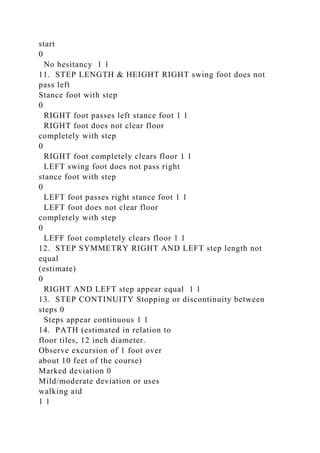
10. INITIATION OF GAIT
(immediately after told to “go”)
Any hesitancy or multiple attempts to
start
0
No hesitancy 1 1
11. STEP LENGTH & HEIGHT RIGHT swing foot does not
pass left
Stance foot with step
0
RIGHT foot passes left stance foot 1 1
RIGHT foot does not clear floor
completely with step
0
RIGHT foot completely clears floor 1 1
LEFT swing foot does not pass right
stance foot with step
0
LEFT foot passes right stance foot 1 1
LEFT foot does not clear floor
completely with step
0
LEFF foot completely clears floor 1 1
12. STEP SYMMETRY RIGHT AND LEFT step length not
equal
(estimate)
0
RIGHT AND LEFT step appear equal 1 1
13. STEP CONTINUITY Stopping or discontinuity between
steps 0
Steps appear continuous 1 1
14. PATH (estimated in relation to
floor tiles, 12 inch diameter.
Observe excursion of 1 foot over
about 10 feet of the course)
Marked deviation 0
Mild/moderate deviation or uses
walking aid
1 1
Straight without walking aid 2 2
Running head: Functional Assessment
[Shortened Title up to 50 Characters] 19
Assessing the Functional Elements of the Older Adult
South University
Assessing the Functional Elements of the Older Adult
Completing a comprehensive assessment of an adult over 65 is a
way for the nurse to identify any issues that need attention and
help the patient have the best quality of life possible. The
purpose of the screening is to provide care, preempt disease,
retain good health, keep a record of health, minimize
disabilities, and give a holistic approach to independent living
(lecture online,wk.2). Various tools can be used to assess the
patient for the functional ability during an assessment. I will
use nursing tools that are applicable to the interviewed subject
and analyze where potential problem areas are. After analyzing
the information gathered, I will then connect the dots with
formulating interventions for the problems identified. I will be
discussing a 77-year-old female, AW, who lives independently
at home alone. The Patient interview
To ensure privacy of the person being discussed, I will refer to
the interviewee as AW. AW lives alone in her single floor
home close to her daughter and granddaughter. For the past
seventy years she has had very few medical issues which
include, arthritis, vision impairment, bursitis and plantar
fasciitis (personal conversation, Appendix A) AW’s view on life
is holistic and autonomous. AW has a good sense of control of
her medical problems and indicates that she is “in good health”.
AW agreed to a comprehensive assessment and each tool used
was explained to her in detail. I believe her cognitive status was
intact to understand and consent to this project. I will first
discuss, as a nurse, the focus of assessment is on the day to day
activities.
Assessment tools1
By nursing standards, the functional assessment is completed to
measure a person’s ability to perform day to day task of living
and self -care (Miller, 2015, p.100). The first tool I will discuss
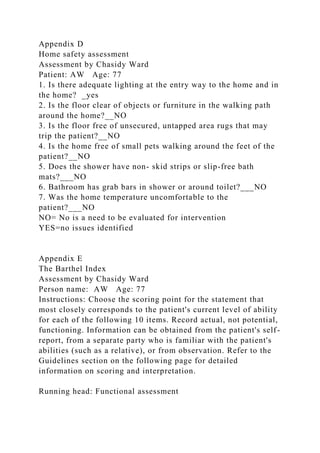
is the Tinetti Balance tool. The use of this tool was to assess
AW’s steadiness, gait, and her overall ability to move sit and
walk. Using verbal instructions, AW was asked to perform
simple task such as sitting and standing, turning around and
walking steps. There were an achievable 28 points to attain and
AW scored a 27 on the Tinetti (see Appendix B). With an
almost perfect score, I did not feel that this was a problem area
for her plan of care.
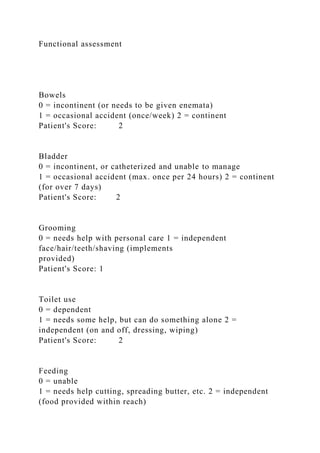
The next tool described is the Katz Index of Independence in
Activities of Daily Living, referred to as the Katz ADL. This
tool is used to measure an elder person’s independent daily life
duties. Such duties included, bathing, dressing, and toileting.
The tool uses 6 activities of daily life to score the patient, and a
possible total score of 6. For the Katz ADL assessment, AW
scored a 6 (see Appendix C). The objective view of this tool
indicates no need for interventions at this time. I would
recommend that she is evaluated yearly for any decline now that
a baseline has been established. The next assessment was of the
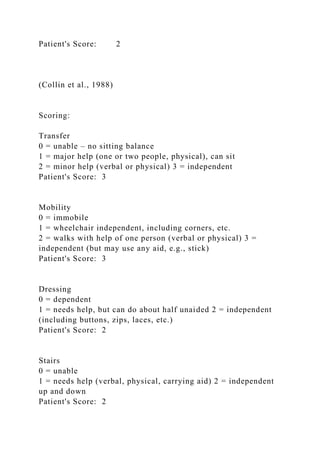
home, using the Assessment of Home Safety Tool.
The importance of the home assessment is to identify any fall
risk factors as well as identify any environmental factors that
positively or negatively affect safety, functioning, and quality
of life (Miller, 2015, p.106). Having a safe home environment
include proper lighting, removal of rugs and furniture, as well
as efficient heating and cooling of the home. Good lighting in
the home is often overlooked, but it is essential to reading, and
other activities enjoyed by the older adult. Proper lighting also
helps to avoid tripping over objects, and seeing a wet area that
the person may slip on. The proper climate of a home is also a
vital part of quality of living, making sure that the person is
comfortable where they spend most of their time. I used
recommendations for the home safety assessment from the text
by Miller (2015) and from the Medscape website to create a
tailored version for AW (see appendix D). From this
assessment there were identifiable needs for intervention to
make the home safer. The problems identified were; furniture to
close to walking areas, small pets walking around the feet of
AW, unsecured rugs throughout the home, and no grab bars in
the bathroom area. Interventions will be discussed in another
section of this essay under the section inerventions. Lastly, I
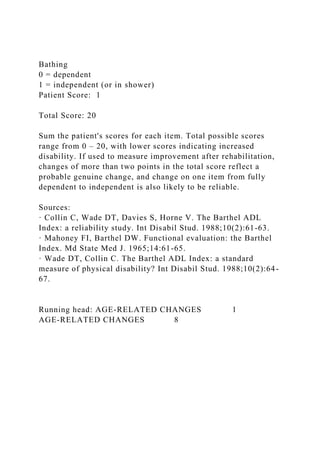
assessed AW using the Barthel Index of daily function’s as an
addition to the Katz ADL.
When I found the Barthel Index and reviewed it, I felt that the
information had already been established from the other tools
used as in the Katz ADL. The main purpose for the Barthel
index tool is determine the degree of independence, from any
help, whether its physical or verbal to any degree. The Barthel
Index is a record of what the patient does, not what they could
do (strokecenter.org). When I did the Barthel test, AW had a
perfect score of 20 which correlates with her Katz score (see
Appendix E). I did not recognize any issues or problem areas
during this assessment of AW. The mental assessment and
cognitive tools were not used on this person, because the initial
interview combined with the other tools provided enough
information that I did not feel she had any memory loss or
dementia tendencies. This 77-year-old proved to be as
independent as I am at 41 and her overall health just as good.
There were some noted changes related to aging to discuss that
could be potential areas of intervention.Age related changes.
AW was wearing glasses and spoke of her loss of good eye sight
during our time of assessments. To complete her overall
functional assessment, I asked AW questions about driving at
night and reading to decide if she had age related changes. I
also looked at her eyes with her glasses off and noticed the
yellowing of her cornea and the drooping of her top eyelid. In
the text by Miller (2015, p.336) yellowing of the cornea will
cause interference of light passage to the retina making glares
an issue. Eyelid droop, due to loss of elasticity in the skin and
the muscles around the eye, can cause problems with vision if
the skin is in the line of vision. AW’s visual acuity is corrected
by her glasses but she stated that seeing at night while driving
was difficult due the glare from the lights. Age related changes
to the lens, pupil, retina and retinal-neural pathways cause the
older adult to have a delay in adapting to dark and light (Miller,
2015, p.337). This causes an issue for the older adult to
respond as quickly when driving and meeting cars with
headlights on the road. Form this assessment I identified a
problem area of safety that implies a need for intervention for
AW with her vision and night driving.
Another age-related change to discuss is sleep. In AW’s health
assessment she had complaints about trouble with sleeping
patterns. Prolonged sleep latency, is the primary reason for
aging adult’s loss of sleep efficiency. This is a latency is from
increased time to fall asleep and increased frequency of
awakenings during the night (Miller, 2015, p.512). Usually, the
older adult take’s naps as way to compensate for the sleep loss.
The interruption in the adult’s circadian rhythm is annoying but
overall not bad for one’s health. Light sleep, known as non-
REM, increases as the person ages. The non- REM phase is
when hormones are released, muscles relax and restorative
processes occur (Miller, 2015). This does however, cause
drowsiness during the day and early rise times with late fall
asleep times. AW has a need here as well for intervention to
help improve her quality of life.
Lastly, in considering her health issues, her focus was on
arthritis pain. In her interview she stated that she did not
regularly exercise but she moves around, stretches and take’s
walk’s some days (see Appendix A). As cited in text by Miller
(2015, p.298), adults often avoid exercise due to arthritic pain.
Age related changes here are, joints become less flexible with
loss of fluid to cushion them, and muscles become more lax and
less tone from changes in the muscle fibers and the central
nervous system (medlineplus.gov). Due to the lack of desire to
exercise regularly an intervention is needed to provide her with
information about tailored programs of exercise. Controlling
pain with arthritis can be a bit tricky when it comes to taking
medications. The most often used medications are NSAID’s
which can increase blood pressure. AW made it clear in her
interview that she had personal beliefs about taking pain pills.
In awareness of her beliefs, I feel that an intervention could be
used to improve her knowledge of other pain relieving
methods.Interventions for problems.
My interventions for the problems identified during her
assessment are my own tailored ideas using suggestions from
other sources as cited in the references.
1. Problem-Seeing at night while driving. Intervention
recommended-Encourage AW to group activities of driving to
the daylight hours, refer her to an eye specialist, promote family
help for night driving activities, and encourage eye care and
checkups to keep glasses adjusted to eye changes.
2. Problem-Safety of the home environment. Interventions-teach
risks of falling due to small pets around the feet when walking,
encourage AW and family to make necessary changes of
walking path to include moving furniture out of way, educate
AW and family on assistive devices for bathroom such as
shower bars and raised toilets, and raise awareness of in home
call buttons for help.
3. Problem-Disturbed sleep patterns. Interventions-promote
wellness by identifying risk factors for lack of sleep such as
pain control for her arthritis, encourage daily physical activity
such as exercise, educate to avoid alcohol, nicotine and caffeine
close to bed time, and promote soothing music at bedtime.
4. Problem-Pain from arthritis. Interventions-educate sources of
support from national and government organizations that are
online that teach prevention and management, and encourage
the use of non-pharmacological means to control pain such as
heat or cold therapy.
After completing the functional assessment there was no need
for a true mental assessment for AW. Her ability to answer,
recall information and perform all tasks independently were
sufficient for a mental assessment and no deficits were noted.
Using all the tools discussed and her interview, I was able to
formulate problem areas with interventions. After reviewing
age related changes that pertained to AW I have recognized four
problem areas of health and living well. From the problems
noted, I applied nursing evidence based practice suggestions
and ideas, from literature read and experience as a nurse to give
at least three detailed interventions for each problem listed. The
importance of assessing older adults is to identify conditions
that affect not only health but level of functioning and quality
of life (Miller, 2015, p.99).
References
Internet Stroke Center. retreived from:
http://www.strokecenter.org
Miller, C. A. (2015). Nursing for wellness in older adults, (7th
ed). [Bookshelf Online]. Retrieved from
https://bookshelf.vitalsource.com/#/books/9781469895277/
Medscape.com. Retreived from: http://medscape.com.
Shelkey, M., Wallace, M., (2012). Katz index of independence
in activities of daily living. New York University College of
Nursing, I (2).
South University Online (2018). NSG4067: Gerontological
nursing: week 3: lecture 3. Retrieved from myeclassonline.com.
Appendix A
Patient Questionnaire by Chasidy Ward
Name: AM Age: 77
Personal communication, March …….
Brief background:
Has been self-employed for 40 years selling antiques, lives
alone in a one-story house, enjoys internet surfing and selling
antiques online and spending time with her daughter and
friends. AW has a history of arthritis, plantar fasciitis, bursitis,
trouble with sleeping at night and impaired vision. Visits to
primary physician are infrequent but goes yearly for checkup.
AW states she has not been hospitalized for any acute or
chronic illness in the past.
1. Philosophy on living a long life:
Don’t take all the medicines the doctor tries to give you to take.
Love the Lord and others as you do yourself.
2. Thoughts about when a person is considered “too old”
I think people tell me I’m too old to do things but really, I’m
not too old until I can’t do something anymore such as lifting
and moving furniture.
3. Opinion on the status and treatment of older adults
Very poorly, people treat you like you don’t know anything and
like you aren’t capable of doing what they are.
4. Beliefs about health and illness
It is what you make it, a lot of is mental and how you take care
of yourself over the years. You have to think young and never
stop thinking your age depends on your mind set about it.
5. Health promotion activities he or she participates in
I try to stay moving and doing and stay off medication. When I
sit to much and start getting stiff I get up and move around
stretch or talk a walk most days. Educating myself over the
years on vitamins and healing food choices.
6. Something special that helped the person live so long
Good genes and the other half is not taking all the prescribed
drugs the doctors try to give you. If you are in pain its best to
try natural things first like a heating pad or a cold pack. I don’t
take a pain pill just because I’m hurting that’s usually the last
result. I think certain foods heal you from a lot of aliments.
7. Life span of other family members
My mother and her siblings lived well beyond their 80’s, two of
them up to 100 and 105. I don’t know my father’s history.
8. Special dietary traditions in patient’s culture attributed with
aiding long life
Healing food and vitamins when you notice a deficiency. It’s
not cultural but I eat food high protein without a lot of meats-I
only eat chicken. I eat nuts and vegetables. And I don’t salt my
food because of high BP so I won’t have to take the medicines.
9. Any remedies/medications that have been handed down in
family/group. If yes, describe.
We used to put onions on our feet to take out fever but I don’t
use that anymore. My grandmother always taught me to eat real
food, not packaged stuff. Food right out the garden.
10. Patient’s description of current and past health status
Currently my health is good, I have had some bad times with
arthritis and trouble falling asleep and staying asleep, but good
otherwise. I don’t like to drive at night because its harder to see
with the glare of the lights.
11. The values that guided life so far
I value the quality of life and good clean living. I don’t really
know more than that
Additional Questions
12. What do you feel about how family’s treat their elder?
I think they don’t care of them in general until they are dying
and most of them won’t take care of the elder if they are really
sick. When I need it, I would hope to afford to pay someone to
take care of me.
13. Have you fallen in the last three months?
No, not in over a year and I tripped on something behind me
but I’m steady I watch carefully for stuff around me. I learned
to wear good shoes and do balancing exercises I read about
14. Is there anything in your community to do for your age
group?
Yes, there are centers and activities but I stay busy with my life
and don’t entertain them. I would if I was bored and lonely.
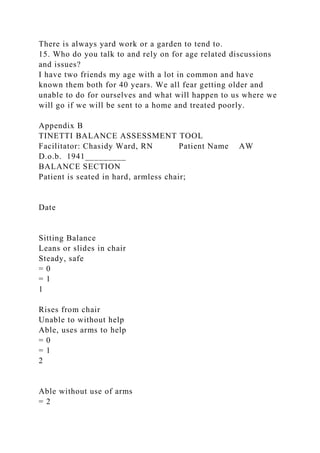
There is always yard work or a garden to tend to.
15. Who do you talk to and rely on for age related discussions
and issues?
I have two friends my age with a lot in common and have
known them both for 40 years. We all fear getting older and
unable to do for ourselves and what will happen to us where we
will go if we will be sent to a home and treated poorly.
Appendix B
TINETTI BALANCE ASSESSMENT TOOL
Facilitator: Chasidy Ward, RN Patient Name AW
D.o.b. 1941_________
BALANCE SECTION
Patient is seated in hard, armless chair;
Date
Sitting Balance
Leans or slides in chair
Steady, safe
= 0
= 1
1
Rises from chair
Unable to without help
Able, uses arms to help
= 0
= 1
2
Able without use of arms
= 2
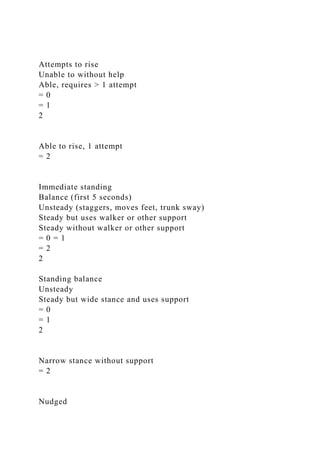
Attempts to rise
Unable to without help
Able, requires > 1 attempt
= 0
= 1
2
Able to rise, 1 attempt
= 2
Immediate standing
Balance (first 5 seconds)
Unsteady (staggers, moves feet, trunk sway)
Steady but uses walker or other support
Steady without walker or other support
= 0 = 1
= 2
2
Standing balance
Unsteady
Steady but wide stance and uses support
= 0
= 1
2
Narrow stance without support
= 2
Nudged
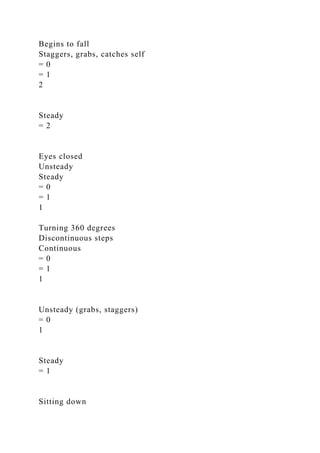
Begins to fall
Staggers, grabs, catches self
= 0
= 1
2
Steady
= 2
Eyes closed
Unsteady
Steady
= 0
= 1
1
Turning 360 degrees
Discontinuous steps
Continuous
= 0
= 1
1
Unsteady (grabs, staggers)
= 0
1
Steady
= 1
Sitting down
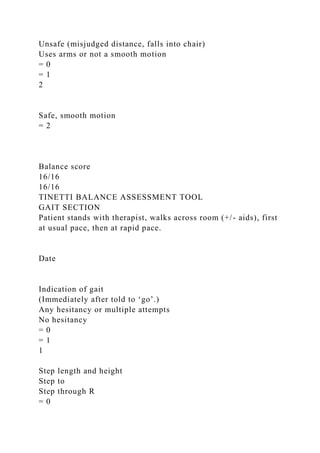
Unsafe (misjudged distance, falls into chair)
Uses arms or not a smooth motion
= 0
= 1
2
Safe, smooth motion
= 2
Balance score
16/16
16/16
TINETTI BALANCE ASSESSMENT TOOL
GAIT SECTION
Patient stands with therapist, walks across room (+/- aids), first
at usual pace, then at rapid pace.
Date
Indication of gait
(Immediately after told to ‘go’.)
Any hesitancy or multiple attempts
No hesitancy
= 0
= 1
1
Step length and height
Step to
Step through R
= 0
= 1
2
Step through L
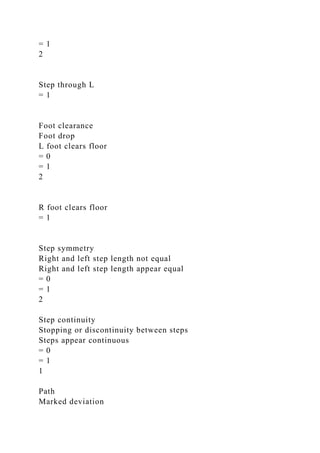
= 1
Foot clearance
Foot drop
L foot clears floor
= 0
= 1
2
R foot clears floor
= 1
Step symmetry
Right and left step length not equal
Right and left step length appear equal
= 0
= 1
2
Step continuity
Stopping or discontinuity between steps
Steps appear continuous
= 0
= 1
1
Path
Marked deviation
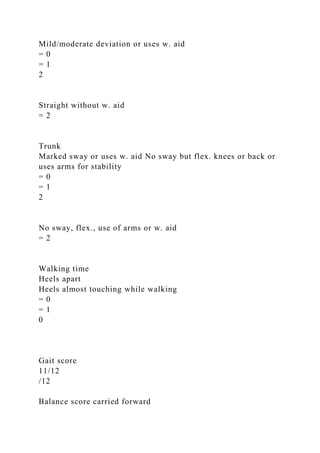
Mild/moderate deviation or uses w. aid
= 0
= 1
2
Straight without w. aid
= 2
Trunk
Marked sway or uses w. aid No sway but flex. knees or back or
uses arms for stability
= 0
= 1
2
No sway, flex., use of arms or w. aid
= 2
Walking time
Heels apart
Heels almost touching while walking
= 0
= 1
0
Gait score
11/12
/12
Balance score carried forward
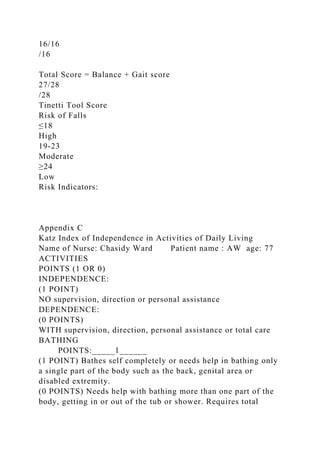
16/16
/16
Total Score = Balance + Gait score
27/28
/28
Tinetti Tool Score
Risk of Falls
≤18
High
19-23
Moderate
≥24
Low
Risk Indicators:
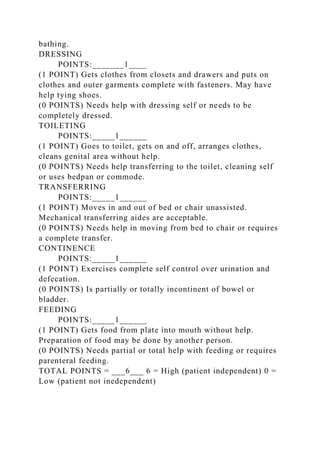
Appendix C
Katz Index of Independence in Activities of Daily Living
Name of Nurse: Chasidy Ward Patient name : AW age: 77
ACTIVITIES
POINTS (1 OR 0)
INDEPENDENCE:
(1 POINT)
NO supervision, direction or personal assistance
DEPENDENCE:
(0 POINTS)
WITH supervision, direction, personal assistance or total care
BATHING
POINTS:_____1______
(1 POINT) Bathes self completely or needs help in bathing only
a single part of the body such as the back, genital area or
disabled extremity.
(0 POINTS) Needs help with bathing more than one part of the
body, getting in or out of the tub or shower. Requires total
bathing.
DRESSING
POINTS:_______1____
(1 POINT) Gets clothes from closets and drawers and puts on
clothes and outer garments complete with fasteners. May have
help tying shoes.
(0 POINTS) Needs help with dressing self or needs to be
completely dressed.
TOILETING
POINTS:_____1______
(1 POINT) Goes to toilet, gets on and off, arranges clothes,
cleans genital area without help.
(0 POINTS) Needs help transferring to the toilet, cleaning self
or uses bedpan or commode.
TRANSFERRING
POINTS:_____1______
(1 POINT) Moves in and out of bed or chair unassisted.
Mechanical transferring aides are acceptable.
(0 POINTS) Needs help in moving from bed to chair or requires
a complete transfer.
CONTINENCE
POINTS:_____1______
(1 POINT) Exercises complete self control over urination and
defecation.
(0 POINTS) Is partially or totally incontinent of bowel or
bladder.
FEEDING
POINTS:_____1______
(1 POINT) Gets food from plate into mouth without help.
Preparation of food may be done by another person.
(0 POINTS) Needs partial or total help with feeding or requires
parenteral feeding.
TOTAL POINTS = ___6___ 6 = High (patient independent) 0 =
Low (patient not inedependent)
Appendix D
Home safety assessment
Assessment by Chasidy Ward
Patient: AW Age: 77
1. Is there adequate lighting at the entry way to the home and in
the home? _yes
2. Is the floor clear of objects or furniture in the walking path
around the home?__NO
3. Is the floor free of unsecured, untapped area rugs that may
trip the patient?__NO
4. Is the home free of small pets walking around the feet of the
patient?__NO
5. Does the shower have non- skid strips or slip-free bath
mats?___NO
6. Bathroom has grab bars in shower or around toilet?___NO
7. Was the home temperature uncomfortable to the
patient?___NO
NO= No is a need to be evaluated for intervention
YES=no issues identified
Appendix E
The Barthel Index
Assessment by Chasidy Ward
Person name: AW Age: 77
Instructions: Choose the scoring point for the statement that
most closely corresponds to the patient's current level of ability
for each of the following 10 items. Record actual, not potential,
functioning. Information can be obtained from the patient's self-
report, from a separate party who is familiar with the patient's
abilities (such as a relative), or from observation. Refer to the
Guidelines section on the following page for detailed
information on scoring and interpretation.
Running head: Functional assessment
Functional assessment
Bowels
0 = incontinent (or needs to be given enemata)
1 = occasional accident (once/week) 2 = continent
Patient's Score: 2
Bladder
0 = incontinent, or catheterized and unable to manage
1 = occasional accident (max. once per 24 hours) 2 = continent
(for over 7 days)
Patient's Score: 2
Grooming
0 = needs help with personal care 1 = independent
face/hair/teeth/shaving (implements
provided)
Patient's Score: 1
Toilet use
0 = dependent
1 = needs some help, but can do something alone 2 =
independent (on and off, dressing, wiping)
Patient's Score: 2
Feeding
0 = unable
1 = needs help cutting, spreading butter, etc. 2 = independent
(food provided within reach)
Patient's Score: 2
(Collin et al., 1988)
Scoring:
Transfer
0 = unable – no sitting balance
1 = major help (one or two people, physical), can sit
2 = minor help (verbal or physical) 3 = independent
Patient's Score: 3
Mobility
0 = immobile
1 = wheelchair independent, including corners, etc.
2 = walks with help of one person (verbal or physical) 3 =
independent (but may use any aid, e.g., stick)
Patient's Score: 3
Dressing
0 = dependent
1 = needs help, but can do about half unaided 2 = independent
(including buttons, zips, laces, etc.)
Patient's Score: 2
Stairs
0 = unable
1 = needs help (verbal, physical, carrying aid) 2 = independent
up and down
Patient's Score: 2
Bathing
0 = dependent
1 = independent (or in shower)
Patient Score: 1
Total Score: 20
Sum the patient's scores for each item. Total possible scores
range from 0 – 20, with lower scores indicating increased
disability. If used to measure improvement after rehabilitation,
changes of more than two points in the total score reflect a
probable genuine change, and change on one item from fully
dependent to independent is also likely to be reliable.
Sources:
· Collin C, Wade DT, Davies S, Horne V. The Barthel ADL
Index: a reliability study. Int Disabil Stud. 1988;10(2):61-63.
· Mahoney FI, Barthel DW. Functional evaluation: the Barthel
Index. Md State Med J. 1965;14:61-65.
· Wade DT, Collin C. The Barthel ADL Index: a standard
measure of physical disability? Int Disabil Stud. 1988;10(2):64-
67.
Running head: AGE-RELATED CHANGES 1
AGE-RELATED CHANGES 8
Age-Related Changes
South University
Age-Related ChangesCardiovascular Changes
As much as the 78-year-old interviewee considers him healthy,
he admits that most parts of his body and their functionality has
greatly changed. The first instance of change is found in the
cardiovascular system. The aging slowly brings about isolated
systolic hypertension where the individual has his arterial walls
grow thicker and stiffer and therefore leading to decrease in
compliance of the heart. In closer examination of the patient’s
cardiovascular system, there could be found diminished
peripheral pulses with extremities as well as strong arterial
pulses (Smith & Cotter, 2008). These conclusions were made as
a result of the discovery of decreased cardiac reserve, constant
heart rate whether at exercise or rest, inability to exercise
vigorously and for long and decreased heart rate. Other signs
included fatigue and being short of breath frequently.
While comparing to a normally functioning cardiovascular
system to that of the aging individual interviewed, there are
numerous differenced that were observable. First, as mentioned
above, the individual maintained a high heart rate whether while
engaged in an exercise or not. On the other hand, under normal
circumstances, the heart rate increases when an individual
engages in physical activities that require of their body to
consume more oxygen, which is supplied through blood (APA,
n.d.). At old age, cardiac output remains low. Consequently,
when the individual engages in physical exercises, he cannot
last long, since he would get easily fatigued, run out of breath
fast, and in case of tachycardia, experience slow recovery.
Other probable cardiac conditions that are experienced at old
age include the risk of inflamed varicosities. Other risks include
arrhythmias, hypotension, which is believed to be induced by
posture. As a result, syncope may be caused, which also
increases the risk of arrhythmias. Habits contribute a lot to a
heart’s condition. Indeed, every individual desire to have a
healthy heart, but few of them are keen on their habits, to
ensure that whatever they eat is heart-friendly (Smith & Cotter,
2008). For instance, as the interviewee confessed it gets hard to
avoid stress and depression sometimes. But, once these episodes
are over, one assumes that they are fine and healthy. They
forget that damage to the heart might have been caused during
the stressful episode.
Other habits include failure of controlling sleep apnea, which is
known to accelerate high blood pressure. But, diet is the capital
of heart conditions. Eating well guarantees to any individual a
healthy heart. However, many people fail to know about the
various foods that are heart friends. As explained by the
interviewee, he learned of various healthy foods through
seminars, campaigns and other sources of education. The
interviewee explains of cardiac friendly diet to be comprised of
fruits and vegetables—tomatoes, carrots, broccoli, among
others. Others include soluble fiber foods whose rich sources
are oats, beans, berries, and more (Care & Home, n.d.). Others
include sources of fatty acids—Omega 3, which are found in
fishes—Salmon, Tuna, Herring, and other unprocessed foods
such as Sardines, walnuts, chia seeds, hemp seeds, and ground
flaxseeds. Changes in the Pulmonary System
The pulmonary system was also found to have continued
encounter with changes, where the respiratory muscles were
decreased in strength, reduced compliance of chest walls, which
were stiff. Response to hypercapnia and hypoxia were
decreased. This could also be observed through reduced
exercise tolerance. What the strength of clearance of foreign
matter can cough was reduced—coughing and sneezing were
weaker, were not coming out in high velocity (Sharma &
Goodwin, 2006). The risks of airway obstruction remained
higher. These were identified through assessment of the
respiratory rhythm, rate, depth, volume, and capacity while at
rest and while engaged in activities. Even though the patient did
not need to be nursed, he could implement some nursing
techniques such as maintaining an upright posture to breathe
comfortably and implement education on cough enhancement.
To know of any alterations in the respiratory system, the patient
is subjected to assessment procedures, specialized for the
pulmonary system. The assessment procedures entail assessing
breathing behaviors as described above, and inspection of
breathing organs—the thorax in general. Also, the study of the
patient’s smoking history is necessary too. Also, the patient
may be subjected to exercises while his breathing procedure
being checked. Not only movement of air is checked, but also
the presence of secretions, if any, blood gasses, and pulse
oximetry. Hover, in looking at a deeper understanding of the
effects of aging on lungs, the tissues themselves as well as the
surrounding area affected (Lechtzin, n.d.). First, the bones and
muscles of chest and spine are affected. As one grows old,
bones shrink and change in shape. The changes can alter the
ribcage. This minimizes the rate of contraction and expansion of
the ribcage. The weakening of muscles, especially the
diaphragm also leads to reduced performance in contraction and
relaxation of lungs to achieve proper breathing.
The lungs tissues also change greatly. For instance, some
tissues that make the airway may weaken lose the ability to
keep it open. Collapsing disrupts the normal flow of air to and
from the lungs. Air can get trapped inside, and fresh air fails to
find its way into the lungs. This would lead to concentration of
more carbon dioxide in the blood and very little and insufficient
oxygen supply to the organs, leading to their underperformance.
Resultantly, common lung infections such as pneumonia and
bronchitis are experienced. Others include abnormal breathing
pattern and running short of breath frequently, and low oxygen
supply.
Since the respiratory system continues reducing its strength in
functionality, intervention is required sooner or later, where the
patient will need to be nursed. For instance, for his airway to
remain maintained, he has to keep an upright position, a
reposition, or suction (Smith & Cotter, 2008). The patient ought
to be provided with extra oxygen if needed, and be hydrated
always. For a patient who may be smoking, s/he can be urged to
quit. Incentive spirometry can also be conducted on the patient.
The respiratory problems at old age can, however, be prevented
through different means. First, the interviewee claimed to
engage in physical exercises to enhance breath. It is indeed true;
lung functionality is improved through physical exercises. Also
making movements rather than lying down or sitting for long
periods of time allows for the collection of mucus in lungs. This
increases the risk of lung infection. Changes in the
Musculoskeletal System
Third, is the age-associated changes in the musculoskeletal
system could be observable on the interviewee. The interviewee
was not as strong as he had been during his 50s. His muscular
strength and mass were declining with age. Bone capacity had
also reduced. Also, ligaments were found to have decreased as
well as tendon strength. The examination could show
degeneration of the intervertebral disc. The articular cartilage,
in comparison with that of a youth, had started eroding (Loeser,
2010). The individual’s gait had started eroding. According to
health information, the persistence of this condition would lead
the individual starting losing scores while graded against the
Katz Index of Activities of Daily Living. This implies that he
would no longer be able to do some activities on his own.
Old age is known to change bone structure, strength, and
wright, and posture. Evidently, when people grow old, they not
only quit engaging in heavy tasks, but also their movements
slow down, and they significantly reduce muscular strength.
Also, joints, especially knees and hips reduce flexibility, where
they become more fixed. Also in case of accidents, the bones
may break easily, due to reduced resistance in them. When
joints break down, chances of inflammation, deformity,
stiffness, pain, and other changes may occur (Loeser, 2010).
Resultantly, common problems such as osteoporosis, fractures,
and many others may occur. Although the interviewee did not
give any history of bone issues as years increased, he could
confess, as well as it was observable that movement was slowed
down and his posture had started bending already.
To prevent these bone and muscular disorders, frequent
exercises are very much important. Exercising keeps the
muscles, bones, and joints engaged, which makes them have
their strength, balance, and flexibility maintained. Bones stay
strong with a lot of exercises. Also, the bones retain strength
(Smith & Cotter, 2008). However, some exercises may cause
strain and worsen the condition of the bones. Thus, before
engaging in a given exercise, especially when trying new ones,
an aging individual is highly recommended to seed advice from
a professional healthcare provider, for them to affirm that the
exercise is not harmful in any way. Last but not the least; a
balanced diet is very much important. About balanced diet, the
individual should take foods with plenty of calcium to
strengthen the bones. For women, not only calcium but also
Vitamin D is required of them as they age (Chart et al., 2014).
According to clinical information, women and men of 70 years
and above should consume 1, 200 mg of calcium daily, and be
supplied with 800 units of vitamin D, on a daily basis too.
FUNCAPES
Fluids: Patient does not drink that much of water. Nearly, 3
glasses a day with his medication.
Aeration: Patient feels lonely and depressed sometimes.
Nutrition: Patient with a good knowledge of appropriate diet.
Communication: Patient is able to participate in a normal
conversation and give logically
answers.
Activity: Patient refers that he goes for a walk almost every day
for near 20 minutes.
Pain: He refers to his pain as “normal for the age”
Elimination: Patient is continent of bowel and incontinent of
urine (at times due to his meds).
Socialization: Patient has some friends that he talks to them
over the phone once a week and his
family would visit him whenever they have free
time.
Assessment of Home Safety
According to my assessment, patient is still able to live at
home safely under supervision of his family. Patient is
knowledgeable and capable of taking his medications. No health
environment related issues found, although patient will benefit
from Meals on Wheels or a Cantina arrangement. Katz index of
independence in activities of daily living (ADL)
The individual put under review using this tool was a retired
clinical officer, aged 78. When the interviewee was put under
test against the Katz Index of Independence in Activities of
Daily Living, he scored all 6/6 points. The tool was checking if
the individual could be able to bath all parts of his body without
necessarily requiring assistance. Or, in case of assistance was
needed, he would require it for only a part of the body. The next
issue was dressing—he could get clothes by himself and put
them all without needing assistance. He could comfortably take
himself to the toilet and do all associated activities without
requiring any assistance. About transferring, the individual
could move from one place to another without needing
assistance, not even by use of a walking stick. He could fully
and accurately control defecation and urination, which earned
him a mark on continence. Last but not the least; concerning
feeding, he could comfortably get food from plate to mouth
without requiring any help. Moreover, he could take part in
preparing the food (Wallace & Shelkey, 2007). Patient
Questionnaire
INTERVIEW OF CHOSEN ELDER ADULT
Name: ________________________________ Age: ______78
Years__________
Brief Introduction (Background information):
The interviewee is a male of the age mentioned above, retired
professional who used to work as a clinical officer. He has
worked in public organizations for about thirty years, and
lately, before retiring has been working in a private hospital,
while he dropped the job willingly at the age of 62. His services
were still great and highly valued, but he considered himself old
to still be working.
1. Philosophy of living a long life
According to the interviewee, whose religion is Christianity, he
believes that 70 years is the right period that one should live.
That is a long enough life. He says that it is a biblical
philosophy. Less than 70 is a short-lived and more than that is
an extended life.
2. Thoughts about when a person is considered “too old.”
Concerning the above philosophy, too old is when a person is
above 70. Also, when the body gets depleted of energy and an
individual stay weak.
3. Opinion on the status and treatment of older adults
Older adults should be treated with extensive care just like
children. This is because their bodies grow weaker with time
rather than stronger.
4. Beliefs about health and illness
Good health depends on what people eat. Sometimes illness
comes as punishment for one’s evil deeds. However, diet,
exercises, and habits also contribute a lot to an individual’s
health as well as the probability of falling ill.
5. Health promotion activities he or she participates in
The interviewee takes walks and participates in golf playing as
physical exercises. He also ensures proper diet and regular
eating and having sufficient sleep.
6. Something special that helped the person live so long
The interviewee believed that the habit of staying happy,
without stress, conducting physical exercises regularly, and
eating healthy foods as well as holding onto his beliefs, were
the main aspects that have enabled him to live that long.
7. Lifespan of other family members
As the interviewee puts it, fellow, family members have lived
valid lengths of life, where few of them reach old age—above
70 years. But, the interviewee’s grandmother lived for more
than a hundred and ten years.
8. Special dietary traditions in patient’s culture attributed to
aiding long life
About the patient’s traditions and culture eating processed
foods are against their cultural practices. Natural vegetables,
cereals, and animal products such as milk are best for human
consumption as far as their traditions are concerned. Also,
processed fluids are not recommendable, and instead, plenty of
fruits are to be consumed.
9. Any remedies/medications that have been handed down to
family/group. If yes, describe.
The interviewee’s family at some point believes in herbal
remedies to cure common ailments such as cold, flu, fever,
headache and others. For instance, a Sodom apple root could be
chewed to cure stomach upset.
10. Patient’s description of current and past health status
The patient’s health status continues becoming poor as his
body’s immune system weakens. This is signified by his aspect
of catching minor illnesses frequently.
11. The values that guided life so far
According to the interviewee, doing no harm and living up to
one’s expectations is what can be termed as good long life. He
also believes in doing unto others what he would love others do
to him.
Additional Questions
1. How long does the patient think he may live? Why?
The interviewee thinks that he may live for more than ten other
years. The main reason for this is because he is confident that
his body still has much strength and abilities, and he continues
exercising, he is always careful about diet, and he still holds on
his beliefs.
2. What are some of the things that the patient should stop or
start doing?
As far as the interviewee is concerned, no behavioral habit in
him is inappropriate, or that he desires to stop or change.
3. Is old age enjoyable? Describe.
Everybody wishes to live a long life; it shows that one is indeed
blessed. Also, nothing gives an old person greater joy than
seeing their grandchildren grown to adults. At old age, being
around loved ones is the best thing.
Summary
The interviewee, aged 78 finds is very much appropriate to
grow old. Lifestyle is a very great determinant of how long one
may live. The lifestyle is dictated by diet, habits, religious as
well as personal beliefs, stress management, and physical
exercises. Older people should be treated with greater care than
the young ones. Being too old is not only determined by age,
but also by the state of the body. How good or bad old age is
depending on the individual. Some find a lot of fun as they are
around their loved ones, while others live solitary lives.
References
Miller, C. (2015). Nursing for wellness in older adults 7th ed.
Retrieved
from: https://digitalbookshelf.southuniversity.edu/#/books/9781
469895277/first
APA. (n.d.). Older Adults' Health and Age-Related Changes.
Retrieved February 28, 2018, from
http://www.apa.org/pi/aging/resources/guides/older.aspx
Care, I. H., & Home, T. Heart-Healthy Foods?.
Chart, M. M., Give, W. T., & Risk, F. (2014). Aging changes in
the bones-muscles-joints.
Lechtzin, N. (n.d.). Effects of Aging on the Respiratory System
- Lung and Airway Disorders. Retrieved February 28, 2018,
from http://www.msdmanuals.com/home/lung-and-airway-
disorders/biology-of-the-lungs-and-airways/effects-of-aging-on-
the-respiratory-system
Loeser, R. F. (2010). Age-related changes in the
musculoskeletal system and the development of
osteoarthritis. Clinics in geriatric medicine, 26(3), 371-386.
Sharma, G., & Goodwin, J. (2006). Effect of aging on
respiratory system physiology and immunology. Clinical
interventions in aging, 1(3), 253.
Smith, C. M., & Cotter, V. T. (2008). Nursing standard of
practice protocol: age-related changes in health. Hartford
İnstitute For Geriatric Nursing, New York.
Villa-Forte, A. (n.d.). Effects of Aging on the Musculoskeletal
System - Bone, Joint, and Muscle Disorders. Retrieved February
28, 2018, from http://www.msdmanuals.com/home/bone,-joint,-
and-muscle-disorders/biology-of-the-musculoskeletal-
system/effects-of-aging-on-the-musculoskeletal-system
Wallace, M., & Shelkey, M. (2007). Katz index of independence
in activities of daily living (ADL). Urol Nurs, 27(1), 93-94.
NSG4067 Gerontological NursingPatient Questionnaire
INTERVIEW OF CHOSEN ELDER ADULT
Name: ________________________________ Age:
________________
Brief Introduction (Background information):
_____________________________________________________
_____________________________________________________
_____________________________________________________
_____________________________________________________
_____________________________________________________
_____________________________________________________
__________________________________________
1. Philosophy on living a long life
_____________________________________________________
_____________________________________________________
_____________________________________________________
_____________________________________________________
_____________________________________________________
_____________________________________________________
__________________________________________
2. Thoughts about when a person is considered “too old”
________________________________________________
_____________________________________________________
_____________________________________________________
_____________________________________________________
_____________________________________________________
_____________________________________________________
______________________________________________
3. Opinion on the status and treatment of older adults
_____________________________________________________
_____________________________________________________
_____________________________________________________
_____________________________________________________
_____________________________________________________
_____________________________________________________
__________________________________________
4. Beliefs about health and illness
_____________________________________________________
_____________________________________________________
_____________________________________________________
_____________________________________________________
_____________________________________________________
_____________________________________________________
__________________________________________
5. Health promotion activities he or she participates in
_____________________________________________________
_____________________________________________________
_____________________________________________________
_____________________________________________________
_____________________________________________________
_____________________________________________________
__________________________________________
6. Something special that helped the person live so long
________________________________________________
_____________________________________________________
_____________________________________________________
_____________________________________________________
_____________________________________________________
_____________________________________________________
_________________________________________
7. Life span of other family members
_____________________________________________________
_____________________________________________________
_____________________________________________________
_____________________________________________________
_____________________________________________________
_____________________________________________________
__________________________________________
8. Special dietary traditions in patient’s culture attributed with
aiding long life
________________________________________________
_____________________________________________________
_____________________________________________________
_____________________________________________________
_____________________________________________________
_____________________________________________________
______________________________________________
9. Any remedies/medications that have been handed down in
family/group. If yes, describe.
_____________________________________________________
_____________________________________________________
_____________________________________________________
_____________________________________________________
_____________________________________________________
_____________________________________________________
__________________________________________
10. Patient’s description of current and past health status
_____________________________________________________
_____________________________________________________
_____________________________________________________
_____________________________________________________
_____________________________________________________
_____________________________________________________
__________________________________________
11. The values that guided life so far
_____________________________________________________
_____________________________________________________
_____________________________________________________
_____________________________________________________
_____________________________________________________
_____________________________________________________
__________________________________________
Additional Questions
1.
_____________________________________________________
_____________________________________________________
_____________________________________________________
_____________________________________________________
_____________________________________________________
_______________________________
2.
_____________________________________________________
_____________________________________________________
_____________________________________________________
_____________________________________________________
_____________________________________________________
_______________________________
3.
_____________________________________________________
_____________________________________________________
_____________________________________________________
_____________________________________________________
_____________________________________________________
_______________________________
Summary
_____________________________________________________
_____________________________________________________
_____________________________________________________
_____________________________________________________
_____________________________________________________
_____________________________________________________
__________________________________________
_____________________________________________________
_____________________________________________________
_____________________________________________________
_____________________________________________________
_____________________________________________________
_____________________________________________________
__________________________________________
Contrast of client’s responses with findings in current literature
·
_____________________________________________________
_____________________________________________________
_____________________________________________________
_____________________________________________________
_____________________________________________________
_____________________________________________________
__________________________________________
·
_____________________________________________________
_____________________________________________________
_____________________________________________________
_____________________________________________________
_____________________________________________________
_____________________________________________________
__________________________________________
·
_____________________________________________________
_____________________________________________________
_____________________________________________________
_____________________________________________________
_____________________________________________________
_____________________________________________________
__________________________________________
Page 1 of 4
© 2015 South University

Running Head 9Assessing and Planning Care for My El.docx

  • 1.
    Running Head: 9 Assessingand Planning Care for My Elderly Mom NSG4067: Gerontological Nursing My subject I chose my …… as my subject. She is a 68-year-old woman, who is still working full-time as the Vice President of a bank in the small community that she lives in. She is still married to my Dad, with whom she just celebrated her 47th wedding anniversary and, in my opinion, is quite healthy. She has a solid group of friends that regularly eat lunch together as well as take trips together a couple of times a year. She does not take any medications, nor has been diagnosed with any chronic health issues. Although, exercise has never been something she has indulged in, she is still leisurely active around the house and likes to take walks with her dog. Mom loves wine, but has never smoked cigarettes. She agreed to be the subject of my gerontological assessment. Since my subject is not frail but rather very robust for her age, I focused my assessments by using tools that were meant to help gain a better understanding
  • 2.
    of my subject’shealth status and where improvements can be made for optimal health management and disease prevention. In combination with a comprehensive questionnaire, I utilized the Tinetti Balance Assessment Tool to assess gait, and the Katz Index to assess how well subject does with ADLs. Subject questionnaire It seems that my subject is very healthy in contrast to other people her age. She feels strong mentally and physically, and has a great attitude towards the way one should live life. She should concentrate on weight management, exercising more regularly, and preventing osteoporosis by including enough calcium in her diet. She should also be sure to have regular, annual checkups such as vision and hearing checks, in addition to her normal blood work. Subject is not happy with the way she thinks the older generation is treated by younger people or doctors even. It would seem that the subject’s family has been predisposed to living longer lives, with the exception of her father, who was a heavy, lifelong smoker that died of cancer. So far, subject’s genetics are working in her favor. See Appendix A. Tinetti Balance Assessment Tool The Tinetti Gait and Balance Instrument is designed to determine an elders risk for falls within the next year. The higher the score, the better the performance. In performing the balance and gait assessment for my subject, it was found that subject scored as high in points as possible and therefore, has no issues with either balance or gait and is a low risk for falls. Katz Index The Katz Index is a tool that assesses functional status as a measure of the patient’s ability to perform activities of daily living (ADLs) on a daily basis. “One of the best ways to evaluate the health status of older adults is through functional assessment which provides objective data that may indicate future decline or improvement in health status, allowing the nurse to intervene appropriately” (Katz, 2007). This tool assesses bathing, dressing, toileting, eating, as well as
  • 3.
    shopping, transportation, foodpreparation, and the ability to handle finances, among other things. My subject, again, had a perfect score on this assessment, which shows no signs of a decline in her ability to take care of herself, independently. INHOMESSS assessment INHOMESSS stands for: immobility, nutrition, housing, others, medication, examination, safety, spirituality, services, and provides a framework for the evaluation of a patient's functional status and home environment. The subject lives in a safe environment, has no impairments or mobility issues that would cause problems for her, eats fairly healthy, etc. During this assessment, there were only a couple of issues identified. The subject does not have an advanced directive and she admits to needing to exercise more and lose weight. My subject in relation to the average 68 year old “Almost 50% of the population older than 65 have osteoarthritis, 40% has hypertension, 33% has chronic heart disease, and more than 25% suffer from hearing impairment” (Barker, 2007, p. 177). My subject is a healthy older woman that has minimal health-related issues. There were several preliminary issues I identified that can be addressed to prevent complications in the future: The subject needs to introduce an exercise regimen into her routine that will help her maintain a healthy heart. She also could benefit from losing some weight, to ensure she maintains optimal cholesterol levels, with a reduction in the amount of fat that sits around her organs. This not only with help her heart and health, but will also have a positive impact on the way she sees herself. In addition, subject should be encouraged to maintain her social network so that she continues to reap the benefits of such alliances. Interventions for these issues include referring the subject to weight loss resources and gyms in her area, educating the subject on where to find information on nutritional diets, encouraging continued, routine social interaction, and educating subject on the importance of this. Subject also needs to be educated on the importance of having an advanced directive in
  • 4.
    place so that,in the event she cannot make decisions for herself, her family does not make decisions she would not want for herself. Appendix A Patient Questionnaire INTERVIEW OF CHOSEN ELDER ADULT Name: Pam Browning Age: 68 Brief Introduction (Background information): Raised in a rural county in ……. My grandparents were part of my everyday life and the importance of family was instilled at a young age. I graduated from High School and completed some College. I have been a banker all of my career and worked my way up from a clerk to a Vice President and Sr Lender. My father had many health issues starting at the early age of 48 and died at 64. I took care of my mother from the time that I was 40, until she died at 83. 1. Philosophy on living a long life Enjoy life. Be positive. Help others. Keep your mind and body active and strong. 2. Thoughts about when a person is considered “too old” I do not believe that a person is ever “too old” to make a difference in other’s lives. I already see some younger people looking at me or speaking to me in a condescending manner and I do not like that. It is as if they do not see me as a viable contributing member to society. You should always do anything that you want without thinking of your age. 3. Opinion on the status and treatment of older adults I do believe that older people are treated differently. Almost as if they are children and need to be taken care of. Doctors even
  • 5.
    seem to treatolder people differently. Their treatment options and their attitude about those treatment options change as you age. I believe that older people are given up on when they should not be. 4. Beliefs about health and illness It is important that you take care of yourself both physically and mentally. If you give up and become sedentary then your physical and mental health begin to decline. 5. Health promotion activities he or she participates in I am part of a wellness program through my work. I keep up with my annual checkups; take any medicines as prescribed and try to eat healthy. I should exercise more. 6. Something special that helped the person live so long Education as to what I should be doing to keep myself healthy. Positive attitude, enjoyment of life and friends and family. Belief that I am put on this earth to help others. 7. Life span of other family members Grandfather very active and lived to be 86. Died having hip replacement surgery because he believed that quality of life was more important than quantity. Grandmother lived to be 93 and came from a long-lived family. Mother lived to be 83 and father died at 64 due to cancer. 8. Special dietary traditions in patient’s culture attributed with aiding long life Growing up, if the food did not come from our garden or the meat from what we raised, we did not eat it. 9.Any remedies/medications that have been handed down in family/group. If yes, describe. None that I can remember 10. Patient’s description of current and past health status
  • 6.
    I was sicklyas a child. Born with low gamaglobulin and had to have IV drips as a child. As a teenager and adult I have been healthy, with few health issues. 11. The values that guided life so far Work hard. Treat others the way that you would want to be treated. Help others. Love your family. Always look to the positive. 12.What do you think about cosmetic procedures to delay the aging process? I believe that if they help make you feel better about yourself then you should consider it. 13. Do you have any big regrets in your life? Yes. I wish that I had completed my college degree. Also, I worked outside of the home my entire life and looking back I wish that I had spent more time with my children. 14. Are you satisfied with your level of daily physical activity? No. I should exercise more. Summary It seems that my subject is very healthy in contrast to other people her age. She feels strong mentally and physically, and has a great attitude towards the way one should live life. She should concentrate on weight management, exercising more regularly, and preventing osteoporosis by including enough calcium in her diet. She should also be sure to have regular, annual checkups such as vision and hearing checks, in addition to her normal blood work. Subject is not happy with the way she thinks the older generation is treated by younger people or doctors even. It would seem that the subject’s family has been predisposed to living longer lives, with the exception of her father, who was a heavy, lifelong smoker that died of cancer. So far, subject’s
  • 7.
    genetics are workingin her favor. Contrast of client’s responses with findings in current literature · Subject is extremely healthy in contrast to other people her age. “Almost 50% of the population older than 65 have osteoarthritis, 40% has hypertension, 33% has chronic heart disease, and more than 25% suffer from hearing impairment” (Barker, 2007, p. 177). · On average, seniors visit a physician nine times a year (Barker, 2007, p. 177). My subject has annual visits and is only seen, otherwise, if she is sick. · Vision changes and hearing impairment are widespread among the older population. My subject has worn glasses her entire life but does not suffer from cataracts or glaucoma, and has not experienced any hearing loss to date. Appendix B Appendix C INHOMESSS assessment
  • 8.
    References: Barker, L. R.,Burton, J. R., Zieve, P. D., & Fiebach, N. H. (2007). Barker, Burton, and Zieve's principles of ambulatory medicine. [electronic resource]. Philadelphia, PA: Lippincott Williams & Wilkins, c2007. Katz Index of Independence in Activities of Daily Living (ADL). (2007). Urologic Nursing, 27(1), 93-94. 15. TRUNK Marked sway or uses walking aid 0 No sway – but flexion of knees or back, or spreads arms out while walking 1 No sway, no flexion, no use of arms, and no use of walking aid 2 2 16. WALKING STANCE Heels apart 0 Heels almost touching while walking 1 1 SCORE – GAIT 13 SCORE – BALANCE 15 SCORE – BALANCE AND GAIT 29 Rate 1 Rate 2 Rate 3 Date of Assessment Assessor Signature and Title Location of Subject During Assessment 1.Jan 01, 2018 Paige Shinn Home 2 3 TINETTI ASSESSMENT TOOL: BALANCE Subject’s Name: Pam Browning Initial Instructions: Subject is seated in a hard, armless chair. The following maneuvers are tested.
  • 9.
    Task Description ofBalance Possible Score Date Score Date Score Date 1. SITTING BALANCE Leans or slides in chair 0 Steady, Safe 1 1 2. ARISES Unable without help 0 Able, uses arms to help 1 Able without using arms 2 2 3. ATTEMPTS TO ARISE Unable without help 0 Able, requires >1 attempt 1 Able to rise >1 attempt 2 2 4. IMMEDIATE STANDING BALANCE (first 5 seconds) Unsteady (swaggers, moves feet, trunk sway) 0 Steady but uses walker or other support 1 Steady without walker or other support 2 2 5. STANDING BALANCE Unsteady 0 Steady but wide stance (medical heels 4 inches apart) and uses cane or other support 1 Narrow stance without support 2 2 6. NUDGED (subject at max position with feet as close together as possible, examiner pushes lightly on subject’s sternum with palm of hand 3 times.) Begins to fall 0 Staggers, grabs, catches self 1 Steady 2 2 7. EYES CLOSED (at max position – see #6 above) Unsteady 0
  • 10.
    Steady 1 1 8.TURNING 360 DEGREES Discontinuous steps 0 Continuous Steps 1 Unsteady (grabs, swaggers) 0 Steady 1 1 9. SITTING DOWN Unsafe (misjudged distance, falls into chair) 0 Uses arms or not a smooth motion 1 Safe, smooth motion 2 2 BALANCE SCORES: 15 Rate 1 Rate 2 Rate 3 Date of Assessment Assessor Signature and Title Location of Subject During Assessment 1. Jan 01, 2018 E. Paige Shinn Home 2 3 TINETTI ASSESSMENT TOOL: GAIT Subject’s Name: Pam Browning Initial Instructions: Subject stands with examiner, walks down hallway or across the room, first at “usual” pace, then back at “rapid, but safe” pace (using usual walking aids). Task Description of Balance Possib le Score Date Score Date Score Date 10. INITIATION OF GAIT (immediately after told to “go”) Any hesitancy or multiple attempts to
  • 11.
    start 0 No hesitancy 11 11. STEP LENGTH & HEIGHT RIGHT swing foot does not pass left Stance foot with step 0 RIGHT foot passes left stance foot 1 1 RIGHT foot does not clear floor completely with step 0 RIGHT foot completely clears floor 1 1 LEFT swing foot does not pass right stance foot with step 0 LEFT foot passes right stance foot 1 1 LEFT foot does not clear floor completely with step 0 LEFF foot completely clears floor 1 1 12. STEP SYMMETRY RIGHT AND LEFT step length not equal (estimate) 0 RIGHT AND LEFT step appear equal 1 1 13. STEP CONTINUITY Stopping or discontinuity between steps 0 Steps appear continuous 1 1 14. PATH (estimated in relation to floor tiles, 12 inch diameter. Observe excursion of 1 foot over about 10 feet of the course) Marked deviation 0 Mild/moderate deviation or uses walking aid 1 1
  • 12.
    Straight without walkingaid 2 2 Running head: Functional Assessment [Shortened Title up to 50 Characters] 19 Assessing the Functional Elements of the Older Adult South University Assessing the Functional Elements of the Older Adult Completing a comprehensive assessment of an adult over 65 is a way for the nurse to identify any issues that need attention and help the patient have the best quality of life possible. The purpose of the screening is to provide care, preempt disease, retain good health, keep a record of health, minimize disabilities, and give a holistic approach to independent living (lecture online,wk.2). Various tools can be used to assess the patient for the functional ability during an assessment. I will use nursing tools that are applicable to the interviewed subject and analyze where potential problem areas are. After analyzing the information gathered, I will then connect the dots with formulating interventions for the problems identified. I will be discussing a 77-year-old female, AW, who lives independently at home alone. The Patient interview To ensure privacy of the person being discussed, I will refer to the interviewee as AW. AW lives alone in her single floor home close to her daughter and granddaughter. For the past seventy years she has had very few medical issues which include, arthritis, vision impairment, bursitis and plantar fasciitis (personal conversation, Appendix A) AW’s view on life is holistic and autonomous. AW has a good sense of control of her medical problems and indicates that she is “in good health”. AW agreed to a comprehensive assessment and each tool used was explained to her in detail. I believe her cognitive status was intact to understand and consent to this project. I will first
  • 13.
    discuss, as anurse, the focus of assessment is on the day to day activities. Assessment tools1 By nursing standards, the functional assessment is completed to measure a person’s ability to perform day to day task of living and self -care (Miller, 2015, p.100). The first tool I will discuss is the Tinetti Balance tool. The use of this tool was to assess AW’s steadiness, gait, and her overall ability to move sit and walk. Using verbal instructions, AW was asked to perform simple task such as sitting and standing, turning around and walking steps. There were an achievable 28 points to attain and AW scored a 27 on the Tinetti (see Appendix B). With an almost perfect score, I did not feel that this was a problem area for her plan of care. The next tool described is the Katz Index of Independence in Activities of Daily Living, referred to as the Katz ADL. This tool is used to measure an elder person’s independent daily life duties. Such duties included, bathing, dressing, and toileting. The tool uses 6 activities of daily life to score the patient, and a possible total score of 6. For the Katz ADL assessment, AW scored a 6 (see Appendix C). The objective view of this tool indicates no need for interventions at this time. I would recommend that she is evaluated yearly for any decline now that a baseline has been established. The next assessment was of the home, using the Assessment of Home Safety Tool. The importance of the home assessment is to identify any fall risk factors as well as identify any environmental factors that positively or negatively affect safety, functioning, and quality of life (Miller, 2015, p.106). Having a safe home environment include proper lighting, removal of rugs and furniture, as well as efficient heating and cooling of the home. Good lighting in the home is often overlooked, but it is essential to reading, and other activities enjoyed by the older adult. Proper lighting also helps to avoid tripping over objects, and seeing a wet area that the person may slip on. The proper climate of a home is also a
  • 14.
    vital part ofquality of living, making sure that the person is comfortable where they spend most of their time. I used recommendations for the home safety assessment from the text by Miller (2015) and from the Medscape website to create a tailored version for AW (see appendix D). From this assessment there were identifiable needs for intervention to make the home safer. The problems identified were; furniture to close to walking areas, small pets walking around the feet of AW, unsecured rugs throughout the home, and no grab bars in the bathroom area. Interventions will be discussed in another section of this essay under the section inerventions. Lastly, I assessed AW using the Barthel Index of daily function’s as an addition to the Katz ADL. When I found the Barthel Index and reviewed it, I felt that the information had already been established from the other tools used as in the Katz ADL. The main purpose for the Barthel index tool is determine the degree of independence, from any help, whether its physical or verbal to any degree. The Barthel Index is a record of what the patient does, not what they could do (strokecenter.org). When I did the Barthel test, AW had a perfect score of 20 which correlates with her Katz score (see Appendix E). I did not recognize any issues or problem areas during this assessment of AW. The mental assessment and cognitive tools were not used on this person, because the initial interview combined with the other tools provided enough information that I did not feel she had any memory loss or dementia tendencies. This 77-year-old proved to be as independent as I am at 41 and her overall health just as good. There were some noted changes related to aging to discuss that could be potential areas of intervention.Age related changes. AW was wearing glasses and spoke of her loss of good eye sight during our time of assessments. To complete her overall functional assessment, I asked AW questions about driving at night and reading to decide if she had age related changes. I also looked at her eyes with her glasses off and noticed the yellowing of her cornea and the drooping of her top eyelid. In
  • 15.
    the text byMiller (2015, p.336) yellowing of the cornea will cause interference of light passage to the retina making glares an issue. Eyelid droop, due to loss of elasticity in the skin and the muscles around the eye, can cause problems with vision if the skin is in the line of vision. AW’s visual acuity is corrected by her glasses but she stated that seeing at night while driving was difficult due the glare from the lights. Age related changes to the lens, pupil, retina and retinal-neural pathways cause the older adult to have a delay in adapting to dark and light (Miller, 2015, p.337). This causes an issue for the older adult to respond as quickly when driving and meeting cars with headlights on the road. Form this assessment I identified a problem area of safety that implies a need for intervention for AW with her vision and night driving. Another age-related change to discuss is sleep. In AW’s health assessment she had complaints about trouble with sleeping patterns. Prolonged sleep latency, is the primary reason for aging adult’s loss of sleep efficiency. This is a latency is from increased time to fall asleep and increased frequency of awakenings during the night (Miller, 2015, p.512). Usually, the older adult take’s naps as way to compensate for the sleep loss. The interruption in the adult’s circadian rhythm is annoying but overall not bad for one’s health. Light sleep, known as non- REM, increases as the person ages. The non- REM phase is when hormones are released, muscles relax and restorative processes occur (Miller, 2015). This does however, cause drowsiness during the day and early rise times with late fall asleep times. AW has a need here as well for intervention to help improve her quality of life. Lastly, in considering her health issues, her focus was on arthritis pain. In her interview she stated that she did not regularly exercise but she moves around, stretches and take’s walk’s some days (see Appendix A). As cited in text by Miller (2015, p.298), adults often avoid exercise due to arthritic pain. Age related changes here are, joints become less flexible with loss of fluid to cushion them, and muscles become more lax and
  • 16.
    less tone fromchanges in the muscle fibers and the central nervous system (medlineplus.gov). Due to the lack of desire to exercise regularly an intervention is needed to provide her with information about tailored programs of exercise. Controlling pain with arthritis can be a bit tricky when it comes to taking medications. The most often used medications are NSAID’s which can increase blood pressure. AW made it clear in her interview that she had personal beliefs about taking pain pills. In awareness of her beliefs, I feel that an intervention could be used to improve her knowledge of other pain relieving methods.Interventions for problems. My interventions for the problems identified during her assessment are my own tailored ideas using suggestions from other sources as cited in the references. 1. Problem-Seeing at night while driving. Intervention recommended-Encourage AW to group activities of driving to the daylight hours, refer her to an eye specialist, promote family help for night driving activities, and encourage eye care and checkups to keep glasses adjusted to eye changes. 2. Problem-Safety of the home environment. Interventions-teach risks of falling due to small pets around the feet when walking, encourage AW and family to make necessary changes of walking path to include moving furniture out of way, educate AW and family on assistive devices for bathroom such as shower bars and raised toilets, and raise awareness of in home call buttons for help. 3. Problem-Disturbed sleep patterns. Interventions-promote wellness by identifying risk factors for lack of sleep such as pain control for her arthritis, encourage daily physical activity such as exercise, educate to avoid alcohol, nicotine and caffeine close to bed time, and promote soothing music at bedtime. 4. Problem-Pain from arthritis. Interventions-educate sources of support from national and government organizations that are online that teach prevention and management, and encourage the use of non-pharmacological means to control pain such as heat or cold therapy.
  • 17.
    After completing thefunctional assessment there was no need for a true mental assessment for AW. Her ability to answer, recall information and perform all tasks independently were sufficient for a mental assessment and no deficits were noted. Using all the tools discussed and her interview, I was able to formulate problem areas with interventions. After reviewing age related changes that pertained to AW I have recognized four problem areas of health and living well. From the problems noted, I applied nursing evidence based practice suggestions and ideas, from literature read and experience as a nurse to give at least three detailed interventions for each problem listed. The importance of assessing older adults is to identify conditions that affect not only health but level of functioning and quality of life (Miller, 2015, p.99). References Internet Stroke Center. retreived from: http://www.strokecenter.org Miller, C. A. (2015). Nursing for wellness in older adults, (7th ed). [Bookshelf Online]. Retrieved from https://bookshelf.vitalsource.com/#/books/9781469895277/ Medscape.com. Retreived from: http://medscape.com. Shelkey, M., Wallace, M., (2012). Katz index of independence in activities of daily living. New York University College of Nursing, I (2). South University Online (2018). NSG4067: Gerontological nursing: week 3: lecture 3. Retrieved from myeclassonline.com. Appendix A Patient Questionnaire by Chasidy Ward
  • 18.
    Name: AM Age:77 Personal communication, March ……. Brief background: Has been self-employed for 40 years selling antiques, lives alone in a one-story house, enjoys internet surfing and selling antiques online and spending time with her daughter and friends. AW has a history of arthritis, plantar fasciitis, bursitis, trouble with sleeping at night and impaired vision. Visits to primary physician are infrequent but goes yearly for checkup. AW states she has not been hospitalized for any acute or chronic illness in the past. 1. Philosophy on living a long life: Don’t take all the medicines the doctor tries to give you to take. Love the Lord and others as you do yourself. 2. Thoughts about when a person is considered “too old” I think people tell me I’m too old to do things but really, I’m not too old until I can’t do something anymore such as lifting and moving furniture. 3. Opinion on the status and treatment of older adults Very poorly, people treat you like you don’t know anything and like you aren’t capable of doing what they are. 4. Beliefs about health and illness It is what you make it, a lot of is mental and how you take care of yourself over the years. You have to think young and never stop thinking your age depends on your mind set about it. 5. Health promotion activities he or she participates in I try to stay moving and doing and stay off medication. When I sit to much and start getting stiff I get up and move around stretch or talk a walk most days. Educating myself over the years on vitamins and healing food choices. 6. Something special that helped the person live so long Good genes and the other half is not taking all the prescribed drugs the doctors try to give you. If you are in pain its best to try natural things first like a heating pad or a cold pack. I don’t take a pain pill just because I’m hurting that’s usually the last result. I think certain foods heal you from a lot of aliments.
  • 19.
    7. Life spanof other family members My mother and her siblings lived well beyond their 80’s, two of them up to 100 and 105. I don’t know my father’s history. 8. Special dietary traditions in patient’s culture attributed with aiding long life Healing food and vitamins when you notice a deficiency. It’s not cultural but I eat food high protein without a lot of meats-I only eat chicken. I eat nuts and vegetables. And I don’t salt my food because of high BP so I won’t have to take the medicines. 9. Any remedies/medications that have been handed down in family/group. If yes, describe. We used to put onions on our feet to take out fever but I don’t use that anymore. My grandmother always taught me to eat real food, not packaged stuff. Food right out the garden. 10. Patient’s description of current and past health status Currently my health is good, I have had some bad times with arthritis and trouble falling asleep and staying asleep, but good otherwise. I don’t like to drive at night because its harder to see with the glare of the lights. 11. The values that guided life so far I value the quality of life and good clean living. I don’t really know more than that Additional Questions 12. What do you feel about how family’s treat their elder? I think they don’t care of them in general until they are dying and most of them won’t take care of the elder if they are really sick. When I need it, I would hope to afford to pay someone to take care of me. 13. Have you fallen in the last three months? No, not in over a year and I tripped on something behind me but I’m steady I watch carefully for stuff around me. I learned to wear good shoes and do balancing exercises I read about 14. Is there anything in your community to do for your age group? Yes, there are centers and activities but I stay busy with my life and don’t entertain them. I would if I was bored and lonely.
  • 20.
    There is alwaysyard work or a garden to tend to. 15. Who do you talk to and rely on for age related discussions and issues? I have two friends my age with a lot in common and have known them both for 40 years. We all fear getting older and unable to do for ourselves and what will happen to us where we will go if we will be sent to a home and treated poorly. Appendix B TINETTI BALANCE ASSESSMENT TOOL Facilitator: Chasidy Ward, RN Patient Name AW D.o.b. 1941_________ BALANCE SECTION Patient is seated in hard, armless chair; Date Sitting Balance Leans or slides in chair Steady, safe = 0 = 1 1 Rises from chair Unable to without help Able, uses arms to help = 0 = 1 2 Able without use of arms = 2
  • 21.
    Attempts to rise Unableto without help Able, requires > 1 attempt = 0 = 1 2 Able to rise, 1 attempt = 2 Immediate standing Balance (first 5 seconds) Unsteady (staggers, moves feet, trunk sway) Steady but uses walker or other support Steady without walker or other support = 0 = 1 = 2 2 Standing balance Unsteady Steady but wide stance and uses support = 0 = 1 2 Narrow stance without support = 2 Nudged
  • 22.
    Begins to fall Staggers,grabs, catches self = 0 = 1 2 Steady = 2 Eyes closed Unsteady Steady = 0 = 1 1 Turning 360 degrees Discontinuous steps Continuous = 0 = 1 1 Unsteady (grabs, staggers) = 0 1 Steady = 1 Sitting down
  • 23.
    Unsafe (misjudged distance,falls into chair) Uses arms or not a smooth motion = 0 = 1 2 Safe, smooth motion = 2 Balance score 16/16 16/16 TINETTI BALANCE ASSESSMENT TOOL GAIT SECTION Patient stands with therapist, walks across room (+/- aids), first at usual pace, then at rapid pace. Date Indication of gait (Immediately after told to ‘go’.) Any hesitancy or multiple attempts No hesitancy = 0 = 1 1 Step length and height Step to Step through R = 0
  • 24.
    = 1 2 Step throughL = 1 Foot clearance Foot drop L foot clears floor = 0 = 1 2 R foot clears floor = 1 Step symmetry Right and left step length not equal Right and left step length appear equal = 0 = 1 2 Step continuity Stopping or discontinuity between steps Steps appear continuous = 0 = 1 1 Path Marked deviation
  • 25.
    Mild/moderate deviation oruses w. aid = 0 = 1 2 Straight without w. aid = 2 Trunk Marked sway or uses w. aid No sway but flex. knees or back or uses arms for stability = 0 = 1 2 No sway, flex., use of arms or w. aid = 2 Walking time Heels apart Heels almost touching while walking = 0 = 1 0 Gait score 11/12 /12 Balance score carried forward
  • 26.
    16/16 /16 Total Score =Balance + Gait score 27/28 /28 Tinetti Tool Score Risk of Falls ≤18 High 19-23 Moderate ≥24 Low Risk Indicators: Appendix C Katz Index of Independence in Activities of Daily Living Name of Nurse: Chasidy Ward Patient name : AW age: 77 ACTIVITIES POINTS (1 OR 0) INDEPENDENCE: (1 POINT) NO supervision, direction or personal assistance DEPENDENCE: (0 POINTS) WITH supervision, direction, personal assistance or total care BATHING POINTS:_____1______ (1 POINT) Bathes self completely or needs help in bathing only a single part of the body such as the back, genital area or disabled extremity. (0 POINTS) Needs help with bathing more than one part of the body, getting in or out of the tub or shower. Requires total
  • 27.
    bathing. DRESSING POINTS:_______1____ (1 POINT) Getsclothes from closets and drawers and puts on clothes and outer garments complete with fasteners. May have help tying shoes. (0 POINTS) Needs help with dressing self or needs to be completely dressed. TOILETING POINTS:_____1______ (1 POINT) Goes to toilet, gets on and off, arranges clothes, cleans genital area without help. (0 POINTS) Needs help transferring to the toilet, cleaning self or uses bedpan or commode. TRANSFERRING POINTS:_____1______ (1 POINT) Moves in and out of bed or chair unassisted. Mechanical transferring aides are acceptable. (0 POINTS) Needs help in moving from bed to chair or requires a complete transfer. CONTINENCE POINTS:_____1______ (1 POINT) Exercises complete self control over urination and defecation. (0 POINTS) Is partially or totally incontinent of bowel or bladder. FEEDING POINTS:_____1______ (1 POINT) Gets food from plate into mouth without help. Preparation of food may be done by another person. (0 POINTS) Needs partial or total help with feeding or requires parenteral feeding. TOTAL POINTS = ___6___ 6 = High (patient independent) 0 = Low (patient not inedependent)
  • 28.
    Appendix D Home safetyassessment Assessment by Chasidy Ward Patient: AW Age: 77 1. Is there adequate lighting at the entry way to the home and in the home? _yes 2. Is the floor clear of objects or furniture in the walking path around the home?__NO 3. Is the floor free of unsecured, untapped area rugs that may trip the patient?__NO 4. Is the home free of small pets walking around the feet of the patient?__NO 5. Does the shower have non- skid strips or slip-free bath mats?___NO 6. Bathroom has grab bars in shower or around toilet?___NO 7. Was the home temperature uncomfortable to the patient?___NO NO= No is a need to be evaluated for intervention YES=no issues identified Appendix E The Barthel Index Assessment by Chasidy Ward Person name: AW Age: 77 Instructions: Choose the scoring point for the statement that most closely corresponds to the patient's current level of ability for each of the following 10 items. Record actual, not potential, functioning. Information can be obtained from the patient's self- report, from a separate party who is familiar with the patient's abilities (such as a relative), or from observation. Refer to the Guidelines section on the following page for detailed information on scoring and interpretation. Running head: Functional assessment
  • 29.
    Functional assessment Bowels 0 =incontinent (or needs to be given enemata) 1 = occasional accident (once/week) 2 = continent Patient's Score: 2 Bladder 0 = incontinent, or catheterized and unable to manage 1 = occasional accident (max. once per 24 hours) 2 = continent (for over 7 days) Patient's Score: 2 Grooming 0 = needs help with personal care 1 = independent face/hair/teeth/shaving (implements provided) Patient's Score: 1 Toilet use 0 = dependent 1 = needs some help, but can do something alone 2 = independent (on and off, dressing, wiping) Patient's Score: 2 Feeding 0 = unable 1 = needs help cutting, spreading butter, etc. 2 = independent (food provided within reach)
  • 30.
    Patient's Score: 2 (Collinet al., 1988) Scoring: Transfer 0 = unable – no sitting balance 1 = major help (one or two people, physical), can sit 2 = minor help (verbal or physical) 3 = independent Patient's Score: 3 Mobility 0 = immobile 1 = wheelchair independent, including corners, etc. 2 = walks with help of one person (verbal or physical) 3 = independent (but may use any aid, e.g., stick) Patient's Score: 3 Dressing 0 = dependent 1 = needs help, but can do about half unaided 2 = independent (including buttons, zips, laces, etc.) Patient's Score: 2 Stairs 0 = unable 1 = needs help (verbal, physical, carrying aid) 2 = independent up and down Patient's Score: 2
  • 31.
    Bathing 0 = dependent 1= independent (or in shower) Patient Score: 1 Total Score: 20 Sum the patient's scores for each item. Total possible scores range from 0 – 20, with lower scores indicating increased disability. If used to measure improvement after rehabilitation, changes of more than two points in the total score reflect a probable genuine change, and change on one item from fully dependent to independent is also likely to be reliable. Sources: · Collin C, Wade DT, Davies S, Horne V. The Barthel ADL Index: a reliability study. Int Disabil Stud. 1988;10(2):61-63. · Mahoney FI, Barthel DW. Functional evaluation: the Barthel Index. Md State Med J. 1965;14:61-65. · Wade DT, Collin C. The Barthel ADL Index: a standard measure of physical disability? Int Disabil Stud. 1988;10(2):64- 67. Running head: AGE-RELATED CHANGES 1 AGE-RELATED CHANGES 8
  • 32.
    Age-Related Changes South University Age-RelatedChangesCardiovascular Changes As much as the 78-year-old interviewee considers him healthy, he admits that most parts of his body and their functionality has greatly changed. The first instance of change is found in the cardiovascular system. The aging slowly brings about isolated systolic hypertension where the individual has his arterial walls grow thicker and stiffer and therefore leading to decrease in compliance of the heart. In closer examination of the patient’s cardiovascular system, there could be found diminished peripheral pulses with extremities as well as strong arterial pulses (Smith & Cotter, 2008). These conclusions were made as a result of the discovery of decreased cardiac reserve, constant heart rate whether at exercise or rest, inability to exercise vigorously and for long and decreased heart rate. Other signs included fatigue and being short of breath frequently. While comparing to a normally functioning cardiovascular system to that of the aging individual interviewed, there are numerous differenced that were observable. First, as mentioned above, the individual maintained a high heart rate whether while engaged in an exercise or not. On the other hand, under normal circumstances, the heart rate increases when an individual engages in physical activities that require of their body to consume more oxygen, which is supplied through blood (APA, n.d.). At old age, cardiac output remains low. Consequently, when the individual engages in physical exercises, he cannot last long, since he would get easily fatigued, run out of breath fast, and in case of tachycardia, experience slow recovery. Other probable cardiac conditions that are experienced at old age include the risk of inflamed varicosities. Other risks include arrhythmias, hypotension, which is believed to be induced by posture. As a result, syncope may be caused, which also increases the risk of arrhythmias. Habits contribute a lot to a
  • 33.
    heart’s condition. Indeed,every individual desire to have a healthy heart, but few of them are keen on their habits, to ensure that whatever they eat is heart-friendly (Smith & Cotter, 2008). For instance, as the interviewee confessed it gets hard to avoid stress and depression sometimes. But, once these episodes are over, one assumes that they are fine and healthy. They forget that damage to the heart might have been caused during the stressful episode. Other habits include failure of controlling sleep apnea, which is known to accelerate high blood pressure. But, diet is the capital of heart conditions. Eating well guarantees to any individual a healthy heart. However, many people fail to know about the various foods that are heart friends. As explained by the interviewee, he learned of various healthy foods through seminars, campaigns and other sources of education. The interviewee explains of cardiac friendly diet to be comprised of fruits and vegetables—tomatoes, carrots, broccoli, among others. Others include soluble fiber foods whose rich sources are oats, beans, berries, and more (Care & Home, n.d.). Others include sources of fatty acids—Omega 3, which are found in fishes—Salmon, Tuna, Herring, and other unprocessed foods such as Sardines, walnuts, chia seeds, hemp seeds, and ground flaxseeds. Changes in the Pulmonary System The pulmonary system was also found to have continued encounter with changes, where the respiratory muscles were decreased in strength, reduced compliance of chest walls, which were stiff. Response to hypercapnia and hypoxia were decreased. This could also be observed through reduced exercise tolerance. What the strength of clearance of foreign matter can cough was reduced—coughing and sneezing were weaker, were not coming out in high velocity (Sharma & Goodwin, 2006). The risks of airway obstruction remained higher. These were identified through assessment of the respiratory rhythm, rate, depth, volume, and capacity while at rest and while engaged in activities. Even though the patient did
  • 34.
    not need tobe nursed, he could implement some nursing techniques such as maintaining an upright posture to breathe comfortably and implement education on cough enhancement. To know of any alterations in the respiratory system, the patient is subjected to assessment procedures, specialized for the pulmonary system. The assessment procedures entail assessing breathing behaviors as described above, and inspection of breathing organs—the thorax in general. Also, the study of the patient’s smoking history is necessary too. Also, the patient may be subjected to exercises while his breathing procedure being checked. Not only movement of air is checked, but also the presence of secretions, if any, blood gasses, and pulse oximetry. Hover, in looking at a deeper understanding of the effects of aging on lungs, the tissues themselves as well as the surrounding area affected (Lechtzin, n.d.). First, the bones and muscles of chest and spine are affected. As one grows old, bones shrink and change in shape. The changes can alter the ribcage. This minimizes the rate of contraction and expansion of the ribcage. The weakening of muscles, especially the diaphragm also leads to reduced performance in contraction and relaxation of lungs to achieve proper breathing. The lungs tissues also change greatly. For instance, some tissues that make the airway may weaken lose the ability to keep it open. Collapsing disrupts the normal flow of air to and from the lungs. Air can get trapped inside, and fresh air fails to find its way into the lungs. This would lead to concentration of more carbon dioxide in the blood and very little and insufficient oxygen supply to the organs, leading to their underperformance. Resultantly, common lung infections such as pneumonia and bronchitis are experienced. Others include abnormal breathing pattern and running short of breath frequently, and low oxygen supply. Since the respiratory system continues reducing its strength in functionality, intervention is required sooner or later, where the patient will need to be nursed. For instance, for his airway to remain maintained, he has to keep an upright position, a
  • 35.
    reposition, or suction(Smith & Cotter, 2008). The patient ought to be provided with extra oxygen if needed, and be hydrated always. For a patient who may be smoking, s/he can be urged to quit. Incentive spirometry can also be conducted on the patient. The respiratory problems at old age can, however, be prevented through different means. First, the interviewee claimed to engage in physical exercises to enhance breath. It is indeed true; lung functionality is improved through physical exercises. Also making movements rather than lying down or sitting for long periods of time allows for the collection of mucus in lungs. This increases the risk of lung infection. Changes in the Musculoskeletal System Third, is the age-associated changes in the musculoskeletal system could be observable on the interviewee. The interviewee was not as strong as he had been during his 50s. His muscular strength and mass were declining with age. Bone capacity had also reduced. Also, ligaments were found to have decreased as well as tendon strength. The examination could show degeneration of the intervertebral disc. The articular cartilage, in comparison with that of a youth, had started eroding (Loeser, 2010). The individual’s gait had started eroding. According to health information, the persistence of this condition would lead the individual starting losing scores while graded against the Katz Index of Activities of Daily Living. This implies that he would no longer be able to do some activities on his own. Old age is known to change bone structure, strength, and wright, and posture. Evidently, when people grow old, they not only quit engaging in heavy tasks, but also their movements slow down, and they significantly reduce muscular strength. Also, joints, especially knees and hips reduce flexibility, where they become more fixed. Also in case of accidents, the bones may break easily, due to reduced resistance in them. When joints break down, chances of inflammation, deformity, stiffness, pain, and other changes may occur (Loeser, 2010). Resultantly, common problems such as osteoporosis, fractures,
  • 36.
    and many othersmay occur. Although the interviewee did not give any history of bone issues as years increased, he could confess, as well as it was observable that movement was slowed down and his posture had started bending already. To prevent these bone and muscular disorders, frequent exercises are very much important. Exercising keeps the muscles, bones, and joints engaged, which makes them have their strength, balance, and flexibility maintained. Bones stay strong with a lot of exercises. Also, the bones retain strength (Smith & Cotter, 2008). However, some exercises may cause strain and worsen the condition of the bones. Thus, before engaging in a given exercise, especially when trying new ones, an aging individual is highly recommended to seed advice from a professional healthcare provider, for them to affirm that the exercise is not harmful in any way. Last but not the least; a balanced diet is very much important. About balanced diet, the individual should take foods with plenty of calcium to strengthen the bones. For women, not only calcium but also Vitamin D is required of them as they age (Chart et al., 2014). According to clinical information, women and men of 70 years and above should consume 1, 200 mg of calcium daily, and be supplied with 800 units of vitamin D, on a daily basis too. FUNCAPES Fluids: Patient does not drink that much of water. Nearly, 3 glasses a day with his medication. Aeration: Patient feels lonely and depressed sometimes. Nutrition: Patient with a good knowledge of appropriate diet. Communication: Patient is able to participate in a normal conversation and give logically answers. Activity: Patient refers that he goes for a walk almost every day for near 20 minutes. Pain: He refers to his pain as “normal for the age” Elimination: Patient is continent of bowel and incontinent of urine (at times due to his meds). Socialization: Patient has some friends that he talks to them
  • 37.
    over the phoneonce a week and his family would visit him whenever they have free time. Assessment of Home Safety According to my assessment, patient is still able to live at home safely under supervision of his family. Patient is knowledgeable and capable of taking his medications. No health environment related issues found, although patient will benefit from Meals on Wheels or a Cantina arrangement. Katz index of independence in activities of daily living (ADL) The individual put under review using this tool was a retired clinical officer, aged 78. When the interviewee was put under test against the Katz Index of Independence in Activities of Daily Living, he scored all 6/6 points. The tool was checking if the individual could be able to bath all parts of his body without necessarily requiring assistance. Or, in case of assistance was needed, he would require it for only a part of the body. The next issue was dressing—he could get clothes by himself and put them all without needing assistance. He could comfortably take himself to the toilet and do all associated activities without requiring any assistance. About transferring, the individual could move from one place to another without needing assistance, not even by use of a walking stick. He could fully and accurately control defecation and urination, which earned him a mark on continence. Last but not the least; concerning feeding, he could comfortably get food from plate to mouth without requiring any help. Moreover, he could take part in preparing the food (Wallace & Shelkey, 2007). Patient Questionnaire INTERVIEW OF CHOSEN ELDER ADULT Name: ________________________________ Age: ______78 Years__________ Brief Introduction (Background information): The interviewee is a male of the age mentioned above, retired
  • 38.
    professional who usedto work as a clinical officer. He has worked in public organizations for about thirty years, and lately, before retiring has been working in a private hospital, while he dropped the job willingly at the age of 62. His services were still great and highly valued, but he considered himself old to still be working. 1. Philosophy of living a long life According to the interviewee, whose religion is Christianity, he believes that 70 years is the right period that one should live. That is a long enough life. He says that it is a biblical philosophy. Less than 70 is a short-lived and more than that is an extended life. 2. Thoughts about when a person is considered “too old.” Concerning the above philosophy, too old is when a person is above 70. Also, when the body gets depleted of energy and an individual stay weak. 3. Opinion on the status and treatment of older adults Older adults should be treated with extensive care just like children. This is because their bodies grow weaker with time rather than stronger. 4. Beliefs about health and illness Good health depends on what people eat. Sometimes illness comes as punishment for one’s evil deeds. However, diet, exercises, and habits also contribute a lot to an individual’s health as well as the probability of falling ill. 5. Health promotion activities he or she participates in The interviewee takes walks and participates in golf playing as physical exercises. He also ensures proper diet and regular eating and having sufficient sleep. 6. Something special that helped the person live so long The interviewee believed that the habit of staying happy, without stress, conducting physical exercises regularly, and eating healthy foods as well as holding onto his beliefs, were the main aspects that have enabled him to live that long. 7. Lifespan of other family members As the interviewee puts it, fellow, family members have lived
  • 39.
    valid lengths oflife, where few of them reach old age—above 70 years. But, the interviewee’s grandmother lived for more than a hundred and ten years. 8. Special dietary traditions in patient’s culture attributed to aiding long life About the patient’s traditions and culture eating processed foods are against their cultural practices. Natural vegetables, cereals, and animal products such as milk are best for human consumption as far as their traditions are concerned. Also, processed fluids are not recommendable, and instead, plenty of fruits are to be consumed. 9. Any remedies/medications that have been handed down to family/group. If yes, describe. The interviewee’s family at some point believes in herbal remedies to cure common ailments such as cold, flu, fever, headache and others. For instance, a Sodom apple root could be chewed to cure stomach upset. 10. Patient’s description of current and past health status The patient’s health status continues becoming poor as his body’s immune system weakens. This is signified by his aspect of catching minor illnesses frequently. 11. The values that guided life so far According to the interviewee, doing no harm and living up to one’s expectations is what can be termed as good long life. He also believes in doing unto others what he would love others do to him. Additional Questions 1. How long does the patient think he may live? Why? The interviewee thinks that he may live for more than ten other years. The main reason for this is because he is confident that his body still has much strength and abilities, and he continues exercising, he is always careful about diet, and he still holds on his beliefs. 2. What are some of the things that the patient should stop or start doing? As far as the interviewee is concerned, no behavioral habit in
  • 40.
    him is inappropriate,or that he desires to stop or change. 3. Is old age enjoyable? Describe. Everybody wishes to live a long life; it shows that one is indeed blessed. Also, nothing gives an old person greater joy than seeing their grandchildren grown to adults. At old age, being around loved ones is the best thing. Summary The interviewee, aged 78 finds is very much appropriate to grow old. Lifestyle is a very great determinant of how long one may live. The lifestyle is dictated by diet, habits, religious as well as personal beliefs, stress management, and physical exercises. Older people should be treated with greater care than the young ones. Being too old is not only determined by age, but also by the state of the body. How good or bad old age is depending on the individual. Some find a lot of fun as they are around their loved ones, while others live solitary lives. References Miller, C. (2015). Nursing for wellness in older adults 7th ed. Retrieved from: https://digitalbookshelf.southuniversity.edu/#/books/9781 469895277/first APA. (n.d.). Older Adults' Health and Age-Related Changes. Retrieved February 28, 2018, from http://www.apa.org/pi/aging/resources/guides/older.aspx Care, I. H., & Home, T. Heart-Healthy Foods?. Chart, M. M., Give, W. T., & Risk, F. (2014). Aging changes in the bones-muscles-joints. Lechtzin, N. (n.d.). Effects of Aging on the Respiratory System - Lung and Airway Disorders. Retrieved February 28, 2018, from http://www.msdmanuals.com/home/lung-and-airway- disorders/biology-of-the-lungs-and-airways/effects-of-aging-on- the-respiratory-system Loeser, R. F. (2010). Age-related changes in the musculoskeletal system and the development of osteoarthritis. Clinics in geriatric medicine, 26(3), 371-386. Sharma, G., & Goodwin, J. (2006). Effect of aging on
  • 41.
    respiratory system physiologyand immunology. Clinical interventions in aging, 1(3), 253. Smith, C. M., & Cotter, V. T. (2008). Nursing standard of practice protocol: age-related changes in health. Hartford İnstitute For Geriatric Nursing, New York. Villa-Forte, A. (n.d.). Effects of Aging on the Musculoskeletal System - Bone, Joint, and Muscle Disorders. Retrieved February 28, 2018, from http://www.msdmanuals.com/home/bone,-joint,- and-muscle-disorders/biology-of-the-musculoskeletal- system/effects-of-aging-on-the-musculoskeletal-system Wallace, M., & Shelkey, M. (2007). Katz index of independence in activities of daily living (ADL). Urol Nurs, 27(1), 93-94. NSG4067 Gerontological NursingPatient Questionnaire INTERVIEW OF CHOSEN ELDER ADULT Name: ________________________________ Age: ________________ Brief Introduction (Background information): _____________________________________________________ _____________________________________________________ _____________________________________________________ _____________________________________________________ _____________________________________________________ _____________________________________________________ __________________________________________ 1. Philosophy on living a long life _____________________________________________________ _____________________________________________________ _____________________________________________________ _____________________________________________________ _____________________________________________________ _____________________________________________________
  • 42.
    __________________________________________ 2. Thoughts aboutwhen a person is considered “too old” ________________________________________________ _____________________________________________________ _____________________________________________________ _____________________________________________________ _____________________________________________________ _____________________________________________________ ______________________________________________ 3. Opinion on the status and treatment of older adults _____________________________________________________ _____________________________________________________ _____________________________________________________ _____________________________________________________ _____________________________________________________ _____________________________________________________ __________________________________________ 4. Beliefs about health and illness _____________________________________________________ _____________________________________________________ _____________________________________________________ _____________________________________________________ _____________________________________________________ _____________________________________________________ __________________________________________ 5. Health promotion activities he or she participates in _____________________________________________________ _____________________________________________________ _____________________________________________________ _____________________________________________________ _____________________________________________________ _____________________________________________________
  • 43.
    __________________________________________ 6. Something specialthat helped the person live so long ________________________________________________ _____________________________________________________ _____________________________________________________ _____________________________________________________ _____________________________________________________ _____________________________________________________ _________________________________________ 7. Life span of other family members _____________________________________________________ _____________________________________________________ _____________________________________________________ _____________________________________________________ _____________________________________________________ _____________________________________________________ __________________________________________ 8. Special dietary traditions in patient’s culture attributed with aiding long life ________________________________________________ _____________________________________________________ _____________________________________________________ _____________________________________________________ _____________________________________________________ _____________________________________________________ ______________________________________________ 9. Any remedies/medications that have been handed down in family/group. If yes, describe. _____________________________________________________ _____________________________________________________ _____________________________________________________ _____________________________________________________
  • 44.
    _____________________________________________________ _____________________________________________________ __________________________________________ 10. Patient’s descriptionof current and past health status _____________________________________________________ _____________________________________________________ _____________________________________________________ _____________________________________________________ _____________________________________________________ _____________________________________________________ __________________________________________ 11. The values that guided life so far _____________________________________________________ _____________________________________________________ _____________________________________________________ _____________________________________________________ _____________________________________________________ _____________________________________________________ __________________________________________ Additional Questions 1. _____________________________________________________ _____________________________________________________ _____________________________________________________ _____________________________________________________ _____________________________________________________ _______________________________ 2. _____________________________________________________ _____________________________________________________ _____________________________________________________ _____________________________________________________
  • 45.
    _____________________________________________________ _______________________________ 3. _____________________________________________________ _____________________________________________________ _____________________________________________________ _____________________________________________________ _____________________________________________________ _______________________________ Summary _____________________________________________________ _____________________________________________________ _____________________________________________________ _____________________________________________________ _____________________________________________________ _____________________________________________________ __________________________________________ _____________________________________________________ _____________________________________________________ _____________________________________________________ _____________________________________________________ _____________________________________________________ _____________________________________________________ __________________________________________ Contrast of client’sresponses with findings in current literature · _____________________________________________________ _____________________________________________________ _____________________________________________________ _____________________________________________________ _____________________________________________________ _____________________________________________________
  • 46.
    __________________________________________ · _____________________________________________________ _____________________________________________________ _____________________________________________________ _____________________________________________________ _____________________________________________________ _____________________________________________________ __________________________________________ · _____________________________________________________ _____________________________________________________ _____________________________________________________ _____________________________________________________ _____________________________________________________ _____________________________________________________ __________________________________________ Page 1 of4 © 2015 South University