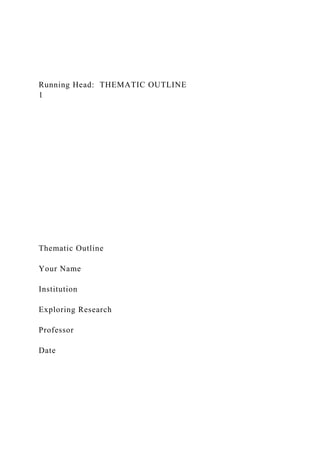
Running Head: THEMATIC OUTLINE
1
Thematic Outline
Your Name
Institution
Exploring Research
Professor
Date
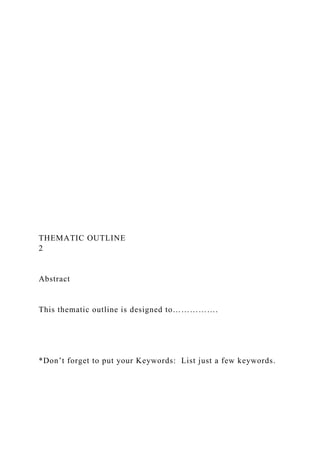
THEMATIC OUTLINE
2
Abstract
This thematic outline is designed to…………….
*Don’t forget to put your Keywords: List just a few keywords.
THEMATIC OUTLINE
3
Article
Theme
1.
A
2.
A, B
3.
D
4.
B
5.
A, D
6.
A, C
7.
B, C
8.
A, B, C
9.
A, B, C, D
10
B, C
THEMATIC OUTLINE
4
Theme
Articles Cited
A-
B-
C-
D-
E-
THEMATIC OUTLINE
5
References
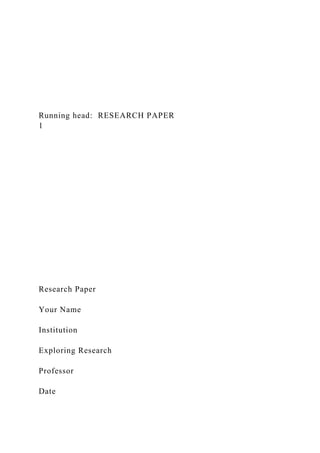
Running head: RESEARCH PAPER
1
Research Paper
Your Name
Institution
Exploring Research
Professor
Date
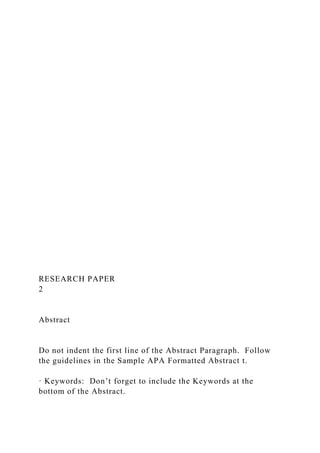
RESEARCH PAPER
2
Abstract
Do not indent the first line of the Abstract Paragraph. Follow
the guidelines in the Sample APA Formatted Abstract t.
· Keywords: Don’t forget to include the Keywords at the
bottom of the Abstract.
RESEARCH PAPER
3
RESEARCH PAPER
4
RESEARCH PAPER
5
RESEARCH PAPER
6
RESEARCH PAPER
7
RESEARCH PAPER
8
RESEARCH PAPER
9
RESEARCH PAPER
10
References
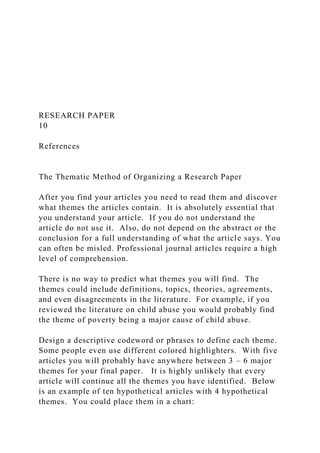
The Thematic Method of Organizing a Research Paper
After you find your articles you need to read them and discover
what themes the articles contain. It is absolutely essential that
you understand your article. If you do not understand the
article do not use it. Also, do not depend on the abstract or the
conclusion for a full understanding of what the article says. You
can often be misled. Professional journal articles require a high
level of comprehension.
There is no way to predict what themes you will find. The
themes could include definitions, topics, theories, agreements,
and even disagreements in the literature. For example, if you
reviewed the literature on child abuse you would probably find
the theme of poverty being a major cause of child abuse.
Design a descriptive codeword or phrases to define each theme.
Some people even use different colored highlighters. With five
articles you will probably have anywhere between 3 – 6 major
themes for your final paper. It is highly unlikely that every
article will continue all the themes you have identified. Below
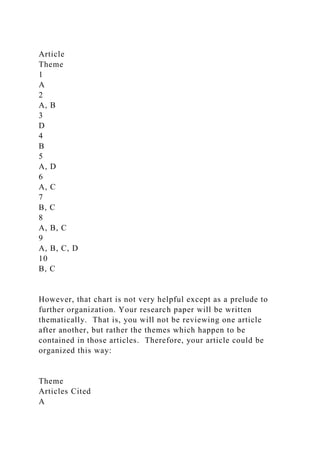
is an example of ten hypothetical articles with 4 hypothetical
themes. You could place them in a chart:
Article
Theme
1
A
2
A, B
3
D
4
B
5
A, D
6
A, C
7
B, C
8
A, B, C
9
A, B, C, D
10
B, C
However, that chart is not very helpful except as a prelude to
further organization. Your research paper will be written
thematically. That is, you will not be reviewing one article
after another, but rather the themes which happen to be
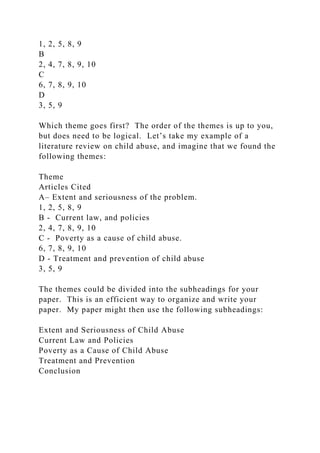
contained in those articles. Therefore, your article could be
organized this way:
Theme
Articles Cited
A
1, 2, 5, 8, 9
B
2, 4, 7, 8, 9, 10
C
6, 7, 8, 9, 10
D
3, 5, 9
Which theme goes first? The order of the themes is up to you,
but does need to be logical. Let’s take my example of a
literature review on child abuse, and imagine that we found the
following themes:
Theme
Articles Cited
A– Extent and seriousness of the problem.
1, 2, 5, 8, 9
B - Current law, and policies
2, 4, 7, 8, 9, 10
C - Poverty as a cause of child abuse.
6, 7, 8, 9, 10
D - Treatment and prevention of child abuse
3, 5, 9
The themes could be divided into the subheadings for your
paper. This is an efficient way to organize and write your
paper. My paper might then use the following subheadings:
Extent and Seriousness of Child Abuse
Current Law and Policies
Poverty as a Cause of Child Abuse
Treatment and Prevention
Conclusion
Running head: ANNOTATED BIBLIOGRAPHY
1
ANNOTATED BIBLIOGRAPHY
2
Annotated Bibliography
Your Name
Institution
Exploring Research
Professor
Date
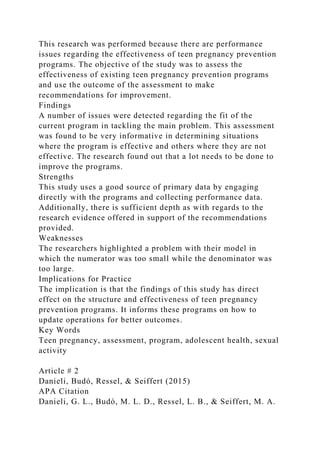
Article # 1
Feldman & Margolis (2016)
APA Citation
Feldman Farb, A., & Margolis, A. L. (2016). The teen
pregnancy prevention program (2010-2015): Synthesis of impact
findings. American Journal of Public Health 106(51), 509-515.
What is the article about?
This article is a documentation of program evaluation for teen
pregnancy prevention. The research is basically a synthesis of
the impact findings as they relate to how the pregnancy
prevention program can be improved by focusing on
performance measures and recommendations advanced by the
study.
Why was the research performed?
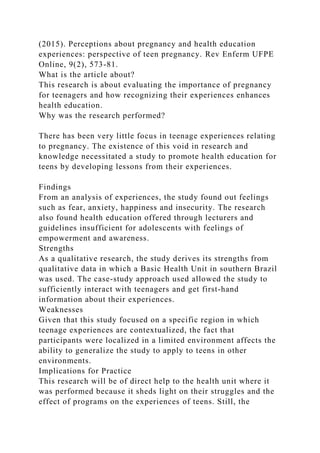
This research was performed because there are performance
issues regarding the effectiveness of teen pregnancy prevention
programs. The objective of the study was to assess the
effectiveness of existing teen pregnancy prevention programs
and use the outcome of the assessment to make
recommendations for improvement.
Findings
A number of issues were detected regarding the fit of the
current program in tackling the main problem. This assessment
was found to be very informative in determining situations
where the program is effective and others where they are not
effective. The research found out that a lot needs to be done to
improve the programs.
Strengths
This study uses a good source of primary data by engaging
directly with the programs and collecting performance data.
Additionally, there is sufficient depth as with regards to the
research evidence offered in support of the recommendations
provided.
Weaknesses
The researchers highlighted a problem with their model in
which the numerator was too small while the denominator was
too large.
Implications for Practice
The implication is that the findings of this study has direct
effect on the structure and effectiveness of teen pregnancy
prevention programs. It informs these programs on how to
update operations for better outcomes.
Key Words
Teen pregnancy, assessment, program, adolescent health, sexual
activity
Article # 2
Danieli, Budó, Ressel, & Seiffert (2015)
APA Citation
Danieli, G. L., Budó, M. L. D., Ressel, L. B., & Seiffert, M. A.
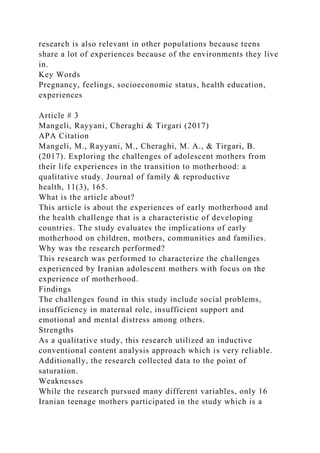
(2015). Perceptions about pregnancy and health education
experiences: perspective of teen pregnancy. Rev Enferm UFPE
Online, 9(2), 573-81.
What is the article about?
This research is about evaluating the importance of pregnancy
for teenagers and how recognizing their experiences enhances
health education.
Why was the research performed?
There has been very little focus in teenage experiences relating
to pregnancy. The existence of this void in research and
knowledge necessitated a study to promote health education for
teens by developing lessons from their experiences.
Findings
From an analysis of experiences, the study found out feelings
such as fear, anxiety, happiness and insecurity. The research
also found health education offered through lecturers and
guidelines insufficient for adolescents with feelings of
empowerment and awareness.
Strengths
As a qualitative research, the study derives its strengths from
qualitative data in which a Basic Health Unit in southern Brazil
was used. The case-study approach used allowed the study to
sufficiently interact with teenagers and get first-hand
information about their experiences.
Weaknesses
Given that this study focused on a specific region in which
teenage experiences are contextualized, the fact that
participants were localized in a limited environment affects the
ability to generalize the study to apply to teens in other
environments.
Implications for Practice
This research will be of direct help to the health unit where it
was performed because it sheds light on their struggles and the
effect of programs on the experiences of teens. Still, the
research is also relevant in other populations because teens
share a lot of experiences because of the environments they live
in.
Key Words
Pregnancy, feelings, socioeconomic status, health education,
experiences
Article # 3
Mangeli, Rayyani, Cheraghi & Tirgari (2017)
APA Citation
Mangeli, M., Rayyani, M., Cheraghi, M. A., & Tirgari, B.
(2017). Exploring the challenges of adolescent mothers from
their life experiences in the transition to motherhood: a
qualitative study. Journal of family & reproductive
health, 11(3), 165.
What is the article about?
This article is about the experiences of early motherhood and
the health challenge that is a characteristic of developing
countries. The study evaluates the implications of early
motherhood on children, mothers, communities and families.
Why was the research performed?
This research was performed to characterize the challenges
experienced by Iranian adolescent mothers with focus on the
experience of motherhood.
Findings
The challenges found in this study include social problems,
insufficiency in maternal role, insufficient support and
emotional and mental distress among others.
Strengths
As a qualitative study, this research utilized an inductive
conventional content analysis approach which is very reliable.
Additionally, the research collected data to the point of
saturation.
Weaknesses
While the research pursued many different variables, only 16
Iranian teenage mothers participated in the study which is a
relatively small sample size.
Implications for Practice
This study promotes knowledge on the experiences of early
mothers by going deeper into their lives and revealing their
feelings and experiences.
Key Words
Early motherhood, content analysis, ineffectiveness,
responsibility, child-care.
Article # 4
Mollborn (2017)
APA Citation
Mollborn, S. (2017). Teenage mothers today: what we know and
how it matters. Child development perspectives, 11(1), 63-69.
What is the article about?
This article is a status update on the predicament of teenage
mothers today from a practical and research points of view. This
is a research study that provides details about the experiences of
teenage mothers, what is known through research and what
needs to be done.
Why was the research performed?
This research was performed to establish a case for continued
research and shifts in policy to not only protect teens from
pregnancies, but to also offer a supportive environment for
young mothers.
Findings
This was a research review, it established that the depth of
knowledge and effectiveness of policies in place are
exceedingly wanting. There is need to improve societal
knowledge through research and improve the social environment
through policies.
Strengths
The main strength of this research is the depth of studies used
to inform the inferences made. Being a research review, the
study has utilized the most recent studies on the subject to
determine trends among teenage mothers today.
Weaknesses
As a research review, it has extensively relied on secondary
data. This means that in many instances, it has relied on facts
that have been influenced by perspectives as opposed to primary
data.
Implications for Practice
This research contributes to the level of awareness and health
education about teenage pregnancies and related experiences. It
calls for improvements in the socioeconomic environment that
teenage mothers live.
Key Words
Teenage mothers, policy, socioeconomic, teenage fertility,
societal trends
Article # 5
Kirven (2014)
APA Citation
Kirven, J. (2014). Maintaining Their Future After Teen
Pregnancy: Strategies for Staying Physically and Mentally
Fit. International Journal of Childbirth Education, 29(1).
What is the article about?
This research is about how teenage mothers can engage coping
strategies to keep themselves physically and mentally fit.
Why was the research performed?
This research was performed because adolescents are confronted
with varying levels of social pressure and mental torture that
impacts their physical and mental health. There is need to
communicate strategies that can help them cope and sustain a
healthy life after childbearing.
Findings
This research review found out that teenage mothers are not
well-informed of strategies they can use to avoid obesity and
other physical as well as emotional health effects of teen
childbearing.
Strengths
The research is highly descriptive and informative, this ensures
that it reaches its audience well.
Weaknesses
This research has failed to adequately illustrate the source of
data used or the origin of the recommendations offered as
strategies. The research should provide a scientific basis for its
strategies.
Implications for Practice
This research can be readily consumed by its target population
because it is straightforward and well-structured. Teens can get
the information they need quite easily and use it to better their
physical and emotional health.
Key Words
Stressors, obesity, coping strategies, risk factors, interventions.
Article # 6
Whitworth (2017)
APA Citation
Whitworth, T. R. (2017). Teen childbearing and depression: do
pregnancy attitudes matter?. Journal of Marriage and
Family, 79(2), 390-404.
What is the article about?
This research is about evaluating how young women’s attitudes
influence the relationship between teen childbearing and
depression.
Why was the research performed?
This research was performed to show that attitudes held by
teens before they become mothers has an effect on depression
induced by childbearing. Attitudes have an effect on emotions
and psychological health of teen mothers after delivery.
Findings
This research found significant variations as to the
manifestation of depressive symptoms among women of
different ages. However, the research showed that teens who
had negative pregnancy attitudes sustained these depressive
symptoms after childbirth.
Strengths
Besides retrieving data from a reliable database, this research
conducted a comprehensive literature review on the subject
which correctly positioned its contribution to the existing body
of research on the subject.
Weaknesses
The first limitation is that the research used participants, some
of which were approaching the end of their teen years.
Secondly, the research used unreliable wording for pregnancy
attitudes.
Implications for Practice
Despite the two limitations, this study will actively inform the
structure of programs that prevent teenage pregnancy by
recommending a new approach that focuses on their attitudes to
promote proper mental health before and after childbirth.
Key Words
Teen childbearing, depression, attitudes.

Running Head THEMATIC OUTLINE .docx

  • 1.
    Running Head: THEMATICOUTLINE 1 Thematic Outline Your Name Institution Exploring Research Professor Date
  • 2.
    THEMATIC OUTLINE 2 Abstract This thematicoutline is designed to……………. *Don’t forget to put your Keywords: List just a few keywords.
  • 3.
  • 4.
    3 Article Theme 1. A 2. A, B 3. D 4. B 5. A, D 6. A,C 7. B, C 8. A, B, C 9. A, B, C, D 10 B, C
  • 5.
  • 6.
  • 7.
  • 9.
    Running head: RESEARCHPAPER 1 Research Paper Your Name Institution Exploring Research Professor Date
  • 10.
    RESEARCH PAPER 2 Abstract Do notindent the first line of the Abstract Paragraph. Follow the guidelines in the Sample APA Formatted Abstract t. · Keywords: Don’t forget to include the Keywords at the bottom of the Abstract.
  • 12.
  • 13.
  • 15.
  • 16.
  • 17.
  • 19.
  • 20.
  • 22.
    RESEARCH PAPER 10 References The ThematicMethod of Organizing a Research Paper After you find your articles you need to read them and discover what themes the articles contain. It is absolutely essential that you understand your article. If you do not understand the article do not use it. Also, do not depend on the abstract or the conclusion for a full understanding of what the article says. You can often be misled. Professional journal articles require a high level of comprehension. There is no way to predict what themes you will find. The themes could include definitions, topics, theories, agreements, and even disagreements in the literature. For example, if you reviewed the literature on child abuse you would probably find the theme of poverty being a major cause of child abuse. Design a descriptive codeword or phrases to define each theme. Some people even use different colored highlighters. With five articles you will probably have anywhere between 3 – 6 major themes for your final paper. It is highly unlikely that every article will continue all the themes you have identified. Below is an example of ten hypothetical articles with 4 hypothetical themes. You could place them in a chart:
  • 23.
    Article Theme 1 A 2 A, B 3 D 4 B 5 A, D 6 A,C 7 B, C 8 A, B, C 9 A, B, C, D 10 B, C However, that chart is not very helpful except as a prelude to further organization. Your research paper will be written thematically. That is, you will not be reviewing one article after another, but rather the themes which happen to be contained in those articles. Therefore, your article could be organized this way: Theme Articles Cited A
  • 24.
    1, 2, 5,8, 9 B 2, 4, 7, 8, 9, 10 C 6, 7, 8, 9, 10 D 3, 5, 9 Which theme goes first? The order of the themes is up to you, but does need to be logical. Let’s take my example of a literature review on child abuse, and imagine that we found the following themes: Theme Articles Cited A– Extent and seriousness of the problem. 1, 2, 5, 8, 9 B - Current law, and policies 2, 4, 7, 8, 9, 10 C - Poverty as a cause of child abuse. 6, 7, 8, 9, 10 D - Treatment and prevention of child abuse 3, 5, 9 The themes could be divided into the subheadings for your paper. This is an efficient way to organize and write your paper. My paper might then use the following subheadings: Extent and Seriousness of Child Abuse Current Law and Policies Poverty as a Cause of Child Abuse Treatment and Prevention Conclusion
  • 25.
    Running head: ANNOTATEDBIBLIOGRAPHY 1 ANNOTATED BIBLIOGRAPHY 2 Annotated Bibliography Your Name Institution Exploring Research Professor Date
  • 26.
    Article # 1 Feldman& Margolis (2016) APA Citation Feldman Farb, A., & Margolis, A. L. (2016). The teen pregnancy prevention program (2010-2015): Synthesis of impact findings. American Journal of Public Health 106(51), 509-515. What is the article about? This article is a documentation of program evaluation for teen pregnancy prevention. The research is basically a synthesis of the impact findings as they relate to how the pregnancy prevention program can be improved by focusing on performance measures and recommendations advanced by the study. Why was the research performed?
  • 27.
    This research wasperformed because there are performance issues regarding the effectiveness of teen pregnancy prevention programs. The objective of the study was to assess the effectiveness of existing teen pregnancy prevention programs and use the outcome of the assessment to make recommendations for improvement. Findings A number of issues were detected regarding the fit of the current program in tackling the main problem. This assessment was found to be very informative in determining situations where the program is effective and others where they are not effective. The research found out that a lot needs to be done to improve the programs. Strengths This study uses a good source of primary data by engaging directly with the programs and collecting performance data. Additionally, there is sufficient depth as with regards to the research evidence offered in support of the recommendations provided. Weaknesses The researchers highlighted a problem with their model in which the numerator was too small while the denominator was too large. Implications for Practice The implication is that the findings of this study has direct effect on the structure and effectiveness of teen pregnancy prevention programs. It informs these programs on how to update operations for better outcomes. Key Words Teen pregnancy, assessment, program, adolescent health, sexual activity Article # 2 Danieli, Budó, Ressel, & Seiffert (2015) APA Citation Danieli, G. L., Budó, M. L. D., Ressel, L. B., & Seiffert, M. A.
  • 28.
    (2015). Perceptions aboutpregnancy and health education experiences: perspective of teen pregnancy. Rev Enferm UFPE Online, 9(2), 573-81. What is the article about? This research is about evaluating the importance of pregnancy for teenagers and how recognizing their experiences enhances health education. Why was the research performed? There has been very little focus in teenage experiences relating to pregnancy. The existence of this void in research and knowledge necessitated a study to promote health education for teens by developing lessons from their experiences. Findings From an analysis of experiences, the study found out feelings such as fear, anxiety, happiness and insecurity. The research also found health education offered through lecturers and guidelines insufficient for adolescents with feelings of empowerment and awareness. Strengths As a qualitative research, the study derives its strengths from qualitative data in which a Basic Health Unit in southern Brazil was used. The case-study approach used allowed the study to sufficiently interact with teenagers and get first-hand information about their experiences. Weaknesses Given that this study focused on a specific region in which teenage experiences are contextualized, the fact that participants were localized in a limited environment affects the ability to generalize the study to apply to teens in other environments. Implications for Practice This research will be of direct help to the health unit where it was performed because it sheds light on their struggles and the effect of programs on the experiences of teens. Still, the
  • 29.
    research is alsorelevant in other populations because teens share a lot of experiences because of the environments they live in. Key Words Pregnancy, feelings, socioeconomic status, health education, experiences Article # 3 Mangeli, Rayyani, Cheraghi & Tirgari (2017) APA Citation Mangeli, M., Rayyani, M., Cheraghi, M. A., & Tirgari, B. (2017). Exploring the challenges of adolescent mothers from their life experiences in the transition to motherhood: a qualitative study. Journal of family & reproductive health, 11(3), 165. What is the article about? This article is about the experiences of early motherhood and the health challenge that is a characteristic of developing countries. The study evaluates the implications of early motherhood on children, mothers, communities and families. Why was the research performed? This research was performed to characterize the challenges experienced by Iranian adolescent mothers with focus on the experience of motherhood. Findings The challenges found in this study include social problems, insufficiency in maternal role, insufficient support and emotional and mental distress among others. Strengths As a qualitative study, this research utilized an inductive conventional content analysis approach which is very reliable. Additionally, the research collected data to the point of saturation. Weaknesses While the research pursued many different variables, only 16 Iranian teenage mothers participated in the study which is a
  • 30.
    relatively small samplesize. Implications for Practice This study promotes knowledge on the experiences of early mothers by going deeper into their lives and revealing their feelings and experiences. Key Words Early motherhood, content analysis, ineffectiveness, responsibility, child-care. Article # 4 Mollborn (2017) APA Citation Mollborn, S. (2017). Teenage mothers today: what we know and how it matters. Child development perspectives, 11(1), 63-69. What is the article about? This article is a status update on the predicament of teenage mothers today from a practical and research points of view. This is a research study that provides details about the experiences of teenage mothers, what is known through research and what needs to be done. Why was the research performed? This research was performed to establish a case for continued research and shifts in policy to not only protect teens from pregnancies, but to also offer a supportive environment for young mothers. Findings This was a research review, it established that the depth of knowledge and effectiveness of policies in place are exceedingly wanting. There is need to improve societal knowledge through research and improve the social environment through policies. Strengths The main strength of this research is the depth of studies used to inform the inferences made. Being a research review, the study has utilized the most recent studies on the subject to determine trends among teenage mothers today.
  • 31.
    Weaknesses As a researchreview, it has extensively relied on secondary data. This means that in many instances, it has relied on facts that have been influenced by perspectives as opposed to primary data. Implications for Practice This research contributes to the level of awareness and health education about teenage pregnancies and related experiences. It calls for improvements in the socioeconomic environment that teenage mothers live. Key Words Teenage mothers, policy, socioeconomic, teenage fertility, societal trends Article # 5 Kirven (2014) APA Citation Kirven, J. (2014). Maintaining Their Future After Teen Pregnancy: Strategies for Staying Physically and Mentally Fit. International Journal of Childbirth Education, 29(1). What is the article about? This research is about how teenage mothers can engage coping strategies to keep themselves physically and mentally fit. Why was the research performed? This research was performed because adolescents are confronted with varying levels of social pressure and mental torture that impacts their physical and mental health. There is need to communicate strategies that can help them cope and sustain a healthy life after childbearing. Findings This research review found out that teenage mothers are not well-informed of strategies they can use to avoid obesity and other physical as well as emotional health effects of teen childbearing. Strengths The research is highly descriptive and informative, this ensures
  • 32.
    that it reachesits audience well. Weaknesses This research has failed to adequately illustrate the source of data used or the origin of the recommendations offered as strategies. The research should provide a scientific basis for its strategies. Implications for Practice This research can be readily consumed by its target population because it is straightforward and well-structured. Teens can get the information they need quite easily and use it to better their physical and emotional health. Key Words Stressors, obesity, coping strategies, risk factors, interventions. Article # 6 Whitworth (2017) APA Citation Whitworth, T. R. (2017). Teen childbearing and depression: do pregnancy attitudes matter?. Journal of Marriage and Family, 79(2), 390-404. What is the article about? This research is about evaluating how young women’s attitudes influence the relationship between teen childbearing and depression. Why was the research performed? This research was performed to show that attitudes held by teens before they become mothers has an effect on depression induced by childbearing. Attitudes have an effect on emotions and psychological health of teen mothers after delivery. Findings This research found significant variations as to the manifestation of depressive symptoms among women of different ages. However, the research showed that teens who had negative pregnancy attitudes sustained these depressive symptoms after childbirth. Strengths
  • 33.
    Besides retrieving datafrom a reliable database, this research conducted a comprehensive literature review on the subject which correctly positioned its contribution to the existing body of research on the subject. Weaknesses The first limitation is that the research used participants, some of which were approaching the end of their teen years. Secondly, the research used unreliable wording for pregnancy attitudes. Implications for Practice Despite the two limitations, this study will actively inform the structure of programs that prevent teenage pregnancy by recommending a new approach that focuses on their attitudes to promote proper mental health before and after childbirth. Key Words Teen childbearing, depression, attitudes.