Università degli studi di Bari “Aldo Moro”
                         Dipartimento di Informatica


      A Run Length Smoothing-Based Algorithm
     for non-Manhattan Document Segmentation
                           S. Ferilli, F. Leuzzi, F. Rotella, F. Esposito
                               Via Orabona, 4 - 70126 Bari – Italy
                                   {ferilli, esposito}@di.uniba.it
L.A.C.A.M.                    {fabio.leuzzi, fulvio.rotella}@uniba.it
http://lacam.di.uniba.it
Introduction
● Automatic document processing a hot topic
  ― Layout analysis a fundamental step

    ● Identification of frames (relevant components in the document)

    ● Performance can determine quality and feasibility of the whole process

● Two different…

    ● Kinds of sources: Digitized (scanned) vs. Natively digital documents

    ● Categories of layouts: Manhattan vs. Non-Manhattan

    ● Types of algorithms: Top-down vs. Bottom-up


● Run Length Smoothing Algorithm
    ● Manhattan Layout

● Other works exploit or try to improve the RLSA by setting its parameters

● Many works on Manhattan layout

  ― Top-down strategies

● Less works on non-Manhattan layout

  ― Bottom-up strategies


●   The Manhattan assumption holds for many typeset documents, simplifies
    document processing…BUT cannot be assumed in general
RLSO
                   Application to scanned images
RLSO (Run Length Smoothing with OR)
1) horizontal smoothing with threshold th, row by row

2) vertical smoothing with threshold tv, column by column
●   logical OR of the images obtained in steps 1 and 2
                                         th = 5
                                         tv = 4
                                        (AND)
RLSO


                         ?
Application to scanned images
RLSO
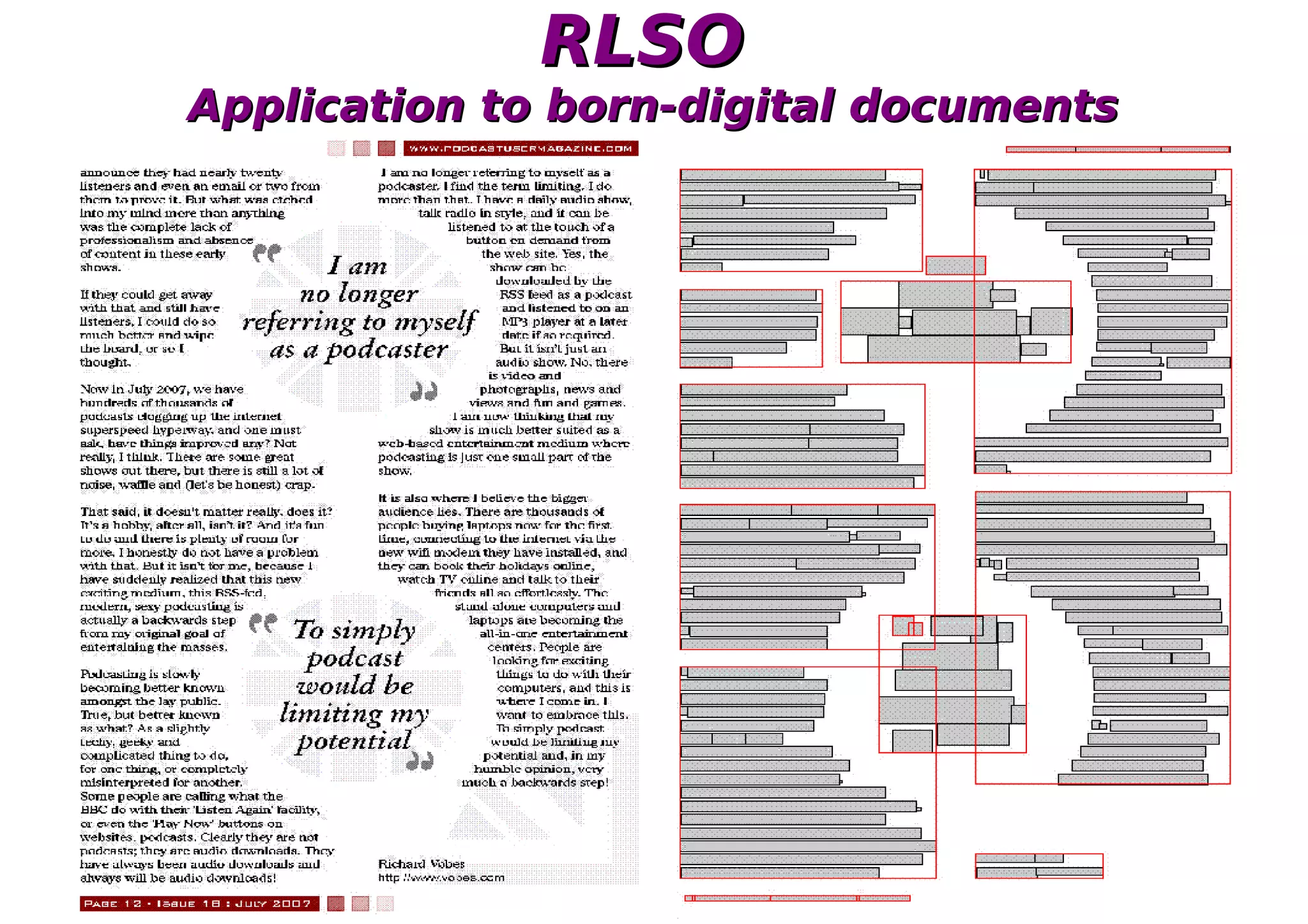
              Application to born-digital documents
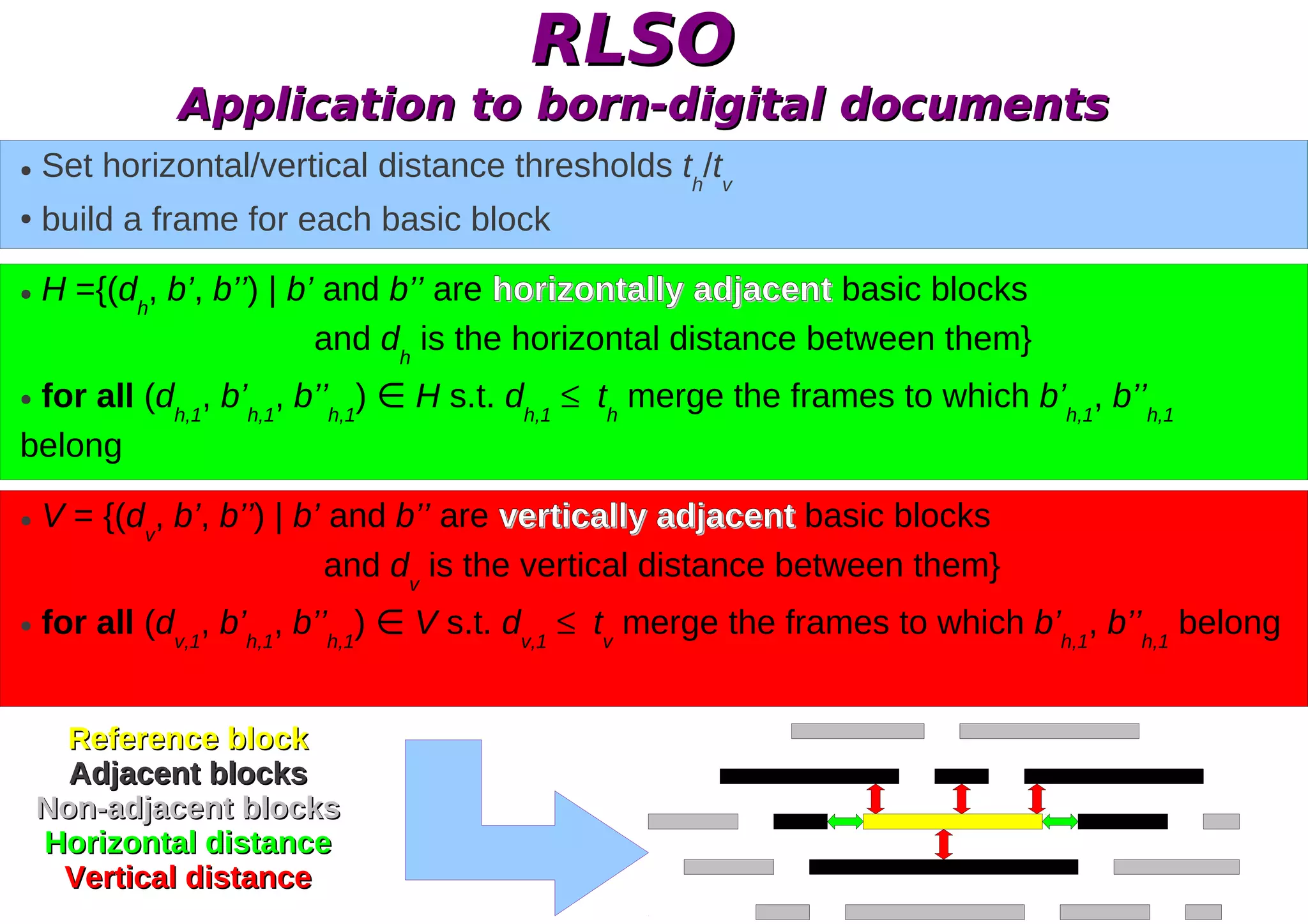
●   Set horizontal/vertical distance thresholds th/tv
●   build a frame for each basic block
●   H ={(dh, b’, b’’) | b’ and b’’ are horizontally adjacent basic blocks
                          and dh is the horizontal distance between them}
●for all (dh,1, b’h,1, b’’h,1) ∈ H s.t. dh,1 ≤ th merge the frames to which b’h,1, b’’h,1
belong

●   V = {(dv, b’, b’’) | b’ and b’’ are vertically adjacent basic blocks
                           and dv is the vertical distance between them}
●   for all (dv,1, b’h,1, b’’h,1) ∈ V s.t. dv,1 ≤ tv merge the frames to which b’h,1, b’’h,1 belong


      Reference block
      Adjacent blocks
    Non-adjacent blocks
    Horizontal distance
     Vertical distance
RLSO
Application to born-digital documents
RLSO
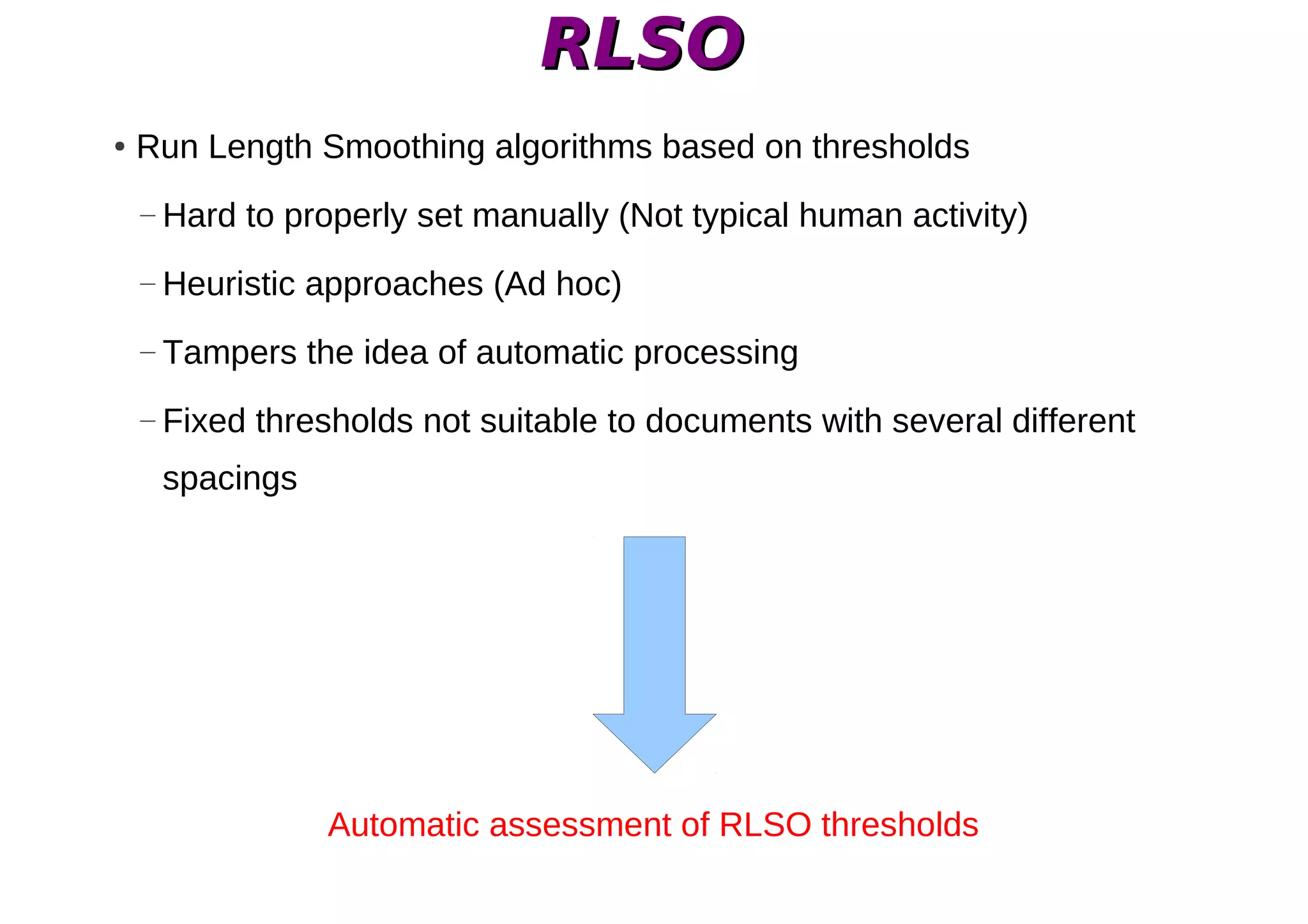
●   Run Length Smoothing algorithms based on thresholds
    ―   Hard to properly set manually (Not typical human activity)
    ―   Heuristic approaches (Ad hoc)
    ―   Tampers the idea of automatic processing
    ―   Fixed thresholds not suitable to documents with several different
        spacings


                   Automatic assessment of RLSO thresholds
RLSO
                   Automatic threshold assessment
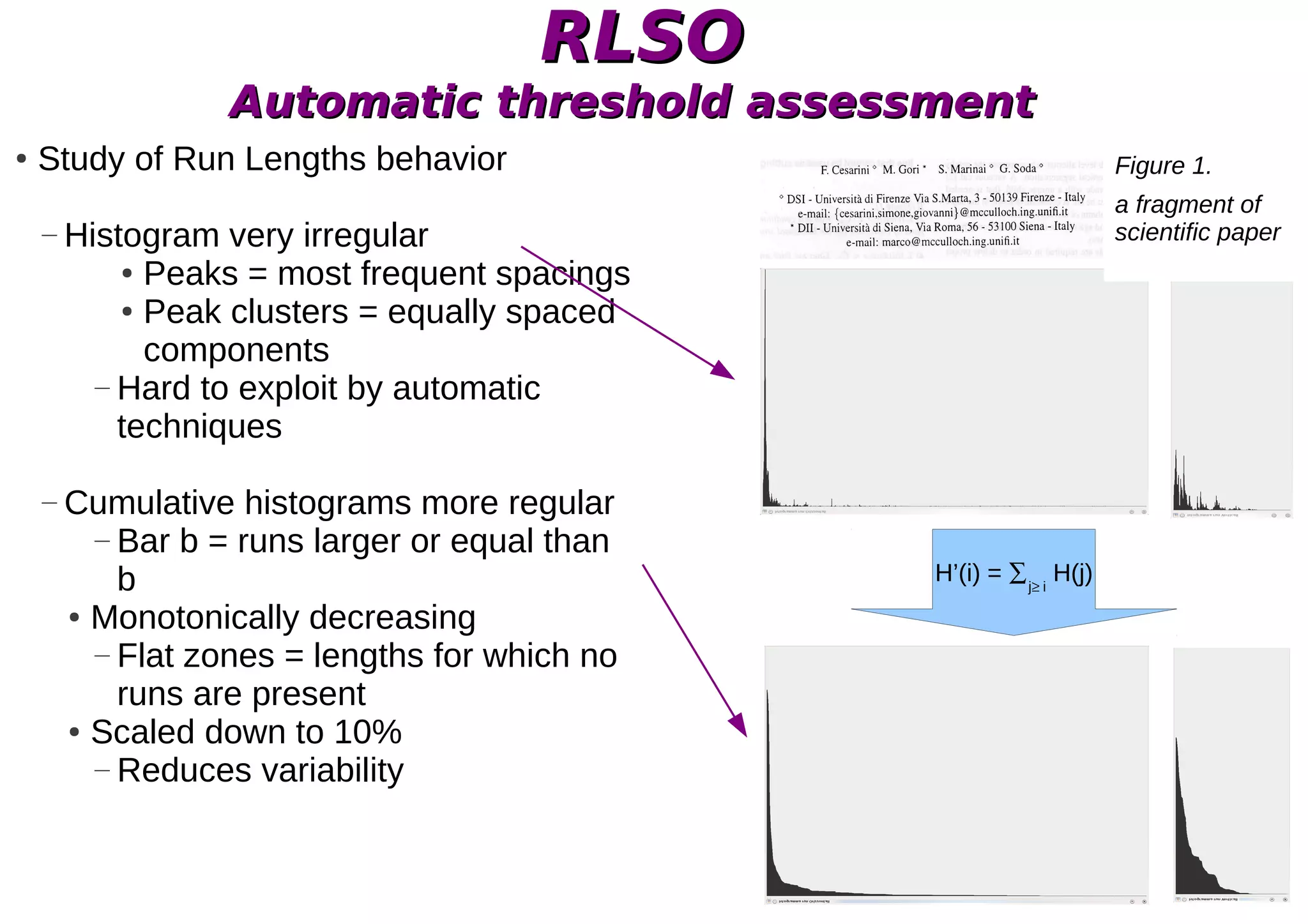
●   Study of Run Lengths behavior                                     Figure 1.
                                                                      a fragment of
    ―   Histogram very irregular                                      scientific paper
            ● Peaks = most frequent spacings

            ● Peak clusters = equally spaced

              components
          ― Hard to exploit by automatic

            techniques

    ―   Cumulative histograms more regular
          ― Bar b = runs larger or equal than

            b                                   H’(i) = ∑ j≥ i H(j)
        ● Monotonically decreasing

          ― Flat zones = lengths for which no

            runs are present
        ● Scaled down to 10%

          ― Reduces variability
RLSO
                    Automatic threshold assessment
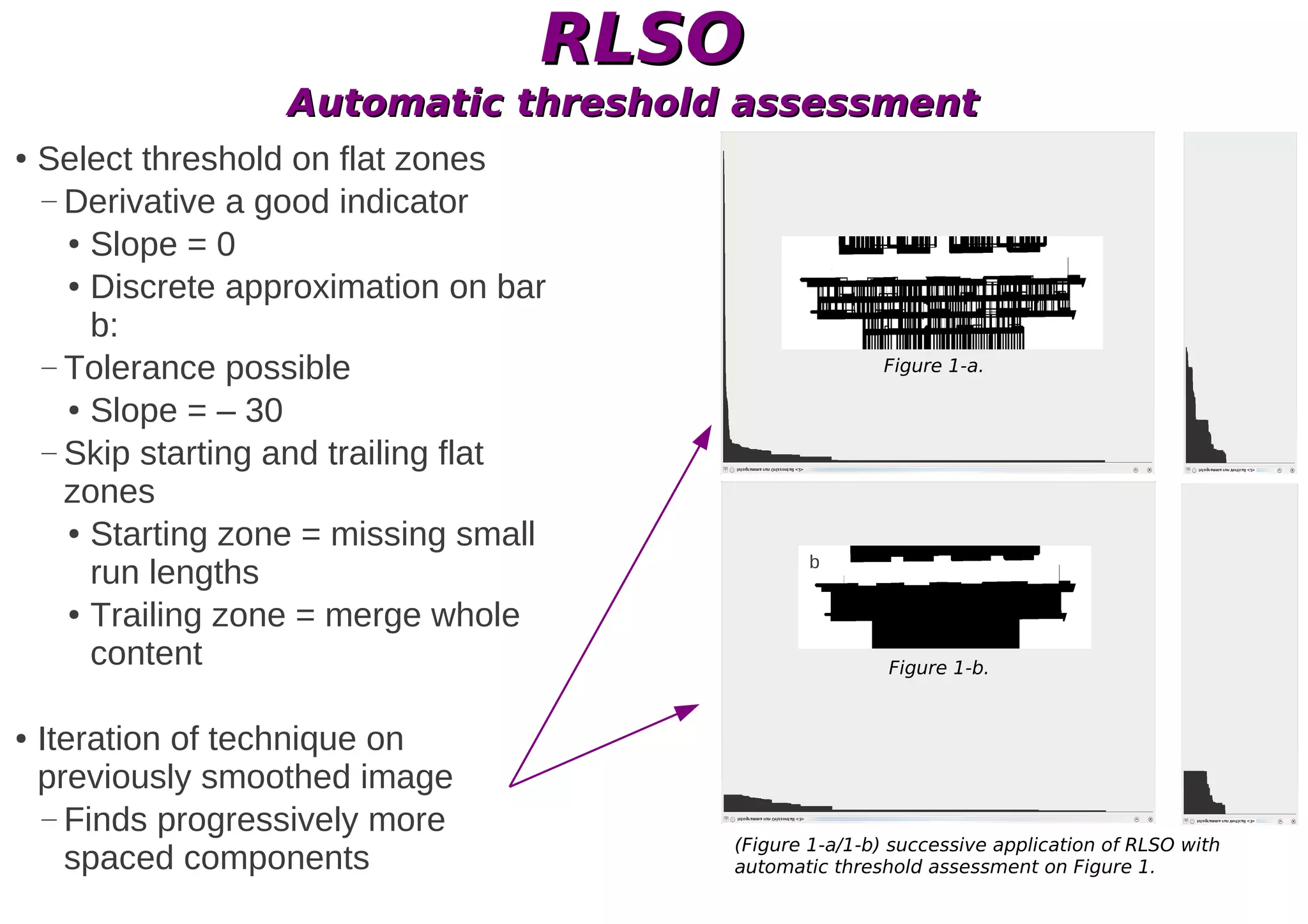
●   Select threshold on flat zones
    ― Derivative a good indicator

      ● Slope = 0

      ● Discrete approximation on bar

        b:
    ― Tolerance possible                               Figure 1-a.

      ● Slope = – 30

    ― Skip starting and trailing flat

      zones
      ● Starting zone = missing small
                                                b
        run lengths
      ● Trailing zone = merge whole

        content                                         Figure 1-b.


●   Iteration of technique on
    previously smoothed image
    ― Finds progressively more
                                        (Figure 1-a/1-b) successive application of RLSO with
      spaced components                 automatic threshold assessment on Figure 1.
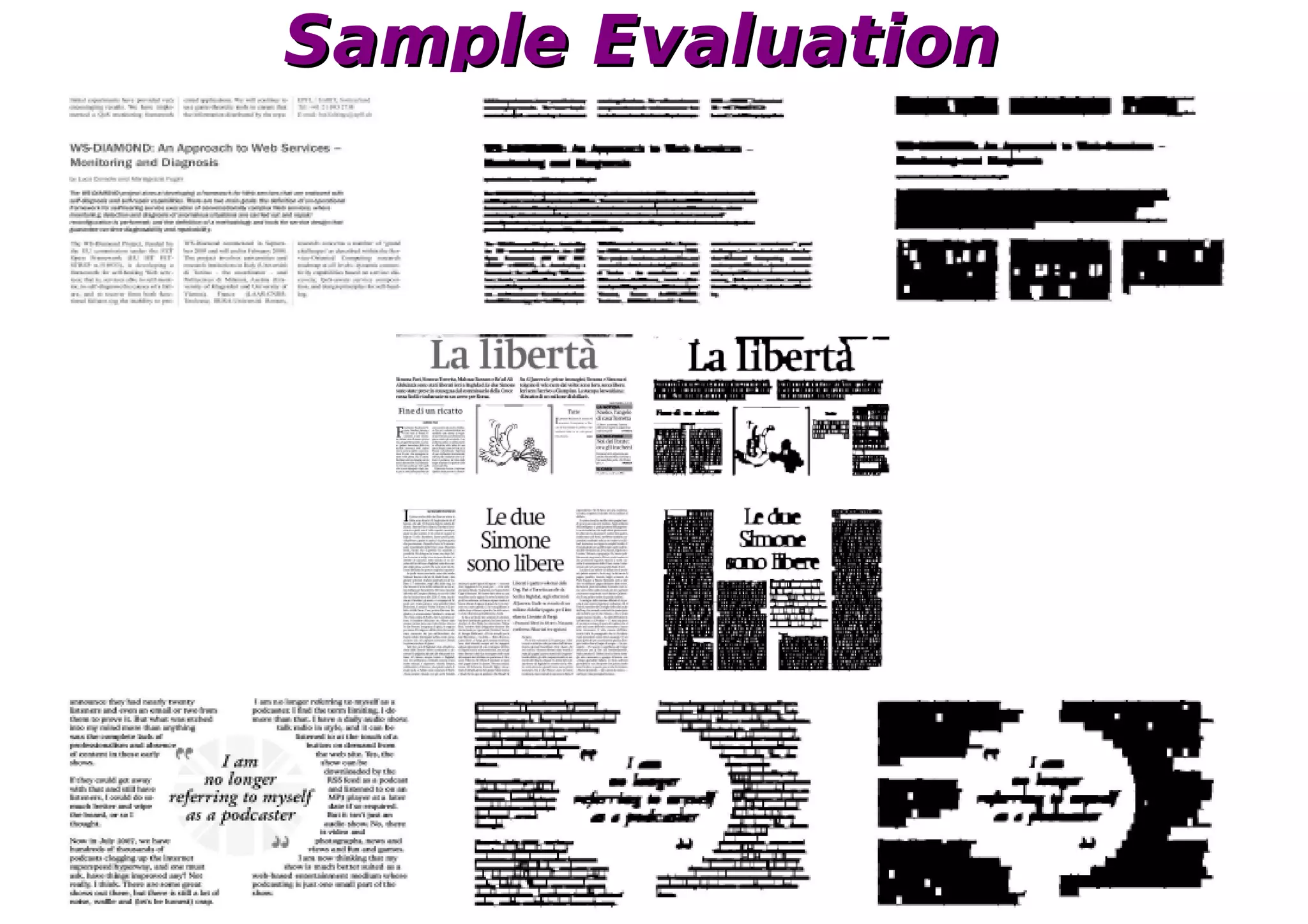
Sample Evaluation
Conclusions
●   RLSO (Run Length Smoothing with OR) identifies runs of white pixel in the
    document image and fill them with black pixels whenever they are shorter than a
    given threshold
     –   Both Manhattan and Non-Manhattan Layout
     –   Version for natively digital documents
●   Automatic thresholding effective on documents having
     –   single character size
     –   different spacings

●   Good baseline towards more complex documents
     –   different character sizes
     –   graphics
●   Current and future Work
     –   Stop criterion for iteration
     –   Clustering based on positioning and spacing

A Run Length Smoothing-Based Algorithm for Non-Manhattan Document Segmentation

  • 1.
    Università degli studidi Bari “Aldo Moro” Dipartimento di Informatica A Run Length Smoothing-Based Algorithm for non-Manhattan Document Segmentation S. Ferilli, F. Leuzzi, F. Rotella, F. Esposito Via Orabona, 4 - 70126 Bari – Italy {ferilli, esposito}@di.uniba.it L.A.C.A.M. {fabio.leuzzi, fulvio.rotella}@uniba.it http://lacam.di.uniba.it
  • 2.
    Introduction ● Automatic documentprocessing a hot topic ― Layout analysis a fundamental step ● Identification of frames (relevant components in the document) ● Performance can determine quality and feasibility of the whole process ● Two different… ● Kinds of sources: Digitized (scanned) vs. Natively digital documents ● Categories of layouts: Manhattan vs. Non-Manhattan ● Types of algorithms: Top-down vs. Bottom-up ● Run Length Smoothing Algorithm ● Manhattan Layout ● Other works exploit or try to improve the RLSA by setting its parameters ● Many works on Manhattan layout ― Top-down strategies ● Less works on non-Manhattan layout ― Bottom-up strategies ● The Manhattan assumption holds for many typeset documents, simplifies document processing…BUT cannot be assumed in general
  • 3.
    RLSO Application to scanned images RLSO (Run Length Smoothing with OR) 1) horizontal smoothing with threshold th, row by row 2) vertical smoothing with threshold tv, column by column ● logical OR of the images obtained in steps 1 and 2 th = 5 tv = 4 (AND)
  • 4.
    RLSO ? Application to scanned images
  • 5.
    RLSO Application to born-digital documents ● Set horizontal/vertical distance thresholds th/tv ● build a frame for each basic block ● H ={(dh, b’, b’’) | b’ and b’’ are horizontally adjacent basic blocks and dh is the horizontal distance between them} ●for all (dh,1, b’h,1, b’’h,1) ∈ H s.t. dh,1 ≤ th merge the frames to which b’h,1, b’’h,1 belong ● V = {(dv, b’, b’’) | b’ and b’’ are vertically adjacent basic blocks and dv is the vertical distance between them} ● for all (dv,1, b’h,1, b’’h,1) ∈ V s.t. dv,1 ≤ tv merge the frames to which b’h,1, b’’h,1 belong Reference block Adjacent blocks Non-adjacent blocks Horizontal distance Vertical distance
  • 6.
  • 7.
    RLSO ● Run Length Smoothing algorithms based on thresholds ― Hard to properly set manually (Not typical human activity) ― Heuristic approaches (Ad hoc) ― Tampers the idea of automatic processing ― Fixed thresholds not suitable to documents with several different spacings Automatic assessment of RLSO thresholds
  • 8.
    RLSO Automatic threshold assessment ● Study of Run Lengths behavior Figure 1. a fragment of ― Histogram very irregular scientific paper ● Peaks = most frequent spacings ● Peak clusters = equally spaced components ― Hard to exploit by automatic techniques ― Cumulative histograms more regular ― Bar b = runs larger or equal than b H’(i) = ∑ j≥ i H(j) ● Monotonically decreasing ― Flat zones = lengths for which no runs are present ● Scaled down to 10% ― Reduces variability
  • 9.
    RLSO Automatic threshold assessment ● Select threshold on flat zones ― Derivative a good indicator ● Slope = 0 ● Discrete approximation on bar b: ― Tolerance possible Figure 1-a. ● Slope = – 30 ― Skip starting and trailing flat zones ● Starting zone = missing small b run lengths ● Trailing zone = merge whole content Figure 1-b. ● Iteration of technique on previously smoothed image ― Finds progressively more (Figure 1-a/1-b) successive application of RLSO with spaced components automatic threshold assessment on Figure 1.
  • 10.
  • 11.
    Conclusions ● RLSO (Run Length Smoothing with OR) identifies runs of white pixel in the document image and fill them with black pixels whenever they are shorter than a given threshold – Both Manhattan and Non-Manhattan Layout – Version for natively digital documents ● Automatic thresholding effective on documents having – single character size – different spacings ● Good baseline towards more complex documents – different character sizes – graphics ● Current and future Work – Stop criterion for iteration – Clustering based on positioning and spacing