Rule-based Capture/Storage
of Scientific Data from PDF Files
and Export using a
Generic Scientific Data Model
Stuart J. Chalk, Audrey Bartholomew, Bashar Baraz, John Turner
Department of Chemistry, University of North Florida
schalk@unf.edu
CINF Paper 3 – 251st ACS Meeting Spring 2016
#ACSCINFDataSummit
 Data, Data Everywhere
 Extracting Text from PDF Files
 Making Sense of Textual Data
 Rules and Rulesets
 Overcoming Incompatibilities
 A Generic Scientific Data Model
 Building the Website
 Functionality of the Website
 Next Steps
 Future Plans
 Conclusion
Outline
Data, Data Everywhere
 U.S. Gov. “…open and machine readable data…” (5/2013)
 http://www.data.gov/
 NSF's Open Data Inventory (http://www.nsf.gov/data/)
 Expand -- publish additional data assets in the inventory:
 Enrich -- improve the discoverability, management, and
reusability of agency data assets through metadata.
 Open -- provide machine-readable and publically accessible
agency data assets.
 Funding agencies require “Data Management Plans”
 MPS Open Data Workshop - https://mpsopendata.crc.nd.edu/
Data, Data Everywhere
(but interoperable?)
 Joint Declaration of Data Citation Principles
Force 11 - https://www.force11.org/datacitation
 Importance
 Credit and Attribution
 Unique Identification
 Access
 Persistence
 Specificity and Verifiability
 Interoperability and Flexibility
 PDF Files are not meant to be vehicles for research data
sharing – but sadly have become the default
 Force 11 grew out of an initial meeting at UC San Diego in
2011 – Beyond the PDF
https://sites.google.com/site/beyondthepdf/
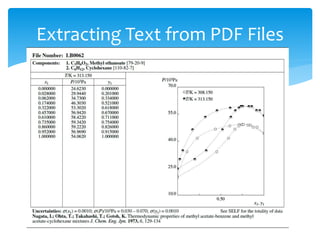
 PDF files store text in many places, and not in logical
sequence as it appears on the page
 Scanned images can be converted to text using optical
character recognition
 Many tools to get text out of PDF files
Extracting Text from PDF Files
 Software tested
 Adobe acrobat (plain text, accessible text, RTF, XML)
Converted to the newest PDF version
 lapdftext (Location Aware)
https://github.com/GullyAPCBurns/lapdftext
 pdftotext (part of)
Xpdf http://www.foolabs.com/xpdf/home.html
Extracting Text from PDF Files
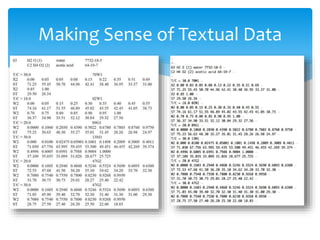
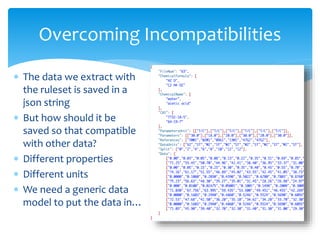
Making Sense of Textual Data
 Process the text file one line at a time
 ‘Generic’ rules to make decisions on a line
 May be multiple rules for one line
 Includes instructions to move down or stay on line
 Sets of rules tailored to match the generic layout of the text
 These were linked to datatype and publication
Rules and Rulesets
More sophiticated GetFormula regex (([A-Z][a-zA-Z0-9]{0,2}s)+)
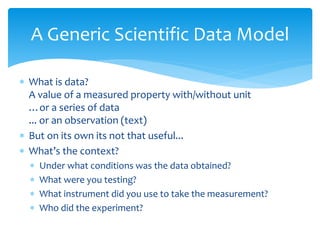
 The data we extract with
the ruleset is saved in a
json string
 But how should it be
saved so that compatible
with other data?
 Different properties
 Different units
 We need a generic data
model to put the data in…
Overcoming Incompatibilities
 What is data?
A value of a measured property with/without unit
…or a series of data
... or an observation (text)
 But on its own its not that useful...
 What’s the context?
 Under what conditions was the data obtained?
 What were you testing?
 What instrument did you use to take the measurement?
 Who did the experiment?
A Generic Scientific Data Model
 How to store all this information?
 Relational database – very structured, data has to fixed schema
 Graph database – unstructured, flexible, non-standardized
 Intermediate solution needed
 Must have some structure so it can be easily searched
 Must be flexible to handle and type of data
 Approach
 Use JSON for linked data (JSON-LD) as format to hold data
 Provide a framework upon which you can hang the data and
metadata
A Generic Scientific Data Model
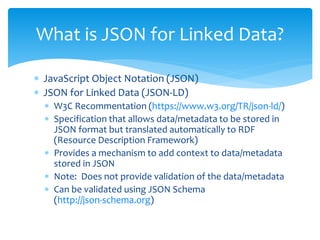
 JavaScript Object Notation (JSON)
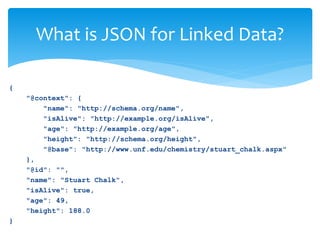
 JSON for Linked Data (JSON-LD)
 W3C Recommentation (https://www.w3.org/TR/json-ld/)
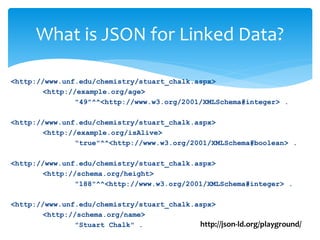
 Specification that allows data/metadata to be stored in
JSON format but translated automatically to RDF
(Resource Description Framework)
 Provides a mechanism to add context to data/metadata
stored in JSON
 Note: Does not provide validation of the data/metadata
 Can be validated using JSON Schema
(http://json-schema.org)
What is JSON for Linked Data?
{
"@context": {
"name": "http://schema.org/name",
"isAlive": "http://example.org/isAlive",
"age": "http://example.org/age",
"height": "http://schema.org/height",
"@base": "http://www.unf.edu/chemistry/stuart_chalk.aspx"
},
"@id": "",
"name": "Stuart Chalk",
"isAlive": true,
"age": 49,
"height": 188.0
}
What is JSON for Linked Data?
<http://www.unf.edu/chemistry/stuart_chalk.aspx>
<http://example.org/age>
"49"^^<http://www.w3.org/2001/XMLSchema#integer> .
<http://www.unf.edu/chemistry/stuart_chalk.aspx>
<http://example.org/isAlive>
"true"^^<http://www.w3.org/2001/XMLSchema#boolean> .
<http://www.unf.edu/chemistry/stuart_chalk.aspx>
<http://schema.org/height>
"188"^^<http://www.w3.org/2001/XMLSchema#integer> .
<http://www.unf.edu/chemistry/stuart_chalk.aspx>
<http://schema.org/name>
"Stuart Chalk" . http://json-ld.org/playground/
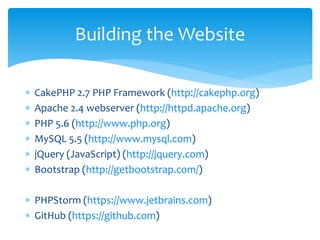
 CakePHP 2.7 PHP Framework (http://cakephp.org)
 Apache 2.4 webserver (http://httpd.apache.org)
 PHP 5.6 (http://www.php.org)
 MySQL 5.5 (http://www.mysql.com)
 jQuery (JavaScript) (http://jquery.com)
 Bootstrap (http://getbootstrap.com/)
 PHPStorm (https://www.jetbrains.com)
 GitHub (https://github.com)
Building the Website
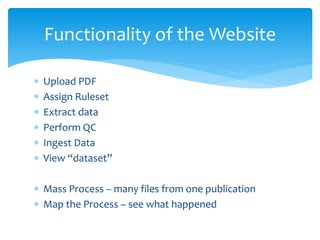
 Upload PDF
 Assign Ruleset
 Extract data
 Perform QC
 Ingest Data
 View “dataset”
 Mass Process – many files from one publication
 Map the Process – see what happened
Functionality of the Website
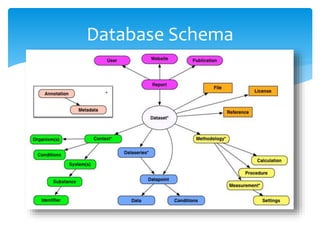
Database Schema
Live Demo
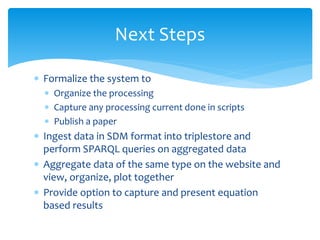
 Formalize the system to
 Organize the processing
 Capture any processing current done in scripts
 Publish a paper
 Ingest data in SDM format into triplestore and
perform SPARQL queries on aggregated data
 Aggregate data of the same type on the website and
view, organize, plot together
 Provide option to capture and present equation
based results
Next Steps
Take Home
 ~27,500 PDF pages processed
 ~530,000 pieces of physical property data extracted
 Data can be extracted from PDF files as long as the
 Text is cleaned up
 Context is encoded in the process of extraction
 Data homogeneity can be achieved by using a generic
scientific data model
 More work needed to create robust system to handle data
in any “well structured” format
 schalk@unf.edu
 Phone: 904-620-5311
 Skype: stuartchalk
 LinkedIn/Slidehare: https://www.linkedin.com/in/stuchalk
 ORCID: http://orcid.org/0000-0002-0703-7776
 ResearcherID: http://www.researcherid.com/rid/D-8577-2013
Questions?
Thanks to Michael Klinge and Stefan Scherer
 Text Extraction of 11 Landolt-Börnstein Volumes
 Regulat Expression (Regex) fragments used to develop
rules to detect specific types of data
 PHP Scripts used to apply ‘Rulesets’ to text
 Extracted data and metadata captured in JSON
 JSON data added to MySQL database to support searching
and export in a generic scientific data model (JSON-LD)
 Website developed to search and display data
 ~27,500 PDF pages processed
 ~530,000 pieces of physical property data extracted
ChemExtractor:
Semantic Data from PDF Files

Rule-based Capture/Storage of Scientific Data from PDF Files and Export using a Generic Scientific Data Model

  • 1.
    Rule-based Capture/Storage of ScientificData from PDF Files and Export using a Generic Scientific Data Model Stuart J. Chalk, Audrey Bartholomew, Bashar Baraz, John Turner Department of Chemistry, University of North Florida schalk@unf.edu CINF Paper 3 – 251st ACS Meeting Spring 2016 #ACSCINFDataSummit
  • 2.
     Data, DataEverywhere  Extracting Text from PDF Files  Making Sense of Textual Data  Rules and Rulesets  Overcoming Incompatibilities  A Generic Scientific Data Model  Building the Website  Functionality of the Website  Next Steps  Future Plans  Conclusion Outline
  • 3.
    Data, Data Everywhere U.S. Gov. “…open and machine readable data…” (5/2013)  http://www.data.gov/  NSF's Open Data Inventory (http://www.nsf.gov/data/)  Expand -- publish additional data assets in the inventory:  Enrich -- improve the discoverability, management, and reusability of agency data assets through metadata.  Open -- provide machine-readable and publically accessible agency data assets.  Funding agencies require “Data Management Plans”  MPS Open Data Workshop - https://mpsopendata.crc.nd.edu/
  • 4.
    Data, Data Everywhere (butinteroperable?)  Joint Declaration of Data Citation Principles Force 11 - https://www.force11.org/datacitation  Importance  Credit and Attribution  Unique Identification  Access  Persistence  Specificity and Verifiability  Interoperability and Flexibility
  • 5.
     PDF Filesare not meant to be vehicles for research data sharing – but sadly have become the default  Force 11 grew out of an initial meeting at UC San Diego in 2011 – Beyond the PDF https://sites.google.com/site/beyondthepdf/  PDF files store text in many places, and not in logical sequence as it appears on the page  Scanned images can be converted to text using optical character recognition  Many tools to get text out of PDF files Extracting Text from PDF Files
  • 6.
     Software tested Adobe acrobat (plain text, accessible text, RTF, XML) Converted to the newest PDF version  lapdftext (Location Aware) https://github.com/GullyAPCBurns/lapdftext  pdftotext (part of) Xpdf http://www.foolabs.com/xpdf/home.html Extracting Text from PDF Files
  • 7.
  • 8.
    Making Sense ofTextual Data
  • 9.
     Process thetext file one line at a time  ‘Generic’ rules to make decisions on a line  May be multiple rules for one line  Includes instructions to move down or stay on line  Sets of rules tailored to match the generic layout of the text  These were linked to datatype and publication Rules and Rulesets More sophiticated GetFormula regex (([A-Z][a-zA-Z0-9]{0,2}s)+)
  • 10.
     The datawe extract with the ruleset is saved in a json string  But how should it be saved so that compatible with other data?  Different properties  Different units  We need a generic data model to put the data in… Overcoming Incompatibilities
  • 11.
     What isdata? A value of a measured property with/without unit …or a series of data ... or an observation (text)  But on its own its not that useful...  What’s the context?  Under what conditions was the data obtained?  What were you testing?  What instrument did you use to take the measurement?  Who did the experiment? A Generic Scientific Data Model
  • 12.
     How tostore all this information?  Relational database – very structured, data has to fixed schema  Graph database – unstructured, flexible, non-standardized  Intermediate solution needed  Must have some structure so it can be easily searched  Must be flexible to handle and type of data  Approach  Use JSON for linked data (JSON-LD) as format to hold data  Provide a framework upon which you can hang the data and metadata A Generic Scientific Data Model
  • 13.
     JavaScript ObjectNotation (JSON)  JSON for Linked Data (JSON-LD)  W3C Recommentation (https://www.w3.org/TR/json-ld/)  Specification that allows data/metadata to be stored in JSON format but translated automatically to RDF (Resource Description Framework)  Provides a mechanism to add context to data/metadata stored in JSON  Note: Does not provide validation of the data/metadata  Can be validated using JSON Schema (http://json-schema.org) What is JSON for Linked Data?
  • 14.
    What is JSONfor Linked Data? { "@context": { "name": "http://schema.org/name", "isAlive": "http://example.org/isAlive", "age": "http://example.org/age", "height": "http://schema.org/height", "@base": "http://www.unf.edu/chemistry/stuart_chalk.aspx" }, "@id": "", "name": "Stuart Chalk", "isAlive": true, "age": 49, "height": 188.0 }
  • 15.
    What is JSONfor Linked Data? <http://www.unf.edu/chemistry/stuart_chalk.aspx> <http://example.org/age> "49"^^<http://www.w3.org/2001/XMLSchema#integer> . <http://www.unf.edu/chemistry/stuart_chalk.aspx> <http://example.org/isAlive> "true"^^<http://www.w3.org/2001/XMLSchema#boolean> . <http://www.unf.edu/chemistry/stuart_chalk.aspx> <http://schema.org/height> "188"^^<http://www.w3.org/2001/XMLSchema#integer> . <http://www.unf.edu/chemistry/stuart_chalk.aspx> <http://schema.org/name> "Stuart Chalk" . http://json-ld.org/playground/
  • 16.
     CakePHP 2.7PHP Framework (http://cakephp.org)  Apache 2.4 webserver (http://httpd.apache.org)  PHP 5.6 (http://www.php.org)  MySQL 5.5 (http://www.mysql.com)  jQuery (JavaScript) (http://jquery.com)  Bootstrap (http://getbootstrap.com/)  PHPStorm (https://www.jetbrains.com)  GitHub (https://github.com) Building the Website
  • 17.
     Upload PDF Assign Ruleset  Extract data  Perform QC  Ingest Data  View “dataset”  Mass Process – many files from one publication  Map the Process – see what happened Functionality of the Website
  • 18.
  • 19.
  • 20.
     Formalize thesystem to  Organize the processing  Capture any processing current done in scripts  Publish a paper  Ingest data in SDM format into triplestore and perform SPARQL queries on aggregated data  Aggregate data of the same type on the website and view, organize, plot together  Provide option to capture and present equation based results Next Steps
  • 21.
    Take Home  ~27,500PDF pages processed  ~530,000 pieces of physical property data extracted  Data can be extracted from PDF files as long as the  Text is cleaned up  Context is encoded in the process of extraction  Data homogeneity can be achieved by using a generic scientific data model  More work needed to create robust system to handle data in any “well structured” format
  • 22.
     schalk@unf.edu  Phone:904-620-5311  Skype: stuartchalk  LinkedIn/Slidehare: https://www.linkedin.com/in/stuchalk  ORCID: http://orcid.org/0000-0002-0703-7776  ResearcherID: http://www.researcherid.com/rid/D-8577-2013 Questions? Thanks to Michael Klinge and Stefan Scherer
  • 23.
     Text Extractionof 11 Landolt-Börnstein Volumes  Regulat Expression (Regex) fragments used to develop rules to detect specific types of data  PHP Scripts used to apply ‘Rulesets’ to text  Extracted data and metadata captured in JSON  JSON data added to MySQL database to support searching and export in a generic scientific data model (JSON-LD)  Website developed to search and display data  ~27,500 PDF pages processed  ~530,000 pieces of physical property data extracted ChemExtractor: Semantic Data from PDF Files