RuHL
                          How can I see with all that code in my view?


Wednesday, December 9, 2009
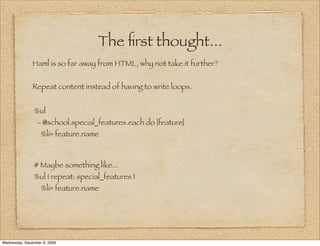
The first thought...
               Haml is so far away from HTML, why not take it further?


               Repeat content instead of having to write loops.


                %ul
                 - @school.special_features.each do |feature|
                   %li= feature.name


                # Maybe something like...
                %ul { repeat: special_features }
                   %li= feature.name


Wednesday, December 9, 2009
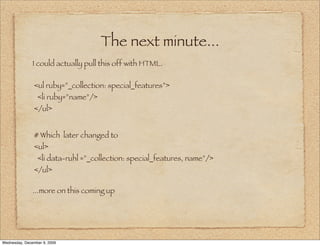
The next minute...
               I could actually pull this off with HTML.

                <ul ruby=”_collection: special_features”>
                 <li ruby=”name”/>
                </ul>


                # Which later changed to
                <ul>
                 <li data-ruhl =”_collection: special_features, name”/>
                </ul>

               ...more on this coming up


Wednesday, December 9, 2009
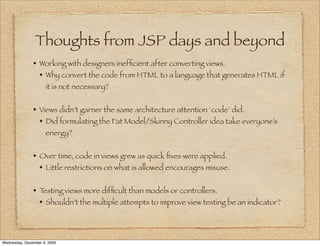
Thoughts from JSP days and beyond
               • Working with designers inefficient after converting views.
                 • Why convert the code from HTML to a language that generates HTML if
                     it is not necessary?


               • Views didn’t garner the same architecture attention ‘code’ did.
                 • Did formulating the Fat Model/Skinny Controller idea take everyone’s
                     energy?


               • Over time, code in views grew as quick fixes were applied.
                 • Little restrictions on what is allowed encourages misuse.

               • Testing views more difficult than models or controllers.
                 • Shouldn’t the multiple attempts to improve view testing be an indicator?


Wednesday, December 9, 2009
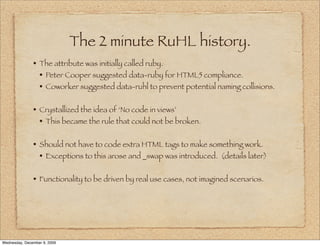
The 2 minute RuHL history.
               • The attribute was initially called ruby.
                 • Peter Cooper suggested data-ruby for HTML5 compliance.
                 • Coworker suggested data-ruhl to prevent potential naming collisions.

               • Crystallized the idea of ‘No code in views’
                 • This became the rule that could not be broken.

               • Should not have to code extra HTML tags to make something work.
                 • Exceptions to this arose and _swap was introduced. (details later)

               • Functionality to be driven by real use cases, not imagined scenarios.


Wednesday, December 9, 2009
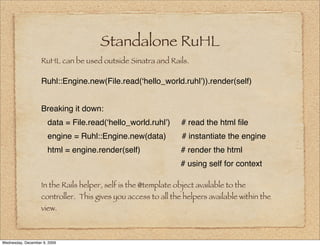
Standalone RuHL
                   RuHL can be used outside Sinatra and Rails.

                   Ruhl::Engine.new(File.read(ʻhello_world.ruhlʼ)).render(self)


                   Breaking it down:
                      data = File.read(ʻhello_world.ruhlʼ)      # read the html file
                      engine = Ruhl::Engine.new(data)           # instantiate the engine
                      html = engine.render(self)                # render the html
                                                                # using self for context

                   In the Rails helper, self is the @template object available to the
                   controller. This gives you access to all the helpers available within the
                   view.


Wednesday, December 9, 2009
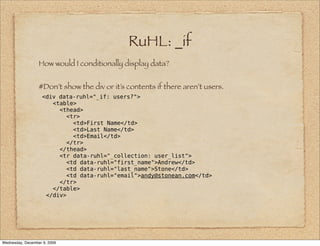
RuHL: _if
                  How would I conditionally display data?


                  #Don’t show the div or it’s contents if there aren’t users.
                    <div data-ruhl="_if: users?">
                       <table>
                         <thead>
                            <tr>
                              <td>First Name</td>
                              <td>Last Name</td>
                              <td>Email</td>
                            </tr>
                         </thead>
                         <tr data-ruhl="_collection: user_list">
                            <td data-ruhl="first_name">Andrew</td>
                            <td data-ruhl="last_name">Stone</td>
                            <td data-ruhl="email">andy@stonean.com</td>
                         </tr>
                       </table>
                     </div>


Wednesday, December 9, 2009
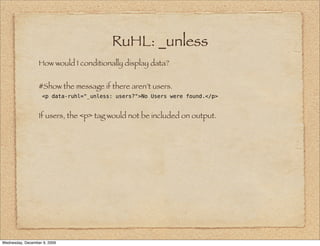
RuHL: _unless
                  How would I conditionally display data?


                  #Show the message if there aren’t users.
                    <p data-ruhl="_unless: users?">No Users were found.</p>


                  If users, the <p> tag would not be included on output.


Wednesday, December 9, 2009
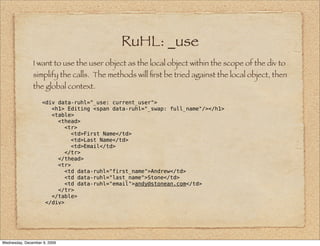
RuHL: _use
               I want to use the user object as the local object within the scope of the div to
               simplify the calls. The methods will first be tried against the local object, then
               the global context.

                    <div data-ruhl="_use: current_user">
                       <h1> Editing <span data-ruhl="_swap: full_name"/></h1>
                       <table>
                         <thead>
                           <tr>
                              <td>First Name</td>
                              <td>Last Name</td>
                              <td>Email</td>
                           </tr>
                         </thead>
                         <tr>
                           <td data-ruhl="first_name">Andrew</td>
                           <td data-ruhl="last_name">Stone</td>
                           <td data-ruhl="email">andy@stonean.com</td>
                         </tr>
                       </table>
                     </div>


Wednesday, December 9, 2009
RuHL: _use
               So what about iterating over a collection?
                     <select id="states">
                       <option data-ruhl="_use: state_options">
                     </select>

               The option tag will be repeated for each item returned.
               state_options can return an array of hashes:
                  def state_options
                    [ {:value => 'AL', :inner_html => 'Alabama'},
                      {:value => 'AK', :inner_html => 'Alaska'},
                      {:value => 'AZ', :inner_html => 'Arizona'},
                      ...
                    ]
                  end

               :inner_html will set the contents of the tag. all other keys are treated as
               attributes for the tag.


Wednesday, December 9, 2009
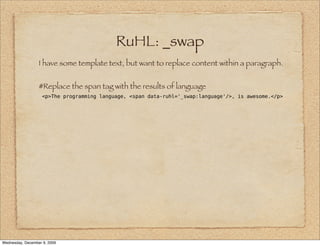
RuHL: _swap
                  I have some template text, but want to replace content within a paragraph.


                  #Replace the span tag with the results of language
                    <p>The programming language, <span data-ruhl='_swap:language'/>, is awesome.</p>


Wednesday, December 9, 2009
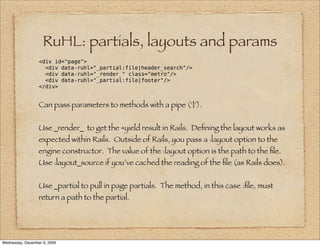
RuHL: partials, layouts and params
                  <div id="page">
                    <div data-ruhl="_partial:file|header_search"/>
                    <div data-ruhl="_render_" class="metro"/>
                    <div data-ruhl="_partial:file|footer"/>
                  </div>


                  Can pass parameters to methods with a pipe (‘|’).


                  Use _render_ to get the =yield result in Rails. Defining the layout works as
                  expected within Rails. Outside of Rails, you pass a :layout option to the
                  engine constructor. The value of the :layout option is the path to the file.
                  Use :layout_source if you’ve cached the reading of the file (as Rails does).


                  Use _partial to pull in page partials. The method, in this case :file, must
                  return a path to the partial.


Wednesday, December 9, 2009
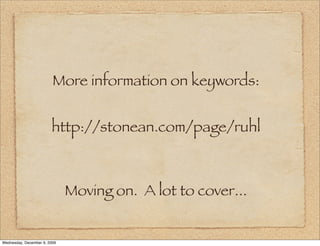
More information on keywords:


                        http://stonean.com/page/ruhl


                              Moving on. A lot to cover...


Wednesday, December 9, 2009
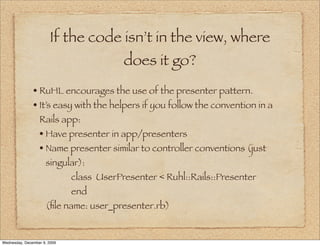
If the code isn’t in the view, where
                                          does it go?
               • RuHL encourages the use of the presenter pattern.
               • It’s easy with the helpers if you follow the convention in a
                  Rails app:
                  • Have presenter in app/presenters
                  • Name presenter similar to controller conventions (just
                     singular):
                              class UserPresenter < Ruhl::Rails::Presenter
                              end
                     (file name: user_presenter.rb)


Wednesday, December 9, 2009
What does my controller look like?
                  Controller methods look like:
                          def new
                            @post = Post.new

                            present
                          end


                         def create
                           @post = Post.new(params[:post])

                           if @post.save
                             flash[:notice] = 'Post was successfully created.'
                             redirect_to(@post)
                           else
                             present :new
                           end
                         end


Wednesday, December 9, 2009
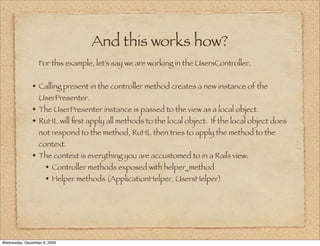
And this works how?
                  For this example, let’s say we are working in the UsersController.


               • Calling present in the controller method creates a new instance of the
                  UserPresenter.
               • The UserPresenter instance is passed to the view as a local object.
               • RuHL will first apply all methods to the local object. If the local object does
                  not respond to the method, RuHL then tries to apply the method to the
                  context.
               • The context is everything you are accustomed to in a Rails view:
                  • Controller methods exposed with helper_method
                  • Helper methods (ApplicationHelper, UsersHelper)


Wednesday, December 9, 2009
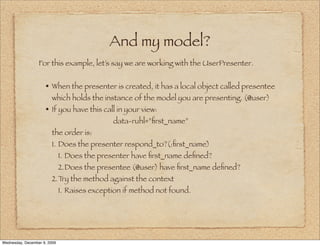
And my model?
                  For this example, let’s say we are working with the UserPresenter.


                     • When the presenter is created, it has a local object called presentee
                        which holds the instance of the model you are presenting. (@user)
                     • If you have this call in your view:
                                              data-ruhl=”first_name”
                        the order is:
                        1. Does the presenter respond_to?(:first_name)
                              1. Does the presenter have first_name defined?
                              2.Does the presentee (@user) have first_name defined?
                        2.Try the method against the context
                              1. Raises exception if method not found.


Wednesday, December 9, 2009
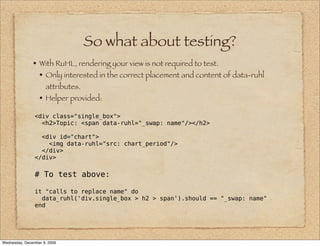
So what about testing?
               • With RuHL, rendering your view is not required to test.
                 • Only interested in the correct placement and content of data-ruhl
                     attributes.
                  • Helper provided:
                <div class="single_box">
                  <h2>Topic: <span data-ruhl="_swap: name"/></h2>

                  <div id="chart">
                    <img data-ruhl="src: chart_period"/>
                  </div>
                </div>

                # To test above:

                it "calls to replace name" do
                  data_ruhl('div.single_box > h2 > span').should == "_swap: name"
                end


Wednesday, December 9, 2009
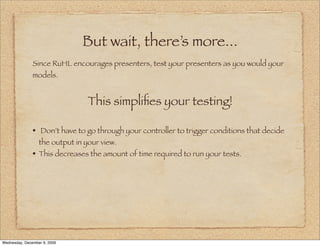
But wait, there’s more...
               Since RuHL encourages presenters, test your presenters as you would your
               models.


                                 This simplifies your testing!

               • Don’t have to go through your controller to trigger conditions that decide
                  the output in your view.
               • This decreases the amount of time required to run your tests.


Wednesday, December 9, 2009
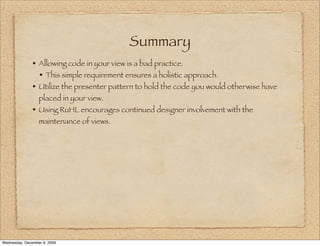
Summary
               • Allowing code in your view is a bad practice.
                 • This simple requirement ensures a holistic approach.
               • Utilize the presenter pattern to hold the code you would otherwise have
                  placed in your view.
               • Using RuHL encourages continued designer involvement with the
                  maintenance of views.


Wednesday, December 9, 2009

RuHL

  • 1.
    RuHL How can I see with all that code in my view? Wednesday, December 9, 2009
  • 2.
    The first thought... Haml is so far away from HTML, why not take it further? Repeat content instead of having to write loops. %ul - @school.special_features.each do |feature| %li= feature.name # Maybe something like... %ul { repeat: special_features } %li= feature.name Wednesday, December 9, 2009
  • 3.
    The next minute... I could actually pull this off with HTML. <ul ruby=”_collection: special_features”> <li ruby=”name”/> </ul> # Which later changed to <ul> <li data-ruhl =”_collection: special_features, name”/> </ul> ...more on this coming up Wednesday, December 9, 2009
  • 4.
    Thoughts from JSPdays and beyond • Working with designers inefficient after converting views. • Why convert the code from HTML to a language that generates HTML if it is not necessary? • Views didn’t garner the same architecture attention ‘code’ did. • Did formulating the Fat Model/Skinny Controller idea take everyone’s energy? • Over time, code in views grew as quick fixes were applied. • Little restrictions on what is allowed encourages misuse. • Testing views more difficult than models or controllers. • Shouldn’t the multiple attempts to improve view testing be an indicator? Wednesday, December 9, 2009
  • 5.
    The 2 minuteRuHL history. • The attribute was initially called ruby. • Peter Cooper suggested data-ruby for HTML5 compliance. • Coworker suggested data-ruhl to prevent potential naming collisions. • Crystallized the idea of ‘No code in views’ • This became the rule that could not be broken. • Should not have to code extra HTML tags to make something work. • Exceptions to this arose and _swap was introduced. (details later) • Functionality to be driven by real use cases, not imagined scenarios. Wednesday, December 9, 2009
  • 6.
    Standalone RuHL RuHL can be used outside Sinatra and Rails. Ruhl::Engine.new(File.read(ʻhello_world.ruhlʼ)).render(self) Breaking it down: data = File.read(ʻhello_world.ruhlʼ) # read the html file engine = Ruhl::Engine.new(data) # instantiate the engine html = engine.render(self) # render the html # using self for context In the Rails helper, self is the @template object available to the controller. This gives you access to all the helpers available within the view. Wednesday, December 9, 2009
  • 7.
    RuHL: _if How would I conditionally display data? #Don’t show the div or it’s contents if there aren’t users. <div data-ruhl="_if: users?"> <table> <thead> <tr> <td>First Name</td> <td>Last Name</td> <td>Email</td> </tr> </thead> <tr data-ruhl="_collection: user_list"> <td data-ruhl="first_name">Andrew</td> <td data-ruhl="last_name">Stone</td> <td data-ruhl="email">andy@stonean.com</td> </tr> </table> </div> Wednesday, December 9, 2009
  • 8.
    RuHL: _unless How would I conditionally display data? #Show the message if there aren’t users. <p data-ruhl="_unless: users?">No Users were found.</p> If users, the <p> tag would not be included on output. Wednesday, December 9, 2009
  • 9.
    RuHL: _use I want to use the user object as the local object within the scope of the div to simplify the calls. The methods will first be tried against the local object, then the global context. <div data-ruhl="_use: current_user"> <h1> Editing <span data-ruhl="_swap: full_name"/></h1> <table> <thead> <tr> <td>First Name</td> <td>Last Name</td> <td>Email</td> </tr> </thead> <tr> <td data-ruhl="first_name">Andrew</td> <td data-ruhl="last_name">Stone</td> <td data-ruhl="email">andy@stonean.com</td> </tr> </table> </div> Wednesday, December 9, 2009
  • 10.
    RuHL: _use So what about iterating over a collection? <select id="states"> <option data-ruhl="_use: state_options"> </select> The option tag will be repeated for each item returned. state_options can return an array of hashes: def state_options [ {:value => 'AL', :inner_html => 'Alabama'}, {:value => 'AK', :inner_html => 'Alaska'}, {:value => 'AZ', :inner_html => 'Arizona'}, ... ] end :inner_html will set the contents of the tag. all other keys are treated as attributes for the tag. Wednesday, December 9, 2009
  • 11.
    RuHL: _swap I have some template text, but want to replace content within a paragraph. #Replace the span tag with the results of language <p>The programming language, <span data-ruhl='_swap:language'/>, is awesome.</p> Wednesday, December 9, 2009
  • 12.
    RuHL: partials, layoutsand params <div id="page"> <div data-ruhl="_partial:file|header_search"/> <div data-ruhl="_render_" class="metro"/> <div data-ruhl="_partial:file|footer"/> </div> Can pass parameters to methods with a pipe (‘|’). Use _render_ to get the =yield result in Rails. Defining the layout works as expected within Rails. Outside of Rails, you pass a :layout option to the engine constructor. The value of the :layout option is the path to the file. Use :layout_source if you’ve cached the reading of the file (as Rails does). Use _partial to pull in page partials. The method, in this case :file, must return a path to the partial. Wednesday, December 9, 2009
  • 13.
    More information onkeywords: http://stonean.com/page/ruhl Moving on. A lot to cover... Wednesday, December 9, 2009
  • 14.
    If the codeisn’t in the view, where does it go? • RuHL encourages the use of the presenter pattern. • It’s easy with the helpers if you follow the convention in a Rails app: • Have presenter in app/presenters • Name presenter similar to controller conventions (just singular): class UserPresenter < Ruhl::Rails::Presenter end (file name: user_presenter.rb) Wednesday, December 9, 2009
  • 15.
    What does mycontroller look like? Controller methods look like: def new @post = Post.new present end def create @post = Post.new(params[:post]) if @post.save flash[:notice] = 'Post was successfully created.' redirect_to(@post) else present :new end end Wednesday, December 9, 2009
  • 16.
    And this workshow? For this example, let’s say we are working in the UsersController. • Calling present in the controller method creates a new instance of the UserPresenter. • The UserPresenter instance is passed to the view as a local object. • RuHL will first apply all methods to the local object. If the local object does not respond to the method, RuHL then tries to apply the method to the context. • The context is everything you are accustomed to in a Rails view: • Controller methods exposed with helper_method • Helper methods (ApplicationHelper, UsersHelper) Wednesday, December 9, 2009
  • 17.
    And my model? For this example, let’s say we are working with the UserPresenter. • When the presenter is created, it has a local object called presentee which holds the instance of the model you are presenting. (@user) • If you have this call in your view: data-ruhl=”first_name” the order is: 1. Does the presenter respond_to?(:first_name) 1. Does the presenter have first_name defined? 2.Does the presentee (@user) have first_name defined? 2.Try the method against the context 1. Raises exception if method not found. Wednesday, December 9, 2009
  • 18.
    So what abouttesting? • With RuHL, rendering your view is not required to test. • Only interested in the correct placement and content of data-ruhl attributes. • Helper provided: <div class="single_box"> <h2>Topic: <span data-ruhl="_swap: name"/></h2> <div id="chart"> <img data-ruhl="src: chart_period"/> </div> </div> # To test above: it "calls to replace name" do data_ruhl('div.single_box > h2 > span').should == "_swap: name" end Wednesday, December 9, 2009
  • 19.
    But wait, there’smore... Since RuHL encourages presenters, test your presenters as you would your models. This simplifies your testing! • Don’t have to go through your controller to trigger conditions that decide the output in your view. • This decreases the amount of time required to run your tests. Wednesday, December 9, 2009
  • 20.
    Summary • Allowing code in your view is a bad practice. • This simple requirement ensures a holistic approach. • Utilize the presenter pattern to hold the code you would otherwise have placed in your view. • Using RuHL encourages continued designer involvement with the maintenance of views. Wednesday, December 9, 2009