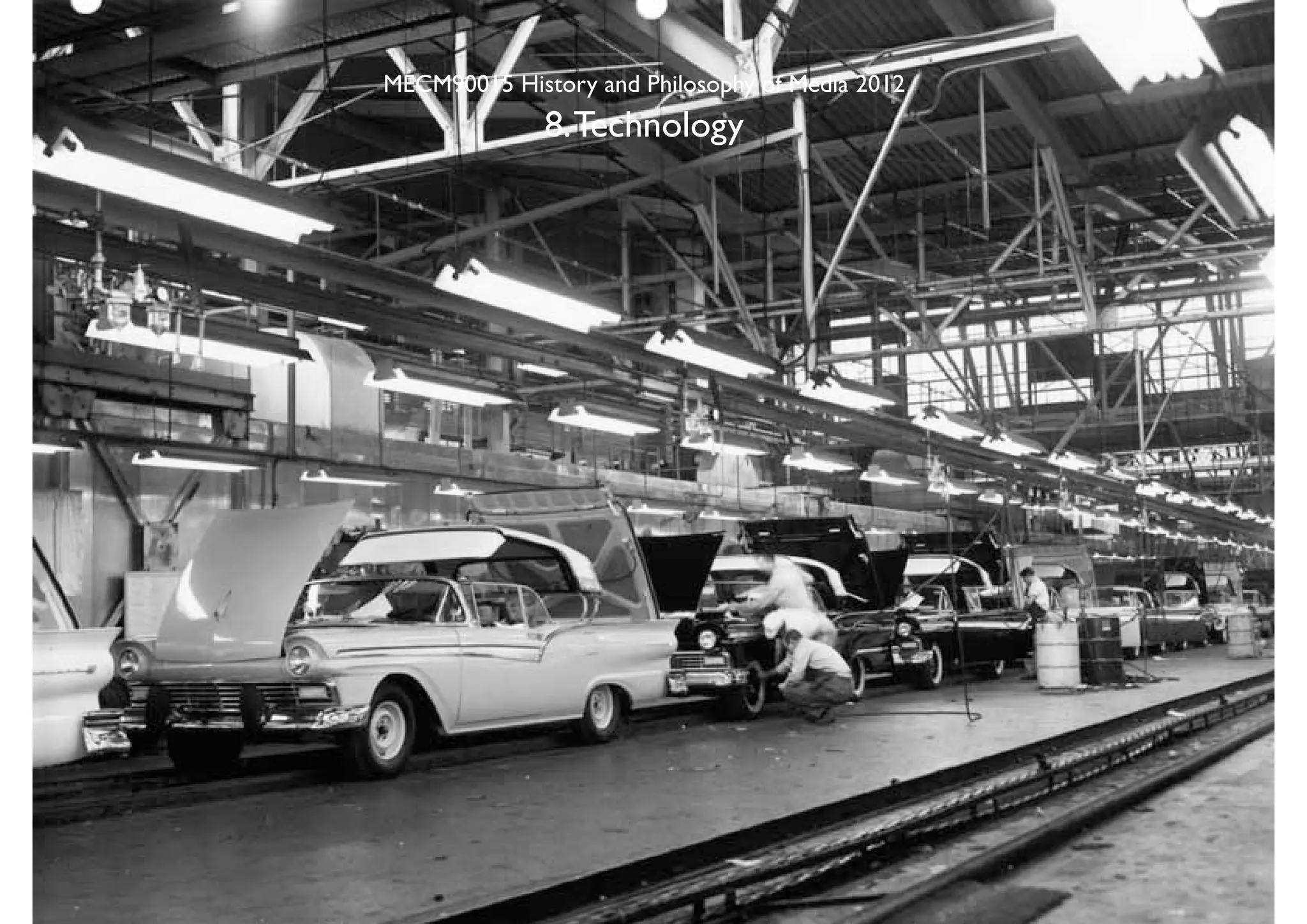
MECM90015 History and Philosophy of Media 2012
              8. Technology
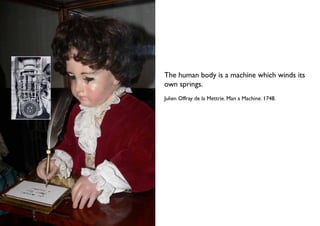
The human body is a machine which winds its
own springs.
Julien Offray de la Mettrie. Man a Machine. 1748.
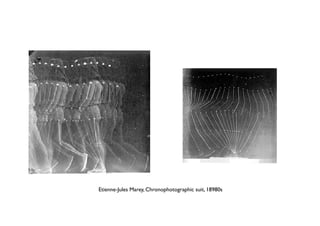
Etienne-Jules Marey, Chronophotographic suit, 18980s
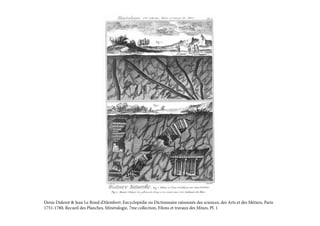
Denis Diderot & Jean Le Rond d’Alembert: Encyclopédie ou Dictionnaire raisonnée des sciences, des Arts et des Métiers, Paris
1751-1780, Recueil des Planches, Minéralogie, 7me collection, Filons et travaux des Mines, Pl. 1
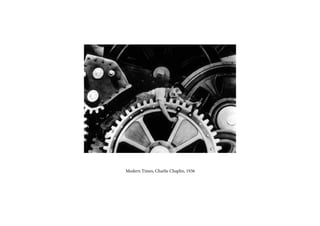
Modern Times, Charlie Chaplin, 1936
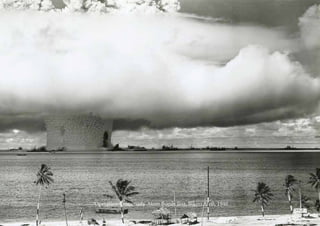
‘Operation Crossroads’ Atom Bomb Test, Bikini Atoll, 1946
Auschwitz was not only a crime against human-
ity: it is the beginning of the accident of science
. . . . Apocalypse is happening all the time, every
day since Genesis. It never stops. Man is the
end of the world.
(Virilio, Ground Zero: 153, 154)
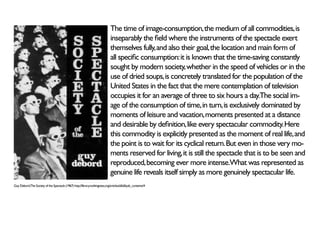
The time of image-consumption, the medium of all commodities, is
                                                                                inseparably the field where the instruments of the spectacle exert
                                                                                themselves fully, and also their goal, the location and main form of
                                                                                all specific consumption: it is known that the time-saving constantly
                                                                                sought by modern society, whether in the speed of vehicles or in the
                                                                                use of dried soups, is concretely translated for the population of the
                                                                                United States in the fact that the mere contemplation of television
                                                                                occupies it for an average of three to six hours a day.The social im-
                                                                                age of the consumption of time, in turn, is exclusively dominated by
                                                                                moments of leisure and vacation, moments presented at a distance
                                                                                and desirable by definition, like every spectacular commodity. Here
                                                                                this commodity is explicitly presented as the moment of real life, and
                                                                                the point is to wait for its cyclical return. But even in those very mo-
                                                                                ments reserved for living, it is still the spectacle that is to be seen and
                                                                                reproduced, becoming ever more intense.What was represented as
                                                                                genuine life reveals itself simply as more genuinely spectacular life.
Guy Debord,The Society of the Spectacle (1967) http://library.nothingness.org/articles/all/all/pub_contents/4
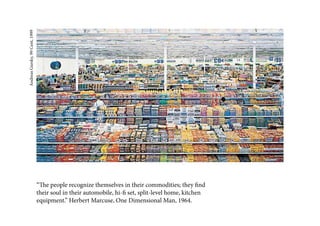
Andreas Gursky, 99 Cent, 1999


                                “The people recognize themselves in their commodities; they find
                                their soul in their automobile, hi-fi set, split-level home, kitchen
                                equipment.” Herbert Marcuse, One Dimensional Man, 1964.
As soon as what is unconcealed no longer concerns man even as object, but exclu-
sively as standing-reserve, and man in the midst of objectlessness is nothing but
the orderer of the standing-reserve, then he comes to the very brink of a precipi-
tous fall; that is, he comes to the point where he himself will have to be taken as
standing-reserve. Meanwhile, man, precisely as the one so threatened, exalts him-
self and postures as lord of the earth. In this way the illusion comes to prevail that
everything man encounters exists only insofar as it is his construct. This illusion
gives rise in turn to one final delusion: it seems as though man everywhere and
always encounters only himself.

Heidegger, The Question Concerning Technology
humanity’s history is that of technics as a process of exteriorisation in
which technical evolution is dominated by tendencies that societies must
perpetually negotiate . . . Becoming technical is originarily a derivation:
socio-genesis recapitulates techno-genesis. Techno-genesis is structurally
prior to socio-genesis . . .

Those who oppose technics to civilization do not accept that . . . humans
are prosthetic beings, without qualities

Bernard Stiegler, Technics and Time 2: Disorientation, Introduction, 2
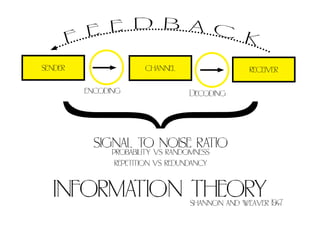
e e d b a c
         f             k
sender                 channel                   receiver

          encoding                 Decoding


{           signal tovs randomness o
               probability
                           noise rati
                repetition vs redundancy


   information theory              shannon and weaver 1947
In order to consolidate its field of influence, capital
demands a constant emergence of subjective and
territorialized identities that, at the end of the day,
require no more than an equality of exposure ac-
cording to the uniform prerogatives of the market.
Thus we have the capitalist logic of general equiva-
lences and the cultural logic of community and mi-
nority identities coming together in an articulated
whole
(Badiou, Alain (1997), St Paul, la fondation de l’universalisme, Collège Interna-
tionale de Philosophie, Paris: 11)
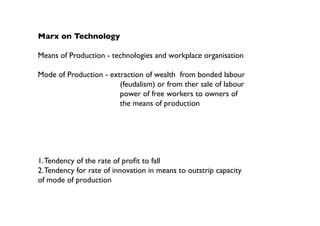
Marx on Technology

Means of Production - technologies and workplace organisation

Mode of Production - extraction of wealth from bonded labour
                        (feudalism) or from ther sale of labour
                        power of free workers to owners of
                        the means of production


1. Tendency of the rate of profit to fall
2. Tendency for rate of innovation in means to outstrip capacity
of mode of production
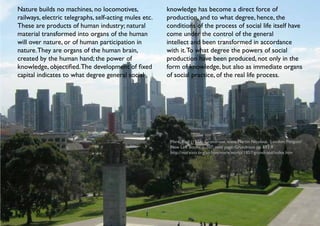
Nature builds no machines, no locomotives,              knowledge has become a direct force of
railways, electric telegraphs, self-acting mules etc.   production, and to what degree, hence, the
These are products of human industry; natural           conditions of the process of social life itself have
material transformed into organs of the human           come under the control of the general
will over nature, or of human participation in          intellect and been transformed in accordance
nature. They are organs of the human brain,             with it. To what degree the powers of social
created by the human hand; the power of                 production have been produced, not only in the
knowledge, objectified. The development of fixed        form of knowledge, but also as immediate organs
capital indicates to what degree general social         of social practice, of the real life process.


                                                         Marx, Karl (1973), Grundrisse, trans Martin Nicolaus. London: Penguin/
                                                         New Left Books, p. 707; next page: Grundrisse pp. 693 ff
                                                         http://marxists.org/archive/marx/works/1857/grundrisse/index.htm
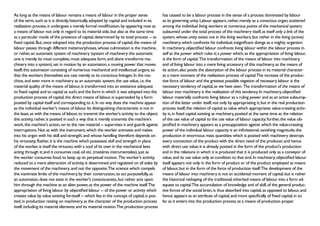
As long as the means of labour remains a means of labour in the proper sense                  has ceased to be a labour process in the sense of a process dominated by labour
of the term, such as it is directly, historically, adopted by capital and included in its     as its governing unity. Labour appears, rather, merely as a conscious organ, scattered
realization process, it undergoes a merely formal modification, by appearing now as           among the individual living workers at numerous points of the mechanical system;
a means of labour not only in regard to its material side, but also at the same time          subsumed under the total process of the machinery itself, as itself only a link of the
as a particular mode of the presence of capital, determined by its total process -- as        system, whose unity exists not in the living workers, but rather in the living (active)
fixed capital. But, once adopted into the production process of capital, the means of         machinery, which confronts his individual, insignificant doings as a mighty organism.
labour passes through different metamorphoses, whose culmination is the machine,              In machinery, objectified labour confronts living labour within the labour process it-
or rather, an automatic system of machinery (system of machinery: the automatic               self as the power which rules it; a power which, as the appropriation of living labour,
one is merely its most complete, most adequate form, and alone transforms ma-                 is the form of capital. The transformation of the means of labour into machinery,
chinery into a system), set in motion by an automaton, a moving power that moves              and of living labour into a mere living accessory of this machinery, as the means of
itself; this automaton consisting of numerous mechanical and intellectual organs, so          its action, also posits the absorption of the labour process in its material character
that the workers themselves are cast merely as its conscious linkages. In the ma-             as a mere moment of the realization process of capital.The increase of the produc-
chine, and even more in machinery as an automatic system, the use value, i.e. the             tive force of labour and the greatest possible negation of necessary labour is the
material quality of the means of labour, is transformed into an existence adequate            necessary tendency of capital, as we have seen. The transformation of the means of
to fixed capital and to capital as such; and the form in which it was adopted into the        labour into machinery is the realization of this tendency. In machinery, objectified
production process of capital, the direct means of labour, is superseded by a form            labour materially confronts living labour as a ruling power and as an active subsump-
posited by capital itself and corresponding to it. In no way does the machine appear          tion of the latter under itself, not only by appropriating it, but in the real production
as the individual worker's means of labour. Its distinguishing characteristic is not in       process itself; the relation of capital as value which appropriates value-creating activ-
the least, as with the means of labour, to transmit the worker's activity to the object;      ity is, in fixed capital existing as machinery, posited at the same time as the relation
this activity, rather, is posited in such a way that it merely transmits the machine's        of the use value of capital to the use value of labour capacity; further, the value ob-
work, the machine's action, on to the raw material -- supervises it and guards against        jectified in machinery appears as a presupposition against which the value-creating
interruptions. Not as with the instrument, which the worker animates and makes                power of the individual labour capacity is an infinitesimal, vanishing magnitude; the
into his organ with his skill and strength, and whose handling therefore depends on           production in enormous mass quantities which is posited with machinery destroys
his virtuosity. Rather, it is the machine which possesses skill and strength in place         every connection of the product with the direct need of the producer, and hence
of the worker, is itself the virtuoso, with a soul of its own in the mechanical laws          with direct use value; it is already posited in the form of the product's production
acting through it; and it consumes coal, oil etc. (matières instrumentales), just as          and in the relations in which it is produced that it is produced only as a conveyor of
the worker consumes food, to keep up its perpetual motion. The worker's activity,             value, and its use value only as condition to that end. In machinery, objectified labour
reduced to a mere abstraction of activity, is determined and regulated on all sides by        itself appears not only in the form of product or of the product employed as means
the movement of the machinery, and not the opposite.The science which compels                 of labour, but in the form of the force of production itself.The development of the
the inanimate limbs of the machinery, by their construction, to act purposefully, as          means of labour into machinery is not an accidental moment of capital, but is rather
an automaton, does not exist in the worker's consciousness, but rather acts upon              the historical reshaping of the traditional, inherited means of labour into a form ad-
him through the machine as an alien power, as the power of the machine itself.The             equate to capital.The accumulation of knowledge and of skill, of the general produc-
appropriation of living labour by objectified labour -- of the power or activity which        tive forces of the social brain, is thus absorbed into capital, as opposed to labour, and
creates value by value existing for-itself -- which lies in the concept of capital, is pos-   hence appears as an attribute of capital, and more specifically of fixed capital, in so
ited, in production resting on machinery, as the character of the production process          far as it enters into the production process as a means of production proper.
itself, including its material elements and its material motion.The production process
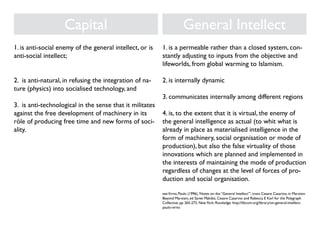
Capital                                             General Intellect
1. is anti-social enemy of the general intellect, or is   1. is a permeable rather than a closed system, con-
anti-social intellect;                                    stantly adjusting to inputs from the objective and
                                                          lifeworlds, from global warming to Islamism.

2. is anti-natural, in refusing the integration of na-    2. is internally dynamic
ture (physics) into socialised technology, and
                                                          3. communicates internally among different regions
3. is anti-technological in the sense that it militates
against the free development of machinery in its          4. is, to the extent that it is virtual, the enemy of
rôle of producing free time and new forms of soci-        the general intelligence as actual (to whit what is
ality.                                                    already in place as materialised intelligence in the
                                                          form of machinery, social organisation or mode of
                                                          production), but also the false virtuality of those
                                                          innovations which are planned and implemented in
                                                          the interests of maintaining the mode of production
                                                          regardless of changes at the level of forces of pro-
                                                          duction and social organisation.

                                                          see Virno, Paulo (1996), ‘Notes on the “General Intellect”’, trans Cesare Casarino, in Marxism
                                                          Beyond Marxism, ed Saree Makdisi, Cesare Casarino and Rebecca E Karl for the Polygraph
                                                          Collective, pp 265-272. New York: Routledge. http://libcom.org/library/on-general-intellect-
                                                          paulo-virno
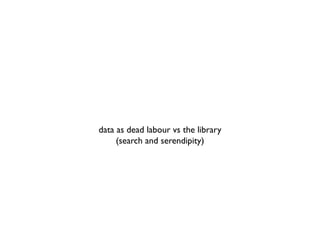
data as dead labour vs the library
     (search and serendipity)

Hpm8technology

  • 1.
    MECM90015 History andPhilosophy of Media 2012 8. Technology
  • 2.
    The human bodyis a machine which winds its own springs. Julien Offray de la Mettrie. Man a Machine. 1748.
  • 3.
  • 4.
    Denis Diderot &Jean Le Rond d’Alembert: Encyclopédie ou Dictionnaire raisonnée des sciences, des Arts et des Métiers, Paris 1751-1780, Recueil des Planches, Minéralogie, 7me collection, Filons et travaux des Mines, Pl. 1
  • 5.
    Modern Times, CharlieChaplin, 1936
  • 6.
    ‘Operation Crossroads’ AtomBomb Test, Bikini Atoll, 1946
  • 7.
    Auschwitz was notonly a crime against human- ity: it is the beginning of the accident of science . . . . Apocalypse is happening all the time, every day since Genesis. It never stops. Man is the end of the world. (Virilio, Ground Zero: 153, 154)
  • 8.
    The time ofimage-consumption, the medium of all commodities, is inseparably the field where the instruments of the spectacle exert themselves fully, and also their goal, the location and main form of all specific consumption: it is known that the time-saving constantly sought by modern society, whether in the speed of vehicles or in the use of dried soups, is concretely translated for the population of the United States in the fact that the mere contemplation of television occupies it for an average of three to six hours a day.The social im- age of the consumption of time, in turn, is exclusively dominated by moments of leisure and vacation, moments presented at a distance and desirable by definition, like every spectacular commodity. Here this commodity is explicitly presented as the moment of real life, and the point is to wait for its cyclical return. But even in those very mo- ments reserved for living, it is still the spectacle that is to be seen and reproduced, becoming ever more intense.What was represented as genuine life reveals itself simply as more genuinely spectacular life. Guy Debord,The Society of the Spectacle (1967) http://library.nothingness.org/articles/all/all/pub_contents/4
  • 9.
    Andreas Gursky, 99Cent, 1999 “The people recognize themselves in their commodities; they find their soul in their automobile, hi-fi set, split-level home, kitchen equipment.” Herbert Marcuse, One Dimensional Man, 1964.
  • 10.
    As soon aswhat is unconcealed no longer concerns man even as object, but exclu- sively as standing-reserve, and man in the midst of objectlessness is nothing but the orderer of the standing-reserve, then he comes to the very brink of a precipi- tous fall; that is, he comes to the point where he himself will have to be taken as standing-reserve. Meanwhile, man, precisely as the one so threatened, exalts him- self and postures as lord of the earth. In this way the illusion comes to prevail that everything man encounters exists only insofar as it is his construct. This illusion gives rise in turn to one final delusion: it seems as though man everywhere and always encounters only himself. Heidegger, The Question Concerning Technology
  • 11.
    humanity’s history isthat of technics as a process of exteriorisation in which technical evolution is dominated by tendencies that societies must perpetually negotiate . . . Becoming technical is originarily a derivation: socio-genesis recapitulates techno-genesis. Techno-genesis is structurally prior to socio-genesis . . . Those who oppose technics to civilization do not accept that . . . humans are prosthetic beings, without qualities Bernard Stiegler, Technics and Time 2: Disorientation, Introduction, 2
  • 12.
    e e db a c f k sender channel receiver encoding Decoding { signal tovs randomness o probability noise rati repetition vs redundancy information theory shannon and weaver 1947
  • 13.
    In order toconsolidate its field of influence, capital demands a constant emergence of subjective and territorialized identities that, at the end of the day, require no more than an equality of exposure ac- cording to the uniform prerogatives of the market. Thus we have the capitalist logic of general equiva- lences and the cultural logic of community and mi- nority identities coming together in an articulated whole (Badiou, Alain (1997), St Paul, la fondation de l’universalisme, Collège Interna- tionale de Philosophie, Paris: 11)
  • 14.
    Marx on Technology Meansof Production - technologies and workplace organisation Mode of Production - extraction of wealth from bonded labour (feudalism) or from ther sale of labour power of free workers to owners of the means of production 1. Tendency of the rate of profit to fall 2. Tendency for rate of innovation in means to outstrip capacity of mode of production
  • 15.
    Nature builds nomachines, no locomotives, knowledge has become a direct force of railways, electric telegraphs, self-acting mules etc. production, and to what degree, hence, the These are products of human industry; natural conditions of the process of social life itself have material transformed into organs of the human come under the control of the general will over nature, or of human participation in intellect and been transformed in accordance nature. They are organs of the human brain, with it. To what degree the powers of social created by the human hand; the power of production have been produced, not only in the knowledge, objectified. The development of fixed form of knowledge, but also as immediate organs capital indicates to what degree general social of social practice, of the real life process. Marx, Karl (1973), Grundrisse, trans Martin Nicolaus. London: Penguin/ New Left Books, p. 707; next page: Grundrisse pp. 693 ff http://marxists.org/archive/marx/works/1857/grundrisse/index.htm
  • 16.
    As long asthe means of labour remains a means of labour in the proper sense has ceased to be a labour process in the sense of a process dominated by labour of the term, such as it is directly, historically, adopted by capital and included in its as its governing unity. Labour appears, rather, merely as a conscious organ, scattered realization process, it undergoes a merely formal modification, by appearing now as among the individual living workers at numerous points of the mechanical system; a means of labour not only in regard to its material side, but also at the same time subsumed under the total process of the machinery itself, as itself only a link of the as a particular mode of the presence of capital, determined by its total process -- as system, whose unity exists not in the living workers, but rather in the living (active) fixed capital. But, once adopted into the production process of capital, the means of machinery, which confronts his individual, insignificant doings as a mighty organism. labour passes through different metamorphoses, whose culmination is the machine, In machinery, objectified labour confronts living labour within the labour process it- or rather, an automatic system of machinery (system of machinery: the automatic self as the power which rules it; a power which, as the appropriation of living labour, one is merely its most complete, most adequate form, and alone transforms ma- is the form of capital. The transformation of the means of labour into machinery, chinery into a system), set in motion by an automaton, a moving power that moves and of living labour into a mere living accessory of this machinery, as the means of itself; this automaton consisting of numerous mechanical and intellectual organs, so its action, also posits the absorption of the labour process in its material character that the workers themselves are cast merely as its conscious linkages. In the ma- as a mere moment of the realization process of capital.The increase of the produc- chine, and even more in machinery as an automatic system, the use value, i.e. the tive force of labour and the greatest possible negation of necessary labour is the material quality of the means of labour, is transformed into an existence adequate necessary tendency of capital, as we have seen. The transformation of the means of to fixed capital and to capital as such; and the form in which it was adopted into the labour into machinery is the realization of this tendency. In machinery, objectified production process of capital, the direct means of labour, is superseded by a form labour materially confronts living labour as a ruling power and as an active subsump- posited by capital itself and corresponding to it. In no way does the machine appear tion of the latter under itself, not only by appropriating it, but in the real production as the individual worker's means of labour. Its distinguishing characteristic is not in process itself; the relation of capital as value which appropriates value-creating activ- the least, as with the means of labour, to transmit the worker's activity to the object; ity is, in fixed capital existing as machinery, posited at the same time as the relation this activity, rather, is posited in such a way that it merely transmits the machine's of the use value of capital to the use value of labour capacity; further, the value ob- work, the machine's action, on to the raw material -- supervises it and guards against jectified in machinery appears as a presupposition against which the value-creating interruptions. Not as with the instrument, which the worker animates and makes power of the individual labour capacity is an infinitesimal, vanishing magnitude; the into his organ with his skill and strength, and whose handling therefore depends on production in enormous mass quantities which is posited with machinery destroys his virtuosity. Rather, it is the machine which possesses skill and strength in place every connection of the product with the direct need of the producer, and hence of the worker, is itself the virtuoso, with a soul of its own in the mechanical laws with direct use value; it is already posited in the form of the product's production acting through it; and it consumes coal, oil etc. (matières instrumentales), just as and in the relations in which it is produced that it is produced only as a conveyor of the worker consumes food, to keep up its perpetual motion. The worker's activity, value, and its use value only as condition to that end. In machinery, objectified labour reduced to a mere abstraction of activity, is determined and regulated on all sides by itself appears not only in the form of product or of the product employed as means the movement of the machinery, and not the opposite.The science which compels of labour, but in the form of the force of production itself.The development of the the inanimate limbs of the machinery, by their construction, to act purposefully, as means of labour into machinery is not an accidental moment of capital, but is rather an automaton, does not exist in the worker's consciousness, but rather acts upon the historical reshaping of the traditional, inherited means of labour into a form ad- him through the machine as an alien power, as the power of the machine itself.The equate to capital.The accumulation of knowledge and of skill, of the general produc- appropriation of living labour by objectified labour -- of the power or activity which tive forces of the social brain, is thus absorbed into capital, as opposed to labour, and creates value by value existing for-itself -- which lies in the concept of capital, is pos- hence appears as an attribute of capital, and more specifically of fixed capital, in so ited, in production resting on machinery, as the character of the production process far as it enters into the production process as a means of production proper. itself, including its material elements and its material motion.The production process
  • 17.
    Capital General Intellect 1. is anti-social enemy of the general intellect, or is 1. is a permeable rather than a closed system, con- anti-social intellect; stantly adjusting to inputs from the objective and lifeworlds, from global warming to Islamism. 2. is anti-natural, in refusing the integration of na- 2. is internally dynamic ture (physics) into socialised technology, and 3. communicates internally among different regions 3. is anti-technological in the sense that it militates against the free development of machinery in its 4. is, to the extent that it is virtual, the enemy of rôle of producing free time and new forms of soci- the general intelligence as actual (to whit what is ality. already in place as materialised intelligence in the form of machinery, social organisation or mode of production), but also the false virtuality of those innovations which are planned and implemented in the interests of maintaining the mode of production regardless of changes at the level of forces of pro- duction and social organisation. see Virno, Paulo (1996), ‘Notes on the “General Intellect”’, trans Cesare Casarino, in Marxism Beyond Marxism, ed Saree Makdisi, Cesare Casarino and Rebecca E Karl for the Polygraph Collective, pp 265-272. New York: Routledge. http://libcom.org/library/on-general-intellect- paulo-virno
  • 18.
    data as deadlabour vs the library (search and serendipity)